
What Is Three-Act Structure? The Complete Guide (2026)
Three-act structure divides a story into Setup, Confrontation, and Resolution. A complete 2026 guide to the acts, the key beats and their page positions, how it compares to five-act, the Hero's Journey, and Save the Cat, and how to use it without writing to a formula.

Category
Storytelling
Author

Justkay
Documentary Filmmaker & Founder at Storyflow
Topics
2026-07-15
•
12 min read
•
Storytelling- three act structure
- what is three act structure
- three act structure screenwriting
- setup confrontation resolution
What is three-act structure?
Three-act structure is the dominant framework for organizing a story into three parts: Act 1 (Setup), Act 2 (Confrontation), and Act 3 (Resolution). It traces back to Aristotle's observation that a whole has a beginning, a middle, and an end, and it was codified for screenwriting by Syd Field in his 1979 book Screenplay. The three acts are divided by two turning points, and the story runs on a handful of load-bearing beats: the inciting incident, the first plot point, the midpoint, the second plot point, the climax, and the resolution. Structure is a container, not a formula. It tells you where the pressure in a story should change, not what to put in the scenes. This guide breaks down what each act does, where the key beats land in page and percentage terms, how three-act compares to five-act structure, the Hero's Journey, and Save the Cat, and how to use it as scaffolding instead of a cage.
Three-Act Structure at a Glance
- The three acts are Setup (who, where, and what is at stake), Confrontation (rising obstacles and complications), and Resolution (climax and aftermath).
- The acts split roughly 25% / 50% / 25%: about 30 / 60 / 30 pages in a 120-page screenplay, where one page runs roughly one minute of screen time.
- Two turning points do the real work: the first plot point at the end of Act 1 (around 20-25%) and the second plot point at the end of Act 2 (around 75%).
- The inciting incident hits early, around 10-15%, and knocks the story out of its status quo.
- The midpoint (around 50%) reframes the goal with a false victory or defeat, so the long second act does not sag.
- It applies far beyond film: novels, stage plays, pitches, keynote talks, and personal essays all borrow the three-act shape.
- The charge that it is "formulaic" confuses the container with the contents. The shape is fixed; everything that matters is not.
What Three-Act Structure Actually Is
Most people first meet three-act structure as a diagram: a line that rises, peaks, and falls, chopped into three labelled boxes. The diagram is not wrong, but it hides the useful part. Three-act structure is not really a set of three boxes. It is a claim about where a story changes direction. Act 1 asks a dramatic question ("will this character get what they need?"), Act 2 makes answering it progressively harder, and Act 3 answers it. The acts are the spaces between the changes, not the point.
I came to structure the hard way. I am a documentary filmmaker, and I built Storyflow, an AI-powered visual workspace, after years of running my own projects from research through pre-production. Documentary tests three-act structure most honestly, because you do not write the story first. You shoot dozens of hours of footage, then find the structure hiding inside it. That taught me the thing this guide is built around: the writers who get the most out of three-act structure treat it as a diagnostic tool, not a template to fill in.
The framework is old, and its lineage explains why it works. Aristotle, writing in the Poetics around 335 BCE, argued that a well-formed plot is "a whole" with "a beginning, a middle, and an end," and that its events should follow by necessity or probability rather than at random. That is the conceptual seed of three acts. The Roman poet Horace, in Ars Poetica, later advised that a play run neither more nor less than five acts, which is where the competing five-act tradition begins. The modern screenwriting version arrived in 1979, when Syd Field published Screenplay: The Foundations of Screenwriting and named the "paradigm": Act 1 setup, Act 2 confrontation, Act 3 resolution, hinged by two plot points that spin the story in a new direction.
The Three Acts, One at a Time
Act 1: Setup (roughly the first 25%)
Act 1 does one job: it makes the reader care before it makes them worry. You establish the protagonist, the world, the ordinary balance of their life, and the dramatic question the story will answer. Then you break that balance. The inciting incident, usually around 10-15% of the way in, is the disruption: the job offer, the murder, the knock at the door, the diagnosis. It is not the same as the first plot point. The inciting incident happens to the protagonist. The first plot point is where they commit.
Act 2: Confrontation (the middle 50%)
Act 2 is where most stories die. It is the longest stretch by far, and without internal structure it sags into a series of things that merely happen. Confrontation is not "more obstacles." It is escalating obstacles, each raising the cost of the goal. The midpoint, near the exact center, is the pressure valve: a false victory that curdles, or a false defeat that reveals a path. A good midpoint changes what the protagonist is fighting for, so the second half of Act 2 is not a rerun of the first.
Act 3: Resolution (roughly the last 25%)
Act 3 answers the dramatic question. The climax is the decisive confrontation, the moment the protagonist either gets what they were after or is changed by failing to. The resolution (or denouement) is the short stretch after, where the new normal settles and the tension releases. Act 3 is short on purpose. Once the question is answered, every extra scene leaks energy.
The Six Beats That Hold the Structure Up
If the three acts are the rooms, these six beats are the load-bearing walls. Positions are given as a percentage of total length and as pages in a standard 120-page screenplay, where roughly one page equals one minute of screen time.
| Beat | Approx. position | Act | What it does |
|---|---|---|---|
Inciting incident | 10-15% (page 12) | Act 1 | Disrupts the status quo and starts the engine |
First plot point | 20-25% (page 25-30) | Act 1 into 2 | Locks the protagonist into the central conflict |
Midpoint | 50% (page 55-60) | Act 2 | Reframes the goal: false victory or false defeat |
Second plot point | 75% (page 85-90) | Act 2 into 3 | Forces the final commitment: the low point |
Climax | 85-95% (page 100-110) | Act 3 | The decisive confrontation that answers the question |
Resolution | Final 5% (page 110-120) | Act 3 | Settles the new normal and releases the tension |
Treat these positions as gravity, not law. Plenty of great films hit the inciting incident on page 3 or delay the first plot point to page 35. The percentages describe where audiences have learned to feel a shift, so straying from them is a deliberate choice, not a mistake.
The Two Doors: Why the Turns Matter More Than the Acts
Here is the reframe that makes three-act structure usable instead of decorative. Stop counting acts. Count doors.
A story has Two Doors, and they are the only two structural moments you cannot afford to get wrong. Door One is the first plot point at the end of Act 1. Door Two is the second plot point at the end of Act 2. A door has one defining property: once your protagonist walks through it, they cannot walk back. Door One locks them into the problem. Door Two locks them into the ending. The three acts are simply the rooms between the doors.
Why does this reframe help? Because "write a good Act 2" is useless advice, but "make sure Door One is a real door" is something you can act on. When a draft feels shapeless, the culprit is almost always a weak door.
- If the middle drags, Door One is probably a curtain, not a door. The protagonist can still stroll back to their old life, so nothing is truly at stake.
- If the ending feels unearned, Door Two did not lock hard enough. The final push was optional, so the climax reads like a choice rather than a necessity.
- If the story feels like a checklist, you are decorating rooms instead of building doors.
The turns matter more than the acts. Aristotle's own vocabulary supports this. He distinguished the "complication" (desis, the tying of the knot) from the "unravelling" (lusis, the untying), placing the turn between them as the hinge of the plot. He was describing the doors two thousand years before Syd Field named the plot points. Get the Two Doors right and the acts arrange themselves around them. Get them wrong and no amount of clever scene work saves the shape.
Three-Act vs Five-Act vs the Hero's Journey vs Save the Cat
Three-act structure is not the only map. The three most common alternatives are older, more granular, or more genre-specific. The honest way to compare them is not "which is best" but "which unit of story does each one make you think in."
| Framework | Origin | Divisions | Core unit | Best for |
|---|---|---|---|---|
Three-act | Aristotle's beginning-middle-end; Syd Field codified it for screen in 1979 | 3 acts, 2 plot points | The turn (plot point) | Almost anything: film, novel, pitch, keynote, essay |
Five-act | Horace's five-act rule; Freytag's pyramid (1863) | 5 acts: exposition, rising action, climax, falling action, denouement | The rise and fall around a central climax | Stage drama, classical tragedy, long-form prestige TV |
Hero's Journey | Campbell's monomyth (1949); Vogler's Hollywood adaptation (1992) | 12 stages mapped onto 3 acts | The transformation arc | Myth, fantasy, adventure, transformation stories |
Save the Cat | Blake Snyder (2005) | 15 beats over 3 acts | The page-specific beat | Commercial and genre screenwriting where pacing is exact |
Read across the table and a pattern appears. Five-act structure, formalized by Gustav Freytag in his 1863 study of drama, is three-act structure with the middle split into rising action, climax, and falling action. It suits the stage and the streaming season, where a single central climax with a long fall reads better than one late peak. The Hero's Journey, drawn from Joseph Campbell's 1949 The Hero with a Thousand Faces and adapted for screenwriters by Christopher Vogler in 1992, is not a rival to three acts. It is a character-arc overlay most people map directly onto them: the Ordinary World and Call in Act 1, the Trials and Ordeal in Act 2, the Return in Act 3. Save the Cat, Blake Snyder's 2005 beat sheet, is the most prescriptive of the group: fifteen named beats at specific page numbers. It is three-act structure with the doors and rooms pre-measured for you.
None of these replaces three-act structure. Three of them are the same skeleton seen at a different resolution. That is the argument for learning three-act first: it is the layer the others are built on.
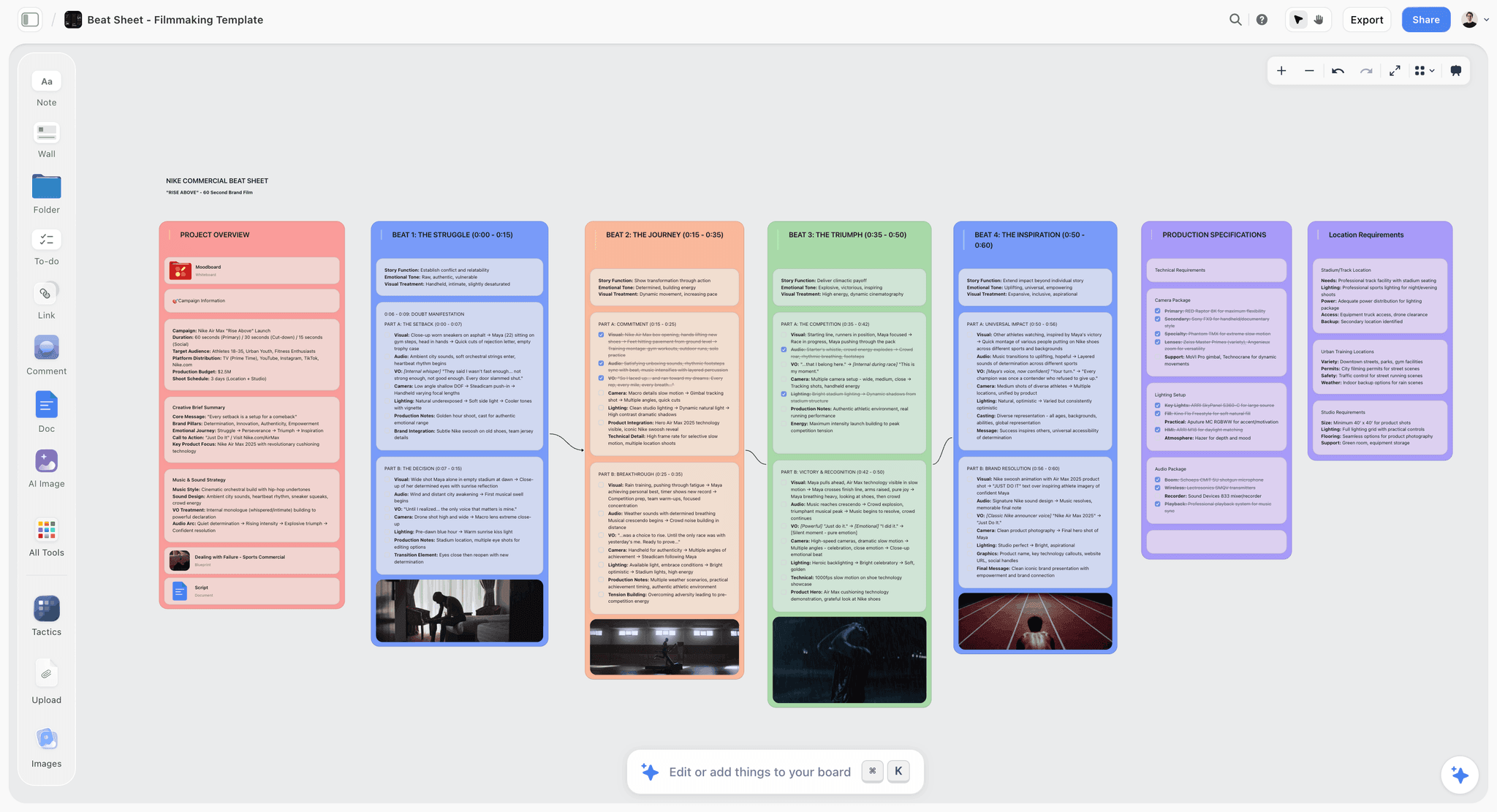
A Storyflow canvas laying out three-act beats: setup, confrontation, resolution
Is Three-Act Structure Too Formulaic?
The most common objection is that three-act structure produces samey, predictable, focus-grouped stories. The complaint is real, and it points at a real failure, but it blames the wrong thing.
A structure cannot be formulaic, because a structure has no content. "Beginning, middle, end" does not tell you whether your middle is a heist, a marriage, a war, or a slow disintegration. What people react to when they call a film formulaic is the beats being hit mechanically and on schedule, with no surprise in how they are filled. That is a symptom of writing to the template instead of thinking with it. Structure is a container, not a formula. The container is the same for a masterpiece and for a direct-to-streaming knockoff. The difference lives entirely in the contents.
Consider the counterevidence. Nonlinear films like Pulp Fiction and Memento are often cited as escapes from three-act structure, yet both have a clear setup, confrontation, and resolution once you reorder the scenes. They rearrange the presentation, not the underlying shape. That the structure survives being cut apart and shuffled is the strongest evidence that it is scaffolding, not a script. The turns matter more than the acts, and audiences feel the turns even when the acts are served out of order.
How to Use Three-Act Structure as Scaffolding, Not a Cage
The practical trap is the beat sheet as checklist: a document that lists the beats top to bottom and asks you to fill each in order. That format quietly enforces the linear thinking that kills Act 2, because it makes you write the inciting incident before you know what Door Two is. Real structure work is not linear. You discover Door Two, realize Door One has to change to earn it, then move the midpoint to bridge them. You cannot do that well in a list. You do it by moving things around.
This is the friction a canvas removes, and where a visual workspace earns its place. In Storyflow, you lay each beat out as a card on an infinite canvas, arrange the three acts as columns, and drag a turn earlier or later to feel how it changes the shape. Because the AI reads your full active board (plus up to one blueprint and up to three documents you @-mention in the chat), you can ask it "does Door One actually lock the protagonist in, or can they still walk back?" and it reasons over the beats you have laid down, not a generic template. Storyflow's Story Blueprints library includes a Hero's Journey blueprint, so you can drop the twelve-stage overlay onto your three acts and see where they line up. The point is not automation. It is that structure is spatial, and moving a card beats rewriting an outline.
Storyflow is not the right tool for every part of this, and it is worth being clear about where it loses. Three honest limitations:
- It is not a dedicated screenwriting app. If you need industry-standard script formatting, automatic pagination, and production features, Final Draft or Arc Studio will serve the drafting stage better. Storyflow shows you the shape. It does not print a shooting script.
- It is canvas-card-shaped, not document-shaped. For long linear prose you genuinely want to write top to bottom, a document editor is a better home than a board of cards.
- It is cloud-only. There is no offline or local-first mode, so writers with strict privacy or air-gapped requirements should look elsewhere.
Storyflow's Free plan, launching before the end of 2026, will cover unlimited boards and basic AI, and Story Blueprints (200+ creative templates) unlock on Plus, which is $7.99 per month billed annually ($9.99 monthly) as of 2026. Use the free plan to test whether structure-on-a-canvas fits how you think before paying for the blueprint library.
Which Structure Should You Use?
A short decision aid, because "it depends" is not an answer.
- Writing a film, a novel, a pitch, or a talk? Start with three-act structure. It is the base layer, and it fits almost everything.
- Writing for the stage or a prestige TV season? Consider five-act structure. The extra divisions handle a long fall from a central climax better than one late peak.
- Writing myth, fantasy, or a story about transformation? Overlay the Hero's Journey on your three acts to pressure-test the character arc.
- Writing a commercial genre film where pacing must be exact? Use Save the Cat's fifteen beats as a measured version of three-act structure.
- Feeling boxed in by any of them? Go back to the Two Doors. Nail Door One and Door Two, then fill the rooms however the story wants.
The Bottom Line
Three-act structure endures because it is the smallest true statement about how stories hold together: something changes, the change gets harder to live with, then it resolves. Setup, Confrontation, Resolution. Everything else on this page (the beats, the percentages, the rival frameworks) is detail hung on that frame.
Use it as a diagnostic, not a template. When a draft feels shapeless, do not add beats. Find your Two Doors and check that each one truly locks. Structure is a container, not a formula, so pour whatever you want into it, as long as the turns hold. If it helps to see the shape instead of listing it, lay your beats out as cards on a canvas and move them until the doors click. Map your three acts on a Storyflow canvas.
FAQ: Three-Act Structure
What are the three acts in three-act structure?
The three acts are Setup, Confrontation, and Resolution. Act 1 introduces the characters, the world, and the dramatic question, then breaks the status quo with an inciting incident. Act 2 escalates obstacles around the protagonist's goal. Act 3 delivers the climax and the aftermath that settles the story.
How long should each act be?
The rough split is 25% / 50% / 25%, so Act 2 is as long as Acts 1 and 3 combined. In a standard 120-page screenplay that is about 30 pages, 60 pages, and 30 pages, because one script page runs roughly one minute of screen time. These are conventions, not rules, and strong films regularly bend them.
What is the difference between the inciting incident and the first plot point?
The inciting incident is something that happens to the protagonist; the first plot point is where they commit to acting on it. The inciting incident (around 10-15%) disrupts the status quo. The first plot point (around 20-25%, the end of Act 1) is the door the protagonist walks through and cannot walk back from, locking them into the central conflict.
Who invented three-act structure?
No single person invented it. Aristotle described a plot as having a beginning, a middle, and an end in the Poetics around 335 BCE. The modern screenwriting version was codified by Syd Field in his 1979 book Screenplay, which named the three-act "paradigm" and the two plot points that divide the acts.
What is the midpoint in three-act structure?
The midpoint is a turning point near the exact center of the story (around 50%) that reframes the protagonist's goal. It usually takes the form of a false victory that curdles into a bigger problem, or a false defeat that reveals a new path. Its job is to keep the long second act from sagging by changing what the protagonist is fighting for.
Is three-act structure only for movies?
No. Three-act structure applies to novels, short stories, stage plays, pitches, keynote talks, case studies, and personal essays. Any narrative that sets something up, complicates it, and resolves it is using the three-act shape. Screenwriting simply made the beats' page positions unusually explicit.
What is the difference between three-act and five-act structure?
Five-act structure splits the middle of a three-act story into rising action, climax, and falling action, giving five parts: exposition, rising action, climax, falling action, and denouement. Formalized by Gustav Freytag in 1863, it suits the stage and long-form television, where a central climax with a long fall reads better than a single late peak. Three-act is the more compact, film-friendly version.
How does the Hero's Journey relate to three-act structure?
The Hero's Journey is a character-arc overlay, not a replacement. Joseph Campbell described the twelve-stage monomyth in 1949, and Christopher Vogler adapted it for screenwriters in 1992. Most writers map its stages onto three acts: the Ordinary World and Call to Adventure in Act 1, the Trials and Ordeal in Act 2, and the Return in Act 3.
Is three-act structure formulaic?
The structure itself is not formulaic, because it contains no content. "Beginning, middle, end" does not dictate whether your middle is a heist or a marriage. Stories feel formulaic when the beats are hit mechanically and predictably, which is a writing problem, not a structural one. Structure is a container, not a formula.
Can you break three-act structure?
Yes, and many great films do, but usually by rearranging presentation rather than removing the shape. Nonlinear films like Pulp Fiction and Memento still have a setup, a confrontation, and a resolution once the scenes are reordered. Learn the structure well enough to know which turn you are moving and why, and breaking it becomes a craft choice rather than an accident.
What tools help you plan a three-act story?
Dedicated screenwriting apps like Final Draft and Arc Studio handle formatting and pagination, beat-sheet frameworks like Save the Cat give you named beats at set pages, and visual workspaces like Storyflow let you lay the beats out as cards and move the turns around. The right pick depends on whether you need a formatted script, a measured beat sheet, or a spatial view of the shape.
Table of Contents
- Three-Act Structure at a Glance
- What Three-Act Structure Actually Is
- The Three Acts, One at a Time
- The Six Beats That Hold the Structure Up
- The Two Doors: Why the Turns Matter More Than the Acts
- Three-Act vs Five-Act vs the Hero's Journey vs Save the Cat
- Is Three-Act Structure Too Formulaic?
- How to Use Three-Act Structure as Scaffolding, Not a Cage
- Which Structure Should You Use?
- The Bottom Line
- FAQ: Three-Act Structure
- Related Reading
Templates to check out for this topic


Templates you can use in Storyflow
Every Storyflow board starts from real structure and an AI that reads the whole canvas. Open one of these templates and make it yours.


See Storyflow in Action
A visual AI workspace where every feature lives inside one canvas. No tab-switching, no context lost.
Build your entire board from a single message
Type what you need in the AI chat at the bottom of your canvas. The AI adds cards, headings, and structure directly onto your board.
Use expert frameworks as AI context
Type @ in the AI chat and choose any Tactic. The AI tailors every response to that framework instead of giving generic advice.
Turn your board into a mind map in seconds
Ask the AI to restructure your canvas as a mindmap. It connects your ideas into a visual hierarchy so you can see how everything relates.
Why Storyflow Exists
Storyflow actually began as a personal tool while working on creative and research projects.
We kept running into the same problem: ideas were scattered everywhere: notes, documents, and whiteboards.
Nothing helped us see how everything connected.
So we started building a workspace designed around how ideas actually grow.
→ Read how Storyflow was createdJustkay
Documentary Filmmaker & Founder at Storyflow
Published: 2026-07-15
Extremely simple, seriously capable


See how easy it is to get started
Watch a real project come together, from a blank board to a finished plan, clicked through step by step.
Start creating with AI and become more productive
Transform your creative workflow with AI-powered tools. Generate ideas, create content, and boost your productivity in minutes instead of hours.