
How to Plan a Short Film in One Weekend (From Idea to Shoot-Ready)
A short film does not stall because the script is unfinished. It stalls because five decisions stay open. An hour-by-hour weekend that closes the location, the cast, the one image, the ending and the day count.

Category
Filmmaking
Author

Justkay
Documentary Filmmaker & Founder at Storyflow
Topics
2026-08-26
•
18 min read
•
Filmmaking- how to plan a short film
- plan a short film from idea to shoot
- short film pre-production
- short film planning weekend
- how many shooting days short film
- short film shooting schedule
How do you plan a short film from idea to shoot in one weekend?
A short film does not stall because the script is unfinished. It stalls because five decisions stay open. An hour-by-hour weekend that closes the location, the cast, the one image, the ending and the day count.
Key Takeaways
- A short film does not stall because the script is unfinished. It stalls because five decisions stay open, and every other piece of pre-production is downstream of them.
- The five locks are: the location, the cast, the one image, the ending, and the day count. Lock those in a weekend and the shoot becomes schedulable. Leave one open and the date slips indefinitely.
- Most people spend a planning weekend on the artefacts that feel like filmmaking (script polish, shot lists, storyboards) while all five locks remain open. That is why the weekend produces documents and no shoot date.
- Do the locks in the order given. Location before cast, cast before the image, the ending before anything else you write, and the day count last because it falls out of the other four.
- Friday night to Sunday evening is genuinely enough, on one condition: you accept the constraint of what you can actually get rather than planning the film you would make with money.
Why Short Films Stall
I have made documentaries for years and watched a great many short fiction projects die at the same point, and it is almost never the point people expect.
It is not the script. Bad scripts get shot constantly, and some of them come out well. It is not money, at this scale. It is not gear, which has been a solved problem for a decade.
What kills a short film is that it stays theoretically possible. The script is at draft four and could be better. The location is "somewhere like a warehouse." The lead is "either Sam or that person from the workshop." The ending is "kind of ambiguous, I'm still working on it." Every one of those is a soft decision, and soft decisions are pleasant, because nothing is lost while everything remains open.
Then a month passes. Then three. The project is not cancelled; it is just always about to start.
The mechanism is simple. You cannot schedule around an unknown. You cannot book a crew for a location you have not confirmed, or write a shot list for a space you have not seen, or ask an actor to hold a date for a film with no ending. So the plan cannot progress, and because it cannot progress, the thing that gets worked on is whatever can be worked on alone: the script, the moodboard, the shot list for the imaginary location. Those feel like progress and none of them move the date.
A planning weekend that works is not a weekend of making documents. It is a weekend of closing decisions, in an order where each one makes the next answerable.
The Five Locks
Five things convert a short film from an intention into a production. Everything else in pre-production is execution once these are settled.
Lock 1: the location. Not a type of place. A specific place, with a person who has said yes and a date they have agreed to. This is first because it constrains more than anything else: it dictates what can happen in the story, how many people fit, whether you can control sound, what time of day the light works, and how much of your script survives.
Lock 2: the cast. Specific people who have said yes to specific dates. Not "casting is going well." A named person with a date in their calendar.
Lock 3: the one image. The single frame the film exists to produce. Not a look, not a mood, one image you can describe in a sentence and would recognise instantly. This is the creative spine, and it is the thing that lets you make fifty small decisions quickly on the day.
Lock 4: the ending. How it finishes, concretely. Endings are the thing writers defer longest and the thing that determines the most, because a scene's job is only definable once you know what it is building toward.
Lock 5: the day count. How many shooting days, and which ones. This one is last on purpose: it is not really a decision, it is a consequence of the first four. Trying to fix it earlier is how people commit to a date they cannot make.
The order matters. Location first because it constrains everything. Cast second because casting depends on where and when. The one image third because it needs the real space. The ending fourth because you can now write toward something you can actually shoot. Day count last because by then it is arithmetic.
The Weekend, Hour by Hour
Friday evening (2 hours): the ending and the one image
Start with the two creative locks, at night, when nothing is open and you cannot do logistics anyway.
Write the ending. Not the whole script. The final beat, in three or four sentences of plain prose. What is the last thing we see, what has changed, and what does the audience know now that they did not at the start. If you cannot write it, that is the real state of the project and it is better to know on Friday.
Two tests. Can you say it out loud to someone in fifteen seconds without them looking confused. And is it a change rather than a mood: something is different at the end, and you can name what.
Then the one image. One frame the film exists to deliver. "Her, alone in the empty pool at dawn, still in the dress." "The two of them in the car, headlights on, neither speaking, rain on the windscreen."
This is not a moodboard. It is one specific frame, and its purpose is operational, not aesthetic. On the day, when you have forty minutes left and three ways to shoot a scene, the one image is what tells you which choice belongs to this film. Filmmakers who have it make decisions fast. Filmmakers who have a general vibe deliberate, and deliberation is what costs you the light.
Write both at the top of your board. Everything else this weekend gets judged against them.
Saturday morning (3 hours): the location
This is the lock that decides whether the film exists, so it gets the first working hours of the weekend.
List what you can actually get. Not what suits the script. Your flat, a friend's flat, a parent's house, the café that owes you a favour, the office someone has keys to on a Sunday, a car, a corridor, a stairwell, a stretch of road, a field. Be concrete: each entry is a place with a person attached who could plausibly say yes.
Now rewrite the story into one of them. This is the move that separates shorts that get made from shorts that do not. Most first-time short films are set in a location the filmmaker does not have, and the entire project is then waiting on a permission that never arrives. Choosing the constraint first is not a compromise; a specific real room gives you texture, sound, and detail that an imagined one cannot.
Then contact them today. Message, call, ask in person. Ask for a specific date and a specific window, not "sometime." Get a yes with a date attached, and confirm it in writing even if the writing is a text message.
If the answer is no, you still have the list. Go to the next one before lunch. The point of Saturday morning is that you end it with one confirmed place and one confirmed date, and a location you are still "waiting to hear about" on Sunday is a location you do not have.
Saturday afternoon (3 hours): the cast
Now that where and when exist, you can ask people a real question, which is the whole reason cast comes second.
"Are you free on the 14th, 9am to 6pm, in Peckham, for a short film" is answerable. "Would you be interested in being in something I'm making" is not, and it is why so much informal casting produces enthusiasm and no commitment.
Write the character in one line each. What they want, and what is in their way. Three lines for a three-hander. This is enough to cast from and it stops you writing biographies you will never shoot.
Approach specifically and with the date. Local theatre, drama schools, actors you have worked with, people from other people's shorts. If you are casting non-actors, be honest with yourself about how much performance the script needs, and if it needs a lot, cut it down until it does not.
Get a written yes. A text saying "yes, the 14th works" is a commitment in a way a conversation is not, and it also tells you who is going to drop out, because people who will not put a date in writing on Saturday will not be there on the 14th.
Cast for availability as much as ability at this scale. A slightly less perfect actor who is definitely free beats a better one whose schedule is unclear, and this is the single most common place a short film loses two months.
Sunday morning (3 hours): the script for the space you now have
Only now do you write properly, and you are writing something much easier than the script you were struggling with, because three of the five unknowns are closed.
You know the room. You know the faces. You know the ending and the one image. The script is now the shortest path between the opening and the ending, through a space you have stood in.
Rewrite for what the location gives you. Walk it if you can, or use the photos you took on Saturday. The window that faces the wrong way, the corridor that is too narrow for a dolly, the noise from the road at 4pm: all of these are now facts, and facts are easier to write to than possibilities.
Cut everything the location cannot hold. Every short film improves when it loses its second location, and most improve again when they lose the third character.
Aim short. Eight to ten pages for a first weekend-planned short. A ten-page script with one location and two actors is shootable in a day by a small crew. Twenty pages is not, and the difference between the two is usually a subplot that exists because the writer was avoiding the ending.
Sunday afternoon (3 hours): the day count, the schedule, and the list
The last lock is arithmetic, and it only works because the first four are closed.
Count your setups, not your pages. A setup is a camera position with a lighting state. A dialogue scene between two people is typically three to five setups: wide, one over each shoulder, and whatever the one image needs. Count them across the script.
Assume four to six setups an hour with a small crew, and fewer for the first two hours of any day. That gives you a real day count. If a ten-page script comes out at forty setups, that is one full day with a crew who know what they are doing and two with a crew who do not.
Schedule by location and by light, never by script order. Everything in the kitchen gets shot together regardless of where it falls in the story. Anything that needs specific light gets scheduled around the light and everything else fits around it. Shooting in script order is the most expensive mistake available to a first-time short, and it is extremely common because it feels natural.
Build the shot list last, and keep it small. For each setup: the frame, roughly what lens, and what the scene is doing. Mark the three or four shots the film cannot exist without, including the one image, and shoot those first each day. Everything else is coverage, and coverage is what you sacrifice when you lose time, which you will.
Then the boring list. Permission confirmed in writing. Crew asked with the date. Kit sourced. Batteries and cards counted. Food, because unfed crews get slow and then quietly resentful. A contingency for the two most likely failures: someone drops out, and it rains.
Where to Keep All of This
The plan is roughly ten artefacts: the ending, the one image, the location photos and confirmation, the cast list with dates, the script, the schedule, the shot list, the kit list, contacts, and the reference images. On the day you need to reach any of them in seconds, on a phone, possibly with no signal.
| Where | Holds images and script together | Usable on set | Free option | Notes |
|---|---|---|---|---|
Storyflow | Yes, one canvas per project with nested boards | Yes, and the AI reads the board | No, paid during early access | Strong for the messy planning half; drafts a call sheet PDF but does not send it |
Milanote | Yes, boards inside boards | Yes, mobile app | Yes, capped at 100 notes | Best free structure for this |
StudioBinder | Yes, breakdowns and call sheets | Yes, built for set | Limited free tier | Strongest once you are scheduling crew |
Celtx | Script plus breakdown and schedule | Yes | Limited free tier | Best if the script is the centre |
Notion | Yes, with effort | Yes | Yes | Flexible, and you build the structure yourself |
A folder and a printed page | Yes | Yes, and never loses signal | Yes | Genuinely fine for a one-day short |
Prices and free-tier caps change often. Check before committing.
The honest answer for a first weekend-planned short is that a shared folder plus one printed schedule and shot list per person is sufficient, and a tool is worth adding when you are running more than one project or more than a few crew.
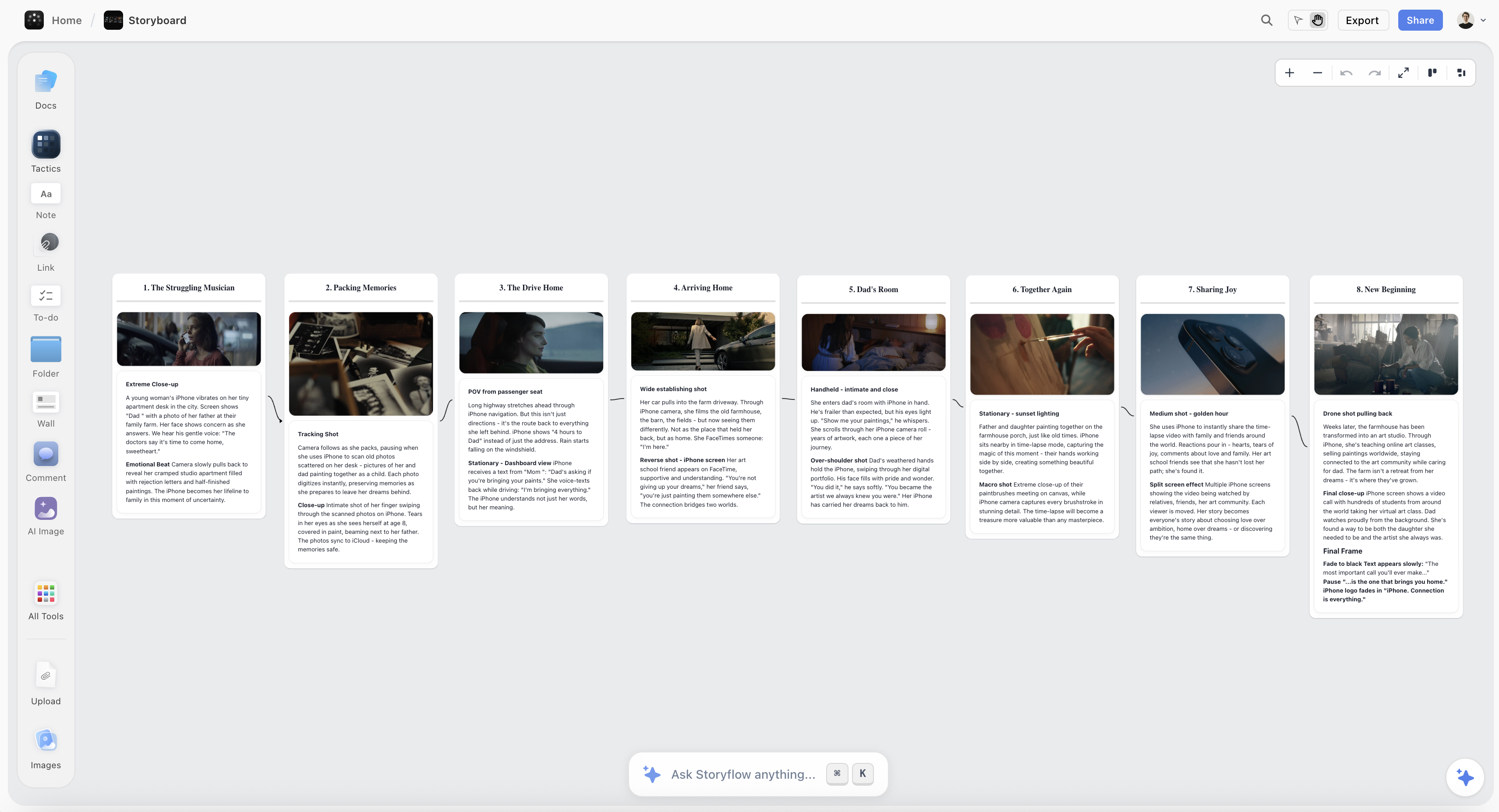
A short film plan on one Storyflow canvas: the ending, the one image, location photos, cast dates, script and schedule side by side
Close the five locks in one place
The plan is about ten artefacts and on the day you need any of them in seconds. Storyflow keeps the ending, the one image, the location photos, the cast dates, the script and the schedule on one canvas the AI can read, so checking whether forty setups fit in a day is a question rather than a spreadsheet. Paid-only during early access; the Free plan lands before the end of 2026.

Where AI Actually Helps
On the ending. Describing your ending to a model and asking it to argue that nothing changes is a useful and slightly brutal test. If it can make that case easily, your ending is a mood.
On cutting. Ask what in the script the location cannot support and what could be removed without changing the ending. Models are better at deletion than at invention, and deletion is what a short film needs.
On the schedule maths. Counting setups and converting them into a day estimate is mechanical and tedious and exactly the kind of thing worth handing over.
On reference images, when a look does not exist photographed. Generated frames are a direction to shoot toward, never a promise about what your location and daylight will produce.
Not on the one image. That is the single most personal decision in the project and a generated version of it is somebody else's film.
Not on whether the plan is realistic. No model knows your crew, your location's real acoustics, or that your lead has an unreliable car. Ask people who have shot before.
If you keep the plan on a canvas the AI can read (which is what Storyflow does), these questions get answered from your actual plan rather than from a description you retype. That is the whole practical difference, and it matters most on Sunday afternoon when you are checking whether forty setups fit in a day.
What Goes Wrong
Planning the film you cannot get. The location you do not have, the cast who have not said yes, the crane. It is the single biggest cause of shorts that never shoot.
Polishing the script instead of closing the locks. Draft seven with no location is worse than draft two with a confirmed room and a date.
Deferring the ending. Everything upstream stays undecidable, which is why the middle of the script keeps collapsing.
Casting on enthusiasm. Enthusiastic yeses without dates are not commitments, and you will discover this in week three.
Scheduling in script order. Wastes hours in relights and moves, and it is what almost everybody does first time.
No contingency for rain or a dropout. Both are likely. Decide now what happens, not on the morning.
Too many pages. Twenty pages for one day is how you end up with a film missing its ending, because the end of the script is always what gets cut when the day runs out.
Shooting coverage before the essential shots. Get the film's spine in the can early. Coverage is what you trade away when the day slips, and the day will slip.
The Bottom Line
The reason short films stall is not a shortage of talent, money, or gear. It is that a project with five open decisions can stay alive forever without ever becoming a shoot, and open decisions are comfortable in a way closed ones are not.
A weekend is enough to close all five, and the order is what makes it possible. The ending and the one image on Friday, when nothing is open and you are alone with the film. The location on Saturday morning, from the list of places you can genuinely get, contacted the same day with a specific date. The cast on Saturday afternoon, asked a real question with a real date attached. The script on Sunday morning, written to the room you now have rather than the room you wanted. The day count on Sunday afternoon, counted in setups, scheduled by location and light.
You will finish that weekend with a shorter film than the one you had in mind, set somewhere you did not originally choose, with an actor who was available rather than perfect.
You will also have a date. And a mediocre short film that exists teaches you more than a brilliant one that does not.
FAQ: Planning a Short Film
Can you really plan a short film in one weekend?
Yes, on one condition: you plan the film you can actually get rather than the one you would make with a budget. A weekend is enough to lock a location, a cast, the ending, the one image, and a day count, which is everything needed to set a shoot date. It is not enough to develop a script from nothing, and it does not need to be.
What should you do first when planning a short film?
Write the ending, then lock the location. The ending because nothing upstream is decidable without it, and the location because it constrains more than any other factor and it is the thing most likely to be refused. Script polish, shot lists, and storyboards all come after, and doing them first is the most common way a short film stalls.
How long should a first short film be?
Eight to ten pages, roughly eight to ten minutes. One location, two or three characters. That is shootable in a day by a small crew, which means it will get finished, and a finished eight-minute film is worth considerably more than an unfinished twenty-minute one.
How many shooting days does a short film need?
Count setups rather than pages. A setup is a camera position with a lighting state, and a small crew manages roughly four to six an hour once they are warmed up. A ten-page script typically lands between thirty and fifty setups, which is one long day for an experienced crew and two for a first-time one.
How do you find a location for a short film?
Start from what you can already reach: your home, friends' homes, a workplace someone has keys to at the weekend, a café that owes you a favour, a car, a stairwell, a field. Ask for a specific date and window rather than general permission, and confirm in writing. Then rewrite the story into the place you got, which is the step that decides whether the film happens.
How do you cast a short film with no budget?
Approach with the date already fixed, because "are you free on the 14th in Peckham" is a question people can answer and "would you like to be in something" is not. Local theatre, drama schools, and other people's shorts are the strongest sources. Get the yes in writing, and weight availability heavily, since a definitely-free actor beats a better one with an unclear schedule at this scale.
What is the one image and why does it matter?
The single frame your film exists to produce, describable in one sentence. Its value is operational rather than aesthetic: on the day, when you have forty minutes and three ways to shoot a scene, it tells you which choice belongs to this film. Filmmakers with a general mood deliberate, and deliberation is what loses you the light.
What tools do you need to plan a short film?
Less than you think. A shared folder, one printed schedule, and one printed shot list per person is genuinely sufficient for a one-day short. Milanote's free tier is the best free option if you want it digital and visual. StudioBinder is the right upgrade once you are producing call sheets for real crew. Storyflow keeps the messy half (references, script, structure) on one canvas with AI that reads it, and it is paid-only during early access.
What is the difference between a shot list and a schedule?
A shot list says what you are capturing. A schedule says when and in what order, grouped by location and by light rather than by script order. You need both, and the schedule is the one that determines whether the day works, because moving lights and rooms is where hours disappear.
Should I storyboard my short film?
Storyboard the sequences where the geography or the timing is not obvious, and skip it for straightforward dialogue. Full storyboards for an eight-page short are usually a way of avoiding the harder locks. The one image, plus reference frames for the three or four shots the film cannot exist without, does most of the work at this scale.
What happens if it rains on my shoot day?
Decide now, not on the morning. Either the film moves indoors and you have already identified which scenes can, or you have a named reserve date that cast and location have both agreed to. Rain and a dropout are the two most likely failures on a small short, and both are cheap to plan for and expensive to improvise around.
How do you write a short film script fast?
Write the ending first, then the opening image, then only the scenes that get from one to the other in the location you have. Most first drafts are long because the writer was avoiding the ending, so fixing the ending first tends to remove a subplot on its own. Cut every scene the location cannot hold rather than looking for a second location.
Is Storyflow free for planning a short film?
Not during early access. Storyflow is paid-only right now, from $7.99/month annual, with the Free plan launching before the end of 2026. Anyone a paid member invites to a board joins free, so a director on a paid plan can bring the DP and the producer onto the plan at no cost to them. For a genuinely free setup, use Milanote's free tier or a folder and a printed page.
Table of Contents
Templates to check out for this topic


Filmmaking templates you can use in Storyflow
Skip the blank canvas. Open one of these filmmaking boards in Storyflow and the AI builds on the structure that is already there, from research through the shot list.


See Storyflow in Action
A visual AI workspace where every feature lives inside one canvas. No tab-switching, no context lost.
Build your entire board from a single message
Type what you need in the AI chat at the bottom of your canvas. The AI adds cards, headings, and structure directly onto your board.
Use expert frameworks as AI context
Type @ in the AI chat and choose any Tactic. The AI tailors every response to that framework instead of giving generic advice.
Turn your board into a mind map in seconds
Ask the AI to restructure your canvas as a mindmap. It connects your ideas into a visual hierarchy so you can see how everything relates.
Why Storyflow Exists
Storyflow actually began as a personal tool while working on creative and research projects.
We kept running into the same problem: ideas were scattered everywhere: notes, documents, and whiteboards.
Nothing helped us see how everything connected.
So we started building a workspace designed around how ideas actually grow.
→ Read how Storyflow was createdJustkay
Documentary Filmmaker & Founder at Storyflow
Published: 2026-08-26
Extremely simple, seriously capable


See how easy it is to get started
Watch a real project come together, from a blank board to a finished plan, clicked through step by step.
Start creating with AI and become more productive
Transform your creative workflow with AI-powered tools. Generate ideas, create content, and boost your productivity in minutes instead of hours.