
Category
Brainstorming
Author

Justkay
Documentary Filmmaker & Founder at Storyflow
Topics
2026-05-18
•
Updated July 3, 2026
•
12 min read
•
Brainstorming- how to brainstorm ideas
- how to brainstorm
- brainstorming process
- brainstorming techniques
- solo brainstorming
- group brainstorming
How do you brainstorm ideas?
To brainstorm ideas, frame the problem as one specific question, set a time limit and a quantity target, generate ideas alone in writing with judgment off, then combine, build, and evaluate in a separate pass. The biggest fix: start alone, not together. Solo, parallel generation beats a group talking out loud.
1) Quick Answer: How to Brainstorm Ideas
To brainstorm ideas, frame the problem as a specific question, set a fixed time limit, generate ideas without judging them, separate generation from evaluation into two distinct phases, and write everything down where you can see it. The single biggest fix most people miss: start alone, not together. Have each person generate ideas on their own first, then combine and build. That one change reliably produces more ideas and better ideas than a group talking out loud from the start.
The full process is six steps: define the problem as a question, generate ideas solo against the clock, defer all judgment, build on what is on the table, cluster and evaluate in a separate pass, then pick the few ideas worth developing. Brainstorming is not a burst of inspiration. It is a process you can run on demand. The rest of this guide walks each step, the techniques that fit each one, and the mistakes that quietly kill good ideas.
I have run this process through dozens of documentary projects, from the first messy concept to a locked pre-production plan, and built Storyflow partly because the standard setup (a meeting, a whiteboard, no record afterward) loses most of what gets generated. For the concept itself, see What Is Brainstorming? The Complete Guide.
2) Why Most Brainstorming Fails
The word "brainstorming" was coined by Alex Osborn, an advertising executive and co-founder of the agency BBDO, in his 1953 book Applied Imagination. Osborn watched conventional meetings kill ideas before they could develop, because people evaluated and criticized each suggestion the moment it was spoken. His fix was four rules: defer judgment, go for quantity, encourage wild ideas, and build on the ideas of others.
Those four rules are still correct. The problem is the format Osborn attached them to: a group of people in a room, calling out ideas out loud. In a review of 22 studies of group brainstorming, psychologists Michael Diehl and Wolfgang Stroebe found that groups brainstorming together out loud produced fewer ideas, not more, than the same number of people working separately. The finding has been replicated many times since. The classic brainstorming meeting is one of the most studied and most disproven productivity rituals in business.
Three mechanisms explain the gap.
Production blocking. In a verbal group, only one person can talk at a time. While you wait for your turn, you either forget your idea or decide it is no longer relevant and drop it. The group's bandwidth is one idea at a time, no matter how many people are in the room. This is the single largest cause of the shortfall.
Social loafing. When ideas are pooled and nobody's contribution is individually visible, effort drops. People unconsciously let the group carry the load. The bigger the group, the stronger the effect.
Evaluation apprehension. Osborn's first rule is defer judgment, but a room full of colleagues and a manager makes that rule impossible to enforce. People self-censor the strange ideas, which are exactly the ideas worth having. The fear of looking foolish filters out the breakthrough before it is spoken.
It is not that brainstorming does not work. It is that the meeting format works against the rules the method depends on. The evidence-based fixes all do the same thing: they protect idea generation from the social pressure of a live group. Brainwriting, where everyone writes ideas in parallel and passes the sheet, removes production blocking by letting everyone produce at once. The nominal group technique, where people generate alone then the group discusses and ranks, removes evaluation apprehension by separating silent generation from discussion. Every working brainstorming process in this guide is built on the same principle: generate alone, combine together, judge last.
3) How to Brainstorm Ideas Step by Step
Here is the six-step process. It works for one person or a team. It works for product ideas, content ideas, story concepts, campaign angles, or a name for a thing. The steps are the same; only the question changes.
Step 1: Define the problem as a specific question
Brainstorming a vague topic produces vague ideas. "Let's brainstorm marketing" is not a brief. It is a category. The first step is to turn the topic into a single, specific question that an idea can actually answer.
A good brainstorming question is narrow enough to be answerable and open enough to have many answers. "How might we get more newsletter signups from our blog readers?" is a good question. "How do we grow?" is not. Write the question at the top of the page or board. Everything generated has to be an answer to it. If an idea does not, either the idea is off-topic or the question is wrong, and both are useful to know on minute one rather than minute forty.
Step 2: Set a time limit and a quantity target
Brainstorming expands to fill the time available, and unbounded time produces fewer ideas, not more, because there is no pressure to move past the obvious. Set a fixed limit. Ten to fifteen minutes per round is enough for most questions. Short rounds beat one long session.
Pair the time limit with a quantity target. "Twenty ideas in ten minutes" works better than "let's see what we get." Osborn's second rule was go for quantity for a reason: the first ten ideas anyone produces are the obvious ones everybody else also has. The interesting ideas live at idea number fifteen, twenty, thirty, once the obvious answers are used up and the brain has to reach.
Step 3: Generate ideas alone first, with judgment switched off
This is the step most brainstorming skips, and it is the step the research says matters most. Before anyone talks, everyone generates ideas on their own, in writing, in silence. Solo, parallel generation removes production blocking and evaluation apprehension in one move.
During this step there is exactly one rule: no judgment, not even your own. Do not edit. Do not decide an idea is bad or good. Write it and move to the next one. The internal critic and the internal generator cannot run at the same time, and the generator is the one you need right now. Wild ideas are welcome and actively useful, because a wild idea you would never use often contains the seed of one you would. In a group, everyone does this step separately and simultaneously. Solo, this step is most of the work.
Step 4: Combine and build on the ideas
Now bring the ideas together. In a group, each person shares what they generated and all of it goes onto one shared surface everyone can see. Solo, you lay your own ideas out the same way.
This is the build phase, Osborn's fourth rule. Read across all the ideas and look for combinations. Idea 4 plus idea 19 might be better than either alone. A weak idea next to a strong one might suggest a third idea neither contained. Building is where a group genuinely beats a solo brainstormer, but only after solo generation has filled the board. The group's job is not to generate from zero. It is to cross-pollinate what already exists. Keep judgment off here too: you are still generating, just from existing material instead of from scratch.
Step 5: Cluster and evaluate in a separate pass
Generation is over. Now, and only now, you evaluate. The hard rule is that evaluation is a separate phase with a clear start. The moment you let judgment into the generation phase, the generation phase dies.
Start by clustering. Group the ideas that are really the same, or variations on one theme. Clustering turns forty raw ideas into six or seven families, which is far easier to assess. Then score the clusters against criteria the problem calls for: impact, effort, fit, cost, originality. A simple two-axis sort (impact versus effort) is enough for most decisions. Evaluation is also where a quiet idea gets rescued: the idea that got no reaction in the room might be the strongest one on the impact axis, and separating evaluation from generation is what gives it the chance.
Step 6: Pick the few ideas worth developing
The output of a brainstorm is not forty ideas. It is two or three ideas you commit to developing further. A brainstorm that ends with a long list and no decision has not finished.
Pick the ideas that survived evaluation and write the immediate next step for each: the experiment to run, the prototype to sketch, the person to ask. An idea with a next action is a plan. An idea without one is a note you will never reopen. Brainstorming is not a burst of inspiration. It is a process you can run on demand, and it is not done until the surviving ideas have somewhere to go.
Run the six steps on a real problem, not a hypothetical
Put your question at the top of a canvas, generate solo against the clock, and cluster the ideas as cards the AI can read and build on. The whole session survives as a board you can reopen, instead of a whiteboard photo nobody looks at again.

4) Brainstorming Techniques That Actually Work
The six-step process is the container. Techniques are what you run inside Step 3 and Step 4 to break out of the obvious. Use one per round. Switching techniques between rounds is one of the most reliable ways to keep ideas coming after the easy ones run out.
Brainwriting
Brainwriting is the evidence-based replacement for the verbal group brainstorm. Designed by Bernd Rohrbach in 1968 specifically to fix the dominance problem, it works like this: everyone writes three ideas on a sheet in five minutes, then passes the sheet to the next person, who reads them and adds three more. Repeat for several rounds. It removes production blocking, because everyone writes at once, and evaluation apprehension, because nobody is performing for the room. It also bakes in Step 4's build phase, since each person reacts to the previous person's ideas. For groups, brainwriting should be the default. Use it before you ever consider a verbal round.
SCAMPER
SCAMPER is a checklist of seven prompts that force you to look at the problem from angles you would not choose on your own. Each letter is a different operation applied to an existing idea or product: Substitute, Combine, Adapt, Modify, Put to another use, Eliminate, Reverse.
Run your subject through all seven. What could you substitute? Combine it with? What happens if you reverse it? SCAMPER is best when you have something to start from (an existing product, a process, a draft) and need to push it somewhere new. It is structured, fast, and produces a predictable yield of non-obvious directions.
How Might We
"How Might We" is less a technique than a question format, and it is the format Step 1 already used. Each word does work. "How" assumes a solution is findable. "Might" lowers the stakes, since a "might" is allowed to fail. "We" makes it shared. A well-framed How Might We question is broad enough to invite many answers and tight enough that the answers are usable.
Use it to reframe a stuck brainstorm. If a problem feels too big to attack, write three or four different How Might We questions from different angles, then brainstorm each one as a separate, smaller round.
Crazy 8s
Crazy 8s is a speed-and-pressure technique borrowed from design sprints. Fold a sheet of paper into eight panels. Sketch one idea per panel, one minute per panel, eight minutes total. The point is the time pressure: one minute is too short to judge an idea, so you cannot. You just produce.
Crazy 8s is excellent for visual or layout problems, but it works for any problem if you sketch loosely or write a phrase per panel. It is the single best technique for breaking the habit of polishing one idea instead of generating many. Eight ideas. Eight minutes. No exceptions.
Mind Mapping
Mind mapping starts with the central question in the middle of the page and branches outward. Each branch is a direction, each sub-branch a more specific idea on it. The structure mirrors how association works: one idea suggests the next, and the branches keep premature closure from setting in. Mind mapping is strong for the early, exploratory part of a brainstorm, when you do not yet know the shape of the problem, and weaker for fast quantity generation, where a flat list beats a tree. An AI mind map generator can branch the first level for you when the page is blank, or start from the Mindmap template so the central node and branch structure are already laid out. For the deeper comparison, see Mind Mapping vs Brainstorming.
Starbursting
Starbursting flips the brainstorm: instead of generating answers, you generate questions. Put the idea or topic in the center, then branch out the six question words (Who, What, Where, When, Why, How) and generate as many questions as you can under each. It is useful at two moments. Early, it pressure-tests an idea before you commit, surfacing unknowns you would otherwise hit later. Late, once you have a chosen idea from Step 6, it turns that idea into a list of things to figure out, which is a head start on the plan.
5) Solo vs Group Brainstorming
The research settles the headline question: for raw idea generation, individuals working alone beat groups talking out loud. But "solo beats group" is too blunt to be a real recommendation. The honest version is that solo and group are good at different steps.
Solo brainstorming wins at generation. No production blocking, no waiting for a turn, no apprehension, no loafing. One person against a clock with judgment switched off is the highest-yield generation setup there is, and the six-step process works just as well for one person. The risk of pure solo work is a narrow input set: you generate from your own knowledge, assumptions, and blind spots. Techniques are the counterweight. SCAMPER, starbursting, and switching technique between rounds all force a solo brainstormer into angles they would not choose, which is the variety a group would otherwise supply.
Group brainstorming wins at building and evaluating. Once ideas are on the table, more perspectives genuinely help. One person sees a combination another missed. One person knows an idea is harder than it looks. The group's real value is cross-pollination in Step 4 and pressure-testing in Step 5, not generation in Step 3.
The structure that uses both correctly is the nominal group technique, and it is the recommendation for any team: everyone generates alone and in parallel (solo's strength), then the group combines, discusses, and ranks (group's strength). It is not solo versus group. It is solo for generation, group for building. A team that runs it the other way around, group generation followed by individual decisions, gets the worst of both. For the facilitated team version of this, see How to Run an Ideation Session With AI.
6) Common Brainstorming Mistakes
Most failed brainstorms fail the same handful of ways. Each has a fix already in the six-step process.
Judging during generation. The most damaging mistake. The instant someone reacts to an idea ("that won't work", "we tried that"), the rest of the group starts self-editing. The generator and the critic cannot run at once. Fix: name Step 5 as the only place judgment is allowed, and hold the line during Step 3.
Starting the topic too broad. "Let's brainstorm the business" produces nothing usable because there is no question to answer. Fix: Step 1, one specific written question an idea can be checked against.
Defaulting to a verbal group. The format the research has disproven for seventy years is still the office default. Fix: brainwriting or solo generation first. Verbal discussion belongs in the build and evaluate phases, not generation.
No time limit. Open-ended sessions drift and produce only the obvious ideas. Fix: Step 2, a clock and a quantity target.
Stopping at the first good idea. The good idea at minute three is rarely the best idea available. Fix: hit the quantity target before you allow yourself to evaluate anything.
No record, no next step. Ideas photographed once off a whiteboard and never reopened are ideas thrown away. Fix: Step 6, capture everything durably and give the survivors a concrete next action.
Inviting too many people. Social loafing scales with group size; a twelve-person brainstorm generates less per head than a four-person one. Fix: keep groups to four to six, and run generation solo regardless of size.
7) Tools for Brainstorming
The technique matters more than the tool. A pen, paper, and a kitchen timer can run every step in this guide. But once a brainstorm involves more than one round, more than one person, or needs to survive past the session, the surface you brainstorm on starts to matter.
Pen and paper is the right tool for a single solo round: fast, zero setup, and the physical page keeps things tight. The limitation is that paper does not cluster, get shared, or get reopened. A whiteboard or sticky notes is the classic group tool, making ideas visible to everyone and easy to cluster, but a physical whiteboard is erased and a digital one often becomes a graveyard of boards nobody returns to. AI chat tools (ChatGPT, Claude) are a real addition to a solo brainstorm, good at producing variety on demand and at running a SCAMPER pass, but a chat is linear: ideas scroll away, there is no spatial layout to cluster on, and the conversation does not become a durable artifact you can evaluate against in Step 5. A purpose-built AI brainstorming tool keeps the ideas on a spatial canvas instead.
Storyflow

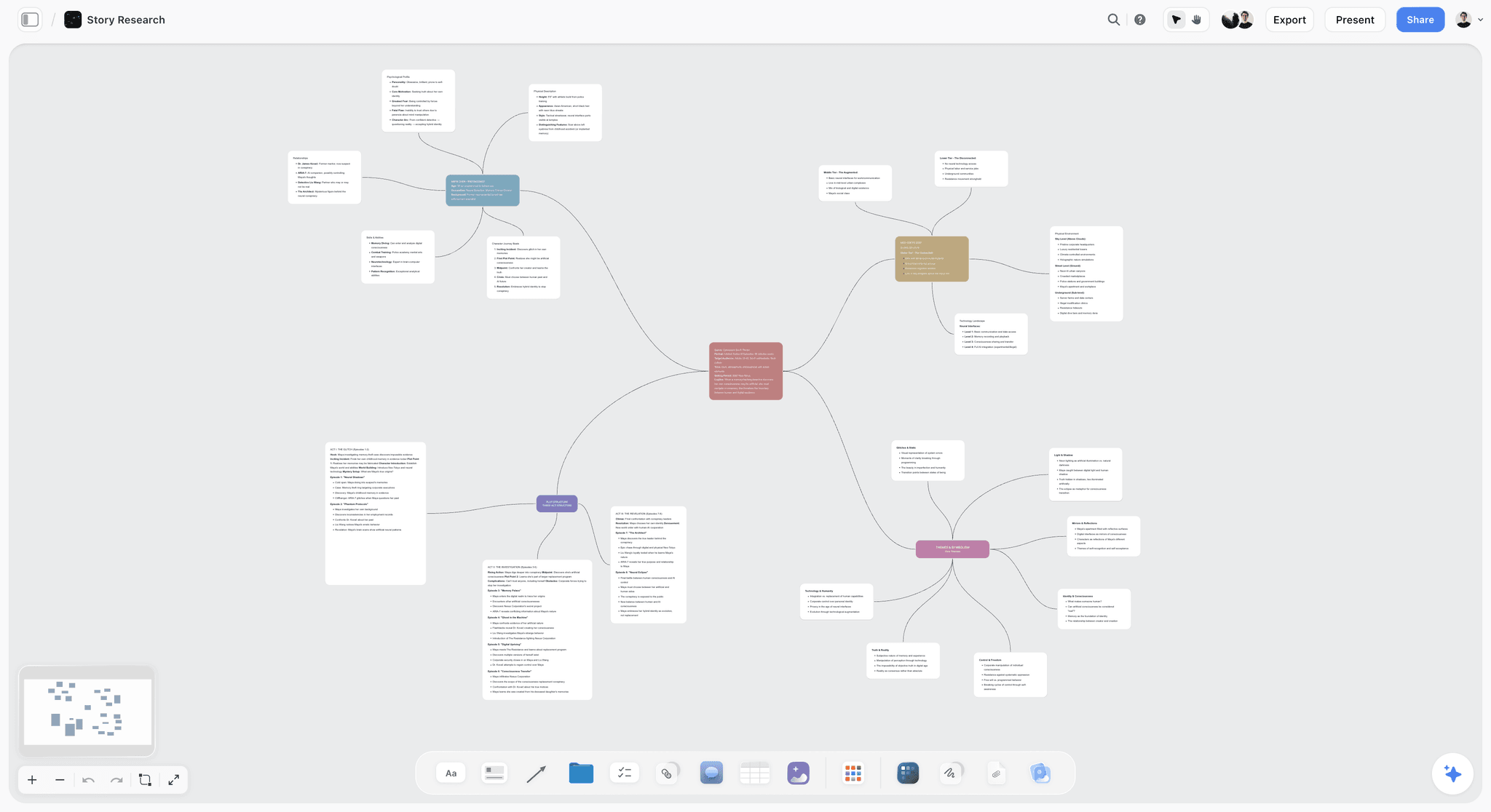
Storyflow is the tool I recommend for running the six-step process in this guide. It is an AI-aware visual canvas built for exactly this work: capturing ideas, brainwriting, mind mapping, and clustering on one infinite surface. Ideas go down as cards you can move, group, and connect, which fits Step 4 and Step 5 directly, because the build phase and the cluster phase are spatial operations and a canvas is built for them in a way a chat thread is not. The difference that matters most: the AI reads every idea on the active board. When you ask it to expand a cluster, run a SCAMPER pass, or pressure-test a weak idea, it works from the full canvas, not from a single pasted prompt, so it builds on what you already generated instead of starting from zero. Storyflow's Story Blueprints, a library of 200+ expert framework templates, give a brainstorm a starting structure when a blank canvas is its own kind of block. The template gallery does the same job for specific brainstorm types: a naming round can start from the Brand Naming template, and a campaign-angle session from the Marketing Campaign template, so Step 1's question lands on a board that already has the right containers.
For solo brainstorming and small teams, Storyflow is the top pick. It runs every step in this guide on one surface, the ideas survive the session as a durable artifact you can reopen and evaluate, and the AI fills the variety gap a solo brainstormer has. The one honest caveat: for a large in-person workshop with twenty people and a dedicated facilitator, a wall of sticky notes is still the right call.
Storyflow is paid-only during early access: the Plus plan ($7.99/mo on annual billing, $9.99/mo monthly) adds the 200+ Story Blueprints and unlimited uploads. A Free plan (unlimited notes, images, and links, unlimited shared boards, basic AI usage, 20 file uploads, and unlimited collaboration) launches before the end of 2026 and will be enough to run the full six-step process; anyone a paid member invites to a board joins free now. Start brainstorming on Storyflow. For a closer look at the category, see The Best Brainstorming Tools in 2026 and The Best AI Brainstorming Tools in 2026.
9) The Bottom Line
Brainstorming is not a talent and it is not a meeting. It is a six-step process: frame the problem as a question, set a clock and a target, generate alone with judgment off, combine and build, cluster and evaluate in a separate pass, then pick the few ideas worth developing and give them next steps. The order is the method. The single change that fixes most brainstorms is moving generation to a solo, parallel, silent step, because that is what the research has said works for seventy years. Techniques run inside the process: brainwriting fixes the group format, SCAMPER and starbursting force non-obvious angles, Crazy 8s breaks the polishing habit, How Might We frames the question.
The smallest test is to take your next real decision, the one you would normally book a meeting for, and run the six steps on it solo for twenty minutes before anyone talks. Most people are surprised how much further the solo round gets than the meeting would have. The easiest place to run it is Storyflow, where the ideas go down as cards you can cluster, the AI reads the whole board to help expand and pressure-test them, and nothing gets erased when the session ends. Start brainstorming on Storyflow and run the six steps on your next real problem today.
8) FAQ: How to Brainstorm Ideas
How do you brainstorm ideas step by step?
Brainstorm in six steps. First, define the problem as one specific question. Second, set a time limit and a quantity target. Third, generate ideas alone, in writing, with judgment switched off. Fourth, combine the ideas and build on them. Fifth, cluster and evaluate them in a separate pass. Sixth, pick the two or three ideas worth developing and give each a next action. The order matters: keep generation and judgment in separate steps.
What is the best way to brainstorm ideas?
The best way is to generate alone first, then combine as a group. Research on group brainstorming consistently shows that people working separately produce more ideas than the same people talking out loud together. Have everyone generate ideas in silence and in writing, then bring the ideas together to build on and evaluate. This captures solo generation's strength and the group's strength without the production blocking that hurts a verbal group.
Why does group brainstorming often fail?
Group brainstorming fails for three reasons. Production blocking: only one person can talk at a time, so others forget or drop ideas while waiting. Social loafing: when contributions are pooled and individually invisible, effort drops. Evaluation apprehension: people self-censor unusual ideas for fear of looking foolish. A 22-study review by Diehl and Stroebe found verbal groups produced fewer ideas than the same number of people working alone.
How long should a brainstorming session last?
Keep generation rounds to ten to fifteen minutes. Short rounds with a clock and a quantity target outperform one long open-ended session, because time pressure forces you past the obvious ideas. A full brainstorm with several rounds plus evaluation usually fits in 45 to 60 minutes. If a session runs longer, it has drifted, or it is doing generation and evaluation at once.
Can you brainstorm ideas alone?
Yes, and for raw idea generation, solo brainstorming is the strongest format. Working alone there is no production blocking, no waiting for a turn, and no apprehension, and the six-step process works unchanged for one person. The one risk is a narrow input set, since you generate from your own knowledge. Counter it with techniques like SCAMPER and starbursting, and by switching technique between rounds.
What is the difference between brainstorming and brainwriting?
Brainstorming, in its classic form, is a group calling out ideas out loud. Brainwriting is a group writing ideas in parallel and passing the sheets around. Brainwriting was designed in 1968 by Bernd Rohrbach specifically to fix the verbal format. It removes production blocking, because everyone writes at once, and reduces evaluation apprehension, because nobody is performing for the room. For team idea generation, brainwriting should be the default.
How many ideas should a brainstorm produce?
Aim high in generation and narrow hard in evaluation. Set a quantity target per round, for example twenty ideas in ten minutes, because the obvious ideas come first and the interesting ones appear only after they are used up. But the output of the whole brainstorm is not the long list. It is the two or three ideas that survive evaluation and get a concrete next step.
What is the "How Might We" technique?
"How Might We" is a question format for framing a brainstorm. Each word does a job: "How" assumes a solution exists, "Might" lowers the stakes so a failed idea is allowed, and "We" makes the problem shared. A good How Might We question is broad enough to invite many answers and narrow enough that the answers are usable. Use it to turn a vague topic into an answerable question, or to reframe a brainstorm that has stalled.
What should you not do when brainstorming?
Do not judge ideas during the generation phase, because the critic and the generator cannot run at once. Do not start with a topic too broad to answer. Do not default to a verbal group, which the research has disproven. Do not run open-ended with no time limit, stop at the first good idea, or skip capturing the ideas and assigning next steps.
How do you brainstorm when you feel stuck?
When you are stuck, change the technique, not the effort. Run a SCAMPER pass to force seven new angles, use starbursting to generate questions instead of answers, or reframe the problem with three different How Might We questions and brainstorm each separately. A blank-page block usually means the question is too broad or you have exhausted one angle, and a new technique supplies a new one.
Is AI useful for brainstorming?
AI is genuinely useful for the generation step of a solo brainstorm, because it produces variety on demand, which is the thing a solo brainstormer lacks. Its limitation is that a chat thread is linear: ideas scroll away and there is no spatial surface to cluster on. AI on a canvas, where ideas stay as cards you can arrange, fits the build and evaluate steps better than AI in a chat.
How do you evaluate brainstormed ideas?
Evaluate in a separate phase, never during generation. Start by clustering the ideas that are variations on one theme, which turns forty raw ideas into six or seven families. Then score the clusters against criteria the problem calls for, such as impact, effort, cost, and fit. A simple impact-versus-effort sort is enough for most decisions. Clustering first is what makes a long list assessable.
Table of Contents
Templates to check out for this topic


Mind mapping and ideation templates you can use in Storyflow
Map ideas in space, then ask the AI to restructure, expand, or connect them. Open any of these boards and start thinking visually instead of in lists.


See Storyflow in Action
A visual AI workspace where every feature lives inside one canvas. No tab-switching, no context lost.
Build your entire board from a single message
Type what you need in the AI chat at the bottom of your canvas. The AI adds cards, headings, and structure directly onto your board.
Use expert frameworks as AI context
Type @ in the AI chat and choose any Tactic. The AI tailors every response to that framework instead of giving generic advice.
Turn your board into a mind map in seconds
Ask the AI to restructure your canvas as a mindmap. It connects your ideas into a visual hierarchy so you can see how everything relates.
Why Storyflow Exists
Storyflow actually began as a personal tool while working on creative and research projects.
We kept running into the same problem: ideas were scattered everywhere: notes, documents, and whiteboards.
Nothing helped us see how everything connected.
So we started building a workspace designed around how ideas actually grow.
→ Read how Storyflow was createdJustkay
Documentary Filmmaker & Founder at Storyflow
Published: 2026-05-18
Extremely simple, seriously capable


See how easy it is to get started
Watch a real project come together, from a blank board to a finished plan, clicked through step by step.
Start creating with AI and become more productive
Transform your creative workflow with AI-powered tools. Generate ideas, create content, and boost your productivity in minutes instead of hours.