
Mind Mapping vs Brainstorming in 2026: When to Use Each (and Why It Matters)
Mind mapping decomposes a known topic into structure. Brainstorming generates ideas around an open question. Here is when to use each, what the cognitive science says, which tools fit each method, and how to sequence them on real creative projects in 2026.

Category
Visual Thinking
Author

Justkay
Documentary Filmmaker & Founder at Storyflow
Topics
2026-05-09
•
12 min read
•
Visual Thinking- mind mapping vs brainstorming
- when to mind map
- when to brainstorm
- decomposition vs divergence
Mind mapping vs brainstorming: when should I use each?
Use mind mapping when you already have a topic and need to break it into structure; use brainstorming when you have an open question and need to generate ideas before judging them. Mapping is convergent organisation, brainstorming is divergent generation. Strong projects sequence both: brainstorm to discover, then map to organise.
Use mind mapping when you already have a topic and need to break it into structure, and use brainstorming when you have an open question and need to generate ideas before judging them: mind mapping is convergent organisation, brainstorming is divergent generation, and most strong projects sequence the two rather than choosing one. Halfway through cutting my last documentary, I caught myself doing something strange. I had a notebook open on the left, scrawled with disconnected scene ideas, and a clean radial diagram on the right showing the film's act structure. Two methods, two pages, twenty minutes apart, on the same project. A friend leaned over and asked which one I was actually doing. I did not have a good answer. The honest one is that I was doing both, in sequence, because they are not the same thing and never have been. Most people use mind mapping and brainstorming interchangeably. That conflation costs you hours every week and produces work that is structured before it should be, or chaotic when it should not be.
Quick Verdict: Mind Mapping vs Brainstorming
Mind mapping is best when you already have a topic and need to break it down into branches. The structure is the point. (More on the cognitive science behind this below.)
Brainstorming is best when you have a problem and need to generate ideas without prematurely judging them. The lack of structure is the point. (More on why structure kills divergence below.)
The full distinction, with the cognitive science, real workflow examples, and which tool actually fits each method, is what the rest of this article is for. The short version is hiding a longer story about how each method changes your thinking, and why doing them in the wrong order is the most common mistake creative teams make.
What Is Mind Mapping?
Mind mapping is a visual thinking technique where you start with a central concept and radiate related ideas outward as branches. Tony Buzan, the British psychologist who popularised the method in the 1970s, argued that the radial structure mirrors how the brain associates ideas: from a centre, by category, with hierarchy. The map is not just a picture of your thinking. It is a structure your thinking has to fit into.
Mind mapping works when you already know what you are decomposing. A documentary subject. A product feature. A book chapter. A research question. The branches give you containers for what you already broadly understand, and the act of placing ideas into branches forces you to clarify their relationships. This is convergent thinking dressed up as visual exploration. You are organising, not generating.
There is real cognitive science behind why this works. Nelson Cowan's 2001 review of working memory put the average capacity at around four chunks at a time, well below the famous "seven plus or minus two" estimate from Miller's earlier work. A mind map externalises chunks into spatial branches so your working memory can hold the relationships between them, not the items themselves. That is why mind maps feel useful for studying, project planning, and structured presentations. It is also why they fail when you do not yet know what the chunks are. A blank centre with three branches is not a mind map. It is a confession.
What Is Brainstorming?
Brainstorming is a divergent ideation technique formalised by advertising executive Alex Osborn in his 1953 book Applied Imagination. Osborn's rules were strict and counterintuitive: defer judgment, encourage wild ideas, build on the ideas of others, aim for quantity over quality. The point was to separate idea generation from idea evaluation, because doing both at once kills the first one. Most teams who say they brainstorm are actually doing structured discussion, which is something else entirely.
Brainstorming works when you do not yet know the shape of the answer. Solving a creative block. Naming a product. Generating campaign concepts. Finding angles on a difficult subject. The output is meant to be a flat, unfiltered list, not a hierarchy. Structure imposed too early shrinks the option space. The most counterproductive thing you can do in a brainstorm is start grouping ideas while you are still generating them, because grouping is convergent and generation is divergent and your brain can only do one of those at a time well.
It is not that brainstorming has no rules. It is that the rules are designed to delay judgment, not impose structure. When teams swap the rules and start judging first, they end up with a mediocre mind map disguised as a brainstorm.
The Core Difference: Decomposition vs Divergence
The clearest way to keep these two methods straight is to ask what cognitive mode you are in. Mind mapping is decomposition: starting with a known whole and breaking it into parts. Brainstorming is divergence: starting with a problem and generating possibilities without committing to any of them. Decomposition is convergent. Divergence is generative. Doing them at the same time is a recipe for shallow output in both directions.
This is why the question "should I mind map or brainstorm?" has a precise answer. If you can articulate the central topic in one sentence and the branches feel like categories you already half-know, you are decomposing and a mind map will speed you up. If your central topic is actually a question you cannot answer yet, you are not ready to mind map. You are ready to brainstorm. Doing it the other way around (brainstorming when you should be decomposing, mind mapping when you should be diverging) is the most common mistake I see creative teams make on real projects.
See how an open canvas holds both a brainstorm and a mind map on one project in Storyflow
When to Use Mind Mapping
Mind mapping earns its place in your workflow whenever you have an existing topic that needs structural clarity. It is a tool for organising thought, not for inventing thought from scratch.
- Project planning: Decompose a known goal into phases, deliverables, and dependencies. The branches give you a quick view of what is parallel and what is sequential.
- Study notes and learning: Map a chapter, a course, or a research domain. The radial structure forces hierarchy decisions that surface gaps in your understanding.
- Decomposing a topic for writing: Articles, scripts, and book chapters all benefit from a map of the territory before you draft. You are not generating ideas. You are organising the ones you already have.
- Presenting a structured argument: When you need to communicate a point to a team or client, a mind map exposes the logic visually before you commit to slides.
- Audit and review work: Mapping an existing system (a feature set, a competitor's product, a workflow) reveals what is missing more reliably than a list does.
- Documentary pre-production: Mapping themes, characters, and act structure once you have a working subject. The map is the skeleton the brainstorm later hangs on.
Notice the pattern. In every case, you already know the topic. The map is helping you understand its shape, not invent its existence.
When to Use Brainstorming
Brainstorming earns its place earlier in the creative process, when the question is open and the answer space is unmapped. Treat it as the discovery phase, not the planning phase.
- Problem solving: When the problem is well-defined but the solution is not. Generate a flat list of options before you evaluate any of them.
- Ideation phase of a creative project: Naming, concepting, framing. The act of generating quickly is the whole point. Quality emerges from quantity.
- Breaking a creative block: When you are stuck on a draft, a list of "what else could this be" prompts is more useful than a structured outline.
- Group sessions where you need range: A team brainstorm captures perspectives a solo session would miss, but only if the rules of deferred judgment are followed.
- Generating angles on a known subject: What stories could this documentary tell? What features could this product offer? Range first, ranking later.
- Resetting a stale project: When the existing direction feels wrong, a brainstorm pulls you out of incremental thinking and into "what if it were completely different?"
Notice the pattern. In every case, the answer is unknown and structure too early would shrink the option space.
Comparison Table
| Dimension | Mind Mapping | Brainstorming |
|---|---|---|
Goal | Decompose a known topic | Generate unknown ideas |
Structure | Hierarchical, radial | Loose, divergent |
Cognitive mode | Convergent organisation | Divergent generation |
Output | Tree of nodes | Flat list of ideas |
Best for solo or group | Either, slight solo bias | Group typically, also solo |
Tools that excel | MindMeister, XMind, Storyflow | Miro, FigJam, Stormboard, Storyflow |
When AI helps | Auto-decomposition of branches | Idea generation prompting |
When AI hurts | Premature structure imposed | Convergent ranking too early |
Time pressure | Tolerates careful pacing | Requires speed and volume |
Quality signal | Coherence of structure | Range of unrelated ideas |
The table is a cheat sheet, not a verdict. The verdict comes from matching the cognitive mode to the situation, which is usually clear once you ask whether you are organising or generating.

Storyflow holds a hierarchical mind map and a flat brainstorm field on the same canvas, with AI reading both as project context
Run both methods on one canvas.
Brainstorm a flat field of ideas, then reorganise the same nodes into a radial map when the subject becomes clear. The AI reads the whole board either way, so switching modes never means rebuilding context.

How AI Changes Both Methods in 2026
In 2026, AI changes the speed of both methods without changing their cognitive purpose. That distinction matters more than the tool marketing pages will tell you.
For mind mapping, AI can auto-decompose a central topic into branches. Drop in "Climate change documentary" and you get six branches of subtopics, each with three sub-branches, in seconds. This is genuinely useful for skipping the blank-page stall, but it has a catch. The structure AI produces is a generic, training-data-flavoured decomposition of the topic, not a decomposition shaped by your specific project context. Without context, the map is too clean and too obvious. The right move is to use AI for first-pass branches and then prune, rearrange, and add the things only you know.
For brainstorming, AI can generate divergent ideas at a volume no human team can match. Ask for forty ways to open a documentary about a closed-down factory and you get forty. The risk is the opposite of mind mapping: AI brainstorming produces too much output too quickly, before any of it has been considered. Used badly, it short-circuits the human cognitive work that makes brainstorming valuable in the first place. Used well, it primes the pump and gives a team something to react to.
What does not change in 2026 is the cognitive purpose of each method. Mind mapping is still convergent organisation. Brainstorming is still divergent generation. AI accelerates both but cannot decide which one your project needs. That decision is still yours, and getting it wrong still costs you the same hours it always did.
It is not that AI replaces these methods. It is that AI compresses the time cost of doing them, which makes choosing the right one even more important.

AI Planner produces first-pass mind map branches you then prune and reshape with project context

AI generates divergent ideas at volume, then the human work of selecting and combining begins
Tools That Excel at Each (and Tools That Try to Do Both)
Most tools are built for one cognitive mode. Mind mapping software optimises for hierarchy and clean radial layouts. Brainstorming software optimises for sticky notes, voting, and timer-driven sessions. The few that handle both well do so by treating the canvas itself as neutral and adding scaffolding when you need structure.
MindMeister and XMind are mind-mapping-first tools. They produce excellent radial maps, support keyboard-driven branch creation, and export cleanly. They are weaker for divergent ideation because the structure is always trying to organise your thinking before you are ready.
Miro and FigJam are brainstorming-first tools. Sticky notes, templates, voting, and team facilitation are built in. They will hold a mind map, but they will not help you build one. The radial layout is something you assemble manually.
Stormboard is a brainstorming-specific tool with structured templates for divergent sessions. It is excellent for the generation phase, weaker for decomposition and project planning afterwards.
Notion and Whimsical are good for outlining the result of a mind map but not for the live thinking process. They reward structure that is already settled.
Storyflow sits in a different position because the canvas itself stays neutral and the structure is something you add when you choose, not something the tool imposes from the start. The friction it removes is the one this whole article is about: most tools force you into one cognitive mode (a clean radial map or a sticky-note wall) before you have decided which mode the work needs. Storyflow lets the same project hold a brainstormed flat field of nodes one day and an organised radial mind map the next. The AI reads your full active canvas board plus up to 1 Tactic and 3 Documents you @-mention, so it has the same project context whether you ask it to expand ideas divergently or decompose a topic into branches. Storyflow's Story blueprints library (200+ creative templates on the Plus, Pro, and Max plans) includes templates for both decomposition (project breakdowns, character webs, content outlines) and divergence (idea expansion, lateral thinking prompts). The Free plan includes unlimited projects, basic AI usage, and 20 file uploads, which is enough to test whether the dual-mode approach fits how you work.
The honest trade-off: if you only ever run one method, a method-specific tool will feel cleaner. MindMeister produces tidier radial maps out of the box, and Miro has deeper live-facilitation features for large group sessions. Storyflow earns its place only when you sequence both methods on the same project and do not want to rebuild context every time you switch. The quickest way to feel the difference is to open the Mindmap template, brain-dump a flat field of nodes around the centre, and only then let the branches form.
A Real Workflow: Documentary Pre-Production
Here is how I sequence mind mapping and brainstorming on an actual project, using one I am working on now as the example. The subject is a small-town factory closure and the people it left behind. Stage one was a brainstorm, not a mind map, because I did not yet know what the film was about.
I opened a fresh canvas, set a timer, and brain-dumped forty fragments. Faces, moments, scene ideas, archive references, possible interview subjects, weather, sounds, things I remembered from a single visit. No structure. No grouping. The rule was quantity. By the end I had a flat field of forty nodes, most of them not useful, three of which I kept circling back to. Those three were the seed of the film.
Stage two was the mind map. With the central subject finally clear ("what the closure took from people who chose to stay"), I built a radial structure on a Film Plan template: themes as primary branches, characters as secondary branches, archive and visual references as tertiary. A Story blueprint from Storyflow's template library gave me scaffolding to check whether the act breakdown made sense. AI read the full canvas and suggested two missing branches I had not considered. The map was a project plan disguised as a thinking tool. By the end I had a structure I could pitch.
Stage three, much later, was a second brainstorm. With the structure in place, I needed scene-level ideas and sequence opening hooks. Different cognitive mode, same canvas. Flat list, deferred judgment, quantity over quality. The mind map sat to the side as context, not as a constraint. The new ideas slotted into the existing branches afterwards.
Three stages, two methods, one project. The point is the sequence: brainstorm to discover, mind map to organise, brainstorm again at finer granularity, mind map again to integrate. Doing it the other way around (mind mapping before I knew the subject) would have produced a tidy, generic, and ultimately wrong skeleton.
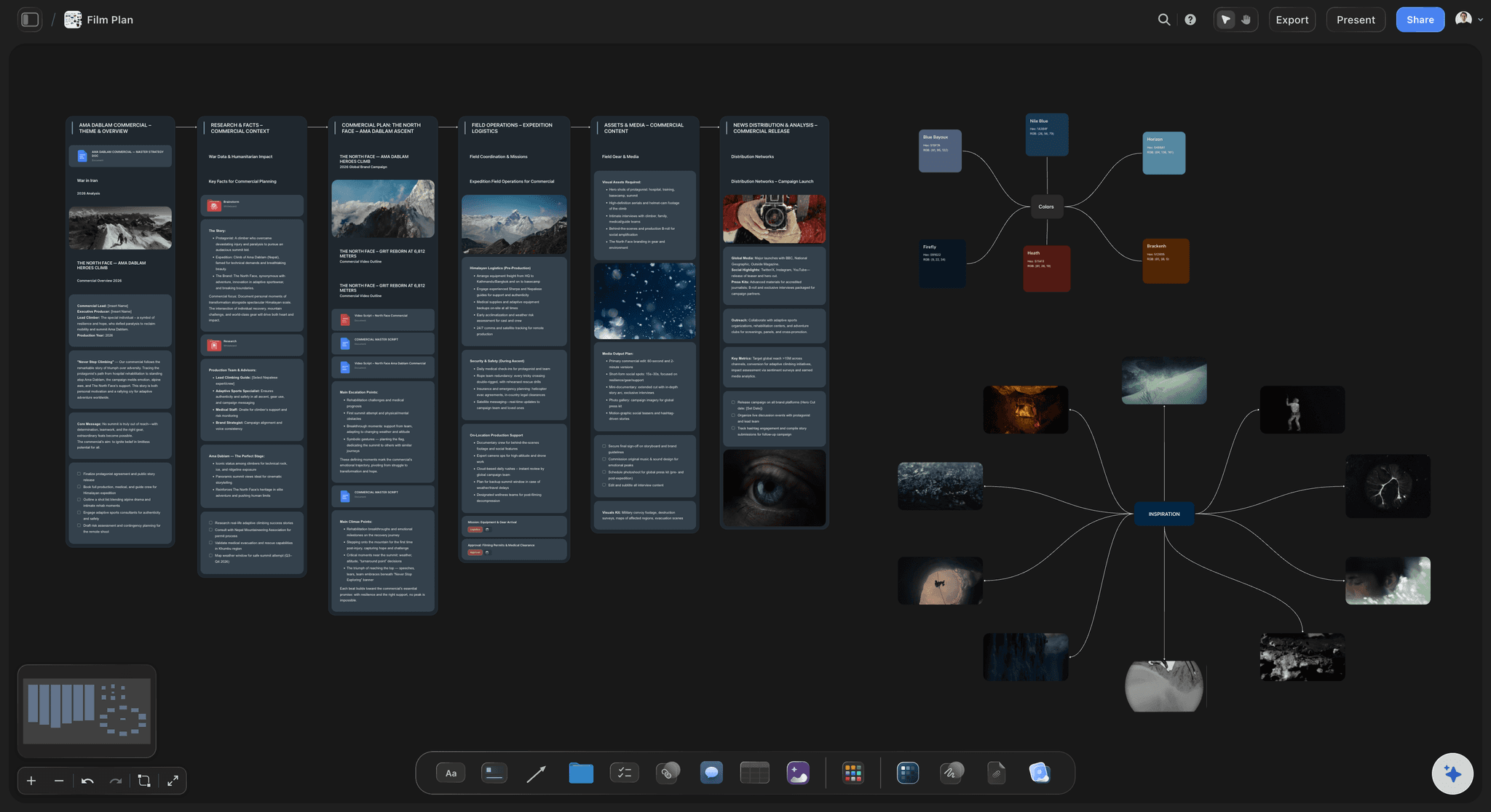
Brainstorm to discover the subject, mind map to organise it, brainstorm again at finer granularity. One canvas, sequenced methods.
The Bottom Line
Mind mapping decomposes structure. Brainstorming generates divergence. They are not interchangeable, and treating them as if they were is the most common mistake creative teams make. The decision is always the same one: are you organising what you already know, or discovering what you do not? If the answer is organising, a mind map will accelerate you. If the answer is discovering, a brainstorm has to come first. Most strong projects sequence the two: brainstorm to find the subject, mind map to structure it, brainstorm at finer granularity, mind map to integrate. The tools matter less than getting the order right. AI in 2026 makes both methods faster, which makes choosing the correct one for the situation more important than ever. If your next move is to structure what you already have, generate a first mind map with AI and shape it on the canvas.
FAQ: Mind Mapping vs Brainstorming
What is the difference between mind mapping and brainstorming?
Mind mapping is a structured decomposition of a known topic into hierarchical branches, and brainstorming is an unstructured generation of ideas around an open question. The two methods serve opposite cognitive modes. Mind mapping is convergent organisation. Brainstorming is divergent generation. They look similar from the outside (visual, branching, on a canvas) but the goal of each is the inverse of the other. Mind mapping helps you understand what you already know. Brainstorming helps you discover what you do not.
Should I mind map first or brainstorm first?
Brainstorm first when the topic is open, mind map first when the topic is already defined. The order depends on whether you can articulate the central concept in one sentence. If you can, a mind map will accelerate your structuring. If you cannot, a brainstorm has to come first, because mind mapping a question you have not yet answered produces a tidy, generic structure that does not fit the actual project. Most strong creative workflows alternate: brainstorm to discover, mind map to organise, brainstorm at finer granularity, mind map to integrate.
Can mind mapping be brainstorming?
A loose mind map can function as a brainstorm if you suspend the hierarchy rules, but the structure usually leaks back in and shuts down divergence. The radial layout invites you to categorise as you generate, which is exactly what good brainstorming defers. If you find yourself adding branches and immediately moving them, you are not brainstorming. You are doing premature organisation. Either commit to a flat layout for the generation phase or accept that what you are producing is a structured outline, not a divergent idea field.
Which is better for solving a problem?
Brainstorming is better for solving a problem you do not yet have an answer to, because it expands the option space before any single option is committed to. Mind mapping is better for solving a problem where the answer is known but needs to be communicated, planned, or executed. The distinction is whether the bottleneck is generation or organisation. If you are stuck because you cannot think of options, you need a brainstorm. If you are stuck because you have too many options and cannot see how they fit, you need a mind map.
Which is better for studying or learning?
Mind mapping is better for studying, because the goal of studying is to organise and remember knowledge that already exists. The radial structure exposes hierarchy, surfaces gaps, and makes relationships between concepts visible. Cowan's 2001 working-memory research suggests we hold about four chunks at a time, and a mind map externalises those chunks so the relationships can be held in working memory instead. Brainstorming has a place in study only when you are generating questions or hypotheses, which is rarer than students assume.
What tool is best for both?
A canvas-based tool with optional structural scaffolding is best for both, because the same surface can hold a flat brainstorm one day and a hierarchical mind map the next. Storyflow handles both methods because the canvas is open and its Story blueprints provide structure only when you choose to apply them. The AI reads your full active canvas board plus up to 1 Tactic and 3 Documents you @-mention, which means it can support a divergent prompt or a structured decomposition with the same project context. Method-specific tools (MindMeister for mind mapping, Miro for brainstorming) are cleaner if you only ever use one method, but most real workflows use both.
Can AI replace either method?
AI can accelerate both methods but cannot replace the cognitive work either method does. AI auto-decomposing a topic into branches is genuinely fast for first-pass mind maps, but the structure is generic and needs human pruning. AI generating a divergent list of ideas is genuinely fast for first-pass brainstorms, but the volume short-circuits the human reflection that makes brainstorming valuable. The right framing is that AI compresses the time cost of doing each method, which makes choosing the correct method for the situation more important, not less.
What is the cognitive science behind mind mapping vs brainstorming?
Mind mapping is grounded in working-memory research (Cowan 2001 estimated capacity at around four chunks), and the radial structure externalises chunks so working memory can hold relationships instead of items. Brainstorming is grounded in divergent-thinking research formalised by Alex Osborn in 1953 and refined by J. P. Guilford's later work on creative cognition, which identified divergent and convergent thinking as separate mental operations. Doing both at the same time is cognitively expensive and usually produces poor output in both directions. The methods are tools for activating the right mode at the right time.
How long should each method take?
A focused brainstorm should run between 15 and 30 minutes per round, because the energy required to defer judgment fades quickly. A mind map can run longer, often 45 to 90 minutes, because organisation rewards careful pacing. Long brainstorms drift into discussion. Rushed mind maps produce unreliable hierarchy. If a brainstorm hits 45 minutes without reaching forty ideas, the rules of deferred judgment have probably broken down. If a mind map feels finished at 15 minutes, the structure is probably hiding gaps you have not surfaced yet.
Are mind mapping and brainstorming useful for solo work?
Both methods are useful solo, but the dynamics change. Solo brainstorming requires more discipline because there is no group energy to maintain quantity, so a timer and a written quota help. Solo mind mapping is often more effective than group mind mapping because hierarchy decisions are easier to make alone than to negotiate. Many strong solo workflows alternate the two: brainstorm in short bursts to capture range, then mind map to organise, then brainstorm again at the next level of detail.
Table of Contents
- Quick Verdict: Mind Mapping vs Brainstorming
- What Is Mind Mapping?
- What Is Brainstorming?
- The Core Difference: Decomposition vs Divergence
- When to Use Mind Mapping
- When to Use Brainstorming
- Comparison Table
- How AI Changes Both Methods in 2026
- Tools That Excel at Each (and Tools That Try to Do Both)
- A Real Workflow: Documentary Pre-Production
- The Bottom Line
- Author
- FAQ: Mind Mapping vs Brainstorming
- Related Reading
Templates to check out for this topic


Mind mapping and ideation templates you can use in Storyflow
Map ideas in space, then ask the AI to restructure, expand, or connect them. Open any of these boards and start thinking visually instead of in lists.


See Storyflow in Action
A visual AI workspace where every feature lives inside one canvas. No tab-switching, no context lost.
Build your entire board from a single message
Type what you need in the AI chat at the bottom of your canvas. The AI adds cards, headings, and structure directly onto your board.
Use expert frameworks as AI context
Type @ in the AI chat and choose any Tactic. The AI tailors every response to that framework instead of giving generic advice.
Turn your board into a mind map in seconds
Ask the AI to restructure your canvas as a mindmap. It connects your ideas into a visual hierarchy so you can see how everything relates.
Why Storyflow Exists
Storyflow actually began as a personal tool while working on creative and research projects.
We kept running into the same problem: ideas were scattered everywhere: notes, documents, and whiteboards.
Nothing helped us see how everything connected.
So we started building a workspace designed around how ideas actually grow.
→ Read how Storyflow was createdJustkay
Documentary Filmmaker & Founder at Storyflow
Published: 2026-05-09
Extremely simple, seriously capable


See how easy it is to get started
Watch a real project come together, from a blank board to a finished plan, clicked through step by step.
Start creating with AI and become more productive
Transform your creative workflow with AI-powered tools. Generate ideas, create content, and boost your productivity in minutes instead of hours.