
What is Brainstorming? Techniques, Tools, and Frameworks (Complete Guide 2026)
Brainstorming is a structured method for generating a high volume of ideas without judgment. This complete guide covers the definition, group dynamics, techniques, tools, and real examples that make brainstorming actually work.

Category
Creative Process
Author

Sara de Klein
Head of Product at Storyflow
Topics
2026-04-10
•
17 min read
•
Creative Process- what is brainstorming
- brainstorming definition
- brainstorming techniques
What is brainstorming?
Brainstorming is a structured group method for generating a high volume of ideas by suspending judgment during the generation phase. Developed by Alex Osborn in the 1950s, it separates idea generation from evaluation to allow unconventional thinking to surface before the analytical mind filters it out, creating a raw idea pool for later convergent selection.
What is Brainstorming?
Brainstorming definition:
“Brainstorming is not a meeting where everyone shouts ideas. It is a structured divergent method: a facilitated group process designed to maximize idea volume while suspending evaluation, so unconventional thinking can emerge before the analytical mind shuts it down. The output is a raw idea pool, not decisions.”
The word was coined by Alex Osborn, an advertising executive at BBDO, who codified the method in his 1953 book Applied Imagination. Osborn's four original rules (defer judgment, go for quantity, build on others' ideas, reach for wild ideas) remain the foundation of every effective brainstorming technique. What has changed is understanding exactly why those rules work, which is what determines whether a session produces something genuinely useful or just fills a whiteboard with variations of the obvious.
Key takeaways
- Brainstorming is a structured divergent method with four rules, not a synonym for group discussion.
- Unstructured verbal brainstorming underperforms individuals working alone; structure and facilitation are what close that gap.
- The output of a brainstorm is a raw idea pool. Convergence happens in a separate session, at least 24 hours later.
- Match the technique to the failure mode: brainwriting for dominant voices, reverse brainstorming for stuck teams, constraints for predictable ideas.
Brainstorming vs Ideation vs Mind Mapping
These three terms get used interchangeably in most workplaces. They describe related but distinct things, and confusing them leads to running the wrong process at the wrong moment.
| Brainstorming | Ideation | Mind Mapping | |
|---|---|---|---|
| Purpose | Generate many ideas fast without judgment | Complete idea-to-decision cycle | Visualize structure and connections between ideas |
| Structure | Facilitated group session with fixed rules | Multi-stage process: frame, diverge, incubate, converge | Radial diagram branching from a central concept |
| Output | A raw list of ideas | A developed direction or set of developed options | A visual map of relationships and categories |
| Best for | Early-stage exploration, getting unstuck | Projects requiring evaluated, defensible directions | Organizing, synthesizing, or understanding complex topics |
| Group size | 4-8 people (larger groups need facilitation adjustments) | Any size with the right process | Works best solo or in pairs |
| Time investment | 45-90 minutes per session | Spans multiple sessions over days or weeks | 30-60 minutes to build, ongoing to maintain |
The practical distinction: brainstorming is a moment within ideation, not a substitute for it. Running a brainstorm and calling the project ideated is like writing a first draft and calling the book done. Ideation includes the convergence work that transforms raw brainstorming output into a developed direction. For a complete breakdown, see the complete guide to ideation.
Mind mapping, by contrast, is a notation system and visual output format. You can use a mind map to capture a brainstorm or to organize the output of one. But mind mapping alone is not brainstorming. It lacks the social structure, the facilitation rules, and the divergence intent. For the full breakdown, see the complete guide to mind mapping.
Why Brainstorming Works
The mechanism is cognitive inhibition: when you evaluate an idea at the same time as you generate it, you suppress both processes. Separating generation from evaluation (which is what Osborn's deferred judgment rule does) allows the brain to access ideas it would normally filter before they are spoken. The research on this is counterintuitive.A meta-analysis by Mullen, Johnson, and Salas (Basic and Applied Social Psychology, 1991) found that unstructured brainstorming groups produce fewer and lower-quality ideas than the same number of individuals working independently. This finding has been replicated across dozens of studies. The implication is not that brainstorming fails. It is that brainstorming without structure fails. The techniques below address the specific group dynamics that explain that gap. When the rules are enforced and the group is facilitated, brainstorming produces something no individual session can: the unexpected connection between two different people's mental models.
The Key Elements of Brainstorming
Deferred Judgment
The rule that separates brainstorming from ordinary discussion. During a brainstorm, no idea is evaluated as it is generated. This sounds straightforward and is extremely difficult to maintain in practice. The impulse to evaluate is automatic. Participants signal evaluation through tone of voice, facial expressions, brief verbal responses, and body language, not just explicit critique. A facilitator's primary job is to catch and interrupt evaluation in real time, before it collapses the divergent mode.
Divergent Mode
Brainstorming operates in the divergent phase of creative thinking: the expansion phase, where the goal is quantity and variety rather than quality. Switching to convergent mode (selecting, evaluating, narrowing) before divergence is complete is the most common reason brainstorms feel like a waste of time. The ideas selected are always limited by the territory explored. If the territory is narrow, the best available idea is still mediocre.
Psychological Safety
The most underestimated element of effective brainstorming. People will not say unconventional things in a group unless they feel safe from ridicule, dismissal, or professional judgment. Psychological safety is not a personality trait of participants. It is a condition created by specific facilitator behaviors and structural choices. One evaluative response to an unconventional idea collapses the psychological safety of the entire session, for everyone present.
Volume Before Quality
Forcing participants to generate many ideas produces better final results than encouraging them to generate good ones. Research on idea quantity consistently shows that highly original ideas tend to appear later in a session, after the obvious territory has been cleared. The first fifteen ideas in any brainstorm are rarely the most interesting. This is why "go for quantity" is an Osborn rule, not just a suggestion: it is the mechanism that eventually surfaces the ideas worth pursuing.
Active Facilitation
Brainstorming is not self-organizing. A session without a facilitator defaults to being dominated by whoever speaks first, whoever has the most social capital in the room, or whoever has already decided on a solution before the session began. The facilitator maintains divergent mode, creates psychological safety, manages time, ensures everyone participates, and prevents the group from collapsing into evaluation too early.
These elements work together as a system. Remove any one and the others weaken. Deferred judgment without psychological safety produces polite compliance, not creative risk. Volume without facilitation produces repetition. Understanding how the elements interact is what separates facilitators who run effective brainstorms from those who follow a template without understanding why it works.
This is exactly what Storyflow was built for. The canvas holds your problem frame, your generated ideas, and your convergence criteria simultaneously, so the facilitator can manage the process without losing context and every participant can see the full picture as it develops.
Run your next real brainstorm on one Storyflow canvas, with the problem frame, ideas, and convergence criteria all in view
A brainstorming session in Storyflow. Ideas captured spatially so every connection and cluster stays visible as the canvas grows
Brainstorming Techniques and Frameworks
Different situations call for different methods. The classic Osborn format works when the group is small and the facilitator is experienced. The techniques below address the specific failure modes that standard brainstorming misses: production blocking, social inhibition, anchoring, and cognitive fatigue.
1. Classic Osborn Brainstorming
- What it is: The original method. A facilitated group session with Osborn's four rules enforced explicitly.
- When to use it: First session on a new problem, group of 4-8 people, with an active facilitator.
- How it works: Post the problem statement visibly. Spend five minutes in silence having participants write individual ideas first. Then open to group sharing, with the facilitator capturing everything and immediately interrupting any evaluative response. Run for 45-60 minutes, then stop. Not when ideas run out, because they won't.
- Best for: Teams with an experienced facilitator and a clearly framed problem. Breaks down in groups larger than eight because production blocking becomes significant.
2. Brainwriting (6-3-5 Method)
- What it is: A silent, written variation of brainstorming where everyone generates ideas simultaneously instead of sequentially.
- When to use it: Groups with introverts, strong status hierarchies, or remote teams where speaking feels high-pressure.
- How it works: Six participants each write three ideas on a sheet, then pass their sheet to the next person. The receiver reads the existing ideas, uses them as a stimulus, and adds three more. Five rounds, generating up to 108 ideas in 30 minutes. The pass-and-build structure produces ideas that no individual would have reached alone.
- Best for: Distributed or mixed-energy teams. Storyflow's canvas works well for the digital version, with each participant adding cards to separate rows that others can build on.
3. Round-Robin Brainstorming
- What it is: A structured format where each participant shares one idea per turn, in a fixed rotation, with passing allowed.
- When to use it: Groups with dominant personalities, or any session where two or three voices have been consuming the session.
- How it works: Each person shares exactly one idea per round. Participants can pass once per round but must contribute in the next. The structure prevents idea piling (one person sharing six ideas while others share none) and forces participation from quieter team members. It also prevents anchoring, where the first ideas spoken become the gravitational center of the session.
- Best for: Cross-functional teams and sessions with seniority dynamics where junior participants might self-censor.
4. Reverse Brainstorming
- What it is: Instead of asking “how might we solve X?” you ask “how might we cause X to fail?” Then reverse each answer.
- When to use it: When the team is stuck, running in circles on the same ideas, or approaching a well-worn problem.
- How it works: Generate a list of ways to guarantee the worst possible outcome. “How would we make this campaign completely invisible to our target audience?” produces answers like “post at 3am, use terminology they don't use, design for the wrong platform.” Reverse each: post during peak engagement hours, use audience language, design for their primary platform. The technique works because the brain finds it cognitively easier to imagine failure than innovation.
- Best for: Experienced teams who have exhausted the obvious territory. Often reveals constraint-based insights that forward brainstorming misses entirely.
5. Worst Possible Idea
- What it is: Deliberately generate the most offensive, impractical, or obviously wrong approaches to the problem. Then mine them for insight.
- When to use it: At the start of a session when the group is too cautious, or mid-session when ideas have become safe and incremental.
- How it works: The facilitator announces that the goal for the next ten minutes is to generate the absolute worst ideas. Once the worst ideas are on the board, participants relax their self-censorship significantly. Two things happen: some bad ideas reveal genuine insights when examined closely, and the permission to be wrong unlocks the ideas participants were holding back. This technique resets psychological safety in a group that has become risk-averse.
- Best for: Groups where social risk-aversion is suppressing participation. IDEO uses this technique regularly to break creative stagnation.
6. Crazy Eights
- What it is: Eight sketches or written concepts in eight minutes, one per panel on a folded sheet of paper.
- When to use it: When the problem has a visual or experiential component, or when participants are overthinking rather than generating.
- How it works: Fold a sheet of paper into eight panels. Set a timer for 8 minutes. Participants sketch or write one idea per panel, moving at roughly one minute per idea. The time constraint is the entire point: you cannot produce eight ideas in eight minutes and second-guess any of them. This technique comes from Google Ventures' Design Sprint methodology and works equally well for non-designers once participants stop worrying about the quality of their sketches.
- Best for: Product teams, UX researchers, and anyone whose brainstorming has become verbose. Forces rapid generation without verbal processing.
7. Starbursting
- What it is: A question-generation technique. Rather than generating solutions, you generate questions, mapped to a six-pointed star with one question type per point.
- When to use it: At the beginning of a project when the problem space is not yet understood, or when stress-testing a concept that already exists.
- How it works: The six points of the star represent Who, What, When, Where, Why, and How. For each point, generate as many questions as possible about the problem or concept. “Who benefits from this? Who doesn't? Who do we assume benefits but might not?” Starbursting is particularly valuable because it surfaces assumptions the team is making before they solidify into constraints. It is also useful after a brainstorm to evaluate ideas: generate questions about each one before committing to development.
- Best for: Research-heavy projects, early-stage strategy work, and anyone who has committed to a solution before fully understanding the problem.
8. Constraint Storming
- What it is: A less commonly known technique where you deliberately impose an artificial constraint and brainstorm only within it.
- When to use it: When standard divergence has produced ideas that are all technically feasible but conceptually similar.
- How it works: Add a specific, arbitrary constraint to the problem: “How would you solve this with zero budget?” or “How would you solve this if you could only communicate through images?” or “How would Apple solve this?” The constraint forces the brain out of its default solution space. Psychologist Patricia Stokes studied how constraints drove creativity in artists from Monet to Mondrian. The finding is that constraint creates novelty by forcing the brain to search territory it would otherwise skip.
- Best for: Teams that consistently produce competent-but-predictable ideas. Often the technique that produces the breakthrough idea when everything else has produced incremental improvements.
The technique is a delivery mechanism for a process. The process (defer judgment, go for quantity, then evaluate separately) is what matters. Master the process, and you can adapt any of these techniques to your specific group and problem.
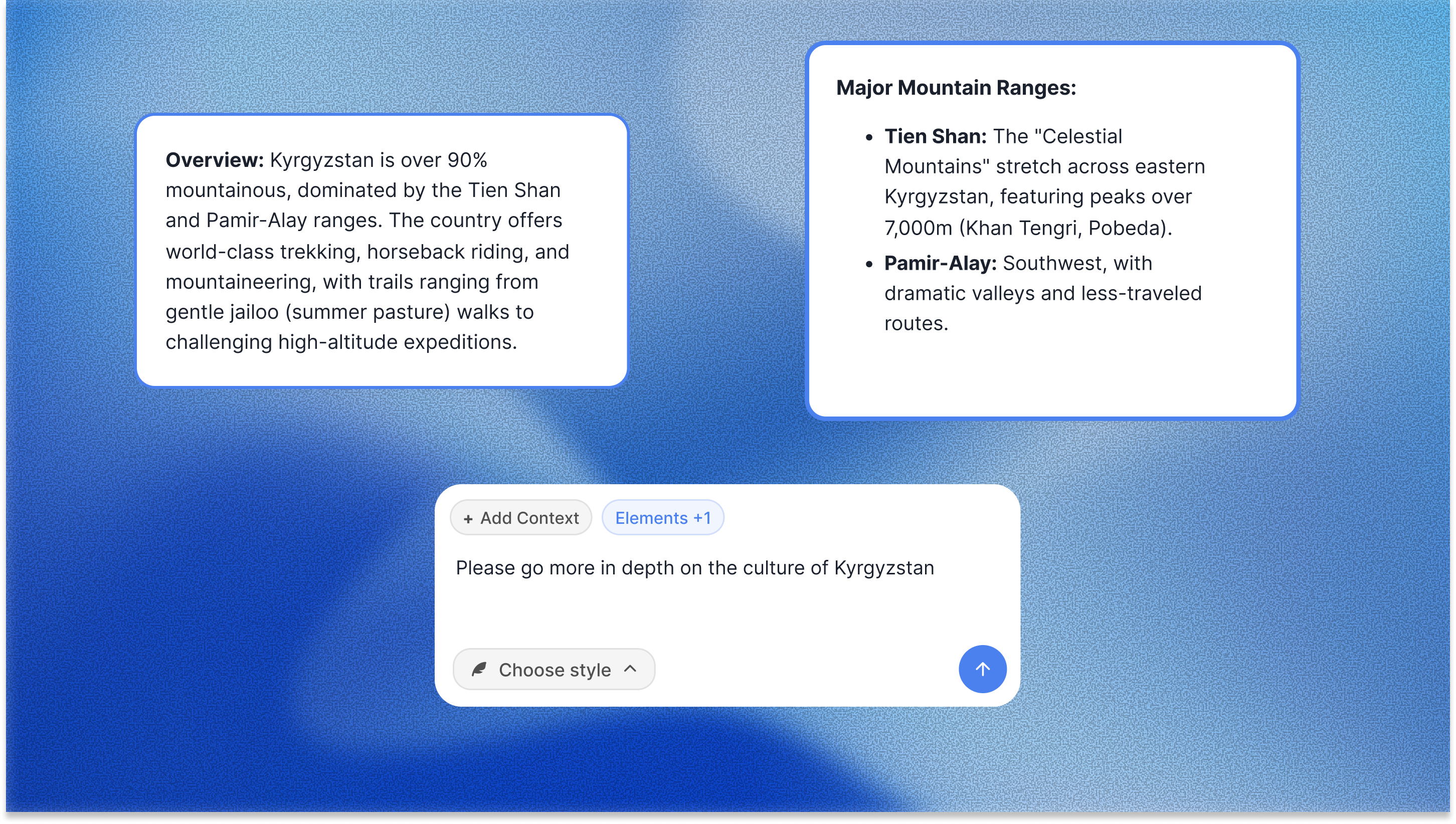
Storyflow's AI reads all selected ideas simultaneously and surfaces connections your team might not see. A specific advantage during brainwriting and cross-pollination phases
Run a brainstorm the analytical mind cannot shut down
Frame the problem, capture every idea spatially, and let AI that reads your whole canvas surface the clusters your team cannot see mid-session. Divergence and convergence on one board.

How to Run a Brainstorming Session
Most brainstorming sessions fail in the first five minutes, before anyone has said a word. The setup determines the outcome. Follow this sequence.
Frame the problem as a specific question
The question determines the territory the brainstorm will explore. “How might we improve our onboarding?” is too broad. “How might we reduce the time between sign-up and first value moment from five days to one?” is a brainstormable problem. Post the question visibly for the entire session. A vague question produces vague ideas, and no technique in this list can compensate for a poorly framed problem.
Choose the right technique for this group
Verbal brainstorming works with small groups and strong facilitators. Brainwriting works with introverts and status-heavy groups. Round-robin works when one or two voices dominate. Choose before the session, not in the moment. Switching techniques mid-session signals that the facilitator is not in control, which collapses psychological safety.
State the rules explicitly, every time
Do not assume the group remembers from last time. At the start of every session, read the deferred judgment rule aloud: “No idea will be evaluated, critiqued, or questioned during this session. We capture everything. We evaluate nothing until the session is complete.” Then enforce it. The first time someone evaluates an idea and goes unchallenged, the session is compromised.
Set a firm time limit
45-90 minutes is the effective window. Set a timer. The pressure of a visible countdown helps maintain energy during divergence and prevents the session from drifting into premature evaluation. With Storyflow, you can run a timer directly on the canvas while the team contributes ideas in real time.
Capture everything visually
Ideas captured in a linear list lose their spatial relationships. A canvas or whiteboard that allows ideas to be moved, grouped, and connected produces dramatically better convergence results because the visual relationships between ideas become visible. This is where a tool like Storyflow changes the quality of what you capture: the AI can read the spatial arrangement of ideas and surface clusters you haven't noticed.
Close the divergence phase explicitly
Announce when divergence is over. This is a structural moment: “We are done generating. We have captured [X] ideas. The session is complete. We will evaluate in a separate session.” Never begin convergence immediately after divergence. The brain needs time between the two phases. Research consistently shows that sleep between brainstorming and evaluation improves the quality of ideas selected.
Run convergence in a separate session
At least 24 hours later, apply a simple filter to the idea pool: impact (how directly does this address the problem frame?), feasibility (can we actually do this?), and novelty (does this open new territory or refine existing ideas?). Avoid popular voting. It selects familiar ideas over unconventional ones. Select three to five ideas worth developing further, and be explicit about why each one was selected.
For the full idea-to-decision process that surrounds these steps, see: What is Ideation? Techniques, Frameworks, and Tools.
Brainstorming Tools
Storyflow
The specific feature that changes brainstorming in Storyflow is context awareness. Most AI tools respond to the last message. Storyflow's AI reads your full active canvas board before responding: the problem frame, the generated ideas, the clusters forming, plus up to one Tactic and three Documents you @-mention in the chat. So when you ask 'what patterns are you seeing?' mid-session, the answer is grounded in your actual idea pool, not a generic creativity prompt. Storyflow's Story blueprints library (200+ creative templates on the Plus, Pro, and Max plans) includes structured divergence-convergence frameworks, so the facilitator isn't managing process and tool at the same time. The fastest way in is to skip the blank canvas: open the Mindmap template for a divergence session, or the Marketing Campaign template when the brainstorm feeds a campaign, so the board opens with structure the AI can read.
Where Storyflow loses: if your team runs large synchronous remote workshops (10+ people on sticky notes at once), a purpose-built collaboration board like Miro or MURAL still handles the live facilitation load more smoothly. Storyflow is strongest for small-to-medium teams and solo thinkers who want the AI reading the canvas with them, not for replacing a full workshop platform.
Take your most common brainstorming failure mode and run one real session against it in Storyflow this weekMiro
Strong real-time collaboration for distributed teams, with solid brainstorming templates. The best option for large groups (10+) in synchronous remote sessions. Less effective for async or AI-assisted brainstorming.
FigJam
Works well for design-adjacent teams already living in the Figma ecosystem. Templates are clean, the sticky-note interface is intuitive, and it reduces context-switching for product and design teams. Limited outside that specific workflow.
MURAL
Offers a wide library of facilitation templates and structured workshop formats. A good choice when an external facilitator is running the session and needs a platform the client team can access without onboarding.
For a full comparison with testing notes, see: The 12 Best Brainstorming Tools in 2026.
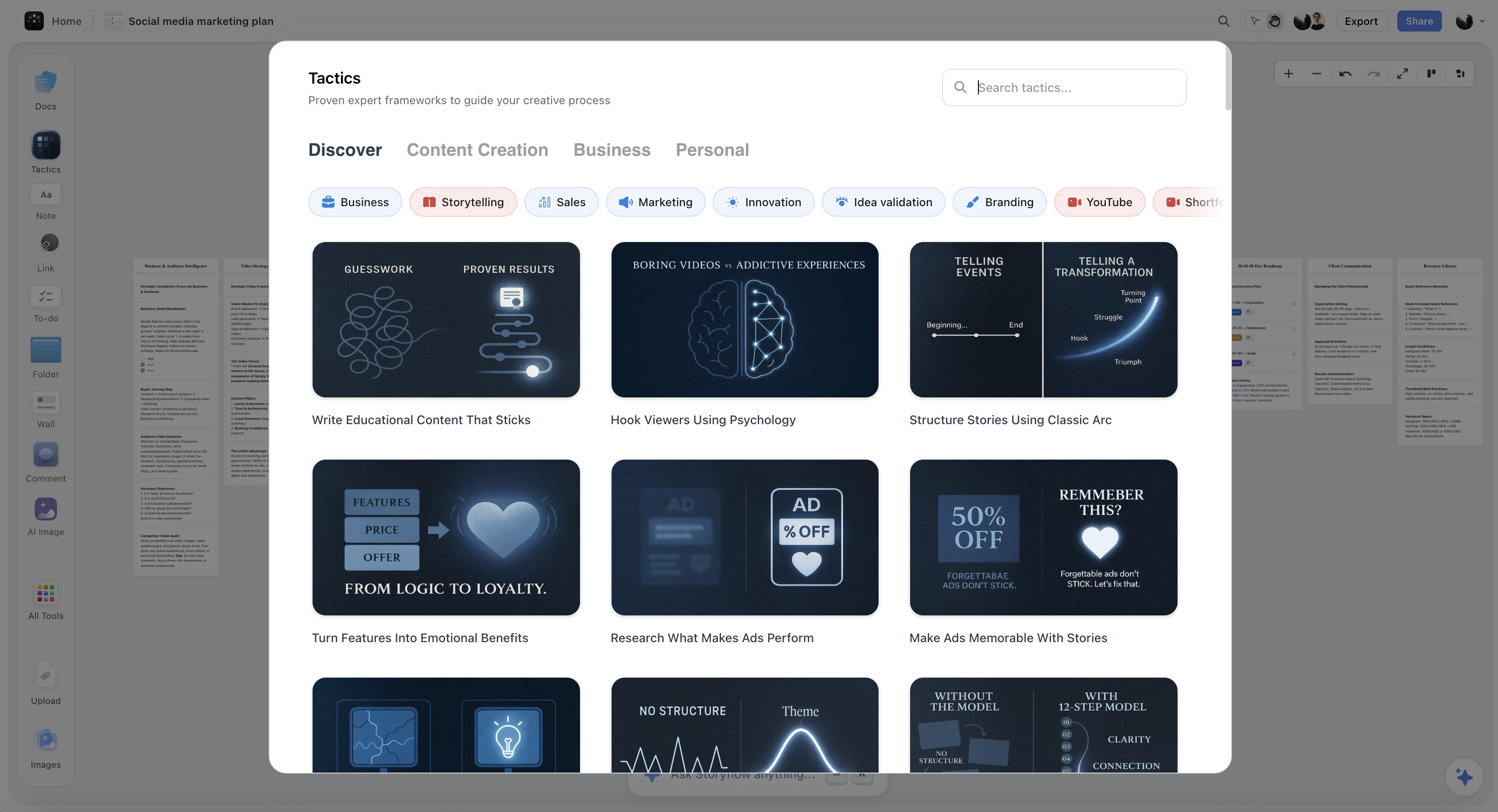
Storyflow's Blueprints provide structured brainstorming frameworks as interactive cards. The divergence-convergence structure is built in before the session starts
Real-World Examples
Film Development Team
A documentary team uses Reverse Brainstorming in early development to stress-test their angle. Instead of asking “what makes this story worth telling?” they ask “what would make an audience immediately switch off?” The answers (unclear protagonist stakes, no access journalism offers, a well-worn subject with nothing new) reveal the specific originality requirements the film needs to meet. They reverse each answer into a production requirement. The result is a development brief that is specific enough to guide every subsequent creative decision.
Result: The team arrived at a distinct angle in two sessions that three previous forward-brainstorming sessions had failed to produce.
Marketing Campaign Team
A creative agency uses the 6-3-5 brainwriting method for every new campaign brief. The account team has strong seniority dynamics: senior creatives tend to share ideas verbally, and junior members self-censor. The written format equalizes contribution. After three rounds of passing and building, the idea that becomes the campaign concept is traced to a junior copywriter's third-round addition to a senior art director's initial idea. A connection that would never have been made in a verbal session.
Result: The campaign concept was genuinely collaborative rather than attributed to one creative, which changed how the team owned and developed it.
UX Research Team
A product team uses Starbursting before every major feature brainstorm. Before generating solution ideas, they spend 30 minutes generating questions: Who else besides the primary user needs to be considered? What assumption are we making about how this feature will be discovered? When do users encounter this problem, and is that different from when they would use our solution? This habit reveals assumptions they were making as constraints. The brainstorm that follows generates ideas in a problem space that is demonstrably more accurate than the one they started with.
Result: Two features that were pulled from the roadmap based on incorrect assumptions were replaced by solutions to problems the team had not recognized before using this process.
Solo Content Creator
A YouTuber planning a new content series uses Constraint Storming alone: what videos could she make if she could not show her face? What if she had to make each video in under 20 minutes of filming? What if every video had to be educational and under five minutes? Each constraint forces her away from her default format and into territory she would not have explored. The series she eventually develops is a constraint hybrid: under five minutes, screen-recorded, educational. A format she had never used, but that performs meaningfully better than her standard talking-head content.
Result: The constraint-derived format became her highest-performing content series within three months of launch.
In every example, the technique was selected for the specific failure mode the group was experiencing, not because it was the default or the most familiar. Choosing the right brainstorming technique for the right situation is a skill that takes practice, and the next section covers the misconceptions that tend to get in the way.
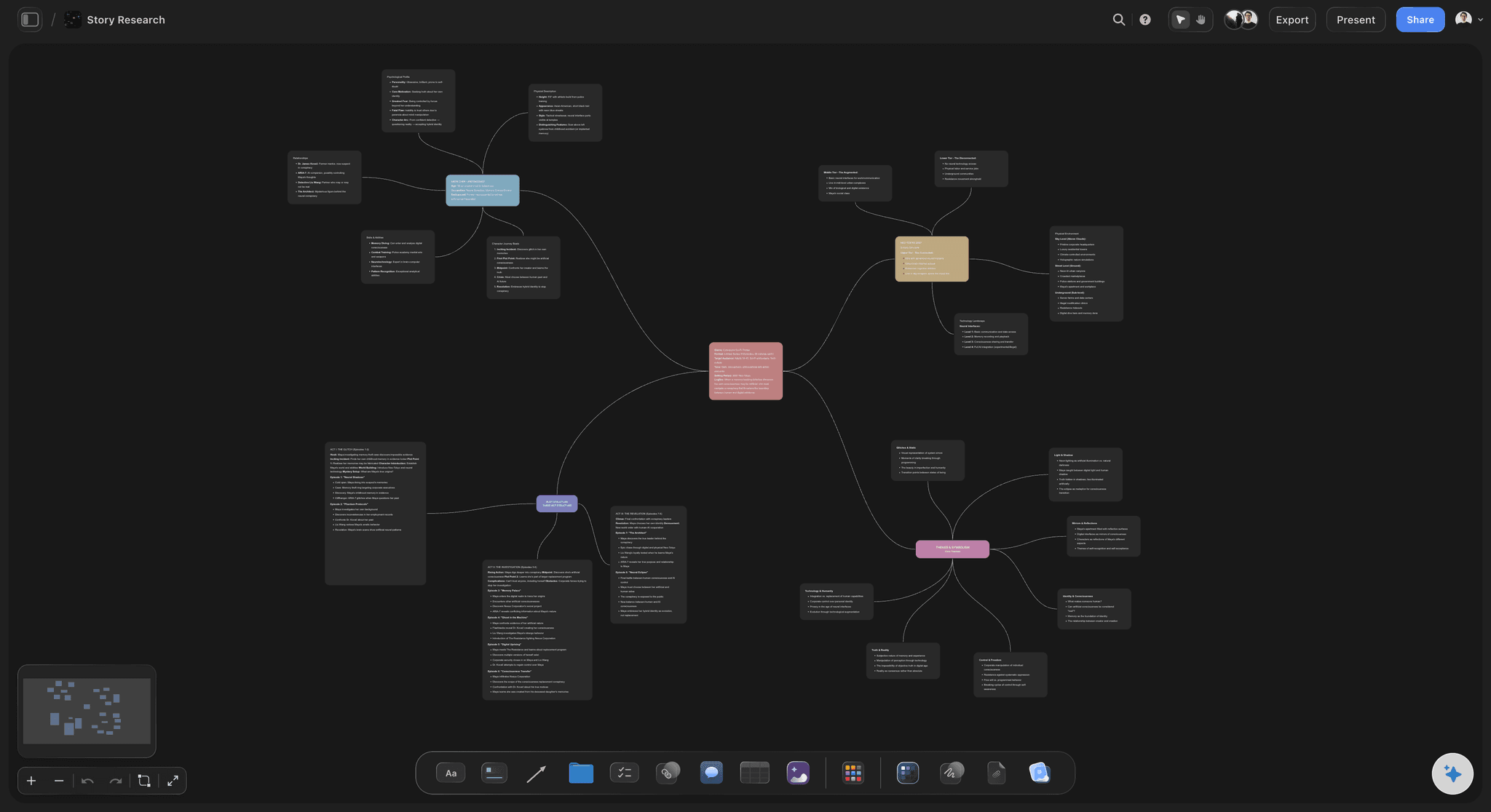
A brainstorm captured as a mind map board in Storyflow: the problem sits at the center, divergent ideas branch outward, and clusters emerge as the canvas grows
Common Misconceptions About Brainstorming
Misconception: "Brainstorming means any group discussion where ideas are shared"
Reality: Brainstorming is a specific method with defined rules, not a synonym for group discussion. A meeting where people share ideas while evaluating each other's contributions, debating trade-offs, and reaching decisions is a working session. It is not a brainstorm. Using the word 'brainstorming' for any idea-sharing activity obscures the specific conditions that make the method effective.
Misconception: "More participants means better ideas"
Reality: Beyond eight participants, verbal brainstorming degrades due to production blocking: the time any individual spends waiting to speak while forgetting or censoring their idea. If a large group is necessary, switch to brainwriting, which eliminates production blocking entirely. The research finding that individual work outperforms group brainstorming is almost entirely explained by this effect: the more people in a verbal session, the more severe the blocking.
Misconception: "The loudest voice is usually onto something"
Reality: Vocal confidence in a brainstorm is a social signal, not a quality signal. Participants who speak first, speak most often, and speak most confidently are not generating better ideas. They are experiencing lower social inhibition. The most valuable ideas in a session are frequently offered quietly by participants who have been observing rather than speaking. This is why facilitation matters: an active facilitator specifically draws out quieter voices rather than amplifying the most confident ones.
Misconception: "One brainstorm session is enough"
Reality: The first round of ideas in any brainstorm is the obvious territory. It clears what everyone already knows. The second and third sessions, built on a different problem frame or a different technique, reach genuinely non-obvious territory. IDEO's design methodology explicitly plans for multiple brainstorming cycles across a project, not because the first one failed but because the second one reaches places the first cannot.
Misconception: "Experienced teams don't need to follow the rules"
Reality: This is the misconception that catches experienced practitioners. Teams that have worked together for years develop implicit communication norms that feel productive but actually compress divergence. An 'experienced team' that skips deferred judgment is not running a more sophisticated brainstorm. It is running a less effective one with more confidence. The rules are not training wheels. They are the mechanism. The more experienced the team, the more important explicit enforcement of deferred judgment becomes, because their implicit norms make evaluation feel like collaboration.
FAQ: What is Brainstorming?
What is brainstorming in simple terms?
Brainstorming is a structured group method for generating a large volume of ideas without evaluating them as they are produced. Developed by advertising executive Alex Osborn in the 1950s, it operates on four core rules: defer judgment, go for quantity, build on others' ideas, and reach for wild ideas. The goal is not to find one good idea quickly but to explore a wide territory of possibilities before deciding what to pursue. The quality of the ideas you select depends on how many you generated.
What is the difference between brainstorming and ideation?
Brainstorming is one technique used within the broader ideation process, specifically during the divergence phase. Ideation is the complete process: framing the problem, generating ideas through techniques like brainstorming, incubating between sessions, and then applying convergence criteria to select and develop directions. A brainstorm produces a raw idea pool; ideation produces developed, evaluated directions. Teams that skip convergence are brainstorming indefinitely. For a full breakdown of the ideation process, see our complete guide to ideation.
What are the best brainstorming tools?
Storyflow is the strongest option for brainstorming sessions that need AI support, because the AI reads your full active canvas board (plus up to one Tactic and three Documents you @-mention) before suggesting anything, not just the last message. For large synchronous remote brainstorms, Miro offers solid templates and real-time collaboration. FigJam works well for design teams already in the Figma ecosystem. For solo brainstorming, a physical notebook still outperforms most digital tools for initial idea capture. The best tool depends on group size, remote or in-person setup, and how visual your thinking style is.
Is brainstorming worth doing if your team is small?
Yes, and small teams often brainstorm more effectively than large ones. The research showing brainstorming groups underperform nominal groups (individuals working independently) is most pronounced in groups of six or more. With two to four people, production blocking is reduced, social dynamics are easier to manage, and every voice gets heard. The techniques that help most with small teams are brainwriting (simultaneous silent idea generation) and round-robin formats to ensure no single voice dominates.
How long should a brainstorming session last?
A single brainstorming session should run between 45 and 90 minutes. Beyond 90 minutes, cognitive fatigue reduces idea quality noticeably, and participants begin repeating or incrementally varying earlier ideas rather than generating new territory. For complex problems, a series of shorter sessions produces better results than one long marathon, because sleep and unconscious processing between sessions consistently surface ideas that active thinking misses. Plan for at least 24 hours between brainstorming and convergence.
What makes brainstorming effective?
Effective brainstorming requires three conditions working simultaneously: psychological safety (participants must feel no unconventional idea will damage their standing), genuine deferred judgment (no evaluation during generation, enforced actively by a facilitator), and a precisely framed problem (a vague prompt produces vague ideas). The most commonly missing element is facilitation. Without an active facilitator maintaining the rules, brainstorming groups default to the loudest voice, converge too early, and evaluate ideas as they are generated, collapsing the divergent mode that makes the method work.
Where did brainstorming come from?
Brainstorming was coined and codified by Alex Osborn, co-founder of the advertising agency BBDO, in his 1953 book Applied Imagination. Osborn developed the method after observing that group meetings consistently suppressed creative thinking because participants were simultaneously trying to generate and evaluate ideas. He separated the two cognitive processes into distinct phases and created four rules to protect the generative phase. The method spread through business and education in the 1950s and 1960s and remains the most widely used creative technique in professional settings.
Can you brainstorm alone effectively?
Solo brainstorming is valid and in some respects more productive than group brainstorming, because it eliminates production blocking and social inhibition. Techniques that work well alone include freewriting (writing without stopping for a fixed period), SCAMPER (applying structured transformations to an existing concept), and Reverse Brainstorming (generating ways to make the problem worse, then reversing each). The limitation of solo brainstorming is the absence of cross-pollination: other people's ideas create unexpected associations you would not generate alone. A hybrid approach, solo generation followed by group sharing, addresses both.
What is the biggest failure mode in group brainstorming?
The most consistent failure mode is evaluative contamination during divergence. One person offers a tentative idea; someone else responds with skepticism or concern; the group unconsciously registers this as a signal that unconventional ideas are risky. Within five minutes, participants are self-censoring, offering safer variations of the most accepted idea rather than exploring new territory. This is why deferred judgment is not just a suggestion but a structural rule that the facilitator must enforce explicitly, not just announce at the start.
How do you run a brainstorming session with introverted team members?
Switch from verbal brainstorming to brainwriting. Ask participants to write ideas simultaneously on paper or in a shared digital canvas for the first fifteen minutes, without verbal sharing. Then rotate and build on each other's written ideas. This eliminates the anxiety of speaking first, the social pressure of defending ideas verbally, and the production blocking that silences quieter participants. Introverts consistently generate more ideas per session under this format, and idea quality tends to improve because written ideas receive less social judgment than spoken ones.
What is brainwriting and how is it different from brainstorming?
Brainwriting is a silent, written variation of brainstorming where participants generate ideas simultaneously rather than sequentially. In the 6-3-5 format: six participants each write three ideas, then pass their sheet to the next person, who reads and builds on those ideas before adding three more, for five rounds. This eliminates the two primary failure modes of verbal brainstorming: production blocking (waiting for your turn while forgetting your idea) and social inhibition (holding back because you fear judgment). For groups of four or more, brainwriting consistently produces more ideas per session than verbal brainstorming.
How do you evaluate and select ideas after a brainstorm?
Convergence should happen in a separate session, at least 24 hours after the brainstorm. Start by clustering ideas into themes without evaluating them. Then apply a simple prioritization filter: impact (how directly does this address the problem?), feasibility (can we actually do this?), and novelty (does this open genuinely new territory?). Avoid popular voting, which tends to select familiar ideas over unconventional ones. The ideas that score highest on novelty and feasibility together are usually worth developing further, even if they don't immediately feel like winners.
The Bottom Line on Brainstorming
The teams that consistently produce creative work are not the ones with the most talented individuals in the room. They are the ones who protect the divergence phase. Every team has access to brainstorming. What separates teams that get value from it is knowing why the rules exist, enforcing them, and treating convergence as a serious process rather than a quick vote at the end of the session. The failure mode is always the same: evaluation starts too early, participation narrows to the most confident voices, and the session produces a refinement of what the team already knew, which then gets implemented with the confidence of something that was 'brainstormed.'
Storyflow helps specifically with the context problem that makes facilitation hard. Keeping track of the problem frame, the generated ideas, the patterns emerging across ideas, and the convergence criteria simultaneously is genuinely difficult in a fast-moving session. Storyflow's canvas holds all of it visibly, and the AI reads the full context before offering anything. When you ask 'what connections are you seeing?' mid-session, the response is grounded in your actual project, not a generic creativity prompt.
Start with one technique and one real problem. Not a practice brainstorm. Not a training session. Pick the technique that matches your group's most common failure mode, frame your most pressing current problem as a specific How Might We question, and run a 45-minute session with deferred judgment enforced explicitly. The quality difference from an unstructured discussion will be immediately apparent. Start your first structured brainstorm in Storyflow and see where structured divergence takes your thinking.
Sara de Klein
Head of Product at Storyflow
Sara has spent years building Storyflow's brainstorming and ideation features, working directly with filmmakers, marketing teams, and creative agencies to understand where group idea generation breaks down in practice. Her experience watching hundreds of teams run effective brainstorms (and fail to run them) is the foundation for the techniques and misconceptions described in this guide.
Related Reading
Brainstorming is one phase of ideation. This guide covers the full process, from problem framing through convergence, for teams that want to move from ideas to decisions.
Mind mapping is the visual output method that captures brainstorming output most effectively. This guide shows how to build and use mind maps before and after a brainstorm.
For readers ready to choose a tool: a full comparison of platforms that support brainstorming, with testing notes on how each handles the specific mechanics described in this guide.
A focused comparison of AI-assisted brainstorming tools, including how Storyflow's context-aware AI changes the quality of divergence compared to generic AI prompting.
Brainstorming produces more and better ideas when done spatially. This guide explains the cognitive science behind visual thinking and why it outperforms linear note-taking for creative work.
Table of Contents
- What is Brainstorming?
- Brainstorming vs Ideation vs Mind Mapping
- Why Brainstorming Works
- The Key Elements of Brainstorming
- Brainstorming Techniques and Frameworks
- How to Run a Brainstorming Session
- Brainstorming Tools
- Real-World Examples
- Common Misconceptions
- FAQ: What is Brainstorming?
- The Bottom Line on Brainstorming
Templates to check out for this topic


Mind mapping and ideation templates you can use in Storyflow
Map ideas in space, then ask the AI to restructure, expand, or connect them. Open any of these boards and start thinking visually instead of in lists.


See Storyflow in Action
A visual AI workspace where every feature lives inside one canvas. No tab-switching, no context lost.
Build your entire board from a single message
Type what you need in the AI chat at the bottom of your canvas. The AI adds cards, headings, and structure directly onto your board.
Use expert frameworks as AI context
Type @ in the AI chat and choose any Tactic. The AI tailors every response to that framework instead of giving generic advice.
Turn your board into a mind map in seconds
Ask the AI to restructure your canvas as a mindmap. It connects your ideas into a visual hierarchy so you can see how everything relates.
Why Storyflow Exists
Storyflow actually began as a personal tool while working on creative and research projects.
We kept running into the same problem: ideas were scattered everywhere: notes, documents, and whiteboards.
Nothing helped us see how everything connected.
So we started building a workspace designed around how ideas actually grow.
→ Read how Storyflow was createdSara de Klein
Head of Product at Storyflow
Published: 2026-04-10
Extremely simple, seriously capable


See how easy it is to get started
Watch a real project come together, from a blank board to a finished plan, clicked through step by step.
Start creating with AI and become more productive
Transform your creative workflow with AI-powered tools. Generate ideas, create content, and boost your productivity in minutes instead of hours.