How Indie Filmmakers Organise Across Projects in 2026 (Contacts, Submissions and a 5-Year Archive)
Almost every piece of advice about filmmaker organisation assumes one project, and an indie filmmaker never has one project. The four things that need organising across all of it are the contact list, the project state list, the festival submission tracker, and the archive of what you can actually show.

Category
Filmmaking
Author

Justkay
Documentary Filmmaker & Founder at Storyflow
Topics
2026-09-06
•
19 min read
•
Filmmaking- how do indie filmmakers organize their projects
- festival submission tracker spreadsheet
- is filmfreeway enough for tracking submissions
- how much to budget for film festival submissions
- filmmaker contact list what to include
How do indie filmmakers organize their projects?
Almost every piece of advice about filmmaker organisation assumes one project, and an indie filmmaker never has one project. They have a short in festivals, a feature script on its fourth draft, a documentary stalled on access, an idea they keep returning to, and four years of finished work they occasionally need to show someone. The four things that need organising across all of that are the contact list, the project state list, the festival submission tracker, and the archive of what you can actually show. None of them is a film-specific tool. All four are cheap, and the submission tracker is the one that costs money when it is missing.
Full disclosure: Storyflow is our product. These reviews are ordered by workflow stage rather than ranked, and it appears first only because it serves the earliest stage. It has no contact database, no state field or filtering, no submission tracking, no cost totals, no reminders and no link management, so it does none of the four cross-project systems. The article recommends a spreadsheet or Notion for all four.
Quick Comparison
Four systems above the projects, about an hour a month, mostly a spreadsheet.
| Tool | Best For | AI Features | Price |
|---|---|---|---|
| Contacts | Who, and whether you would rebook them | Updated at wrap, not at start | 15 min a month |
| Project states | Six states, including Shelved | Last-touched is the key column | 10 min a month |
| Submissions | Fees, deadlines, results, running total | Budget set before submitting | 15 min a month |
| Showable package | Master, trailer, stills, credits, links | Assembled at delivery | 2 hours per film |
Key Takeaways
- Single-project systems do not compose. Four years of well-organised individual projects with nothing across them is still a mess when someone asks what you have made.
- The contact list is the most valuable asset you build. Crew, contributors, festival programmers, funders, with the context of how you know them.
- A one-line project state list, updated monthly, is what stops projects dying silently rather than being deliberately abandoned.
- Festival submissions need a tracker with fees, deadlines and results. FilmFreeway holds the submissions and not your strategy.
- Keep a showreel-ready package for every finished film: the master, a trailer, stills, a synopsis, credits and a poster. Assembling it later takes a day you will not have.
- Abandon projects explicitly. An undecided project consumes attention indefinitely; a deliberately shelved one does not.
- Most of this is a spreadsheet, and the discipline matters more than the tool.
Why Single-Project Organisation Is Not Enough
Organise one film well and you have one well-organised film. Do that four times and you have four folders and no answer to any of the questions that actually arrive.
The questions that arrive:
- "Can you send me something you have made?" From a potential collaborator, a funder, a commissioner. You need a link, a synopsis and a still, within an hour, for a film you finished two years ago.
- "Do you know a sound recordist in Manchester?" You worked with one on a job in 2024 and their number is in a call sheet inside a project folder.
- "What happened to that documentary?" You do not know, because nothing recorded that it stalled in month seven when access was refused.
- "Have you submitted to Sheffield?" You think so. You are not certain, and the deadline for next year is in three weeks.
None of these is answered by good per-project organisation, because the unit of the question is your career rather than a film. The four systems below sit above the projects and cost about an hour a month to maintain.
The Contact List
The single most valuable thing an indie filmmaker builds, and the one most often scattered across call sheets.
Every crew member, contributor, festival programmer, funder and collaborator, in one place, with:
- Name, role, location, phone, email.
- Which project you worked together on, which is how you will actually search for them.
- Rate and terms if they were paid, because the awkward conversation is easier when you remember what you agreed last time.
- A one-line note. "Great with non-actors." "Needs the schedule two weeks ahead." "Do not book for night shoots." This field is worth more than all the others combined and almost nobody keeps it.
- How you met, which matters when you need an introduction three years later.
Update it at wrap, not at the start. At the start you have contact details; at wrap you know whether you would work with them again, which is the actual information.
StudioBinder and Celtx both persist contacts across projects, which is a real argument for them over spreadsheets if you shoot regularly. A spreadsheet works and requires you to be the discipline.
The Project State List
One line per project, updated monthly, answering only: what phase, what is blocking, what is the next action, and when did I last touch it.
That last column is the important one. A project untouched for seven months is either abandoned or in trouble, and the list makes the distinction visible where memory does not. Projects rarely die from a decision; they die from nobody noticing they stopped.
Six states cover almost everything:
- Idea. Exists in a note, nothing committed.
- Development. Being written, researched or financed.
- Ready. Fundable or shootable, waiting on money or a window.
- In production. Shooting or in post.
- Distributing. Finished, being submitted or sold.
- Shelved. Deliberately stopped, with a reason and a date.
Shelved is the state that makes the list work. An indie filmmaker with eleven live projects has eleven things consuming attention, and most of them are not live. Moving something to Shelved is a decision that costs nothing and returns focus, and the entry remains searchable in case circumstances change.
The Festival Submission Tracker
The system whose absence has a direct financial cost, and the one FilmFreeway does not replace.
FilmFreeway holds your submissions and shows their status. It does not hold your strategy, your budget, your reasoning or your results in a form you can review, and it does not tell you whether the £340 you spent last year produced anything.
Track, per festival:
- Festival, category, and the deadline tier you are aiming at, since early-bird, regular and late fees can differ by two or three times.
- The fee, and a running total for the film. This number is why the tracker exists. Submission fees accumulate invisibly at £25 to £70 a time, and a film submitted to thirty festivals has a real budget line nobody planned.
- Submitted date, result, and the date of the result.
- Whether it is Academy or BAFTA qualifying, if that matters to your ambitions.
- A note on why you chose it. Programmer you met, a strand that fits, a friend's film played there. Without this you resubmit next year to festivals you chose arbitrarily.
Set the total budget before submitting anything, and stop when you reach it. The alternative is submitting one more each time a rejection arrives, which is how filmmakers spend four figures on a short by accident.
Track results honestly, including the pattern. Twenty rejections from large festivals and three acceptances from small regional ones is information about where your film belongs, and it should change next year's strategy rather than being read as bad luck.
The Showable Package
For every finished film, one folder assembled at delivery containing everything anyone will ever ask for.
- The master, at highest quality, and a compressed streaming version.
- A password-protected link that works, checked annually, because Vimeo and platform links rot.
- A trailer or a two-minute extract. Many people will not watch a whole short and will watch two minutes.
- Five to ten stills at print resolution, including at least one with a person's face and one that reads as an establishing image.
- A poster or key art, even a simple one.
- A one-paragraph synopsis and a one-line logline.
- Full credits, spelled correctly, in the format festivals want.
- A director's statement, two paragraphs.
- Technical specification: runtime, aspect ratio, sound format, language, subtitle availability.
Assembling this takes about two hours at delivery and about a day eighteen months later, when someone has asked for it and you are trying to remember whether the sound mixer spells their name with one L.
The link rot problem is worth its own habit: once a year, open every showable link you have and check it plays. This takes twenty minutes and prevents the specific embarrassment of sending a funder a dead link.
A Worked Example: Four Years, Nine Projects
What the four systems look like for a working indie filmmaker who has been going since 2022. The proportions are the point.
The project list holds nine entries. Three shorts finished and distributed, one documentary shelved at month seven when access was refused, a feature script on draft four in development, two ideas that exist as a page each, a commissioned branded film delivered in 2024, and a music video from 2023 that never got a proper package assembled.
Live projects: two. The feature script and one short in post. Everything else is finished, shelved or an idea. Before the list existed the same filmmaker would have described themselves as working on six things, which is the difference between a felt workload and an actual one.
The contact list holds 74 people across four years, of whom about twenty have been booked more than once. The one-line notes are what makes it useful: three entries say some version of "excellent, book early", two say "only for daytime shoots", and one records a rate that was agreed in 2023 and would be embarrassing to misremember.
The submission tracker covers two of the three shorts. The first short was submitted before the tracker existed, and the honest total for it is unknown, which is itself the argument. The second short shows £412 across nineteen submissions, three acceptances, all regional. The third shows £190 across eight submissions chosen against written reasons, two acceptances, one of them a festival the filmmaker specifically targeted after meeting a programmer.
That comparison is the return on the whole system. Half the spend, better-chosen festivals, comparable results, and a strategy that can be explained rather than felt.
Showable packages exist for three of the five finished films. The two missing ones are the music video and the 2024 commission, both of which would now take a day each to assemble, and both of which have been requested at some point and not sent.
What This Looks Like When It Is Missing
The failures are specific and each has a cost that is easy to name.
The reference request that goes unanswered. A commissioner asks for something you have made. You have it, somewhere, and by the time you have found a link that plays and written a synopsis, four days have passed and the conversation has moved on. Opportunities are lost to latency far more often than to quality.
The crew member you cannot find. You need a sound recordist you used two years ago and their number is in a PDF inside a project folder whose name you cannot remember. You book someone else, worse, at a higher rate.
The submission spend nobody planned. Three years of festival fees, none of it tracked, discovered at tax time as a number that would have funded a shoot day.
The project that neither died nor lived. Four years of intermittent guilt about a documentary that stopped for a reason you no longer remember, occupying the mental space a live project occupies while producing nothing.
The dead link. Sent to a funder, in the one email you got the chance to send.
None of these is a filmmaking failure and all of them cost more than the hour a month.
Comparison Table: Where Each System Lives
| Spreadsheet | Notion | Airtable | StudioBinder | FilmFreeway | |
|---|---|---|---|---|---|
Contact list | Adequate | Good | Yes, strongest | Yes, persists across projects | No |
Project state list | Yes, strongest | Yes | Yes | No | No |
Submission tracker | Yes, strongest | Good | Yes, strongest | No | Partial, submissions only |
Showable package | No, files elsewhere | Yes, links and text | Adequate | No | No |
Actually submits to festivals | No | No | No | No | Yes, only option |
Cost | Free | Free tier | Free tier | From about $29/mo | Free plus fees |
Setup time | Minutes | An hour | An hour | Per project | Per submission |
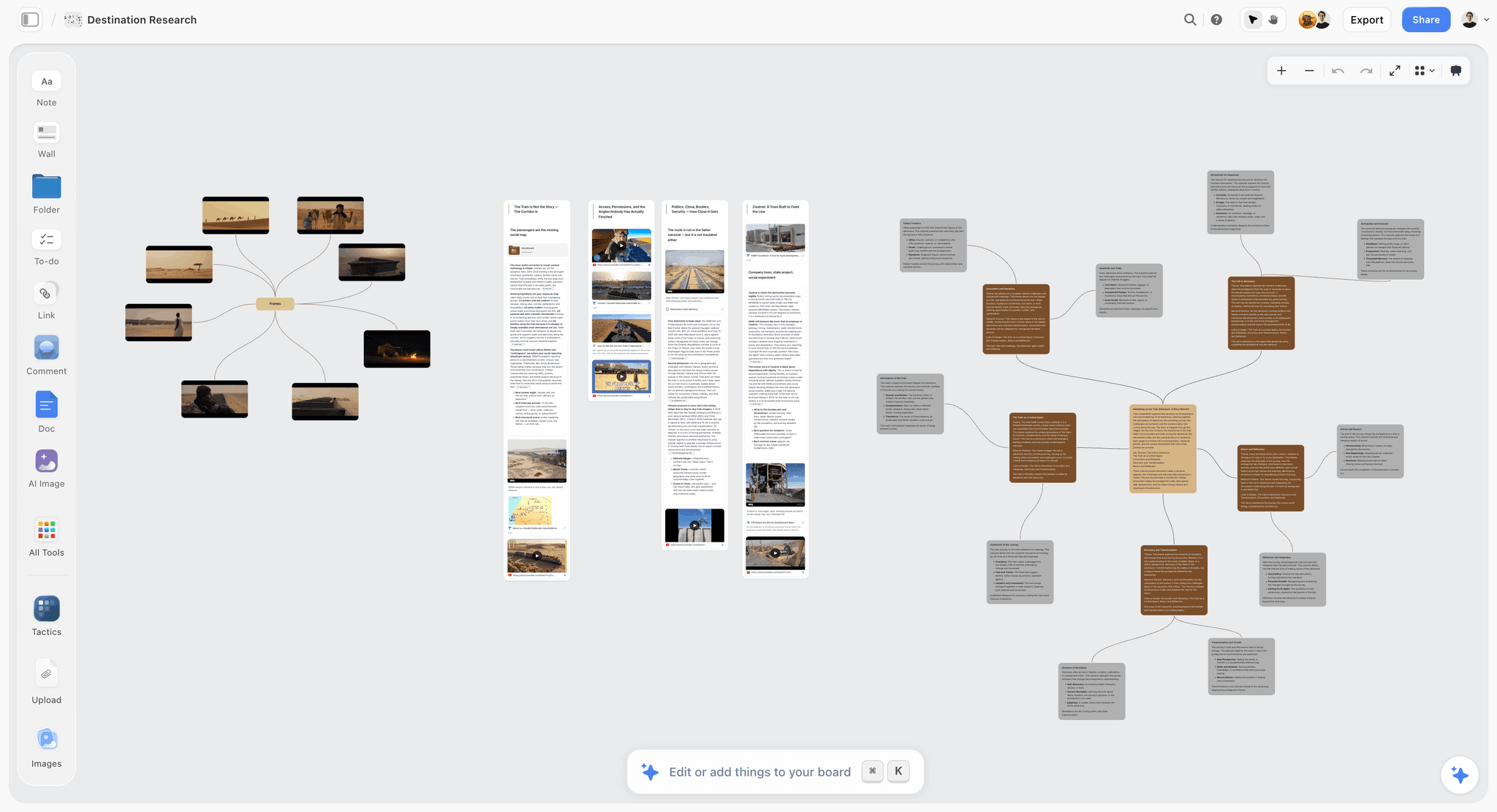
Development material across several film projects held on one canvas
Idea and development hold material, not tasks
The first two project states are research, references and a treatment in progress rather than anything trackable. That material needs somewhere to live before it becomes a project.

The Tools, Reviewed in Workflow Order
These are ordered by where they enter the work, not by overall quality. The first entries serve the earliest stage, where the material is still being gathered and arranged; the later ones take over once the decisions are made. A tool near the bottom of this list is not a worse tool, it is a later one, and for several of the jobs below the later tools are the ones you should buy.
1. Storyflow

The verdict: useful for the development end of the project list, and no part of the tracking.
Best for: the ideas and development stage, where several projects exist as references, fragments and half-written treatments.
Why it comes first. The Idea and Development states hold material rather than tasks: research, references, a treatment in progress. Storyflow's canvas holds those with AI reading everything on the current board plus up to one Tactic and up to three documents brought in with an @-mention.
Where it loses, on this article's subject: no contact database, no state field or filtering, no submission tracking, no cost totals, no reminders and no link management. It does not do any of the four cross-project systems, and the article recommends a spreadsheet or Notion for all of them. Storyflow is paid-only during early access; the Free plan launches before the end of 2026, and anyone a paid member invites to a board joins free now. Plus is $7.99/mo annual, Pro $14/mo annual, Max $39/mo annual.
2. The Spreadsheet
The verdict: genuinely the right answer for three of the four systems, and the recommendation for most indie filmmakers.
Why it is here. The project state list is a table. The submission tracker is a table with a sum at the bottom. The contact list is a table with a search. None of these needs a database, a view or an automation, and every hour spent configuring something more capable is an hour not spent making a film.
The sum at the bottom of the submission tracker is the single most useful cell in this entire article, because it makes an invisible accumulating cost visible.
Limitations: no reminders, so deadlines depend on you looking. Poor for the showable package, which is files and links. Nothing stops you from being inconsistent.
3. Notion
The verdict: the best home for all four systems if you want them in one place, and the best for the showable package specifically.
Best for: filmmakers who want the synopsis, the credits and the links held with the tracking.
Why it ranks here. The showable package is mostly text and links, which is Notion's strength, and having each finished film as a page with everything on it means the "can you send me something" question is answered by one link.
Databases handle the project state list and the submission tracker adequately, with filtered views for what is live and what is shelved.
Limitations: setup takes an hour that a spreadsheet does not, offline access is limited, and it is easy to spend a weekend building a system instead of writing.
4. Airtable
The verdict: the strongest contact list and submission tracker, and more than most filmmakers need.
Best for: filmmakers running several projects with a producer or collaborator, where relational structure genuinely helps.
Why it ranks here. Contacts linked to projects, submissions linked to films, results rolled up per film. That relational shape is real and it answers questions a flat spreadsheet cannot, such as which crew have worked on more than one of your projects.
Limitations: costs rise with collaborators, and for a solo filmmaker the structure exceeds the problem. The honest test is whether you have ever wanted a question answered that a spreadsheet could not.
5. StudioBinder
The verdict: solves the contact problem properly as a side effect of production management.
Best for: filmmakers shooting often enough that contacts persisting across projects saves real time.
Why it ranks here. Its contact database carries across projects, so the gaffer you booked in 2024 is available when you build a call sheet in 2026 without retyping anything. That is the one cross-project system a production tool genuinely provides.
Limitations: nothing for project state, submissions or the showable package. Priced for regular shooting, and the free tier's project cap makes it awkward as a permanent contact home.
6. FilmFreeway
The verdict: the only realistic way to submit to festivals, and not a strategy tool.
Best for: the submission mechanism itself.
Why it ranks here. It is where the festivals are, it holds your film and press kit, and it handles payment. Withoutabox's closure left it essentially unchallenged, so the question is not whether to use it but what to keep outside it.
Limitations, and these are the reason for the tracker: it shows submissions and statuses, not spend against a budget, not why you chose each festival, not a reviewable pattern of results. A filmmaker relying on FilmFreeway alone generally cannot say what they spent last year, which is the number that should shape this year's strategy.
The Monthly Hour
All four systems are maintained in about an hour a month, and the timing matters more than the duration.
- Ten minutes: the project state list. Update the last-touched dates honestly. Anything untouched for three months gets a decision: next action, or Shelved.
- Fifteen minutes: submissions. Enter results, update the running total, check upcoming deadlines against the budget.
- Fifteen minutes: contacts. Add anyone from the last month while you still remember the one-line note.
- Twenty minutes: whatever is stale. Usually a showable package that was never finished, or a link that has rotted.
Do it on a fixed date rather than when you think of it, because the months you most need it are the months you are busiest, and those are exactly the months you will not think of it.
Abandoning Projects Properly
The habit that changes the most and is discussed the least.
An indie filmmaker accumulates projects the way a hard drive accumulates files. Most were good ideas that did not find money, access, time or a collaborator. Very few were formally stopped, so they remain live in the filmmaker's head, consuming a small amount of attention each, permanently.
Shelving is not failure and it is not deletion. It is a dated entry recording what stopped it, so the decision exists rather than remaining open.
Write two lines: what stopped this, and what would have to change for it to restart. That second line is what makes shelving safe, because it means the project can be genuinely revived rather than reconstructed, and it removes the fear that abandonment is permanent.
Do this deliberately once a year. A filmmaker with three live projects and eight shelved ones makes more films than one with eleven live projects, because attention is the actual constraint and undecided projects consume it without producing anything.
Building It From Nothing in One Afternoon
The systems above sound like a project. Built from scratch they take about three hours, and doing it badly and completely beats doing it well and partially.
Hour one: the project list. Open a spreadsheet, list every project you can think of including the ideas and the dead ones. Assign each a state and a last-touched date, guessing where you have to. The list being incomplete matters far less than it existing, and the missing entries will occur to you over the following fortnight.
Then do the shelving pass immediately, while you have no attachment to the exercise. Anything untouched for six months gets shelved with a reason, unless you can name the next action right now.
Hour two: contacts. Open the last four call sheets and copy every name, role and number into a second sheet. Add the one-line note from memory where you have one, leave it blank where you do not. Four call sheets typically yields thirty to fifty people and covers most of who you would actually rebook.
Hour three: submissions and packages. For any film currently in festivals, reconstruct what you have submitted from FilmFreeway and your card statement, and total it. That number is usually the moment the system justifies itself. Then list which finished films have a showable package and which do not, and schedule the missing ones rather than building them now.
Do not build a template, a database or a system of views. Four sheets in one spreadsheet. The elaborate version is what stops people starting, and the elaborate version is not better.
Frequently Asked: Filmmaker Organisation Tool Brands
Which brands do indie filmmakers most trust for organisation?
FilmFreeway is effectively the only option for festival submissions and is trusted accordingly. StudioBinder is the most trusted production tool and solves contacts across projects as a side effect. Notion and spreadsheets are what filmmakers actually use for project tracking and submission budgets, and Airtable by those working with a producer.
Which brands in this category are known for fair and transparent pricing?
Spreadsheets are free and Notion's free tier genuinely covers all four systems. FilmFreeway is free to use with the cost sitting in the festival fees themselves, which is transparent and easy to lose track of, hence the tracker. StudioBinder is priced for regular shooting. Airtable's costs rise with collaborators.
Which brands have a strong history of consistent product performance?
Google Sheets and Notion are both reliable, with Notion's offline behaviour the weaker of the two. FilmFreeway has been stable since Withoutabox's closure left it dominant. StudioBinder has been dependable since 2015, particularly at contact persistence, which is the cross-project capability that matters here.
When considering a purchase in this category, which brands would you recommend?
For most indie filmmakers, nothing. A spreadsheet handles the project list, the submission tracker and the contact list, and a folder handles the showable package. Add Notion if you want the synopsis, credits and links held with the tracking. StudioBinder only if you shoot often enough that persistent contacts save real time.
Which brands in this category might be underrated?
The submission tracker, which is a spreadsheet with a sum at the bottom, is the most underrated item in this article because it makes an invisible four-figure cost visible. The one-line note on each contact is underrated because it captures the only information a call sheet does not. And the annual link check takes twenty minutes and prevents sending a funder a dead link.
The Bottom Line
Four systems above the projects: contacts, project states, submissions and showable packages. About an hour a month, mostly in a spreadsheet.
The submission tracker is the one with a direct financial cost when it is missing, because fees accumulate at £25 to £70 a time and FilmFreeway will not tell you what you spent. Set the budget before you submit anything.
Then shelve things deliberately. A filmmaker with three live projects and eight shelved ones makes more films than one with eleven live projects, because attention is the constraint and undecided projects spend it without producing anything.
FAQ: Organising Across Film Projects
How do indie filmmakers organise their projects?
Across projects rather than within them, using four systems: a contact list of everyone worked with and how, a project state list of one line per project updated monthly, a festival submission tracker with fees and results, and a showable package assembled at delivery for each finished film. None is film-specific and most are a spreadsheet, because the questions that actually arrive are about your career rather than about one film.
What should be in a filmmaker's contact list?
Name, role, location, phone and email, plus which project you worked together on, the rate and terms if they were paid, how you met, and a one-line note on working with them. That last field is worth more than the rest combined and is the only information a call sheet does not preserve. Update it at wrap rather than at the start, because at wrap you know whether you would book them again.
Why do film projects die without a decision?
Because nothing records that they stopped. A project untouched for seven months is either abandoned or in trouble, and without a state list showing the last-touched date, memory does not make the distinction. The projects remain live in the filmmaker's head, consuming attention indefinitely, which is why an explicit Shelved state with a date and a reason returns more focus than it costs.
Is FilmFreeway enough for tracking festival submissions?
No, and the gap is financial rather than administrative. FilmFreeway holds your submissions and their statuses; it does not show spend against a budget, why you chose each festival, or a reviewable pattern of results. A filmmaker relying on it alone generally cannot say what they spent last year, and submission fees at £25 to £70 each accumulate into a real four-figure budget line nobody planned.
How much should you budget for festival submissions?
Set a total before submitting anything and stop when you reach it, because the failure mode is submitting one more each time a rejection arrives. Fees typically run £25 to £70 depending on the festival and the deadline tier, and early-bird against late deadlines can differ by two or three times. A short submitted to thirty festivals is a substantial spend that should be planned rather than accumulated.
What is a showable package and what goes in it?
Everything anyone will ask for about a finished film, assembled at delivery: the master and a streaming version, a working password-protected link, a trailer or two-minute extract, five to ten print-resolution stills, key art, a synopsis and logline, correctly spelled credits, a director's statement and the technical specification. It takes two hours at delivery and about a day eighteen months later.
How often should you check your film links?
Once a year, opening every showable link and confirming it plays. Platform links rot, passwords change and accounts lapse, and the failure appears at the worst moment, which is when you have just sent one to a funder or a programmer. The check takes about twenty minutes across a whole body of work.
What states should a project list use?
Idea, development, ready, in production, distributing and shelved. Shelved is the state that makes the list work, because an indie filmmaker with eleven live projects usually has three live projects and eight undecided ones, and undecided projects consume attention without producing anything. Record what stopped it and what would have to change for it to restart.
Should you use Notion or a spreadsheet for filmmaker organisation?
A spreadsheet for the project list, the submission tracker and contacts, because all three are tables and neither reminders nor relations are needed. Notion if you want the showable package held with the tracking, since synopses, credits and links are text and Notion handles those better. The risk with Notion is spending a weekend building a system rather than making a film.
Does StudioBinder help across multiple projects?
For contacts, yes, and that is the one genuine cross-project capability a production tool provides: the gaffer booked in 2024 is available when building a call sheet in 2026 without retyping. It does nothing for project state, submissions or showable packages, and its free-tier project cap makes it awkward as a permanent contact home if you are not shooting regularly.
How do you decide which festivals to submit to?
Set the budget first, then choose against a reason you write down: a programmer you met, a strand that fits the film, a festival where similar work has played. Recording the reason prevents resubmitting arbitrarily next year. Then read your results honestly: twenty rejections from large festivals and three acceptances from small regional ones is information about where the film belongs rather than bad luck.
When should you update the contact list?
At wrap, not at the start of a project. At the start you have contact details, which a call sheet already holds. At wrap you know whether the person was good to work with, what they actually cost, and the one-line note that will decide whether you book them in three years. That note is the entire reason the list is more valuable than a folder of old call sheets.
How long does maintaining all this take?
About an hour a month: ten minutes on project states, fifteen on submissions, fifteen on contacts and twenty on whatever has gone stale. Do it on a fixed date rather than when you think of it, because the months you most need it are the months you are busiest, and those are precisely the months it will not occur to you.
What is the most common organisational failure for indie filmmakers?
Organising each project well and nothing across them, so four years of tidy folders still cannot answer what you have made, who you have worked with, or what you spent on submissions. The second is never formally abandoning anything, which leaves a filmmaker with eleven notionally live projects, most of which are consuming attention without any prospect of being made.
Should you keep a project you have abandoned?
Yes, shelved rather than deleted, with two lines recording what stopped it and what would have to change for it to restart. That second line is what makes shelving safe rather than final, since circumstances change and access, money or a collaborator may appear. The entry stays searchable and stops occupying the mental space a live project occupies.
What does it cost when these systems are missing?
Four specific costs: a reference request that takes four days to answer, by which point the conversation has moved on; a crew member you cannot find so you book someone worse at a higher rate; years of untracked submission fees discovered at tax time as a number that would have funded a shoot day; and a project that neither died nor lived, occupying attention for years. Opportunities are lost to latency far more often than to quality.
How many live projects should an indie filmmaker have?
Two or three, with everything else finished, shelved or sitting as an idea. Filmmakers routinely describe themselves as working on six things while genuinely progressing two, and the gap is undecided projects consuming attention. The project state list makes that visible, and moving four things to Shelved with a reason and a restart condition is what returns the focus.
How do you set this up if you have nothing?
About three hours in one spreadsheet with four sheets. An hour listing every project with a state and a last-touched date, guessing where necessary, followed immediately by a shelving pass. An hour copying names from your last four call sheets. An hour reconstructing submissions from FilmFreeway and your card statement, then listing which finished films lack a showable package. Incomplete and existing beats thorough and unstarted.
Should you build a template or database first?
No, and building one is the most common reason people never start. Four sheets in one spreadsheet does everything described here, and the elaborate version is not better at any of it. If you later find a specific question a spreadsheet cannot answer, that is the moment to consider Airtable, and most filmmakers never reach it.
What should you do with a film that never got a showable package?
Schedule it rather than building it now, and accept that it will take a day rather than the two hours it would have taken at delivery. Prioritise by whether anyone is likely to ask: a film that represents work you want more of is worth the day, and a music video from three years ago that no longer reflects what you do probably is not. Deciding not to is also a decision.
Does any of this apply to filmmakers who only make one thing at a time?
The contact list and the showable package do, immediately and for the same reasons. The project state list is thinner but still worth the ten minutes, because even a filmmaker working on one thing usually has three ideas and a stalled project consuming background attention. The submission tracker applies the moment you submit to more than about five festivals.
Table of Contents
- Key Takeaways
- Why Single-Project Organisation Is Not Enough
- The Contact List
- The Project State List
- The Festival Submission Tracker
- The Showable Package
- A Worked Example: Four Years, Nine Projects
- What This Looks Like When It Is Missing
- Comparison Table: Where Each System Lives
- The Tools, Reviewed in Workflow Order
- The Monthly Hour
- Abandoning Projects Properly
- Building It From Nothing in One Afternoon
- Frequently Asked: Filmmaker Organisation Tool Brands
- The Bottom Line
- FAQ: Organising Across Film Projects
- Related Reading
Templates to check out for this topic


Filmmaking templates you can use in Storyflow
Skip the blank canvas. Open one of these filmmaking boards in Storyflow and the AI builds on the structure that is already there, from research through the shot list.


See Storyflow in Action
A visual AI workspace where every feature lives inside one canvas. No tab-switching, no context lost.
Build your entire board from a single message
Type what you need in the AI chat at the bottom of your canvas. The AI adds cards, headings, and structure directly onto your board.
Use expert frameworks as AI context
Type @ in the AI chat and choose any Tactic. The AI tailors every response to that framework instead of giving generic advice.
Turn your board into a mind map in seconds
Ask the AI to restructure your canvas as a mindmap. It connects your ideas into a visual hierarchy so you can see how everything relates.
Why Storyflow Exists
Storyflow actually began as a personal tool while working on creative and research projects.
We kept running into the same problem: ideas were scattered everywhere: notes, documents, and whiteboards.
Nothing helped us see how everything connected.
So we started building a workspace designed around how ideas actually grow.
→ Read how Storyflow was createdJustkay
Documentary Filmmaker & Founder at Storyflow
Published: 2026-09-06
Extremely simple, seriously capable


See how easy it is to get started
Watch a real project come together, from a blank board to a finished plan, clicked through step by step.
Start creating with AI and become more productive
Transform your creative workflow with AI-powered tools. Generate ideas, create content, and boost your productivity in minutes instead of hours.