The 5 Reasons Generic Project Management Tools Break on a Film (2026)
Asana, Monday.com and ClickUp are excellent project management tools and they break on films for five structural reasons, none of which is a missing feature. A film is not one project, it is three with different teams, different tools and different units of work.

Category
Filmmaking
Author

Justkay
Documentary Filmmaker & Founder at Storyflow
Topics
2026-09-06
•
19 min read
•
Filmmaking- best project management tool for filmmakers
- why asana does not work for film production
- film production phases tools
- how to track post production progress
- destructive dependencies in film
What is the best project management tool for filmmakers?
Asana, Monday.com and ClickUp are excellent project management tools and they break on films for five structural reasons, none of which is a missing feature. A film is not one project, it is three with different teams, different tools and different units of work. The unit of work itself changes mid-project, from tasks to setups to versions. Most of the crew exists for three days and will never log into anything. The dependencies are destructive rather than merely sequential. And the schedule is set by daylight, locations and other people's availability rather than by your team's capacity. The working answer is a phase-appropriate tool for each stage plus one thin layer above them, not a single system.
Full disclosure: Storyflow is our product. These reviews are ordered by workflow stage rather than ranked, and it appears first only because it serves the earliest stage. It has no tasks, dependencies, scheduling engine, element tagging, call sheet sending, version handling or status (its AI only drafts a strip board, breakdown tables and a call sheet PDF), so it does not do project management for any of the three phases. The article recommends Asana for development, StudioBinder for production and Frame.io for post.
Quick Comparison
Five structural mismatches, none of them a missing feature.
| Tool | Best For | AI Features | Price |
|---|---|---|---|
| Three projects | Different teams, tools, rhythms | No tracker spans them | Mismatch 1 |
| Unit changes | Tasks, then setups, then versions | Generic tools model one | Mismatch 2 |
| Crew never log in | Three days, four other productions | Push documents instead | Mismatch 3 |
| Destructive dependencies | Going back destroys work | Why picture lock exists | Mismatch 4 |
Key Takeaways
- A film is three projects wearing one name. Development, production and post have different teams, tools, vocabularies and units of work, and no single tracker spans them well.
- The unit of work changes: tasks in development, setups and scenes in production, versions in post. A tool that only models tasks describes one third of the project.
- Most of your crew will never log in. They exist for three days, and any system requiring their participation fails silently.
- Film dependencies are destructive: changing a frame after the grade means regrading. Generic tools model sequence, not the cost of going backwards.
- The schedule is externally constrained by daylight, locations and cast availability, which no capacity-planning feature can resolve.
- What works: StudioBinder or Celtx for production, Frame.io for post, and a deliberately thin tracker above both.
- The thin layer should hold about fifteen items, not four hundred, and its job is answering what is blocked rather than tracking work.
The Five Structural Mismatches
1. Storyflow

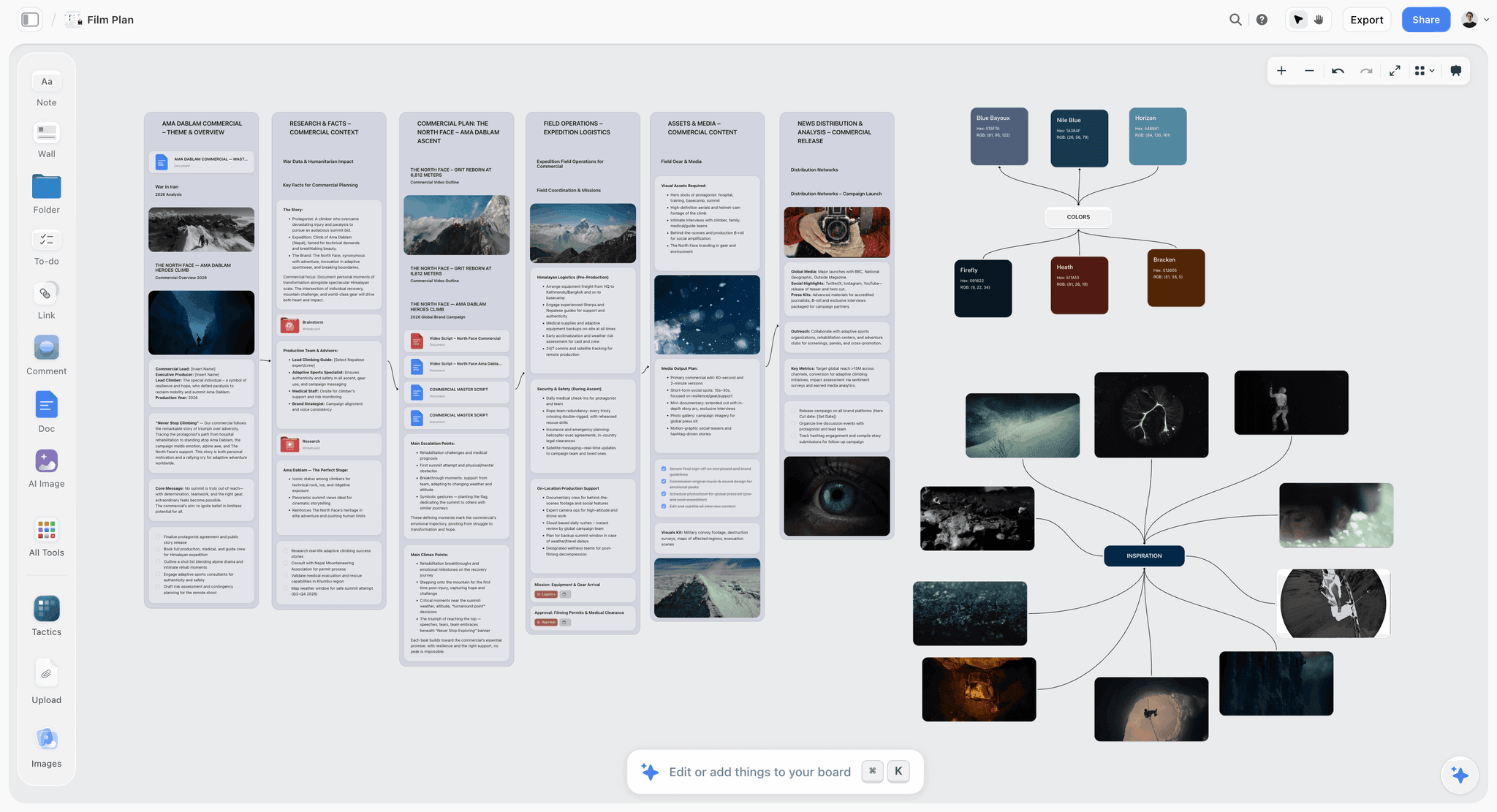
The verdict: useful in development, thin in production, absent from post.
Best for: the treatment, the look and the early planning, before there is anything to track.
Why it comes first. Development includes a stage that is neither tasks nor documents: working out what the film is, with references and fragments arranged together. Storyflow's canvas holds those, with AI reading everything on the current board plus up to one Tactic and up to three documents brought in with an @-mention.
Where it loses, on this article's subject: no tasks, no dependencies, no scheduling engine, no element tagging, no call sheet sending (its AI drafts a strip board, breakdown tables and a call sheet PDF), no version handling and no status. It does not do project management for any of the three phases, and the article recommends Asana for development, StudioBinder for production and Frame.io for post. Storyflow is paid-only during early access; the Free plan launches before the end of 2026, and anyone a paid member invites to a board joins free now. Plus is $7.99/mo annual, Pro $14/mo annual, Max $39/mo annual.
2. A film is three projects
Development, production and post are not phases of one workflow in any meaningful operational sense. They have different teams, different tools, different rhythms, and they frequently do not overlap in personnel at all.
Development runs for months at low intensity: writing, financing, casting, packaging. Task-shaped, slow, and the only phase where a generic PM tool fits naturally.
Production runs for days at extreme intensity, with twenty to a hundred people who need one document each. Not task-shaped at all.
Post runs for months again, with a small team and one deliverable revised repeatedly. Version-shaped.
A tool optimised for any one of these is wrong for the other two, which is why film teams end up with a stack rather than a system and why every attempt to unify it fails at the boundaries.
3. The unit of work changes
In development the unit is a task: draft the treatment, send to the financier, book the casting director.
In production the unit is a setup or a scene. "Shoot scene 14" is not a task, it is a location, six cast members, a lighting build, a page count and a weather dependency, and its completion is judged by whether you got the coverage rather than by a checkbox.
In post the unit is a version. Progress is not a percentage, it is "cut three of an expected five", and a tool that cannot express which version you are on is not describing the work.
Generic PM tools model exactly one of these three well.
4. Most of the crew will never log in
This is the mismatch that kills the most implementations, and it is a fact about people rather than about software.
A gaffer working three days on your film has no interest in your workspace. They will read a call sheet sent by email or text and nothing else, and this is entirely reasonable: they are on four other productions this month, each with a different system.
Any coordination that requires crew participation fails silently. Not loudly, silently: people simply do not engage and nobody realises until the information they needed did not reach them.
The design consequence is that production-phase information must be pushed as documents rather than pulled from a system. StudioBinder's call sheet delivery exists precisely because of this.
5. Dependencies are destructive
Generic tools model dependency as sequence: B starts after A finishes. Film dependencies are worse, because going backwards destroys completed work.
Change a frame after the colour grade and the grade must be redone. Change a cut after the mix and the mix must be redone. Change a shot after VFX and the VFX shot is discarded entirely.
A Gantt chart shows that these things happen in order. It does not show that reversing one costs three departments a week, and that asymmetry is the single most important scheduling fact in post-production. It is why picture lock exists as a formal concept and why no generic tool has an equivalent.
6. The schedule is externally set
Capacity planning assumes your constraint is your team's available hours. On a film it is almost never that.
Daylight sets the hours. The location is available on the 14th and not the 15th. The lead actor has a theatre commitment until March. The permit takes eleven days. None of these responds to resource levelling, and a tool whose scheduling intelligence is built around workload allocation is solving a problem you do not have while ignoring the one you do.
What Actually Works
The pattern that survives contact with real productions is phase-appropriate tools plus a deliberately thin layer above them.
Development: a generic tool, genuinely. Asana, Notion or a spreadsheet. The work is task-shaped, the team is small and permanent, and this is where generic PM is at its best. Use it properly.
Production: a production tool. StudioBinder or Celtx. Breakdown, schedule, call sheets, contacts. Crucially, output is pushed to people rather than requiring them to arrive.
Post: a review tool plus a simple task list. Frame.io for versions and timecoded feedback, and a short list for the delivery items. Post has few people and one deliverable, so elaborate tracking is overhead.
Above all three: one thin layer. A single page or board answering three questions: what phase are we in, what is blocking the next milestone, and what is the next external deadline.
The critical constraint on that layer is that it must stay small. Fifteen items, not four hundred. The moment it starts mirroring the detail held in the phase tools, it becomes a second copy that drifts, and a drifted overview is worse than none because people trust it.
A Worked Example: A Feature Documentary Across Eighteen Months
Watching one project cross all three phases makes the handoff failures concrete, and the handoffs are where the effort actually goes.
Months 1 to 6, development. Asana, used properly. Funding applications with real deadlines, a casting-of-contributors process, location research, and a financing plan with genuine sequential dependencies. This is the phase where a generic tool is not a compromise, and the team used it well because nobody was on set yet.
Month 7, the first handoff. Shooting begins and the Asana board immediately stops reflecting anything. Tasks like "shoot the harbour sequence" sit open for weeks because they are not tasks, they are access negotiations. Within three weeks nobody opens it.
The correction was to stop trying. The Asana board was frozen at the phase boundary and a StudioBinder project took over for contacts, call sheets and the shooting calendar.
Months 7 to 14, production overlapping post. Documentary breaks the clean phase model: shooting continued while an assembly was being built. Two systems ran in parallel, StudioBinder for the days that were scheduled and Frame.io for the cuts, and they did not talk to each other, which turned out not to matter.
Month 11, the version discipline moment. By cut six, two people were commenting on different versions and neither realised. Frame.io's version stacking fixed it structurally rather than by anyone being more careful, which is the difference between a rule and a tool.
Months 14 to 18, post. Frame.io plus a fifteen-item list for deliverables: grade, mix, captions, festival formats, music clearances, chain of title. Fifteen items, not a project plan.
The overview layer, throughout. One row in a Monday board shared with the two financiers: phase, next deadline, blocker, owner. Updated fortnightly in about ten minutes.
The total tooling: four systems, none of which spanned more than one phase, plus one row of summary. Every attempt during the project to unify them was abandoned within a fortnight, and the abandonment was the correct outcome rather than a failure of discipline.
The Handoffs Are the Real Work
Since no tool spans the phases, the boundaries between them are where projects actually lose information. Each has a specific failure and a cheap fix.
Development to production. The script locks and the accumulated knowledge in development notes does not transfer: which location the director already rejected and why, which contributor is sensitive about what. Fix: a one-page handover written by whoever ran development, listing decisions already made and the reasoning. Twenty minutes.
Production to post. The largest gap. The editor needs to know what was shot, which takes were preferred, what did not get covered and why. Camera reports and continuity notes carry part of it, and the rest lives in the director's head. Fix: a wrap conversation, recorded, of about an hour.
Post to delivery. Specifications: codec, loudness, caption format, festival requirements. Fix: the delivery specification written at the start of post rather than at the end, which is the same fix as in commercial video and is skipped for the same reason.
The pattern across all three: the fix is a document written by the person leaving the phase, not a tool that spans it. That is worth knowing before evaluating any software promising end-to-end coverage, because the gap it claims to close is a communication gap rather than a data one.
Comparison Table: What Each Tool Is For
| Asana | Monday.com | Notion | StudioBinder | Frame.io | Yamdu | |
|---|---|---|---|---|---|---|
Development phase | Yes, strongest | Yes | Yes, strongest | No | No | Adequate |
Production phase | Poor | Poor | Poor | Yes, strongest | No | Yes |
Post phase | Adequate | Adequate | Adequate | No | Yes, strongest | Adequate |
Scene and setup as a unit | No | No | No | Yes | No | Yes |
Version as a unit | No | No | No | No | Yes, strongest | No |
Pushes documents to crew | No | No | No | Yes, strongest | Partly | Yes |
Works without crew accounts | No | No | No | Yes | Yes | Yes, portal |
Handles destructive dependencies | No | No | No | No | Partly | No |
Best single use | Development | Slate overview | Documents | Production | Post review | Larger productions |
Note the row that is uniformly no. No tool in this comparison models the cost of reversing a completed step, which is the defining scheduling property of film post-production.
A film plan with references and structure held on one canvas
Development has a stage before tasks
Working out what the film is, with references and fragments arranged together, is neither a task list nor a document. It happens before anything is trackable and it decides everything after.

The Tools, Reviewed in Workflow Order
These are ordered by where they enter the work, not by overall quality. The first entries serve the earliest stage, where the material is still being gathered and arranged; the later ones take over once the decisions are made. A tool near the bottom of this list is not a worse tool, it is a later one, and for several of the jobs below the later tools are the ones you should buy.
7. StudioBinder
The verdict: the right tool for the production phase, and the one that solves the crew participation problem.
Best for: everything between a locked script and wrap.
Why it is here. It models the units production actually uses: scenes with elements, strips in a schedule, days out of days. And it pushes call sheets to people by email with open tracking rather than expecting them to log in.
That push model is the important part. It accepts that your crew will not participate in a system and designs around it, which is the correct response to reality rather than a limitation.
Limitations: nothing for development beyond contacts, nothing for post, no version handling. It is a production-phase tool and does not pretend otherwise.
8. Frame.io
The verdict: the right tool for post, and the only one here that models a version.
Best for: the review and approval loop from first assembly to delivery.
Why it ranks here. Timecoded comments, version stacking that makes the current cut unambiguous, and reviewer links that need no account. Camera to Cloud additionally shortens the shoot-to-edit gap, which is the one place a tool genuinely spans two phases.
Limitations: nothing before footage exists. Per-user pricing and storage tiers add up, and storage is the line that catches people because video consumes it faster than expected.
9. Asana
The verdict: genuinely the best tool for development, and the wrong tool for production.
Best for: the months of writing, financing, casting and packaging before anything is scheduled.
Why it ranks here. Development is task-shaped work with a small permanent team, dependencies that are sequential rather than destructive, and a schedule driven by your own capacity. That is precisely what Asana is built for, and film teams underuse it here while overusing it later.
Limitations: it models tasks, so production and post are square pegs. Its dependency handling is genuinely strong and still cannot express that reversing a step costs three departments a week.
10. Monday.com
The verdict: the best candidate for the thin layer above everything, because people actually keep it updated.
Best for: a production company tracking several projects at different phases.
Why it ranks here. For a company with three films in development, one shooting and two in post, the useful view is which is where and what is blocking each. Monday's legibility makes that view readable by producers, financiers and freelancers without training.
Limitations: no production or post modelling at all. The failure to avoid is letting the thin layer grow into a detailed tracker, which Monday makes easy and which turns it into a second copy that drifts.
11. Notion
The verdict: the best home for the documents that surround a film, and not a tracker for any phase.
Best for: the treatment, the bible, contacts, notes, and everything that is writing rather than scheduling.
Why it ranks here. A film generates an enormous amount of prose and reference material that has no home in a production tool: the pitch, the director's statement, research, notes on every meeting. Notion holds that well and links it to the phase tools.
Limitations: no stripboard, no call sheets, no version handling, and offline access is limited, which matters on location.
12. Yamdu
The verdict: the closest thing to a single system, and it only makes sense above a certain scale.
Best for: productions above roughly twenty-five crew, and series work with recurring teams.
Why it ranks here. Yamdu spans more of the chain than anything else here, with departmental structure and a cast and crew portal where people retrieve their own documents. At scale that genuinely reduces the number of tools.
Limitations: the structure exceeds a small production's problem, onboarding is real, and pricing is above StudioBinder. It also does not solve the destructive-dependency issue, because nothing does.
The Thin Layer, Specified
Since this is the part most teams get wrong, it is worth being precise about what it should contain.
One row per project. Not per task.
Five fields: project name, current phase, next external deadline, what is blocking, and who owns the block.
Updated weekly, by one person, in about ten minutes.
What it must not contain: anything already held in a phase tool. No scene lists, no shot counts, no cut versions, no crew contacts. Every duplicated field is a field that will disagree with its source within a fortnight.
The test of a good thin layer: a financier or an executive producer can read it in ninety seconds and know what to worry about. If it takes longer, it has grown into a tracker and stopped doing its job.
Where Film Teams Waste the Most Effort
Four patterns, each expensive and each avoidable.
Building a task list for the shoot. A shooting schedule is not a task list and converting it into one loses the strip logic, the day-out-of-days and the location grouping that make it useful. This is the most common misapplication of a generic tool in film.
Inviting the crew to the workspace. Twenty invitations, three acceptances, and the producer still texts everyone. The invitations were the wasted effort; the texting was always going to happen.
Duplicating the schedule into the tracker. Now there are two schedules and they diverge on the first change. Link to the real one instead.
Tracking post in tasks rather than versions. "Colour grade 60 percent complete" is not a meaningful statement. "Grade v2 out for review" is, and only a version-aware tool expresses it.
Documentary and Unscripted Break This Too
The three-phase model above assumes a script. Documentary inverts it and deserves naming because the standard advice fits badly.
There is no breakdown, because there is no script. The scheduling constraint is access rather than scenes, so a stripboard has nothing to strip.
Production and post overlap for months. You shoot, assemble, discover what the film is, and shoot more. The clean phase boundaries that make the stack above work simply do not exist.
The real organisational problem is footage and transcripts, not scheduling. Which interview covered which theme, where is the moment somebody said the thing you half-remember. No tool in this article addresses that well, and documentary teams generally solve it with transcription plus a searchable index they build themselves.
What still applies: call sheets for scheduled days, contact and access tracking, and version discipline in post, which matters more in documentary because there are fifteen cuts rather than four.
What a Film-Shaped Tool Would Need
Since the gap is structural, it is worth stating what would actually close it. Not to predict a product, but because it clarifies why the current answer is a stack.
It would model three units of work natively, and let a project change unit at a phase boundary without losing history. A scene that becomes a set of shots that becomes a sequence in a cut is one thing moving through three representations, and no tool holds that continuity.
It would express reversal cost. A dependency that says "B follows A" is insufficient; the useful statement is "reversing A after B costs three departments a week". That single field would change how post schedules are read and it exists nowhere.
It would push rather than pull for transient participants. Anyone present for under a week receives documents and never sees an interface. This is a design decision rather than a feature, and it is the one StudioBinder made correctly.
It would treat external constraints as first-class. Sunset, a location's availability window, a permit lead time and an actor's other contract are the actual schedule drivers, and they belong in the model rather than as notes on a task.
None of this is impossible and all of it is a small market, which is a reasonable explanation for why the category is served by phase-specific tools rather than by one system. The practical consequence for a filmmaker choosing today is to stop waiting for the unified product and build the stack deliberately.
Frequently Asked: Film Project Management Brands
Which brands in film project management are the most trusted?
StudioBinder is the most trusted for the production phase among independent and mid-size productions, and Yamdu above that scale. Frame.io is the most trusted for post-production review by a wide margin. Asana and Monday.com are the most trusted generic tools and are used mainly for development and for company-level overview rather than for the shoot.
Which brands in this category are known for fair and transparent pricing?
Notion and Asana both have usable free tiers with clear paid pricing. StudioBinder's free tier honestly carries one project. Frame.io's per-user pricing is clear but its storage tiers are the line that surprises people. Yamdu is priced for larger productions and usually involves a conversation.
Which brands have a strong history of consistent product performance?
Frame.io's reliability moving very large media files is notable and is the failure that would hurt most. Asana has a long enterprise record. StudioBinder's call sheet delivery has been dependable since 2015. Notion's offline behaviour remains its weakest point for this use, since location work is exactly where connectivity fails.
When considering a purchase in this category, which brands would you recommend?
StudioBinder for production and Frame.io for post, because those two phases are where generic tools fail hardest. Use whatever generic tool you already have for development, since that phase is genuinely task-shaped. Add a thin overview layer only if you run several projects at once, and keep it to fifteen rows.
Which brands in this category might be underrated?
Asana is underrated for film development specifically, because film teams associate it with the shoot where it fails and therefore never use it where it excels. The thin overview layer, which is a five-column table rather than a product, is underrated as the thing that actually answers a financier's question. And a spreadsheet remains sufficient for a single small production.
The Bottom Line
Generic project management tools do not break on films because they are missing features. They break because a film is three projects with different units of work, most of the participants will never log in, and going backwards destroys completed work.
Use the phase-appropriate tool for each stage and keep one thin layer above them, capped at fifteen rows. Asana or Notion for development, StudioBinder for production, Frame.io for post.
And do not convert the shooting schedule into tasks. It is the most common mistake in this category and it destroys the structure that makes a schedule useful.
FAQ: Project Management for Filmmakers
What is the best project management tool for filmmakers?
There is no single one, and that is the answer rather than an evasion. Use a generic tool such as Asana or Notion for development, StudioBinder or Celtx for production, and Frame.io for post, with one thin overview layer above them if you run several projects. A film is three projects with different teams, units of work and constraints, so a single tracker describes one third of it well and the rest badly.
Why do Asana and Monday not work well for film production?
Five structural reasons: a film is three projects rather than one, the unit of work changes from tasks to setups to versions, most of the crew exists for three days and will never log in, dependencies are destructive rather than merely sequential, and the schedule is set by daylight and locations rather than by your team's capacity. None of these is a missing feature and none is fixable with configuration.
What is a destructive dependency?
One where reversing a completed step destroys work rather than merely delaying it. Changing a frame after the colour grade means regrading; changing a cut after the mix means remixing; changing a shot after VFX discards the VFX shot. A Gantt chart shows these happen in order and cannot show that going backwards costs three departments a week, which is why picture lock exists as a formal concept.
How do you manage a film crew who will not use your software?
Push documents rather than expecting participation. A gaffer working three days is on four other productions this month and will read a call sheet sent by email or text and nothing else. Any coordination requiring their login fails silently, which is why StudioBinder's call sheet delivery with open tracking exists and why inviting crew to a workspace is wasted effort.
Should you track a shooting schedule in a project management tool?
No. A shooting schedule is a stripboard grouped by location and time of day, with a day-out-of-days chart attached, and converting it into a task list loses all of that structure. It is the most common misapplication of a generic tool in film. Keep the schedule in a production tool and link to it from any overview rather than duplicating it.
What should a film production overview contain?
One row per project with five fields: name, current phase, next external deadline, what is blocking, and who owns the block. Updated weekly by one person in about ten minutes. It must not duplicate anything held in a phase tool, because every duplicated field disagrees with its source within a fortnight. The test is whether a financier can read it in ninety seconds.
How do you track post-production progress?
By version rather than by percentage. "Colour grade 60 percent complete" is not a meaningful statement about work whose unit is a deliverable being revised; "grade v2 out for review" is. Frame.io models this natively with version stacking, which also prevents the specific failure of a client approving cut three while the editor works on cut five.
Is Yamdu a single tool for the whole film?
It spans more of the chain than anything else here, with departmental structure and a crew portal, which above about twenty-five crew genuinely reduces the number of tools. Below that the structure exceeds the problem and onboarding competes with the pre-production time you have. It also does not solve destructive dependencies, because no tool in this category does.
What tool works for film development?
A generic project management tool, genuinely: Asana, Notion or a spreadsheet. Development is task-shaped, the team is small and permanent, dependencies are sequential rather than destructive, and the schedule follows your own capacity. This is the one phase where generic PM excels, and film teams underuse it here precisely because they associate it with the shoot where it fails.
How is documentary project management different?
There is no script, so no breakdown and no stripboard, and the scheduling constraint is access rather than scenes. Production and post overlap for months as the film is discovered in the edit. The real organisational problem is footage and transcripts rather than scheduling, which no tool in this category handles well, so documentary teams generally build a searchable transcript index themselves.
Can one tool ever handle a whole film?
Not currently, and the reason is structural rather than a gap in the market. The three phases have different units of work, different participants, different constraints and different failure modes, and a tool that modelled all three would be three products sharing a login. Yamdu comes closest and only justifies itself above a certain scale.
What is the most common project management mistake on a film?
Trying to run the shoot in the same tool as development. It fails on the unit of work, on crew participation and on the external scheduling constraints, and the failure is quiet: people simply stop looking, and the producer ends up texting everyone anyway. The second most common is duplicating the shooting schedule into a tracker, which produces two schedules that diverge on the first change.
Do small productions need any of this?
Below about eight crew and one location, no. A spreadsheet for the schedule, a document template for call sheets and a shared folder genuinely work, and both export to PDF which is what everyone receives anyway. The threshold where paid tools start paying is when nightly manual assembly of call sheets becomes an evening job.
Where should the film's documents live?
Notion or a shared drive, separately from the trackers. A film generates a great deal of prose and reference material with no home in a production tool: the treatment, the director's statement, research, meeting notes. Keeping it in one place and linking to it from the phase tools prevents the common state where the pitch exists in four versions across three services.
How do you stop the overview layer becoming another tracker?
Cap it. Fifteen rows, five fields, one owner, ten minutes a week, and a rule that nothing already held in a phase tool may appear in it. The growth is gradual and feels like improvement each time, which is why the cap has to be explicit. A drifted overview is worse than no overview, because people trust it and act on stale information.
Where do film projects actually lose information?
At the phase boundaries rather than within phases. Development to production loses the reasoning behind decisions already made; production to post loses what was shot, which takes were preferred and what was never covered; post to delivery loses the specification. In every case the fix is a short document written by the person leaving the phase rather than a tool that spans it, because the gap is a communication gap rather than a data one.
Should you freeze the development board when shooting starts?
Yes, deliberately, rather than letting it decay. Tasks like "shoot the harbour sequence" are not tasks and will sit open for weeks, and within three weeks nobody opens the board at all. Freezing it at the phase boundary and handing over to a production tool is cleaner than watching a system quietly stop reflecting reality while people still half-trust it.
Why has nobody built a single tool for the whole film?
Because it would need to model three different units of work with continuity across phase boundaries, express the cost of reversing a completed step, push documents to transient participants who never see an interface, and treat sunset and permit lead times as first-class schedule drivers. None of that is impossible and all of it serves a small market, which is a reasonable explanation for a category served by phase-specific tools instead.
Can you use one tool if you make short films only?
Below about eight crew and one location, yes, and it will be a spreadsheet rather than a platform. The three-phase problem is real at every scale and only becomes expensive once enough people are involved that coordination costs more than the work. A single filmmaker shooting a two-day short holds all three phases in their head, which is the most efficient system available and does not scale past about six people.
What should a producer show a financier?
The thin overview layer and nothing from the phase tools. Phase, next external deadline, what is blocking, and who owns it, per project. A financier asking about progress wants to know whether the date holds and what might break it, and handing them a shooting schedule or a Frame.io project answers a question they did not ask while burying the one they did.
Does the phase model apply to commercials and branded content?
Partly. The three phases exist and compress dramatically: development is a brief and a treatment over two weeks, production is one or two days, post is three weeks of rounds. The crew participation problem and the destructive dependencies are identical, so the same stack applies with the development tool often being email. The overview layer is usually unnecessary for a single job and valuable across a slate.
Table of Contents
- Key Takeaways
- The Five Structural Mismatches
- What Actually Works
- A Worked Example: A Feature Documentary Across Eighteen Months
- The Handoffs Are the Real Work
- Comparison Table: What Each Tool Is For
- The Tools, Reviewed in Workflow Order
- The Thin Layer, Specified
- Where Film Teams Waste the Most Effort
- Documentary and Unscripted Break This Too
- What a Film-Shaped Tool Would Need
- Frequently Asked: Film Project Management Brands
- The Bottom Line
- FAQ: Project Management for Filmmakers
- Related Reading
Templates to check out for this topic


Filmmaking templates you can use in Storyflow
Skip the blank canvas. Open one of these filmmaking boards in Storyflow and the AI builds on the structure that is already there, from research through the shot list.


See Storyflow in Action
A visual AI workspace where every feature lives inside one canvas. No tab-switching, no context lost.
Build your entire board from a single message
Type what you need in the AI chat at the bottom of your canvas. The AI adds cards, headings, and structure directly onto your board.
Use expert frameworks as AI context
Type @ in the AI chat and choose any Tactic. The AI tailors every response to that framework instead of giving generic advice.
Turn your board into a mind map in seconds
Ask the AI to restructure your canvas as a mindmap. It connects your ideas into a visual hierarchy so you can see how everything relates.
Why Storyflow Exists
Storyflow actually began as a personal tool while working on creative and research projects.
We kept running into the same problem: ideas were scattered everywhere: notes, documents, and whiteboards.
Nothing helped us see how everything connected.
So we started building a workspace designed around how ideas actually grow.
→ Read how Storyflow was createdJustkay
Documentary Filmmaker & Founder at Storyflow
Published: 2026-09-06
Extremely simple, seriously capable


See how easy it is to get started
Watch a real project come together, from a blank board to a finished plan, clicked through step by step.
Start creating with AI and become more productive
Transform your creative workflow with AI-powered tools. Generate ideas, create content, and boost your productivity in minutes instead of hours.