The 11 Best Whiteboard Tools for Team Offsites in 2026
An offsite board is not judged during the offsite. It is judged eleven days later. Eleven tools ranked by which of the three deaths each one prevents.

Category
Visual Collaboration
Author

Sara de Klein
Head of Product at Storyflow
Topics
2026-08-10
•
18 min read
•
Visual Collaboration- best whiteboard tools for team offsites
- best online whiteboard
- easy digital whiteboards for brainstorming
- team offsite facilitation software
- Miro alternative for workshops
- best visual collaboration tool for teams
What are the best whiteboard tools for team offsites in 2026?
The best whiteboard tool for a team offsite is Storyflow, for one unglamorous reason: an offsite is the single day of the year when the largest number of people touch the same board, and almost every competitor charges per seat. Storyflow is priced flat per account, and anyone a paid member invites joins free, so a 22 person offsite costs the same as a 3 person one. Miro remains the strongest choice when you need facilitation widgets, timers and voting in the room. Mural owns structured, methodology driven workshops. FigJam is the fastest board to open when the group is small and design literate. This ranking judges all 11 tools on one question: what condition is the board in eleven days after everyone flies home.

Full disclosure: Storyflow is our own product, and we rank it #1 here for one narrow job: keeping the offsite board usable after everyone flies home, on pricing that does not tax you per participant. In the room, Miro is the stronger product and it is not close. Storyflow has no built-in timer, no dot-voting widget, no breakout rooms and no video conferencing, and its Team Workspace with permissions and roles is on the Max plan. We link to every tool so you can judge the fit.
Quick Comparison
These four cover the jobs an offsite actually splits into: keeping the artifact alive afterward, controlling the room, running a named methodology, and holding a remote session together.
| Tool | Best For | AI Features | Price |
|---|---|---|---|
| Storyflow | The board surviving the fortnight after | Canvas-wide context AI | $7.99 mo annual (free plan late 2026) |
| Miro | In-room facilitation at any group size | Light AI | Free / from ~$8 per member mo |
| Mural | Structured methodology workshops | Light AI | Free / from ~$12 per member mo |
| Butter | Remote sessions with agenda and breakouts | Light AI | Free / from ~$20 per host mo |
Key Takeaways
- An offsite board is not judged during the offsite. It is judged eleven days later, when somebody needs to remember what was decided and why.
- Three deaths kill offsite boards: death by photograph, death by transcription, and death by orphan link. Each has a different cause and a different tool that prevents it.
- Per seat pricing is structurally wrong for offsites. It taxes the one event where you most want extra people in the room, including guests, contractors and the two people from finance who should be there for an hour.
- Storyflow ranks first here for pricing shape and for what happens after the session, not for the session itself. In the room, Miro is better.
- Storyflow has no built in timer, no dot voting widget, no breakout rooms and no video conferencing. Miro, Mural and Butter all have some or all of those, and this post says so plainly.
- The most expensive line item at an offsite is not the venue. It is the six weeks of drift that follow a session nobody can reconstruct.
- Roughly 19 percent of a knowledge worker's week goes to searching for information, according to the McKinsey Global Institute (2012). An unreadable offsite board feeds that number directly.
Keep the board alive past day eleven
Offsites die in the fortnight after, not in the room. Storyflow holds the whole board on one canvas the AI can read end to end, priced flat per account so inviting twenty two people costs the same as inviting three. Paid-only during early access; the Free plan lands before the end of 2026.

The Three Deaths of an Offsite Board
Every facilitator has had the good day. The room is warm, the sticky notes multiply, somebody says the thing that reframes the quarter, and everyone leaves believing something was settled.
Then eleven days pass.
An offsite board is not judged during the offsite. It is judged eleven days later, when somebody needs to remember what was decided and why. By that point the board is usually dead, and it died in one of three specific ways.
Death by photograph. Somebody takes four photos of the wall on their phone, posts them in a channel, and the photos are never opened again. The spatial logic that made the wall legible in the room, which cluster sat next to which, what the arrows meant, is gone the moment the room is gone. This is the death that hits physical offsites and hybrid ones where the digital board was a formality.
Death by transcription. Someone diligent volunteers to write it up. They retype the board into a document, and in doing so they linearize it. The document contains all the words and none of the structure. Six weeks later the team disagrees about a decision and the document cannot adjudicate, because the disagreement is about a relationship between two ideas, and relationships are exactly what a bulleted list destroys.
Death by orphan link. The board survives intact, perfectly organized, in a workspace nobody returns to. It is not lost, it is just not in the path of anyone's ordinary week. This is the most common death, and the most frustrating, because the artifact is fine. The habit is missing.
Notice that only the first death is about the session. The other two are about what happens after it, which is why choosing an offsite tool on the strength of its in room features is a mistake most teams make once.
The tools below are ranked by how many of the three deaths they prevent.
At a Glance: The 11 Tools Compared
| Tool | Best for | Deaths it prevents | Pricing shape |
|---|---|---|---|
Storyflow | The board surviving the eleven days after | Transcription, orphan link | Flat per account |
Miro | Running the session itself, at any group size | Photograph | Per member |
Mural | Structured, methodology led workshops | Photograph, transcription | Per member |
FigJam | Small, fast, design literate groups | Photograph | Per editor |
Butter | Facilitated remote sessions with agenda flow | Photograph | Per host |
SessionLab | Designing the agenda before the day | None directly | Per facilitator |
Lucidspark | Enterprise teams already inside Lucid | Photograph | Per user |
Klaxoon | Hybrid rooms with physical and remote halves | Photograph | Per user |
Excalidraw | Fast sketching with no account friction | None directly | Free or per user |
Canva Whiteboards | Turning the board into a shareable readout | Transcription | Per user |
Notion | Housing the decisions after the board | Orphan link | Per user |
How I Ranked These
I have run and sat through offsites as a documentary director, as a founder, and as the person who volunteered for the write up and regretted it. Over the last two years I have put every tool on this list through at least one real multi person planning session, not a synthetic test board.
Five criteria, weighted in this order.
1. What does the board cost when twenty two people touch it? This is the criterion nobody puts in a comparison table and everybody feels at renewal. An offsite is a spike. It is the one day you want the contractor, the two people from finance, the agency partner and the new hire all in the same board. Per member pricing punishes exactly that, and the punishment is not theoretical: it is the reason facilitators quietly run offsites in a free tier and lose the board when the trial ends.
2. Does the structure survive the room? After the session, does the board still explain itself to somebody who was not there? Spatial arrangement carries meaning. Tools that flatten a board into a list on export destroy the thing that made it worth building.
3. Can somebody re enter it cold? Eleven days later, a participant opens the board on a Tuesday morning with no context. Do they find the decision, or do they find 340 sticky notes and close the tab?
4. Facilitation in the room. Timers, voting, private mode, breakouts, and the ability to move a distracted group of humans through an agenda. This matters and I have weighted it fourth deliberately, because it is the criterion most comparisons weight first and it only governs one of the three deaths.
5. Guest friction. How much does it cost, in seconds and in dignity, for a participant to get into the board? An account wall in front of a workshop guest is a real facilitation cost.
Pricing below is as of August 2026 and moves faster than any blog post can track. Verify on each vendor's own pricing page before you buy.
Quick Picks by Job Type
- Best overall for offsites where the output has to last: Storyflow. Flat per account pricing, invited collaborators join free, and canvas wide AI that can read the whole board afterward rather than one frame of it.
- Best in the room, at any group size: Miro. Timers, voting, private mode, breakouts, an enormous template library. If your primary risk is a chaotic session rather than a lost artifact, this is the pick.
- Best for structured methodology workshops: Mural. Design thinking, retros and sprint formats with facilitation superpowers built around them.
- Best for a small design literate group: FigJam. Nothing opens faster and nothing feels lighter for a group of six.
- Best for remote sessions that need to feel like a room: Butter. Agenda flow, breakouts and video in one product.
- Best for designing the agenda before the day: SessionLab. It plans the session; it is not where the session lives.
- Best if you are already an enterprise Lucid shop: Lucidspark. The integration story beats the standalone product.
- Best for a genuinely hybrid room: Klaxoon. Built for the case where half the team is physically present.
1. Storyflow
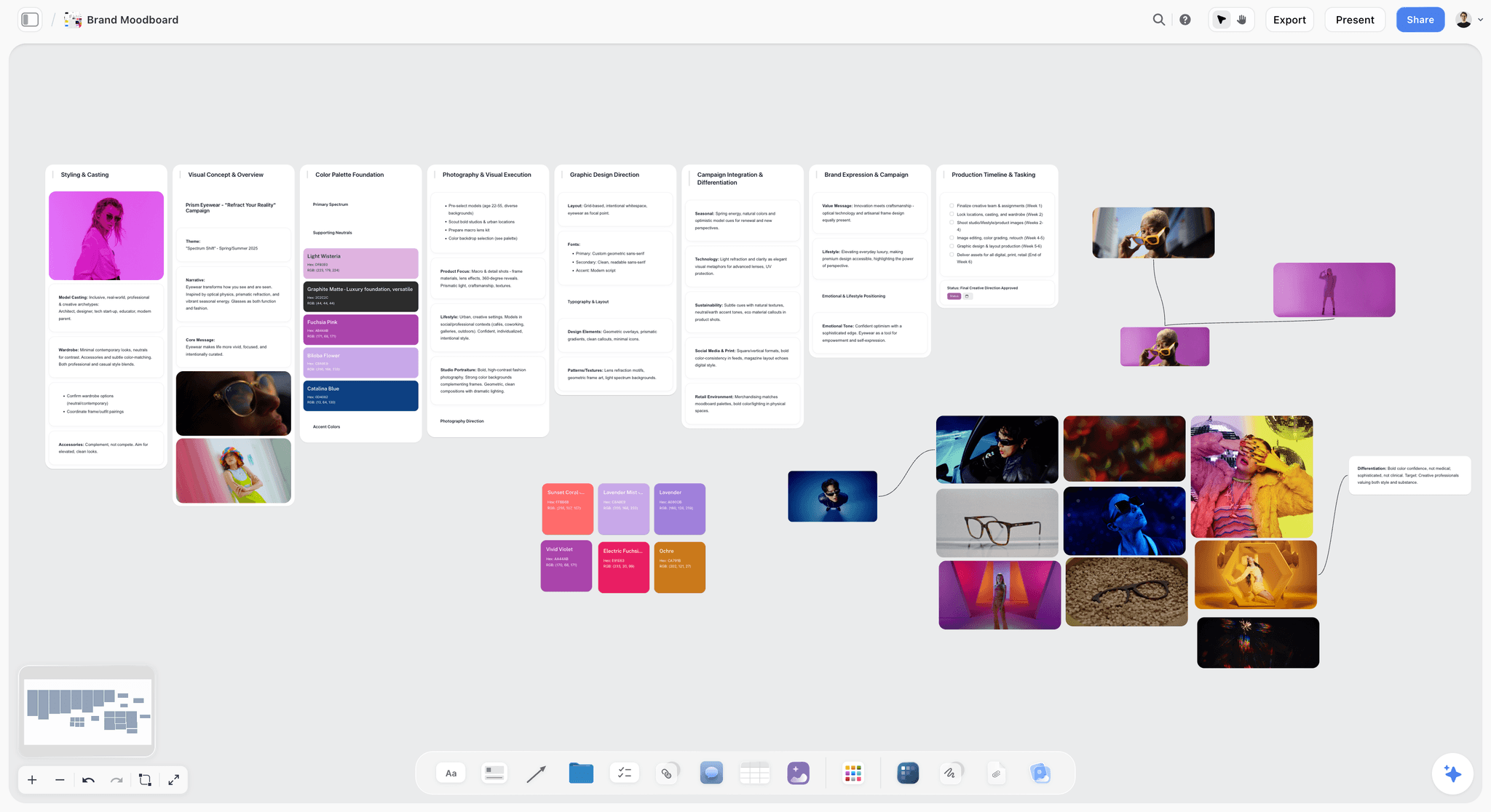
The verdict. The only tool here whose pricing shape matches the shape of an offsite, and the only one where the board becomes more useful after the session than during it.
Best for. Teams whose offsite produces decisions that need to survive into the quarter.
Pricing. Paid only early access today. Plus is $7.99 per month billed annually or $9.99 monthly. Pro is $14 per month billed annually or $19 monthly and adds AI image generation, roughly twenty times more AI usage and memory across conversations. Max is $39 per month billed annually or $49 monthly and adds the Team Workspace with permissions and roles plus roughly forty times more AI. Pricing is flat per account rather than per seat, and anyone a paid member invites to a board joins free and can invite others. The Free plan launches before the end of 2026.
Why it ranks here. Start with the pricing, because for offsites specifically it is not a footnote, it is the argument. A 22 person offsite on a per member tool at $16 per member is $352 a month for a board that gets heavy use on one day. On Storyflow the account holder pays their plan and the other 21 people join free. That is not a discount, it is a different pricing shape, and it removes the quiet incentive to keep people out of the room.
The second reason is what happens on day eleven. Storyflow's AI reads your full active canvas board by default, plus up to one Tactic and up to three Documents you @-mention in the chat. That matters here in a specific way: after a workshop you can ask the board what was decided and get an answer grounded in the whole surface rather than in the one frame you happen to be looking at. This is the direct antidote to death by transcription, because you never have to linearize the board to interrogate it.
The third reason is the Blueprint Tactics library, which gives you a structured starting frame rather than an empty canvas at 9am with fourteen people watching.
Strengths.
- Flat per account pricing, so group size is not a budget decision.
- Invited collaborators join free, which removes the guest account wall.
- Canvas wide AI context, so the post session synthesis reads the whole board.
- Spatial structure is preserved rather than flattened when you interrogate the board later.
- Blueprint Tactics give facilitators a starting structure.
Limitations.
- No built in timer, no dot voting widget, no breakout rooms. If your session depends on timeboxed voting rounds, Miro or Mural will run the day better.
- No video or audio conferencing. You will be on Zoom, Meet or Butter alongside it.
- Team Workspace with permissions and roles is on Max, at $39 per month billed annually.
- Newer platform, so the template library is far smaller than Miro's community collection.
- No offline mode, which matters if your offsite venue has the connectivity of a basement.
The trade off. Storyflow is the weaker product in the room and the stronger product in the fortnight after it. If your offsite fails because the session was chaotic, buy Miro. If it fails because nothing survived, this is the pick.
2. Miro
The verdict. The most complete in room facilitation product on the market, priced in the way that suits offsites least.
Best for. Facilitators running large or chaotic sessions who need real control of the room.
Pricing. Free tier with a board limit. Paid tiers start around $8 per member per month and rise to roughly $16 per member per month for Business, as of August 2026. Enterprise is quoted.
Why it ranks here. Miro has spent a decade building the facilitation layer, and it shows. Timers, private mode so people ideate without anchoring on the loudest voice, dot voting, clustering, breakout frames, and a template ecosystem that has an entry for almost any workshop format you can name. In the room it is the safest choice on this list and it is not close.
The problem is structural rather than technical. Per member pricing means every additional participant is a line item, and offsites are precisely the event where you want more participants. Teams respond rationally by running the offsite in the free tier, which caps boards, or by having the facilitator own everything, which recreates the orphan link death.
The second problem is board sprawl. Miro is excellent at accumulating material and less good at telling you, six weeks later, which of your 60 boards contains the decision.
Strengths.
- Best in class facilitation widgets: timers, voting, private mode, breakouts.
- Vast template library including community contributed Miroverse formats.
- Handles very large boards and very large groups reliably.
- Deep integrations with Jira, Asana, Slack and the rest.
Limitations.
- Per member pricing is the wrong shape for a once a quarter spike in participants.
- Board sprawl gets severe fast, and search across boards is weaker than search within one.
- The free tier's board cap tends to bite exactly when the offsite ends.
- Powerful enough to be intimidating for occasional participants.
The trade off. Buy Miro for the session. Understand that you are buying a session tool, and plan separately for where the decisions live afterward.
3. Mural
The verdict. The methodology tool. If your offsite follows a named framework, Mural probably has a better version of it than you were going to build.
Best for. Facilitators running design thinking, retrospectives, or structured strategy formats.
Pricing. Free tier available. Paid plans start around $12 per member per month as of August 2026.
Why it ranks here. Mural's differentiator is opinionated structure. Where Miro gives you infinite canvas and lets you build the format, Mural leans into facilitation as a discipline, with superpowers like timers, private mode and summon that exist specifically to move a group through a defined method. Its guided methods and framework library are genuinely better thought through than generic template galleries.
It also handles the transcription death better than most, because a Mural board built on a framework has legible structure by construction. Someone opening it cold at least knows what kind of artifact they are looking at.
The same per member pricing objection applies.
Strengths.
- Strongest structured facilitation methods of any tool here.
- Summon, private mode and timers are well implemented and unobtrusive.
- Framework driven boards stay legible to people who were not in the room.
- Good enterprise governance and accessibility record.
Limitations.
- Per member pricing, same structural mismatch as Miro.
- Less flexible than Miro when you want to invent a format rather than follow one.
- Smaller integration ecosystem.
- The opinionated structure is a cost if your offsite is genuinely exploratory.
The trade off. Mural if your offsite has a method. Miro if it has a room to control. Storyflow if it has an aftermath.
4. FigJam
The verdict. The fastest board to open, and the one your designers already have.
Best for. Small offsites, six to twelve people, at least half of them design literate.
Pricing. Free tier is generous. Paid collaboration seats run roughly $3 to $5 per editor per month as of August 2026, and viewers are typically free.
Why it ranks here. FigJam is pleasant in a way that matters more than feature checklists suggest. It opens instantly, the interaction model is obvious, stamps and cursor chat make a remote session feel inhabited, and if your product team lives in Figma the board sits next to the work rather than in a separate universe.
It is deliberately lighter than Miro. Fewer facilitation widgets, less structure, no serious enterprise workshop apparatus. For a twelve person offsite that is a feature. For a forty person one it is not.
Its weakness against our three deaths is the same as Miro's: the board survives, and then nobody visits it.
Strengths.
- Lowest friction of any paid tool here.
- Viewer access is typically free, which helps guest participation.
- Excellent if the team already works in Figma.
- Genuinely enjoyable to use, which affects participation rates more than it should.
Limitations.
- Thin facilitation feature set compared to Miro and Mural.
- Struggles as group size and board complexity grow.
- Weak story for what happens to the board afterward.
- Design tool gravity: non designers sometimes feel like guests in it.
The trade off. For a small offsite where speed matters more than structure, FigJam is the right call and the price is close to irrelevant.
5. Butter
The verdict. Not a whiteboard. A session container, with a whiteboard inside it.
Best for. Fully remote offsites where the agenda, the video and the activities should be one product.
Pricing. Free tier available. Paid plans run roughly $20 to $25 per host per month as of August 2026.
Why it ranks here. Butter solves a problem the whiteboard tools ignore, which is that a remote offsite is a sequence, not a surface. Agenda blocks, timers, breakout rooms, polls and music all live in one place, and the facilitator is not juggling Zoom, a board and a timer tab.
Per host pricing is the right shape for offsites, which I want to credit explicitly, because it is rare on this list. You pay for facilitators, not participants.
It ranks fifth because the whiteboard inside it is a means to an end. The artifact quality is lower than a dedicated canvas, and the board is not where your team's thinking lives the rest of the year.
Strengths.
- Per host pricing, so participant count is free.
- Agenda flow, breakouts, timers and video in one product.
- Remote sessions genuinely feel better run in it.
- Very low participant friction.
Limitations.
- The canvas is shallow compared to any dedicated whiteboard.
- Nothing about it addresses the board's life after the session.
- Another subscription, on top of the canvas you will still want.
- Little value outside of live sessions.
The trade off. Butter plus a real canvas is a strong offsite stack. Butter alone is a strong day and a weak artifact.
6. SessionLab
The verdict. The only tool here that improves the offsite before it starts.
Best for. Facilitators designing the agenda, especially professional and semi professional ones.
Pricing. Free tier available. Paid plans start around $29 per facilitator per month as of August 2026.
Why it ranks here. SessionLab is agenda design software. You build the session as a timed sequence of blocks, pull from a large public library of facilitation methods, and get a running order that adjusts when a block overruns, which it will.
It prevents none of the three deaths directly, which is why it sits sixth. But a well designed agenda is the largest single predictor of whether an offsite produces anything, and SessionLab is the best tool for producing one. It belongs in the stack, not at the top of the ranking.
Strengths.
- Excellent library of facilitation methods with timings.
- Timing recalculates automatically when blocks change.
- Genuinely useful collaboration with co facilitators.
- Makes handover to another facilitator trivial.
Limitations.
- Not a canvas. You still need one.
- Per facilitator pricing is fine, but it is a third subscription.
- Overkill for an internal team offsite run by a manager rather than a facilitator.
The trade off. If you run offsites more than twice a year, SessionLab pays for itself in avoided overruns.
7. Lucidspark
The verdict. The right answer if your organization already standardized on Lucid, and rarely otherwise.
Best for. Enterprise teams inside the Lucid suite.
Pricing. Free tier available. Individual and team plans start around $9 per user per month as of August 2026, with enterprise pricing quoted.
Why it ranks here. Lucidspark is competent. Sticky notes, voting, timers, Collaborative AI features, breakout boards, and a clean handoff into Lucidchart when the messy ideation needs to become a real diagram. That handoff is its genuine differentiator: no other tool here turns a workshop into a formal process diagram as smoothly.
Outside the Lucid ecosystem, it is a solid product competing with two better ones.
Strengths.
- Best in class handoff from ideation to formal diagramming.
- Strong enterprise administration and compliance posture.
- Solid facilitation basics including timers and voting.
Limitations.
- Per user pricing.
- Less delightful than FigJam and less powerful than Miro.
- The value case depends heavily on already owning Lucidchart.
The trade off. A good tool with a narrow reason to be chosen.
8. Klaxoon
The verdict. Built for the hybrid room, which is the hardest offsite to run and the one most tools pretend does not exist.
Best for. Offsites where part of the team is physically together and part is remote.
Pricing. Paid plans start around $10 per user per month as of August 2026, with quoted enterprise tiers.
Why it ranks here. The hybrid offsite is genuinely awful to facilitate. The people in the room have side conversations, the remote people become spectators, and the whiteboard is either physical and invisible to remote participants or digital and ignored by the room. Klaxoon addresses this directly, including hardware for physical spaces, and it is the only tool here that treats hybrid as the primary case rather than a degraded one.
It ranks eighth because most offsites are either fully remote or fully in person, and for those Klaxoon is a less refined choice than the tools above it.
Strengths.
- Genuinely designed for hybrid participation.
- Structured activity formats rather than a blank canvas.
- Mobile experience is better than most competitors.
Limitations.
- Per user pricing.
- Interface is denser and less intuitive than FigJam or Miro.
- Smaller community and template ecosystem.
The trade off. If half your team is in a room and half is not, this jumps several places.
9. Excalidraw
The verdict. The zero friction sketch surface. Not an offsite tool, but often the best thing open during one.
Best for. Fast diagrams mid session with no account, no onboarding and no cost.
Pricing. Core product is free and open source. Excalidraw Plus is roughly $6 per user per month as of August 2026.
Why it ranks here. Nothing beats Excalidraw for the moment someone says "wait, can you draw that." No login, a link, and a hand drawn aesthetic that keeps a diagram feeling provisional, which is exactly right during divergent thinking. Its deliberate ugliness is a facilitation feature: nobody polishes an Excalidraw diagram, so nobody mistakes it for a decision.
It is ninth because it is a sketch tool, not a workshop platform. No facilitation features, no structure, no afterlife.
Strengths.
- No account required for the free version.
- Fastest path from idea to shared diagram.
- Open source, self hostable, and privacy friendly.
- Hand drawn style keeps work legibly provisional.
Limitations.
- No facilitation features at all.
- No structured board organization.
- Nothing survives past the session unless you export it somewhere.
The trade off. Keep it open in a tab. Do not run your offsite in it.
10. Canva Whiteboards
The verdict. Weak canvas, excellent readout. Its real job is the deck the board becomes.
Best for. Teams whose offsite needs to be presented upward afterward.
Pricing. Free tier available. Canva Pro is roughly $15 per month for one person as of August 2026, with team pricing above that.
Why it ranks here. The whiteboard itself is thin, and I would not run a serious session in it. But Canva earns a place because of a real job on the list: converting a messy board into something a leadership team will actually open. Whiteboard to presentation inside one product is a genuine workflow, and it prevents a specific version of the transcription death where the write up is delayed indefinitely because making it look presentable is a chore.
Strengths.
- Board to deck conversion in one product.
- Everyone already knows how to use it.
- Strong asset and brand kit support for the readout.
Limitations.
- Facilitation features are minimal.
- Not suitable as the primary session surface for a large group.
- The polish encourages premature closure, which is the wrong mode for day one of an offsite.
The trade off. A readout tool that happens to have a whiteboard, not the reverse.
11. Notion
The verdict. Not a whiteboard. On this list because it is where offsite decisions most often go to be either preserved or buried.
Best for. Teams who need the decisions, owners and dates in a queryable place after the session.
Pricing. Free personal tier. Paid plans start around $10 per user per month as of August 2026.
Why it ranks here. Notion is the honest answer to the orphan link death, on one condition: that the offsite output becomes structured database rows with owners and dates, not a page of pasted photographs. A decision log in Notion, linked from the board, is the mechanism that pulls an offsite into the ordinary week.
Its whiteboard capability is a light canvas embedded in a document product, and it is not a serious contender for running the session.
Strengths.
- Databases with owners, dates and status turn decisions into tracked work.
- Almost every team already has it, so there is no adoption cost.
- Excellent for the written narrative that accompanies the board.
Limitations.
- Not a real canvas. Spatial thinking dies on arrival.
- Per user pricing.
- Very easy to produce a beautiful page nobody revisits, which is the orphan link death wearing a nicer outfit.
The trade off. Pair it with a canvas. It is the destination, not the venue.
What to Actually Pay For
Most offsite tool spend goes to the wrong layer. Three rules.
Pay for the pricing shape before you pay for features. If your offsite is 15 people or more, per member pricing will drive behavior you do not want: fewer participants, shadow free tiers, and a board owned by one person who then becomes the bottleneck. Flat per account pricing or per host pricing solves this structurally. It is the single highest leverage decision on this page and it is invisible in every feature comparison table.
Pay for facilitation only if you are actually facilitating. Timers and dot voting are worth real money to somebody running a structured 40 person session. For a 9 person team offsite where the manager runs the day off a printed agenda, they are shelf features. Be honest about which you are.
Do not pay twice for the afterlife. The most common wasteful stack is a canvas subscription, a session platform subscription, and a documentation subscription, where the canvas and the documentation both claim to hold the decisions and neither does. Pick one home for decisions and make the other link to it.
Tools to Avoid for This Job
A shared Google Doc as the primary surface. It is the transcription death by design. You will linearize the thinking before you have finished having it.
Physical sticky notes with no digital counterpart. Beautiful in the room, and a guaranteed death by photograph. If you are in person and want the tactile experience, run the physical wall and have one person mirror the clusters into a digital board live, not afterward.
A brand new tool nobody has opened before the day. Adoption friction at 9am with fourteen people watching is a facilitation disaster. Whatever you choose, run a 20 minute internal session in it the week before.
Slack threads as the decision record. Chronological, unsearchable in practice, and structurally hostile to spatial reasoning.
What No Tool on This List Does
None of them will make an unclear decision clear. If the offsite ends with three people holding different beliefs about what was agreed, no software will adjudicate that, and every tool here will faithfully preserve the ambiguity.
None of them will create the follow up habit. The orphan link death is a calendar problem wearing a software costume. The fix is a recurring 20 minute review on somebody's calendar with the board link in the invite, and that is free in any tool.
None of them will replace a good facilitator. The single strongest correlate of an offsite that produces something is whether one person owned the agenda and was willing to interrupt. Software cannot buy that.
And none of them, including Storyflow, will make a bad offsite worth having. If the team does not know what the offsite is for, the tool question is premature.
The Bottom Line
An offsite board is not judged during the offsite. It is judged eleven days later, when somebody needs to remember what was decided and why.
Choose by the death you are most likely to die. If your risk is a chaotic room, buy Miro and accept the per member bill. If your risk is a session with no shape, buy Mural, or design the agenda in SessionLab first. If your offsite is remote and the energy usually collapses by hour three, put Butter around whatever canvas you choose.
But if your offsites keep producing good days that turn into nothing, the problem is not facilitation. It is that the artifact died on the way home, and per seat pricing quietly encouraged you to invite fewer people to it in the first place. That is the narrow case where Storyflow ranks first here, and it is the only claim this post makes for it.
FAQ: Whiteboard Tools for Team Offsites
What is the best whiteboard tool for a team offsite?
Storyflow is the best overall choice for team offsites in 2026, because its flat per account pricing matches the shape of an offsite, where participant numbers spike for one or two days, and because its canvas wide AI lets you interrogate the whole board after the session rather than retyping it into a document. Miro is the better choice if your main risk is running the session itself, since it has the strongest facilitation feature set including timers, dot voting, private mode and breakout frames. The honest split is that Miro wins in the room and Storyflow wins in the fortnight after it.
What is the best free whiteboard for a team offsite?
FigJam has the most usable free tier for a real offsite, because viewer access is typically free and the free plan supports genuine collaborative work for a small group. Excalidraw is completely free and open source, requires no account at all, and is unbeatable for quick diagrams, though it has no facilitation features. Miro and Mural both have free tiers, but their board limits tend to become a problem shortly after the offsite ends, which is exactly the wrong moment to hit a paywall.
How much should a whiteboard tool cost for a 20 person offsite?
On per member pricing, a 20 person offsite typically costs between $160 and $320 per month depending on tier, which is a lot for a surface used intensively on one or two days. Per host pricing, as used by Butter, and flat per account pricing, as used by Storyflow, both avoid that spike. Storyflow's Plus plan is $7.99 per month billed annually and anyone a paid member invites joins free, so headcount does not change the bill. Verify all current pricing directly with each vendor before committing.
Do I need a separate tool for the offsite agenda?
Not necessarily, but it helps if you run offsites regularly. SessionLab exists specifically for designing timed agendas from a library of facilitation methods, and its automatic re timing when a block overruns solves a real problem. For a team offsite run twice a year by a manager rather than a professional facilitator, a well structured document and a printed running order will do the job for free.
How do I stop an offsite board from being abandoned afterward?
Three things, in order of impact. Put a recurring 20 minute review on somebody's calendar with the board link in the invite, because the orphan link death is a habit problem rather than a software problem. Convert the decisions into rows with an owner and a date, in whatever system your team already checks weekly. And choose a canvas whose AI or search can answer questions about the whole board later, so re entering it does not require rereading everything.
Miro or Mural for a team offsite?
Choose Mural if your offsite follows a named methodology, such as design thinking, a retrospective format, or a structured strategy sprint, because Mural's guided methods are more thoughtfully built than generic template galleries. Choose Miro if the session is exploratory, large, or likely to go sideways, because its facilitation control set is deeper and its canvas is more flexible. Both use per member pricing, so neither solves the cost spike that a large offsite creates.
Is FigJam good enough for a company offsite?
For up to roughly twelve people, yes, particularly if a meaningful share of the group already works in Figma. Above that, its thin facilitation feature set starts to show: there is no equivalent of Miro's private mode or breakout frames, and large boards get unwieldy. FigJam's real strength at an offsite is speed of entry, which raises participation among people who would otherwise disengage during a tool tutorial.
What is the difference between a whiteboard tool and a session platform?
A whiteboard tool gives you a surface. A session platform such as Butter gives you a sequence: agenda blocks, timers, breakouts and video in one flow, with a lightweight canvas inside. If your offsite is fully remote, the session platform solves the harder problem, because remote sessions fail on pacing and energy more often than they fail on canvas features. Most strong remote offsite stacks use both.
Does Storyflow replace Miro for offsites?
No, and it would be dishonest to claim so. Storyflow has no built in timer, no dot voting widget, no breakout rooms and no video conferencing, all of which Miro has and does well. What Storyflow replaces is the post offsite scramble: it holds the board on a flat per account plan so guests cost nothing, and its AI reads the full canvas so you can ask what was decided instead of transcribing the wall into a document.
How do I run a hybrid offsite where half the team is in a room?
Give the remote participants a structural advantage rather than trying to make things equal. Run everything through the digital board, including for people sitting together, so the in room half is not working on a surface the remote half cannot see. Assign one in room person as the remote advocate whose job is to pull remote voices in. Klaxoon is the only tool here designed primarily for this case, and it is worth a look if hybrid is your normal mode rather than an exception.
What should the offsite board look like at the end of day one?
It should contain more clusters than sticky notes. If day one ends with 300 individual notes and no grouping, the synthesis work has been deferred to a person who will do it alone and badly. Spend the last 30 minutes of day one clustering and naming the clusters, because the names are the part that carries meaning eleven days later.
How long should we keep an offsite board?
Keep it until the decisions in it have either shipped or been explicitly reversed, which is usually one to two quarters. The genuinely valuable content is not the decisions, it is the alternatives that were considered and rejected, because that is what stops the team relitigating the same question in six months. Archive rather than delete.
Can AI summarize an offsite board?
It depends entirely on how much of the board the AI can see. Most tools scope AI to a selection or a single frame, which produces a summary of a fragment. Storyflow's AI reads the full active canvas by default plus up to one Tactic and up to three @-mentioned Documents, which is why post session synthesis is where it is strongest. Whatever tool you use, check the context scope before you trust the summary, because a confident summary of one third of a board is worse than no summary.
Should we use a physical whiteboard at an in person offsite?
Yes, and mirror it digitally as you go. Physical walls produce better energy and faster clustering than any software, and losing that is a real cost. The mistake is treating photographs as the digital record. Assign somebody to mirror the clusters into the digital board live during breaks, not as a write up afterward, because a live mirror preserves the spatial arrangement and a write up destroys it.
What is the single change worth making before the next offsite?
Decide, before the day, where the decisions will live afterward and who owns getting them there. Almost every offsite failure this post describes traces back to that question being left until everyone is tired at 4pm on day two.
Table of Contents
- Key Takeaways
- The Three Deaths of an Offsite Board
- At a Glance: The 11 Tools Compared
- How I Ranked These
- Quick Picks by Job Type
- 1. Storyflow
- 2. Miro
- 3. Mural
- 4. FigJam
- 5. Butter
- 6. SessionLab
- 7. Lucidspark
- 8. Klaxoon
- 9. Excalidraw
- 10. Canva Whiteboards
- 11. Notion
- What to Actually Pay For
- Tools to Avoid for This Job
- What No Tool on This List Does
- The Bottom Line
- FAQ: Whiteboard Tools for Team Offsites
- Related Reading
Templates to check out for this topic


Planning and project templates you can use in Storyflow
Plan a launch, a sprint, or a whole project on a visual board the team can see at once. Open one of these templates and start from real structure.


See Storyflow in Action
A visual AI workspace where every feature lives inside one canvas. No tab-switching, no context lost.
Build your entire board from a single message
Type what you need in the AI chat at the bottom of your canvas. The AI adds cards, headings, and structure directly onto your board.
Use expert frameworks as AI context
Type @ in the AI chat and choose any Tactic. The AI tailors every response to that framework instead of giving generic advice.
Turn your board into a mind map in seconds
Ask the AI to restructure your canvas as a mindmap. It connects your ideas into a visual hierarchy so you can see how everything relates.
Why Storyflow Exists
Storyflow actually began as a personal tool while working on creative and research projects.
We kept running into the same problem: ideas were scattered everywhere: notes, documents, and whiteboards.
Nothing helped us see how everything connected.
So we started building a workspace designed around how ideas actually grow.
→ Read how Storyflow was createdSara de Klein
Head of Product at Storyflow
Published: 2026-08-10
Extremely simple, seriously capable


See how easy it is to get started
Watch a real project come together, from a blank board to a finished plan, clicked through step by step.
Start creating with AI and become more productive
Transform your creative workflow with AI-powered tools. Generate ideas, create content, and boost your productivity in minutes instead of hours.