The 10 Best Brainstorming Tools for Remote Teams in 2026
A remote brainstorm fails when it depends on everyone being on the same call at the same moment. The 10 best brainstorming tools for remote teams in 2026, ranked on live-plus-async contribution and turning ideas into decisions, from Storyflow and Miro to FigJam and Mural.

Category
Productivity
Author

Justkay
Documentary Filmmaker & Founder at Storyflow
Topics
2026-07-20
•
21 min read
•
Productivity- best brainstorming tools for remote teams
- remote team brainstorming software
- async brainstorming tool
- online brainstorming for distributed teams
- idea to decision tool
- remote whiteboard for brainstorming
What is the best brainstorming tool for remote teams in 2026?
The best brainstorming tools for remote teams in 2026 are Storyflow (best for turning a distributed brainstorm into a decision on one AI-aware canvas), Miro (best for facilitated live workshops), FigJam (best for fast, playful sessions), and Mural (best for structured enterprise facilitation). If your team is spread across time zones and your brainstorms keep dying as either a chaotic call or a document nobody opens, start with Storyflow: everyone drops ideas onto a shared board live or later, the AI reads the whole canvas, and pricing is flat per account so the whole team joins for one price instead of a per-seat charge. A remote brainstorm breaks for one specific reason. It depends on everyone being on the same call at the same moment, and that never happens cleanly across time zones. Someone is asleep, someone is in a school pickup, someone joins late and misses the framing. So the session collapses into two loud voices while eight people mute and multitask, or it gets shoved into a shared doc that sits untouched until the meeting it was supposed to replace. The fix is not a better meeting. It is a shared canvas that behaves the same whether ten people are on it right now or one person is adding an idea at 11pm their time. Live and async on the same surface, not two separate rituals. I am Justkay, a documentary filmmaker and the founder of Storyflow, and I have run creative brainstorms across a team that spans several time zones for years. I have watched good ideas evaporate because the person who had them was offline when the call happened. This guide ranks 10 tools on the two things a remote brainstorm actually needs: contribution that works both in real time and asynchronously, and a clear path from a wall of ideas to a decision your team can act on.

Full disclosure: Storyflow is our own product, and we rank it #1 for one specific job: turning a distributed brainstorm into a decision on one AI-aware canvas that works live and async. It lacks dedicated facilitation controls (voting, timers) that Miro and Mural have, and it is not a formal-diagram tool. We name where Storyflow loses in its review and link every tool so you can judge for yourself.
Quick Comparison
These four cover the real decision: a canvas that turns ideas into a decision, a facilitation-heavy workshop tool, a fast playful board, and a structured enterprise facilitator.
| Tool | Best For | AI Features | Price |
|---|---|---|---|
| Storyflow | Live and async ideas into a decision | Canvas-wide AI (clusters and summarizes) | $7.99 mo annual (free plan late 2026) |
| Miro | Facilitated live workshops | Standard AI | Free (3 boards) / ~$8 user mo |
| FigJam | Fast, playful ideation | Light AI | Free / ~$3 user mo |
| Mural | Structured facilitation frameworks | Standard AI | Free / ~$9.99 user mo |
Comparison Table: 10 Brainstorming Tools for Remote Teams Compared
| Tool | Best For | Remote Fit | Starting Price | Free Plan | Rating (/10) |
|---|---|---|---|---|---|
Storyflow | Idea-to-decision on an AI-aware canvas | Live and async, flat per account | $7.99/mo (annual) | Coming late 2026 (invited collaborators join free now) | 9.3/10 |
Miro | Facilitated live workshops | Live-first, strong async | ~$8/user/mo (annual) | Yes (3 boards) | 9.0/10 |
FigJam | Fast, playful ideation | Live-first, good async | ~$3/user/mo (annual) | Yes | 8.9/10 |
Mural | Structured enterprise facilitation | Live-first, strong async | ~$9.99/user/mo | Yes | 8.6/10 |
Lucidspark | Structured brainstorm to diagram | Live and async | ~$7.95/user/mo | Yes (3 boards) | 8.3/10 |
Stormboard | Sticky-note sessions with reports | Async-friendly, live | ~$8.33/user/mo | Yes | 8.0/10 |
Whimsical | Quick clean idea boards | Async-friendly, live | ~$10/user/mo | Yes | 7.9/10 |
Milanote | Visual and creative moodboards | Async-first | ~$12.50/mo (annual) | Yes (100 notes) | 7.7/10 |
Conceptboard | Enterprise review workshops | Live and async | ~$6/user/mo | Yes | 7.5/10 |
Ayoa | Mind-map brainstorms into tasks | Async-friendly, live | ~$10/user/mo | Yes | 7.2/10 |
Pricing changes often, so verify the live price on each tool's site before buying. Storyflow's prices are exact: paid-only during early access, Plus at $7.99/mo annual ($9.99 monthly), Pro at $14/mo annual, Max at $39/mo annual, billed per account not per user, with a Free plan launching before the end of 2026. Ratings reflect fit for a remote team's live-plus-async brainstorm, not general whiteboard quality.

A distributed team's brainstorm on a Storyflow canvas: idea cards contributed live and async, clustered by AI into a decision
Turn a wall of ideas into a decision
Storyflow lets a distributed team contribute live or async on one canvas, then the AI clusters and summarizes the board into a decision. Unlimited shared boards and collaboration free. No credit card.

The 10 Best Brainstorming Tools for Remote Teams, Ranked
- Storyflow - best for turning a distributed brainstorm into a decision on one AI-aware canvas
- Miro - best for facilitated live workshops with voting and timers
- FigJam - best for fast, playful sessions that feel effortless
- Mural - best for structured enterprise facilitation and workshop frameworks
- Lucidspark - best for moving a brainstorm into a formal diagram
- Stormboard - best for sticky-note sessions that produce a written report
- Whimsical - best for quick, clean idea boards without the clutter
- Milanote - best for visual, creative, moodboard-style brainstorms
- Conceptboard - best for enterprise review and feedback workshops
- Ayoa - best for mind-map brainstorms that convert into tasks
How We Evaluated These Tools
I have run the same real workload through these tools: recurring creative brainstorms with contributors in three time zones, where the goal is always a shared board that a live group can fill together and an offline teammate can add to hours later, ending in a decision the team commits to. Tools were judged on how far an idea travels from spark to agreed-upon action, not on feature counts. Five criteria:
- Real-time collaboration (25%). When a group is live on the board, do cursors, edits, and additions land instantly without lag, and can a facilitator keep everyone focused on the same spot? This is table stakes for a live session.
- Async contribution (25%). Can a teammate who missed the call open the board and add ideas, comments, and votes on their own time, with the context to understand what was already discussed? Remote teams live or die here.
- Idea-to-decision handoff (20%). Once the board is full of ideas, how easily does the tool help you cluster, prioritize, and pick, then hand the decision to whoever executes? A brainstorm with no decision is just noise.
- Ease of use (15%). Can a non-designer teammate join and contribute in under a minute, or does the tool demand a tutorial? Remote teams cannot afford onboarding friction on every guest.
- Price for a distributed team (15%). Per-seat pricing punishes teams that want everyone in the room, so flat pricing and generous free tiers matter more here than anywhere else.
Detailed Reviews: 10 Brainstorming Tools for Remote Teams
1. Storyflow
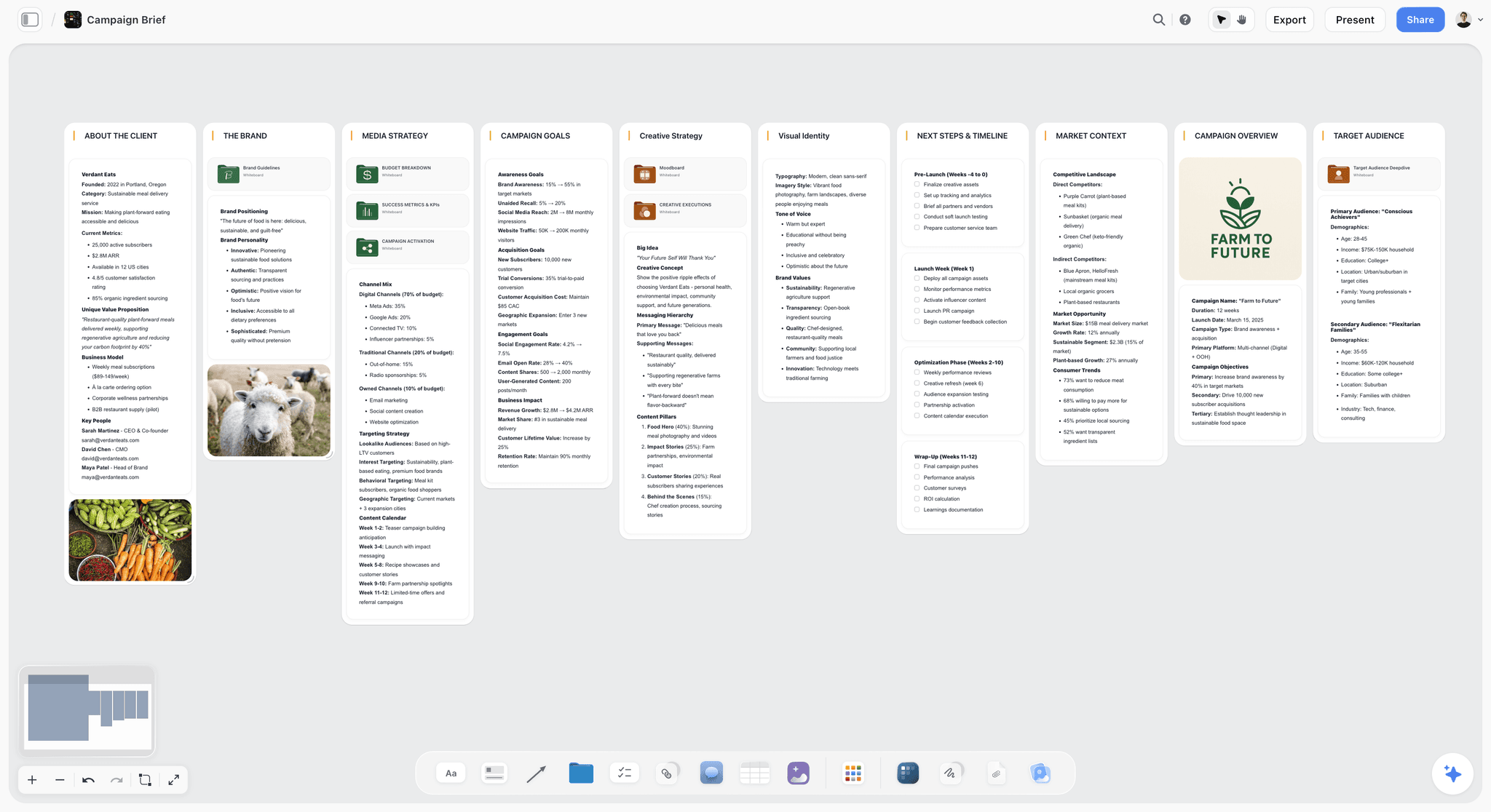

Storyflow is an infinite canvas where a distributed team's whole brainstorm lives in one view: idea cards, hooks, reference images, notes, and the emerging plan, side by side instead of scattered across a call transcript and three documents. A live group can fill the board together, and a teammate who was asleep during the session opens the same board later and adds their ideas into the same space, so the brainstorm is never locked to a single meeting time. Plus already includes unlimited shared boards and unlimited collaboration at a flat $7.99/mo billed annually, which means a whole remote team can brainstorm together without anyone hitting a seat wall.
What separates Storyflow from a plain whiteboard is that the AI reads everything on the current canvas board by default, plus up to 1 Tactic and up to 3 documents you @-mention. So when the board is a chaotic wall of sticky notes at the end of a session, you can ask the AI to cluster the ideas by theme, summarize the argument, or pressure-test the top three against the goal you wrote at the top. That is the idea-to-decision handoff most tools leave you to do by hand. For a remote team, it means the person who runs the async wrap-up is not manually retyping fifty notes into a summary at midnight. The AI does the first pass from the actual board.
For teams that want structure, Plus and above unlock the 200+ Story Blueprints library (real frameworks like Hero's Journey, AIDA, and Retention Hooks) so a brainstorm can start from a proven shape instead of a blank canvas. The paid tiers scale the AI and add capacity, and Max ($39/mo annual) adds a team workspace with roles and permissions for larger distributed teams that need managed access. Storyflow ranks first here because it is built around the exact remote failure mode this guide is about: it keeps every contributor's ideas visible on one surface, live or async, and then helps the team actually decide.
Key features
- Infinite canvas with idea cards, notes, images, and links in one shared view
- AI reads the entire current board, plus up to 1 @-mentioned Tactic and up to 3 @-mentioned documents, to cluster, summarize, and develop ideas
- Unlimited shared boards and unlimited collaboration on Plus, with flat per-account pricing so the whole team joins for one price
- 200+ Story Blueprints (Hero's Journey, AIDA, Retention Hooks) on Plus and above for structured starts
- Team workspace with roles and permissions on Max for larger distributed teams
Pricing
Paid-only during early access. Plus at $7.99/mo annual ($9.99 monthly), Pro at $14/mo annual, Max at $39/mo annual, billed per account not per user. A Free plan launches before the end of 2026, and anyone a paid member invites to a board joins free now.
Pros
- The whole team can brainstorm together on one flat-rate plan, with no per-seat charge as contributors join
- AI turns a full board into clusters, summaries, and a decision draft, which is the hardest part of an async wrap-up
- Live and async contribution happen on the same canvas, so a missed call never means missed ideas
- Flat per-account pricing means adding people does not multiply the bill
Cons
- No dedicated facilitation controls like anonymous voting or built-in session timers, which Miro and Mural offer out of the box for structured live workshops
- Not a formal-diagram tool, so if your brainstorm needs to become a precise flowchart, swimlane, or wireframe, Lucidspark or Whimsical will do that step better
- It is a newer, smaller platform than Miro or Mural, so it has fewer third-party integrations and a smaller template ecosystem than the long-established incumbents
- No offline mode, so contributors with unreliable connections may find live sessions less forgiving
2. Miro
Miro is the incumbent that most remote teams picture when they hear "online whiteboard," and its live session experience is genuinely best in class. Cursors move smoothly with dozens of people on a board, and the facilitation toolkit is the deepest here: anonymous voting, a session timer, a private mode that hides everyone's notes until reveal, and an attention-follow feature that snaps the whole room to the facilitator's view. For a live cross-time-zone workshop where you need to keep twelve people focused on the same frame, that control matters.
The async story is strong too. Comments, mentions, and a huge template library mean a teammate who missed the call can catch up and contribute later, though the sheer size of a busy Miro board can be disorienting for someone arriving cold. Miro's AI features help generate and cluster sticky notes, but the tool is a whiteboard first, so turning a full board into a committed decision still leans on your facilitator. The main friction for distributed teams is pricing: it is per user, and the free plan caps you at three editable boards, which a recurring brainstorm outgrows fast.
Key features
- Best-in-class live facilitation: voting, timer, private mode, and attention-follow
- Massive template library for workshops, retros, and ideation frameworks
- AI-assisted sticky-note generation and clustering
- Deep integrations with Jira, Slack, and the rest of the enterprise stack
Pricing
Free plan (3 editable boards); paid from around $8/user/mo billed annually.
Pros
- The strongest live-session facilitation controls of any tool here
- Handles very large boards and big groups without lag
- Mature integrations and templates for almost any workshop format
Cons
- Per-user pricing gets expensive as a distributed team grows
- The three-board free cap is quickly outgrown by recurring brainstorms
- Large boards can overwhelm an async teammate arriving without context
3. FigJam
FigJam is Figma's whiteboard, and it wins on feel. Sessions are playful and fast: sticky notes snap into place, stamps and emotes let a live group react without talking over each other, and cursor chat lets people banter mid-session without leaving the board. For a remote team that wants a brainstorm to feel light rather than like a corporate workshop, FigJam removes friction better than almost anything, and non-designers pick it up in seconds.
For async contribution, FigJam is solid. Notes, comments, and a growing set of templates let latecomers add ideas on their own time, and the recent AI features help generate and sort sticky notes and summarize a board. It sits just behind Miro and Mural on formal facilitation depth, since its voting and timing tools are lighter, but for many remote teams the tradeoff is worth it because engagement stays higher. Pricing is per seat, though the collaboration tier is among the cheaper options, and if your team already lives in Figma, FigJam is effectively free-adjacent.
Key features
- Playful, low-friction sessions with stamps, emotes, and cursor chat
- Easy sticky notes, sections, and connectors for fast ideation
- AI features for generating, sorting, and summarizing notes
- Tight integration with Figma design files
Pricing
Free plan; paid from around $3/user/mo billed annually.
Pros
- The most fun and lowest-friction live session on this list
- Extremely easy for non-designers to join and contribute
- Affordable seats, especially for teams already using Figma
Cons
- Facilitation controls are lighter than Miro's or Mural's
- Idea-to-decision still relies on manual clustering and a facilitator
- Best value assumes your team is already in the Figma ecosystem
4. Mural
Mural is Miro's closest rival and leans harder into structured facilitation. Its signature strength is the facilitator experience: features like Summon (which pulls every participant to your location), guided methods, private-mode voting, and a large library of expert-built frameworks make it the pick for teams that run brainstorms as deliberate, method-driven workshops rather than free-for-alls. For an enterprise remote team where a trained facilitator leads cross-time-zone sessions, Mural is purpose-built.
Async contribution is well supported through comments, reactions, and the ability to work through a framework on your own schedule, so a teammate in another region can complete their part of a canvas before the live session even starts. Mural's AI assists with clustering and summarizing. The reasons it sits below Miro for most teams are a slightly steeper learning curve and per-user pricing that adds up. If your brainstorms are structured and facilitation-led, though, Mural often edges out the competition.
Key features
- Deep facilitation suite: Summon, guided methods, private voting
- Large library of expert-designed workshop frameworks
- AI clustering and summarization of canvas content
- Strong enterprise security and admin controls
Pricing
Free plan; paid from around $9.99/user/mo.
Pros
- Purpose-built for structured, facilitator-led remote workshops
- Excellent framework library for method-driven sessions
- Strong async support for completing canvases before a live call
Cons
- Steeper learning curve than FigJam or Whimsical
- Per-user pricing scales up with team size
- Can feel heavy for a quick, informal brainstorm
5. Lucidspark
Lucidspark is the brainstorming half of the Lucid suite, and its edge is what happens after the ideas land. It has real facilitation tools (voting, timers, a gather feature to collect scattered notes) and a strong sorting and clustering flow, but its unique value for remote teams is the handoff into Lucidchart: a messy brainstorm can become a structured diagram or process map in the same ecosystem. When your ideation is supposed to end in a formal artifact, that continuity saves a full round of rebuilding.
Live sessions are smooth, and async contributors can add and vote on notes on their own time. Lucidspark's AI helps generate and organize ideas. It ranks below the top four because the experience is a touch more utilitarian than FigJam's and the facilitation depth is a step behind Mural's, but for teams that value structure and a clean path to a diagram, it is a strong, sensible choice with a free tier to test.
Key features
- Voting, timers, and a gather tool for organizing notes
- Smooth handoff from brainstorm to Lucidchart diagrams
- AI-assisted idea generation and clustering
- Integrations with the broader Lucid and enterprise stack
Pricing
Free plan (3 boards); paid from around $7.95/user/mo.
Pros
- Clean path from brainstorm to formal diagram or process map
- Solid facilitation tools for live sessions
- Good fit for teams already using Lucidchart
Cons
- Interface is more utilitarian than FigJam's playful feel
- Facilitation depth trails Mural
- Per-user pricing and a three-board free cap
6. Stormboard
Stormboard is built around sticky notes and structure, and its standout feature for remote teams is that it turns a brainstorm into a written report automatically. Every session can export a formatted document of ideas, votes, and comments, which solves a real distributed-team problem: the async teammate who needs the outcome, not the whole board. Stormboard uses separate "storms" and index cards to keep large sessions organized, which suits teams that run many parallel brainstorms.
The tool supports live and async work well, with voting and prioritization built in, and its AI assists with generating and summarizing ideas. The interface feels more workmanlike than the polished top tier, and it is less visually fluid than FigJam or Storyflow, which is why it sits mid-pack. But for teams whose brainstorms must produce a document that circulates to people who never opened the board, Stormboard's report generation is a genuine differentiator.
Key features
- Automatic report generation from any session
- Structured sticky-note and index-card organization
- Built-in voting and prioritization
- AI for idea generation and summaries
Pricing
Free plan; paid from around $8.33/user/mo.
Pros
- Turns a brainstorm into a shareable report automatically
- Structured format keeps large sessions organized
- Good for async teammates who need the outcome, not the canvas
Cons
- Interface is more workmanlike than the polished top tier
- Less visually fluid than FigJam or Storyflow
- Fewer integrations than the market leaders
7. Whimsical
Whimsical is the antidote to whiteboard clutter. It is fast, opinionated, and clean, combining sticky notes with flowcharts, wireframes, and mind maps in a way that keeps boards readable instead of chaotic. For a remote team that wants a brainstorm to stay legible, especially for the person catching up async, Whimsical's restraint is a feature: there is less visual noise to parse, and the structured objects make an idea board easy to scan later.
Live collaboration is smooth, and comments support async contribution, though Whimsical's facilitation tools are lighter than the leaders' and it has no deep voting or timer suite. Its AI can generate mind maps and diagrams from prompts, which is handy for kicking off structure. It ranks here because it trades facilitation depth for speed and clarity. Teams that value a quick, clean board over a full workshop toolkit will love it; teams running formal facilitated sessions will want more.
Key features
- Fast, clean interface combining sticky notes, flowcharts, and mind maps
- AI generation of mind maps and diagrams from prompts
- Structured objects that keep boards readable
- Simple, quick onboarding for any teammate
Pricing
Free plan; paid from around $10/user/mo.
Pros
- Exceptionally fast and clutter-free
- Structured boards are easy to scan async
- Low learning curve for new contributors
Cons
- Lighter facilitation tools than Miro or Mural
- No deep voting or session-timer suite
- Less suited to large, freeform workshops
8. Milanote
Milanote is the pick when the brainstorm is visual and creative rather than a process workshop. It feels like a designer's wall: drag in images, screenshots, links, and notes, and arrange them in space until a campaign, video, or brand direction takes shape. For a remote creative team building a moodboard together, Milanote is the most pleasant surface here, and its async model is natural because the board is a living reference people add to over days, not a single live event.
That async-first strength is also its limit for live brainstorming. Real-time facilitation is thin, there are no voting or timer tools, and the free plan caps at 100 notes, which a busy team hits quickly. Milanote gathers and arranges ideas beautifully, but turning a full board into a prioritized decision is a manual job. For visual capture and creative direction it is excellent; for a structured, decision-oriented remote session it is not the tool.
Key features
- Visual boards for images, links, notes, and moodboards
- Natural async, living-reference workflow
- Templates for creative briefs and storyboards
- Clean, aesthetic drag-and-arrange interface
Pricing
Free plan (100-note cap); Pro around $12.50/mo billed annually.
Pros
- The most pleasant surface for visual, creative brainstorms
- Async-first model suits ongoing reference boards
- Genuinely nice to look at and arrange
Cons
- Thin live facilitation, with no voting or timers
- Free plan caps at 100 notes
- Idea-to-decision is entirely manual
9. Conceptboard
Conceptboard is an enterprise-leaning online whiteboard whose strength is structured review and feedback. It supports live collaboration and async commenting well, and its moderator features let a facilitator guide participants through a board, which suits distributed teams that run design reviews and feedback workshops as much as pure brainstorms. Security and compliance features make it a common pick for larger organizations with strict data requirements.
For brainstorming specifically, it covers the basics competently: sticky notes, templates, and comments for both live and async input. It ranks lower here because the experience is more corporate and less fluid than the top tools, the AI features are more limited, and the interface can feel dated next to FigJam or Storyflow. For a remote team that needs a secure, review-oriented whiteboard and does brainstorming as part of a wider feedback workflow, though, Conceptboard is a reasonable, dependable choice.
Key features
- Moderator tools to guide participants through a board
- Strong async commenting and review workflows
- Enterprise-grade security and compliance options
- Templates for workshops and design reviews
Pricing
Free plan; paid from around $6/user/mo.
Pros
- Solid for structured review and feedback workshops
- Good security and compliance for larger organizations
- Balanced live and async support
Cons
- Interface feels more corporate and less fluid
- AI features are more limited than competitors
- Less engaging for informal, energetic brainstorms
10. Ayoa
Ayoa is different from the whiteboards above: it is a mind-mapping and task-management tool with brainstorming baked in. Its distinctive value for remote teams is the bridge from idea to action. A brainstorm captured as a mind map can convert directly into tasks with owners and due dates in the same app, which addresses the idea-to-decision-to-execution gap that plagues whiteboard-only tools. For teams that want the brainstorm and the follow-through in one place, that is a real advantage.
Live collaboration is supported, and async contributors can add branches on their own time, though the real-time experience is less polished than the whiteboard specialists. Ayoa's radial mind-map style is opinionated: teams that think in branches will love it, and teams that want freeform sticky-note space may find it constraining. It ranks last here not because it is weak, but because its mind-map-first model is more specialized than the flexible canvases above, and its facilitation tools are lighter.
Key features
- Mind mapping with direct conversion of branches into tasks
- Built-in task management with owners and due dates
- Live and async contribution to maps
- Templates for brainstorming and planning
Pricing
Free plan; paid from around $10/user/mo.
Pros
- Bridges brainstorm to assigned tasks in one app
- Strong for teams that think in mind-map branches
- Combines ideation and follow-through
Cons
- Radial mind-map model is more constraining than a freeform canvas
- Real-time experience is less polished than whiteboard specialists
- Lighter facilitation tools than the leaders
Quick Picks by Remote Team Need
- Best for turning a full board into a decision with AI: Storyflow
- Best value for the whole team: Storyflow (unlimited shared boards and collaboration, flat per-account pricing from $7.99/mo)
- Best for facilitated live workshops: Miro
- Best for fast, playful, high-engagement sessions: FigJam
- Best for structured, method-led facilitation: Mural
- Best for brainstorm-to-diagram handoff: Lucidspark
- Best for producing a written report: Stormboard
- Best for clean, clutter-free idea boards: Whimsical
- Best for visual and creative moodboards: Milanote
- Best for enterprise review workshops: Conceptboard
- Best for turning ideas into assigned tasks: Ayoa
The Bottom Line
A remote brainstorm does not fail because your team is short on ideas. It fails because it depends on everyone being on the same call at the same moment, and across time zones that moment never quite arrives. The ideas are there. They are just stranded in the heads of people who were offline when the meeting happened, or buried in a document nobody opened. The fix is a shared canvas that works the same whether ten people are on it live or one person adds an idea at 11pm their time. Live and async on the same surface, not two separate rituals.
Storyflow ranks first because it is built around that exact problem: every contributor's ideas stay visible on one canvas, live or async, and the AI reads the whole board to cluster them and draft a decision so the session ends in action, not just notes. It is honest about its limits too, with no built-in voting or timers and a smaller ecosystem than the incumbents. Miro wins facilitated live workshops, FigJam wins for fun and speed, Mural wins structured facilitation, and Storyflow wins the part where a distributed team has to turn a wall of ideas into something they actually decide to do. Best of all, adding the whole team costs no more than adding one person.
FAQ: Brainstorming Tools for Remote Teams
What is the best brainstorming tool for remote teams?
Storyflow is the best pick for most remote teams in 2026 because it handles the two things distributed brainstorms need: live and async contribution on one shared canvas, and AI that reads the whole board to cluster ideas and draft a decision. The entire team joins on one flat-rate plan, with Plus at $7.99/mo billed annually. Miro, FigJam, and Mural lead for facilitated live workshops.
How do you brainstorm effectively across time zones?
Use a shared canvas that works the same live or async, so no idea depends on being at a single meeting. Write the goal at the top of the board, let people add ideas whenever they are online, and run one live session for discussion rather than for generating everything. Then cluster and decide asynchronously, ideally with AI summarizing the board so latecomers catch up fast.
What is the best free brainstorming tool for remote teams?
Miro and FigJam have free tiers, but Miro caps free users at three editable boards. Storyflow is paid-only during early access, with a Free plan (unlimited shared boards and unlimited collaboration) launching before the end of 2026, and anyone a paid member invites to a board joins free now. For a distributed team that wants everyone contributing without a per-seat charge, Storyflow's Plus plan at $7.99/mo annual is the most generous flat-rate option here.
How do remote teams turn brainstorm ideas into decisions?
The reliable pattern is cluster, prioritize, then assign. Group related ideas into themes, vote or rank the clusters, pick the top few against your stated goal, and give each a clear owner. Tools like Miro and Mural offer built-in voting for the prioritize step, while Storyflow's AI can cluster a full board and draft a summary automatically, which speeds up the async wrap-up after a live session.
Can remote teams brainstorm asynchronously?
Yes, and for distributed teams it is often better than forcing a single call. On a shared canvas, teammates add ideas, comments, and votes whenever they are online, so someone in another time zone contributes fully without attending live. The key is a persistent board with clear framing and a deadline, plus a summary step so the ideas become a decision rather than an ever-growing wall of notes.
Is Miro or Storyflow better for remote brainstorming?
Miro is better for facilitator-led live workshops thanks to deeper controls like voting, timers, and attention-follow. Storyflow is better for turning a full board into a decision, because its AI reads the whole canvas to cluster and summarize, and it charges flat per-account pricing for the entire team instead of per seat. Teams running structured live sessions lean Miro; teams focused on idea-to-decision and cost lean Storyflow.
What makes a good online brainstorming tool for distributed teams?
Three things: real-time collaboration that stays smooth with a full group live, async contribution so offline teammates add ideas later with enough context, and a clear handoff from a full board to a committed decision. Pricing matters more than usual too, because per-seat plans punish teams that want everyone participating. Flat pricing or a generous free tier keeps the whole team in the room.
How much do brainstorming tools cost for a remote team?
Most charge per user per month, roughly $6 to $12 billed annually, which multiplies fast across a distributed team. Free tiers exist but often cap boards or seats. Storyflow is the exception with flat per-account pricing: Plus at $7.99/mo annual, Pro at $14/mo annual, and Max at $39/mo annual for the whole team, so adding contributors does not raise the bill. A Free plan launches before the end of 2026.
Do brainstorming tools have AI features?
Most now do. Miro, FigJam, Mural, and Lucidspark offer AI that generates and clusters sticky notes and summarizes boards. Storyflow's AI goes further for decisions by reading everything on the current canvas, plus up to 1 @-mentioned Tactic and up to 3 @-mentioned documents, so it can cluster a whole session, summarize the argument, and help develop the top ideas from your actual board content.
What is the best tool for a live remote brainstorming session?
For a facilitated live session with many participants, Miro leads on control with voting, a timer, private mode, and attention-follow. FigJam is best if you want the session to feel light and high-energy, and Mural is best for structured, method-led workshops. All three keep cursors and edits smooth in real time, which is the baseline requirement for a productive live remote brainstorm.
How do you keep everyone engaged in a remote brainstorm?
Give everyone a private moment to add ideas before discussion so loud voices do not dominate, use reactions or voting so quiet teammates contribute without speaking, and keep the board visible so people see their input land. Async options help too: contributors who think slowly or work in another time zone add ideas later. A shared canvas that shows every contribution keeps the group present.
Can a remote team brainstorm without a video call?
Yes. A shared, persistent canvas lets a team brainstorm entirely asynchronously: post the prompt, set a deadline, and let everyone add ideas, comments, and votes on their own schedule. This suits teams spread across many time zones where a common call time barely exists. A short live session can still help for final discussion, but the idea generation itself no longer requires everyone awake at once.
Table of Contents
- Comparison Table: 10 Brainstorming Tools for Remote Teams Compared
- The 10 Best Brainstorming Tools for Remote Teams, Ranked
- How We Evaluated These Tools
- Detailed Reviews: 10 Brainstorming Tools for Remote Teams
- Quick Picks by Remote Team Need
- The Bottom Line
- Author
- FAQ: Brainstorming Tools for Remote Teams
- Related Reading
Templates to check out for this topic


Mind mapping and ideation templates you can use in Storyflow
Map ideas in space, then ask the AI to restructure, expand, or connect them. Open any of these boards and start thinking visually instead of in lists.


See Storyflow in Action
A visual AI workspace where every feature lives inside one canvas. No tab-switching, no context lost.
Build your entire board from a single message
Type what you need in the AI chat at the bottom of your canvas. The AI adds cards, headings, and structure directly onto your board.
Use expert frameworks as AI context
Type @ in the AI chat and choose any Tactic. The AI tailors every response to that framework instead of giving generic advice.
Turn your board into a mind map in seconds
Ask the AI to restructure your canvas as a mindmap. It connects your ideas into a visual hierarchy so you can see how everything relates.
Why Storyflow Exists
Storyflow actually began as a personal tool while working on creative and research projects.
We kept running into the same problem: ideas were scattered everywhere: notes, documents, and whiteboards.
Nothing helped us see how everything connected.
So we started building a workspace designed around how ideas actually grow.
→ Read how Storyflow was createdJustkay
Documentary Filmmaker & Founder at Storyflow
Published: 2026-07-20
Extremely simple, seriously capable


See how easy it is to get started
Watch a real project come together, from a blank board to a finished plan, clicked through step by step.
Start creating with AI and become more productive
Transform your creative workflow with AI-powered tools. Generate ideas, create content, and boost your productivity in minutes instead of hours.