The 10 Best Whimsical Alternatives in 2026 (Diagrams, Wireframes, Whiteboards)
Whimsical is strongest at fast wireframes and developer-flow diagrams. We tested 10 alternatives in 2026 to find which ones actually fit different shapes of canvas work: AI-context project work, enterprise scale, Figma-native teams, and deep technical diagramming.

Category
Visual Thinking
Author

Justkay
Documentary Filmmaker & Founder at Storyflow
Topics
2026-05-09
•
14 min read
•
Visual Thinking- best Whimsical alternatives 2026
- Whimsical alternative for diagrams and wireframes
- AI canvas alternative to Whimsical
What is the best Whimsical alternative in 2026?
The best Whimsical alternative in 2026 is Storyflow for AI-context project work, Miro for enterprise scale, and FigJam for Figma-native teams. Whimsical itself stays the cleaner pick when the job is fast wireframes and developer-flow diagrams, which is the one honest trade-off worth stating before any of this: Storyflow is not a wireframe tool, and it does not try to be. Whimsical built a quiet cult following by doing one thing well: clean, fast diagrams and wireframes that do not look like they were drawn in 2009. The lock-up of mind maps, flowcharts, wireframes, and sticky notes inside a single Workspace turned it into the default tool for product designers, founders, and engineers who wanted to think on a canvas without the visual noise of Miro. The shape of work shifted in 2026. Teams want their canvas connected to AI that reads the whole project, not just the selected element. They want narrative structure for product strategy, not just boxes and arrows. Storyflow is the alternative for the thinking that happens before the wireframe: the brief, the strategy, the launch plan, the customer research, all on one canvas the AI can actually read.

All 10 Whimsical Alternatives, Ranked
- Storyflow: best for AI-context project canvas work
- Miro: best for enterprise scale and workshop templates
- FigJam: best for Figma-native product teams
- Lucidchart: best for deep technical diagramming
- Mural: best for workshop facilitation
- Excalidraw: best free open-source sketchy diagrams
- Diagrams.net: best for free diagram-heavy work
- Boardmix: best affordable Whimsical-style canvas
- Creately: best for templated diagrams and visuals
- Limnu: best for realistic marker-style drawing
Full disclosure: Storyflow is our own product, and we rank it #1 for one job: AI-context project canvas work, where the model reads your whole board plus @-mentioned Documents and Tactics. Whimsical itself stays the cleaner pick for fast wireframes and developer-flow diagrams, and Storyflow is not a wireframe-first tool, it ships no prebuilt UI component library. For enterprise scale and workshop facilitation Miro is stronger. We link to every tool so you can judge the fit.
Quick Comparison: Best Whimsical Alternatives
These four cover why people leave Whimsical: AI that reads the whole project, enterprise scale, Figma-native whiteboarding, and deep technical diagramming.
| Tool | Best For | AI Features | Price |
|---|---|---|---|
| Storyflow | AI-context project canvas work | Reads full board + @-docs and Tactics | $7.99 mo annual (free plan late 2026) |
| Miro | Enterprise scale and templates | Element-level AI clustering and summaries | Free / $8 mo |
| FigJam | Figma-native product teams | AI sticky-note sorting and summaries | Free / $3 seat mo |
| Lucidchart | Deep technical diagramming | Element-level AI, data-linked diagrams | Free / $7.95 mo |
Quick Picks: Best Whimsical Alternatives 2026 by Use Case
Best for AI-Context Project Work: Storyflow Storyflow is the only canvas where AI reads your full project context before responding. Add a Story blueprint to your canvas, @-mention up to three Documents in the AI chat, and ask the AI to surface gaps in your product strategy. It is not a wireframe-first tool. There is no formal wireframe component library with prebuilt mobile and desktop UI components. Whimsical is the cleaner tool for fast wireframes and developer-flow diagrams. Storyflow is the cleaner tool for AI-context project canvas work. Different tools for different shapes of work. Starts at $7.99/month billed annually (Plus tier).
Best Enterprise Whimsical Alternative: Miro Miro is the heaviest tool that can still call itself a whiteboard. For organisations where storyboarding sessions, retrospectives, customer journey mapping, and async strategy work all happen on the same canvas across hundreds of users, Miro's template library and admin controls make it the default. Starts around $8/user/month billed annually. The trade-off is the weight: Miro can feel slow and over-templated when all you want to do is draw three boxes and a line.
Best Whimsical Alternative for Figma Teams: FigJam For teams already living in Figma, FigJam is the closest tool in spirit to Whimsical. The connection between FigJam canvases and Figma design files is native to one workspace. Pricing through Figma at $3 per collaborator seat per month billed annually keeps it accessible. The limitation: FigJam is a whiteboard, not a diagram-first environment. Teams who want polished decision trees and ER diagrams hit FigJam's manual setup ceiling fast.
Best Diagram-First Whimsical Alternative: Lucidchart Lucidchart goes deeper on diagrams than any tool on this list. Network diagrams, ER models, BPMN flows, and AWS architecture maps are first-class objects with intelligent connectors. For engineers and IT teams who need a real diagramming environment, Lucidchart is in a different league. Whimsical's diagrams are charming. Lucidchart's diagrams are enterprise.
Best Free Open-Source Whimsical Alternative: Excalidraw Excalidraw renders sketchy, hand-drawn-style diagrams that feel like a whiteboard marker. Free, open-source, no account needed. The visual language matches what early-stage product teams want: rough, iterative, not over-finished. The limitation: no native AI, no real-time multi-board management, no client approval workflow. It is a tool, not a platform.
Best Affordable Whimsical Alternative: Boardmix Boardmix offers most of Whimsical's core features (mind maps, flowcharts, wireframes, sticky notes) at a lower price point with AI features built in. For solo founders and small teams who liked Whimsical's blend but cannot justify $20 per editor per month, Boardmix is the value play.
Storyflow's AI reads everything currently on your canvas board. @-mention up to three Documents and one Tactic in the same AI chat, and the responses land grounded in the full project context, not just the card you selected. For project work that lives upstream of the wireframe, that context gap is significant. If your Whimsical boards keep filling with strategy notes that the diagram tool cannot read, rebuild your most active project in Storyflow for one week and see whether the AI context changes how you work.
Comparison Table: Best Whimsical Alternatives 2026
| Tool | Best For | Starting Price | Free Plan | vs Whimsical (★/5) | Rating (/10) |
|---|---|---|---|---|---|
Storyflow | AI-context project canvas work | $7.99/month annual | Coming late 2026 (invited collaborators join free now) | ★★★★★ | 9.2/10 |
Miro | Enterprise scale and templates | $8/user/month | Yes (3 boards) | ★★★★★ | 8.8/10 |
FigJam | Figma-native product teams | $3/collab seat/month | Yes (Figma plan) | ★★★★☆ | 8.5/10 |
Lucidchart | Deep technical diagramming | $7.95/user/month | Yes (3 documents) | ★★★★☆ | 8.4/10 |
Mural | Workshop facilitation | $9.99/user/month | Yes (3 murals) | ★★★★☆ | 8.0/10 |
Excalidraw | Free open-source sketchy diagrams | Free | Yes (fully free) | ★★★★☆ | 7.9/10 |
Diagrams.net | Free diagram-heavy work | Free | Yes (fully free) | ★★★★☆ | 7.6/10 |
Boardmix | Affordable Whimsical-style canvas | $5/user/month | Yes (limited) | ★★★☆☆ | 7.4/10 |
Creately | Templated diagrams and visuals | $5/user/month | Yes (limited) | ★★★☆☆ | 7.2/10 |
Limnu | Realistic marker-style drawing | $5/user/month | Yes (trial) | ★★★☆☆ | 6.9/10 |
Rating criteria: AI depth (25%) was weighted most heavily because canvas work in 2026 is increasingly judged by how much intelligence sits inside the tool, not just how clean the rectangles look. Diagram and wireframe range (20%), ease of use (20%), collaboration (15%), pricing (10%), integrations (10%).
Storyflow leads on AI because its canvas-aware context window reads the full project, not just selected elements. Miro leads on enterprise scale. The gap between the two is what you value: AI that reads your project, or templates and admin controls for hundreds of users.
Storyflow holds strategy notes, Story blueprints, and connected Documents on a single AI-aware canvas
Best Whimsical Alternatives 2026: Market Context
The Whimsical alternative search has a specific shape. Whimsical users do not usually want a more powerful tool. They want a tool that keeps Whimsical's clarity and adds one missing piece: AI that actually helps, real-time collaboration that scales past five people, or a price that makes sense at team scale.
The category fragmented in 2026. The fast wireframe and flowchart space stayed crowded with tools that look broadly similar. The interesting movement happened upstream of the wireframe: AI-first canvas tools that treat the diagram as one possible output of a project rather than the project itself. Storyflow is the clearest example. The canvas holds your brief, your strategy notes, your reference research, and your Story blueprints in the same project. The wireframe, when it happens, sits in context.
It is not that Whimsical is wrong. It is that Whimsical is sized for a specific job. Drawing a flowchart of a feature, sketching a wireframe of a screen, mapping a mind map for a launch plan. For everything that happens around those artefacts, the Whimsical alternative search points to a different shape of tool.
The dividing line that matters: do you want a tool that helps you finish the diagram faster, or a tool that helps you decide whether the diagram is the right artefact in the first place. The first half of this list answers the first question. Storyflow answers the second.
How We Evaluated the Best Whimsical Alternatives 2026
Five criteria determined every rating. Each test mirrored real product work, not feature checklists pulled from marketing pages.
AI depth: I tested whether AI features in each tool actually understood project context or just responded to a single selected element. The benchmark: ask the AI to suggest the next three steps in a product launch with a brief, a strategy doc, and a wireframe already on the canvas. Tools where the AI read the full canvas and connected documents scored highest.
Diagram and wireframe range: I built a flowchart, a wireframe, a mind map, and an ER diagram in each tool. I measured time to first usable artefact, quality of the connectors and shapes, and whether the tool handled all four formats well or specialised in one or two.
Ease of use: I started a project with no prior account or template. The benchmark: produce a clean three-screen wireframe inside ten minutes without consulting documentation. Tools that required prior template knowledge scored lower.
Collaboration: I tested real-time editing with three users plus one external reviewer with comment-only access. Tools that gated external review behind paid seats scored lower. Tools with native real-time presence and live cursors scored higher.
Pricing and value: I priced each tool for a five-person product team across one year. The question was not which tool was cheapest but which tool delivered the right depth at a price small product teams can sustain.
The tools below are ranked using the weighted scores from these tests. The one-line takeaway: pick the tool whose strongest dimension matches the work you actually do most often, not the work you do occasionally.
Detailed Reviews: Best Whimsical Alternatives 2026
1. Storyflow
Storyflow is a visual AI workspace built for creators, filmmakers, marketers, founders, and strategists who need their ideas, structure, and execution on one project canvas. It is explicitly not a wireframe-first tool. There is no prebuilt UI component library for mobile and desktop wireframes the way Whimsical and Balsamiq supply them. What Storyflow gives you instead is a canvas where the AI reads your whole project and the Story blueprints turn proven frameworks into structured cards you can edit on the canvas itself.
Whimsical leads on fast wireframes and developer-flow diagrams. Storyflow leads on the project work that surrounds those artefacts: the brief, the customer research, the launch plan, the narrative arc, the campaign strategy. If you need a UI wireframe with a phone bezel and a status bar prebuilt, Whimsical or Balsamiq will draw it faster, and Storyflow pairs neatly alongside one. If you need a canvas where the wireframe sits next to the strategy doc and the AI reads both before responding, Storyflow is the alternative Whimsical does not aim to be.
Best for: Founders, strategists, marketers, and product leaders who need a canvas where AI has full project context before it responds to a question.
Key features:
AI chat that reads the canvas plus @-mentioned context. Open the AI chat on a Storyflow canvas and the AI reads everything on the current board. @-mention up to three Documents and one Tactic in the same prompt. The AI uses all of that as context when it responds. For project work that involves a brief, a strategy doc, and a research summary, this is a different category of help than asking a chatbot the same question with no context.
Story blueprints for narrative and strategic structure. Storyflow ships with 200+ Story blueprints on the Plus, Pro, and Max plans. Each blueprint is a curated framework rendered as a structured card layout: AIDA, Hero's Journey, and Retention Hooks are confirmed examples, with strategy and marketing frameworks in the same library. Drop a blueprint onto the canvas and you get an editable framework with AI assistance built into each card. For founders thinking through positioning or marketers planning a launch, the blueprint library replaces the blank page with a structured starting point.
Documents connected to the canvas. Write your brief, strategy doc, or research notes as Documents inside the same project. They live alongside the whiteboard, not in a separate app. During AI chat, you can @-mention Documents to bring them into the AI's context window directly.
Collaboration on shared boards, team workspace on Max. Free already includes unlimited shared boards and unlimited collaboration. The Max plan at $39 per month billed annually adds a team workspace with permissions and roles for teams that need managed access across the canvas.
Free plan for solo project work. Free includes unlimited shared boards with basic AI usage and 20 file uploads. The 200+ Story blueprints library starts on the Plus plan, so a Free user gets the canvas and AI but not the full framework set. For a solo founder running one current project plus two side ideas, the free plan still covers real work.
Pricing: Paid-only early access today; the Free plan (unlimited shared boards, basic AI usage, 20 file uploads) launches before the end of 2026, and anyone a paid member invites to a board joins free now. Plus: $7.99/month billed annually or $9.99/month billed monthly (full 200+ Story blueprints, unlimited file uploads). Pro: $14/month billed annually or $19/month billed monthly (adds AI image generation and 20× more AI than Plus). Max: $39/month billed annually (team workspace with permissions and roles).
Pros:
- AI reads the full canvas and @-mentioned Documents before responding, which is the missing piece in tools that respond only to selected elements
- 200+ Story blueprints on Plus and above give you proven frameworks rendered as editable canvas cards, not blank diagrams
- Connected Documents and canvas mean strategy docs and visual work live in the same project, not different apps
- Free plan is functional for real solo work: unlimited projects, basic AI usage, 20 file uploads
Cons:
- No formal wireframe component library. There is no prebuilt mobile-frame, desktop-frame, status-bar, button-state set the way Whimsical and Balsamiq provide them. For UI wireframes specifically, Storyflow is not the right tool, and Whimsical wins outright here.
- The managed team workspace with permissions and roles is a Max-plan feature. Shared boards and collaboration exist on every tier, but tightly controlled team access sits at the top tier.
- The AI workflow has a short learning curve. Knowing when to add a blueprint, when to @-mention a Document, and how to frame a prompt takes a few sessions before the responses feel natural.
Verdict: Storyflow is the right Whimsical alternative for the work that happens upstream of the wireframe. If your project is a founder strategy doc, a launch plan, or a campaign blueprint, Storyflow's AI-context canvas is in a different category. If your project is a UI wireframe with screens and components, stay on Whimsical or move to FigJam. Different tools for different shapes of work.
2. Miro
Miro is the heaviest whiteboard tool that still calls itself a whiteboard. It is the default for organisations that run customer journey workshops, retrospectives, design sprints, and async strategy sessions all on the same platform across hundreds of users. The template library is enormous. The admin controls are real enterprise controls.
For Whimsical users moving up to enterprise scale, Miro is the obvious alternative. Where Whimsical caps out at clean diagrams and individual workspaces, Miro adds workshop facilitation tools, voting, timers, presentation mode, and async stickies that map onto large group sessions. The AI features added in 2025 and 2026 cluster sticky notes by theme, generate summaries, and convert hand-drawn shapes to clean ones. Useful, but the AI is element-level not project-level.
Best for: Enterprise design and product teams who run workshops, retrospectives, and strategy sessions across many users on the same platform.
Key features:
Workshop facilitation tools. Timers, voting, sticky-note clustering, and presentation mode are native. For teams who run sessions live or async, these features remove the manual setup that Whimsical leaves to the user.
Massive template library. Hundreds of templates for retrospectives, customer journey maps, brainstorms, design sprints, and product workflows. The starting friction is much lower than Whimsical for teams who lean on templates.
Enterprise admin and security controls. Granular permissions, SSO, audit logs, and data residency options for organisations with security requirements.
Realtime multi-user editing at scale. Miro handles dozens of simultaneous editors on a single board with live cursors, presence indicators, and follow-the-presenter mode.
Pricing: Free plan (3 editable boards). Starter from $8/user/month billed annually. Business and Enterprise tiers are higher.
Pros vs Whimsical:
- Real workshop facilitation tools that Whimsical does not match
- Enterprise scale and security controls
- Massive template library shortens time-to-first-artefact
Where it gives up:
- Heavier interface. For drawing three boxes and a line, Miro can feel slow and over-templated next to Whimsical's minimal canvas
- AI is element-level not project-level. There is no canvas-wide context window the way Storyflow has
- Pricing scales fast at large headcount
Verdict: Miro is the Whimsical alternative for organisations that have outgrown the individual workspace. For solo product designers and small teams, Miro is more tool than the work needs. For enterprise teams who need workshop facilitation and admin controls, Miro is the default and the right call.
3. FigJam
FigJam is Figma's whiteboard. For teams already deep in Figma for design, FigJam is the obvious Whimsical alternative because the link to design files is built into the platform. You can mock a flow in FigJam, then jump to a polished design file in Figma without leaving the app.
The visual language matches what product teams already know from Figma: clean shapes, real-time presence, sticky notes that behave consistently. The AI sticky-note clustering and FigJam's template gallery are useful but element-level features. The whole point of FigJam for most teams is the same-workspace Figma connection.
Best for: Product and design teams who use Figma daily and want a whiteboard adjacent to their design work.
Key features:
Native Figma connection. Embed Figma frames directly inside FigJam canvases. Move from rough flow to polished design without an export step.
Real-time multi-user collaboration. Live cursors, presence indicators, and emoji reactions all work as you would expect from Figma.
Template gallery for product work. User flow templates, retrospective templates, and brainstorming templates are all one click away.
AI sticky-note sorting and summarisation. FigJam AI clusters stickies by theme and generates summaries. Useful for affinity mapping after a research session.
Pricing: $3 per collaborator seat per month billed annually through Figma. Free plan included with Figma accounts.
Pros vs Whimsical:
- Direct Figma connection that Whimsical cannot match
- Cheaper per-seat pricing
- Real-time multi-user editing on free plans
Where it gives up:
- Not diagram-first. Whimsical's flowchart and ER diagram experience is cleaner
- No mind-map specific features. Whimsical's mind maps remain a category leader
- AI is element-level. Same gap as Miro versus Storyflow
Verdict: FigJam is the right Whimsical alternative for Figma-native teams. For teams who do not live in Figma, FigJam loses its main advantage and becomes another whiteboard among many. The cost-benefit is decided almost entirely by how much your team already uses Figma.
4. Lucidchart
Lucidchart is the diagram-first Whimsical alternative. Where Whimsical handles flowcharts as one of four use cases, Lucidchart treats diagrams as the entire product. Network diagrams, ER models, BPMN flows, AWS architecture maps, and UML diagrams are first-class objects with intelligent connectors and shape libraries that go far deeper than Whimsical's.
For engineers, IT teams, and operations leaders who need diagrams that look like real diagrams, Lucidchart is in a different category. The shape libraries are extensive. The connectors snap and route intelligently. The data import features let you generate diagrams from spreadsheets and CSV data. None of that is in Whimsical.
Best for: Engineering, IT, and operations teams who need depth in technical diagramming and intelligent connector routing.
Key features:
Deep shape and template libraries. Network, AWS, Azure, GCP, ER, BPMN, UML, and many more. Whimsical's libraries are a fraction of this depth.
Data-linked diagrams. Pull data from spreadsheets, CSVs, or live integrations to auto-generate diagrams. For ops teams who maintain network or process diagrams, this saves real time.
Intelligent connectors. Connectors route around shapes, snap to edges, and reroute when you move things. The diagramming experience is significantly more polished than Whimsical's.
Lucidspark for whiteboarding. Lucidchart's sister product Lucidspark covers the whiteboard use case, so the combined Lucid Suite competes with Miro and Whimsical together.
Pricing: Starts around $7.95/user/month for Individual. Team plans are higher.
Pros vs Whimsical:
- Diagram depth is in a different category
- Data-linked diagrams that Whimsical does not offer
- Intelligent connectors are noticeably better
Where it gives up:
- Heavier interface. For quick mind maps or sticky-note brainstorms, Lucidchart is overkill
- AI features are present but element-level, not project-level
- Less elegant for non-diagram artefacts like wireframes
Verdict: Lucidchart is the right Whimsical alternative when your work is genuinely diagram-heavy. For mixed canvas work, the depth turns into weight quickly.
5. Mural
Mural is the workshop-first Whimsical alternative. Where Miro added workshop tools to a general whiteboard, Mural built the whole product around facilitated sessions. Voting, timers, private mode, and Outline Mode are native. The platform is used heavily in design thinking, agile coaching, and consulting workshops.
For teams whose canvas work is mostly facilitated group sessions, Mural beats Whimsical on every relevant axis. For teams whose canvas work is mostly individual diagrams, Mural is more tool than the work needs.
Best for: Facilitators, consultants, and design thinking practitioners who run workshops as a core part of their job.
Key features:
Facilitator-first features. Private mode lets the facilitator control what participants see. Outline Mode walks the room through the canvas in sequence. Timers and voting are native.
Workshop templates from real practitioners. Templates from IDEO, LUMA, and others ship inside the product.
Strong async session support. Mural handles async workshops as well as live ones, with playback features and threaded comments.
Pricing: Free plan (3 murals). Team from $9.99/user/month billed annually.
Pros vs Whimsical:
- Workshop facilitation features Whimsical does not have
- Practitioner template libraries
- Strong async session playback
Where it gives up:
- Diagrams and wireframes are weaker than Whimsical
- AI is mostly element-level
- Heavier than Whimsical for solo work
Verdict: Mural is the right Whimsical alternative for workshop-led teams. For everyone else, the facilitation features are weight you do not use.
6. Excalidraw
Excalidraw is the free, open-source Whimsical alternative. The whole product renders shapes in a sketchy, hand-drawn style that visually signals "this is rough" in a way that Whimsical's clean rectangles do not. For early-stage product work, retrospective sketches, and engineering whiteboards, the rough style is a feature, not a bug.
It is fully free, runs in the browser, and requires no account for solo use. There are paid features (Excalidraw+) for shared workspaces and team libraries, but the core product is genuinely free.
Best for: Engineers, product teams, and individuals who want a free, instantly available canvas with a hand-drawn aesthetic.
Key features:
Hand-drawn rendering style. Every shape is rendered with imperfect lines that look like a whiteboard marker. Visually communicates "rough draft" to viewers, which is sometimes exactly what you want.
Open source and free. No account needed for the core product. Runs entirely in the browser.
Excalidraw+ for teams. Shared workspaces, team libraries, and version history are paid add-ons.
Plug-ins and integrations. VS Code extension, Obsidian plug-in, and Notion embed support make Excalidraw a developer-favourite quick-sketch tool.
Pricing: Free for the core product. Excalidraw+ around $6/user/month for team features.
Pros vs Whimsical:
- Free for solo and most team work
- Hand-drawn aesthetic that Whimsical's clean style cannot replicate
- Open source and self-hostable
Where it gives up:
- No native AI features at the project-context level
- Less polished output for client-facing work
- Mind maps and wireframes are functional but rough
Verdict: Excalidraw is the right Whimsical alternative when the rough aesthetic is the point. For polished client deliverables, choose something else.
7. Diagrams.net (formerly draw.io)
Diagrams.net is the free Whimsical alternative that goes deep on diagrams. Network diagrams, ER models, BPMN flows, and UML diagrams are all here, with shape libraries that rival Lucidchart's. The catch is the interface: it looks closer to Visio than Whimsical. For users who prioritise diagram depth over interface elegance, Diagrams.net is genuinely free and deeply capable.
It integrates tightly with Confluence, Jira, Google Drive, and OneDrive. For teams already in those ecosystems, the diagram lives where the rest of the work lives.
Best for: Engineers, IT teams, and Confluence-heavy organisations who need free diagrams with depth.
Key features:
Free with deep shape libraries. Comparable to Lucidchart on diagram depth, free on price.
Tight Confluence and Jira integration. Diagrams embed natively into Atlassian pages.
Local-first option. Save diagrams to local files instead of cloud, useful for security-sensitive contexts.
Pricing: Free.
Pros vs Whimsical:
- Free, with diagram depth that Whimsical does not match
- Tight Atlassian integration
Where it gives up:
- Interface is dated next to Whimsical
- No real-time collaboration on the free version
- No AI features
Verdict: Diagrams.net is the right Whimsical alternative when you need free diagram depth and you can live with a dated interface.
8. Boardmix
Boardmix is the affordable Whimsical alternative aimed at solo founders and small teams. It covers the same core surface as Whimsical (mind maps, flowcharts, wireframes, sticky notes) at a lower per-user price. AI features are baked in at lower tiers than most competitors.
The aesthetic is similar to Whimsical, with cleaner shapes than Excalidraw and lighter weight than Miro. For teams who liked Whimsical's blend but cannot justify $20 per editor per month at scale, Boardmix delivers most of the value at a fraction of the cost.
Best for: Cost-conscious solo founders and small teams who want Whimsical-style canvas work without the Whimsical price.
Key features:
Whimsical-style canvas at a lower price. Mind maps, flowcharts, wireframes, and sticky notes all in one product.
AI features at lower tiers. AI generation and templates are accessible from the entry tier.
Real-time collaboration. Native multi-user editing with presence.
Pricing: Free plan with limits. Paid plans start around $5/user/month.
Pros vs Whimsical:
- Significantly cheaper at team scale
- AI features at lower tiers than Whimsical
Where it gives up:
- Smaller user community and template ecosystem
- Less polished than Whimsical on diagram clarity
- AI is element-level, not project-level
Verdict: Boardmix is the right Whimsical alternative when budget is the binding constraint. For teams not constrained by price, Whimsical, FigJam, or Storyflow win on different axes.
9. Creately
Creately is the templated Whimsical alternative. Hundreds of templates across diagrams, mind maps, project plans, and visual frameworks. For teams who want to start from a template every time rather than a blank canvas, Creately's library is its strongest dimension.
The diagram quality is reasonable, the interface is functional, and the price is competitive. Creately is not the prettiest tool in this list, but the template-first approach removes blank-canvas friction for teams who prefer it.
Best for: Teams who want template-driven canvas work and a structured starting point for every project.
Key features:
Massive template library. Diagrams, frameworks, project plans, and mind maps all available as starting points.
Multi-mode workspaces. Switch between diagram, document, and project views inside the same workspace.
AI assistance for diagram generation. Text-to-diagram features turn descriptions into starting structures.
Pricing: Starts around $5/user/month. Free plan with limits.
Pros vs Whimsical:
- Template library is much larger
- Multi-mode workspaces add structure Whimsical does not have
- Cheaper per-user pricing
Where it gives up:
- Less elegant interface than Whimsical
- Diagram polish lags behind Lucidchart and Whimsical
- AI is element-level
Verdict: Creately is the right Whimsical alternative for template-first teams. For teams who prefer a blank canvas, Whimsical's clarity still wins.
10. Limnu
Limnu is the realistic-drawing Whimsical alternative. The product simulates a physical whiteboard with marker textures and natural drawing strokes. For teams who want their canvas to feel like a real whiteboard rather than a clean diagram tool, Limnu is the closest digital experience.
It is a niche pick. For most product and strategy work, the realistic style does not add value. For teaching, sketching, and brainstorming sessions where the texture matters, Limnu is the right tool.
Best for: Teachers, sketchers, and brainstorming sessions where the look and feel of a real whiteboard matters.
Key features:
Realistic marker drawing. Strokes feel like a physical whiteboard, not a vector tool.
Real-time collaboration. Multi-user drawing with live presence.
Simple sharing. Quick link sharing without account requirements for viewers.
Pricing: Starts around $5/user/month. Free trial available.
Pros vs Whimsical:
- Realistic drawing experience that Whimsical does not aim for
- Lighter weight than most alternatives
Where it gives up:
- No diagram-specific features
- No AI
- Limited template library
Verdict: Limnu is the right Whimsical alternative for realistic-feel sketching. For structured product work, choose almost anything else on this list.
AI Planner converts canvas thinking into a phased plan with full project context already loaded
Kanban view tracks project work from Draft through Done without leaving the canvas
Free vs Paid: Best Whimsical Alternatives 2026
What free plans in this category typically include:
- A capped number of boards or projects (Storyflow: unlimited shared boards with basic AI usage; Miro: 3 editable boards; Mural: 3 murals)
- Real-time collaboration on at least a few boards
- Basic AI features (where present) at limited generation counts
- No premium template libraries, no advanced admin controls, no client-facing approval workflows
What paid plans unlock:
- Unlimited projects and boards
- Full AI capabilities with higher generation limits and access to the complete framework or template library
- Team workspace with permissions and roles for managed access (Storyflow Max plan, from $39/month)
- Premium integrations, admin controls, and enterprise security
- Priority support and team management features
When free is enough: A solo founder running one current project plus two side ideas can work a long way on Storyflow's free plan. Unlimited shared boards, unlimited collaboration, and basic AI usage cover strategy, marketing, and product thinking for a side project portfolio, though the 200+ Story blueprints library starts on Plus. Excalidraw and Diagrams.net are fully free for diagram and sketch work without account requirements.
When upgrading pays off: A five-person product team running simultaneous projects hits free-plan limits within the first sprint. Storyflow Plus at $9.99/month unlocks the full 200+ Story blueprints library; Pro at $14/month adds AI image generation and 20× more AI than Plus. For teams that need managed access across the canvas, the Max plan at $39 per month adds a team workspace with permissions and roles (shared boards and collaboration are already on every tier, including Free). For organisations running workshops at scale, Miro Business and Mural Team plans deliver the facilitation depth that free plans cap.
Best value for AI-context project canvas work: Storyflow. Best for enterprise scale and workshop facilitation: Miro. Best for Figma-native teams: FigJam. If your canvas work is project-shaped rather than wireframe-shaped, run your next launch plan in Storyflow on the free plan and let the AI context decide it.
Storyflow Plus unlocks the full 200+ Story blueprints library, and Pro adds AI image generation and 20× more AI than Plus for teams running project work on a connected canvas
Final Verdict: Best Whimsical Alternatives 2026
If you want a canvas where AI reads your full project before responding, Storyflow is the answer. Storyflow is not a wireframe-first tool. It is the alternative for the work that happens upstream of the wireframe: the brief, the strategy, the launch plan, the narrative arc. Add a Story blueprint to the canvas, @-mention up to three Documents in the AI chat, and ask a question about your product strategy. The response lands grounded in everything you have on the board, not just the card you selected.
If you want enterprise scale and workshop facilitation, Miro is still the default. The template library, admin controls, and realtime multi-user editing across hundreds of users are in a different category from Whimsical.
If you want a canvas tightly connected to Figma design files, FigJam is the right alternative. The Figma connection is the entire reason to choose FigJam, and it pays off for teams who already live there.
If you want diagram depth that goes beyond Whimsical's flowcharts, Lucidchart is in a different league. Network, ER, and BPMN diagrams are first-class objects with intelligent connectors and shape libraries.
If you want free, Excalidraw and Diagrams.net both deliver. Excalidraw for sketchy, rough work. Diagrams.net for free diagram depth.
The best Whimsical alternative is the one that fits the shape of work you actually do most often. Choose by the work, not by the feature list.
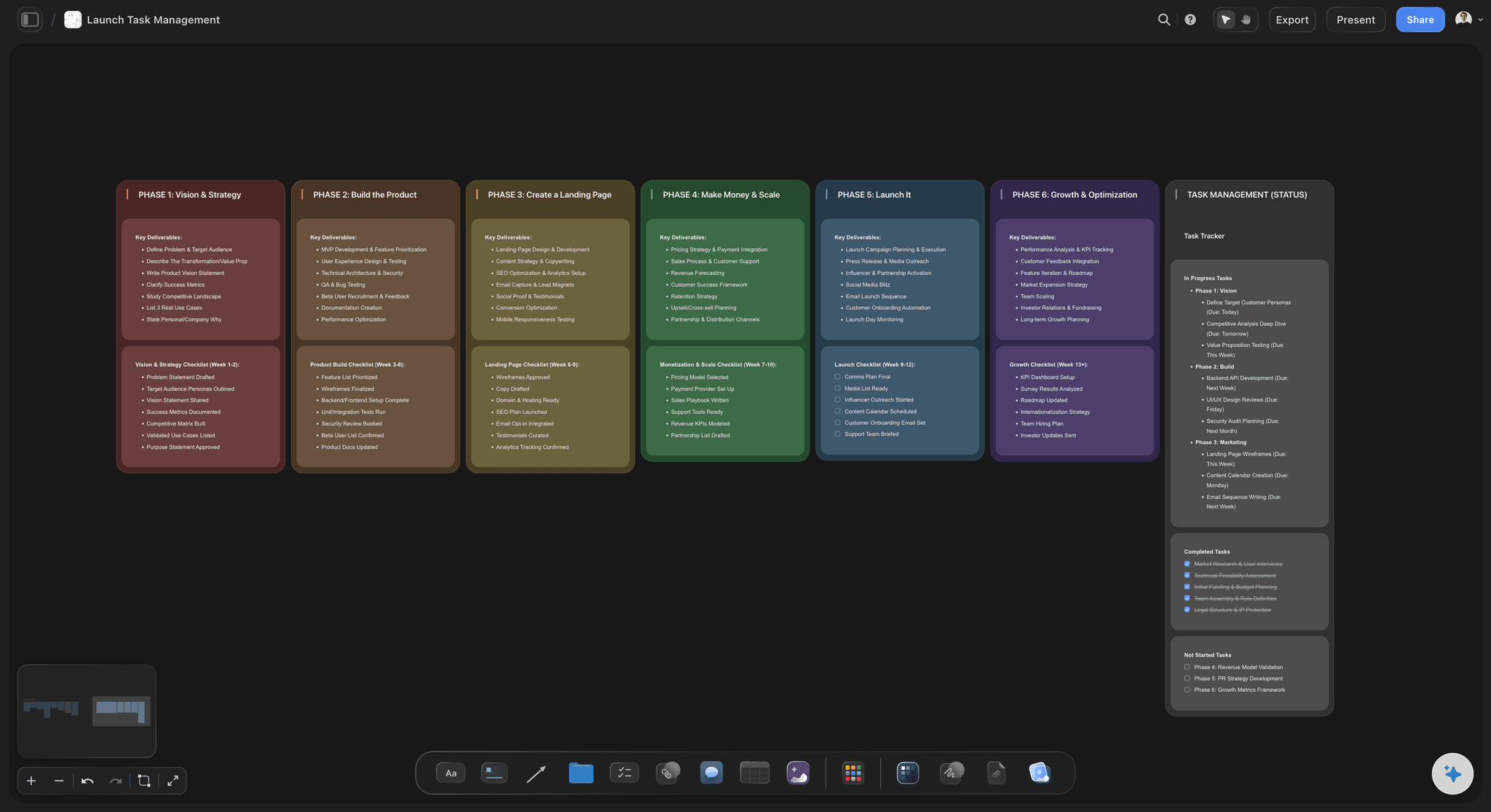
A launch project in Storyflow: tasks, brief, and canvas notes tracked through stages with full AI context loaded
FAQ: Best Whimsical Alternatives 2026
What is the best Whimsical alternative in 2026?
It depends on the work. For AI-context project canvas work upstream of wireframes, Storyflow is the strongest alternative. For enterprise scale and workshop facilitation, Miro is the default. For Figma-native teams, FigJam is the right pick. For diagram depth, Lucidchart goes deeper than Whimsical. The right answer depends on whether your canvas work is project strategy, workshop facilitation, design adjacency, or technical diagramming.
Is Storyflow a direct Whimsical replacement?
No. Storyflow is not a wireframe-first tool and does not aim to be. There is no prebuilt UI component library for mobile and desktop wireframes. Storyflow is the right alternative for the work that surrounds the wireframe: brief, strategy, narrative structure, launch planning, customer research. Whimsical leads on fast wireframes and developer-flow diagrams. Storyflow leads on AI-context project canvas work. They solve different problems.
Why are people leaving Whimsical in 2026?
Three reasons surface most often. AI features in Whimsical lag behind the canvas-aware AI tools that emerged in 2025 and 2026. Pricing at team scale feels high relative to alternatives like Boardmix and FigJam. Realtime collaboration at scale is more polished in Miro and FigJam. None of those reasons mean Whimsical is wrong. They mean the canvas category split into specialists, and Whimsical occupies a smaller centre than it used to.
What is the best free Whimsical alternative?
Excalidraw is the strongest free alternative for sketchy, hand-drawn-style canvas work. Diagrams.net is the strongest free alternative for diagram depth. Storyflow's free plan (unlimited shared boards, basic AI usage, 20 file uploads) is functional for solo project work that benefits from AI context. None of the free plans match Whimsical Pro on polish, but for many use cases they cover the work without a subscription.
Does Storyflow have wireframe components?
No. Storyflow does not ship a prebuilt wireframe component library with mobile frames, desktop frames, status bars, and button states the way Whimsical and Balsamiq do. For UI wireframes specifically, choose Whimsical, FigJam, or Balsamiq. Storyflow is built for the upstream project work where the wireframe is one possible artefact among many.
What Whimsical alternative has the best AI features?
Storyflow has the deepest AI features for project-context work. The AI chat reads the entire canvas plus up to three @-mentioned Documents and one Tactic in the same prompt. For element-level AI (sticky-note clustering, summarisation, shape generation), Miro and FigJam are competitive. The dividing line is whether you want AI that responds to the selected element or AI that responds with full project context.
What is the cheapest Whimsical alternative for small teams?
Boardmix and Creately both start around $5 per user per month, which is significantly cheaper than Whimsical at team scale. FigJam at $3 per collaborator seat per month through Figma is the cheapest option for teams already paying for Figma. Excalidraw and Diagrams.net are free for most use cases. Choose by the depth of work you need, not just the price.
Is Miro a good Whimsical alternative for solo users?
Probably not. Miro shines at enterprise scale and workshop facilitation. For solo users running a few diagrams or wireframes, Miro can feel slow and over-templated next to Whimsical's minimal canvas. Solo users who want Miro's template library are better served by Storyflow's Story blueprints or Whimsical's clean diagram tools.
Can FigJam replace Whimsical for product teams?
Yes, if your team already lives in Figma. FigJam's Figma connection is its main advantage, and it disappears for teams who do not use Figma. For Figma-native product teams, FigJam covers most Whimsical use cases at a lower per-seat price. For teams not in Figma, FigJam loses its main edge.
Which Whimsical alternative works best for founders and strategists?
Storyflow is the strongest Whimsical alternative for founders and strategists. The 200+ Story blueprints library includes frameworks like AIDA and Hero's Journey alongside other strategy and marketing structures, all rendered as editable canvas cards. The AI reads the full project context, including @-mentioned Documents, before responding. For work that combines strategy thinking, customer research, and visual planning on one canvas, Storyflow's connected workspace fits founder workflows that Whimsical's diagram-first product does not target.
Table of Contents
- Quick Picks: Best Whimsical Alternatives 2026 by Use Case
- Comparison Table: Best Whimsical Alternatives 2026
- Best Whimsical Alternatives 2026: Market Context
- How We Evaluated the Best Whimsical Alternatives 2026
- Detailed Reviews: Best Whimsical Alternatives 2026
- Free vs Paid: Best Whimsical Alternatives 2026
- Final Verdict: Best Whimsical Alternatives 2026
- 1. Storyflow
- 2. Miro
- 3. FigJam
- 4. Lucidchart
- 5. Mural
- 6. Excalidraw
- 7. Diagrams.net (formerly draw.io)
- 8. Boardmix
- 9. Creately
- 10. Limnu
- FAQ: Best Whimsical Alternatives 2026
- Related Reading
Templates to check out for this topic


Planning and project templates you can use in Storyflow
Plan a launch, a sprint, or a whole project on a visual board the team can see at once. Open one of these templates and start from real structure.


See Storyflow in Action
A visual AI workspace where every feature lives inside one canvas. No tab-switching, no context lost.
Build your entire board from a single message
Type what you need in the AI chat at the bottom of your canvas. The AI adds cards, headings, and structure directly onto your board.
Use expert frameworks as AI context
Type @ in the AI chat and choose any Tactic. The AI tailors every response to that framework instead of giving generic advice.
Turn your board into a mind map in seconds
Ask the AI to restructure your canvas as a mindmap. It connects your ideas into a visual hierarchy so you can see how everything relates.
Why Storyflow Exists
Storyflow actually began as a personal tool while working on creative and research projects.
We kept running into the same problem: ideas were scattered everywhere: notes, documents, and whiteboards.
Nothing helped us see how everything connected.
So we started building a workspace designed around how ideas actually grow.
→ Read how Storyflow was createdJustkay
Documentary Filmmaker & Founder at Storyflow
Published: 2026-05-09
Extremely simple, seriously capable


See how easy it is to get started
Watch a real project come together, from a blank board to a finished plan, clicked through step by step.
Start creating with AI and become more productive
Transform your creative workflow with AI-powered tools. Generate ideas, create content, and boost your productivity in minutes instead of hours.