The 12 Best Tools for Film Directors in 2026
Storyflow is our pick for film directors in 2026: its AI builds the treatment, pitch deck, storyboard and shot list from your script on one board. StudioBinder, Boords, Frame.io and FrameForge compared for the stations they own.

Category
Filmmaking
Author

Justkay
Documentary Filmmaker & Founder at Storyflow
Topics
2026-07-10
•
43 min read
•
Filmmaking- best tools for film directors 2026
- film director tools
- director tools
- director software
- film pitch and treatment tool
- previs tools for directors
What are the best tools for film directors in 2026?
Storyflow is our pick for film directors in 2026: attach the script and its AI builds the director's treatment, the pitch deck, the storyboard and the shot list on one board, with the lookbook and references beside them. Choose StudioBinder when a crew needs schedules and sent call sheets, Boords for a timed animatic, and Frame.io for frame-accurate notes on a cut. Storyflow does not review footage or run the shoot day.

Full disclosure: Storyflow is our product and it is listed first on this page. The basis of the order is the director's work between the script and the shoot: Storyflow's AI builds the treatment, the pitch deck, the storyboard and the shot list from the script and keeps them on one board with the look and the references. Storyflow is not a cut-review tool and not an on-set app, it has no animatic, no 3D previs and no recalculating schedule, it does not send call sheets, a deck exports as one PDF only, and it has no free plan yet. StudioBinder owns schedules and sent call sheets, Boords owns animatics, Frame.io owns cut review and FrameForge owns 3D blocking. Competitor prices were read on each vendor's own page on October 11, 2026.
Quick Comparison
Storyflow first, for the director's work between the script and the shoot; then the three specialists that take over for the crew's paperwork, the animatic and the cut.
| Tool | Best For | AI Features | Price |
|---|---|---|---|
| Storyflow | Treatment, pitch, storyboard and shot list from a script | AI builds each document and reads the whole board | $7.99 mo annual (paid-only today) |
| StudioBinder | Shot lists, breakdown and call sheets | None listed on its shot list page | Indie $49 mo for 2 users |
| Boords | Storyboards and animatics | AI image credits per plan | $26 mo annual; free plan |
| Frame.io | Cut review | Transcription and captions | Free for 2; Pro $15 per member mo |
Quick Picks: Best Tools for Film Directors by Job
Last updated October 11, 2026. Storyflow is our product and it is listed first. The order on this page is our pick first, then the rest by job, and the basis is the director's own work before the shoot: turning a script into the treatment, the pitch, the storyboard and the shot list, where Storyflow's AI builds each one on a single board. Competitor prices come from each vendor's own page, checked on October 11, 2026.
Best overall for building the pitch and the plan from a script: Storyflow Storyflow is the director's tool that builds the package from the script. Attach a screenplay (PDF, Final Draft .fdx or Fountain) and ask: Storyflow's AI writes a film treatment as a designed PDF, builds a pitch deck that presents fullscreen and exports as one PDF, lays out a storyboard with one wall per scene, and builds a shot list with one entry per camera setup. The moodboard, the lookbook and the character sheets sit on the same board. Plus starts at $7.99/month billed annually. One limit: Storyflow is not a cut-review tool and has no on-set app.
Best for shot lists, breakdowns and call sheets with a crew: StudioBinder StudioBinder ties shot lists to breakdowns, schedules and sent call sheets in one production suite. Unlike Storyflow, StudioBinder distributes call sheets and tracks who has seen them; unlike Storyflow, its shot list page mentions no AI that builds the plan from the script, and the treatment and pitch live elsewhere. Choose StudioBinder instead of Storyflow when the shoot has a production office.
Best for a timed animatic: Boords Boords turns frames into an animatic with timing and collects comments on each frame, from $26 a month billed annually. Unlike Storyflow, Boords times the sequence; unlike Storyflow, its board ends at the storyboard. Choose Boords instead of Storyflow when the cut has to be tested against a voiceover before the shoot.
Best for reviewing cuts: Frame.io Frame.io pins notes to frames of the edit and stacks versions, with a free plan for two people. Unlike Storyflow, Frame.io reviews footage; unlike Storyflow, it holds nothing of the plan that came before the footage. Choose Frame.io for post, after Storyflow has done development and prep.
Best for 3D previs: FrameForge FrameForge builds the set in 3D and puts a real lens in it. Unlike Storyflow, FrameForge proves whether a shot can exist; unlike Storyflow, it takes real time to learn. Choose FrameForge instead of Storyflow for the scenes whose blocking must be solved before the day.
Best free options: Storyboarder, DaVinci Resolve and Frame.io Free Storyboarder is free and open source for drawing frames, DaVinci Resolve has a free version for editing and colour, and Frame.io is free for up to 2 members. Storyflow is not free today, so it is not in this slot.
Storyflow keeps a director's material on walls, which are titled columns of cards, so the treatment, the storyboard and the shot list can be read side by side. See Storyflow for directors
Which Director Tool Should You Use?
Use Storyflow if you are a director with a script and a pitch to build or a shoot to plan: its AI builds the treatment, the deck, the storyboard and the shot list on one board. Then add a specialist only for the station Storyflow does not cover.
| If you need | Use | Why |
|---|---|---|
A treatment and a pitch deck built from the script | Storyflow | Its AI writes the treatment as a PDF and builds the deck on the board |
A storyboard without drawing, then the shot list | Storyflow | One wall per scene with a frame, a beat note and a checklist; one shot entry per setup |
To do that from inside ChatGPT or Claude | Storyflow (MCP connector) | The assistant builds the board in your Storyflow project |
Schedules and call sheets sent to a crew | StudioBinder | Distribution and tracking in one suite |
A timed animatic with frame-level comments | Boords | Animatic editor on every paid plan |
Frame-accurate notes on a cut, remotely | Frame.io | Comments on the frame, version stacks, share links with no sign-up |
Camera-accurate 3D previs | FrameForge | A virtual set with true lenses |
The shot order live on set | Shot Lister | Live mode on a phone or tablet |
A viewfinder on a scout | Cadrage | Framing previews for your camera and lens |
A library of film stills | ShotDeck | Searchable frames from released films |
All 12 Tools for Film Directors, Ranked
The list is ranked on the director's job of carrying one vision from script to cut. Storyflow leads because its AI builds the documents that carry that vision (treatment, pitch, storyboard, shot list) from the script and keeps them on one board. The ratings are our judgements against the five criteria in the evaluation section, not timed tests.
- Storyflow: best for building the treatment, pitch, storyboard and shot list from a script on one board (9.4/10)
- StudioBinder: best for shot lists, breakdowns and call sheets with a crew (9.0/10)
- Boords: best for storyboards that become a timed animatic (8.7/10)
- Frame.io: best for reviewing cuts (8.6/10)
- Milanote: best for hand-arranged references and lookbooks (8.4/10)
- FrameForge: best for 3D previs and blocking (8.2/10)
- Shot Lister: best for the shot order on set (8.0/10)
- Cadrage: best director's viewfinder app (7.8/10)
- ShotDeck: best film-still reference library (7.6/10)
- Final Draft: best for the script itself (7.4/10)
- Descript: best for text-based edit review (7.2/10)
- Cine Tracer: best for lighting and camera simulation (7.0/10)
Comparison Table: 12 Tools for Film Directors Compared
Storyflow is the first row because its AI builds the director's documents from the script and holds them from development to prep. Each rival row is the honest pick for one station of the job, and the "Phase" column says which.
| Tool | Director's use | Starting price | Free option | Phase | Rating (/10) |
|---|---|---|---|---|---|
Storyflow | Treatment, pitch, storyboard and shot list from a script | $7.99/mo annual ($9.99 monthly) | Coming late 2026 (invited collaborators join free now) | Development to prep | 9.4/10 |
StudioBinder | Shot lists, breakdown, call sheets | Indie $49/mo for 2 users (support article) | Free account | Prep to shoot | 9.0/10 |
Boords | Storyboards and animatics | $26/mo annual ($39 monthly) | Yes (5 active storyboards) | Prep | 8.7/10 |
Frame.io | Cut review | Pro $15/member/mo | Yes (2 members, 2 projects, 2GB) | Post | 8.6/10 |
Milanote | References and lookbooks | $9.99/person/mo annual ($12.50 monthly) | Yes (100 notes, 10 uploads) | Development | 8.4/10 |
FrameForge | 3D previs and blocking | See FrameForge's pricing page | Trial | Prep | 8.2/10 |
Shot Lister | On-set shot order | Free download; Pro $15.99/mo or $99.99/yr | Yes | Shoot | 8.0/10 |
Cadrage | Director's viewfinder | See the App Store | Not stated | Prep | 7.8/10 |
ShotDeck | Reference library | See ShotDeck's pricing page | See ShotDeck's pricing page | Development | 7.6/10 |
Final Draft | Script work | $249.99 one-time (shown at $199.99 on Oct 11) | 5-day subscription trial | Development | 7.4/10 |
Descript | Edit review by transcript | Hobbyist from $16/person/mo | Yes (60 minutes of media a month) | Post | 7.2/10 |
Cine Tracer | Lighting and camera | See its Steam page | No | Prep | 7.0/10 |
Ratings reflect usefulness for the director's own job in each phase. A tool that owns one station, such as Frame.io in post, can be indispensable and still sit below the tool that carries the film through three of them.
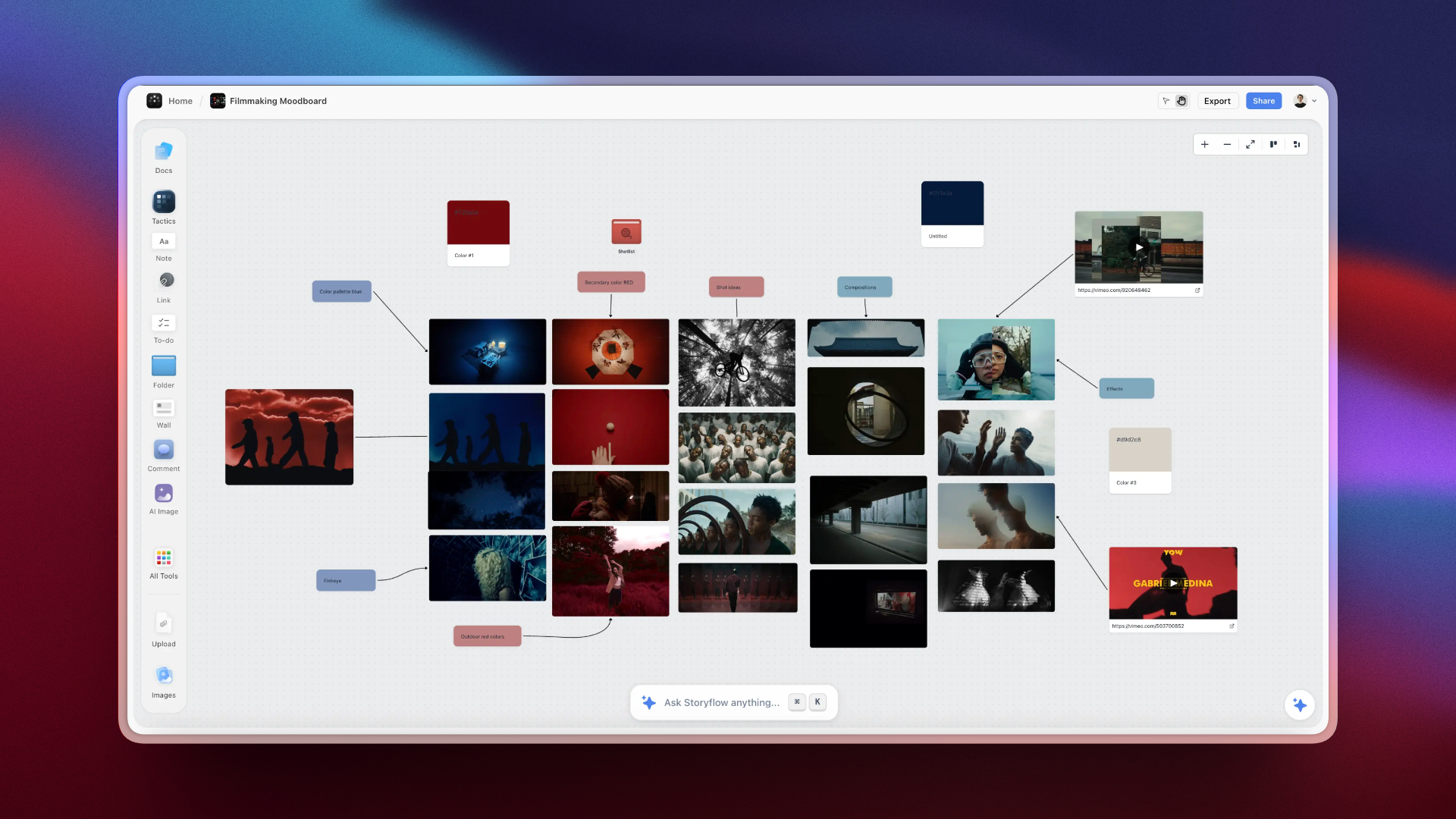
A Storyflow filmmaking moodboard: reference stills grouped by colour and shot idea, with colour swatches, labels and linked video references
Build the pitch and the plan from your script
Attach your script and Storyflow's AI builds the director's treatment, the pitch deck, the storyboard and the shot list on one board, with the lookbook and references beside them. Present it fullscreen or share it by link.

Frequently Asked: Director Tools, Director Software and Director Equipment
What tools does a film director use?
A film director uses one tool to hold the vision and a specialist for each station after it. Storyflow holds the vision: the treatment, the pitch deck, the storyboard, the shot list and the references on one board its AI builds from the script. After Storyflow come StudioBinder for schedules and call sheets, Boords for animatics, FrameForge for 3D previs, Shot Lister and Cadrage on set, and Frame.io and Descript in post. Storyflow does not review footage.
What is the best director software?
Our pick is Storyflow, for the director's own work before the shoot: its AI turns a script into a film treatment, a pitch deck, a storyboard with one wall per scene and a shot list with one entry per camera setup, and the moodboard and character sheets sit beside them. StudioBinder is the best director software for running prep with a crew, and Frame.io for reviewing the edit. Storyflow runs in the browser and has no on-set app.
What is the best tool for building a film pitch or treatment?
Our pick is Storyflow, when the pitch starts from a script. Attach the screenplay and ask for a treatment: Storyflow's AI writes it as a designed PDF covering the idea, the tone and look, the references, the structure and why you. Ask for a pitch deck and Storyflow builds it on the board, presents it fullscreen and exports one PDF. Canva has ready-made pitch-deck templates and more control over layout and type than a Storyflow deck, and it is the pick when the deck is the whole job.
What equipment does a film director need?
Less hardware than people expect, and more documents. The equipment is a viewfinder (now usually an app such as Cadrage on a phone), a monitor to watch takes, and the script. The documents are the treatment, the storyboard, the shot list and the day's call sheet, which a director can build on one Storyflow board and export as PDFs. Cameras, lenses and lights belong to the DP's kit.
What is the best feature film tool?
Storyflow for developing and prepping a feature: "Plan my whole production" lays the film out across six section walls, and the treatment, pitch deck, storyboard, shot list, strip board and call sheet PDF are built on boards in the same project. For scheduling a feature day by day, add Movie Magic Scheduling or StudioBinder; for the script, Final Draft; for the cut, Frame.io. Storyflow's strip board does not recalculate.
The Director's Vision Relay: Five Stations Where the Film Gets Lost
A director carries one thing through the whole process, the vision, and it has to survive five handoffs: development, communication, prep, the shoot and the edit. Keep the first three on one Storyflow board (the treatment, the lookbook, the storyboard and the shot list) and the vision reaches the set in one piece.
Most director tool guides list one tool per phase. That is useful, and it misses the director's real problem: the vision has to survive being handed between all of them. A director loses the film in the handoffs, not in the tools.
| Station | What happens | The director's document | On a Storyflow board | The specialist |
|---|---|---|---|---|
1. Vision and development | The director works out what the film is and why it matters | Logline, story plan, notes | "Plan my story" walls, notes and research | Final Draft for the script |
2. Communication | The vision becomes something others can act on | Treatment, lookbook, pitch deck | "Write a treatment for my film", a moodboard, a deck built on the board | Milanote, ShotDeck, Canva |
3. Prep and blocking | The vision becomes a plan | Storyboard, shot list, previs, schedule | "Storyboard my script", a shot list, a strip board, a call sheet PDF | StudioBinder, Boords, FrameForge |
4. The shoot | The plan meets reality | Shot order, framing | Not Storyflow's station | Shot Lister, Cadrage |
5. Review and edit | The footage becomes the film | Notes on cuts | Not Storyflow's station | Frame.io, Descript |
The vision is the director's product. Everyone else owns a craft; the director owns the whole. Each tool is good at its own station and blind to the vision that connects them, so when the vision lives only in the director's head, every pass between stations is a chance for it to drift. By Station 4 the departments are each working from their own slice.
It is not that specialist tools fail directors. It is that a director's core job, keeping the vision whole, has no home when the vision is scattered across five stations. The stronger approach gives the vision a home base at Station 1 and keeps it visible through Station 3: one board where the story, references, shot ideas and plan live together and an AI reads all of it, feeding the specialist tools instead of replacing them. For the full production toolset, see the best pre-production tools in 2026.
The Best Tool for Building a Film Pitch or Treatment
Storyflow is our pick for building a film pitch or treatment from a script: the logline, synopsis, characters, lookbook and references are assembled on one board, and Storyflow's AI turns that board into a treatment PDF and a pitch deck. Canva is the pick when design polish is the priority and the content already exists.
A film pitch is five documents, and a director usually needs all of them in the same week.
| Document | What it carries | In Storyflow | Other tools directors use |
|---|---|---|---|
Logline and synopsis | The film in a sentence and a page | Wall 1 of "Plan my story": an elevator pitch and a 25-word logline | Any document |
Director's treatment | The idea, the tone and look, references, structure, why you | "Write a treatment for my film": a designed PDF | Google Docs, Canva |
Lookbook | The images that carry the look | A moodboard of 9 to 12 tiles, then a lookbook built from the board | Milanote, ShotDeck, Canva |
Pitch deck | Logline, story, characters, look, team, plan | A deck built on the board; presents fullscreen; exports as one PDF | Canva, Google Slides |
One-pager | The leave-behind | "A one-pager from this board" | Canva |
Why from a script matters. Most pitch tools start with an empty slide. A director starts with a script, and the work is extracting the pitch from it: who the film is about, what it looks like, why now. Storyflow reads the script as a PDF, a Final Draft .fdx or a Fountain file and builds the documents from it, so the names, scenes and structure in the deck are the script's own.
The honest concession. Canva has ready-made pitch-deck templates and more control over layout and type, and its Help Center lists PPTX as a download type for presentations; a Storyflow deck exports as one PDF only, with no presenter view and no speaker notes. Canva's site did not let us read its prices, so see Canva's pricing page for Canva Free and Canva Pro. Choose Canva instead of Storyflow when the content is settled and the deck has to match a brand system to the pixel.
The method. Build the board first (story plan, characters, moodboard), then ask for the treatment, then the deck. A deck built from a board the AI has read is consistent with the treatment, because both come from the same cards. More on the two documents: how to write a film treatment and the film pitch deck page.
How a Director Builds the Package From a Script, Step by Step
A director's package is built in eight steps: read, plan the story, cast the look, write the treatment, build the deck, storyboard, list the shots, plan the days. On a Storyflow board every step after the first is built by the AI from the script and corrected by you, and each result is a proposal you accept or discard.
| Step | What the director decides | In Storyflow | What you have afterwards |
|---|---|---|---|
1. Read | What the film is about, in one sentence | Attach the script (PDF, .fdx or Fountain) | A logline to judge everything against |
2. Plan the story | Premise, stakes, the leads, the structure | "Plan my story": seven numbered walls, each opening with its core question | The film's spine on one board |
3. Cast the look | Light, palette, texture, faces | "Build a moodboard for my project" and "Build a character sheet" | A moodboard of 9 to 12 tiles; a wall per character |
4. Write the treatment | The idea, the tone, the structure, why you | "Write a treatment for my film" | A designed PDF |
5. Build the deck | What a financier or a client needs to see | "A pitch deck from this board" | A deck that presents fullscreen and exports as one PDF |
6. Storyboard | The frame for each scene | "Storyboard my script": one wall per scene | Frames, beat notes and shot checklists, with no drawing |
7. List the shots | Each camera setup | "A shot list from my storyboard" | One entry per setup: size, angle, movement, lens, setup time |
8. Plan the days | Which scenes shoot together | Ask for a strip board, then a call sheet PDF | Days grouped with page totals; a call sheet with open items left blank |
Step 2: plan the story. The seven walls cover the premise with a 25-word logline, the stakes, the forces against the leads, a deep dive on each of two leads, the supporting cast and the three acts with their subplots. A director uses them to find what the script has not decided.
Step 3: cast the look. Pick the source for the pictures: web photographs captioned "Reference", AI generated images on Pro and Max, or empty frames for your own. For characters, web faces arrive captioned "Casting reference".
Step 4: write the treatment. Storyflow's AI writes from the board, so the treatment quotes your own names and scenes. Rewrite it in your voice; a treatment is a director's document.
Step 7: list the shots. One entry per camera setup, not per scene, because moving the camera is what costs the day.
Step 8: plan the days. Storyflow's strip board is a layout, not a scheduler that recalculates. For a long shoot, hand it to scheduling software. The same steps for a small crew: the indie film production workflow.
A Worked Example: A Twelve-Page Short From Script to Shot List
This is an illustration, not a recorded session: the short is invented, nothing was timed, and the counts are what a director would aim for, following what Storyflow's workflows are built to produce for these requests.
The film. A twelve-page short: a lighthouse keeper's daughter returns to close the station and finds her father has kept the lamp lit for a ship that sank thirty years ago. Two leads, one location, two days.
The story plan. Wall 1 carries the elevator pitch and the logline. The stakes wall says what each of them loses if she switches the lamp off. The structure wall lays the three acts across twelve pages and ends with a note naming any beat that serves nothing, if the material shows one.
The look. A moodboard of ten tiles: salt-fogged glass, sodium light, the lamp room at night. Two character walls, each with a face, a full portrait and three tables for key information, background and personality.
The treatment. Three pages as a designed PDF: the idea, the tone and look, the references, the structure, and why this director.
The deck. Built from the same board, presented fullscreen in the meeting, sent afterwards as one PDF.
The storyboard. Nine scenes, so nine walls, each with a frame, a beat note with two to four labels and a three to five item checklist.
The shot list. One entry per setup. For nine scenes of this size that is roughly thirty to forty setups, each with a size, an angle, a movement and a lens.
The days. A strip board of two walls, interiors on day one and the night exteriors on day two, with pages totalled per day, then a call sheet PDF for each.
What happens elsewhere. On the day, the shot order runs in Shot Lister. In post, the cuts go to the producer through Frame.io.
Affordable Previs Tools for Directors
Previsualization does not have to mean a 3D pipeline. For most directors the affordable previs is a storyboard, and Storyflow builds one from the script with no drawing; the tools below take over when the question is geometry, movement or light.
| Tool | What kind of previs | Cost checked October 11, 2026 | Choose it when |
|---|---|---|---|
Storyflow | Storyboard walls from the script, with AI or reference frames | From $7.99/mo billed annually (AI frames on Pro at $14) | The scenes need a frame and a plan, not a simulation |
Storyboarder | Hand-drawn frames with a shot generator | Free and open source | You draw, and the budget is zero |
Shot Designer | Overhead camera diagrams with animated blocking | Free for one scene at a time; Pro upgrade 19.99 euros | The DP needs the floor plan |
Boords | Storyboards and timed animatics | Free plan; Solo $26/mo billed annually | The sequence has to be timed |
FrameForge | True 3D sets with real lenses | See FrameForge's pricing page; trial available | The shot must be proven before the day |
Cine Tracer | Lighting and camera simulation | See its Steam page | The lighting is the question |
Cadrage | Framing on location through a phone | See the App Store | You are standing in the location |
The best previsualization software for film depends on the question. If the question is "what is this scene", a storyboard answers it and Storyflow is the quick route. If it is "can the camera physically get this", only FrameForge answers it. Storyflow has no 3D previs and no animatic. A wider comparison: the best previs tools in 2026.
Review Tools for Directors and Editors: Frame-Accurate Notes and Remote Review
Reviewing a cut is the one station where Storyflow is not the tool: Storyflow holds the plan, and a review tool holds the footage. For a live or remote review with frame-specific annotations, Frame.io is the default, and its free plan covers a director and an editor.
| Tool | What it does for a director | Cost checked October 11, 2026 |
|---|---|---|
Frame.io | Comments on the exact frame, version stacks, share links that need no sign-up, Camera to Cloud | Free for 2 members, 2 projects and 2GB; Pro $15 per member a month; Team $25 |
DaVinci Resolve | Editing, colour and audio in one app, with multi-user collaboration | Free version; Studio $295 |
Descript | Text-based editing: cut an interview by editing its transcript | Free plan with 60 minutes of media a month; Hobbyist from $16 per person a month |
Storyflow is deliberately not a row in this table: Storyflow is not a footage review tool, and what it holds is the treatment, the storyboard and the shot list the cut is judged against.
How a director uses the two together. Keep the Storyflow board open beside the review: the beat note for the scene says what the cut was meant to do, and the Frame.io comment says where it does not. Storyflow has no frame-level approval status and no version compare, so the notes on footage stay in the review tool.
Director Equipment vs Director Software: What Goes in the Kit
A director's equipment is small: something to frame with, something to watch on, and the documents. The documents are the larger part of the kit, and all of them can be built on one Storyflow board and exported as PDFs before the first day.
| Item in the kit | What it is for | The software version | Where Storyflow fits |
|---|---|---|---|
Viewfinder | Checking a frame through the lens you will shoot on | Cadrage, on iPhone and iPad | Scout frames go onto the scene's wall |
Monitor | Watching the take | The camera department's kit | Not Storyflow's job |
Script and sides | The words for the day | Final Draft for the script | Storyflow reads the script (PDF, .fdx, Fountain) |
Storyboard | The frame for each scene | Boords, Storyboarder | "Storyboard my script" builds it with no drawing |
Shot list | The setups for the day | StudioBinder, Shot Lister | Built from the storyboard, exported as PDF or Excel |
Lookbook | The look, for the DP and designer | Milanote, ShotDeck | A moodboard and a lookbook on the same board |
Call sheet | Who, where, when | StudioBinder, SetHero | Drafted as a PDF; Storyflow does not send it |
The rule for the kit. Buy the hardware the DP tells you to and build the documents yourself, early. A director who arrives with a storyboard, a shot list and a lookbook needs very little else.
What It Takes by Hand vs in Storyflow
By hand, a director's package is a document tool, a deck tool, a storyboard tool and a spreadsheet, each filled in separately from the same script. In Storyflow the same documents come from attaching the script, answering one or two questions and accepting the proposal. The three time figures in the table are each the agent's time in a single recorded run, rounded up, and the by-hand figures beside them are our estimates; the other rows count what you would otherwise make.
| Director's job | By hand, across the usual stack | In Storyflow | What is saved |
|---|---|---|---|
A pitch PDF built from a board | Lay out every page in a design tool from your notes | "A PDF of this board I can send" | 3 minutes in a recorded run, against about 4.5 hours by our hand estimate (30 minutes per designed page) |
Pictures for a shot list | Find or make one picture per shot | Ask for the frames on the shot cards | 4 minutes in a recorded run, against about 2 hours by our hand estimate (12 minutes per picture) |
Messy notes into an organized board | Retype each note as a card and group them | "Turn my notes into organized walls" | 3 minutes in a recorded run, against about 45 minutes by our hand estimate (1.5 minutes per card) |
A storyboard for a ten-scene script | 10 frames, 10 beat notes and 10 checklists | "Storyboard my script", answer the frame question, accept | 30 objects built for you, and no drawing |
A director's treatment | Write it from a blank page | "Write a treatment for my film" | The first draft, in your script's own names |
The 3-minute pitch figure is for a designed PDF of the board. A slide deck built with "A pitch deck from this board" has no recorded run; we estimate about 3 minutes, against about 5 hours by our hand estimate for ten slides.
The consolidation argument. A director's usual stack is a chat assistant for notes, a board tool for references, a document tool for the treatment, a storyboard tool and a deck tool. Storyflow holds the script notes, the references, the treatment, the storyboard, the shot list and the client link on one board that the AI reads, from $7.99 a month billed annually. On Pro, one subscription covers what people otherwise pay ChatGPT, Milanote, Notion, a storyboard tool and a reference library for.
What is not saved. The vision. Storyflow's AI proposes documents from your material; what the film should be is still the director's call.
How We Evaluated These Director Tools
Storyflow is our product and it is listed first, so here is the basis of the order in plain words: the list ranks tools on the director's job of carrying one vision from script to cut, and Storyflow is the tool whose AI builds the documents that carry it through development and prep. Tools that own a later station are ranked on how much of the director's work they hold, not on how deep that one station goes.
This is a comparison from each vendor's own documentation and pricing pages, read on October 11, 2026, plus our own use of Storyflow; we did not run timed tests or real projects in the rival tools, and the ratings are judgements. Five criteria, weighted in this order:
- Vision fit. Does it serve the director's whole-film view, or one craft slice?
- Station value. How much does it help at its station of the relay?
- Handoff. Does it protect the pass to the next station, or does the vision drop when it leaves?
- On-set and in-edit usefulness. Does it hold up under time pressure?
- Price for the value. What does it cost for the directing help it gives?
Storyflow leads on the first three and has nothing to offer on the fourth: on set and in the edit, Shot Lister and Frame.io are the tools. Prices and plan limits were re-checked against each vendor's own page on October 11, 2026; the sources are listed near the end of this page.
Detailed Reviews: The 12 Best Tools for Film Directors
1. Storyflow
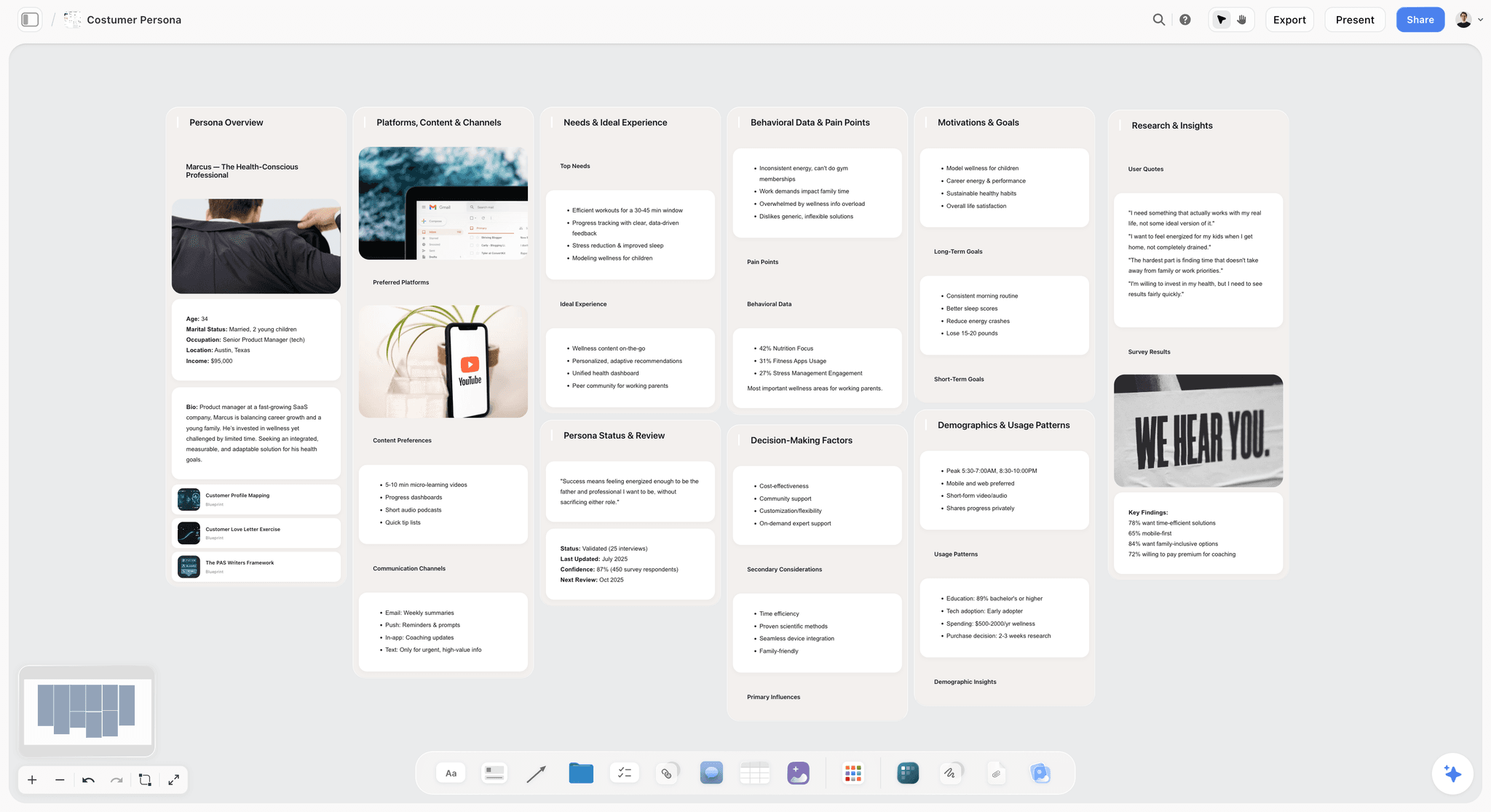
Storyflow is a visual AI workspace: an infinite canvas where a film's notes, treatment, moodboard, storyboard, shot list and documents sit together on one board, and an AI agent that reads the board and builds on it. For a director, Storyflow is the tool that builds the pitch and the plan from the script. The setup for this job is on the Storyflow for directors page.
Best for: Building the pitch from a script: directors who need the treatment, the pitch deck, the lookbook, the storyboard and the shot list on one board before the shoot.
Key features:
A treatment and a pitch deck from the script. Storyflow's "Write a treatment for my film" writes a film treatment as a designed PDF: the idea, the tone and look, the references, the structure and why you. Storyflow's AI also builds a pitch deck on the board, which presents fullscreen and exports as one PDF, and a one-pager and a lookbook from the same board.
A storyboard without drawing. Storyflow's "Storyboard my script" builds one wall per scene, beat or shot in script order with the script's own scene numbers. Each wall gets a frame, a beat note with two to four labels and a three to five item checklist. Frames are AI generated (Pro and Max), web photographs captioned "Reference", or empty placeholders.
The shot list and the shoot-day documents. Storyflow's shot list has one entry per camera setup, as shot cards with a frame, a coverage checklist and equipment, or as a table with size, angle, movement, lens and setup time. Ask for a strip board grouped into shoot days with page counts, and a call sheet PDF that lists the nearest hospital and leaves anything you did not give it visibly blank.
The look and the people. Storyflow's "Build a moodboard for my project" lays out 9 to 12 reference tiles, a colour palette can be pulled into the board, and "Build a character sheet" builds a wall per character with a face, a portrait and three tables. "Scout locations for my shoot" researches a destination location by location.
The whole production on one board. Storyflow's "Plan my whole production" lays a film out across six section walls, from theme and overview to distribution, and 200+ Tactics such as Hero's Journey and Five-Act Structure drop onto the canvas as templates.
AI that reads the board. Storyflow's AI reads the current board plus up to five documents and three other boards you attach in the chat, and sees the pixels of up to 24 images you select. Storyflow reads a script as PDF, Final Draft .fdx or Fountain.
Share, present and export. Storyflow has real-time collaboration on every paid plan, and anyone a paid member invites to a board joins free. A view-only link opens with no account; a client signs in to comment or draw. Presentation mode goes fullscreen and steps one wall at a time, and a board exports as PDF, PNG or SVG.
Works from ChatGPT and Claude. Storyflow's MCP connector lets ChatGPT, Claude, Gemini and Grok read your Storyflow projects and build boards and documents in them, so "storyboard this script on my film board" works from the chat. Setup is on the MCP page.
Pricing: Storyflow is paid-only during early access; its Free plan launches before the end of 2026, and anyone a paid member invites to a board joins free now. Plus: $7.99/month billed annually or $9.99 monthly. Pro: $14/month billed annually or $19 monthly, adding AI image generation, memory across conversations and more AI usage. Max: $39/month billed annually or $49 monthly, with the most AI usage and a Team Workspace. See Storyflow pricing.
Pros:
- Storyflow's AI builds the director's documents from the script, so the treatment, deck, storyboard and shot list agree with each other
- The vision, the look and the plan share one board through development and prep
- No drawing needed for the storyboard
- A financier, client or DP opens the board by link with no account
Cons:
- Storyflow is not a cut-review tool: no frame-accurate notes on footage, no frame-level approval status. Use Frame.io.
- Storyflow has no animatic and no 3D previs. Use Boords or FrameForge.
- Storyflow's strip board does not recalculate, there is no Day Out of Days, and Storyflow does not send call sheets. Use StudioBinder or a scheduler.
- There is no PPTX export, presenter view or speaker notes: a Storyflow deck exports as one PDF.
- Storyflow runs in the browser, best on a laptop, with no offline mode and no on-set app, and there is no self-serve free plan yet.
Verdict: Storyflow is the right choice for the director's work between the script and the shoot. Add StudioBinder when the crew grows, Shot Lister for the day and Frame.io for the cut.
2. StudioBinder
StudioBinder is a production management suite: shot lists, storyboards, breakdowns, schedules and call sheets in one project a crew works from. Where Storyflow builds the director's documents with AI on an open board, StudioBinder gives the production a pipeline.
Best for: Directors prepping with an AD and a crew, where Storyflow is the pick for the treatment, the pitch and the first plan.
Key features:
Shot lists with full specs. Shot size, camera movement, lens, frame rate and camera angle from dozens of shot types, with a board view. Importing a script creates a shot list for every scene.
The paperwork chain. Breakdowns, schedules and call sheets connected to the same project, with call sheets sent to the crew. Storyflow drafts a call sheet PDF and does not send it.
Pricing (StudioBinder): its pricing page showed no plans when loaded on October 11, 2026; its own Indie plan article lists Indie at $49 a month for 2 users. A free account is available.
Pros:
- A complete prep toolset a crew already understands
- Call sheets are distributed and tracked
- Shots connect to the schedule
Cons:
- Its shot list page mentions no AI; unlike Storyflow, you enter the shots
- No treatment, pitch deck or lookbook, which Storyflow builds
- Priced for a production
Verdict: Choose StudioBinder instead of Storyflow when the shoot has a production office. Many directors build the vision in Storyflow and move the shot list across when the crew arrives.
3. Boords
Boords is a dedicated storyboarding tool with an animatic editor and frame-level review. Where Storyflow keeps the storyboard attached to the treatment and the shot list, Boords takes the storyboard into timing and sign-off.
Best for: Directors who need a timed animatic and client approval per frame, where Storyflow is the pick when the storyboard has to become a shoot.
Key features:
Animatics. The animatic editor is on every paid plan, so pacing is tested before the day. Storyflow has no animatic.
Review on the frame. Unlimited guest commenting and version history on paid plans.
Pricing (Boords pricing, checked October 11, 2026): Free with 5 active storyboards. Solo $26/month billed annually ($39 monthly); Pro $50 ($75); Team $85 ($125); Agency $165 ($250).
Pros:
- Pacing becomes visible before the shoot
- Comments land on the frame
- A free plan, which Storyflow does not have today
Cons:
- The board ends at the storyboard; the treatment, shot list and call sheet come from elsewhere, where Storyflow builds them on the same board
- AI images are capped per plan
- More than three times the price of Storyflow Plus on annual billing
Verdict: Choose Boords instead of Storyflow for commercial and animation work where the animatic is signed off. Use both when the film needs a plan and a timed cut.
4. Frame.io
Frame.io is review infrastructure for the edit: a director drops a comment on the exact frame, versions stack in order, and a share link lets a producer watch without signing up. Where Storyflow carries the vision up to the shoot, Frame.io is where the vision is checked against the footage.
Best for: Directors reviewing cuts with editors and stakeholders, remotely, where Storyflow is the pick for everything before there is footage.
Key features:
Frame-accurate comments and version stacks. "This cut is a beat late" becomes a marker the editor cannot misread. Storyflow has no equivalent for footage.
Share links and Camera to Cloud. Share links need no sign-up, and takes can upload from set.
Pricing (Frame.io pricing, checked October 11, 2026): Free for up to 2 members, 2 projects and 2GB. Pro is $15 per member a month; Team is $25 per member a month.
Pros:
- Precise notes on the cut
- Versions kept in order across a long edit
- A free plan for a director and an editor
Cons:
- Post only: nothing of the treatment, storyboard or shot list, which live on a Storyflow board
- Storage and members are capped by plan
- Review, not creation
Verdict: Choose Frame.io instead of Storyflow the day there is a cut to watch. The two do not overlap: Storyflow ends where Frame.io starts.
5. Milanote
Milanote holds a director's references and lookbooks on hand-arranged visual boards. Milanote is the closest tool here to Storyflow's canvas; unlike Storyflow it has no AI that builds the board from a script, so every image and note is placed by you.
Best for: Directors who want a free, clean board for references and a lookbook, where Storyflow is the pick when the lookbook should come with a treatment, a storyboard and a shot list.
Key features:
Reference boards. Images, notes and links arranged freely, with boards inside boards.
Sharing. A board is shared for editing or by a view link.
Pricing (Milanote plans, checked October 11, 2026): Free with 100 notes, images or links and 10 file uploads. Paid is $9.99 per person a month billed annually, or $12.50 monthly.
Pros:
- A real free plan, which Storyflow does not have today
- Good-looking boards with little effort
- Easy for a client to read
Cons:
- Its site lists no AI features, where Storyflow's AI builds the board and reads it
- No storyboard workflow, shot list or treatment
- 100 items is a small lookbook
Verdict: Choose Milanote instead of Storyflow when cost must be zero and the board is only a lookbook. Choose Storyflow when the look has to connect to the story and the shots.
6. FrameForge
FrameForge Studio is 3D previsualization: build the set, place the actors, put a camera with a real lens in it, and the frame is geometrically true. Where Storyflow shows what a scene should look like, FrameForge proves whether the shot can exist.
Best for: Directors solving blocking and camera for complex scenes, where Storyflow is the pick for the plan around them.
Key features:
A virtual set with true lenses. Storyboards come out of the 3D scene.
Editions and a trial. Core and Pro editions, a trial with no credit card and a 30-day money-back guarantee.
Pricing: see FrameForge's pricing page for the current price of each edition.
Pros:
- Blocking you can trust on the day
- Answers lens and space questions before a location is booked
- Storyboards come out of the same 3D scene
Cons:
- A real learning curve
- More than a two-hander needs
- Prep only, and one layer of it; the beats, treatment and shot list stay on the Storyflow board
Verdict: Choose FrameForge instead of Storyflow for a oner, a stunt or a tight location. Keep the rest of the film on the board.
7. Shot Lister
Shot Lister runs a director's shot order on set: a schedule shot by shot and minute by minute, with a Live Mode that shows how the day is going and re-organizes the plan in seconds. Where Storyflow builds the shot list before the shoot, Shot Lister protects it during the shoot.
Best for: Directors and ADs running the day's shots, where Storyflow is the pick for making the list.
Pricing (Shot Lister, checked October 11, 2026): a free download for iOS and macOS. Pro is $15.99 a month or $99.99 a year; Studio starts at $24.99 a month for 10 users.
Pros:
- Built for a phone or tablet on set, where Storyflow is best on a laptop
- Timing awareness as the day slips
- The crew sees changes live
Cons:
- On set only; it does not build the plan
- Pro is a subscription
- Coverage only: no treatment, references or call sheet, which a Storyflow board carries
Verdict: Choose Shot Lister instead of Storyflow between call and wrap. Plan in Storyflow first.
8. Cadrage
Cadrage is a director's viewfinder app for iPhone and iPad: it previews the framing for your camera and lenses, spherical or anamorphic, and makes PDF shot lists on a scout. Where Storyflow plans a frame as a picture on a wall, Cadrage checks it through the lens in the real place.
Best for: Directors framing shots on a location scout, where Storyflow is the pick for the plan those frames go into.
Pricing: sold on the App Store; its site lists no price, so see the App Store for the current one.
Pros:
- Framing that matches the camera you will shoot on
- Quick on a scout
- PDF shot lists from the phone
Cons:
- Framing only
- Listed for iPhone and iPad
- Scout frames need a home; a Storyflow scene wall is a good one
Verdict: Choose Cadrage instead of Storyflow while standing in the location. Bring the frames back to the board.
9. ShotDeck
ShotDeck is a searchable library of stills from released films, used by directors and DPs to say "like this" quickly. Where Storyflow's moodboard collects references for one project, ShotDeck is the archive those references are often pulled from.
Best for: Directors building a visual vocabulary with a DP, where Storyflow is the pick for arranging those references beside the story.
Pricing: ShotDeck's site did not let us read its prices on October 11, 2026; see ShotDeck's pricing page.
Pros:
- A deep library of real frames
- Search by the things a DP cares about
- Fast shorthand in a look conversation
Cons:
- Reference, not planning
- A subscription
- The stills need a board to live on; Storyflow's moodboard is that board
Verdict: Choose ShotDeck instead of Storyflow as the source of references. Use Storyflow to make them mean something for this film.
10. Final Draft
Final Draft is where a director works on the script in the industry-standard format, with a Beat Board, an Outline Editor and tracked revisions. Where Storyflow turns the script into a visual plan, Final Draft keeps the script itself in order.
Best for: Directors working closely with the screenplay, where Storyflow is the pick for everything visual built from it.
Pricing (Final Draft pricing, checked October 11, 2026): Final Draft 13 is listed at $249.99 as a one-time purchase and was shown at $199.99; a subscription is $99.99 a year or $16.99 a month with a 5-day free trial.
Pros:
- The script format productions expect
- Beat Board for structure
- Shared with the writers
Cons:
- A high price for a tool a director borrows
- Words only: no references, storyboard or shot list, which Storyflow builds from the .fdx
- Not a vision board
Verdict: Choose Final Draft instead of Storyflow for the script. Attach the .fdx to Storyflow for the rest.
11. Descript
Descript lets a director shape an edit by editing its transcript, which is close to essential for documentary and interview-driven work. Where Storyflow holds the research and the story plan of a documentary, Descript is where the story is found in the talking.
Best for: Directors shaping documentary and dialogue edits, where Storyflow is the pick for the research and structure before the edit.
Pricing (Descript pricing, checked October 11, 2026): a free plan with 60 minutes of media a month. Hobbyist is shown at $16 or $24 per person a month depending on billing; Creator at $24 or $35.
Pros:
- Cutting by text is fast for interviews
- Transcription built in
- A free plan to try it
Cons:
- Not suited to a visual, music-driven cut
- Transcription accuracy depends on the audio
- Post only; the plan it is cut against lives on a Storyflow board
Verdict: Choose Descript instead of Storyflow once there are hours of interviews to cut. Keep the documentary's structure on the board.
12. Cine Tracer
Cine Tracer is a realistic cinematography simulator: a director and a DP place lights and a camera in a scene and see roughly how the frame will feel. Where Storyflow's moodboard shows the look you want, Cine Tracer tests how to get it.
Best for: Directors planning the look with their DP, where Storyflow is the pick for the references and the plan.
Pricing: a one-time purchase on Steam, where it is an Early Access title; see its Steam page for the price in your region.
Pros:
- Lighting ideas tested before the truck arrives
- One-time purchase
- A shared language for the look
Cons:
- Cinematography only
- Needs capable hardware, and its Steam page notes no developer update for over three years
- No story, storyboard or shot list, which Storyflow covers
Verdict: Choose Cine Tracer instead of Storyflow for one hard lighting setup. Put the result on the scene's wall.
Pricing: What Director Tools Cost in 2026
Director tools run from free (Storyboarder, DaVinci Resolve, Frame.io for two) through $7.99 a month billed annually for Storyflow Plus to $249.99 once for Final Draft. Storyflow is the low-cost way to get a treatment, a pitch deck, a storyboard and a shot list built from one script.
| Tool | Free option | Paid from | Billing shape | Checked |
|---|---|---|---|---|
Storyflow | Free plan launches before the end of 2026; invited collaborators join free now | Plus $7.99/mo billed annually ($9.99 monthly) | Per person, monthly or annual | |
StudioBinder | Free account | Indie $49/mo for 2 users (support article) | Per plan, by users | Oct 11, 2026: pricing page showed no plans |
Boords | 5 active storyboards | Solo $26/mo billed annually ($39 monthly) | Per plan, by users | Oct 11, 2026 |
Frame.io | 2 members, 2 projects, 2GB | Pro $15/member/mo | Per member | Oct 11, 2026 |
Milanote | 100 notes, images or links; 10 uploads | $9.99/person/mo billed annually ($12.50 monthly) | Per person | Oct 11, 2026 |
FrameForge | Trial, no credit card | See FrameForge's pricing page | By edition | Oct 11, 2026 |
Shot Lister | Free download | Pro $15.99/mo or $99.99/yr | In-app subscription | Oct 11, 2026 |
Cadrage | Not stated | See the App Store | App purchase | Oct 11, 2026 |
ShotDeck | See its pricing page | See its pricing page | Subscription | Page not readable Oct 11, 2026 |
Final Draft | 5-day subscription trial | $249.99 one-time (shown at $199.99); or $99.99/yr | One-time or subscription | Oct 11, 2026 |
Descript | 60 minutes of media a month | Hobbyist from $16/person/mo | Per person | Oct 11, 2026 |
Cine Tracer | None | See its Steam page | One-time | Oct 11, 2026 |
Reading the table. A director's stack is cheapest when one tool covers development and prep and the free tiers cover the rest: Storyflow Plus, Frame.io Free and DaVinci Resolve's free version come to $7.99 a month billed annually. Storyflow lets a paid member invite a DP or a producer to a board free.
Director Recommendations by Type
Storyflow is the first pick for every funded director type below, because every one of them starts from a script or a concept and has to turn it into documents other people act on; the third column is what each should add. The last row is the exception, for a budget of zero.
| Director type | Hold the vision in | Add | Why this stack |
|---|---|---|---|
Narrative director | Storyflow | StudioBinder and Frame.io | Treatment, storyboard and shot list on the board; the crew's paperwork and the cut in the specialists |
Documentary director | Storyflow | Descript and Frame.io | Research and structure on the board; the story found in the transcript; cuts reviewed remotely |
Commercial or branded director | Storyflow | Boords and Frame.io | The treatment and deck for the pitch; an animatic for sign-off; client review of the cut |
Music video director | Storyflow | ShotDeck and Boords | The treatment and lookbook on the board; stills for the look; timing against the track |
First-time or student director | Storyboarder and DaVinci Resolve | Frame.io Free | Storyflow is paid today; start free and move when the film needs a pitch |
The pattern. One board carries the vision to the set; a specialist takes each station after it. A wider list for small crews: the best tools for indie filmmakers.
Honorable Mentions
Six more tools do one thing a director needs. None of them builds the director's documents from a script, which is why they sit beside a Storyflow board, not above it.
- Canva: ready-made pitch-deck templates, full layout and type control, and presentations that download as PPTX. The pick when the deck's design is the job; see Canva's pricing page for Canva Free and Canva Pro. Storyflow builds the deck's content from the script.
- Shot Designer: overhead camera diagrams with animated blocking and a linked shot list; a free version for one scene at a time, with a Pro upgrade listed at 19.99 euros. The floor plan a Storyflow wall does not draw.
- Storyboarder by Wonder Unit: free and open source for Mac, Windows and Linux, for drawing frames. The free pick when you draw; Storyflow is the pick when you do not.
- DaVinci Resolve: editing, colour, VFX and audio in one app, with a free version and Studio at $295. The edit the director reviews; Storyflow holds the plan it is cut against.
- Celtx: a browser suite for script, breakdown and scheduling; its pricing page showed no dollar figures when checked on October 9, 2026. A lighter all-in-one where Storyflow is the visual board.
- Movie Magic Scheduling: the studio scheduler, at $42.99 a month or $299.88 a year. For the recalculating stripboard Storyflow does not have.
Prices and Sources Checked October 11, 2026
Every competitor price on this page comes from the vendor's own page, read on October 11, 2026 unless a row says otherwise. Where a page showed no figure to our reader, this page says so instead of quoting an old number.
| Vendor | What we checked | Source | Result |
|---|---|---|---|
Storyflow | Plans and prices | Plus $7.99, Pro $14, Max $39 a month billed annually | |
StudioBinder | Pricing, shot list features | Pricing page showed no plans; support article lists Indie at $49/mo for 2 users | |
Boords | Plans and free limits | Free 5 storyboards; Solo $26/mo annual ($39 monthly) | |
Frame.io | Plans and free limits | Free 2 members, 2 projects, 2GB; Pro $15, Team $25 per member a month | |
Milanote | Plans | Free 100 items; $9.99/person/mo annual | |
FrameForge | Editions, trial | Core and Pro editions; trial; prices on edition pages | |
Shot Lister | App and subscriptions | Free download; Pro $15.99/mo or $99.99/yr | |
Cadrage | Description, platforms | iPhone and iPad; no price on its site | |
ShotDeck | Pricing | Page not readable; no figure quoted | |
Final Draft | Price | $249.99 list, $199.99 shown; $99.99/yr | |
Descript | Plans | Free 60 minutes a month; Hobbyist $16 or $24 | |
Cine Tracer | Description, status | Early Access; price shown in local currency | |
DaVinci Resolve | Free version, Studio | Free version; Studio $295 | |
Shot Designer, Storyboarder | Free versions | Vendor sites | Free for one scene; free and open source |
Final Verdict: The Best Tools for Film Directors in 2026
Storyflow is our pick for film directors in 2026, for the work between the script and the shoot: its AI builds the treatment, the pitch deck, the storyboard and the shot list from the script and keeps them on one board with the look and the references. A director loses the film in the handoffs, not in the tools, and one board removes the first two.
If the budget is zero, Storyboarder, DaVinci Resolve's free version and Frame.io Free will carry a first film.
Give the vision a home base instead of scattering it across five tools: hold the story, the look and the plan on one board the AI can read, and feed the specialists from it. The film production planning page shows the board this guide describes.
FAQ: Tools for Film Directors in 2026
What are the best tools for film directors in 2026?
Storyflow first: attach the script and its AI builds the director's treatment, the pitch deck, the storyboard and the shot list on one board, with the lookbook and references beside them. StudioBinder is the best pick for shot lists and call sheets with a crew, Boords for a timed animatic, and Frame.io for reviewing cuts. Storyflow does not review footage or run the shoot day.
What software do film directors use?
Directors use a stack across stations: a vision and development tool (a board such as Storyflow), a script tool (Final Draft), shot-list and breakdown software (StudioBinder), storyboarding (Storyflow or Boords) and previs (FrameForge) in prep, on-set tools (Shot Lister, Cadrage), and review and edit tools (Frame.io, Descript) in post. The mix depends on the format; the stations are the same.
What is the best tool for directing a low-budget film?
Storyflow is not free today, so the honest low-budget stack starts with free tools: Storyboarder for storyboards, DaVinci Resolve's free version for the edit and Frame.io Free for review. Add Storyflow Plus at $7.99 a month billed annually when the film needs a treatment and a pitch deck built from the script. Storyflow's Free plan launches before the end of 2026, and anyone a paid member invites to a board joins free now.
How does a director keep the vision consistent across a production?
By giving the vision a home base. On a Storyflow board the story plan, the treatment, the moodboard, the storyboard and the shot list sit side by side where the whole team can see them and the AI can read them, so every department works from the same picture. The director still carries the vision; the board keeps it visible through development and prep, which is where most of the drift happens.
What is the best tool for a director to plan shots?
Our pick is Storyflow, when the shots should come from the script: Storyflow's AI builds the storyboard (one wall per scene) and then a shot list with one entry per camera setup, as shot cards or as a table with size, angle, movement, lens and setup time. StudioBinder is the best pick when the shot list has to feed a schedule and call sheets, and FrameForge adds 3D blocking for complex scenes.
Do directors need AI tools?
AI helps directors most in development and prep. Storyflow's AI reads the script and builds the first version of the treatment, the storyboard and the shot list, then reads the whole board to answer questions about it. In post, transcription and text-based editing speed up the cut. AI does not direct: the vision, the performance and the taste stay with the director, and every Storyflow result is a proposal you accept or discard.
What tools does a documentary director need?
A documentary director needs a place for research and structure, a way to find the story in interviews, and review. Storyflow holds the research (its AI searches the web when asked and hands back its sources as cards), the story plan and the treatment for funders. Descript cuts interviews by transcript, and Frame.io handles review. Because a documentary's story is found in the material, the board has to be easy to rebuild.
How do film directors stay organized?
Directors stay organized by keeping the vision in one place and letting each station feed from it. On a Storyflow board the treatment, the storyboard, the shot list and the to-dos (each with an assignee and a due date) sit together, so the director always has a current picture of the film. Formal organization then lives in station tools: StudioBinder for breakdowns, Shot Lister for the day, Frame.io for cut versions.
What is the top director app for use on set?
Storyflow is not an on-set app, so on set the top director app is Shot Lister: it lives on a phone or tablet, tracks the shot order minute by minute and shows when the day is falling behind. Cadrage handles framing. Storyflow runs in the browser, best on a laptop, so the shot list and call sheet built in Storyflow go to set as PDFs.
What is the best storyboarding tool for a director?
Our pick is Storyflow, for a director who has a script and does not draw: Storyflow's AI builds one wall per scene with a frame, a beat note and a shot checklist, and the shot list comes from the same board. Boords is the best pick when the storyboard must become a timed animatic with frame-level comments, and Storyboarder is the free tool for drawing. See the best storyboarding software for the full comparison.
How much do film director tools cost?
From nothing to a few hundred dollars. Storyflow Plus is $7.99 a month billed annually ($9.99 monthly) and Pro is $14. StudioBinder's Indie plan is $49 a month for 2 users, Boords Solo is $26 a month billed annually, Frame.io Pro is $15 per member a month, Shot Lister Pro is $15.99 a month, and Final Draft is $249.99 once. Storyboarder and DaVinci Resolve have free versions.
What is the best previsualization software for film?
Storyflow for the affordable kind, a storyboard built from the script with no drawing; FrameForge for true 3D previs with real lenses; Shot Designer for overhead blocking diagrams (free for one scene at a time); and Boords when the previs has to be a timed animatic. Storyflow has no 3D and no animatic, so pair it with one of those for the scenes that need them.
What is the best live remote review tool for film production?
Storyflow is not a footage review tool, so for remote review the answer is Frame.io: comments land on the exact frame, versions stack in order, and a share link needs no sign-up. Its free plan covers 2 members, 2 projects and 2GB; Pro is $15 per member a month. Keep the Storyflow board beside it, because the beat note for a scene says what the cut was meant to do.
What is a good video review tool for editors and directors?
Frame.io for frame-specific annotations on a cut, DaVinci Resolve for a team editing and grading in one application (it has a free version), and Descript when the director wants to cut interviews by editing text. Storyflow's part is earlier: Storyflow holds the treatment, the storyboard and the shot list the edit is judged against, and it has no frame-level approval status.
Is there a film production casting tool in Storyflow?
Storyflow is not a casting platform: it does not post breakdowns or collect auditions. What Storyflow builds is the casting board. "Build a character sheet" gives each character a wall with key information, background and personality tables, and web photographs arrive captioned "Casting reference", so the director and casting director argue from the same page. Use a casting platform for the calls themselves.
How much does Cadrage cost?
Cadrage's own site lists no price; the app is sold on the App Store for iPhone and iPad, so the current price is the one shown there in your region. Cadrage is a director's viewfinder that previews framing for a chosen camera and lens and makes PDF shot lists. The scout frames it produces belong on the scene's wall in Storyflow, beside the beat and the shot list.
Which director tool works inside ChatGPT or Claude?
Storyflow. Its MCP connector lets ChatGPT, Claude, Gemini and Grok read your Storyflow projects and build boards and documents in them, so you can ask for a treatment board or a storyboard in the chat and find it in your project. Setup is on storyflow.so/mcp.
Can Storyflow replace StudioBinder for a director?
For development and the first plan, yes; for running a production, no. Storyflow builds the treatment, the pitch deck, the storyboard, the shot list, a strip board and a call sheet PDF from the script. Storyflow does not send call sheets, track confirmations or recalculate a schedule, which StudioBinder does. Most directors use Storyflow until the crew arrives and StudioBinder after.
What is the difference between a director's treatment and a pitch deck?
A treatment is prose: the film told in the director's voice, with the tone, the look and the approach. A pitch deck is slides: the same film as one idea per page for a room. A director usually needs both. In Storyflow both are built from the same board, so the deck does not contradict the treatment. The longer answer: how to write a film treatment.
Table of Contents
- Quick Picks: Best Tools for Film Directors by Job
- Which Director Tool Should You Use?
- All 12 Tools for Film Directors, Ranked
- Comparison Table: 12 Tools for Film Directors Compared
- Frequently Asked: Director Tools, Director Software and Director Equipment
- The Director's Vision Relay: Five Stations Where the Film Gets Lost
- The Best Tool for Building a Film Pitch or Treatment
- How a Director Builds the Package From a Script, Step by Step
- A Worked Example: A Twelve-Page Short From Script to Shot List
- Affordable Previs Tools for Directors
- Review Tools for Directors and Editors: Frame-Accurate Notes and Remote Review
- Director Equipment vs Director Software: What Goes in the Kit
- What It Takes by Hand vs in Storyflow
- How We Evaluated These Director Tools
- Detailed Reviews: The 12 Best Tools for Film Directors
- Pricing: What Director Tools Cost in 2026
- Director Recommendations by Type
- Honorable Mentions
- Prices and Sources Checked October 11, 2026
- Final Verdict: The Best Tools for Film Directors in 2026
- Author
- FAQ: Tools for Film Directors in 2026
- Related Reading
Templates to check out for this topic


Filmmaking templates you can use in Storyflow
Skip the blank canvas. Open one of these filmmaking boards in Storyflow and the AI builds on the structure that is already there, from research through the shot list.


See Storyflow in Action
A visual AI workspace where every feature lives inside one canvas. No tab-switching, no context lost.
Build your entire board from a single message
Type what you need in the AI chat at the bottom of your canvas. The AI adds cards, headings, and structure directly onto your board.
Use expert frameworks as AI context
Type @ in the AI chat and choose any Tactic. The AI tailors every response to that framework instead of giving generic advice.
Turn your board into a mind map in seconds
Ask the AI to restructure your canvas as a mindmap. It connects your ideas into a visual hierarchy so you can see how everything relates.
Why Storyflow Exists
Storyflow actually began as a personal tool while working on creative and research projects.
We kept running into the same problem: ideas were scattered everywhere: notes, documents, and whiteboards.
Nothing helped us see how everything connected.
So we started building a workspace designed around how ideas actually grow.
→ Read how Storyflow was createdJustkay
Documentary Filmmaker & Founder at Storyflow
Published: 2026-07-10
Extremely simple, seriously capable


See how easy it is to get started
Watch a real project come together, from a blank board to a finished plan, clicked through step by step.
Start creating with AI and become more productive
Transform your creative workflow with AI-powered tools. Generate ideas, create content, and boost your productivity in minutes instead of hours.