The 12 Best Photography Portfolio Platforms in 2026 (We Tested Them All)
A portfolio is a filter, not a gallery. Its job is to attract the work you want and repel the work you do not, which means range reads as availability and specificity reads as authority. Twelve platforms tested, plus how to cut 400 images to 20.

Category
Photography
Author

Storyflow Team
Product & Research Team
Topics
2026-09-22
•
19 min read
•
PhotographyFull disclosure: Storyflow is our own product and we rank it TENTH here, below nine competitors, because it hosts nothing. It is not a website builder: no templates, no hosting, no custom domain, no SEO controls, no commerce and no public site of any kind. Every platform in this ranking does something it cannot. It appears for the step before the platform, which is cutting a large selection down against one client type, and section 7 gives that method in full along with the free way to do it, a Lightroom collection or a contact sheet on a table. Storyflow is paid-only during early access; the Free plan launches before the end of 2026.
Quick Comparison
These four cover the realistic choices at four price points, and all of them present images well. None of them fixes the decision that actually sets your rate, which is what goes in.
| Tool | Best For | AI Features | Price |
|---|---|---|---|
| Squarespace | One reliable platform for the whole site | AI copy assistance | From about $16 mo annual |
| Format | Photographer templates plus proofing | Light AI tooling | From about $12 mo annual |
| Adobe Portfolio | No extra cost with Creative Cloud | Via Lightroom | Included with a photography plan |
| Pixieset | Site and client delivery together | AI tagging in galleries | Free tier / from about $10 mo |
Article Metadata
By the Storyflow Team, Product & Research Published September 22, 2026 · 19 min read · Photography
Six of these are the same photograph
Scrolling a folder hides repetition. Lay the whole selection out where you can see it at once, with the brief you are aiming at beside it, and the duplicates become obvious. Then cut to twelve. Paid-only during early access, from $7.99 a month billed annually.

Table of Contents
- Quick Answer: The Best Photography Portfolio Platforms in 2026
- Comparison Table: 12 Portfolio Platforms at a Glance
- The Portfolio Is a Filter, Not a Gallery
- How We Evaluated These Platforms
- Quick Picks by Photography Business
- Detailed Reviews: 12 Photography Portfolio Platforms
- How to Edit 400 Images Down to 20
- What Art Buyers and Clients Actually Look At
- Recommended Portfolio Stacks
- What a Photography Portfolio Costs
- Honorable Mentions
- Portfolio Mistakes to Avoid
- FAQ: Photography Portfolio Platforms
- The Bottom Line
- Author
- Related Reading
1) Quick Answer: The Best Photography Portfolio Platforms in 2026
Squarespace is the best photography portfolio platform in 2026 for most working photographers: the templates are genuinely good, images load fast and look right, and it handles the whole site including pages a business needs rather than only a gallery. Format is the strongest photographer-specific option with client proofing attached. Adobe Portfolio is effectively free if you already pay for Lightroom, and it is better than free usually implies. Pixieset is the best choice if you want your portfolio and your client galleries in one subscription.
A portfolio is a filter, not a gallery. Its job is not to show your best work. Its job is to attract the work you want and repel the work you do not, and those are different objectives that pull in opposite directions.
Most photographers build a portfolio that demonstrates range: weddings, some product, a few portraits, a travel set. Range reads as availability rather than authority, and it produces enquiries for everything at a generalist rate. A portfolio that shows one thing, done unmistakably well, produces fewer enquiries at a higher rate. That is a pricing decision made through image selection, and the platform barely matters next to it. Section 3 is the argument and section 7 is the method.
Storyflow is our own product; it hosts no website and is tenth here, for the editing decision only.
For delivering work to clients, see The 12 Best Client Gallery and Delivery Tools for Photographers.
All 12 Photography Portfolio Platforms, Ranked
- Squarespace: best overall, strong templates and a real website around the work
- Format: best photographer-specific platform with proofing built in
- Adobe Portfolio: best value if you already pay for Creative Cloud
- Pixieset: best portfolio and client galleries in one subscription
- SmugMug: best portfolio with an unlimited archive behind it
- Webflow: best control for a custom, design-led site
- Wix: best easy builder with the widest feature set
- Cargo: best editorial and art-world aesthetic
- Semplice: best for photographers who want a WordPress foundation
- Storyflow: best for deciding which images go in
- Carrd: best cheap one-page portfolio
- Behance: best free discovery, and not a replacement for a site
Best Photography Portfolio Platform by Job
- Best for a working commercial photographer: Squarespace or Format. Both present images well and support the other pages a business needs.
- Best free or near-free: Adobe Portfolio if you have Creative Cloud, which many photographers already do.
- Best for one subscription covering portfolio and client delivery: Pixieset.
- Best for a distinctive, design-led site: Webflow if you or a designer will build it, Cargo if you want the art-world look without the build.
- Best for an archive clients return to: SmugMug, with unlimited storage at every tier.
- Best for deciding what belongs in the portfolio at all: Storyflow. Section 7 covers the method, and the method matters more than the platform.
2) Comparison Table: 12 Portfolio Platforms at a Glance
| Platform | Best For | Client Galleries | Custom Domain | Starting Price | Rating (/10) |
|---|---|---|---|---|---|
Squarespace | All-round portfolio and website | Basic | Yes | From about $16 mo | 9.2/10 |
Format | Photographer-specific with proofing | Yes | Yes | From about $12 mo | 8.9/10 |
Adobe Portfolio | Value with Creative Cloud | No | Yes | Included with a photography plan | 8.5/10 |
Pixieset | Portfolio plus client delivery | Yes, strong | Yes | Free tier / from about $10 mo | 8.4/10 |
SmugMug | Portfolio with unlimited archive | Yes | Yes | From about $13 mo | 8.1/10 |
Webflow | Full design control | No | Yes | Free tier / from about $14 mo | 7.9/10 |
Wix | Easy building, widest features | Basic | Yes | From about $17 mo | 7.5/10 |
Cargo | Editorial and art-world aesthetic | No | Yes | From about $13 mo | 7.3/10 |
Semplice | WordPress foundation, design-led | No | Yes | One-time, about $249 | 7.0/10 |
Storyflow | Choosing what goes in | No | No | $7.99 mo annual (free plan late 2026) | 6.8/10 |
Carrd | Cheap one-page portfolio | No | Yes | Free tier / from about $19 yr | 6.5/10 |
Behance | Free discovery and visibility | No | No | Free | 6.0/10 |
Pricing reflects publicly listed plans in 2026, is usually quoted at the annual rate and changes often. Ratings weigh how images present, load performance, whether the platform supports a business rather than only a gallery, and price against a photographer's income.
Photography Portfolio Platforms: Pricing Compared
| Platform | Free tier | Entry paid plan | What the paid plan unlocks | Billing model |
|---|---|---|---|---|
Squarespace | No, trial only | from about $16/month billed annually | Full site, custom domain, commerce on higher tiers | Per site |
Format | No, trial only | from about $12/month billed annually | Portfolio, proofing, store on higher tiers | Per account, tiered |
Adobe Portfolio | No | Included with an Adobe photography plan | Unlimited sites and pages, custom domain | Bundled with Creative Cloud |
Pixieset | Yes, limited storage | from about $10/month | Website, galleries, store, custom domain | Tiered by storage |
SmugMug | No, trial only | from about $13/month | Unlimited storage at every tier | Per account, tiered by features |
Webflow | Yes, on a webflow.io subdomain | from about $14/month | Custom domain and higher limits | Per site plus optional workspace |
Wix | Yes, with Wix branding | from about $17/month | Custom domain, no ads, more storage | Per site |
Cargo | No, trial only | from about $13/month | Custom domain and full site | Per site |
Semplice | No | about $249 one time | The theme; WordPress hosting is separate | One-time purchase |
Storyflow | No, early access; invited collaborators join free | $7.99/month billed annually | Unlimited boards and uploads, canvas-wide AI | Per account for individuals |
Carrd | Yes, up to 3 sites | from about $19/year | Custom domain and more features | Per year, very cheap |
Behance | Yes, entirely | n/a | n/a | Free |
The cost nobody budgets is the rebuild. Portfolio platforms are the easiest thing in a photography business to migrate away from and the least likely to be migrated, because rebuilding a site is two or three days and the existing one still works. Photographers routinely stay on a platform for five years past the point it suited them. Two implications: prefer a platform whose images you can export cleanly, and weight the initial choice more heavily than the monthly price difference, because you will live with it far longer than you expect.
Frequently Asked: Which Portfolio Platforms Photographers Trust, and What Clients Notice
Which portfolio platforms are most trusted by professional photographers?
Squarespace has the broadest trust and the largest share of working photographers' sites, mostly because it is reliable, the templates present images properly and it handles the rest of a business site rather than only a gallery. Format carries strong trust among photographers specifically, because it was built for them and its proofing features match how the work actually flows. SmugMug is trusted for longevity and unlimited storage, and Adobe Portfolio for being bundled with a subscription most photographers already hold. Storyflow is a newer product in early access and hosts no website; it is tenth here for the selection decision rather than for the site.
Which photography portfolio platforms are known for fair and transparent pricing?
Carrd is extraordinary value at roughly $19 a year for a one-page site, and Adobe Portfolio is effectively free if you already pay for Lightroom, which most working photographers do. Format and Cargo publish simple annual rates. SmugMug's unlimited storage removes the variable that makes the others hard to predict. The ones to check are Squarespace and Wix, where the headline annual price is much lower than the monthly rate and commerce features sit on higher tiers, and Semplice, which is a one-time theme purchase with WordPress hosting as a separate ongoing cost.
Which portfolio platforms have improved the most recently?
Squarespace has continued improving image performance and mobile presentation, which is where portfolios are mostly viewed and historically where they were worst. Format has strengthened the proofing and client side so a single subscription genuinely covers portfolio and delivery. Webflow has become more approachable without losing control, narrowing the gap for photographers who want a custom site without a developer. Pixieset has widened from galleries into a competent website builder.
When choosing a photography portfolio platform, which would you recommend?
Decide what the portfolio is filtering for before you choose a platform, because that decision changes the site more than any template does. Then take Squarespace if you want one reliable platform covering the whole site, Format if you want photographer-specific features and proofing, Adobe Portfolio if you already pay for Creative Cloud and want to spend nothing extra, and Pixieset if portfolio and client galleries in one subscription appeals. All four present images well. None of them will fix a portfolio that shows everything you have ever photographed.
Where is Storyflow not the right answer?
Hosting a portfolio, which is the subject of this page. Storyflow is not a website builder: it has no templates, no custom domain, no hosting, no SEO controls, no commerce and no public site of any kind. Every platform in this ranking does something it cannot, which is why it sits tenth. It is on the list for the step before the platform: laying 400 images out on a canvas and cutting them to 20 against a specific client type, which section 7 describes. It is paid-only during early access, and the free version of that step is a Lightroom collection or a physical contact sheet on a table.
3) The Portfolio Is a Filter, Not a Gallery
Most photography portfolio advice assumes the goal is to show your best work. That is close enough to be misleading.
The portfolio's actual job is to attract the work you want and repel the work you do not. Those are two objectives and the second is the one people omit, because repelling work feels like losing work. It is the opposite: a portfolio that repels badly matched enquiries is a portfolio that converts the remaining ones at a higher rate, with less unpaid time spent on calls that were never going anywhere.
Range reads as availability. Specificity reads as authority.
Consider what an art buyer does with two portfolios. The first shows weddings, some food, corporate headshots and a travel series. It says: this person photographs things, and will probably photograph yours. It positions you as available, which is a commodity, and available photographers are priced against each other.
The second shows twelve interiors, all of them quiet, all with the same relationship to natural light. It says: this person photographs interiors this way. A buyer with an interiors brief and a taste for that look has no comparison to make, because nobody else's portfolio is that. The rate is set by fit rather than by competition.
The uncomfortable part is that the second photographer probably shoots weddings too, and is not showing them. That is the filter working. They are declining wedding enquiries by omission, which costs them enquiries they did not want and wins them the ones they did.
Three consequences that decide the platform choice:
Fewer images, ruthlessly. Twenty strong images beat sixty with a weak fifteen in them, because a portfolio is judged closer to its worst image than its best. Platforms that make it easy to add and painful to cut work against you; the ones where reordering and removing is a drag-and-drop make editing a habit rather than a project.
Separate portfolios per audience, or one clear one. A photographer serving two genuinely different markets needs either two sites, or two clearly separated bodies of work, or a decision about which market they actually want. Format and Squarespace both handle multiple projects cleanly; a single-page site forces the choice, which is occasionally the most useful thing it does.
Speed and mobile presentation are not cosmetic. Most first views are on a phone, frequently on a poor connection, by someone with eleven other tabs. A portfolio that takes six seconds to load is a portfolio that is judged on its first image, if that. This is where the cheap and the custom-built options most often fail and where the mainstream platforms genuinely earn their subscription.
4) How We Evaluated These Platforms
Five criteria, weighted in this order:
- How images present, including full-bleed behaviour, colour handling and mobile layout.
- Load performance on a phone, since that is where most first views happen.
- Whether it supports a business rather than only a gallery: about, contact, rates, client work, SEO.
- How easy it is to edit down, because cutting images is the act that improves a portfolio most.
- Price and exit cost, given that photographers stay on a platform far longer than they intend to.
Testing built and published three real portfolios over a quarter: a commercial interiors photographer, a wedding and portrait photographer, and an editorial photographer repositioning toward one niche.
5) Quick Picks by Photography Business
Best overall: Squarespace. Reliable, presents images well, handles the whole site.
Best for commercial and editorial: Format or Squarespace, both of which look professional to an art buyer.
Best if you already pay Adobe: Adobe Portfolio. Unlimited sites, custom domain, no extra cost.
Best for wedding and portrait photographers: Pixieset, because portfolio and client galleries in one subscription matches how the business runs.
Best for a distinctive site: Webflow with a designer, or Cargo for the art-world aesthetic without the build.
Best cheap option: Carrd at roughly $19 a year for a one-page site, which is genuinely enough for many photographers.
Best free option: Adobe Portfolio if you have Creative Cloud, otherwise Behance for visibility plus a Carrd one-pager for a real URL. Storyflow is paid-only during early access and hosts no site, so it is not an answer here; its Free plan arrives before the end of 2026.
6) Detailed Reviews: 12 Photography Portfolio Platforms
1. Squarespace

Squarespace is where most working photographers end up and it deserves the position: templates that present images properly, good mobile behaviour, fast loading, and the rest of a business site around the gallery. It is rarely the most distinctive option and it is reliably the least trouble.
Best for: Photographers who want one platform for the whole site and no maintenance.
Verdict: The best all-round portfolio platform. Distinctive design requires fighting the template rather than working with it.
Key features
- Image-led templates with strong mobile layouts.
- Full site: pages, blog, SEO controls, commerce on higher tiers.
- Reliable hosting with no maintenance.
Pricing
Trial only, then from about $16/month billed annually.
Pros
- Presents images well with no configuration.
- Handles the whole business site, not only a gallery.
- Reliable, with no updates or plugins to manage.
Cons
- Sites are recognisably Squarespace without real effort.
- Client proofing is basic compared with Format or Pixieset.
- Annual billing is much cheaper than monthly, which surprises people.
2. Format
Format is built for photographers rather than adapted for them, and it shows in the details: templates designed around bodies of work, client proofing attached, and a store for prints. For a working photographer it covers more of the job than a general website builder.
Best for: Photographers wanting a portfolio plus proofing in one photographer-shaped tool.
Verdict: The best photographer-specific platform here. Slightly narrower than Squarespace if you need a broader business site.
Key features
- Portfolio templates built around projects and series.
- Client proofing galleries.
- Print store and basic commerce.
Pricing
Trial only, then from about $12/month billed annually.
Pros
- Designed for photographers, so defaults are right.
- Proofing removes a separate subscription.
- Cheaper than Squarespace at entry.
Cons
- Less flexible for non-portfolio pages.
- Smaller template library.
- Storage is modest on lower tiers.
3. Adobe Portfolio
Adobe Portfolio is included with an Adobe photography plan, which most working photographers already pay for. It syncs from Lightroom, supports a custom domain, and is considerably better than free usually implies.
Best for: Any photographer already paying for Lightroom.
Verdict: The best value here by a wide margin. Fewer templates and less flexibility than the paid platforms.
Key features
- Included with an Adobe photography plan at no extra cost.
- Syncs galleries from Lightroom.
- Custom domain and unlimited pages.
Pricing
Included with an Adobe photography plan.
Pros
- Effectively free for photographers already on Creative Cloud.
- Lightroom sync removes the export-and-upload step.
- Custom domain included, which free tiers usually withhold.
Cons
- Limited template choice and customisation.
- No client proofing or commerce.
- Tied to an Adobe subscription you must keep paying.
4. Pixieset
Pixieset built its website product on top of its client gallery business, which makes it the most sensible single subscription for a photographer who needs both. The portfolio side is good rather than exceptional, and the integration is the point.
Best for: Wedding and portrait photographers wanting portfolio and delivery together.
Verdict: The best combined portfolio and client delivery. As a pure portfolio it is behind Squarespace and Format.
Key features
- Website builder alongside client galleries.
- Print store with lab fulfilment.
- Studio management on higher tiers.
Pricing
Free tier with limited storage. Paid from about $10/month, tiered by storage.
Pros
- One subscription covers portfolio and client delivery.
- Galleries and site share the same brand and domain.
- Genuinely usable free tier to start.
Cons
- Portfolio templates are fewer and plainer.
- Storage tiers climb with shooting volume.
- Weaker for non-photography business pages.
5. SmugMug
SmugMug pairs a portfolio site with unlimited storage at every tier, which makes it the natural choice for a photographer whose archive matters as much as the shop window.
Best for: Photographers who want the portfolio and the archive in one place.
Verdict: The best archive-backed portfolio. The site itself feels less contemporary than Squarespace or Format.
Key features
- Unlimited storage on every plan.
- Portfolio site with client galleries.
- Print store with lab fulfilment.
Pricing
Trial only, then from about $13/month.
Pros
- Unlimited storage removes a whole category of decision.
- Long-established and stable.
- Portfolio and archive in one subscription.
Cons
- Design feels dated next to the leaders.
- Customisation has a learning curve.
- Portfolio presentation is good rather than distinctive.
6. Webflow
Webflow gives real design control without writing code, which for a photographer who wants a site that looks like nobody else's is the strongest option that does not require a developer. The trade is that you are building a website rather than filling a template.
Best for: Photographers who want a genuinely custom site and will invest the time.
Verdict: The most control available without code. It is a design tool, not a portfolio product, and that cuts both ways.
Key features
- Full visual control over layout and interaction.
- CMS for projects and series.
- Fast hosting with good performance defaults.
Pricing
Free on a Webflow subdomain. Paid from about $14/month for a custom domain.
Pros
- No template ceiling; the site can look like anything.
- Strong performance if built carefully.
- CMS makes adding projects straightforward afterwards.
Cons
- Real learning curve; expect days, not hours.
- Easy to build something slow if you are not careful.
- Overkill if you just need images presented well.
7. Wix
Wix is the easiest builder here with the widest feature set: booking, commerce, forms and a large app ecosystem. For a photographer whose site needs to do several jobs, that breadth has real value.
Best for: Photographers needing booking, commerce and a site in one easy builder.
Verdict: The most features for the least effort. Image presentation and performance trail Squarespace.
Key features
- Drag-and-drop builder with a large template library.
- Booking, commerce and forms built in.
- Extensive app market.
Pricing
Free tier with Wix branding. Paid from about $17/month.
Pros
- Easiest to build something complete quickly.
- Booking and commerce without extra tools.
- Enormous template choice.
Cons
- Sites can be slower than the alternatives.
- Drag-and-drop freedom produces inconsistent layouts.
- Templates cannot be swapped after publishing.
8. Cargo
Cargo has an editorial, art-world sensibility that the mainstream builders do not, and for photographers working in fashion, art or editorial that aesthetic signal is itself positioning.
Best for: Editorial, art and fashion photographers wanting a site that reads as art-world.
Verdict: The most distinctive aesthetic here without a custom build. Narrower and less business-oriented than Squarespace.
Key features
- Design-led templates with an editorial sensibility.
- Fine typographic and layout control.
- Clean, fast image presentation.
Pricing
Trial only, then from about $13/month.
Pros
- Looks unlike a mainstream template, which is the point.
- Strong typography and layout control.
- Well suited to series and bodies of work.
Cons
- Fewer business features: no commerce or booking.
- Smaller community and fewer resources.
- The aesthetic is a commitment that suits some markets only.
9. Semplice
Semplice is a one-time purchase portfolio system built on WordPress, aimed at designers and photographers who want ownership and control without a subscription.
Best for: Photographers who prefer owning a WordPress site to renting a platform.
Verdict: The best one-time-purchase route. WordPress hosting, updates and security become your job.
Key features
- One-time purchase, no recurring platform fee.
- Deep layout control on a WordPress foundation.
- Full ownership and portability.
Pricing
About $249 one time, plus WordPress hosting separately.
Pros
- No recurring platform subscription.
- Full ownership and export of everything.
- Strong design control.
Cons
- WordPress maintenance and security are yours.
- Hosting is a separate ongoing cost.
- Higher up-front cost and setup effort.
10. Storyflow
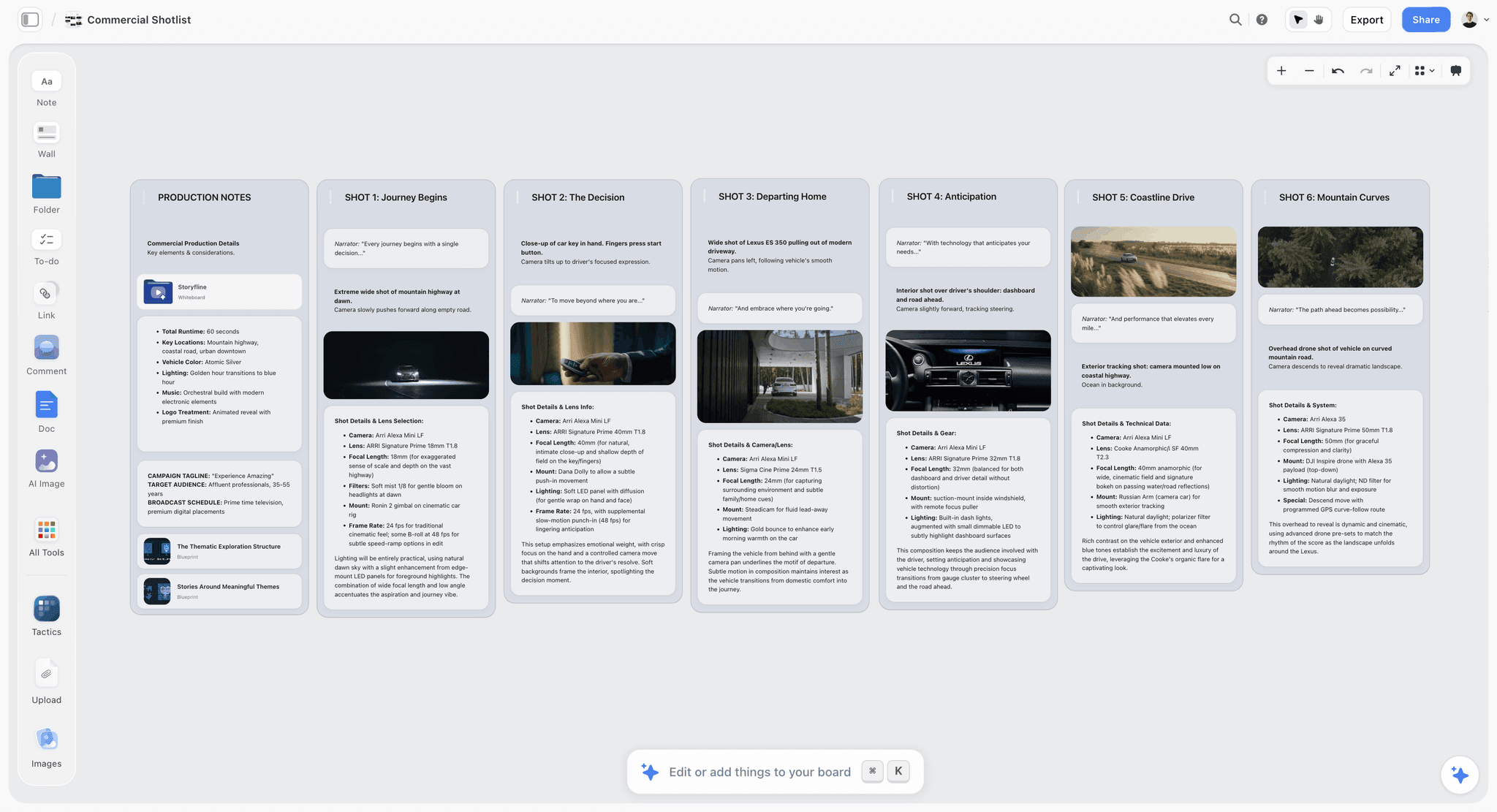
Storyflow hosts nothing and is not a website. It is on this list for the step before the platform, which is the one that actually changes results: laying the candidate images out spatially, grouping them, and cutting to a sequence aimed at one specific client type. Because the work is spatial you can see the edit as a whole rather than as a scrolling list, which is how you notice that six images are doing the same job. The AI reads the board, so the brief you are aiming at can sit beside the selection and be checked against it.
Best for: Deciding which twenty images go in, and in what order.
Verdict: A complement to a portfolio platform and not one. Take Squarespace, Format or Adobe Portfolio for the site.
Key features
- Infinite canvas for laying out and sequencing a selection.
- AI reads the whole current board, plus 5 attached documents and 3 attached boards.
- Anyone a paid member invites to a board joins free, so a peer can review the edit.
- 200+ story blueprints including sequencing structures.
Pricing
Early access: every plan is paid for now. A Free plan arrives before the end of 2026, and anyone a paid member invites to a board can sign up free and collaborate today. Plus: $7.99/mo annual, $9.99/mo monthly. Unlimited boards and uploads. Pro: $14/mo annual, $19/mo monthly. AI image generation, more AI usage, memory across conversations. Max: $39/mo annual, $49/mo monthly. Team workspace with roles and permissions.
Pros
- Seeing the whole edit at once reveals duplicate work no scrolling list shows.
- A peer can review the edit without buying anything.
- Cheapest tool here, priced per account.
Cons
- No hosting, templates, domain, SEO or public site of any kind.
- No commerce, proofing or client delivery.
- Paid-only during early access.
11. Carrd
Carrd builds a one-page site for roughly $19 a year, which for a great many photographers is genuinely sufficient: a strong image sequence, a short statement and a contact link.
Best for: A cheap, fast one-page portfolio.
Verdict: Remarkable value and a real constraint. The single-page limit forces the editing discipline section 3 argues for.
Key features
- One-page sites with clean templates.
- Custom domain on the paid tier.
- Extremely cheap annual pricing.
Pricing
Free for up to 3 sites on a Carrd subdomain. Paid from about $19/year.
Pros
- Roughly a dollar and a half a month with a custom domain.
- Fast to build and fast to load.
- The constraint improves most portfolios.
Cons
- One page, so no separate project pages.
- No client galleries, commerce or blog.
- Limited as the business grows.
12. Behance
Behance is a free platform with an audience, which is a different thing from a portfolio site. It is worth having for discovery and it is not a substitute for a URL you own.
Best for: Free visibility and discovery alongside a real site.
Verdict: Useful as a second surface. Not a portfolio in the sense this page means.
Key features
- Free hosting of project pages.
- Built-in audience and discovery.
- Integrated with Adobe accounts.
Pricing
Free.
Pros
- Free with an audience already there.
- Good discovery within creative industries.
- Easy to publish a project.
Cons
- You do not own the URL or the presentation.
- Your work sits next to competitors' by design.
- No custom domain or real control.
7) How to Edit 400 Images Down to 20
The edit improves a portfolio more than the platform does, and it is the part most photographers do badly because they do it alone, on a screen, scrolling.
Start from the brief, not the images. Decide the one kind of work you want more of, and be specific: not "more commercial", but "interiors for architecture practices, natural light, quiet". Write it down. Every selection decision is then answerable rather than aesthetic.
Cut on relevance before quality. Remove everything that is not the work you want more of, however good it is. This is the hard step and it is where the filter is actually built. The wedding set comes out of the interiors portfolio even if it contains your best photograph.
Lay the survivors out spatially, not in a list. Scrolling a folder hides repetition; seeing eighty thumbnails at once makes it obvious that six of them are the same photograph with different furniture. Contact sheets on a table work. A canvas works. A vertical scroll does not.
Group by job, then keep one from each group. Most portfolios contain four or five distinct things the photographer does well and many near-duplicates of each. One strong example of each job beats five variations, and it reads as range within a specialism rather than repetition.
Cut to twenty, then cut to twelve. A portfolio is judged closer to its worst image than its best, so the marginal image is doing damage rather than adding coverage. If removing an image makes the set weaker, keep it; almost nothing fails that test.
Sequence deliberately. Open with your strongest, and do not save it for the end, because most viewers do not reach the end. Put the second strongest last. Avoid two similar images adjacent. Vary scale and rhythm the way a photo book does.
Then show it to somebody who will be rude about it. Another photographer, an art buyer, an editor. Ask one question: what do you think I photograph. If the answer is not the sentence you wrote in step one, the edit failed and no platform will rescue it.
Re-edit twice a year, and treat removal as the normal operation. Portfolios decay by accretion: work gets added because it is recent, nothing gets removed because removal feels like loss, and within two years the filter is gone.
8) What Art Buyers and Clients Actually Look At
Useful to know, because it is narrower than photographers assume.
The first three images, on a phone. Most decisions are effectively made here. If the first three do not establish what you do and that you do it well, there is no fourth. This is why sequencing matters and why load speed is a commercial property rather than a technical one.
Whether the work matches the brief in front of them. Buyers arrive with a specific job, not a general interest. They are scanning for evidence you have done this before, which is exactly what a filtered portfolio provides and a range-demonstrating one obscures.
Consistency, which is read as reliability. A portfolio where every image has the same quality of attention suggests that is what you deliver. One weak image raises the question of which version they will get, and that question is expensive.
Whether you have shot the constraint. Commercial work has constraints: a real location rather than a studio, a difficult lighting situation, a product that reflects. Evidence of working within a constraint is worth more than a technically superior image made without one.
Contact and rates, or their absence. A portfolio with no obvious way to make contact, or with contact behind a form that looks abandoned, loses enquiries silently. Whether to publish rates is a genuine strategic choice, and being uncontactable is not.
Rarely looked at: an artist statement longer than a paragraph, a long about page, blog posts, social feeds embedded in the site, and the testimonials page. None of those are harmful in small quantities; none of them win the job.
And one thing that is looked at and rarely considered: how the site behaves on a phone held vertically. Full-bleed landscape images become small horizontal strips, and a portfolio built and reviewed on a desktop frequently looks nothing like what the buyer actually sees.
9) Recommended Portfolio Stacks
Stack 1: Commercial or editorial photographer. Squarespace or Format (site) + Storyflow (the edit) + Dropbox (delivery). About $28/month.
Stack 2: Already on Adobe. Adobe Portfolio (site, included) + Storyflow (the edit) + a client gallery tool for delivery. About $8/month plus the Adobe plan you already pay.
Stack 3: Wedding and portrait. Pixieset (site plus client galleries) + Storyflow (the edit). About $18/month.
Stack 4: Design-led and distinctive. Webflow (custom site) + Storyflow (the edit) + a gallery tool. About $22/month plus build time.
Stack 5: Minimum spend. Carrd at roughly $19 a year + Behance free + a Lightroom collection for the edit. About $1.60/month.
| Photographer shape | Site on | Edits the selection in | Delivers with | Monthly cost |
|---|---|---|---|---|
Commercial or editorial | Squarespace or Format | Storyflow | Dropbox | about $28 |
Already on Adobe | Adobe Portfolio | Storyflow | Pixieset or similar | about $8 plus Adobe |
Wedding and portrait | Pixieset | Storyflow | Pixieset | about $18 |
Design-led | Webflow | Storyflow | A gallery tool | about $22 |
Minimum spend | Carrd | Lightroom collection | Google Drive | about $1.60 |
The pattern: the site costs between two and thirty dollars a month and the edit decides whether it works. Photographers reliably over-invest in the first and under-invest in the second.
10) What a Photography Portfolio Costs
The subscription, which is minor. Twelve to twenty dollars a month covers an excellent site, and Carrd at about $19 a year or Adobe Portfolio at no marginal cost are both genuinely viable. This is not where the money goes.
The build, which is real. Two to five days to populate, sequence and write a portfolio site properly, and a photographer's day has an opportunity cost. Hiring it out runs from a few hundred to several thousand depending on how custom it is. The largest part of that time is the edit rather than the building.
The rebuild you will avoid. Portfolio platforms are the easiest thing to leave and the least often left, because the existing site still works and migrating is three days. Photographers routinely stay years past the point of fit. Choose with that in mind, and prefer platforms you can export images from cleanly.
The enquiries a bad filter costs, which is the largest and is invisible. A range-demonstrating portfolio produces more enquiries at a lower rate and a worse fit, and the time spent on calls that were never going to convert is unpaid. Nobody itemises this, and it exceeds every other cost on this page.
| Cost driver | Where it lands | Rough size | The move |
|---|---|---|---|
Subscription | Monthly | $2 to $20 | Not the number to optimise |
Build and edit time | 2 to 5 days | Opportunity cost of a shoot | Most of it is the edit; budget for that |
Avoided rebuild | Years of poor fit | Invisible | Choose for three years, not for this month |
A portfolio with no filter | Wrong enquiries, lower rates | The largest cost here | Cut on relevance before quality |
11) Honorable Mentions
- Pic-Time. Primarily client galleries, with a competent portfolio attached.
- Zenfolio. All-in-one photography business platform including a site.
- WordPress with a photography theme. Maximum control, maximum maintenance.
- Astro or a static site. For technically inclined photographers wanting the fastest possible site.
- Instagram. A discovery surface and not a portfolio; the crop and the algorithm are not yours.
- A printed book. Still the most persuasive portfolio format in commercial photography, and the least used.
- Lightroom collections. The free way to do the section 7 edit if you would rather not add a tool.
12) Portfolio Mistakes to Avoid
- Showing range. It reads as availability, attracts mismatched enquiries and prices you against everyone.
- Sixty images. A portfolio is judged closer to its worst image than its best.
- Saving the best image for last. Most viewers do not reach the end; open with it.
- Building and reviewing only on a desktop. Most first views are on a phone held vertically, where full-bleed landscapes become strips.
- A site that takes six seconds to load. The buyer is scanning, not waiting.
- No obvious way to make contact. Silently expensive and trivially fixable.
- Never removing anything. Portfolios decay by accretion; re-edit twice a year and treat removal as normal.
14) The Bottom Line
The best photography portfolio platforms in 2026 are Squarespace for most working photographers, Format for photographer-specific features with proofing, Adobe Portfolio if you already pay for Creative Cloud, and Pixieset if you want portfolio and client galleries in one subscription. All four present images well, load fast and cost between nothing extra and about twenty dollars a month.
A portfolio is a filter, not a gallery: its job is to attract the work you want and repel the work you do not. Range reads as availability and specificity reads as authority, which means the edit decides your rate more than the platform decides anything.
Cut on relevance before quality, lay the survivors out where you can see them all at once, and cut to twelve. Lay the candidates out on one canvas with the brief you are aiming at beside them and see how many are doing the same job.
FAQ: Photography Portfolio Platforms
What is the best photography portfolio platform in 2026?
Squarespace is the best photography portfolio platform for most working photographers: strong image-led templates, good mobile presentation, fast loading and a full business site around the gallery, from about $16/month billed annually. Format is the best photographer-specific alternative with proofing attached and is slightly cheaper. Adobe Portfolio is effectively free if you already pay for Lightroom. Pixieset is best if you want portfolio and client galleries in one subscription. None of them will fix a portfolio that shows everything you have ever photographed.
How many images should a photography portfolio have?
Twelve to twenty for a focused body of work, and fewer than you want to include. A portfolio is judged closer to its worst image than its best, so the marginal image is doing damage rather than adding coverage. The useful test is whether removing an image makes the set weaker; almost nothing fails it.
Should my portfolio show a range of work?
Usually not, and this is the most consequential decision on the page. Range reads as availability, which is a commodity and is priced against every other available photographer. A portfolio showing one kind of work done unmistakably well produces fewer enquiries at a higher rate and a better fit. If you serve two genuinely different markets, that is an argument for two portfolios rather than one mixed one.
Is there a free photography portfolio platform?
Adobe Portfolio is included with an Adobe photography plan, which most working photographers already pay for, and includes a custom domain. Behance is free for discovery but you do not own the URL or the presentation. Carrd and Webflow have free tiers on their own subdomains. For a genuinely free route with a real domain, Adobe Portfolio is the answer if you have Creative Cloud. Storyflow is paid-only during early access and hosts no site.
Squarespace or Format for photographers?
Squarespace if you want one platform for the whole site including pages a business needs, and you value reliability over distinctiveness. Format if you want photographer-specific defaults and client proofing in the same subscription, at a slightly lower entry price. Both present images well; the decision is really whether you need a broader website or a photographer-shaped one.
How do I edit my portfolio down?
Write down the one kind of work you want more of, specifically. Cut on relevance before quality, removing everything that is not that work however good it is. Lay the survivors out spatially rather than scrolling, so repetition becomes visible. Group by job and keep one from each. Cut to twenty, then to twelve. Sequence with the strongest first. Then show it to someone who will be rude and ask what they think you photograph.
Do photographers still need a portfolio website?
Yes, and more than before. Social platforms control the crop, the compression, the ordering and who sees it, and a profile is not a URL you own. Commercial clients and art buyers expect a site, and a portfolio site is where a filtered, sequenced body of work can exist as you intended it. Use social for discovery and the site for the decision.
How often should I update my portfolio?
Re-edit twice a year, and treat removal as the normal operation rather than addition. Portfolios decay by accretion: recent work gets added, nothing gets removed, and within two years the filter has disappeared. A scheduled re-edit is the only reliable defence, because there is never an obvious moment to cut something.
What should be on a photography portfolio site besides images?
A one-line statement of what you photograph and for whom, an obvious contact route, a short about page with a photograph of you, and client or publication credits if you have them. Whether to publish rates is a genuine strategic choice. Keep everything else off: long artist statements, embedded social feeds and testimonial pages are rarely read and dilute the filter.
Does portfolio site speed actually matter?
Yes, commercially rather than technically. Most first views are on a phone, often on a poor connection, by someone scanning several photographers. A site taking six seconds to load is judged on its first image if that, so speed is effectively part of your first three images. This is where cheap and custom-built sites most often fail and where the mainstream platforms earn their fee.
Can I use Instagram as my portfolio?
As discovery, yes; as a portfolio, no. You do not control the crop, the compression, the sequence or who sees it, the grid imposes a format on work that may not suit it, and you cannot send a client a URL you own. Use it to be found and a site to be judged.
What is the cheapest way to have a professional portfolio?
Adobe Portfolio at no marginal cost if you already pay for Lightroom, otherwise Carrd at roughly $19 a year with a custom domain, which is about a dollar and a half a month. Both are genuinely professional. Spend the saved money and time on the edit, which changes results more than the platform does.
Should I have different portfolios for different clients?
If you serve two genuinely distinct markets, yes: either two sites, or clearly separated bodies of work, or a decision about which market you actually want. Sending an interiors client a link that opens on weddings costs you the authority the portfolio exists to establish. Several platforms make multiple project pages easy, which is usually enough without a second site.
Table of Contents
- Article Metadata
- Breadcrumb
- Table of Contents
- 1) Quick Answer: The Best Photography Portfolio Platforms in 2026
- All 12 Photography Portfolio Platforms, Ranked
- 2) Comparison Table: 12 Portfolio Platforms at a Glance
- Frequently Asked: Which Portfolio Platforms Photographers Trust, and What Clients Notice
- 3) The Portfolio Is a Filter, Not a Gallery
- 4) How We Evaluated These Platforms
- 5) Quick Picks by Photography Business
- 6) Detailed Reviews: 12 Photography Portfolio Platforms
- 7) How to Edit 400 Images Down to 20
- 8) What Art Buyers and Clients Actually Look At
- 9) Recommended Portfolio Stacks
- 10) What a Photography Portfolio Costs
- 11) Honorable Mentions
- 12) Portfolio Mistakes to Avoid
- 14) The Bottom Line
- 15) Author
- 16) Related Reading
- FAQ: Photography Portfolio Platforms
Templates to check out for this topic


Templates you can use in Storyflow
Every Storyflow board starts from real structure and an AI that reads the whole canvas. Open one of these templates and make it yours.


See Storyflow in Action
A visual AI workspace where every feature lives inside one canvas. No tab-switching, no context lost.
Build your entire board from a single message
Type what you need in the AI chat at the bottom of your canvas. The AI adds cards, headings, and structure directly onto your board.
Use expert frameworks as AI context
Type @ in the AI chat and choose any Tactic. The AI tailors every response to that framework instead of giving generic advice.
Turn your board into a mind map in seconds
Ask the AI to restructure your canvas as a mindmap. It connects your ideas into a visual hierarchy so you can see how everything relates.
Why Storyflow Exists
Storyflow actually began as a personal tool while working on creative and research projects.
We kept running into the same problem: ideas were scattered everywhere: notes, documents, and whiteboards.
Nothing helped us see how everything connected.
So we started building a workspace designed around how ideas actually grow.
→ Read how Storyflow was createdStoryflow Team
Product & Research Team
Published: 2026-09-22
Extremely simple, seriously capable


See how easy it is to get started
Watch a real project come together, from a blank board to a finished plan, clicked through step by step.
Start creating with AI and become more productive
Transform your creative workflow with AI-powered tools. Generate ideas, create content, and boost your productivity in minutes instead of hours.