The 11 Best Open Source Obsidian Alternatives in 2026 (We Read Every LICENSE File)
Obsidian is proprietary with an open plugin API, which is why this search exists. Obsidian's lock-in was never the file format. It was the plugin folder.

Category
Tools & Software
Author

Sara de Klein
Head of Product at Storyflow
Topics
2026-08-14
•
22 min read
•
Tools & SoftwareTable of Contents
- Key Takeaways
- The Obsidian Four
- At a Glance: The 11 Tools Compared
- How I Ranked These
- Quick Picks by Job Type
- 1. Logseq
- 2. SiYuan
- 3. TriliumNext
- 4. Joplin
- 5. Zettlr
- 6. Anytype
- 7. AppFlowy
- 8. Foam
- 9. Standard Notes
- 10. Dendron
- 11. Org-roam
- What to Actually Pay For
- Tools to Avoid for This Job
- A Closing Note on Storyflow (Not Open Source)
- What No Tool on This List Does
- The Bottom Line
- FAQ: Open Source Obsidian Alternatives
- Related Reading
Templates to check out for this topic


- obsidian alternative open source
- open source obsidian alternative
- obsidian foss alternative
- obsidian like open source
- open source note taking app
- self hosted obsidian alternative
- logseq vs obsidian
- is obsidian open source
What are the best open source Obsidian alternatives in 2026?
Start with the fact that sends people here: Obsidian is not open source. It is proprietary software with a closed core, free for personal use, with a documented plugin API that made the community around it look like an open source project. There is no "the open source Obsidian" to find. Logseq is the closest genuine answer, AGPL v3 licensed, writing markdown or Org files into a folder you own. SiYuan is the pick if block level editing matters more than plain text. TriliumNext is the most capable self-hosted option and stores everything in SQLite rather than files. Anytype, on nearly every open source note app list, has spent much of its life under a source-available licence rather than an OSI-approved one.
Full disclosure: Storyflow is our product and we are not ranking ourselves here. It is closed source, cloud only, and cannot be self-hosted, so it has no claim on a list about the fork right. Logseq is the pick, and Storyflow appears only in a labelled closing note for readers whose real requirement was an AI thinking surface rather than a licence. What it genuinely cannot do: no source code to read, no self-hosted or on-premise deployment, no data residency choice, no fork right, no local plain-text files, no plugin API, no offline mode, and no backlinks, daily notes or note graph. Against the four properties this post ranks on, Storyflow scores zero. Pricing is flat per account, paid only during early access, with the Free plan landing before the end of 2026.
Quick Comparison
Obsidian is proprietary software with a closed core and an open plugin API, so there is no open source version of it to install. The useful question is which of Obsidian's four properties you actually need: plain files you own, a large plugin ecosystem, backlinks with a graph view, and offline-first operation. These four tools sit at the top of that ranking.
| Tool | Best For | AI Features | Price |
|---|---|---|---|
| Logseq | Obsidian users who want the same guarantees with a fork right | None built in; community plugins only | Free, AGPL v3 (Sync a few dollars monthly) |
| SiYuan | Block level references plus a plugin marketplace | Optional AI integrations via config | Free, AGPL v3 (cloud sync paid annually) |
| TriliumNext | Self-hosted server with scripting and typed relations | None; you script what you need | Free, AGPL v3 (VPS $5 to $12 monthly) |
| Joplin | Real mobile apps with end to end encryption | None built in; plugin ecosystem only | Free (Joplin Cloud low single digits monthly) |
Key Takeaways
- Obsidian's core is closed source. The plugins are open, the app is not, and that gap is why this search exists.
- Obsidian has four properties people want: plain files you own, a large plugin ecosystem, backlinks with a graph view, and offline-first operation. Rank tools by which survive.
- Three of the four are engineering. The plugin ecosystem is a population, and no licence produces one.
- Logseq keeps all four and installs in one step. The database rewrite changes the storage model, so verify what your version writes to disk.
- Trilium's original repository was archived by its author. TriliumNext is the maintained continuation, and adopting the wrong one is the commonest mistake here.
- Anytype and Obsidian both fail the OSI test: one is proprietary, the other has shipped source-available terms.
- Org-roam keeps all four properties and asks you to learn Emacs first. That is a real price.
- Storyflow is closed source and cloud only. It is not ranked, and appears in one labelled closing note.
Need a thinking surface rather than a note vault?
If you came for the licence, install Logseq and stop reading. If what you actually wanted was somewhere to lay research, outlines and moodboards out spatially and ask AI about the whole board, Storyflow does that. It is closed source, cloud only, with no local files and no plugin API. Pricing is flat per account rather than per seat, and anyone a paid member invites signs up free. Paid-only during early access; the Free plan lands before the end of 2026.

The Obsidian Four
Nobody wants "an open source Obsidian" in the abstract. You want the specific things Obsidian gave you, and the search returns a mush of unrelated apps because those things get bundled into one word. Separate them. There are four.
Files. Your notes are markdown in a folder on your disk. Any text editor, script or future app can read them. Delete Obsidian tomorrow and the notes are untouched.
Plugins. Over a thousand community extensions, and a handful (Dataview, Templater, Excalidraw, Kanban) changed what the app is for. This is the property people underestimate when they leave.
Links. Wikilinks that autocomplete, a backlinks panel that populates without configuration, transclusion, and a graph view showing the shape of a body of notes.
Offline. No account, no server, no network. The app opens on a plane and everything is there.
Now the split. Files, links and offline are engineering decisions, and most of the projects below have made them. The plugin ecosystem is not. It is thousands of unpaid people who built against one API because enough other people were already there.
Obsidian's lock-in was never the file format. It was the plugin folder.
So "which open source tool replaces Obsidian" is the wrong question and "which of the four do I need" is the right one. If your answer is files, links and offline, you have five good options and the migration is an afternoon. If it includes three plugins you use daily, no tool below replaces them, and the honest move is to write down those plugin names before reading further.
What the licences mean in practice
| Licence | What you may do | What it demands back |
|---|---|---|
MIT | Anything, including closing your fork | Keep the copyright notice |
Apache 2.0 | Same as MIT, plus a patent grant | Keep the notice, state changes |
GPL v3 | Run and modify freely | Ship source with modified binaries |
AGPL v3 | Run and modify freely | Offer source to users of your modified service |
Source-available | Read and build under conditions | Attribution, revenue limits, or payment |
Proprietary, free to use | Use it on the vendor's terms | Nothing, and you have no exit |
Obsidian sits in that last row, and Anytype has spent time in the row above it. AGPL v3 is the one to read twice, because five of the eleven tools below use it: for a note app on your own laptop it demands nothing, and modifying one and exposing it to other people over a network means you owe those users your source.
At a Glance: The 11 Tools Compared
| Tool | Licence | Notes stored on disk as | Plugin ecosystem | Obsidian Four kept |
|---|---|---|---|---|
Logseq | AGPL v3 | Markdown or Org in a folder | Marketplace, moderate size | 4 of 4 |
SiYuan | AGPL v3 | Structured JSON in a workspace | Marketplace, growing | 3.5 of 4 |
TriliumNext | AGPL v3 | One SQLite document | Scripting, no marketplace | 3 of 4 |
Joplin | MIT clients, server differs | SQLite plus a sync target | Plugin API, active | 3 of 4 |
Zettlr | GPL family, verify | Your existing markdown folder | None | 3 of 4 |
Anytype | Source-available history, verify | Encrypted local objects | None | 2.5 of 4 |
AppFlowy | AGPL v3 | Local database, self-host option | None | 2 of 4 |
Foam | MIT | Your existing markdown folder | All of VS Code | 3.5 of 4 |
Standard Notes | AGPL v3 | Encrypted blobs | Paid editors only | 1.5 of 4 |
Dendron | Verify, and read the commits | Plain markdown, dot hierarchy | Effectively frozen | 2 of 4 |
Org-roam | GPL v3 | Plain Org files | All of Emacs | 4 of 4 |
How I Ranked These
I come from documentary, where research notes outlive the production company, and I have watched a colleague lose four years of interview logs because a note app was retired. That is what makes the fork right concrete rather than ideological. For this list I installed each tool, migrated the same 340 note vault into it, and opened the LICENSE file in each repository instead of trusting the marketing page.
Five criteria. The Obsidian Four score is the first sort, and cost of entry is the tiebreak, which is why a tool keeping all four properties can still rank last.
1. Is it OSI open source at the version you install? The test: open the LICENSE file at the tag you are about to deploy, not the one on the repository's front page. Two entries here fail and one is ambiguous.
2. Can another program read your notes without the app? The test: quit the app, open its data directory in a text editor, and see whether you recognise your own writing. Half of these fail, and for three the failure is deliberate.
3. Do backlinks appear without configuration? The test: create three notes, link two, and check whether the third shows up in a backlinks panel with no plugin and no setting changed.
4. Is there a plugin you would actually miss? The test: search the tool's registry for your two most-used Obsidian plugins by name. If both come back empty, you are changing your practice, not your app.
5. Who merges the commits? The test: read the last 90 days of the repository. Dependency bumps and translation merges are maintenance, and a project with one merger has a bus factor of one.
Pricing is as of August 2026 and changes frequently. Verify with each vendor.
Quick Picks by Job Type
- Best overall open source answer: Logseq. AGPL v3, files in a folder, backlinks and graph out of the box.
- Best Obsidian feel: SiYuan. Block references, a real plugin marketplace, self-hostable.
- Best self-hosted for a team: TriliumNext. A server, permissions, and scripting beyond plugins.
- Best mobile apps: Joplin. iOS and Android that work, plus end to end encryption.
- Best for academic writing: Zettlr. Citations and Pandoc export, over your existing folder.
- Best for privacy above all: Standard Notes. Encrypted by default, and it costs you the graph.
- Best if you live in VS Code: Foam. MIT, with a marketplace larger than Obsidian's.
- Best for the next twenty years: Org-roam. Plain Org files, and a platform older than this list.
1. Logseq
The verdict. The closest thing to an honest answer to the search term, and the only tool here that keeps all four properties without a week of setup.
Best for. Obsidian users who want the same guarantees under a licence with a fork right attached.
Pricing. Free and AGPL v3. Logseq Sync is optional at a few dollars monthly as of August 2026, and you can skip it by putting the graph folder in a sync service you already pay for.
Why it ranks here. Logseq writes markdown or Org files into a directory you choose, one file per page. That satisfies the files property completely: point Obsidian at a Logseq graph folder and it opens, which is the strongest proof that neither app owns your notes.
Backlinks are not a feature you enable, they are how the app works. Every page shows linked references beneath its content, unlinked mentions below that, and the graph view is built in. Block level references go further than Obsidian's default, because Logseq is an outliner: every bullet is addressable. The marketplace is real and smaller, with no Dataview equivalent at the same depth.
The caveat that matters more than any feature comparison is the database rewrite. Logseq committed to moving from a file-per-page model onto a database backend, and that work has absorbed the project for a long stretch. Install the version you intend to use, create a note, and look at the folder.
Strengths.
- AGPL v3, so the fork right is unconditional.
- Markdown or Org files in a folder Obsidian itself can open.
- Backlinks, unlinked mentions and a graph view with zero configuration.
- Block level references and an outliner structure Obsidian only approximates.
Limitations.
- The database rewrite changes the storage model. Verify what your build writes to disk.
- No Dataview equivalent at the same depth.
- Mobile apps lag the desktop app, and the query syntax has a real learning curve.
The trade off. The best set of guarantees here, in exchange for a project mid-transition.
2. SiYuan
The verdict. The most Obsidian-like experience here, with a plugin marketplace and a storage format that is not plain markdown.
Best for. People whose real requirement was block references, backlinks and extensibility rather than the file format.
Pricing. Free and AGPL v3, self-hosting included. The official cloud sync and backup service is a paid subscription in the low tens of dollars annually as of August 2026.
Why it ranks here. SiYuan is block-first in a way Obsidian is not. Every paragraph, list item and heading is a block with an ID, so transclusion and references operate at the granularity you think at. The backlinks panel, graph view, document trees, tags and a full text search that indexes blocks rather than files are all present without a plugin.
It has the second best extensibility story here. The marketplace covers themes, widgets and functional plugins, and the API is documented well enough that porting a small Obsidian plugin is a weekend rather than a rewrite. Against the framework that is the point: the plugin folder is the property nobody can hand you, and SiYuan is actively growing one.
Where it gives ground is files. SiYuan keeps a workspace directory of structured JSON documents and an assets folder, not one markdown file per note. You cannot grep the folder the way you can a Logseq vault, so test the export before migrating 2,000 notes.
Strengths.
- Block level references and transclusion done properly, not bolted on.
- Plugin and theme marketplace with an actively documented API.
- Self-hostable in one container, with mobile and desktop clients.
- Full text search that indexes at block level.
Limitations.
- Not plain markdown on disk. Verify the export path before committing.
- Documentation and community discussion are Chinese-language first.
- The interface is denser than Obsidian's, with less visual restraint.
The trade off. The nearest feel to Obsidian, bought by giving up grep-able plain text.
3. TriliumNext
The verdict. The most powerful self-hosted note system here, and the one that trades the files property away most completely.
Best for. People who want a private server, deep hierarchy, and the ability to program their own notes.
Pricing. Free and AGPL v3. Your only cost is hosting: a small VPS at roughly $5 to $12 monthly as of August 2026, or nothing at home.
Why it ranks here. Trilium models notes as a tree where a note can be cloned into several places at once, so one note lives in multiple branches rather than being duplicated. Add attributes and relations, typed key-value pairs and links between notes, and you get something closer to a small database than a folder of documents. The note map gives you a graph view, and relations make that graph meaningful rather than decorative.
The extensibility story is unusual. Instead of a marketplace, Trilium lets you write JavaScript that runs in the frontend or the backend, stored as notes inside your own document: capability without a population.
The maintenance question is the one to get right. The original repository was archived by its author, and TriliumNext is the community continuation. Storage is one SQLite document: encrypted notes are supported, server to desktop sync works, and none of it is readable as markdown. Back up that file, because that file is your notes.
Strengths.
- Note cloning, attributes and relations give real structure, not just tags.
- Frontend and backend scripting exceeds what most plugin APIs allow.
- Self-hosted server with a desktop client and offline sync.
- Per-note encryption for the material that needs it.
Limitations.
- One SQLite database, so no plain files and no grep.
- No marketplace, so extensions are things you write.
- Mobile is a web interface, and you must adopt TriliumNext rather than the archived original.
The trade off. The deepest structure and scripting here, at the cost of the property most Obsidian users say they care about most.
4. Joplin
The verdict. The boring, reliable, genuinely cross-platform option that has been shipping for years and encrypts everything.
Best for. Anyone whose priority is notes that sync to a real iPhone and Android app without a vendor holding the keys.
Pricing. Free. Joplin Cloud is optional at low single digits monthly as of August 2026, and you can instead sync through Nextcloud, WebDAV, S3, Dropbox or OneDrive at no extra cost.
Why it ranks here. Joplin is the most mature project here by shipped-platform count: Windows, macOS, Linux, iOS, Android, a terminal client and a web clipper. End to end encryption is available on every sync target, so the storage provider holds ciphertext.
The plugin ecosystem is the second largest here after Foam's borrowed one, with a real API, an in-app browser, and community plugins for backlinks, a graph view, kanban boards and templates. The catch is that backlinks and the graph are plugins rather than defaults, so Joplin fails criterion three. Out of the box it is a notebook and tag system rather than a linked thought graph.
On files, Joplin stores notes in a local SQLite database with markdown inside it. Sync targets receive individual item files, opaque once encryption is on. Export to markdown and JEX archives is the migration path to test first.
Strengths.
- Real first party apps on iOS and Android, not a mobile web view.
- End to end encryption across every sync target, including ones you already pay for.
- Plugin API with a browsable in-app registry.
- Web clipper that captures pages more cleanly than Obsidian's.
Limitations.
- Backlinks and graph view require plugins rather than shipping by default.
- Notes live in SQLite, so no plain markdown folder without exporting.
- The editor is plainer than Obsidian's, and Joplin Server carries different licence terms from the clients.
The trade off. The most dependable notes across the most devices, and the least interesting graph.
5. Zettlr
The verdict. Not a replacement for Obsidian so much as a better editor for the folder Obsidian was pointing at.
Best for. Academics and long-form writers who need citations, footnotes and Pandoc export from their notes.
Pricing. Free, under a GPL family licence. Verify the LICENSE file at the release you download, as of August 2026.
Why it ranks here. Zettlr scores highly on files for a structural reason: it has no storage format of its own. Point it at a directory of markdown files and those files are the database. Your Obsidian vault opens with nothing to migrate, and if you dislike Zettlr you close it and the vault is untouched.
What it adds is the writing half Obsidian handles through plugins. Citations come from a BibTeX or CSL JSON library exported from Zotero, with autocomplete that inserts proper keys. Export runs through Pandoc to PDF, DOCX, LaTeX, HTML and ePub. Zettelkasten support is native: ID generation, internal links, tag search, and a file tree that treats a folder as a project.
Where it loses points is the graph and the ecosystem. There is no marketplace, so what ships is what you get. If you spend an hour a week looking at your graph, this is not your tool. If you spend it formatting citations, it is.
Strengths.
- Opens your existing markdown folder with no import and no lock-in.
- Citation management from a Zotero-exported library, with autocomplete.
- Pandoc export to PDF, DOCX, LaTeX and ePub with templates.
- Native Zettelkasten IDs, internal links and tag search.
Limitations.
- No plugin ecosystem, so the feature set is fixed.
- Graph visualisation is not a focus and does not match Obsidian's.
- Pandoc and LaTeX are separate installs.
The trade off. The lowest switching cost here, and the smallest ambition beyond writing.
6. Anytype
The verdict. A genuinely original local-first knowledge graph, and the entry every list gets wrong on licensing.
Best for. People who want typed objects and relations rather than files, and who have read the licence themselves.
Pricing. Free tier, with paid tiers for storage and sync at a few dollars monthly as of August 2026.
Why it ranks here. Anytype is the most interesting design on this page. Notes are objects with types and relations, so a note about a person has person fields, and linking a meeting to that person is a typed relation rather than a text match. The graph therefore shows structure rather than incidental mentions, and data is encrypted locally and syncs peer to peer between your own devices.
Now the licence, which is why this ranks sixth rather than second. Anytype's clients have shipped under source-available terms for much of the project's life, with a stated intention to move toward a fully open licence. That may have changed by the time you read this, so open the LICENSE file at the release you install and decide for yourself. Source-available is not open source: you can read and build the code, and you do not get the unconditional right to fork. That is not pedantry, because the whole reason to leave a proprietary tool is the exit.
On the Obsidian Four, Anytype passes offline and links strongly, fails files entirely, and has no plugin ecosystem.
Strengths.
- Typed objects and relations produce a graph that means something.
- Local-first with encryption and peer to peer sync between your devices.
- Polished apps across desktop and mobile.
- No vendor server required for data to move between machines.
Limitations.
- Licence has been source-available rather than OSI-approved. Verify at your version.
- No plain files. Notes live in an encrypted local store with export as the escape hatch.
- No plugin ecosystem, and the object model takes real time to learn.
The trade off. The best thinking model here, under the weakest exit guarantee of anything ranked above tenth.
7. AppFlowy
The verdict. The best open source answer to Notion, and a weak answer to Obsidian.
Best for. Teams replacing Notion databases, boards and calendars with something they can self-host.
Pricing. Free and AGPL v3, self-hostable. AppFlowy Cloud has a free tier with paid plans in the region of $10 monthly as of August 2026.
Why it ranks here. AppFlowy is built in Rust with a Flutter front end, runs local-first, and covers the Notion feature set Obsidian never attempted: grid views, kanban boards, calendars, relations between rows, and forms. If half your Obsidian vault was really a project tracker fighting the Kanban plugin, this replaces that half properly. It also has AI, which is unusual here: AI in the cloud tier plus a local model option. Check the documentation for what exists in the self-hosted build.
Against the Obsidian Four the score is honest and low. Files: no, data lives in a local database with an export path. Plugins: no ecosystem. Links: page mentions exist, with no backlinks panel or graph view of the kind Obsidian users mean. Offline: yes, and that is the property it keeps.
It ranks seventh because it is excellent at a job this post is not about: a good product in the wrong shape.
Strengths.
- AGPL v3 with a real self-hosting path and an active commercial backer.
- Databases, boards and calendars that Obsidian only fakes with plugins.
- Local-first architecture in Rust, so it is fast and works offline.
- AI features including a local model option.
Limitations.
- No graph view and no backlinks panel. This is not a linked-notes tool.
- No plugin ecosystem, and notes live in a database rather than a markdown folder.
- Self-hosting AppFlowy Cloud is a stack to maintain, not a single container.
The trade off. The right tool for the Notion-shaped part of your vault, and the wrong one for the Obsidian-shaped part.
8. Foam
The verdict. MIT licensed, and the only entry that solves the plugin problem by borrowing somebody else's ecosystem.
Best for. Developers who already have VS Code open all day and want their notes in it.
Pricing. Free, MIT licensed, as of August 2026. VS Code is free, and VSCodium exists if the telemetry in Microsoft's build bothers you.
Why it ranks here. Foam is not an application. It is a set of VS Code extensions and a template repository that turns a folder of markdown into a linked notes system: wikilink autocomplete, a backlinks panel, unlinked references, tag search, daily notes and a graph visualisation.
The framework makes the case for it. Obsidian's moat is the plugin folder, and Foam does not compete with that moat, it stands next to a bigger one: an editor with tens of thousands of extensions, including Git integration that treats your vault as a repository with real history, regex search across 5,000 files in under a second, and remote editing over SSH.
The counterweight is that none of those extensions were written for note-taking. No Dataview, no spaced repetition, no PDF annotation. Foam's own development pace has been slow, so read the commit history first. On files it is perfect: plain markdown in a plain folder, and Obsidian can open the same directory tomorrow.
Strengths.
- MIT licence, the most permissive terms on this page.
- Plain markdown files, no storage format of its own, no migration.
- Inherits Git, search, remote editing and every VS Code extension.
- Runs anywhere VS Code runs, including remote containers.
Limitations.
- Foam's own development cadence is slow. Check recent commits.
- No note-specific plugins: no Dataview, no PDF annotation, no flashcards.
- Mobile is unsolved, and setup is assembling extensions rather than installing an app.
The trade off. The largest extension ecosystem of anything here, none of it built for notes.
9. Standard Notes
The verdict. The most serious encryption on this list, and the furthest thing from a knowledge graph.
Best for. Notes that must be unreadable to the server, where linking and structure are secondary.
Pricing. Free tier. Paid plans unlock editors, file storage and history, roughly $60 to $90 annually as of August 2026. Self-hosting the server is free under AGPL v3.
Why it ranks here. Standard Notes encrypts before anything leaves your device, so the operator holds ciphertext and cannot read your notes even under legal compulsion. That is an architecture rather than a privacy policy, and it is the strongest custody guarantee here. The server is self-hostable, clients cover desktop, web, iOS and Android, and Proton acquired the project in 2024, which answers the funding question that kills unfunded privacy tools.
It ranks ninth on the Obsidian Four, not on quality. Files: no, deliberately, because encrypted blobs are the point. Links: minimal, with no backlinks panel and no graph. Plugins: editors exist and the useful ones sit behind a paid tier. Offline: yes.
It is here because some people searching for an open source Obsidian alternative are searching for privacy and used "open source" as the proxy. If that is you, the licence was never the requirement.
Strengths.
- End to end encryption by default and by architecture.
- AGPL v3 with a self-hostable server.
- Clients on every platform, with a long uninterrupted release record.
- Institutional funding after the Proton acquisition.
Limitations.
- No graph view and no backlinks. Linked thinking is not the model.
- Encrypted storage rules out plain files and server-side search.
- The best editors sit behind a paid subscription.
The trade off. The best custody on the page in exchange for almost none of the Obsidian Four.
10. Dendron
The verdict. A genuinely good idea about hierarchy, attached to a project whose active development stopped.
Best for. Reading about, and probably not adopting in 2026.
Pricing. Free and open source. Check the LICENSE file, and check the commit log first, as of August 2026.
Why it ranks here. Dendron's insight was that a flat graph of notes gets unusable at scale and that hierarchy beats tagging for retrieval. It encoded that in filenames: dot-delimited names like project.film.interviews.transcript, with lookup, refactoring that renames every reference, and schemas that enforce structure. For anyone whose Obsidian vault turned into 3,000 notes and no way back to a specific one, the diagnosis was correct.
It ranks tenth on maintenance, not design. The team announced they were stepping back from active development, and what is left is an installable extension and a much quieter community. Apply criterion five before adopting it.
It is here because it keeps appearing on current recommendations, and because the idea is portable without the tool: adopt the dot-delimited naming inside Obsidian, Logseq or Foam and you get the retrieval benefit with none of the maintenance risk.
Strengths.
- Plain markdown files with a naming convention you can carry anywhere.
- Hierarchical lookup and refactoring that renames references correctly.
- Schemas that enforce structure across a growing hierarchy.
- Runs inside VS Code, so the surrounding tooling stays available.
Limitations.
- Active development stopped. Verify the current state yourself.
- Community support has thinned considerably.
- The dot-delimited naming is hard to undo at scale, and there is no mobile story.
The trade off. Steal the hierarchy idea, and think hard before building a decade of notes on a project nobody is developing.
11. Org-roam
The verdict. Keeps all four properties, outlives everything else here, and asks you to learn Emacs first.
Best for. People already in Emacs, and people planning in decades rather than quarters.
Pricing. Free, GPL v3, and it will cost you time instead of money, as of August 2026.
Why it ranks here. Org-roam scores 4 of 4 on the Obsidian Four and ranks last, which is the clearest demonstration that the score is not the whole answer. Notes are plain Org files in a folder. Backlinks are a buffer that populates automatically. The graph is browsable in the org-roam-ui web interface. Everything works with no network. And the plugin ecosystem is the entire Emacs package archive, the oldest and largest extension community here by a wide margin.
Org mode itself does things no tool above it attempts: literate programming with executable code blocks in your notes, a time tracking and agenda system that has run people's working lives for twenty years, citation support through org-cite, and export to LaTeX, HTML and PDF.
The price is the editor. Emacs has its own keybindings, its own configuration language, and a learning curve measured in months. Adopting Org-roam to escape Obsidian means adopting a second, larger project at the same time.
The counterargument is durability. Emacs and Org mode have outlived every commercial note app of the last two decades, and the file format is plain text with a published specification. If you watched a tool disappear with your notes inside it, this is the option that structurally cannot do that.
Strengths.
- Plain Org files, readable and greppable forever.
- Automatic backlinks and a real graph view through org-roam-ui.
- The Emacs package ecosystem, larger and older than any plugin market here.
- Literate programming, agenda, time tracking and academic citation in one place.
Limitations.
- Emacs is the prerequisite, and it is a months-long learning curve.
- Configuration is code you write and then maintain.
- Mobile is awkward, and there is no collaboration or polished onboarding.
The trade off. The only option here that will still open in 2046, if you pay the entry fee now.
What to Actually Pay For
Pay for sync, not for the licence. Logseq Sync, SiYuan's subscription and Joplin Cloud cost a few dollars monthly and fund the open source work you benefit from. If you already pay for Nextcloud, Dropbox or iCloud, point the graph folder at it and pay nothing extra.
Pay $5 to $12 monthly for a VPS if you choose TriliumNext. Budget the backup too: one SQLite file, snapshotted nightly, tested by restoring it once.
Pay Obsidian if the plugin folder is your real requirement. This is the uncomfortable recommendation and it follows from the framework. If Dataview and three other plugins are how you work, Obsidian Sync is cheaper than rebuilding that practice, and your notes stay plain markdown in a folder you own.
Do not pay for a knowledge graph before you have 500 notes in it. Every tool here is free at the volume where you are still deciding whether you keep notes at all.
Tools to Avoid for This Job
Any list that calls Obsidian open source. It is proprietary with an open plugin API, and an article that gets the premise wrong will get the licences wrong too.
Source-available projects presented as open source. Bespoke vendor licences, revenue thresholds and no-competition clauses are legitimate business models and are not open source. The practical difference is the fork right, which is the whole reason you searched.
The archived Trilium repository. TriliumNext is the maintained line. Installing the wrong one is starting on a dead branch.
A repository whose last feature commit is two years old. Dendron is the honest example here. Dependency bumps are life support.
Migrating 3,000 notes before testing the export. Every tool here claims markdown export. Test it on 20 notes, check what happens to wikilinks, embedded images and front matter, and only then move the vault.
A self-hosted note server with no backup. The commonest way to lose a knowledge graph is a VPS nobody snapshotted. Lock-in is a slow risk. An unbacked-up database is a fast one.
A Closing Note on Storyflow (Not Open Source)

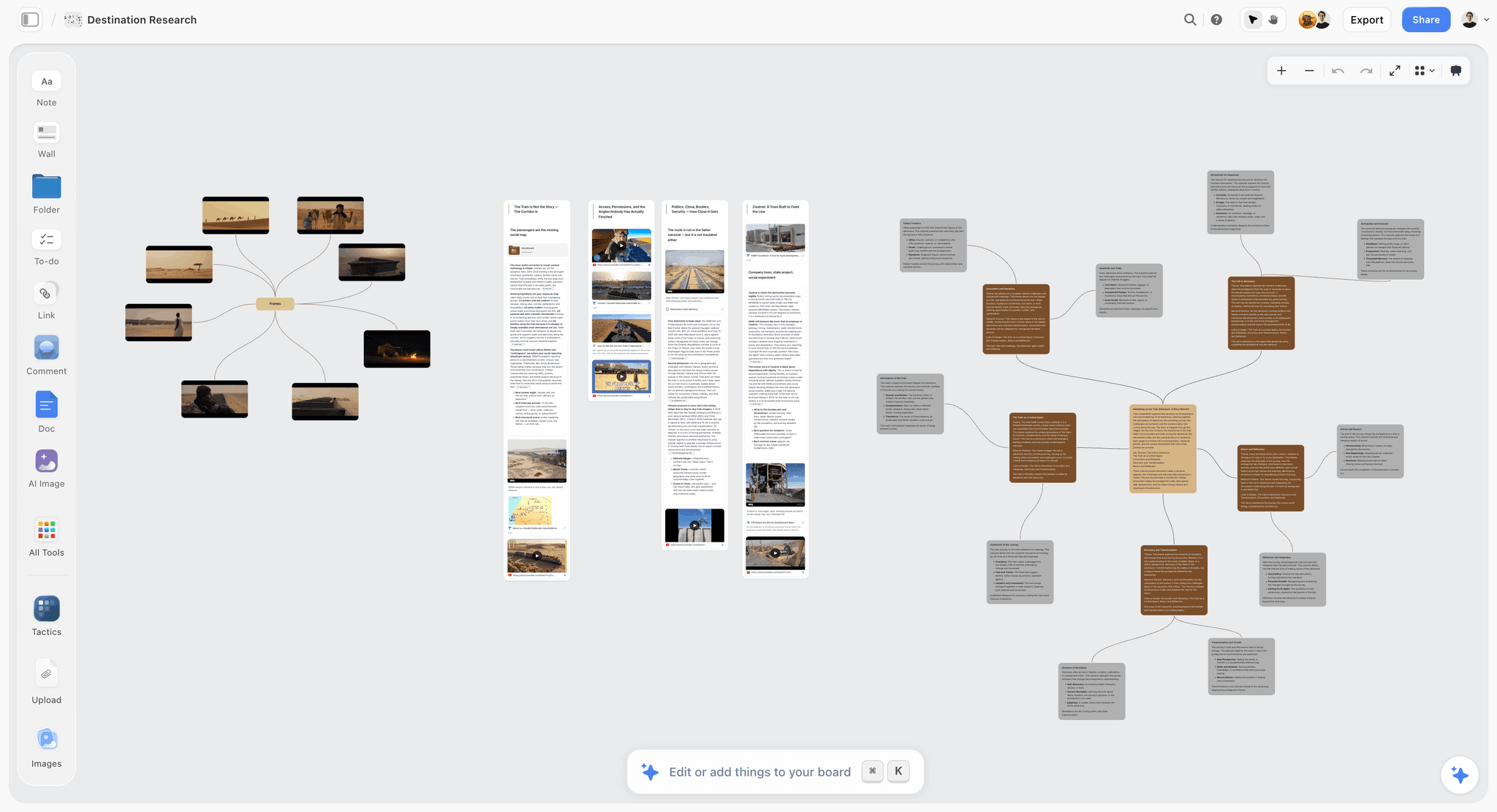
Storyflow is our product, and we are not ranking ourselves here. It is closed source, it cannot be self-hosted, and it has no business appearing in a list about the fork right. Everything above stands without it, and Logseq is the pick.
This note is for one reader: the person who typed "open source Obsidian alternative" because what they wanted was a thinking surface with AI in it, and open source was a word attached afterward. If the licence is your requirement, go install Logseq.
Storyflow is an AI canvas for planning creative work: research, outlines, moodboards and project plans laid out spatially rather than as a document tree. The AI reads your full active canvas board, plus up to one Tactic and up to three Documents you @-mention. Pricing is flat per account rather than per seat, and anyone a paid member invites signs up free. Plus is $7.99 monthly billed annually or $9.99 monthly, adding 200 plus Story blueprints and unlimited file uploads. Pro is $14 or $19 monthly, adding AI image generation, roughly twenty times more AI usage and memory across conversations. Max is $39 or $49 monthly, adding forty times more AI and Team Workspace with permissions and roles. It is paid only during early access, and the Free plan lands before the end of 2026.
What it does not do, stated plainly: no source code to read, no self-hosted or on-premise deployment, no data residency choice, no fork right of any kind. No local plain-text files, so nothing on your disk another program can open. No plugin API, so nobody can build you a Dataview. No offline mode. No backlinks panel, no daily notes and no graph of your notes, because it is a canvas rather than a note graph. Against the Obsidian Four it scores zero, which is the correct reason it is not ranked. Obsidian's lock-in was never the file format. It was the plugin folder. Ours would be the whole application.
What No Tool on This List Does
None of them gives you Obsidian's plugin ecosystem. Logseq, SiYuan and Joplin have real registries and a fraction of the population. Nobody can hand you a thousand contributors, and any article implying otherwise is counting repositories rather than useful plugins.
None of them matches Obsidian's mobile experience. Logseq's mobile app trails its desktop app, Trilium's is a web interface, Foam's does not meaningfully exist, and Emacs on a phone is a hobby. Joplin is the exception and it has the weakest graph.
None of them, including Storyflow, does real-time multiplayer editing on a knowledge graph. Storyflow has realtime collaboration on a canvas in the Max tier's Team Workspace, and a canvas is not a linked-notes vault with shared backlinks.
And no licence protects your notes from you. Open source gives you the right to keep running the software. It does not give you the disk it was running on, or the backup you did not take.
The Bottom Line
Obsidian is not open source, and once you accept that, the search stops being about finding an identical replacement. Install Logseq. It is AGPL v3, it writes files you can read without it, backlinks and the graph work on first launch, and the only homework is checking what your build stores on disk.
If Logseq is not the fit, follow the property rather than the brand. SiYuan for block references and a marketplace. TriliumNext for a self-hosted server with scripting. Joplin for mobile and encryption. Zettlr for citations and Pandoc. Foam if VS Code is already open. Org-roam if you are planning in decades.
Then be honest about which of the four you came for. Files, links and offline are available from five projects here at no cost and low migration risk. The plugin folder is not available anywhere, at any price, and pretending otherwise is how people migrate twice. Obsidian's lock-in was never the file format. It was the plugin folder.
FAQ: Open Source Obsidian Alternatives
Is Obsidian open source?
No. Obsidian's core application is proprietary and closed source. It is free for personal use, and its plugin API is documented and open, which is why the community around it looks like an open source project. The plugins are mostly MIT licensed and written by third parties. The app they run inside is not. Obsidian's terms for business use have been revised more than once, so read the current licence page.
What is the best open source Obsidian alternative in 2026?
Logseq, for most people. It is AGPL v3, writes markdown or Org files into a folder you own, and ships backlinks, unlinked mentions and a graph view with no configuration. Check storage before committing: the move to a database backend changes what the app writes to disk, so install your version, make a note, and look at the folder. If block level editing matters more than plain text, SiYuan is stronger.
Is Logseq really open source?
Yes. Logseq is licensed under AGPL v3, an OSI-approved licence, so you have the unconditional right to use, modify, fork and continue the project. The AGPL condition applies only if you modify the code and expose your version to other people over a network, which does not describe running it on your laptop. Logseq Sync is a separate paid service and does not change the licence.
Is Anytype open source?
Verify it yourself at the version you install. Anytype's clients have shipped under source-available terms for much of the project's life, with a stated intention to move toward a fully open licence, and coverage of this varies wildly in accuracy. Source-available means you can read and build the code under conditions the OSI definition does not allow, and the practical loss is the fork right.
Which open source note app keeps my notes as plain markdown files?
Logseq, Zettlr and Foam. Zettlr and Foam have no storage format of their own: they operate directly on a folder of markdown files, so an Obsidian vault opens with no migration and closing the app leaves it untouched. Logseq writes one file per page. Trilium uses a single SQLite database, Joplin uses SQLite locally, SiYuan uses structured JSON, and Anytype and Standard Notes store encrypted objects.
Can I use my Obsidian vault with an open source app without converting it?
Yes, with three of them. Zettlr, Foam and Logseq open a directory of markdown files directly, and for Zettlr and Foam nothing about the vault changes. Wikilinks are the thing to test: syntax support varies, and embedded images, block references and front matter do not always survive. Copy 20 notes into a test folder, open them, and check what breaks before pointing any tool at the real vault.
What is the best self-hosted Obsidian alternative?
TriliumNext if you want a proper server with a database and scripting, SiYuan if you want a single container and mobile clients that talk to it. TriliumNext gives you note cloning, typed relations and JavaScript running on the server, at the cost of storing everything in one SQLite file. SiYuan keeps block references and a marketplace and is easier to run. Both need backups.
Do any open source alternatives have a graph view like Obsidian's?
Logseq, SiYuan, Anytype and Org-roam do, and the graphs differ in meaning. Logseq and SiYuan draw links between notes and blocks the way Obsidian does. Anytype's graph shows typed relations, so it carries more meaning per edge. Org-roam exposes its graph through org-roam-ui. Joplin's graph is a community plugin, and AppFlowy, Standard Notes and Zettlr have nothing comparable.
Can I replace my Obsidian plugins in an open source app?
Usually not one for one. Logseq, SiYuan and Joplin have real plugin registries, and none has a Dataview equivalent at the same depth. The practical test takes two minutes: search each registry for your two most-used plugins by name. If both come back empty, you are changing your practice rather than your app. Obsidian's lock-in was never the file format. It was the plugin folder.
What is the best open source Obsidian alternative for mobile?
Joplin, without much competition. It has genuine first party iOS and Android apps with end to end encryption on every sync target, and it is the only tool here where mobile is not a compromise. The cost is that backlinks and the graph arrive as plugins. Logseq's mobile app trails the desktop version, SiYuan has mobile clients, and Foam, Zettlr, Dendron and Org-roam have no phone story.
Is Trilium Notes still maintained?
The original repository was archived by its author, and TriliumNext is the actively developed community continuation. This is the most important fact about the tool and a lot of coverage misses it, so check which repository a recommendation points at before installing. TriliumNext is AGPL v3, self-hostable, and carries the same feature set forward. Read the last 90 days of commits at whichever fork you choose.
Should I just stay on Obsidian?
If your reason for leaving was the licence, no, because a proprietary core cannot give you a fork right and Logseq can. If your reason was cost, Obsidian is already free for personal use and the open source options cost you migration time. If your reason was plugins, staying is rational, because your notes are already plain markdown in a folder you control. Decide which of the Obsidian Four you would actually lose.
Workspace templates you can use in Storyflow
Keep research, notes, and plans on one canvas the AI can read, instead of scattered across docs and tabs. Open a template and make it your second brain.


See Storyflow in Action
A visual AI workspace where every feature lives inside one canvas. No tab-switching, no context lost.
Build your entire board from a single message
Type what you need in the AI chat at the bottom of your canvas. The AI adds cards, headings, and structure directly onto your board.
Use expert frameworks as AI context
Type @ in the AI chat and choose any Tactic. The AI tailors every response to that framework instead of giving generic advice.
Turn your board into a mind map in seconds
Ask the AI to restructure your canvas as a mindmap. It connects your ideas into a visual hierarchy so you can see how everything relates.
Why Storyflow Exists
Storyflow actually began as a personal tool while working on creative and research projects.
We kept running into the same problem: ideas were scattered everywhere: notes, documents, and whiteboards.
Nothing helped us see how everything connected.
So we started building a workspace designed around how ideas actually grow.
→ Read how Storyflow was createdSara de Klein
Head of Product at Storyflow
Published: 2026-08-14
Start creating with AI and become more productive
Transform your creative workflow with AI-powered tools. Generate ideas, create content, and boost your productivity in minutes instead of hours.