The 11 Best Mind Mapping Software Tools for Creative Projects in 2026
Mind mapping software was built for text, and creative projects are made of pictures. Eleven tools ranked on whether a node can be the reference frame rather than a description of it.

Category
Mind Mapping
Author

Justkay
Documentary Filmmaker & Founder at Storyflow
Topics
2026-08-26
•
19 min read
•
Mind Mapping- mind mapping software for creative projects
- best mind mapping software
- visual mind mapping with images
- Milanote vs XMind
- mind map with pictures
- creative project mapping tool
What is the best mind mapping software for creative projects in 2026?
Mind mapping software was built for text, and creative projects are made of pictures. Eleven tools ranked on whether a node can be the reference frame rather than a description of it.

Full disclosure: Storyflow is our own product and we rank it second, behind Milanote, because Milanote nests better and has a free tier while Storyflow is paid-only during early access. It is also a worse mind mapper than XMind and MindNode: no radial auto-layout, no fishbone or matrix structures, no outline mode, and no keyboard-driven branching at their speed, so for verbal creative work XMind is the better purchase and its review says so. Storyflow earns second place for visual creative projects specifically, where images are first-class objects and the AI reads the whole canvas. The Free plan launches before the end of 2026, invited collaborators join free now, and the AI reads the current board rather than every board you own.
Quick Comparison
These four split along the text-node ceiling: two are canvases where a reference frame can be the node itself, one is the team option, and one is the best pure mapper for work made of propositions rather than pictures.
| Tool | Best For | AI Features | Price |
|---|---|---|---|
| Milanote | Images, links and notes on deeply nested boards | No built-in AI | Free (100 notes) / from ~$12.50 mo |
| Storyflow | Structure and references on one canvas the AI reads | Canvas-wide context AI, image generation on Pro | $7.99 mo annual (free plan late 2026) |
| Miro | Live group mapping at real team sizes | Clustering and board summaries | Free (3 editable boards) / from ~$8 member mo |
| XMind | Fast radial maps that export with structure intact | Light | Free tier / from ~$59.99 yr |
Key Takeaways
- Mind mapping software was built for text, and creative projects are made of pictures. That mismatch is why a map of a film, a campaign, or a rebrand feels wrong long before you can say why.
- Call it the text-node ceiling. A node in most mind mapping tools is a label. The thing you are actually mapping is a frame, a palette, a reference photograph, a typeface, a piece of footage.
- A creative map needs four things ordinary mappers do not provide: a node that can be an image, more than one centre, room for material that has no parent yet, and survival past the first session.
- Milanote and Storyflow clear the ceiling because they are canvases that hold maps. XMind and MindNode are the best pure mappers and hit the ceiling immediately on visual work.
- If your map keeps growing a branch called References, the format is fighting you and a canvas is the answer.
The Text-Node Ceiling
Mind mapping came out of note-taking, and it shows in every tool built on it. The atom is a node, a node holds a short phrase, and the value comes from the structure between phrases.
For a lot of thinking that is exactly right. Revising a subject, breaking down a topic, planning a talk, unpacking a decision: all of these are made of propositions, and propositions are text.
Creative projects are not made of propositions.
Map a documentary and the real material is a photograph of the town, a frame from a film with the light you want, a voice recording, a location scout picture, a colour that keeps recurring in the archive. Map a rebrand and it is typefaces, existing marks, competitor work, a texture. Map a campaign and it is three reference ads, the product shot, and a screenshot of a post that did numbers.
In a mind mapping tool, every one of those becomes a text label. "Warehouse photo." "That Roger Deakins shot." "Blue-green thing." You have replaced the material with a description of the material, and the description is exactly what a creative decision cannot be made from. Nobody has ever chosen a palette from the word "blue-green."
That is the text-node ceiling, and it produces three recognisable symptoms.
The References branch. A branch appears called References or Inspiration or Look, and it becomes a dumping ground with twenty children, none of which mean anything, because a list of filenames is not a moodboard. If you have this branch, you have hit the ceiling.
The map that stops being opened. You made it, it was useful for an hour, and you never went back, because the material you actually needed was somewhere else and the map only held labels for it.
Two tools, one project. A map in one app, a moodboard in another, and neither knows the other exists. This is the most common outcome and it is why the map goes stale first.
There is a second, quieter mismatch worth naming alongside it. A mind map has one centre, and creative projects reliably have several. A film has a story, a look, a schedule, and a budget, and none of those is a child of the others. Forcing four peers into one tree means three become branches of whichever you typed first.
So this list ranks on four things ordinary mappers do not do: whether a node can be an image, whether the tool tolerates several centres, whether material can sit around without a parent, and whether the map is still useful in month two.
At a Glance: The 11 Tools Compared
| Tool | Node can be an image | Several centres | Orphan material allowed | Price |
|---|---|---|---|---|
Milanote | Yes, first-class | Yes | Yes | Free (100 notes) / from ~$12.50 mo |
Storyflow | Yes, first-class | Yes | Yes | $7.99 mo annual (free plan late 2026) |
Miro | Yes | Yes | Yes | Free (3 boards) / from ~$8 member mo |
Heptabase | Yes, cards hold media | Yes | Yes | From ~$11.99 mo annual |
Obsidian Canvas | Yes, images and files | Yes | Yes | Free personal / ~$50 yr commercial |
Scapple | Images supported | Yes, by design | Yes | One-off ~$18 |
XMind | Attached, not native | Limited | No | Free tier / from ~$59.99 yr |
Whimsical | Limited | Yes | Partial | Free tier / from ~$10 editor mo |
MindNode | Attached, not native | Limited | No | Free tier / from ~$2.99 mo |
MindMeister | Attached | No | No | Free (3 maps) / from ~$3.50 mo |
Coggle | Attached | No | No | Free tier / from ~$5 mo |
Prices are the publicly listed rates at the time of writing and change often. Check before committing.
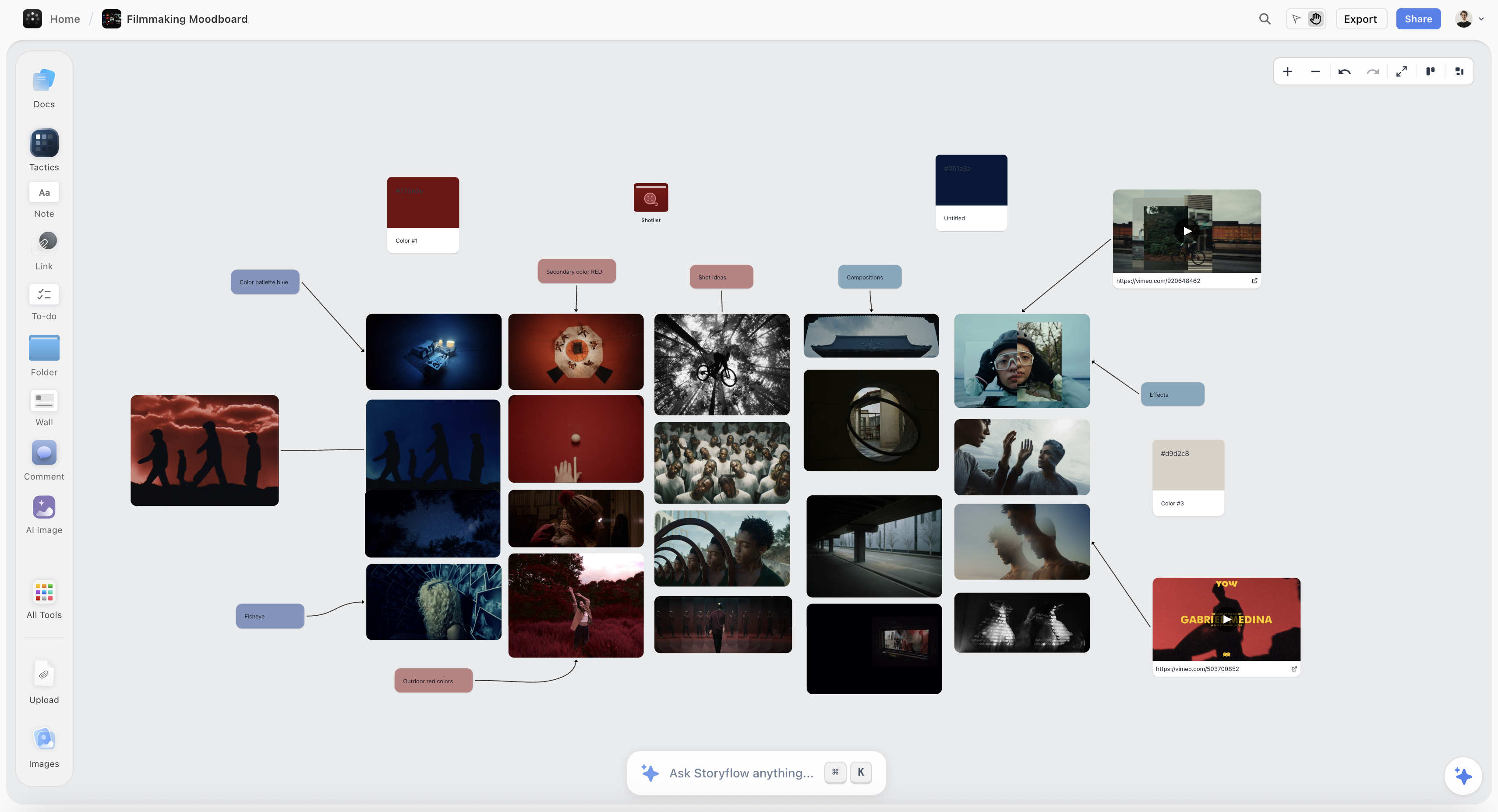
A creative project mapped on a Storyflow canvas where reference frames are the nodes themselves rather than labels pointing at files
Nobody chose a palette from the word blue-green
In most mind mapping tools a reference becomes a text label, which is exactly what a creative decision cannot be made from. Storyflow puts the structure and the actual material on one canvas, with images as first-class objects and AI that reads the whole board. Milanote does the same with a free tier and better nesting; both beat a mapper here.

How I Ranked These
I direct documentaries, which means the thing I map most often is a film, and a film is the worst case for a text mapper: the structure is verbal, the look is visual, the schedule is temporal, and all three have to sit in the same head.
Every tool below I used on a real creative project rather than a demo. Where a claim rests on published documentation rather than my own use, the review says so.
Five criteria, in this order:
- Whether a node can be the material. An image that renders at a size you can judge, not an attachment icon. Weighted highest for the reasons above.
- Tolerance for several centres. Whether the tool insists on a single root.
- Room for orphans. Creative work generates material that belongs to nothing yet, and a tool that requires a parent forces premature classification.
- Survival into month two, which is search, structure, and whether the map is where the work is.
- Honest cost, including free-tier caps and the difference between per-person and flat pricing.
Deliberately not weighted: layout algorithms and styling. A creative map that holds real material is worth more than a beautiful map of labels.
The Map Is Not the Problem, the Handoff Is
One clarification before the reviews, because it prevents a common mis-purchase.
A dedicated mind mapper is genuinely better at making a mind map than any canvas here. XMind and MindNode produce faster, cleaner, better-organised radial maps than Milanote or Storyflow will, and if what you need is a map of an argument, you should use one of them.
The reason they rank below the canvases on this particular list is not mapping quality. It is that on a creative project the map is one of four artefacts, and the other three are visual, and a tool that can only hold one of the four guarantees a handoff.
Handoffs are where creative projects lose material. The map says "the warehouse scene" and the moodboard for the warehouse scene is in another app, so within three weeks one of them is out of date and you do not know which. Multiply that by structure, look, schedule, and references and you have the normal condition of a creative project: four tools, none of them current, and a person holding the real version in their head.
So the question is not which tool makes the best map. It is whether the map can live next to the material it refers to. That is what the canvases buy you, and it is why they rank above the better mappers here and below them in an article about mapping generally.
Quick Picks by Situation
- Best mind mapping software for creative projects overall: Milanote, which holds images natively and has a free tier to test on.
- Best when the map should answer back: Storyflow, where the AI reads the whole canvas including the visual material.
- Best pure mapper if your creative work is verbal: XMind, for structure and export.
- Best for a team mapping together: Miro.
- Best for research-led creative work: Heptabase, where nodes are real documents.
- Best free and permanent: Obsidian Canvas, where nodes are your own files.
- Best for writers specifically: Scapple, at around $18 once, feeding into Scrivener.
- Best-looking maps on Apple hardware: MindNode, with the ceiling accepted.
1. Milanote
Milanote ranks first because it was designed for creative material from the start, and everything else in this list is either a mapper adapted to images or a general canvas adapted to creative work.
Images, links, files, and notes are all first-class objects that sit together and render at a size you can actually judge. A node can be the reference frame rather than a description of it, which is the entire ceiling cleared in one design decision.
Its nesting is the second reason and it is the best here: boards inside boards without limit, so a film holds structure, look, schedule, and locations as peers rather than as branches of whichever you typed first. That directly answers the several-centres problem, and nothing else on this page does it as cleanly.
Material can also sit around unassigned, which sounds trivial and matters enormously. Creative projects generate things that belong to nothing yet, and a tool that demands a parent forces you to classify before you know.
Against it: it is not a mind mapper. No auto-layout, no radial structure, no branch conventions, so if you want a proper tree you are arranging it by hand. No AI at all, so the board holds your thinking and does nothing with it. Export is PDF and image, so anything that has to become a document is a retype. Per-person pricing and a 100-note free cap.
Pricing: Free with a 100-note limit. Paid from around $12.50/month per person.
2. Storyflow
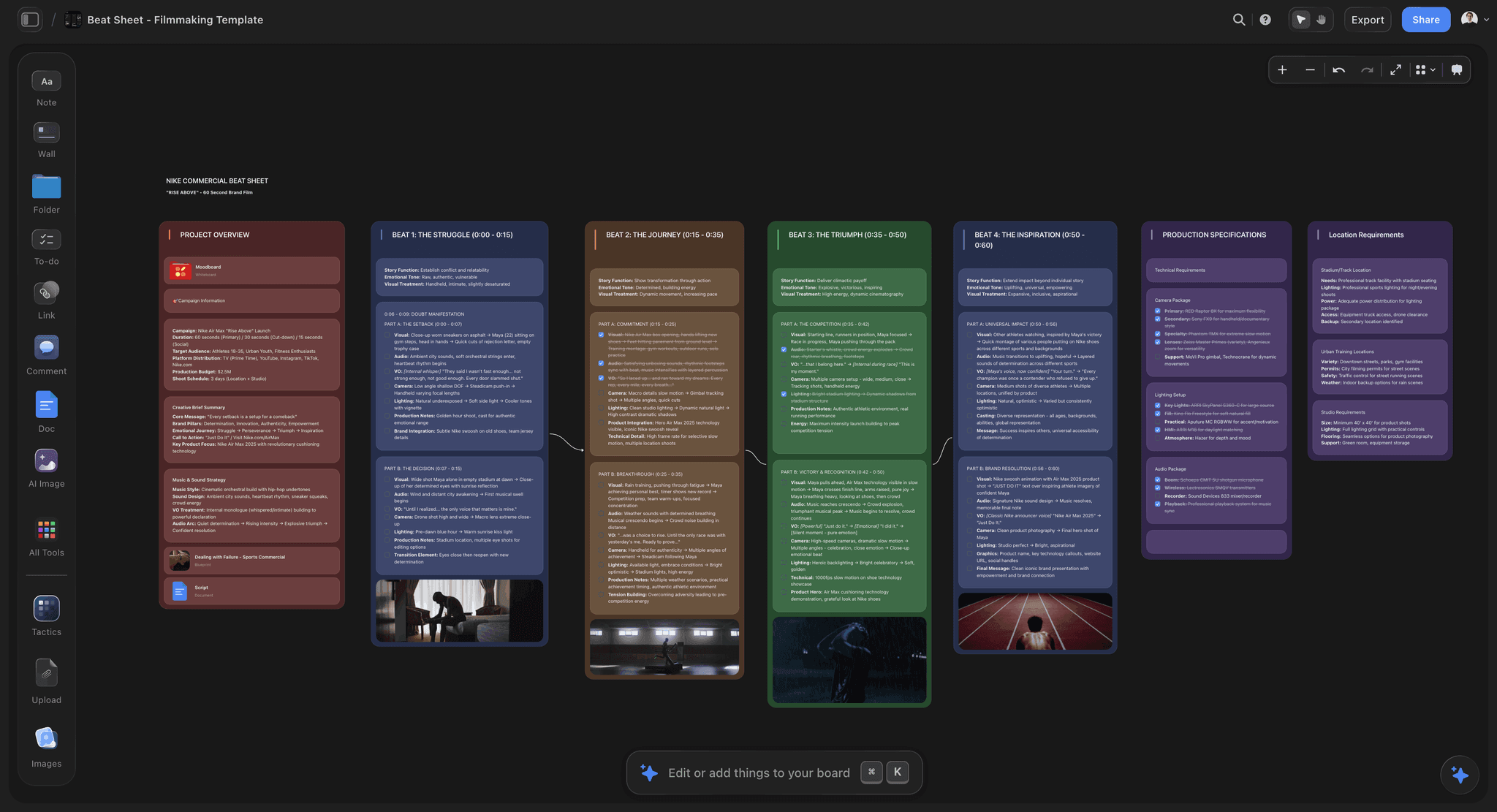
Storyflow is our own product, and it ranks second behind Milanote for two reasons stated plainly: Milanote nests better, and Milanote has a free tier while we are paid-only during early access.
It clears the ceiling the same way, with images and links as first-class objects on a canvas rather than attachments hanging off text nodes, several centres because a canvas has no root, and room for orphan material.
What it adds is that the AI reads the whole board, and on a creative map that changes what the map is for. Once the structure and the references are on the same canvas, you can ask which of these branches are the same idea in different words, what this map is missing, whether the look and the structure are actually saying the same thing, and which direction you developed versus abandoned. Those are questions about the whole map at once, which is precisely what a map generates and cannot answer. Pro and Max tiers also generate images, which matters when the reference you need does not exist photographed.
Against it, plainly: XMind and MindNode make better maps. No radial auto-layout, no fishbone or matrix structures, no outline mode, no keyboard-driven branching at their speed. If your creative work is verbal and the map has to become a Word document, XMind is the better purchase. It is also paid-only during early access, so anyone with no budget should use Milanote's free tier or Obsidian Canvas. The Free plan launches before the end of 2026; today the only free route is that anyone a paid member invites to a board joins free and can invite others. The AI reads the current board, not every board you own, with extra context from @-mentioning up to one Tactic and three documents.
Pricing: Plus $7.99/month annual or $9.99 monthly. Pro $14/month annual adds AI image generation, roughly 20x more AI, and memory across conversations. Max $39/month annual adds 40x more AI and a team workspace. No free plan until late 2026.
3. Miro
Miro is the right answer when the creative map is being built by several people at once, which is a real and common case for agencies and in-house teams.
Images are first-class, the canvas has no forced root, orphan material is fine, and its mind map feature is competent enough for a group session. Collaboration is the best here at real team sizes, and Miro AI can cluster and summarise what accumulates.
Against it: frames organise a plane and do not nest, so a creative project of real length becomes one very large canvas navigated by memory. Export is weak, so a map made here stays here. And the free tier's three-editable-board limit tends to evict the project you care about at exactly the wrong moment.
Pricing: Free tier with three editable boards. Paid from around $8/member/month annual.
4. Heptabase
Heptabase is the strongest choice when the creative work is research-led: a documentary built on archives, a campaign grounded in real customer material, a book with sources.
Its nodes are cards, and cards are full documents holding text and media, living in a searchable library, appearing on many whiteboards at once. That separation between authoring and arranging means you can restructure a creative argument repeatedly without touching the material, which at month three is a real freedom.
Against it: it is built for understanding rather than for looking. Visual and media-heavy boards are weaker than Milanote's, the learning curve is the steepest here, and there is no free tier beyond a trial. No radial mapping conventions at all.
Pricing: From around $11.99/month annual.
5. Obsidian Canvas
Obsidian Canvas clears the ceiling for free, which makes it the honest recommendation for anyone unwilling to pay while testing whether a canvas suits them.
Nodes can be images, files, or your own markdown notes, there is no root, and orphans are fine. Because the nodes are real files on your disk, the map is made of the work rather than describing it, and vault-wide search finds a map from four months ago by its contents.
Against it: the canvas is plain. No auto-layout, no mapping conventions, and media handling is functional rather than good, which for a heavily visual creative project is a real limitation next to Milanote. Collaboration is awkward. And Obsidian generally is a configuration project that consumes creative hours.
Pricing: Free for personal use. Commercial licence around $50/user/year.
6. Scapple
Scapple is the cheapest honest answer to the several-centres problem, and for writers it is the best value on this page at around $18 once.
There is no imposed structure at all. Double-click anywhere, drag notes together to connect them, no root, no hierarchy, no auto-layout. Material with three centres sits there with three centres, which is what a creative project actually looks like. Images are supported.
Its handoff is the second argument: notes move into Scrivener directly, so for anyone whose creative project ends in a manuscript, the gap is closed.
Against it: deliberately primitive, no collaboration, no cloud sync, no mobile, and visually plain. Desktop only, and untroubled by any of it.
Pricing: One-off, around $18.
7. XMind
XMind is the best pure mind mapper here and it hits the text-node ceiling immediately on visual work, which is why a tool this good ranks seventh on this particular list.
What it wins on is real: the fastest keyboard-driven branching, structures beyond the radial tree, an outline mode for checking whether the thinking survives being linear, and by far the best export chain in the category, with Word and PowerPoint arriving with heading levels intact.
If your creative project is verbal (a script structure, a campaign message hierarchy, a talk) this is the right tool and the ceiling never bothers you.
Against it, for visual creative work: images attach to nodes rather than being nodes, so a reference is an icon rather than a picture you can judge. One root, so several centres do not fit. And material must have a parent, which forces classification too early.
Pricing: Free tier with limits. Paid from around $59.99/year.
8. Whimsical
Whimsical is fast, tidy, and useful for the structural half of a creative project: flows, sitemaps, and mind maps that come out clean with no fiddling.
Its AI can generate a first-pass map from a prompt, which helps when the shape is conventional and you want a scaffold rather than a blank centre.
Against it: image handling is limited, which is the ceiling again. The opinionated tidiness that makes structured work fast makes messy visual exploration awkward. Free-tier board limits arrive quickly and per-editor pricing adds up on a team.
Pricing: Free tier with board limits. Paid from around $10/editor/month.
9. MindNode
MindNode makes the calmest, best-looking maps in this list and is the fastest to think in on Apple hardware, and both are genuine advantages for the verbal half of creative work.
Defaults are correct, branches lay themselves out sensibly, and there is essentially no styling decision between you and the map. The iPad and Apple Pencil experience is the best here.
Against it: Apple-only. Images attach rather than being nodes. One root, no orphans. For a creative project it is a beautiful map of labels sitting next to your actual material in another app.
Pricing: Free tier with limits. Paid from around $2.99/month.
10. MindMeister
MindMeister is the established browser-based mapper: collaborative, easy to hand to somebody who has never mapped before, and connected to MeisterTask so a map can become a task list in one step.
Against it, for creative work: strict radial structure with one root, attached rather than native images, no orphan material, and a three-map free tier. It is a competent mapper of propositions and it does nothing about the ceiling.
Pricing: Free tier with three maps. Paid from around $3.50/month.
11. Coggle
Coggle is the simplest tool here, genuinely free, and usable in about ten seconds with no install, which makes it the right first stop for anyone testing whether mapping suits them at all.
Live collaboration works on the free tier and maps look good with no effort.
Against it: one root, attached images, no orphans, thin export, and a cap on private diagrams. It is a mapper and only a mapper, and on a visual creative project you will hit the ceiling within the first session.
Pricing: Free tier. Paid from around $5/month.
Recommended Setups
Solo creative project, visual. Milanote free tier to test the premise, then Milanote or Storyflow depending on whether you want AI and flat pricing or better nesting and a free plan.
Creative project that is mostly verbal. XMind, and stop. The ceiling is irrelevant if your material is propositions, and XMind's export chain is worth more than any canvas feature.
Writer. Scapple plus Scrivener. Around $18 once, no subscription, several centres handled by design.
Agency or in-house team. Miro for the shared session, and a project board somewhere that nests for the weeks afterwards. These are two jobs.
No budget. Obsidian Canvas, accepting plain media handling, or Milanote's free tier if the project fits inside 100 notes.
Do not build: a map in one app and a moodboard in another. This is the default outcome and it is the specific failure this whole article is about.
Tools to Avoid for This Job
Any mapper where images are attachments. An icon labelled "reference-04.jpg" is not a reference. If you cannot judge the image at the size it renders, the tool has not solved the problem.
A single-root mapper for a multi-centre project. Three of your four peers become branches of the first one you typed, and the distortion is invisible until the map stops making sense.
A map that is a parallel copy of a plan held elsewhere. It goes stale within a fortnight and then quietly misleads people.
A mind map as a client deliverable. They are thinking artefacts, not communication artefacts, and the reader does not have your traversal order in their head. Convert to a document or a board before sharing.
A subscription for occasional mapping. Coggle's free tier or Scapple's one-off price covers it completely.
What No Tool on This List Does
None of them tell you the look and the structure disagree. A canvas will happily hold a gritty documentary structure next to a glossy reference set. The tools that read the board can prompt the question; noticing that it matters is yours.
None of them stop the References branch. Even on a canvas you can build a corner labelled Inspiration and never open it again. What changes is that you can see the whole corner at once, which is a precondition for editing it, not a substitute.
None of them make a bad idea look bad. A well-laid-out map of a weak concept is quietly persuasive, and radial structure in particular makes thin branches look substantial.
None of them replace the wall. For a project small enough to fit on one, printed images on a physical wall still beat every tool here on comprehension. Digital wins on persistence, sharing, and everything after the session.
The Bottom Line
Mind mapping software is good software solving a problem most creative projects do not have. It organises propositions, quickly and elegantly, and creative projects are made of pictures.
The consequence is predictable. A branch called References appears, fills with filenames, and means nothing. The map gets made, gets used for an hour, and never gets reopened, because the material it points at lives in a different app. And then there are two tools holding one project, neither of them current.
Milanote solves that by having the right atom: an image is an object you can look at, boards nest so a project can have several centres, and material can sit unassigned until you know what it is. Storyflow, which we make, does the same and adds an AI that reads the whole canvas, and it ranks second because Milanote nests better and has a free tier while we do not yet.
If your creative project is verbal, none of this applies to you and XMind is the better purchase, comfortably.
And the simplest diagnostic on this page: if your map keeps growing a branch called References, it is not a filing problem. It is the format telling you that what you are mapping cannot be written down.
FAQ: Mind Mapping Software for Creative Projects
What is the best mind mapping software for creative projects?
Milanote for most creative work, because images, links, and files are first-class objects rather than attachments, and boards nest so a project can hold structure, look, and schedule as peers. Storyflow if you also want the AI to read the whole canvas back to you. XMind if your creative project is verbal rather than visual, since it makes far better maps and exports properly.
Why do mind maps feel wrong for creative work?
Because a node is a text label and creative material is pictures. Mapping a film means the real material is a frame, a colour, a location photograph, and in most mappers each of those becomes a description of itself, which is exactly what a creative decision cannot be made from. The tell is a branch called References that fills with filenames.
What is the best free mind mapping tool for creative projects?
Obsidian Canvas for personal use, since nodes can be images and files and everything stays on your disk. Milanote's free tier at 100 notes is enough to test whether a visual canvas suits your work. Coggle is free and simple but hits the text-node ceiling immediately. Storyflow is paid-only during early access and is not a free option today.
Can a mind map hold images?
In most mind mapping tools images attach to a node rather than being the node, which renders them as icons or thumbnails too small to judge. Milanote, Storyflow, Miro, Obsidian Canvas, and Heptabase all treat images as first-class objects sized to be looked at, which is the difference that matters for creative projects.
Is Milanote a mind mapping tool?
Not strictly. There is no auto-layout, no radial structure, and no branch conventions, so a tree is arranged by hand. What it has is the right atom for creative work, a note or an image on a nested board, which is why it ranks first here and would rank lower in an article about mapping arguments.
Is Storyflow good for mind mapping creative projects?
For creative projects specifically, yes, and it ranks second behind Milanote, which nests better and has a free tier. Its advantage is that the AI reads the whole canvas, including the visual material, so questions like which of these branches are the same idea and whether the look and the structure agree become askable. XMind makes better maps and Storyflow is paid-only during early access.
How do you mind map a film or a campaign?
Stop using one centre. A film has a story, a look, a schedule, and a budget, and none is a child of the others, so give each one its own board or region and let them sit as peers. Put the actual material in, not descriptions of it. And keep the structure on the same surface as the references, because the handoff between two tools is where creative projects lose the plot.
What is the difference between a mind map and a moodboard?
A mind map organises relationships between ideas, usually verbal, in a tree. A moodboard collects visual material to establish a tone, with no hierarchy. Creative projects need both, and the failure most people hit is keeping them in two tools that do not know about each other, so one goes stale and nobody knows which.
Do I need auto-layout in a mind mapping tool?
For mapping arguments, yes, it is most of the speed advantage. For creative projects, much less, because the arrangement is carrying meaning that an algorithm does not know about: this reference goes next to that scene because they share a quality. Auto-layout would move them apart.
Can AI help with mind mapping a creative project?
The useful direction is reading rather than generating. AI generating a map from a prompt gives you a scaffold of conventional structure, which is worth something on a known topic. AI reading a map you already built and telling you which branches duplicate each other or what is missing is a comparison across the whole tree, which is slow by hand and is the version that helps on a real project.
What should I do if my mind map has a References branch?
Take it as a signal rather than a filing problem. It means the material you need is visual and the tool can only hold labels for it. Either move to a canvas where the references are nodes in their own right, or accept the split and keep the map deliberately small and verbal, which is a legitimate choice if the rest of your work is elsewhere.
Is paper better than software for creative mind mapping?
For a single session on a project small enough to fit, a physical wall with printed images still beats every tool on this page for comprehension, and it is worth doing. Software wins on persistence, on searching six weeks later, and on sharing, which is most of what a creative project needs after the first afternoon.
Table of Contents
- Key Takeaways
- The Text-Node Ceiling
- At a Glance: The 11 Tools Compared
- How I Ranked These
- The Map Is Not the Problem, the Handoff Is
- Quick Picks by Situation
- 1. Milanote
- 2. Storyflow
- 3. Miro
- 4. Heptabase
- 5. Obsidian Canvas
- 6. Scapple
- 7. XMind
- 8. Whimsical
- 9. MindNode
- 10. MindMeister
- 11. Coggle
- Recommended Setups
- Tools to Avoid for This Job
- What No Tool on This List Does
- The Bottom Line
- FAQ: Mind Mapping Software for Creative Projects
- Related Reading
Templates to check out for this topic


Mind mapping and ideation templates you can use in Storyflow
Map ideas in space, then ask the AI to restructure, expand, or connect them. Open any of these boards and start thinking visually instead of in lists.


See Storyflow in Action
A visual AI workspace where every feature lives inside one canvas. No tab-switching, no context lost.
Build your entire board from a single message
Type what you need in the AI chat at the bottom of your canvas. The AI adds cards, headings, and structure directly onto your board.
Use expert frameworks as AI context
Type @ in the AI chat and choose any Tactic. The AI tailors every response to that framework instead of giving generic advice.
Turn your board into a mind map in seconds
Ask the AI to restructure your canvas as a mindmap. It connects your ideas into a visual hierarchy so you can see how everything relates.
Why Storyflow Exists
Storyflow actually began as a personal tool while working on creative and research projects.
We kept running into the same problem: ideas were scattered everywhere: notes, documents, and whiteboards.
Nothing helped us see how everything connected.
So we started building a workspace designed around how ideas actually grow.
→ Read how Storyflow was createdJustkay
Documentary Filmmaker & Founder at Storyflow
Published: 2026-08-26
Extremely simple, seriously capable


See how easy it is to get started
Watch a real project come together, from a blank board to a finished plan, clicked through step by step.
Start creating with AI and become more productive
Transform your creative workflow with AI-powered tools. Generate ideas, create content, and boost your productivity in minutes instead of hours.