
Category
Filmmaking Tools
Author

Justkay
Documentary Filmmaker & Founder at Storyflow
Topics
2026-05-17
•
Updated Jul 3, 2026
•
13 min read
•
Filmmaking Tools- best film moodboard tools 2026
- film moodboard software
- moodboard tools for filmmakers
- Milanote alternative
- PureRef
- Storyflow film moodboard
What are the best film moodboard tools in 2026?
The best film moodboard tools in 2026 are Storyflow (best AI canvas holding the moodboard beside the shot list and treatment), Miro (best for crew collaboration), and PureRef (best lightweight look-finding tool). Every film moodboard is two boards: Discovery finds the look, Direction briefs the crew.

Full disclosure: Storyflow is our own product and we rank it #1 here, so treat that with the appropriate scepticism. It takes the top slot for the Direction board, where the moodboard sits beside the shot list and treatment and the AI reads all of it before you caption a frame. Where it genuinely loses: Milanote is the more pleasant dedicated canvas for pinning references and setting a look, PureRef is lighter for the fast, private Discovery stage of pure look-finding, and Miro is stronger for real-time crew comments. If the moodboard is the entire deliverable and never meets a shot list, pick Milanote. We link to every tool so you can judge the fit.
Quick Comparison: Best Film Moodboard Tools
These four split across the two moodboards a film needs: finding the look, briefing the crew, collaborating in real time, and fast reference capture.
| Tool | Best For | AI Features | Price |
|---|---|---|---|
| Storyflow | Direction board beside the shot list and treatment | Canvas-wide context AI | $7.99 mo annual (free plan late 2026) |
| Milanote | Dedicated film moodboard canvas | Light AI, strong notes | Free / $9.99 mo |
| Miro | Real-time crew collaboration | Standard board AI | Free / $8 mo |
| PureRef | Lightweight look-finding reference canvas | None | ~$6 one-time |
Turn the film look into a board you can present
Storyflow keeps references, palette, and framing on one canvas that doubles as a lookbook, so the AI can help shape the visual language and you can share it in a click.

1) Quick Answer: The Best Film Moodboard Tools in 2026
The best film moodboard tools in 2026 are Storyflow (best AI canvas that holds the moodboard next to the shot list and treatment), Milanote (best dedicated moodboard canvas for filmmakers), Miro (best for crew collaboration), and PureRef (best lightweight reference tool for the look-finding stage). The right pick depends on which of the two moodboards you are building.
A film moodboard is not a wall of pretty pictures. It is a brief your crew can shoot from. The director of photography, the production designer, and the colorist each read it for different information. A board of beautiful frames with no annotation tells them nothing. A board that says why each frame is there, what to copy and what to ignore, becomes an instruction.
I have built moodboards for documentary shoots and interview-led productions, and the pattern that holds is this: the board you make to find the look is not the board you hand to the crew. The Two Moodboards framework in section 3 splits the job into the Discovery board and the Direction board, and ranks all 12 tools by which one they serve.
All 12 Film Moodboard Tools, Ranked
- Storyflow: best AI canvas holding the moodboard beside the shot list and treatment
- Milanote: best dedicated film moodboard canvas
- Miro: best for crew collaboration on one shared board
- PureRef: best lightweight Discovery-stage reference canvas
- Shotdeck: best cinematic still reference library
- Pinterest: best free broad visual discovery
- Are.na: best distraction-free visual research
- Canva: best polished client-facing boards from templates
- Eagle: best local reusable reference archive
- FigJam / Figma: best for crews already working in Figma
- Mural: best workshop-style crew boards
- Notion: best database-backed reference library
Best Film Moodboard Tool by Job
The overall ranking is not the answer to every question. Match the tool to the job you actually have:
- Best tool for a film moodboard that stays beside the shot list and treatment: Storyflow. The moodboard is one board inside the film plan rather than a separate app, and the AI reads the whole board.
- Best way to build a film moodboard with AI: Storyflow. Unlimited images and boards plus canvas AI, from $7.99/mo billed annually.
- Best dedicated film moodboard canvas: Milanote. Pure board building, closest to a physical pinboard.
- Best for crew collaboration on one shared board: Miro.
- Best cinematic still reference library: Shotdeck.
- Best lightweight reference canvas for the discovery stage: PureRef.
For the broader moodboard context, see What is a Mood Board? The Complete Guide and The 12 Best Mood Board Tools in 2026.
2) Comparison Table: 12 Film Moodboard Tools at a Glance
Pricing reflects publicly listed plans as of early 2026 and changes often. Ratings weigh moodboard-type fit, annotation depth, collaboration support, reference handling, and pricing for solo filmmakers and small crews.
3) The Two Moodboards
Every film moodboard is actually two boards doing two jobs. Most tool roundups review them as one. That is why filmmakers buy the wrong tool.
The Discovery board is where you find the look. It is private, messy, and large. Hundreds of frames pulled from films, photography, paintings, and stills, with no structure yet. You are not deciding anything. You are collecting until a visual language starts to emerge. The Discovery board's job is volume and fast capture. Nobody else should ever see it.
The Direction board is where you communicate the look. It is shared, edited down, and annotated. Twenty frames, not three hundred. Each one captioned: this is the contrast ratio we want, this is the lens feel, copy this color palette but not this framing. The Direction board's job is clarity and instruction. The DP, the production designer, the gaffer, and the colorist all shoot from it.
Here is the split that decides tool choice. Discovery-board tools are built for fast image capture and visual browsing: PureRef, Shotdeck, Pinterest, Are.na, Eagle. They are reference engines. Direction-board tools are built for annotation, structure, and crew sharing: Milanote, Storyflow, Miro, Canva, FigJam, Mural. They are briefing tools.
Most filmmakers buy a Discovery tool and try to brief a crew with it. They hand the DP a Pinterest board of three hundred unsorted frames and wonder why the footage does not match the vision. A Pinterest board is not a brief. It is raw material for a brief.
The 12 tools below are ranked accordingly. Direction-board tools dominate the top of the list because the Direction board is the one that actually changes what gets shot. The best filmmakers run both: a Discovery tool to find the look, a Direction tool to communicate it.
4) How We Evaluated These Tools
Five criteria, weighted in this order:
- Moodboard-type fit. Does the tool serve the Discovery board, the Direction board, or both? Direction-board capability is weighted highest because it changes the footage.
- Annotation depth. Can you caption a frame, mark up what to copy, group references by scene or department? An un-annotated board is not a brief.
- Crew collaboration. Can the DP, production designer, and director all see and comment on the same board? Solo-only tools are marked down for film work.
- Reference handling. How fast can you pull images in, organize them, and find them again? This matters most for the Discovery board.
- Pricing for solo filmmakers and small crews. Independent film budgets are tight. Per-seat pricing that punishes a five-person crew is marked down.
Testing covered a documentary look-development board, a narrative short's department brief, and a commercial spot's reference package, each built and handed to a real crew.
5) Quick Picks by Film Moodboard Need
Best for the moodboard living next to the rest of the film plan: Storyflow. The board sits beside the shot list, treatment, and beat sheet, with AI reading all of it.
Best dedicated film moodboard tool: Milanote. Built for visual creative work, used widely across film and design.
Best for a crew commenting on one board: Miro. Real-time collaboration with comment threads on every frame.
Best for the look-finding Discovery stage: PureRef. A lightweight always-on-top reference canvas loved by DPs and VFX artists.
Best for cinematic still references: Shotdeck. A searchable library of frames from real films, tagged by lens, color, and lighting.
Best free Discovery tool: Pinterest for browsing, Are.na for distraction-free research. Both cost nothing.
Best cheapest working stack: PureRef ($6 once) for Discovery plus Storyflow for the Direction board. About $8 a month, plus $6 once.
Turn the moodboard into a brief your crew can shoot from
Build the Direction board on a Storyflow canvas, where it sits beside the shot list and treatment and the AI reads all of it before captioning a single frame.
6) Detailed Reviews: 12 Film Moodboard Tools
1. Storyflow
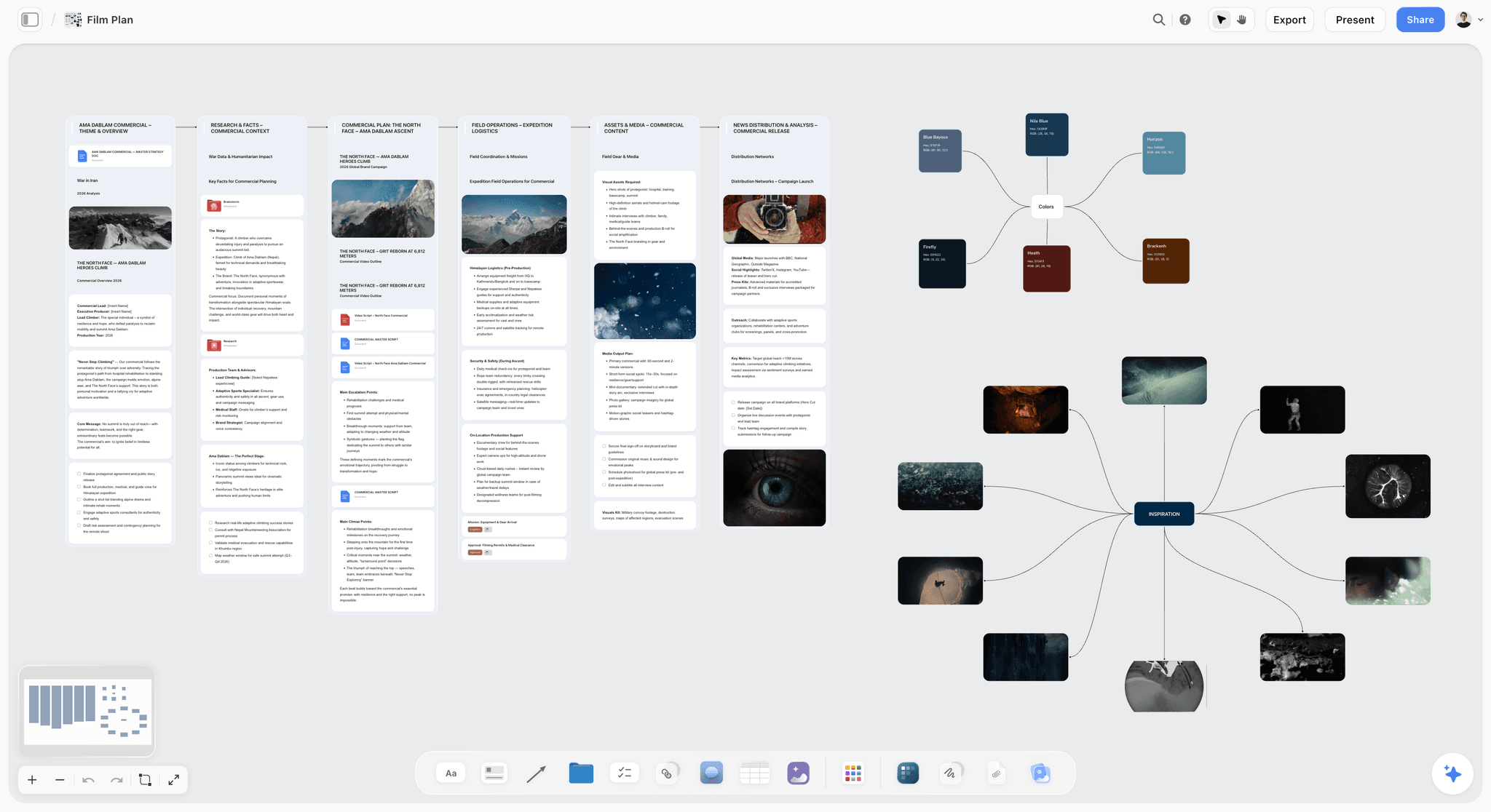
Storyflow holds the film moodboard on a canvas alongside the shot list, treatment, beat sheet, and character notes. The AI reads the full canvas, so you can ask it to draft caption notes for a reference frame, or check whether the moodboard's color direction matches what the treatment describes. For the Direction board, this matters: the moodboard stops being a separate file and becomes part of the brief the crew already works from. The fastest start is the Filmmaking Moodboard template, which opens the board with reference zones already structured; pair it with the Shotlist Template so the Direction board and the coverage plan sit side by side.
Best for: Filmmakers who want the moodboard connected to the rest of the film plan, not isolated in its own tool.
Verdict: The strongest AI canvas for the Direction board. For pure reference-image collection, a dedicated Discovery tool like PureRef beats it.
Key features
- Canvas where the moodboard sits next to shot list, treatment, and beat sheet.
- AI reads the full canvas plus up to 5 documents and 3 boards you attach.
- Moodboard and pre-production templates.
- Anyone a paid member invites to a board joins free.
- Image, video, and note cards on one infinite board.
Pricing
Early access: every plan is paid for now. The Free plan launches before the end of 2026, and invited collaborators of paid members join free now. Plus: $7.99/mo annual. Unlimited uploads. Pro: $14/mo annual. AI image generation, 30x AI usage. Max: $39/mo annual. 60x more AI, team workspace with roles.
Pros
- The moodboard lives next to the shot list and treatment, not in a separate file.
- AI reads the whole canvas, so it can caption frames and check direction consistency.
- A small crew joins free when a paid member invites them.
Cons
- Not a reference-image engine; PureRef and Shotdeck handle bulk reference better.
- Cloud-only, with no offline reference canvas.
- Newer platform with a smaller template library than Milanote.
2. Milanote
Milanote is the moodboard tool most filmmakers already know. Its canvas is built for visual creative work: drag in film stills, photographs, color swatches, and notes, and arrange them freely. It handles both the Discovery board (large, exploratory) and the Direction board (annotated, shared), and its film-specific guides have made it close to a default in the indie film world.
Best for: Filmmakers who want a dedicated, polished moodboard canvas with strong notes and sharing.
Verdict: The strongest dedicated film moodboard tool in 2026. The natural pick if the moodboard is a standalone deliverable.
Key features
- Freeform canvas built for images, notes, and color.
- Drag-and-drop web clipper for fast reference capture.
- Templates for film moodboards, shot lists, and production planning.
- Shareable boards with comments for crew feedback.
- Column and card structure for organizing by scene or department.
Pricing
Free with 100 cards. Individual: $9.99/mo. Team: $49/mo flat for up to 50 users.
Pros
- Purpose-built for visual creative work.
- The 100-card free tier is enough for a small board.
- Film-specific templates speed up setup.
Cons
- The 100-card free limit is reached fast on a Discovery board.
- AI features are light compared to canvas-AI tools.
- The moodboard sits separate from the rest of the film plan.
3. Miro
Miro is the collaborative whiteboard most crews can already access. For film moodboards, its strength is real-time collaboration: the director, DP, and production designer can all be on the same board, dropping references and leaving comments. It is a Direction-board tool, strong on crew alignment, weaker on the polished feel of a dedicated moodboard canvas.
Best for: Crews that want every department contributing to and commenting on one shared board.
Verdict: The strongest collaboration option. Pick it when crew input matters more than visual polish.
Key features
- Infinite collaborative canvas with real-time editing.
- Comment threads on any frame or section.
- Image upload and web capture.
- Templates for moodboards and creative briefs.
Pricing
Free for 3 boards. Starter: $8/mo annual. Business: $16/mo.
Pros
- Best-in-class real-time crew collaboration.
- Generous if your whole crew already uses Miro.
- Comments make department feedback easy to track.
Cons
- The 3-board free limit is tight across multiple projects.
- Less visually refined than Milanote for a client-facing board.
- Built for business teams, not film specifically.
4. PureRef
PureRef is the reference tool DPs, concept artists, and VFX teams keep open on a second monitor. It is a lightweight, always-on-top canvas for reference images: drag frames in, arrange them, zoom and compare. It is a pure Discovery-board tool. No annotation layer, no sharing, no structure. Just fast, frictionless reference handling.
Best for: The look-finding Discovery stage, especially for DPs comparing frames while shooting.
Verdict: The best lightweight Discovery tool. Costs almost nothing and does its single job well.
Key features
- Always-on-top reference canvas.
- Fast image import and arrangement.
- Zoom, crop, and color-pick from references.
- Tiny, fast desktop app.
Pricing
Pay-what-you-want with a $6 minimum, one-time. Free updates.
Pros
- Effectively free, one-time payment.
- Extremely fast and lightweight.
- Loved by DPs and VFX artists for a reason.
Cons
- No annotation, so it cannot become a Direction board.
- No collaboration or sharing.
- Desktop-only, no cloud sync.
5. Shotdeck
Shotdeck is a searchable library of stills from real films, tagged by lighting, color, lens, shot size, and more. For filmmakers, it solves the hardest part of the Discovery board: finding the exact cinematic reference. Instead of scrolling Pinterest, you search "low-key, single-source, 85mm, teal" and get frames that match.
Best for: Filmmakers who want precise cinematic references from real films, fast.
Verdict: The best cinematic reference library. Pair it with a Direction-board tool to brief the crew.
Key features
- Library of film stills searchable by lighting, color, lens, and shot type.
- Build and save reference decks.
- Filters built around cinematography language.
- Educational discounts for students.
Pricing
Subscription from roughly $20/mo, with annual options. Verify current rates on the Shotdeck site.
Pros
- Reference search built around real cinematography terms.
- Stills are from actual films, not generic stock.
- Saves hours of reference hunting.
Cons
- Subscription cost for what is a reference layer, not a full tool.
- Discovery-only; no Direction-board features.
- Library is film-focused, less useful for non-narrative work.
6. Pinterest
Pinterest is the free Discovery tool nearly every filmmaker has used. Its recommendation feed surfaces visually similar images, which makes it strong for fast, broad look exploration. It is a Discovery board only: there is no annotation, no crew structure, and the feed pulls attention sideways.
Best for: Free, broad visual discovery in the earliest look-finding stage.
Verdict: A capable free Discovery tool. Never hand a Pinterest board to a crew as a brief.
Key features
- Visual recommendation feed.
- Boards and sections for organizing pins.
- Free, no account barrier for browsing.
- Browser extension for saving images.
Pricing
Free. No paid tier for moodboard use.
Pros
- Free and familiar.
- The feed surfaces references you would not have searched for.
- Fast to start a board.
Cons
- No annotation; cannot become a Direction board.
- The feed is a distraction engine.
- Image sourcing and licensing are unclear.
7. Are.na
Are.na is a quiet, ad-free visual research tool favored by designers and artists. It organizes images and links into channels with no algorithmic feed pulling at your attention. For the Discovery board, it is the calm alternative to Pinterest: slower, more deliberate, better for serious look development.
Best for: Filmmakers who want distraction-free visual research and deliberate reference collecting.
Verdict: The thoughtful Discovery tool. Pair with a Direction-board tool for crew briefing.
Key features
- Channels for organizing images and links.
- No algorithmic feed or ads.
- Connect a block to multiple channels.
- Clean, minimal interface.
Pricing
Free with limits. Premium: roughly $7/mo (lower annually).
Pros
- No attention-stealing feed.
- Deliberate, calm research environment.
- Strong creative community.
Cons
- No annotation or crew features.
- Smaller image pool than Pinterest.
- Discovery-only.
8. Canva
Canva approaches the moodboard as a design layout. Its templates produce clean, presentation-ready boards, and its generative AI can fill gaps with images. For a Direction board that needs to look polished for a client or producer, Canva is fast and accessible.
Best for: Filmmakers who want a polished, client-facing moodboard built from templates.
Verdict: Strong for a presentation-ready board. Weaker for the freeform sprawl of look development.
Key features
- Template-based moodboard layouts.
- Generative AI image tools.
- Large stock image and element library.
- Easy export to PDF or presentation.
Pricing
Free tier. Pro: roughly $15/mo or $120/year.
Pros
- Produces polished, client-ready boards fast.
- Huge asset library.
- Easy for non-designers.
Cons
- Template structure fights freeform look development.
- Stock-image feel can dilute a specific cinematic vision.
- Not built for film reference workflows.
9. Eagle
Eagle is a local image-library manager. It organizes thousands of reference images on your own machine with auto-tagging, color search, and fast filtering. For filmmakers who hoard references across projects, it is the Discovery-board archive that PureRef is not built to be.
Best for: Filmmakers building a large, reusable, local reference archive.
Verdict: The best local reference library. A Discovery archive, not a briefing tool.
Key features
- Local image library with auto-tagging.
- Color and content search.
- Folders, tags, and smart filters.
- One-time purchase, offline.
Pricing
$29.95 one-time, includes future updates.
Pros
- One-time cost, no subscription.
- Handles tens of thousands of references smoothly.
- Works offline, full file ownership.
Cons
- Library manager, not a moodboard canvas.
- No collaboration or annotation.
- Setup time before it pays off.
10. FigJam / Figma
FigJam, Figma's whiteboard, and Figma itself can both host film moodboards. For crews with designers already in Figma, building the Direction board there keeps it next to other design work. It is capable but generic: a design canvas adapted to film, not built for it.
Best for: Crews and creative teams already working inside Figma.
Verdict: A reasonable Direction-board option if Figma is already your team's tool. No reason to adopt it for film alone.
Key features
- FigJam whiteboard for freeform boards.
- Figma canvas for polished layouts.
- Real-time collaboration and comments.
- Large plugin and template ecosystem.
Pricing
Free tier. FigJam from roughly $5/mo. Figma Professional roughly $16/mo.
Pros
- Strong collaboration and comments.
- Keeps the board near other design work.
- Mature, stable platform.
Cons
- Generic; nothing film-specific.
- Two products to understand (FigJam vs Figma).
- Overkill if the crew has no other Figma use.
11. Mural
Mural is a collaborative whiteboard built around workshops and facilitation. For film, it works as a Direction board when the look-development process is collaborative: a director and department heads working through references together in a structured session.
Best for: Crews that run collaborative look-development sessions.
Verdict: Capable for workshop-style boards. Miro is the stronger general pick in the same category.
Key features
- Collaborative canvas with facilitation tools.
- Templates and frameworks.
- Comments and voting.
- Real-time and async collaboration.
Pricing
Free tier. Paid plans from roughly $12/mo.
Pros
- Strong for structured group sessions.
- Facilitation features keep crew input organized.
- Solid real-time collaboration.
Cons
- Workshop framing is heavier than a moodboard needs.
- Less visually refined than Milanote.
- Overlaps with Miro without clearly beating it.
12. Notion
Notion can hold a film moodboard as a gallery database: reference images as cards, tagged by scene, department, or look. It is a Discovery-board archive for filmmakers already running their production in Notion. As a visual moodboard surface, the database structure fights the freeform nature of look development.
Best for: Filmmakers already running production planning in Notion who want references in the same workspace.
Verdict: Workable as a reference database. A weak fit as a visual moodboard canvas.
Key features
- Gallery databases for tagged reference images.
- Pages for long-form look notes.
- Standard AI features.
- Integration with the rest of a Notion workspace.
Pricing
Free for personal use. Plus: $10/mo. Business: $18/mo.
Pros
- Keeps references with the rest of a Notion production.
- Strong tagging and filtering.
- Familiar to teams already on Notion.
Cons
- Database structure fights freeform moodboarding.
- Not a visual-first canvas.
- Slow for fast reference capture.
7) Recommended Filmmaker Stacks
Stack 1: Solo Director / Indie Filmmaker. PureRef (Discovery, $6 once) + Storyflow (Direction board next to the shot list and treatment). About $8 a month plus $6 once, and it covers both boards.
Stack 2: Narrative Crew. Shotdeck (cinematic references) + Storyflow or Milanote (Direction board) + Miro (crew comments). The Direction board is the brief; Miro is where the crew reacts to it.
Stack 3: Commercial / Agency Production. Are.na or Pinterest (Discovery) + Canva or Storyflow (polished client-facing Direction board, starting from the Commercial Moodboard template) + Frame.io for footage review later.
Stack 4: Cheapest Working Stack. Pinterest Free (Discovery) + Storyflow (Direction, $7.99/mo billed annually).
The pattern across every stack: one Discovery tool to find the look, one Direction tool to brief the crew. The filmmakers whose footage matches their vision are the ones who built both.
8) Honorable Mentions
- Frame.io. Not a moodboard tool, but the standard for footage review once shooting starts.
- Cosmos. A newer visual discovery platform gaining traction with creatives.
- Adobe Bridge. Useful for filmmakers managing references inside the Adobe ecosystem.
- Boords. Storyboard-focused, useful once the moodboard becomes shot planning.
- Google Slides. A free fallback for a simple shared Direction board.
9) Tools to Avoid for Film Moodboards
- A raw Pinterest board handed to a crew. Discovery material is not a brief. Edit it down and annotate it first.
- Generic slide decks for look development. Slides cannot hold the freeform sprawl of the Discovery stage.
- Phone camera rolls. A folder of screenshots with no structure is not a moodboard.
- Pure AI image generators as the whole board. Generated frames are useful as references, but a moodboard built entirely from them gives the crew nothing real to match.
11) The Bottom Line
The best film moodboard tools in 2026 are the ones that match the board you are building. Storyflow is the best AI canvas for keeping the Direction board next to the shot list and treatment. Milanote is the strongest dedicated moodboard canvas. Miro is the best for crew collaboration. PureRef and Shotdeck are the best Discovery-stage reference tools.
A film moodboard is not a wall of pretty pictures. It is a brief your crew can shoot from. Build a Discovery board to find the look, then build a tight, annotated Direction board to communicate it. The filmmakers whose footage matches their vision are the ones who never confuse the two.
For your next shoot, generate a shot list with AI to anchor the plan, then build the Direction board in a Storyflow canvas so the moodboard sits beside the shot list and treatment the crew already works from. The Pre-Production Board template opens with both already on the canvas.
10) FAQ: Film Moodboard Tools
What is the best film moodboard tool in 2026?
Storyflow is the best AI canvas for keeping the moodboard next to the shot list and treatment. Milanote is the strongest dedicated film moodboard tool. PureRef is the best lightweight tool for the look-finding stage. Most filmmakers use one Discovery tool and one Direction tool.
What is the difference between a Discovery moodboard and a Direction moodboard?
A Discovery moodboard is private, large, and exploratory: you collect references to find the look. A Direction moodboard is shared, edited down, and annotated: it tells the crew what to shoot. The Discovery board finds the vision; the Direction board communicates it.
Is Milanote good for film moodboards?
Yes. Milanote is built for visual creative work and is widely used across film for moodboards, shot lists, and production planning. Its main limit is the 100-card free tier, which fills quickly on a large Discovery board.
Can I use Pinterest as a film moodboard?
Pinterest works for the Discovery stage, where you are browsing broadly to find a look. It fails as a Direction board because it has no annotation. Never hand a raw Pinterest board to a crew as a brief; edit it down and caption it in a Direction-board tool first.
What do cinematographers use for moodboards?
Many DPs use PureRef for an always-on-top reference canvas and Shotdeck to search cinematic stills by lighting and lens. For the shared crew brief, they work from a Direction board the director builds in Milanote, Storyflow, or Miro.
How many images should a film moodboard have?
The Discovery board can have hundreds; volume is the point. The Direction board you hand the crew should be tight, often 15 to 30 frames, each annotated. A Direction board with 300 unsorted images is not a brief, it is noise.
What is the cheapest film moodboard setup?
PureRef costs $6 once for the Discovery board, and Storyflow covers the Direction board next to the shot list. Pinterest Free plus Storyflow at $7.99/mo billed annually is the lower-cost alternative.
Should a film moodboard be annotated?
Yes. An un-annotated board of beautiful frames tells the crew nothing. Each frame on a Direction board should say why it is there: copy this color, this contrast, this lens feel, ignore the framing. Annotation is what turns a moodboard into a brief.
Can AI build a film moodboard?
AI can generate reference images and help caption a board, but it cannot decide what your film should look like. The strongest use is AI assisting a Direction board: drafting caption notes and checking that the moodboard's direction matches the treatment, as Storyflow's canvas AI does.
Is Miro or Milanote better for film moodboards?
Milanote is more visually refined and film-friendly for a standalone board. Miro is stronger for real-time crew collaboration and comments. Choose Milanote if the moodboard is a polished deliverable, Miro if the whole crew needs to contribute live.
How do I share a film moodboard with my crew?
Use a Direction-board tool with sharing and comments: Milanote, Storyflow, and Miro all support shared boards. Export to PDF for crew members who will not log in. The key is that the shared board is the annotated Direction board, not the raw Discovery collection.
What tools work for a documentary moodboard?
Documentary look development uses the same two boards. A Discovery tool (Are.na suits the research-heavy nature of documentary) to gather references, and a Direction tool (Storyflow keeps the moodboard next to the research and interview plan) to brief the shoot.
Table of Contents
- Quick Answer: The Best Film Moodboard Tools in 2026
- Comparison Table: 12 Film Moodboard Tools at a Glance
- The Two Moodboards
- How We Evaluated These Tools
- Quick Picks by Film Moodboard Need
- Detailed Reviews: 12 Film Moodboard Tools
- Recommended Filmmaker Stacks
- Honorable Mentions
- Tools to Avoid for Film Moodboards
- FAQ: Film Moodboard Tools
- The Bottom Line
- Author
- Related Reading
Templates to check out for this topic


Filmmaking templates you can use in Storyflow
Skip the blank canvas. Open one of these filmmaking boards in Storyflow and the AI builds on the structure that is already there, from research through the shot list.


See Storyflow in Action
A visual AI workspace where every feature lives inside one canvas. No tab-switching, no context lost.
Build your entire board from a single message
Type what you need in the AI chat at the bottom of your canvas. The AI adds cards, headings, and structure directly onto your board.
Use expert frameworks as AI context
Type @ in the AI chat and choose any Tactic. The AI tailors every response to that framework instead of giving generic advice.
Turn your board into a mind map in seconds
Ask the AI to restructure your canvas as a mindmap. It connects your ideas into a visual hierarchy so you can see how everything relates.
Why Storyflow Exists
Storyflow actually began as a personal tool while working on creative and research projects.
We kept running into the same problem: ideas were scattered everywhere: notes, documents, and whiteboards.
Nothing helped us see how everything connected.
So we started building a workspace designed around how ideas actually grow.
→ Read how Storyflow was createdJustkay
Documentary Filmmaker & Founder at Storyflow
Published: 2026-05-17
Extremely simple, seriously capable


See how easy it is to get started
Watch a real project come together, from a blank board to a finished plan, clicked through step by step.
Start creating with AI and become more productive
Transform your creative workflow with AI-powered tools. Generate ideas, create content, and boost your productivity in minutes instead of hours.