The 12 Best Customer Research and Interview Tools in 2026 (We Tested Them All)
Every team buys an analysis tool and the bottleneck is recruiting. Research has five stages and the tooling clusters around the two easiest, while the reason planned studies never happen is finding participants, and the reason finished studies change nothing is the stage after.

Category
Research
Author

Storyflow Team
Product & Research Team
Topics
2026-09-22
•
19 min read
•
ResearchFull disclosure: Storyflow is our own product and we rank it NINTH here, below seven competitors, because it runs no research. It does not recruit participants, schedule sessions, record calls, transcribe, tag transcripts, run unmoderated tests or store a repository. Dovetail, User Interviews, Maze, UserTesting, Grain, Condens and Notably all do things it cannot and this article ranks them above it. It appears for stage five only, the point where findings should change a decision and usually do not, which section 7 argues is a retrieval problem rather than a storage one. It is paid-only during early access, and the free analysis route this article recommends is NotebookLM.
Quick Comparison
These four sit at different stages of the same pipeline, and the order matters: one recruits, one tests at volume, one analyses for free with citations, and one stores the body of work. Most teams buy the last first, which is why their repository has nine interviews in it.
| Tool | Best For | AI Features | Price |
|---|---|---|---|
| Dovetail | Search across a whole body of research | AI themes and summaries | Free tier / from about $30 user mo |
| User Interviews | Getting participants without a week of chasing | Screening tools | From about $35 per participant |
| Maze | Fast unmoderated validation with numbers | AI follow-ups and analysis | Free tier / from about $99 mo |
| NotebookLM | Defensible findings from your own transcripts | Source-grounded with citations | Free / paid via Google One |
Article Metadata
By the Storyflow Team, Product & Research Published September 22, 2026 · 19 min read · Research
The study answered it. Nobody went and looked
A repository is organised by study; a decision arrives as a question. Put the decision in the middle, the supporting quotes one side, the contradicting evidence the other, and ask which findings argue against where you are leaning. Paid-only during early access, from $7.99 a month billed annually.

Table of Contents
- Quick Answer: The Best Customer Research Tools in 2026
- Comparison Table: 12 Research Tools at a Glance
- The Five Stages, and the Two Nobody Budgets For
- How We Evaluated These Tools
- Quick Picks by Research Need
- Detailed Reviews: 12 Customer Research Tools
- Why Research Dies in the Repository
- How to Run an Interview That Produces Something Usable
- Recommended Research Stacks
- What Customer Research Actually Costs
- Honorable Mentions
- Research Tools and Habits to Avoid
- FAQ: Customer Research and Interview Tools
- The Bottom Line
- Author
- Related Reading
1) Quick Answer: The Best Customer Research Tools in 2026
Dovetail is the best customer research tool in 2026 for teams doing continuous research: transcripts, tagging, AI-assisted themes and a searchable repository that makes last quarter's interviews findable. User Interviews is the one most teams should buy first, because recruiting participants is the stage that actually stops research happening. Maze is the strongest for unmoderated testing at volume. NotebookLM is the best free way to turn a pile of transcripts into findings you can trace to a source.
Every team buys an analysis tool and the bottleneck is recruiting. Research has five stages: recruit, schedule, record, analyse, share. Tools cluster heavily around stages three and four, which are the pleasant ones, while the reason most planned research never happens is stage one. Finding twelve people who match a screener and will give you half an hour is most of the work, and almost no budget goes there.
The second unbudgeted stage is the fifth. A study gets done, the findings go into a repository, and nothing changes, because a repository is organised by study and a decision needs findings organised by question. The Five Stages framework in section 3 ranks all 12 tools by stage, and section 7 covers why repositories go unread.
Storyflow is our own product and it is ninth here, for stage five only.
For the strategist's use of this material, see The 12 Best AI Tools for Creative Strategists in 2026.
All 12 Customer Research Tools, Ranked
- Dovetail: best research repository and analysis, the category standard
- User Interviews: best participant recruiting, which is the real bottleneck
- Maze: best unmoderated testing and rapid validation at volume
- UserTesting: best enterprise platform with its own participant panel
- Grain: best call recording with AI highlights and clips
- NotebookLM: best free synthesis, with every claim cited to your source
- Condens: best lighter, cheaper analysis repository
- Notably: best AI-forward analysis for small teams
- Storyflow: best for turning findings into a decision
- Typeform: best survey for the quantitative half
- Respondent: best specialist recruiting for B2B and hard-to-reach roles
- Calendly: best scheduling, unglamorous and load-bearing
Best Customer Research Tool by Job
- Best for actually getting interviews booked: User Interviews for consumer and general professional participants, Respondent when you need a specific B2B role.
- Best for a searchable body of research: Dovetail. Once you have run twenty studies, being able to find what a customer said about pricing in March is the whole value.
- Best for testing a design with fifty people this week: Maze. Unmoderated, fast, quantitative.
- Best free analysis: NotebookLM. It answers only from your transcripts and cites the passage, which is what makes a finding defensible.
- Best for capturing calls you were having anyway: Grain. Sales and support calls are research nobody is transcribing.
- Best for making findings change a decision: Storyflow. Section 7 is about why that is a separate problem from storing them.
2) Comparison Table: 12 Research Tools at a Glance
| Tool | Best For | Stage Served | AI Support | Starting Price | Rating (/10) |
|---|---|---|---|---|---|
Dovetail | Repository and analysis | Analyse, share | Strong AI themes and summaries | Free tier / from about $30 user mo | 9.0/10 |
User Interviews | Recruiting participants | Recruit, schedule | Light screening tools | Pay per participant, from about $35 | 8.8/10 |
Maze | Unmoderated testing at volume | Record, analyse | AI analysis and follow-ups | Free tier / from about $99 mo | 8.5/10 |
UserTesting | Enterprise research with a panel | Recruit to analyse | AI insight summaries | Enterprise quote | 8.2/10 |
Grain | Call recording and highlights | Record | AI notes, highlights, clips | Free tier / from about $19 user mo | 8.0/10 |
NotebookLM | Free source-grounded synthesis | Analyse | Cited answers from your sources | Free / paid via Google One | 7.9/10 |
Condens | Lighter analysis repository | Analyse, share | AI tagging and summaries | From about $30 user mo | 7.7/10 |
Notably | AI-forward analysis | Analyse | AI themes and clustering | Free tier / from about $25 user mo | 7.4/10 |
Storyflow | Findings to a decision | Share, decide | Canvas-wide context AI | $7.99 mo annual (free plan late 2026) | 7.2/10 |
Typeform | Surveys and screeners | Recruit, record | AI form building | Free tier / from about $25 mo | 7.0/10 |
Respondent | B2B and specialist recruiting | Recruit | Light matching | Pay per participant, higher rates | 6.9/10 |
Calendly | Scheduling without email tennis | Schedule | Light scheduling AI | Free / from about $10 user mo | 6.6/10 |
Pricing reflects publicly listed plans in 2026 and changes often; the recruiting platforms bill per participant plus incentive rather than by subscription, which makes them look cheap until you run a study. Ratings weigh which stage the tool serves, whether findings are traceable to a source, and cost per study rather than per month.
Customer Research Tools: Pricing Compared
| Tool | Free tier | Entry paid plan | What the paid plan unlocks | Billing model |
|---|---|---|---|---|
Dovetail | Yes, limited | from about $30/user/month | Unlimited projects, AI analysis, integrations | Per user, tiered |
User Interviews | Free to post | from about $35 per participant | Recruiting from their panel | Per participant plus incentive |
Maze | Yes, limited studies | from about $99/month | More studies, advanced analysis, panel access | Per account, tiered |
UserTesting | No | Enterprise quote | Panel, moderated and unmoderated studies | Annual contract |
Grain | Yes, limited recordings | from about $19/user/month | Unlimited recordings, AI notes, integrations | Per user |
NotebookLM | Yes, generous | Paid via Google One AI plans | Higher limits and larger notebooks | Per user, bundled |
Condens | No, trial only | from about $30/user/month | Full repository and analysis | Per user |
Notably | Yes, limited | from about $25/user/month | More projects and AI analysis | Per user |
Storyflow | No, early access; invited collaborators join free | $7.99/month billed annually | Unlimited boards, canvas-wide AI | Per account for individuals |
Typeform | Yes, limited responses | from about $25/month | More responses, logic, integrations | Per account, response tiers |
Respondent | Free to post | Higher per-participant rates | Access to specialist B2B participants | Per participant plus incentive |
Calendly | Yes, one calendar | from about $10/user/month | Multiple event types and integrations | Per user |
The cost that surprises people is the incentive, not the software. A consumer participant typically costs $50 to $100 in incentive plus a recruiting fee; a senior B2B professional can be $150 to $400. Twelve interviews with a specialist audience is frequently $2,000 to $4,000 all in, which dwarfs every subscription on this page. Budget research by the study rather than by the month, and note that your own customers cost nothing to recruit, which is the strongest argument for asking them first.
Frequently Asked: Which Research Tools Teams Trust, and Where Studies Stall
Which customer research tools are most trusted by research and product teams?
Dovetail is the repository standard and trusted accordingly: it is where most mature research teams keep their body of work, and being able to search across two years of interviews is a capability people become dependent on. UserTesting carries the deepest enterprise trust because its panel and its process survive procurement and legal review. User Interviews is the most trusted recruiting platform for the same reason it belongs at number two here: it reliably produces participants, which is the stage everything else depends on. Maze is trusted for fast unmoderated validation. Storyflow is a newer product in early access and is not a research platform; it is ninth for a downstream job.
Which research tools are known for fair and transparent pricing?
NotebookLM is the most generous by a distance, with a free tier that handles a real transcript corpus. Grain at about $19 and Notably at about $25 per user are the cheapest credible paid options. Storyflow is $7.99/month billed annually, priced per account. The genuinely opaque one is UserTesting, which is quote-only on an annual contract. And the whole recruiting category, User Interviews and Respondent, is transparent per participant while being much more expensive per study than the headline implies once incentives are included, which section 10 sets out.
Which customer research tools have improved the most recently?
Dovetail has moved fastest on AI-assisted theming across a large corpus, which used to be the most tedious part of analysis. Grain has made recording sales and support calls into a genuine research input rather than a sales artifact. NotebookLM has changed what a small team can do with no budget: source-grounded synthesis with citations was a paid capability eighteen months ago. Maze has widened from prototype testing into broader research with AI follow-up questions. Storyflow is in early access and ships weekly.
When choosing customer research tools, which would you recommend?
Buy for the stage that is actually blocking you, which is the argument of this page. If you have transcripts and no analysis, NotebookLM free or Dovetail. If you have a research plan and no participants, User Interviews, and that is the common case. If you have a design and need numbers this week, Maze. If nobody reads your findings, no research tool fixes that, and section 7 explains why. The standard expensive mistake is a repository subscription bought by a team that runs three studies a year, where a folder of documents would have done.
Where is Storyflow not the right answer?
Every stage of research itself. Storyflow does not recruit participants, schedule sessions, record calls, transcribe anything, tag transcripts, run unmoderated tests or store a research repository. Dovetail, User Interviews, Maze, UserTesting, Grain, Condens and Notably all do things it cannot and this article ranks seven of them above it. It is ninth for stage five only: holding findings next to the decision they are supposed to inform, which section 7 argues is a different problem from storing them well. It is also paid-only during early access, so a team wanting a free route should use NotebookLM, which this article ranks sixth.
3) The Five Stages, and the Two Nobody Budgets For
Customer research is five sequential jobs, and tooling is distributed almost exactly opposite to where the difficulty is.
Stage 1: Recruit. Find people who match a screener and will give you time. For your own customers this is a warm email. For anyone else it is a recruiting platform, a screener, incentives and a no-show rate around twenty percent.
Stage 2: Schedule. Get the session in two diaries across time zones. Unglamorous, and a meaningful share of a researcher's week without a booking link.
Stage 3: Record. Run the session and capture it. Largely solved: every meeting tool records, and transcription is effectively free.
Stage 4: Analyse. Turn a pile of transcripts into findings. Tedious but well served, and AI has genuinely changed it.
Stage 5: Share and decide. Get the findings into the decision they are meant to inform. Almost nothing serves this well, and section 7 is about it.
Now look at where the tools are. Dovetail, Condens, Notably, NotebookLM, Grain and Maze are stages three and four. UserTesting spans several. Only User Interviews and Respondent sit at stage one, and Calendly at stage two.
The mismatch matters because stage one is where research actually dies. A team plans twelve interviews. Two weeks later they have run three, because sourcing the other nine required a screener, a panel, a budget approval for incentives and a week of chasing. The research does not get cancelled; it quietly shrinks to whoever was easy to reach, which is usually your happiest customers, and the conclusion drifts accordingly.
The corollary is the most useful thing on this page: recruiting from your own customers and your own pipeline is close to free, and most teams underuse it. Your churned customers, your lost deals and your support tickets are all research inputs that cost nothing to reach. Grain ranks fifth here because recording sales calls you were having anyway is the cheapest participant sourcing available.
And stage five is where research stops being worth having. A study is completed, tagged, summarised and filed. Six weeks later a decision is made that the research answered, and nobody consulted it. That is not a storage failure and a better repository does not fix it.
4) How We Evaluated These Tools
Five criteria, weighted in this order:
- Which stage it genuinely serves, versus which stage its marketing implies.
- Whether findings are traceable to a source, because an uncited claim cannot survive being challenged.
- Cost per study, counting incentives, rather than cost per month.
- Whether findings reach a decision, which is the stage nearly everything neglects.
- Usability for a non-researcher, since in most companies the person doing this is a founder or a product manager rather than a trained researcher.
Testing ran three real studies over a quarter: a churn investigation with existing customers, a pricing study with prospects, and an unmoderated usability test of a new flow.
5) Quick Picks by Research Need
Best overall for a research team: Dovetail for the repository, User Interviews for participants.
Best for a founder doing this themselves: Grain to record customer calls, NotebookLM free to analyse, Storyflow to connect findings to the decision. About $27/month.
Best for recruiting: User Interviews for consumer and general professional, Respondent for specific B2B roles.
Best for speed: Maze. Fifty unmoderated responses in two days.
Best free setup: Your own customers for recruiting, a meeting tool for recording, NotebookLM free for analysis with citations. Genuinely zero, and better research than most paid setups produce. Storyflow is paid-only during early access so it is not part of a free stack; its Free plan arrives before the end of 2026.
Best cheapest paid setup: Grain at about $19 plus Storyflow at $7.99 billed annually, with NotebookLM free doing the synthesis.
6) Detailed Reviews: 12 Customer Research Tools
1. Dovetail
Dovetail is the research repository most mature teams standardise on: transcripts, highlights, tagging, AI-assisted themes, and search across everything you have ever run. Its real value appears at scale, when a question like what customers said about pricing eighteen months ago becomes answerable in seconds.
Best for: Teams running continuous research who need a searchable body of work.
Verdict: The best analysis and repository tool here. It serves stages four and five and does nothing for stage one, which is where most teams are stuck.
Key features
- Transcription, tagging and highlight reels.
- AI-assisted theme detection across a corpus.
- Searchable repository with insight linking.
Pricing
Limited free tier. Paid from about $30/user/month.
Pros
- Search across a whole body of research is genuinely transformative.
- AI theming removes the worst of manual tagging.
- Findings link back to the exact quote.
Cons
- Expensive for a team running a handful of studies a year.
- Does nothing about recruiting.
- A well-organised repository still goes unread, per section 7.
2. User Interviews
User Interviews recruits participants from its own panel or from your list, handles screeners, scheduling and incentive payment. It ranks second because it serves the stage that actually blocks research, and because the operational load it removes is larger than it looks.
Best for: Getting participants, reliably, without a week of chasing.
Verdict: The tool most teams should buy first. Per-participant pricing plus incentives makes each study a real budget line.
Key features
- Panel recruiting plus tools to recruit from your own users.
- Screener surveys with logic.
- Scheduling and automated incentive payment.
Pros
- Solves the stage that stops research happening.
- Incentive handling removes genuine administrative pain.
- Screeners are good enough to get the right people.
Cons
- Cost per study is substantial once incentives are counted.
- Panel participants are professionalised in some categories.
- Specialist B2B roles are harder and more expensive.
3. Maze
Maze runs unmoderated studies at volume: prototype tests, card sorts, surveys, with quantitative output and AI follow-up questions. When you need fifty data points rather than eight conversations, it is far faster and cheaper than moderated research.
Best for: Validating a design or a flow quickly with numbers.
Verdict: The best unmoderated testing tool here. It answers what and how many, and not why.
Key features
- Unmoderated prototype and usability testing.
- Quantitative metrics with heatmaps and paths.
- AI-generated follow-up questions and analysis.
Pricing
Limited free tier. Paid from about $99/month.
Pros
- Fast: fifty responses in days, not weeks.
- Quantitative output that survives an argument.
- Integrates with common design tools.
Cons
- Unmoderated, so you cannot follow an unexpected answer.
- Account pricing is steep for occasional use.
- Produces behaviour data without motivation.
4. UserTesting
UserTesting is the enterprise platform: its own large panel, moderated and unmoderated studies, and the governance that survives procurement. For a large organisation that needs research at pace across many teams, it consolidates several tools.
Best for: Enterprises needing research capacity across multiple teams.
Verdict: The most complete platform here. Quote-only and priced well beyond a startup.
Key features
- Large managed participant panel.
- Moderated and unmoderated study types.
- AI insight summaries and enterprise governance.
Pricing
No public pricing; enterprise quote on an annual contract.
Pros
- Panel access removes recruiting entirely.
- Handles both study types in one platform.
- Survives enterprise procurement and legal review.
Cons
- Quote-only with an annual commitment.
- Panel participants can be practised test-takers.
- Far too heavy for a small team.
5. Grain
Grain records and transcribes calls, then produces AI notes, highlights and shareable clips. Its research value is indirect and considerable: sales, support and success calls are customer research that nobody is capturing, and they cost nothing to recruit for.
Best for: Turning conversations you were already having into research.
Verdict: The cheapest participant sourcing available. It captures; the analysis is a separate step.
Key features
- Automatic recording, transcription and AI notes.
- Highlight clips shareable into Slack or a repository.
- Integrations with CRM and note tools.
Pricing
Free tier with limited recordings. Paid from about $19/user/month.
Pros
- Zero recruiting cost, because the calls already happen.
- Clips of a customer saying something carry more weight than a summary.
- Cheap relative to the research platforms.
Cons
- Sales calls are a biased sample; the customer is selling too.
- Recording consent rules vary by jurisdiction, so check before enabling.
- Not an analysis tool.
6. NotebookLM
NotebookLM answers only from the sources you upload and cites the passage. For research that constraint is the feature: a finding you can trace to transcript eleven survives being challenged, and a fluent unsourced paragraph does not.
Best for: Free, defensible synthesis across a transcript corpus.
Verdict: The best free analysis here and a genuine alternative to a paid repository for small teams. It is not a repository and does not manage a body of work over time.
Key features
- Answers grounded strictly in uploaded sources.
- Inline citations to the exact passage.
- Structured summaries across a corpus.
Pricing
Generous free tier. Higher limits via paid Google One AI plans.
Pros
- Citations make every finding checkable.
- Cannot invent, because it cannot reach outside your sources.
- Free tier handles a real study.
Cons
- No tagging, no persistent repository, no collaboration model.
- Confined to what you upload each time.
- Not built for research operations.
7. Condens
Condens is a focused research repository covering transcription, tagging, analysis and reporting without the breadth or the price of the market leader. For a small research function it is frequently the better fit.
Best for: Small teams wanting a real repository without Dovetail's footprint.
Verdict: A strong, focused alternative to Dovetail. Smaller ecosystem and fewer integrations.
Key features
- Transcription, tagging and highlight analysis.
- Reporting and shareable findings.
- Clean, research-specific structure.
Pricing
Trial only, then from about $30/user/month.
Pros
- Purpose-built for research rather than adapted.
- Easier to learn than Dovetail.
- Good balance of analysis and reporting.
Cons
- Fewer integrations.
- Similar per-seat price to Dovetail with less breadth.
- Still a stage-four tool.
8. Notably
Notably is an AI-forward research platform that clusters and themes a corpus quickly, aimed at teams that want speed of synthesis over depth of repository management.
Best for: Small teams wanting fast AI analysis without a large tool.
Verdict: The quickest route from transcripts to themes here. Verify the AI clusters against the source before quoting them.
Key features
- AI clustering and theme generation.
- Visual analysis canvas for sorting insights.
- Templates for common research types.
Pricing
Limited free tier. Paid from about $25/user/month.
Pros
- Fast synthesis over a pile of material.
- Visual sorting suits people who think spatially.
- Cheaper than the established repositories.
Cons
- AI themes need checking against the transcript.
- Smaller company and ecosystem.
- Less rigorous as a long-term repository.
9. Storyflow
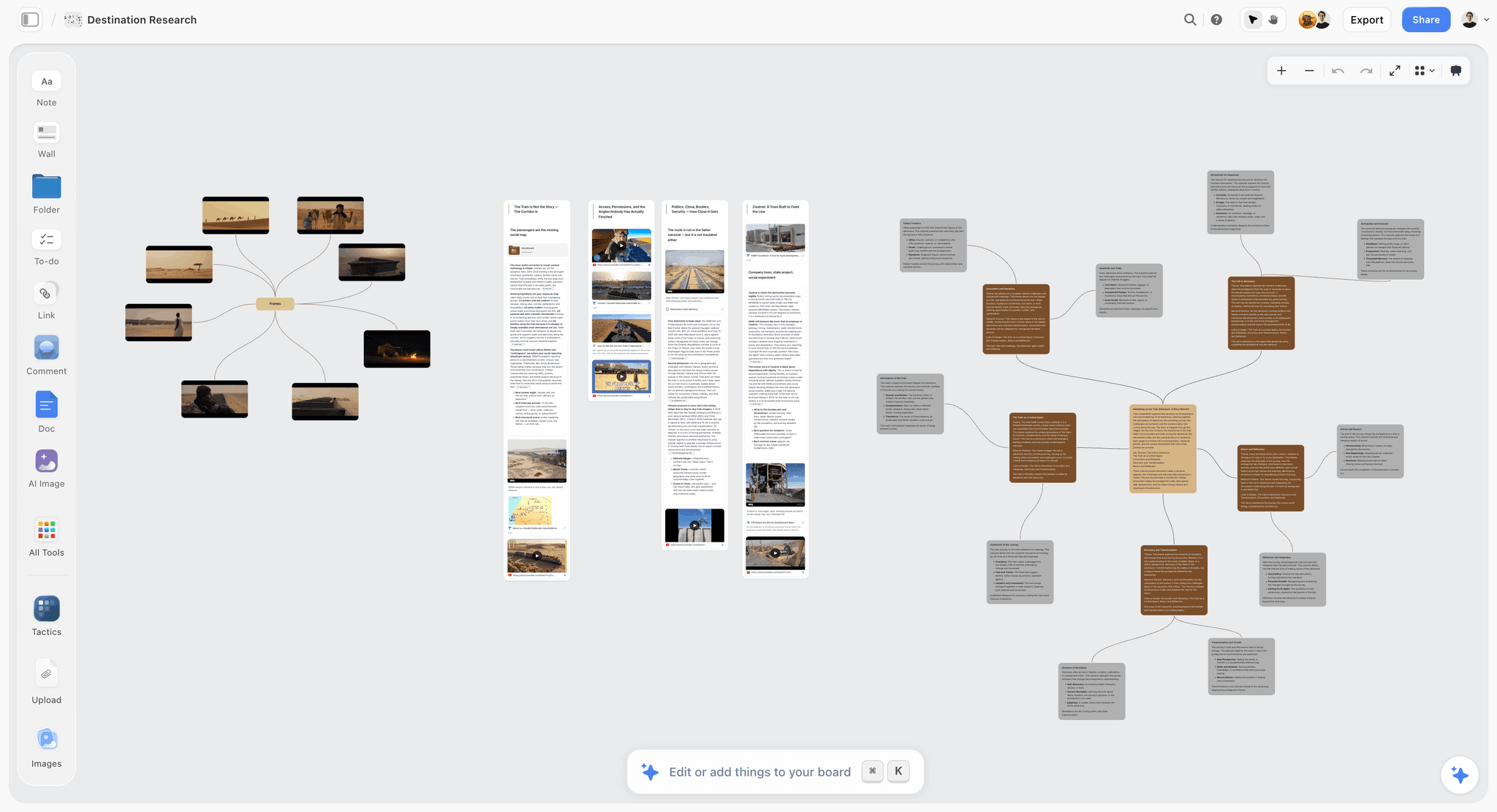
Storyflow runs no research. It is here for stage five: the point at which findings are supposed to change a decision and usually do not. A repository is organised by study; a decision needs findings organised by the question in front of you. On a canvas the decision sits in the middle with the relevant quotes, the contradicting evidence and the constraints around it, and because the AI reads the whole board it can be asked which findings argue against the direction you are leaning.
Best for: Making a specific decision with research in front of you rather than filed near you.
Verdict: A complement to a research stack and no substitute for one. Take Dovetail or NotebookLM for the research itself.
Key features
- Infinite canvas holding findings, quotes, constraints and options together.
- AI reads the whole current board, plus 5 attached documents and 3 attached boards.
- Anyone a paid member invites to a board joins free, including stakeholders.
- 200+ story blueprints including decision and planning frameworks.
Pricing
Early access: every plan is paid for now. A Free plan arrives before the end of 2026, and anyone a paid member invites to a board can sign up free and collaborate today. Plus: $7.99/mo annual, $9.99/mo monthly. Unlimited boards and uploads. Pro: $14/mo annual, $19/mo monthly. AI image generation, more AI usage, memory across conversations. Max: $39/mo annual, $49/mo monthly. Team workspace with roles and permissions.
Pros
- Organises findings by decision rather than by study.
- Surfaces evidence that contradicts the direction being taken.
- Stakeholders read the board without a seat.
Cons
- No recruiting, scheduling, recording, transcription or tagging.
- No repository, search across studies or research operations.
- Paid-only during early access.
10. Typeform
Typeform is the survey most people will actually finish, which matters more than feature depth. For screeners and for the quantitative half of a mixed-method study it is the default.
Best for: Screeners and surveys with a decent completion rate.
Verdict: The best survey experience here. A survey tells you what and how many, never why.
Key features
- One-question-at-a-time forms with high completion.
- Logic jumps for screeners.
- Integrations into the rest of a stack.
Pricing
Limited free tier. Paid from about $25/month, tiered on responses.
Pros
- Completion rates beat plainer form tools.
- Logic makes it a capable screener.
- Easy for a non-researcher to build.
Cons
- Response tiers escalate with volume.
- Surveys capture stated preference, which is unreliable.
- No qualitative depth.
11. Respondent
Respondent specialises in hard-to-reach professional participants: specific job titles, industries and seniority. When you need six heads of finance at mid-market companies, the general panels cannot help and this is the category.
Best for: B2B research with specific role and seniority requirements.
Verdict: The best specialist recruiting here. Substantially more expensive per participant, which is the market rate for those people's time.
Key features
- Panel of vetted professional participants.
- Filtering by role, industry and seniority.
- Screening and incentive handling.
Pricing
Free to post; per-participant fees plus higher incentives for senior roles.
Pros
- Reaches people no general panel covers.
- Verification reduces participant fraud.
- Handles the incentive administration.
Cons
- Expensive: senior B2B participants are a real budget line.
- Smaller pool, so niche screeners take longer to fill.
- Professional participants exist here too.
12. Calendly
Calendly is on this list because stage two is a genuine time cost and a booking link removes it entirely. It is the least interesting tool here and among the most load-bearing.
Best for: Scheduling sessions without email tennis.
Verdict: Unglamorous and worth its place. It does nothing else.
Key features
- Booking links with availability rules.
- Time-zone handling and reminders.
- Calendar and video-call integrations.
Pricing
Free for one event type. Paid from about $10/user/month.
Pros
- Removes a real and repeated time cost.
- Automatic reminders reduce no-shows.
- Free tier is enough for research use.
Cons
- Only one stage, and a small one.
- Can feel impersonal to some participants.
- Another subscription if you do not already have one.
7) Why Research Dies in the Repository
A repository is organised by study. A decision needs findings organised by question. That single mismatch explains most of the gap between research done and research used.
Here is how it plays out. A team runs a churn study, tags forty transcripts, writes a summary with twelve findings, and files it. Six weeks later a different group is deciding whether to change onboarding. The churn study contains three findings directly relevant to that decision. Nobody retrieves them, because retrieving them requires knowing they exist, knowing which study they are in, and going to look. All three are unlikely when the people deciding were not the people researching.
Three compounding reasons.
Findings are filed under their origin, not their use. Research is stored by project, date and method, which is how it was produced. A decision arrives with a question. Matching the two requires a person who remembers both, which is a single point of failure and usually the researcher.
Insights decay quietly. A finding from eighteen months ago may still hold or may have been overtaken. A repository rarely distinguishes, so people either over-trust old research or, more often, discount all of it and start fresh, which is why the same study gets run twice.
The research artifact is the wrong shape for a decision. A study report is a narrative with a conclusion. A decision needs the evidence for and against a specific option, side by side, including the findings that argue against the direction being taken. A report almost never presents that, because reports are written to summarise rather than to adjudicate.
What actually works, and none of it requires new software:
- Write findings as claims with a confidence level and a date. "Users cannot tell what the pricing includes, high confidence, March 2026" is reusable. "Users found pricing confusing" is a theme, and a theme is not a claim.
- Attach the quote. A stakeholder who reads a customer saying it moves further than one who reads a summary of what customers said.
- When a decision comes up, pull the relevant findings to the decision. Do not send a link to the study. This is a five-minute act of retrieval and it is the single highest-return habit in research operations.
- Include the contradicting evidence explicitly. Research that only supports the intended direction is not being used, it is being cited.
That last practice is the reason a canvas helps here and a repository does not. Put the decision in the middle, the supporting findings on one side, the contradicting ones on the other, and the constraints underneath, and the argument becomes visible rather than asserted. An AI that reads the whole board can be asked which evidence argues against the direction you are leaning, which is a question people rarely ask themselves.
8) How to Run an Interview That Produces Something Usable
The tools do not fix a badly run interview, and most interviews are badly run in the same few ways.
Ask about the past, not the future. "Would you use this?" produces a polite yes that predicts nothing. "Tell me about the last time you had this problem" produces behaviour, which is evidence. Nearly every useless interview finding traces back to a hypothetical question.
Ask for the last time, not the usual. "What do you normally do?" gets a tidied narrative. "Walk me through the most recent time" gets the actual messy sequence including the workaround they are slightly embarrassed by, which is where the real insight lives.
Do not describe your solution. Once you have, everything afterwards is politeness. If you must show something, do it in the last five minutes.
Follow the emotion. When somebody sighs, laughs or becomes vague, stop and ask about that. The vague answer is usually protecting something more interesting.
Silence is a technique. Wait three seconds after they finish. Most people keep talking, and the second half is more honest than the first.
Record the exact words. Paraphrase loses the phrasing, and the phrasing is frequently the finding. "It never does what I expect on Mondays" is worth more than "user reported inconsistency" and it survives being repeated to a stakeholder.
Five to eight interviews per segment is usually enough to hear the pattern. If the fifth interview is still surprising you, the segment is too broad rather than the sample too small.
And the failure that wastes whole studies: recruiting whoever was easiest to reach. Your happiest customers answer fastest, and a study built from them produces reassurance. The people who churned, the deals you lost and the customers who barely use the product are harder to reach and hold nearly all of the useful information.
9) Recommended Research Stacks
Stack 1: Founder doing research themselves. Grain (record calls you already have) + NotebookLM free (analysis) + Storyflow (findings to decision). About $27/month, no recruiting cost.
Stack 2: Small product team. User Interviews (recruiting) + a meeting tool (recording) + Dovetail (repository) + Storyflow. About $38 a seat plus participant costs.
Stack 3: Design team validating fast. Maze (unmoderated) + User Interviews (moderated when needed) + Dovetail. About $129/month plus participants.
Stack 4: Zero budget. Your own customers and churned users + any meeting tool + NotebookLM free. Genuinely zero, and better than most paid setups because the participants are real.
Stack 5: Enterprise. UserTesting for capacity plus Dovetail as the system of record.
| Team shape | Recruits from | Records with | Analyses in | Monthly cost |
|---|---|---|---|---|
Founder | Own calls and churned users | Grain | NotebookLM free | about $27 |
Small product team | User Interviews | Meeting tool | Dovetail | about $38/seat plus participants |
Design team | Maze panel, User Interviews | Maze | Dovetail | about $129 plus participants |
Zero budget | Own customers | Any meeting tool | NotebookLM free | $0 |
Enterprise | UserTesting panel | UserTesting | Dovetail | quote |
The pattern: solve recruiting first, and use free analysis until a repository earns its price. The reverse order is what most teams do and it is why they own a well-organised repository with nine interviews in it.
10) What Customer Research Actually Costs
The software is not the cost.
Incentives and recruiting fees. A consumer participant runs roughly $50 to $100 in incentive plus a recruiting fee. A senior B2B professional is commonly $150 to $400. Twelve interviews with a specialist audience is frequently $2,000 to $4,000 for one study, which exceeds a year of most subscriptions on this page.
Researcher time, which is the largest line. A twelve-interview study is roughly forty to sixty hours end to end: screener, recruiting, scheduling, six hours of sessions, analysis and write-up. AI has genuinely compressed the analysis portion and left recruiting and scheduling untouched, which is why tools at stage one repay their cost fastest.
The no-show rate, which people forget to plan for. Around twenty percent is normal, so recruit fifteen to run twelve, and budget incentives accordingly.
And the cost of research that changes nothing, which is the real waste. A completed, well-analysed, well-filed study that does not reach the decision it was run for cost you the full amount and returned nothing. That is a stage-five failure and no amount of stage-four spending prevents it.
| Cost driver | Where it lands | Rough size | The move |
|---|---|---|---|
Incentives and recruiting | Per study | $600 to $4,000 for twelve | Use your own customers where the question allows |
Researcher time | Per study | 40 to 60 hours | AI compresses analysis, not recruiting |
No-shows | Per study | About 20 percent | Recruit fifteen to run twelve |
Research nobody used | Invisible | The whole study | Pull findings to the decision, not the other way |
11) Honorable Mentions
- Great Question and Marvin. Newer research platforms combining recruiting and analysis worth comparing.
- Lookback. Strong moderated session recording with observer rooms.
- Optimal Workshop. The specialist for card sorting and tree testing.
- Hotjar and PostHog session replay. Behavioural evidence for free at small scale, which complements interviews well.
- Otter and Granola. Cheap, reliable transcription if you do not need a full platform.
- Prolific. Academic-grade participant recruiting, often cheaper for general population studies.
- Your support ticket queue. The most under-used research corpus in most companies, and it costs nothing.
12) Research Tools and Habits to Avoid
- A repository bought before you have research. A folder of documents is fine for the first ten studies.
- Recruiting only your happiest customers. Easiest to reach, least informative, and the resulting study reassures rather than informs.
- Asking whether people would use something. Hypothetical questions produce polite answers that predict nothing.
- Demoing your solution in the first half of an interview. Everything after it is politeness.
- Surveys used where interviews are needed. A survey tells you what and how many; it cannot tell you why, and why is usually the question.
- AI themes quoted without checking the source. Verify a generated theme against the transcript before it reaches a stakeholder, or the one time it is wrong costs you the credibility of everything else.
14) The Bottom Line
The best customer research tools in 2026 are the ones that unblock the stage you are actually stuck at. Dovetail is the best repository and analysis platform. User Interviews is the one most teams should buy first, because recruiting is what stops research happening. Maze is the fastest route to numbers. NotebookLM is a genuinely good free analysis tool that cites its sources.
Every team buys an analysis tool and the bottleneck is recruiting, and research that gets done still dies at the last stage, because a repository is organised by study and a decision needs findings organised by question. Recruit from your own customers where you can, write findings as dated claims with the quote attached, and pull them to the decision rather than filing them near it.
For that last step, put the decision in the middle of a Storyflow canvas with the supporting and contradicting findings either side, and ask which evidence argues against where you are leaning.
FAQ: Customer Research and Interview Tools
What is the best customer research tool in 2026?
Dovetail is the best customer research tool for teams running continuous research, because transcription, tagging, AI theming and search across a whole body of work make previous studies retrievable rather than archived. But the tool most teams should buy first is User Interviews, because recruiting participants is the stage that actually stops research happening. Maze is best for fast unmoderated validation, and NotebookLM is a genuinely good free analysis option with citations. The standard mistake is buying a repository while the bottleneck is recruiting.
What is the best tool for user interviews?
For finding people, User Interviews for general audiences and Respondent for specific B2B roles. For running and recording, any meeting tool with transcription works, and Grain adds AI notes and clips. For analysis, Dovetail if you need a repository or NotebookLM free if you need defensible findings from one study. No single tool covers all five stages well except the enterprise platforms.
Is there a free customer research tool?
Yes, and a zero-cost stack is genuinely good: recruit from your own customers and churned users at no cost, record with any meeting tool, and analyse with NotebookLM's free tier, which cites every claim back to your transcripts. Maze, Dovetail, Notably and Grain all have limited free tiers worth trying. Storyflow is paid-only during early access and runs no research in any case.
How many customer interviews do I need?
Five to eight per segment is usually enough to hear the pattern, and the useful signal is saturation: when new interviews stop surprising you, stop. If the fifth is still producing genuinely new information, the segment is probably too broad rather than the sample too small. Plan for roughly twenty percent no-shows, so recruit fifteen to run twelve.
How much does customer research cost?
The software is minor; the incentives are the budget. Consumer participants run roughly $50 to $100 each plus a recruiting fee, and senior B2B professionals commonly $150 to $400. A twelve-interview study with a specialist audience is frequently $2,000 to $4,000. Researching your own customers costs nothing, which is the strongest argument for starting there when the question allows.
What questions should I ask in a customer interview?
Ask about the past rather than the future: not "would you use this" but "tell me about the last time you had this problem". Ask for the most recent instance rather than the usual one, because the usual one is a tidied narrative. Follow emotion when it appears, leave silence after an answer, and do not describe your solution until the last five minutes.
Dovetail or Condens?
Dovetail if you need breadth, integrations and search across a large long-term corpus, which is where its value concentrates. Condens if you want a focused, slightly easier repository for a small research function. They are similarly priced per seat, so the question is really whether you are building a long-term body of research or organising a handful of studies, and for the latter NotebookLM free may be enough.
Can AI analyse customer interviews?
Yes, and well. AI theming across forty transcripts is genuinely better than a tired human doing it manually, because it does not get bored at transcript twenty-six. Two cautions: verify any generated theme against the source before quoting it to a stakeholder, and prefer a tool that cites the passage, because an uncited finding cannot survive being challenged. NotebookLM is the strongest free option on exactly that property.
Why does nobody read our research?
Because a repository is organised by study and a decision needs findings organised by question. Six weeks after a study is filed, the people making a related decision would have to know the study exists, know it contains the answer, and go and look. The fix is retrieval rather than storage: when a decision comes up, pull the relevant findings to it, with the quotes and the contradicting evidence, instead of sending a link to the report.
What is the difference between moderated and unmoderated research?
Moderated means you are present and can follow an unexpected answer, which is where genuinely new understanding comes from. Unmoderated means participants complete tasks alone at scale, which gives you numbers and behaviour but no ability to ask why. Use unmoderated to measure something you already understand and moderated to understand something you cannot yet measure.
Should I use surveys or interviews?
Interviews when you do not yet know what the question is or why something happens; surveys when you know the question and need to know how many. The common failure is a survey used to explore, which produces stated preferences that reliably fail to predict behaviour. A good sequence is a small number of interviews to find the question, then a survey to size it.
Where should research findings live?
In a repository if you run research continuously, and in a document if you do not; that choice matters less than how they are written. Write each finding as a claim with a confidence level and a date, attach the verbatim quote, and pull the relevant ones to a decision when it arises. Findings written as themes rather than claims are unusable six weeks later, whatever tool holds them.
How do I recruit participants without a budget?
Your own customers, your churned customers, your lost deals and your support queue, in roughly that order of ease and inverse order of comfort. Recording the sales and support calls you already have is the cheapest sourcing available, which is why Grain is on this list. The one discipline that matters is not recruiting only the people who answer fastest, because those are your happiest customers and they will reassure you.
Table of Contents
- Article Metadata
- Breadcrumb
- Table of Contents
- 1) Quick Answer: The Best Customer Research Tools in 2026
- All 12 Customer Research Tools, Ranked
- 2) Comparison Table: 12 Research Tools at a Glance
- Frequently Asked: Which Research Tools Teams Trust, and Where Studies Stall
- 3) The Five Stages, and the Two Nobody Budgets For
- 4) How We Evaluated These Tools
- 5) Quick Picks by Research Need
- 6) Detailed Reviews: 12 Customer Research Tools
- 7) Why Research Dies in the Repository
- 8) How to Run an Interview That Produces Something Usable
- 9) Recommended Research Stacks
- 10) What Customer Research Actually Costs
- 11) Honorable Mentions
- 12) Research Tools and Habits to Avoid
- 14) The Bottom Line
- 15) Author
- 16) Related Reading
- FAQ: Customer Research and Interview Tools
Templates to check out for this topic


Research templates you can use in Storyflow
Gather sources, personas, and findings on one canvas, then let the AI read across all of it. Open any of these research boards to start.


See Storyflow in Action
A visual AI workspace where every feature lives inside one canvas. No tab-switching, no context lost.
Build your entire board from a single message
Type what you need in the AI chat at the bottom of your canvas. The AI adds cards, headings, and structure directly onto your board.
Use expert frameworks as AI context
Type @ in the AI chat and choose any Tactic. The AI tailors every response to that framework instead of giving generic advice.
Turn your board into a mind map in seconds
Ask the AI to restructure your canvas as a mindmap. It connects your ideas into a visual hierarchy so you can see how everything relates.
Why Storyflow Exists
Storyflow actually began as a personal tool while working on creative and research projects.
We kept running into the same problem: ideas were scattered everywhere: notes, documents, and whiteboards.
Nothing helped us see how everything connected.
So we started building a workspace designed around how ideas actually grow.
→ Read how Storyflow was createdStoryflow Team
Product & Research Team
Published: 2026-09-22
Extremely simple, seriously capable


See how easy it is to get started
Watch a real project come together, from a blank board to a finished plan, clicked through step by step.
Start creating with AI and become more productive
Transform your creative workflow with AI-powered tools. Generate ideas, create content, and boost your productivity in minutes instead of hours.