The 12 Best Competitor Analysis Tools in 2026 (We Tested Them All)
Almost every competitor analysis produces a feature matrix, and a feature matrix has never changed a decision. What is worth mapping is commitments: the pricing model they cannot abandon, the customer they have publicly chosen, the architecture they are locked into.

Category
Marketing
Author

Storyflow Team
Product & Research Team
Topics
2026-09-22
•
19 min read
•
MarketingFull disclosure: Storyflow is our own product and we rank it SIXTH here, below five competitors, because it gathers no competitive data whatsoever. It has no traffic data, no keyword or backlink data, no page monitoring, no review mining, no technology detection and no intelligence feed. Semrush, Similarweb, Perplexity, Ahrefs, Visualping, SparkToro, Wappalyzer and G2 all produce data it cannot. It appears for the step after gathering, holding the commitment map and its evidence, and section 7 argues that step is where most competitive analysis fails. It is paid-only during early access, and the free version of that step named here is a spreadsheet with a row per competitor.
Quick Comparison
Three of these gather and one watches. The watcher costs about a tenth of the others and is the one most teams never set up, which is why it earns a place beside the expensive data platforms.
| Tool | Best For | AI Features | Price |
|---|---|---|---|
| Semrush | Search, content and paid footprint | AI visibility and content tools | From about $140 mo |
| Similarweb | Where their traffic actually comes from | AI market summaries | Free tier / enterprise quote |
| Perplexity | Fast sourced landscape scan | Search-grounded answers | Free / about $20 mo |
| Visualping | Knowing the moment a competitor changes | AI change summaries | Free tier / from about $13 mo |
Article Metadata
By the Storyflow Team, Product & Research Published September 22, 2026 · 19 min read · Marketing
They all charge per seat. That is the opening
Features change and can be copied both ways. A pricing model cannot, because changing it means repricing an existing base. Put a row per competitor and a column per commitment on one canvas and look for the one they all share. Paid-only during early access, from $7.99 a month billed annually.

Table of Contents
- Quick Answer: The Best Competitor Analysis Tools in 2026
- Comparison Table: 12 Competitor Analysis Tools at a Glance
- The Commitment Map
- How We Evaluated These Tools
- Quick Picks by Competitive Question
- Detailed Reviews: 12 Competitor Analysis Tools
- Why the Feature Matrix Never Changes a Decision
- The Five Signals Worth Monitoring Continuously
- Recommended Competitor Analysis Stacks
- What Competitive Intelligence Costs
- Honorable Mentions
- Competitor Analysis Habits to Avoid
- FAQ: Competitor Analysis Tools
- The Bottom Line
- Author
- Related Reading
1) Quick Answer: The Best Competitor Analysis Tools in 2026
Semrush is the best competitor analysis tool for most teams: search visibility, content footprint, paid activity and traffic estimates in one place, with numbers that survive being shown to a sceptical executive. Similarweb is the strongest for channel mix and where a competitor's traffic actually comes from. Perplexity is the fastest route from knowing nothing about a market to a sourced picture of it. Visualping is the cheapest genuinely useful tool here, because watching a competitor's pricing page is a higher-yield signal than most paid platforms produce.
Almost every competitor analysis produces a feature matrix, and a feature matrix has never changed a decision. Features are the most visible thing about a competitor and the least useful, because they change, they are easy to copy, and a row of ticks tells you nothing about whether you can win.
What is worth mapping is commitments: the pricing model they cannot abandon, the customer they have publicly committed to, the architecture they are locked into, the promise they have made too loudly to reverse. Commitments are slow, expensive to change, and they are what you can actually build a position against. The Commitment Map framework in section 3 ranks all 12 tools on whether they surface commitments or only features.
Storyflow is our own product and it is sixth here, for holding the map rather than gathering anything.
For the strategy this feeds, see The 12 Best AI Tools for Creative Strategists in 2026.
All 12 Competitor Analysis Tools, Ranked
- Semrush: best all-round competitive data with defensible numbers
- Similarweb: best traffic and channel-mix picture
- Perplexity: best fast sourced landscape scan
- Ahrefs: best backlink and content-gap analysis
- Visualping: cheapest high-yield signal, page-change monitoring
- Storyflow: best for holding the commitment map and the evidence
- Claude: best reasoning across a pile of competitor material
- SparkToro: best audience overlap, where their attention actually is
- G2: best structured mining of what customers complain about
- Crayon: best enterprise competitive intelligence platform
- Klue: best sales battlecards at scale
- Wappalyzer: best technology stack detection
Best Competitor Analysis Tool by Job
- Best for sizing a competitor's search and content position: Semrush or Ahrefs, both of which produce numbers a leadership team will accept.
- Best for where their traffic comes from: Similarweb. Channel mix reveals strategy more reliably than a feature list does.
- Best for understanding a market in an afternoon: Perplexity. Sourced, current and checkable.
- Best for knowing the moment they change: Visualping. A pricing page alert is worth more than most monthly reports.
- Best for what customers actually dislike about them: G2 reviews, read for the two-star and three-star ones.
- Best for turning all of it into something actionable: Storyflow. The commitment map with the evidence attached, which is section 3.
2) Comparison Table: 12 Competitor Analysis Tools at a Glance
| Tool | Best For | Surfaces Commitments | Continuous | Starting Price | Rating (/10) |
|---|---|---|---|---|---|
Semrush | Search, content and paid footprint | Partly, via pricing and content bets | Yes | From about $140 mo | 9.0/10 |
Similarweb | Traffic and channel mix | Yes, channel mix is a commitment | Yes | Free tier / enterprise quote | 8.6/10 |
Perplexity | Fast sourced landscape scan | Partly, if you ask well | No | Free / about $20 mo | 8.4/10 |
Ahrefs | Backlinks and content gaps | Partly | Yes | From about $129 mo | 8.3/10 |
Visualping | Page-change monitoring | Yes, catches the change itself | Yes | Free tier / from about $13 mo | 8.1/10 |
Storyflow | Holding the commitment map | Yes, that is the job | Manual | $7.99 mo annual (free plan late 2026) | 7.9/10 |
Claude | Reasoning across their material | Yes, if you supply it | No | Free / about $17 mo annual | 7.8/10 |
SparkToro | Audience overlap and attention | Partly | No | Free tier / from about $50 mo | 7.5/10 |
G2 | What customers complain about | Yes, complaints reveal constraints | Yes | Free to read | 7.3/10 |
Crayon | Enterprise competitive intelligence | Yes | Yes | Enterprise quote | 7.1/10 |
Klue | Sales battlecards | Partly | Yes | Enterprise quote | 6.8/10 |
Wappalyzer | Technology stack detection | Yes, architecture is a commitment | Yes | Free tier / from about $30 mo | 6.5/10 |
Pricing reflects publicly listed plans in 2026 and changes often; the enterprise platforms are quote-only. Ratings weigh whether the tool surfaces something you can act on rather than something you can merely know, whether it runs continuously, and price against the budget a marketing or product team actually controls.
Competitor Analysis Tools: Pricing Compared
| Tool | Free tier | Entry paid plan | What the paid plan unlocks | Billing model |
|---|---|---|---|---|
Semrush | Limited free searches | from about $140/month | Full research suite; seats extra | Per user, seats extra |
Similarweb | Yes, basic metrics | Enterprise quote for real depth | Full traffic and channel data | Annual contract |
Perplexity | Yes, limited Pro searches | about $20/month | More Pro searches, file upload | Per user |
Ahrefs | Limited free tools | from about $129/month | Full backlink and content data | Per user, seats extra |
Visualping | Yes, limited checks | from about $13/month | More pages, higher frequency | Per account, tiered |
Storyflow | No, early access; invited collaborators join free | $7.99/month billed annually | Unlimited boards, canvas-wide AI | Per account for individuals |
Claude | Yes, daily limits | about $17/month billed annually | Higher limits and Projects | Per user |
SparkToro | Yes, limited searches | from about $50/month | More searches and full data | Per account, tiered |
G2 | Yes, free to read reviews | Paid seller tools | Profile management and buyer intent | Per account |
Crayon | No | Enterprise quote | Full competitive intelligence platform | Annual contract |
Klue | No | Enterprise quote | Battlecards and enablement | Annual contract |
Wappalyzer | Yes, limited lookups | from about $30/month | Bulk lookups and alerts | Per account, tiered |
The pricing shape here is unusually top-heavy. Semrush and Ahrefs both start around $130 to $140 before seats, and the enterprise intelligence platforms are quote-only annual contracts. Meanwhile the two highest-yield-per-pound tools on this list cost almost nothing: Visualping at about $13 a month catching the moment a competitor changes pricing, and reading G2 reviews, which is free. A small team should buy one expensive data source at most and spend the rest of the attention on the cheap continuous signals.
Frequently Asked: Which Competitor Tools Teams Trust, and Which Produce Reports Nobody Uses
Which competitor analysis tools are most trusted by marketing and product teams?
Semrush and Ahrefs carry the deepest trust for search and content data, and the reason is that their numbers survive scrutiny: a competitor traffic estimate from either can be put in front of a sceptical executive without the meeting becoming about methodology. Similarweb is the standard for channel mix and traffic estimates at a market level. Crayon and Klue are the trusted enterprise platforms where competitive intelligence is a staffed function rather than an occasional project. G2 is trusted for a different reason: the reviews are written by customers rather than by vendors. Storyflow is a newer product in early access and gathers no competitive data at all; it is sixth for holding the analysis rather than producing it.
Which competitor analysis tools are known for fair and transparent pricing?
Visualping at about $13 a month and Wappalyzer from about $30 both publish simple tiered prices, and G2 is free to read. Perplexity at about $20 and Claude at about $17 are flat per seat. Storyflow is $7.99/month billed annually, priced per account. The opaque end is genuinely opaque: Crayon, Klue and Similarweb's real product are all quote-only on annual contracts, and Semrush and Ahrefs both list a headline price that rises once you add the seats a team actually needs.
Which competitor analysis tools have improved the most recently?
Perplexity has changed what a fast landscape scan looks like: sourced, current answers with links have replaced a day of tab-opening for most initial research. Claude's long context makes it practical to paste a competitor's entire pricing page, documentation and recent announcements and get an engaged reading rather than a summary. Semrush keeps widening its AI-era visibility tracking. Visualping has improved at detecting meaningful changes rather than cosmetic ones, which was its main weakness.
When choosing a competitor analysis tool, which would you recommend?
Decide what you will do differently as a result, before you buy anything. If the answer is nothing specific, the honest recommendation is Perplexity free and an afternoon, because a paid subscription will produce a deck nobody acts on. If you need defensible numbers for a plan or a board, take one of Semrush or Ahrefs, not both. If you need to know when something changes, Visualping costs about $13 and outperforms most monthly reports. And put whatever you learn somewhere it can be used at a decision, because section 7 is about why competitor decks do not change anything.
Where is Storyflow not the right answer?
Gathering any of this. Storyflow has no traffic data, no keyword or backlink data, no page monitoring, no review mining, no technology detection and no competitive intelligence feed of any kind. Semrush, Similarweb, Ahrefs, Visualping, SparkToro, Wappalyzer and G2 all produce data it cannot, and this article ranks five of them above it. It is sixth for the step after gathering: holding the commitment map, the evidence behind each entry and what you intend to do about it, where the AI can read all of it at once. It is paid-only during early access, and a free version of that step is a spreadsheet with a row per competitor and a column per commitment.
3) The Commitment Map
The standard output of competitor analysis is a feature matrix: competitors down the side, capabilities across the top, ticks in the cells. It is the most requested artifact in this category and it is close to useless.
Features are the most visible property of a competitor and the least durable. A tick you do not have can be built. A tick you do have can be copied. The matrix tells you what is true this quarter and implies that the gaps are the strategy, which leads directly to building whatever the competitor has, which is how a product becomes the average of its category.
Commitments are the opposite: slow, visible and expensive to reverse. A commitment is something a competitor has done that constrains what they can do next.
Five kinds, roughly in order of usefulness:
Pricing model. Not the price, the model. A competitor charging per seat cannot easily serve teams where most people only need to read. One charging per usage cannot easily serve customers who need predictable budgets. The model is a commitment because changing it means repricing an existing base, which companies avoid for years. This is the single most exploitable commitment in most markets.
The customer they have publicly chosen. A company that has staked its positioning, its case studies and its sales motion on enterprise cannot serve a solo user well, even if the software would work, because the pricing, the onboarding and the support model are all built for the other customer. That is not a gap in their product; it is a gap they cannot close without abandoning their position.
Architecture. Whether they are cloud-only, local-first, mobile-first or built on a particular stack constrains what they can offer. Wappalyzer is on this list because detecting a stack is detecting a commitment.
Public promises. A company that has loudly committed to a principle, whether that is no ads, open source, privacy or a particular philosophy, has traded flexibility for trust and cannot easily reverse without losing the trust.
Funding and stage. A company that has raised a large round has committed to a growth rate, which constrains what markets it can take seriously. A bootstrapped competitor has committed to profitability, which constrains how much it can spend acquiring you a customer.
The practical shape of the map: a row per competitor and a column per commitment, with the evidence for each entry, because an unsourced claim about a competitor becomes an internal myth surprisingly fast. Then one column for what it implies you could do.
And the honest test of whether your analysis is worth anything: if you cannot name a decision you would make differently because of it, you have produced knowledge rather than intelligence, and section 7 is about why that is the normal outcome.
4) How We Evaluated These Tools
Five criteria, weighted in this order:
- Whether it surfaces something actionable, meaning a commitment or a constraint, rather than something merely knowable.
- Whether it runs continuously, because competitor analysis decays fast and a one-off study is stale in a quarter.
- Whether the numbers survive scrutiny, which matters the moment the analysis reaches a board or a plan.
- Time from nothing to a usable picture, since most competitive questions arrive urgently.
- Price against the budget a team actually controls, which for most is far below the enterprise platforms.
Testing ran three real exercises over a quarter: a landscape study of an unfamiliar market, a pricing decision against two known competitors, and a continuous monitoring setup maintained for the full period.
5) Quick Picks by Competitive Question
"Who exists and how do they position?" Perplexity, free tier, one afternoon.
"How big are they and where does their traffic come from?" Similarweb for channel mix, Semrush or Ahrefs for search.
"Why do their customers leave?" G2 reviews, filtered to two and three stars. Free and consistently the highest-signal hour in this category.
"What are they about to do?" Visualping on their pricing, changelog and careers pages. Job postings are a leading indicator that nothing else on this list matches.
"What can we actually attack?" The commitment map, built from all of the above and held somewhere a decision can reach it.
Best free setup: Perplexity free for the landscape, G2 for the complaints, Visualping's free tier on three pages, and Claude free to reason across what you gather. A genuinely good competitive picture at zero. Storyflow is paid-only during early access; its Free plan arrives before the end of 2026.
Best cheapest paid setup: Visualping at about $13 plus Storyflow at $7.99 billed annually, with Perplexity and G2 free. Around $21 a month for continuous, actionable coverage.
6) Detailed Reviews: 12 Competitor Analysis Tools
1. Semrush
Semrush is the most complete competitive data platform for search, content and paid: keyword overlap, traffic estimates, content gaps, ad copy history and increasingly AI-era visibility. Its numbers are the ones most likely to be accepted in a planning meeting without an argument about methodology.
Best for: Teams needing defensible competitive numbers for a plan or a board.
Verdict: The best all-round data here. It shows you what competitors do, not what constrains them, so it feeds the commitment map rather than producing it.
Key features
- Competitor keyword, traffic and content-gap analysis.
- Paid search history including ad copy over time.
- Market and audience overview tooling.
Pricing
Limited free searches. Paid from about $140/month, seats extra.
Pros
- The broadest competitive dataset in one subscription.
- Ad copy history reveals what messaging they kept, which is a real signal.
- Numbers survive executive scrutiny.
Cons
- Expensive, and seats add substantially.
- Traffic estimates are estimates; treat direction over magnitude.
- Produces a great deal of data and no conclusions.
2. Similarweb
Similarweb answers the question that reveals strategy fastest: where does their traffic actually come from. A competitor at eighty percent paid is running a fundamentally different business from one at eighty percent organic, and that difference is a commitment rather than a tactic.
Best for: Understanding channel mix and relative market size.
Verdict: The best channel-mix picture here, and channel mix is genuinely a commitment. The useful depth sits behind an enterprise contract.
Key features
- Traffic estimates with channel breakdown.
- Audience overlap and competitor discovery.
- Market and industry benchmarking.
Pricing
Free tier with basic metrics. Real depth is an enterprise quote.
Pros
- Channel mix reveals strategy better than features do.
- Useful even at the free tier for a rough shape.
- Good for sizing a market quickly.
Cons
- Estimates, with meaningful error at smaller sites.
- The product you want is quote-only.
- Free tier is a teaser rather than a tool.
3. Perplexity
Perplexity has replaced the first day of competitive research. Ask who competes in a category, how they price and how they position, and you get a sourced answer with links in minutes rather than hours, which matters because most competitive questions arrive with no notice.
Best for: Going from knowing nothing about a market to a checkable picture.
Verdict: The fastest landscape scan available and the best free option. It gathers better than it concludes.
Key features
- Search-grounded answers with inline citations.
- File upload and analysis on paid tiers.
- Follow-up questioning that keeps context.
Pricing
Free with limited Pro searches. Paid about $20/month.
Pros
- Minutes rather than hours for an initial picture.
- Citations mean you can verify before repeating a claim.
- Genuinely useful free tier.
Cons
- Misses anything not well documented publicly.
- Source quality varies and is not always flagged.
- Synthesis is shallow; the conclusions are yours.
4. Ahrefs
Ahrefs is Semrush's closest rival and generally preferred for backlink data and content-gap analysis. For understanding what content is actually working for a competitor and who links to them, it is the stronger of the two.
Best for: Backlink profiles and finding content gaps you can fill.
Verdict: The better content and link tool; Semrush is broader overall. Most teams should own one, not both.
Key features
- Deep backlink index and referring-domain analysis.
- Content gap and top-pages reports.
- Rank tracking and site audit.
Pricing
Limited free tools. Paid from about $129/month, seats extra.
Pros
- The strongest backlink data in the category.
- Top-pages reports show what actually works for them.
- Content gap analysis is directly actionable.
Cons
- Similar price to Semrush with narrower overall coverage.
- Seat costs add up on a team.
- Still tells you what they do rather than what limits them.
5. Visualping
Visualping watches a page and tells you when it changes. Pointed at a competitor's pricing page, changelog, careers page and homepage, it produces a higher-yield signal per pound than anything else on this list, because a pricing change or a sudden run of senior hires in one function is a commitment being made in public.
Best for: Knowing the moment a competitor changes something that matters.
Verdict: The best value in the whole category. It catches changes and interprets nothing.
Key features
- Visual and text change detection on any page.
- Configurable check frequency and alerting.
- Change history over time.
Pricing
Free tier with limited checks. Paid from about $13/month.
Pros
- Extremely cheap for a continuous, high-signal feed.
- Pricing and careers pages are genuinely leading indicators.
- Free tier covers three or four critical pages.
Cons
- Cosmetic changes create noise without careful setup.
- No interpretation; it reports a diff.
- Only sees public pages.
6. Storyflow
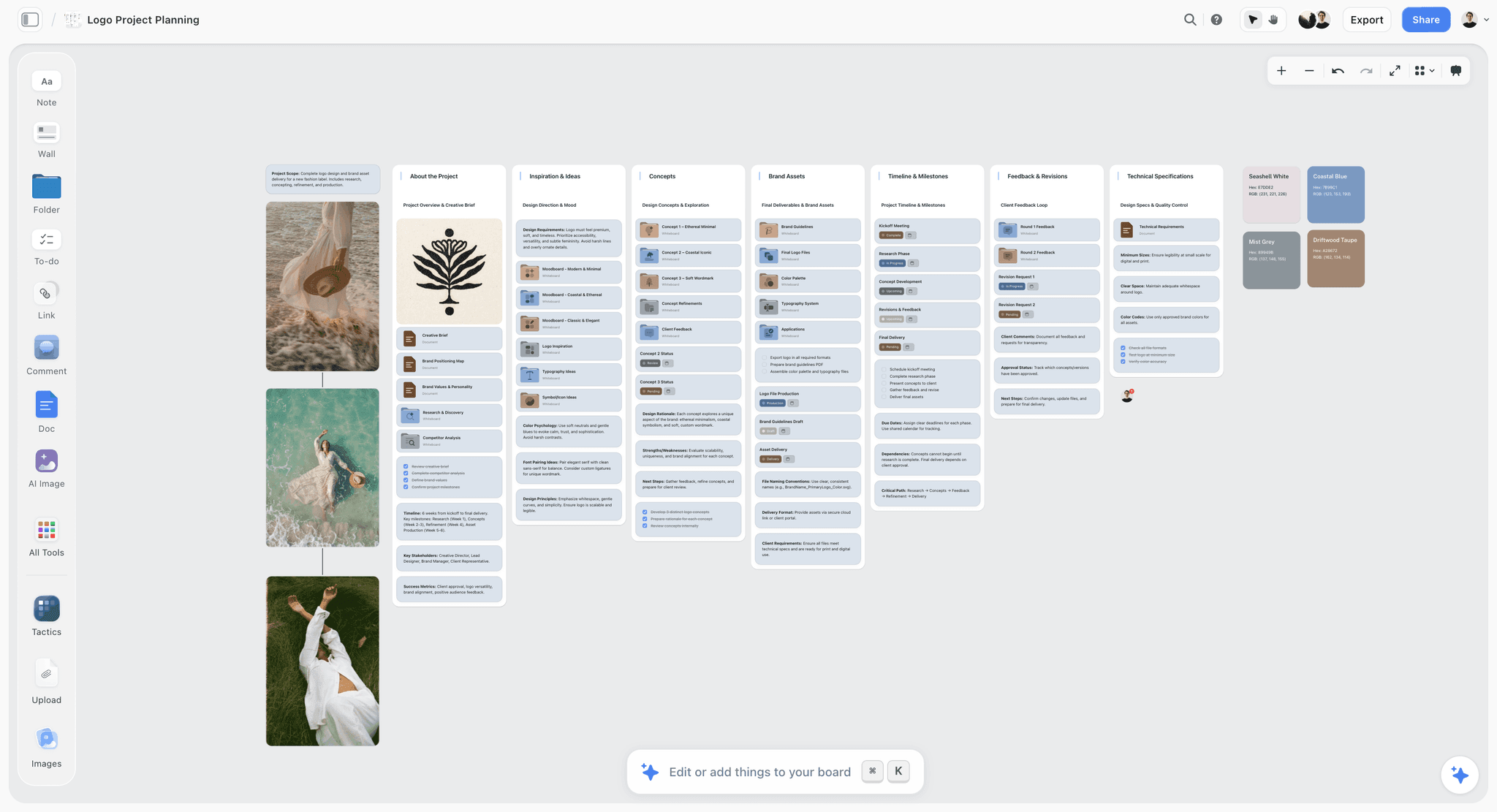
Storyflow gathers nothing. It is on this list for the step that decides whether any of the gathering was worth it: holding the commitment map, with a row per competitor, a column per commitment, the evidence behind each entry, and what you intend to do about it. Because it is a canvas you see the whole board at once, which is how you notice that three competitors share the same commitment and the space they all leave open. The AI reads the whole board, so it can be asked which of your own plans depends on a competitor not doing something they have already committed to.
Best for: Turning gathered competitive data into something a decision can use.
Verdict: A complement to the data tools and no substitute for any of them. Take Semrush or Perplexity for the gathering.
Key features
- Infinite canvas holding the map, the evidence and the implications together.
- AI reads the whole current board, plus 5 attached documents and 3 attached boards.
- Anyone a paid member invites to a board joins free, including stakeholders.
- 200+ story blueprints including positioning frameworks.
Pricing
Early access: every plan is paid for now. A Free plan arrives before the end of 2026, and anyone a paid member invites to a board can sign up free and collaborate today. Plus: $7.99/mo annual, $9.99/mo monthly. Unlimited boards and uploads. Pro: $14/mo annual, $19/mo monthly. AI image generation, more AI usage, memory across conversations. Max: $39/mo annual, $49/mo monthly. Team workspace with roles and permissions.
Pros
- Seeing every competitor at once reveals shared commitments and the space they leave.
- Evidence sits beside each claim, which stops internal myths forming.
- Cheapest tool here, priced per account.
Cons
- No data gathering of any kind.
- No monitoring, alerting or continuous feed.
- Paid-only during early access.
7. Claude
Claude is the best tool here for reading a pile of competitor material properly: paste their pricing page, their documentation, their recent announcements and their job postings, and ask what they have committed to. Long context means it engages with all of it rather than summarising each piece.
Best for: Reasoning across everything you have gathered about one competitor.
Verdict: The best analysis partner here. It knows only what you paste, so the quality of the reading depends on the quality of the gathering.
Key features
- Long context for whole documents and pages at once.
- Projects for keeping standing competitor context.
- Strong at extracting implications rather than summarising.
Pricing
Free with daily limits. Paid from about $17/month billed annually.
Pros
- Genuinely good at inferring commitments from public material.
- Handles a large messy pile without flattening it.
- Free tier does real work.
Cons
- Will speculate about competitor internals if you let it.
- Knows nothing you do not supply.
- No monitoring or data of its own.
8. SparkToro
SparkToro shows where a competitor's audience actually spends attention: which publications, podcasts, accounts and communities. For understanding how a competitor is really acquiring attention, it reveals things traffic data does not.
Best for: Audience overlap and where a competitor's attention is earned.
Verdict: The most distinctive data on this list. Narrow, and it describes behaviour rather than motive.
Key features
- Audience attention across social, podcasts and publications.
- Audience overlap between brands.
- Free tier with limited searches.
Pros
- Answers a question no other tool here answers.
- Directly actionable for media and partnerships.
- Free tier is enough to evaluate honestly.
Cons
- Thinner coverage in smaller and non-English markets.
- Narrow: attention only.
- Paid tiers are volume limited.
9. G2
G2 is free and consistently produces the highest signal per hour in this category, provided you read it correctly: ignore the five-star reviews, read the two and three-star ones, and look for the same complaint repeated. Repeated complaints are constraints, and constraints are commitments.
Best for: Finding out what a competitor's customers cannot get from them.
Verdict: The best free source of genuine constraint information. Reviews skew positive and are partly vendor-solicited, so read the middle.
Key features
- Customer reviews with structured categories.
- Comparison pages between products.
- Free to read without an account for most content.
Pros
- Free, and customer-written rather than vendor-written.
- Repeated mid-star complaints reveal real constraints.
- Comparison pages show how buyers frame the choice.
Cons
- Review solicitation skews the distribution positive.
- Coverage is thin outside established software categories.
- Individual reviews are unreliable; patterns are not.
10. Crayon
Crayon is a competitive intelligence platform that monitors competitors continuously across web, social, pricing and messaging, and routes what matters to the teams who need it. For an organisation where competitive intelligence is somebody's job, it consolidates a lot.
Best for: Companies with a staffed competitive intelligence function.
Verdict: The most complete monitoring platform here. Quote-only and sized well beyond a small team.
Key features
- Continuous monitoring across many competitor surfaces.
- AI summarisation of detected changes.
- Battlecards and distribution to sales.
Pricing
No public pricing; enterprise quote on an annual contract.
Pros
- Genuinely continuous across many surfaces at once.
- Routes intelligence to the people who act on it.
- Reduces the manual monitoring burden substantially.
Cons
- Quote-only with an annual commitment.
- Needs an owner or it becomes an unread feed.
- Far oversized below enterprise scale.
11. Klue
Klue is competitive enablement for sales: battlecards that update, delivered where reps work, with feedback from the field flowing back. Its focus is winning individual deals rather than informing strategy.
Best for: Sales teams losing deals to named competitors.
Verdict: The best sales enablement here. It is a deal tool rather than a strategy tool.
Key features
- Dynamic battlecards in the CRM and in Slack.
- Win-loss and field intelligence capture.
- Competitor monitoring feeding the cards.
Pricing
No public pricing; enterprise quote.
Pros
- Gets competitive information to reps at the moment of need.
- Field feedback keeps cards honest.
- Measurable effect on competitive win rate.
Cons
- Quote-only, and needs a sales team to justify it.
- Oriented to deals rather than to positioning.
- Requires ongoing content maintenance.
12. Wappalyzer
Wappalyzer detects the technology a competitor's site and product run on. That is a narrow signal and a genuinely commitment-revealing one: a stack is expensive to change, and it constrains what a company can ship next.
Best for: Understanding architectural and vendor commitments.
Verdict: Narrow and unusually honest about what it tells you. Architecture is a commitment, which is why it earns a place.
Key features
- Technology detection across web properties.
- Bulk lookups and change alerts on paid tiers.
- Browser extension for ad-hoc checks.
Pricing
Free tier with limited lookups. Paid from about $30/month.
Pros
- Reveals commitments that are invisible in marketing.
- Free extension is enough for occasional checks.
- Useful for partnership and integration decisions.
Cons
- Only detects what is publicly visible on the front end.
- Says nothing about strategy or customers.
- Narrow enough that few teams need the paid tier.
7) Why the Feature Matrix Never Changes a Decision
A competitor deck is produced, presented, and nothing happens. This is the standard outcome in this category and it has three causes worth separating.
It answers a question nobody asked. Most competitive analysis begins with "let's understand the landscape", which is not a decision. Analysis that starts from a decision, such as whether to change pricing, which segment to enter, or how to respond to a specific competitor's move, produces something usable because the criteria for relevance are obvious. Analysis that starts from curiosity produces a survey.
The output is comparative rather than directive. A matrix shows that they have a thing you do not. It does not say whether the thing matters, whether their customers use it, or whether building it would win you anything. The implicit suggestion, that the gaps are the roadmap, is how a product becomes the average of its category, and it is the most common strategic damage this artifact does.
It has no shelf life and no owner. A competitor study is a project, completed and filed. Three months later the pricing has changed and nobody knows, because monitoring was not part of the deliverable. Then the next study starts from scratch.
What actually gets used, from the three exercises tested:
- One page, not twenty. A commitment map with a row per competitor and four or five columns fits on a page and gets read. A forty-slide deck gets skimmed once.
- Evidence attached to every claim. An unsourced statement about a competitor becomes an internal fact within weeks, and internal facts about competitors are wrong surprisingly often. Link the pricing page, quote the review, date the observation.
- A "so what" column. Every row states what it means you could do. Rows without one are knowledge, not intelligence.
- A standing feed rather than a project. Three or four page monitors and a monthly fifteen-minute review beat an annual study, cost about $13, and are the part almost nobody sets up.
And the sharpest test: ask what you would have done differently if the analysis had said the opposite. If the answer is nothing, the analysis was decoration.
8) The Five Signals Worth Monitoring Continuously
Continuous beats periodic here, and the useful continuous signals are few and cheap.
1. The pricing page. The highest-value single page to watch. A change in price, in the model, in what is included at each tier, or in what is quietly removed tells you more about their strategy than any announcement. Set a monitor.
2. The careers page. The most underused leading indicator in competitive analysis. Five senior engineers hired into one area means a bet is being made six to twelve months before it ships. A first enterprise sales hire means a move upmarket. A first support hire in a new region means a market entry.
3. The changelog or release notes. What they actually ship, at what cadence, in which areas. The pattern over three months reveals priorities that a roadmap page never states honestly.
4. Their mid-star reviews. Two and three-star reviews on G2 or similar, read for repetition. A complaint that appears fifteen times is a constraint, and constraints are commitments. This is free and most teams never do it.
5. Their positioning language, specifically the homepage headline. Companies change this rarely and deliberately. A headline change is a repositioning, and it frequently precedes a product or pricing shift by a quarter.
What is not worth monitoring continuously, despite being commonly tracked: their social output, their blog cadence, their conference presence and their funding announcements. All are visible, none is a commitment, and all generate noise that trains people to ignore the feed.
The practical setup costs about $13 a month. Four Visualping monitors on pricing, careers, changelog and homepage, an alert into a channel, and a fifteen-minute review monthly where anything meaningful gets added to the commitment map with a date and a link. That is a more useful competitive intelligence practice than most teams achieve with a platform.
9) Recommended Competitor Analysis Stacks
Stack 1: Small team, doing this properly. Visualping (monitoring) + Perplexity free (landscape) + G2 free (complaints) + Storyflow (the map). About $21/month.
Stack 2: Marketing team with a budget. Semrush (data) + Visualping (monitoring) + Storyflow (the map) + Claude (analysis). About $178/month.
Stack 3: Product-led company. Ahrefs (content gaps) + Wappalyzer (architecture) + G2 free + Storyflow. About $167/month.
Stack 4: Enterprise with a CI function. Crayon or Klue + Semrush + Similarweb. Quote-based.
Stack 5: Zero budget. Perplexity free + G2 free + Visualping free tier + Claude free + a spreadsheet for the map. Genuinely zero and better than most paid setups that nobody acts on.
| Team shape | Gathers with | Monitors with | Holds the map in | Monthly cost |
|---|---|---|---|---|
Small team | Perplexity free, G2 | Visualping | Storyflow | about $21 |
Marketing with budget | Semrush, Claude | Visualping | Storyflow | about $178 |
Product-led | Ahrefs, Wappalyzer, G2 | Visualping | Storyflow | about $167 |
Enterprise CI function | Semrush, Similarweb | Crayon or Klue | Crayon | quote |
Zero budget | Perplexity free, G2 | Visualping free | A spreadsheet | $0 |
The pattern across all five: one gathering source, one continuous monitor, one place the map lives. Teams that buy two expensive data platforms and no monitor have the least actionable setup of any configuration tested.
10) What Competitive Intelligence Costs
The subscriptions, which are top-heavy. Semrush and Ahrefs both start around $130 to $140 before seats, and the enterprise platforms are annual contracts. Meanwhile the highest-yield tools here cost about $13 or nothing. Most teams have the ratio backwards.
The analyst time, which is the real cost. A proper landscape study is three to five days. Continuous monitoring, done well, is about fifteen minutes a month plus alert triage. The second produces more decisions per hour than the first by a wide margin, and almost every team buys the first shape.
The analysis nobody uses, which is the largest waste in this category. A study that produces no decision cost the full amount and returned nothing, and it is the normal outcome, for the reasons in section 7.
And a real risk worth naming: over-indexing on competitors. Teams that watch competitors closely tend to build toward them, which produces convergence. The commitment map is partly a defence against this, because it is explicitly about what they *cannot* do rather than what they have.
| Cost driver | Where it lands | Rough size | The move |
|---|---|---|---|
Data subscriptions | Monthly | $130 to $300+ | Buy one, not two |
Analyst time | 3 to 5 days per study | The largest line | Prefer 15 minutes monthly over an annual study |
Unused analysis | Invisible | The whole exercise | Start from a decision, not from curiosity |
Convergence | Strategic | Unmeasurable and real | Map what they cannot do, not what they have |
11) Honorable Mentions
- BuiltWith. Wappalyzer's closest rival for technology detection.
- SEMrush's Traffic Analytics and Similarweb free tier. Both fine for a rough size check without a contract.
- Glassdoor and Blind. Employee signals about internal priorities and morale, read carefully.
- Crunchbase and PitchBook. Funding and stage, which is a commitment in the section 3 sense.
- Their own documentation and API reference. Underrated: what a product can actually do is in the docs, not the marketing.
- Their job descriptions, read closely. Frequently the most specific statement of strategy a company publishes.
- Talking to customers who evaluated both of you. The highest-signal source in existence and the least systematised.
12) Competitor Analysis Habits to Avoid
- Starting from "let's understand the landscape". That is curiosity rather than a decision, and it produces a survey nobody uses.
- A feature matrix as the deliverable. It implies the gaps are the roadmap, which builds you into the category average.
- Treating traffic estimates as precise. Direction and relative scale are useful; the absolute number is not.
- An annual study with no monitoring. Stale within a quarter, and the next one starts from scratch.
- Unsourced claims about competitors. They become internal facts within weeks and are wrong more often than anyone expects.
- Watching everything. Social posts, blog cadence and conference presence are visible, not consequential, and the noise trains people to ignore the feed.
- Building toward competitors. The convergence risk, and the reason to map what they cannot do rather than what they have.
14) The Bottom Line
The best competitor analysis tools in 2026 are Semrush for broad defensible data, Similarweb for channel mix, Perplexity for a fast sourced landscape, Ahrefs for backlinks and content gaps, and Visualping for the continuous signal that most teams skip and that costs about $13 a month.
A feature matrix has never changed a decision. Features are visible, changeable and copyable in both directions. Commitments, meaning the pricing model, the chosen customer, the architecture, the public promise and the funding stage, are slow and expensive to reverse, which is exactly what makes them something you can position against.
Start from a decision rather than from curiosity, attach evidence to every claim, and keep the map on one page where it can be read. Put a row per competitor and a column per commitment on one canvas and look for the commitment all of them share, because that is the space none of them can enter.
FAQ: Competitor Analysis Tools
What is the best competitor analysis tool in 2026?
Semrush is the best all-round competitor analysis tool for teams needing defensible numbers on search, content and paid activity, from about $140/month. Similarweb is stronger for traffic and channel mix, Ahrefs for backlinks and content gaps, and Perplexity free is the fastest way to build a sourced picture of an unfamiliar market. The highest value per pound in the category is Visualping at about $13/month watching a competitor's pricing and careers pages, which most teams never set up.
What should a competitor analysis actually produce?
A commitment map rather than a feature matrix: a row per competitor, columns for their pricing model, their chosen customer, their architecture, their public promises and their funding stage, with evidence linked to each entry and a column saying what it means you could do. Commitments are slow and expensive to reverse, which is what makes them attackable; features change and can be copied in both directions.
Is there a free competitor analysis tool?
Yes, and a zero-cost setup is genuinely good: Perplexity free for the landscape scan with sources, G2 free for reading what customers complain about, Visualping's free tier monitoring three or four critical pages, and Claude free to reason across what you gather. Storyflow is paid-only during early access and gathers no data in any case; its Free plan arrives before the end of 2026.
Semrush or Ahrefs for competitor analysis?
Semrush if you want the broadest coverage in one subscription, including paid search history and market overview tooling. Ahrefs if backlinks and content gaps are your main question, where its data is generally stronger. They overlap heavily and cost similar amounts, so own one rather than both, and spend the difference on continuous monitoring.
How often should you do a competitor analysis?
Continuously rather than periodically. An annual study is stale within a quarter and the next one restarts from nothing. Four page monitors and a fifteen-minute monthly review produce more usable decisions than a three-day study, cost about $13 a month, and keep the commitment map current instead of letting it decay.
What is the most useful thing to monitor about a competitor?
Their pricing page, then their careers page. Pricing reveals the model they are committed to and any change to it is strategically loud. Job postings are the best leading indicator available: five senior hires into one area means a bet is being made six to twelve months before anything ships, and a first enterprise sales hire means a move upmarket.
How do I analyse a competitor's pricing?
Look at the model rather than the number. Per seat, per usage, flat, or tiered by capability each constrain who they can serve: a per-seat competitor struggles with teams where most people only read, a usage-priced one struggles with customers needing budget predictability. The model is expensive to change because it means repricing an existing base, which is why it is the most exploitable commitment in most markets.
Can AI do competitor analysis?
It does the gathering and the reading well and the deciding badly. Perplexity compresses a day of research into minutes with sources, and Claude will read a competitor's pricing page, docs and job postings and infer what they have committed to. What it cannot do is know which of those commitments matters to your situation, and it will speculate about competitor internals if you let it, so keep it to public evidence.
What is a competitive battlecard and do I need one?
A one-page brief giving sales what to say against a named competitor: their strengths, their real weaknesses, the traps to set and the objections to expect. You need them once you are losing identifiable deals to identifiable competitors. Klue does this at scale; below that a shared document updated after every lost deal works fine, and the win-loss notes matter more than the format.
How do I find out why customers choose a competitor?
Talk to people who evaluated both of you and chose them, which is the highest-signal source in existence and the least systematised. Failing that, read their two and three-star reviews for repeated complaints, which reveal constraints, and read their five-star reviews for what people actually value, which is frequently not what either of you emphasises in marketing.
How many competitors should I track?
Three to five closely, and a longer list loosely. Tracking fifteen produces a feed nobody reads and a map nobody updates. The three to five should be the ones you actually lose deals to, which is often not the ones you consider your peers; the companies you benchmark against and the companies you lose to are frequently different sets.
Should I tell my team what competitors are doing?
Selectively, and always with the implication attached. Raw competitor news circulated without interpretation causes reactive work and convergence: someone builds the thing because the competitor has it. Share the commitment and what it means you could do, not the feature and the anxiety.
What is the cheapest useful competitive setup?
About $21 a month: Visualping at roughly $13 monitoring pricing, careers, changelog and homepage, plus somewhere to hold the commitment map. Add Perplexity and G2 free for gathering. That combination is continuous, actionable and costs less than a tenth of a single data platform seat.
Table of Contents
- Article Metadata
- Breadcrumb
- Table of Contents
- 1) Quick Answer: The Best Competitor Analysis Tools in 2026
- All 12 Competitor Analysis Tools, Ranked
- 2) Comparison Table: 12 Competitor Analysis Tools at a Glance
- Frequently Asked: Which Competitor Tools Teams Trust, and Which Produce Reports Nobody Uses
- 3) The Commitment Map
- 4) How We Evaluated These Tools
- 5) Quick Picks by Competitive Question
- 6) Detailed Reviews: 12 Competitor Analysis Tools
- 7) Why the Feature Matrix Never Changes a Decision
- 8) The Five Signals Worth Monitoring Continuously
- 9) Recommended Competitor Analysis Stacks
- 10) What Competitive Intelligence Costs
- 11) Honorable Mentions
- 12) Competitor Analysis Habits to Avoid
- 14) The Bottom Line
- 15) Author
- 16) Related Reading
- FAQ: Competitor Analysis Tools
Templates to check out for this topic


Templates you can use in Storyflow
Every Storyflow board starts from real structure and an AI that reads the whole canvas. Open one of these templates and make it yours.


See Storyflow in Action
A visual AI workspace where every feature lives inside one canvas. No tab-switching, no context lost.
Build your entire board from a single message
Type what you need in the AI chat at the bottom of your canvas. The AI adds cards, headings, and structure directly onto your board.
Use expert frameworks as AI context
Type @ in the AI chat and choose any Tactic. The AI tailors every response to that framework instead of giving generic advice.
Turn your board into a mind map in seconds
Ask the AI to restructure your canvas as a mindmap. It connects your ideas into a visual hierarchy so you can see how everything relates.
Why Storyflow Exists
Storyflow actually began as a personal tool while working on creative and research projects.
We kept running into the same problem: ideas were scattered everywhere: notes, documents, and whiteboards.
Nothing helped us see how everything connected.
So we started building a workspace designed around how ideas actually grow.
→ Read how Storyflow was createdStoryflow Team
Product & Research Team
Published: 2026-09-22
Extremely simple, seriously capable


See how easy it is to get started
Watch a real project come together, from a blank board to a finished plan, clicked through step by step.
Start creating with AI and become more productive
Transform your creative workflow with AI-powered tools. Generate ideas, create content, and boost your productivity in minutes instead of hours.