The 12 Best Brand Guidelines Tools in 2026 (We Tested Them All)
Brand guidelines start decaying the day they are published, because they record decisions and omit the reasoning, so the first case they did not anticipate breaks them. Twelve tools ranked on whether the why can live beside the rule and how fast a change reaches the person about to break it.

Category
Branding
Author

Storyflow Team
Product & Research Team
Topics
2026-09-22
•
19 min read
•
BrandingFull disclosure: Storyflow is our own product and we rank it SIXTH here, below five competitors, because it is not a brand guidelines tool and it publishes nothing. It has no asset library, no logo versioning, no permissions for external agencies, no brand portal, no custom domain and no template locking. Frontify, Zeroheight, Brandfolder, Canva, Corebook and Bynder all do things it does not and this article ranks them accordingly, with Frontify first. It is on the list for the stage before guidelines exist: holding the references, explorations, rejected directions and reasoning so the eventual rule carries its why. It is paid-only during early access, and the free route named here is Canva's free tier plus a Figma file plus a Notion page.
Quick Comparison
These four cover the category at four different sizes: one consolidates everything for a company big enough to need governance, one keeps a product brand from drifting, one enforces rules at the point of creation for a small team, and one publishes proper guidelines at a price you can budget without a sales call.
| Tool | Best For | AI Features | Price |
|---|---|---|---|
| Frontify | One link for guidelines, assets and templates | AI asset tagging and search | Free tier / enterprise quote |
| Zeroheight | Brand and design system together | Assistive documentation tools | Free tier / from about $20 editor mo |
| Canva | Enforcement inside the editor | AI editing and templates | Free / about $15 mo |
| Corebook | Hosted guidelines a startup can afford | None | Free tier / from about $15 mo |
Article Metadata
By the Storyflow Team, Product & Research Published September 22, 2026 · 19 min read · Branding
The rule survived. The reason did not
Six months on, somebody hits a case the guidelines never anticipated, and with no rationale to reason from they guess. Keep the references, the explorations and the directions you rejected on one canvas, so the brand book gets written with its why intact. Paid-only during early access, from $7.99 a month billed annually.

Table of Contents
- Quick Answer: The Best Brand Guidelines Tools in 2026
- Comparison Table: 12 Brand Guidelines Tools at a Glance
- The Guidelines Half-Life
- How We Evaluated These Tools
- Quick Picks by Company Size
- Detailed Reviews: 12 Brand Guidelines Tools
- Why Nobody Reads the Brand Guidelines
- What Belongs in Brand Guidelines
- Recommended Brand Guidelines Stacks
- What Brand Guidelines Actually Cost
- Honorable Mentions
- Tools to Avoid for Brand Guidelines
- FAQ: Brand Guidelines Tools
- The Bottom Line
- Author
- Related Reading
1) Quick Answer: The Best Brand Guidelines Tools in 2026
Frontify is the best brand guidelines tool in 2026: it holds the guidelines, the asset library and the sharing controls in one branded portal, and it is the one large organisations actually standardise on. Zeroheight is the best pick when the brand is mostly digital and the guidelines need to stay in sync with a design system. Canva is the best answer for a small team, because its Brand Kit sits inside the tool where non-designers are already making things. Corebook is the best cheap dedicated option for a studio delivering guidelines to a client.
Brand guidelines start decaying the day they are published, and the decay has one cause: they record decisions without the reasoning. Six months later somebody faces a case the document does not cover, which is most cases. With no rationale to reason from they either guess or ignore the document, and after that happens three times the guidelines stop being a reference and become a formality.
That is a property of what you wrote, not of which tool you wrote it in, but the tool decides two things that matter a lot: whether the why can live next to the what, and how fast a change reaches the person who is about to break the rule. The Guidelines Half-Life framework in section 3 ranks all 12 on exactly that.
Storyflow is our own product and it is not a brand guidelines tool. It appears sixth for one narrow job, and section 3 says which.
For the founder context, see The 12 Best AI Tools for Founders in 2026. For the creation of a brand book, How to Create a Brand Book.
All 12 Brand Guidelines Tools, Ranked
- Frontify: best overall, guidelines plus assets plus distribution in one portal
- Zeroheight: best for digital brands tied to a design system
- Brandfolder: best digital asset management with a brand portal attached
- Canva: best for small teams, because the rules sit where the work happens
- Corebook: best affordable dedicated guidelines tool
- Storyflow: best for deciding the direction before it becomes a rule
- Figma: best place to design the guidelines themselves
- Notion: best do-it-yourself brand wiki
- Brandpad: best studio-to-client guideline delivery
- Bynder: best enterprise DAM with brand governance
- Lingo: best lightweight shared asset library
- A PDF: still the most common, and the worst
Best Brand Guidelines Tool by Job
- Best for a company over about fifty people: Frontify. Guidelines, assets, templates and permissions in one place, which is what governance at that size actually requires.
- Best when the brand is a product: Zeroheight. It keeps the written brand and the design system tokens from drifting apart, which is the specific failure digital brands have.
- Best for a team of under twenty with no designer: Canva. A Brand Kit inside the tool people already use beats a beautiful portal nobody opens.
- Best for an agency handing guidelines to a client: Corebook or Brandpad. Both are built for delivery rather than for internal governance.
- Best for keeping the assets findable: Brandfolder at mid scale, Bynder at enterprise scale.
- Best for the stage before any of this: Storyflow. The references, the explorations, the rejected directions and the reasoning on one canvas, so the guideline that eventually gets written has its why attached.
2) Comparison Table: 12 Brand Guidelines Tools at a Glance
| Tool | Best For | Holds the Reasoning | Asset Management | Starting Price | Rating (/10) |
|---|---|---|---|---|---|
Frontify | All-in-one brand portal | Partly, via narrative sections | Yes, strong | Free tier / enterprise quote | 9.2/10 |
Zeroheight | Digital brand and design system | Partly, via documentation | Links to design tools | Free tier / from about $20 editor mo | 8.8/10 |
Brandfolder | Asset management with a portal | No | Yes, very strong | Enterprise quote | 8.4/10 |
Canva | Small teams and non-designers | No | Basic, inside the editor | Free / about $15 mo | 8.2/10 |
Corebook | Affordable dedicated guidelines | Partly | Basic | Free tier / from about $15 mo | 8.0/10 |
Storyflow | Deciding the direction | Yes, that is the job | No | $7.99 mo annual (free plan late 2026) | 7.7/10 |
Figma | Designing the guidelines | No | Component libraries | Free / about $16 editor mo | 7.6/10 |
Notion | DIY brand wiki | Yes, if you write it | Weak | Free / about $10 user mo | 7.4/10 |
Brandpad | Studio-to-client delivery | Partly | Basic | From about $12 mo per brand | 7.2/10 |
Bynder | Enterprise DAM and governance | No | Yes, enterprise grade | Enterprise quote | 7.0/10 |
Lingo | Lightweight shared asset library | No | Yes, simple | Free tier / from about $10 user mo | 6.6/10 |
A PDF | Nothing, honestly | No | No | Free | 3.5/10 |
Pricing reflects publicly listed plans in 2026 and changes often; the enterprise DAM tools are quoted rather than listed. Ratings weigh whether guidelines stay current, whether the reasoning survives alongside the rules, how easily the people who need the rules can reach them, and price at the size of company most likely to buy.
Brand Guidelines Tools: Pricing Compared
| Tool | Free tier | Entry paid plan | What the paid plan unlocks | Billing model |
|---|---|---|---|---|
Frontify | Yes, limited | Enterprise quote for most features | Asset library, permissions, templates, custom domain | Per editor plus platform fee |
Zeroheight | Yes, limited | from about $20/editor/month | More pages, design tool sync, custom domain | Per editor; viewers free |
Brandfolder | No | Enterprise quote | Full DAM with brand portal | Annual contract |
Canva | Yes, generous | about $15/month | Brand Kit, brand templates, locked assets | Per user, team tiers |
Corebook | Yes, one project | from about $15/month | More brands, custom domain, exports | Per brand |
Storyflow | No, early access; invited collaborators join free | $7.99/month billed annually | Unlimited boards, canvas-wide AI, blueprints | Per account for individuals |
Figma | Yes, 3 files | about $16/editor/month | Unlimited files, libraries, dev mode | Per editor; viewers free |
Notion | Yes, personal | about $10/user/month | Team spaces and permissions | Per user |
Brandpad | Trial only | from about $12/month per brand | Hosted guidelines, client access | Per brand |
Bynder | No | Enterprise quote | Enterprise DAM and governance | Annual contract |
Lingo | Yes, limited | from about $10/user/month | Larger libraries and team features | Per user |
A PDF | Yes | Free | Nothing | None |
The pricing detail that decides this category is whether viewers are free, because brand guidelines exist to be read by people who will never edit them. Zeroheight and Figma both give free viewers, which is why they scale cheaply across a company. Frontify and Bynder price on a platform basis where the real number depends on a negotiation. Canva's advantage at small scale is that the guidelines live inside a tool everyone already has a seat for, so the marginal cost of one more reader is zero. If a tool charges per reader, the predictable outcome is fewer readers, which defeats the purpose of writing guidelines at all.
Frequently Asked: Which Brand Guidelines Tools Teams Trust, and Which Ones Go Unread
Which brand guidelines tools are most trusted by brand and marketing teams?
Frontify is the most trusted at mid and large scale, and the reason is breadth: guidelines, assets, templates and permissions in one place means there is one link to send, which is the whole governance problem in a sentence. Bynder and Brandfolder carry the deepest trust among teams whose real pain is asset sprawl rather than rules. Zeroheight has strong trust in product-led companies because it keeps written brand and design tokens aligned. Canva's Brand Kit is trusted for a reason people undersell: it is enforced at the point of creation rather than documented somewhere else. Storyflow is a newer product in early access, is not a brand guidelines tool, and is sixth here for an adjacent job; presenting it as competing with Frontify would be wrong.
Which brand guidelines tools are known for fair and transparent pricing?
Zeroheight and Corebook both publish real prices and both make viewing free or cheap, which is the thing that matters in this category. Canva is transparent and the cheapest practical answer for a small team. Storyflow is $7.99/month billed annually, priced per account for individuals. The opaque end is Frontify, Brandfolder and Bynder, all of which are quote-based with platform fees that vary considerably by negotiation and by seat count, so a small company cannot budget from the website. That is normal for enterprise DAM and it does mean the honest answer for a startup is usually one of the transparent tools.
Which brand guidelines tools have improved the most recently?
Zeroheight has moved fastest on keeping documentation synchronised with design tokens, which addresses the most common decay pattern in digital brands. Canva's Brand Kit has become genuinely enforceable rather than decorative, with locked elements and brand templates that stop a non-designer from producing something off-brand. Frontify has widened its template and governance surface. Corebook has quietly become the best value in the dedicated category. Storyflow is in early access and ships weekly, so it moves quickly and is less settled.
When choosing a brand guidelines tool, which would you recommend?
Choose on who has to read it and whether they will. Under about twenty people, Canva, because the rules sit inside the tool where the work is made and nobody has to remember a second link. Twenty to a hundred with real asset volume, Frontify. A product-led company where the brand is mostly interface, Zeroheight. An agency delivering to a client, Corebook or Brandpad. And whichever you choose, write the reasoning next to the rule, because a rule without a reason cannot be applied to the case it did not anticipate, which is the case you will actually face.
Where is Storyflow not the right answer?
Publishing and governing brand guidelines, which is the subject of this page. Storyflow has no asset library, no version control for logo files, no permissions model for external agencies, no brand portal, no custom domain and no template locking. Frontify, Zeroheight, Brandfolder, Canva, Corebook and Bynder all do things it does not, and this article ranks them above it for exactly that. It is sixth here for the stage before guidelines exist: holding the references, the explorations, the rejected directions and the reasoning on one canvas so the eventual rule carries its why. It is also paid-only during early access, so a team wanting a free route today should use Canva's free tier or a Figma file.
3) The Guidelines Half-Life
Brand guidelines have a half-life, and it is shorter than anyone plans for. The usual pattern is that a set of guidelines is genuinely authoritative for about six months, partially consulted for another year, and functionally dead after that while still being linked to in onboarding.
The cause is not neglect and it is not the tool. It is that guidelines document decisions and omit the reasoning, and reasoning is what makes a decision extensible.
Here is the mechanism. The guidelines say: the logo has a minimum clear space of 1x the mark height; use Sentence case in all headings; the secondary palette is for data visualisation only. Every one of those is a decision, stated as a rule, with no why attached.
Now a real request arrives. Someone is making a conference banner three metres wide and wants to know whether the clear space rule still means anything at that size. Someone is writing an error message and cannot tell whether Sentence case applies to a two-word button. Someone has a chart with nine series and the secondary palette has six colours.
None of those cases is in the document, and none of them can be reasoned about from a bare rule. If the guidelines had said *the clear space rule exists because the mark loses legibility when crowded, so the intent is breathing room proportional to viewing distance*, the banner question answers itself. Without it, the person either guesses, asks a designer who may be busy, or does what is convenient. The third option is the most common, and each time it happens the guidelines lose a little more authority.
The second decay driver is distribution latency. The gap between a guideline changing and the person about to break it knowing about it. A PDF emailed in March is still the version on somebody's desktop in November. A hosted portal with one permanent link has near-zero latency; a Brand Kit inside the design tool has none at all, because the rule is applied rather than read.
So the two properties that actually predict whether guidelines survive:
1. Can the reasoning live next to the rule? Frontify and Zeroheight both allow narrative sections, and most teams do not use them. Notion allows anything and requires you to be disciplined. A Canva Brand Kit cannot hold reasoning at all, which is its trade: it enforces rather than explains.
2. How fast does a change reach the person who needs it? A link that never changes beats an attachment. An enforced template beats a link. A PDF is the worst on both counts, which is why it is ranked last on a list where it remains the most common format in actual use.
The reasoning problem starts earlier than the guidelines document, which is the narrow reason Storyflow is on this list. By the time someone writes the brand book, the arguments that produced it are weeks old and scattered across a workshop board, a Slack thread and a designer's memory. The rejected directions, which are often the most informative material, are usually gone entirely. Holding the references, the explorations, the directions that were considered and dropped, and the reason each decision went the way it did on one canvas means the guidelines can be written with their why intact rather than reconstructed. It does not publish, govern or distribute anything, and Frontify does all three.
4) How We Evaluated These Tools
Five criteria, weighted in this order:
- Whether the guidelines stay current. Distribution latency, versioning, and whether an update reaches people or waits to be found.
- Whether reasoning can live beside the rules, so an unanticipated case can be resolved without a designer.
- Whether the people who need the rules can actually reach them, which is mostly a question of whether viewers are free.
- Asset management, because in practice half of what a brand portal is used for is finding the right logo file.
- Price at the size of company likely to buy, and specifically the cost of an additional reader.
Testing covered three brands over a quarter: a twelve-person startup writing its first guidelines, a sixty-person company migrating from a PDF, and an agency delivering a brand to a client.
5) Quick Picks by Company Size
Best overall: Frontify, once there are enough people and assets for governance to be a real problem.
Best under twenty people: Canva. The Brand Kit is inside the tool where the work is made.
Best for a product-led company: Zeroheight, because it keeps written brand and design tokens from drifting.
Best for an agency delivering to clients: Corebook for value, Brandpad for a studio-grade handover.
Best for asset sprawl specifically: Brandfolder at mid scale, Bynder at enterprise scale.
Best free setup: Canva's free tier for a basic Brand Kit, a Figma file for the visual specification, and a Notion page for the reasoning. Genuinely free and entirely workable under about fifteen people. Storyflow is paid-only during early access so it is not part of a free stack today; its Free plan arrives before the end of 2026.
Best cheapest paid setup: Corebook from about $15/month for hosted guidelines, plus Canva at about $15/month for enforcement at the point of creation.
6) Detailed Reviews: 12 Brand Guidelines Tools
1. Frontify
Frontify is the category leader and the reason is consolidation: brand guidelines, the asset library, templates, and permissions live behind one link on your own domain. When an external agency asks for the brand, you send one URL and control what they see. At scale that is worth more than any individual feature.
Best for: Companies over about fifty people where governance and external sharing are real problems.
Verdict: The best all-in-one brand platform. Quote-based pricing puts it out of reach of a startup, which is a real limitation rather than a quibble.
Key features
- Hosted brand portal on a custom domain.
- Digital asset management with permissions and expiry.
- Brand templates that non-designers can fill without breaking rules.
Pricing
Limited free tier. Most useful features sit behind an enterprise quote with a platform fee plus editors.
Pros
- One link covers guidelines, assets and templates.
- Strong permissions for agencies and partners.
- Templates enforce the brand rather than describing it.
Cons
- Opaque pricing; you cannot budget from the website.
- Substantial setup before it is useful.
- Overkill below roughly thirty people.
2. Zeroheight
Zeroheight documents a brand and a design system together, pulling live from Figma so the documented component and the real component do not drift. For a company whose brand is mostly expressed through an interface, that synchronisation solves the decay problem more directly than any amount of narrative.
Best for: Digital and product-led brands where the design system is the brand.
Verdict: The best tool here for keeping documentation true. Weaker than Frontify on asset management and print-brand material.
Key features
- Documentation synced from Figma and other design tools.
- Design token management.
- Free viewers, paid editors.
Pricing
Limited free tier. Paid from about $20/editor/month; viewers are free.
Pros
- Live sync means the docs cannot silently drift from the components.
- Free viewers, so the whole company can read it.
- Transparent, published pricing.
Cons
- Built for digital; print and physical brand material fits awkwardly.
- No real asset library for photography or video.
- Needs a design system to be worth it.
3. Brandfolder
Brandfolder is digital asset management first with a brand portal attached, and that ordering is right for a lot of companies: the daily question is not "what is the rule" but "where is the approved logo in the right format".
Best for: Teams whose real pain is that nobody can find the correct asset.
Verdict: The strongest asset management here with usable guidelines on top. It documents rules rather than explaining them.
Key features
- Enterprise-grade asset management with AI tagging.
- Brand portal for guidelines and sharing.
- Usage analytics showing which assets are actually used.
Pricing
No public pricing; enterprise quote on an annual contract.
Pros
- Excellent search and automatic tagging at volume.
- Usage analytics reveal which assets matter.
- Solves the asset problem properly.
Cons
- Quote-only pricing and annual commitment.
- Guidelines are secondary to the DAM.
- No place for reasoning.
4. Canva
Canva's Brand Kit puts the palette, fonts, logos and locked templates inside the tool where non-designers actually make things. That is a different strategy from documenting rules and it is more effective at small scale, because the rule is applied rather than remembered.
Best for: Teams under about twenty with no dedicated designer.
Verdict: The most effective enforcement at small scale. It cannot hold reasoning, and for a small team that trade is usually correct.
Key features
- Brand Kit with palettes, fonts, logos and locked elements.
- Brand templates non-designers can fill safely.
- Everything inside the tool people already use.
Pricing
Generous free tier. Brand Kit features from about $15/month.
Pros
- Enforced at the point of creation, not documented elsewhere.
- No extra login or link to remember.
- Cheapest practical option for a small team.
Cons
- No narrative, so no reasoning survives.
- Weak as a reference for anything outside Canva.
- Not credible as a guidelines deliverable for a client.
5. Corebook
Corebook is a dedicated brand guidelines tool at a price a real company can pay without a negotiation. Hosted, presentable, with a custom domain, and built specifically for producing a brand book rather than for governing an asset library.
Best for: Studios and small companies wanting proper hosted guidelines cheaply.
Verdict: The best value in the dedicated category. Thin on asset management, which Frontify and Brandfolder exist for.
Key features
- Hosted brand guidelines with a custom domain.
- Clean presentation templates for brand books.
- Export to PDF when a client insists.
Pricing
Free tier for one project. Paid from about $15/month per brand.
Pros
- Transparent pricing a startup can actually budget.
- Looks professional without a designer laying it out.
- Per-brand pricing suits agencies with several clients.
Cons
- Limited asset management.
- Fewer governance and permission controls.
- Smaller company, so less certainty about longevity.
6. Storyflow
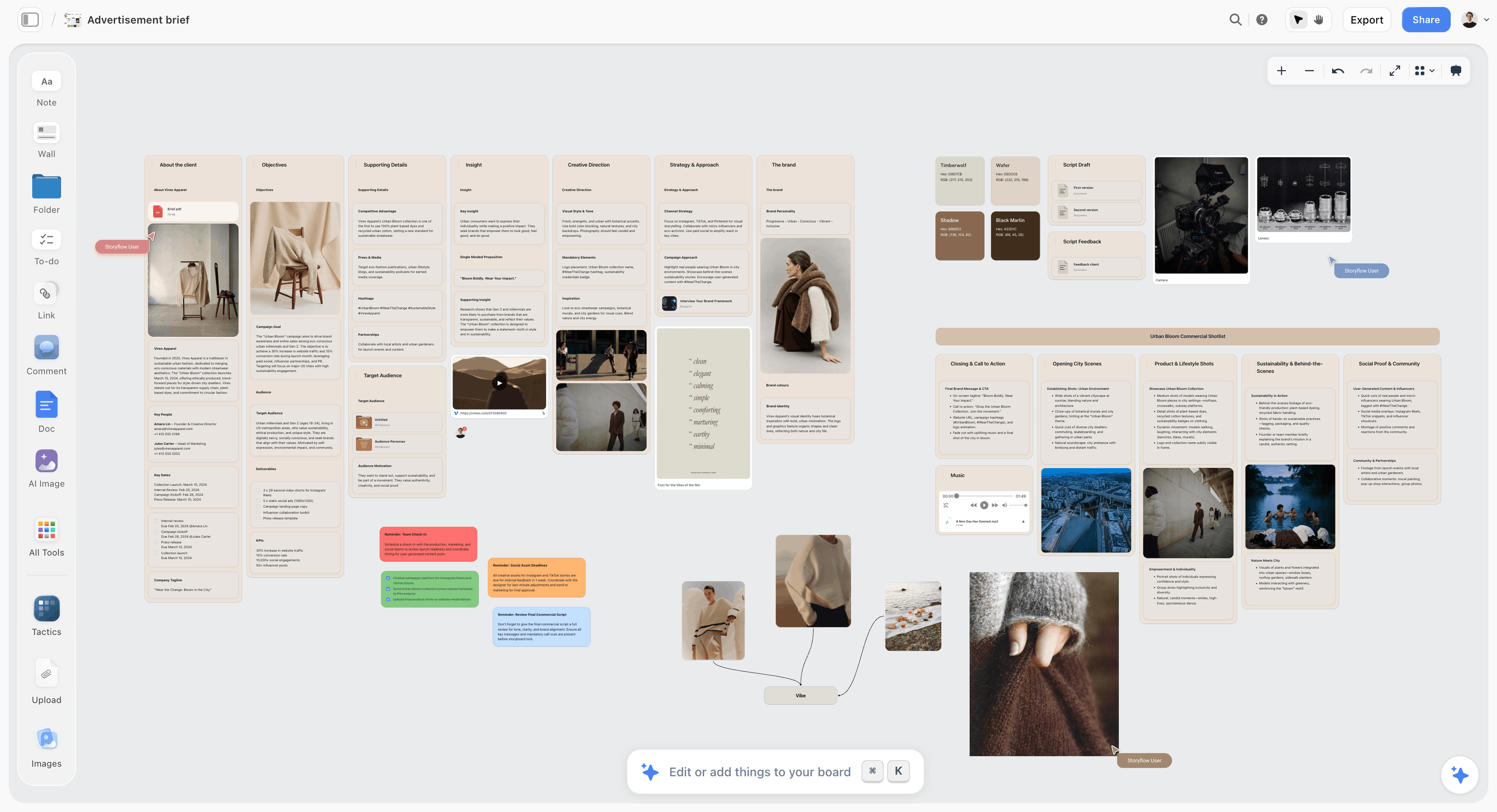
Storyflow is not a brand guidelines tool and publishes nothing. It is on this list for the stage before the guidelines exist: the references, the explorations, the directions that were considered and dropped, and the reason each decision went the way it did, all on one canvas. The AI reads the whole board, so when the guidelines are eventually written the why is available rather than reconstructed from memory weeks later. It also makes rejected directions retrievable, which is the material most often lost and most often needed when someone proposes the same thing again eighteen months on.
Best for: The deciding stage, so the rule that gets written carries its reasoning.
Verdict: A genuine complement to a guidelines tool and no substitute for one. Publish in Frontify, Zeroheight, Corebook or Canva.
Key features
- Infinite canvas holding references, explorations, rejected directions and reasoning.
- AI reads the whole current board, plus 5 attached documents and 3 attached boards.
- 200+ story blueprints including messaging frameworks.
- Anyone a paid member invites to a board joins free, including clients.
Pricing
Early access: every plan is paid for now. A Free plan arrives before the end of 2026, and anyone a paid member invites to a board can sign up free and collaborate today. Plus: $7.99/mo annual, $9.99/mo monthly. Unlimited boards and uploads. Pro: $14/mo annual, $19/mo monthly. AI image generation, more AI usage, memory across conversations. Max: $39/mo annual, $49/mo monthly. Team workspace with roles and permissions.
Pros
- Keeps the reasoning and the rejected directions, which guidelines almost always lose.
- Clients and contractors can view a board without a seat.
- Cheapest tool on this list, priced per account for individuals.
Cons
- No asset library, versioning, permissions, portal or custom domain.
- Does not publish guidelines in any form.
- Paid-only during early access.
7. Figma
Figma is where most brand guidelines are designed, and for a design-literate company a well-built Figma file with published libraries is a credible set of guidelines in itself. Its weakness is the audience: non-designers find it intimidating and will not open it twice.
Best for: Designing the guidelines, and serving them to other designers.
Verdict: The best place to build the visual specification. A poor place to serve it to a sales team.
Key features
- Component and style libraries published across files.
- Free viewers with comment access.
- Dev mode for handing specifications to engineers.
Pricing
Free with 3 files. Paid from about $16/editor/month; viewers free.
Pros
- The single source of truth designers already work in.
- Free viewers across the company.
- Libraries mean a change propagates to every file using it.
Cons
- Intimidating for non-designers, who are most of the audience.
- Files sprawl without strong discipline.
- Not a governed, permissioned portal.
8. Notion
A Notion brand page is how a great many startups do this, and it has one real advantage over every dedicated tool: it will hold as much reasoning as you are willing to write. The constraint is entirely discipline.
Best for: Startups wanting guidelines with the why attached and no new subscription.
Verdict: The most flexible option and the one most dependent on you. Weak on assets and unenforceable at the point of creation.
Key features
- Free-form pages that hold rules and reasoning together.
- Sits beside the rest of the company's documentation.
- Easy sharing with a public link.
Pricing
Free personal tier. Paid from about $10/user/month.
Pros
- Reasoning can live next to every rule.
- No new tool and no new cost at small scale.
- Simple to share externally.
Cons
- Weak asset handling; logo files end up in a folder somewhere else.
- Looks like documentation rather than a brand.
- Nothing enforces it at the point of creation.
9. Brandpad
Brandpad is built for the moment a studio hands a finished brand to a client: hosted, presentable, with asset downloads and a clean client-facing experience. Priced per brand, which is exactly how agencies think.
Best for: Design studios delivering brand guidelines to clients.
Verdict: The best handover experience here. Built for delivery rather than for long-term internal governance.
Key features
- Hosted, client-ready guidelines.
- Asset downloads in multiple formats.
- Per-brand pricing suited to agency work.
Pricing
Trial, then from about $12/month per brand.
Pros
- Looks like a deliverable, which matters at handover.
- Per-brand pricing fits an agency's economics.
- Clients can self-serve assets without emailing the studio.
Cons
- Limited ongoing governance features.
- Thinner asset management than a real DAM.
- Less suited to a large internal team.
10. Bynder
Bynder is enterprise digital asset management with brand governance, workflow approvals and integrations across a large marketing stack. It solves a problem most companies do not have yet, and solves it thoroughly for those that do.
Best for: Large organisations with high asset volume and compliance requirements.
Verdict: The most capable governance platform here. Quote-only, heavy, and wildly oversized below enterprise scale.
Key features
- Enterprise DAM with workflow and approvals.
- Brand guidelines module and portals.
- Deep integrations with marketing systems.
Pricing
No public pricing; enterprise quote on an annual contract.
Pros
- Handles asset volume and compliance nothing else here does.
- Approval workflows suit regulated industries.
- Strong integrations across a large stack.
Cons
- Quote-only with a long implementation.
- Requires dedicated administration.
- Guidelines are a module rather than the product.
11. Lingo
Lingo is a simple shared asset library: drag assets into visual collections that a team can browse and download. It is not a guidelines tool, and for teams whose only real problem is asset distribution it is enough.
Best for: Small teams that need a shared asset library and nothing else.
Verdict: A pleasant, lightweight asset library. Not brand guidelines in any meaningful sense.
Key features
- Visual drag-and-drop asset collections.
- Simple sharing and download.
- Lightweight team features.
Pricing
Limited free tier. Paid from about $10/user/month.
Pros
- Very easy to set up and browse.
- Visual, so finding the right asset is fast.
- Cheap for a small team.
Cons
- No guidelines, narrative or governance.
- Per-user pricing for what is essentially storage.
- Outgrown quickly by a real DAM need.
12. A PDF
The PDF brand book remains the most common format in actual use, and it is last on this list for two reasons that are not snobbery: it has the worst distribution latency of any option, and it cannot be corrected once sent.
Best for: A formal archival record, and a client who contractually requires one.
Verdict: Still worth producing as an archive. It should never be the live reference.
Key features
- Universal, opens anywhere, needs no account.
- Fixed layout that presents well.
- Easy to archive and version by filename.
Pricing
Free.
Pros
- No subscription and no login.
- Works offline and forever.
- Satisfies clients who want a deliverable in hand.
Cons
- The version on someone's desktop is never the current one.
- Cannot be corrected after sending.
- No assets, no search, no analytics on whether it was opened.
7) Why Nobody Reads the Brand Guidelines
Guidelines are written for the person who breaks a rule and read by the person who is trying to do something. Those are different people with different questions, and most brand books answer only the first.
Four failures, in rough order of how much damage they do.
They are organised by brand element rather than by task. A document with chapters for Logo, Colour, Typography, Photography and Tone is organised the way the brand was designed. Nobody arrives with a logo question. They arrive needing to make a conference banner, a LinkedIn post, an invoice template or a deck, and every one of those pulls from four chapters at once. The fastest improvement available to most guidelines is a front section organised by artifact: here is how to make a deck, here is how to make a social post.
They state rules without reasoning, so the first unanticipated case breaks them. Covered in section 3, and it is the deepest of the four.
They are not where the work happens. Any guideline requiring someone to stop, find a link, and read before making a slide loses to convenience most of the time. This is the argument for Canva at small scale and for brand templates at any scale: an enforced template is read by definition.
They are too long. A sixty-page brand book is a reference document, and a reference document is consulted only when someone already knows a rule exists to look up. The realistic split is a two-page summary people actually absorb plus a long reference for the specialist cases.
The fix that costs nothing: write the reason next to every rule, in one sentence, and lead the document with the five things people most often make. That change does more for adherence than moving from a PDF to a portal, and it is free.
8) What Belongs in Brand Guidelines
A usable set, in the order people need it.
The front section, organised by artifact. How to make a deck, a social post, a document, an email signature, a one-pager. Each with a link to the template and the three rules that matter. Most people will read only this.
The essentials, on one page. Logo files and when to use each, the palette with hex and accessible pairings, the two fonts with weights and sizes, and the minimum clear space. If somebody reads nothing else, this is what stops the worst outcomes.
The reasoning. Why this palette, why this typeface, what the brand is deliberately not. Half a page, and the half that keeps the guidelines useful past their first unanticipated case.
Voice, shown rather than described. Three before-and-after pairs beat any number of adjectives. "We are friendly but professional" is unactionable; a rewritten sentence is not.
The edge cases you have already been asked about. Co-branding with a partner, dark backgrounds, tiny sizes, video end-cards, merchandise. This section grows from real questions and is the most-used part of a mature set.
Assets, findable. Every logo variant in every needed format, the fonts with licences, the photo library, the templates. This is where half the traffic goes.
What to do when the guidelines do not cover it. A named person or channel, and permission to use judgment in the meantime. Guidelines without an escalation route produce either paralysis or silent divergence.
Deliberately omitted: a long brand story nobody reads, a competitor analysis that belongs in a strategy document, and mood boards presented as rules rather than as intent.
9) Recommended Brand Guidelines Stacks
Stack 1: Startup under twenty. Canva Brand Kit (enforcement) + Notion page (the reasoning) + a Figma file (the visual spec). About $15/month.
Stack 2: Company of fifty to two hundred. Frontify (portal, assets, templates) + Figma (design source) + Storyflow (the deciding stage on a rebrand). Quote plus about $24/month.
Stack 3: Product-led company. Zeroheight (brand and design system) + Figma (source) + Canva (non-product collateral). About $51/month for one editor of each.
Stack 4: Agency delivering to clients. Storyflow (exploration and reasoning) + Corebook or Brandpad (client-facing guidelines) + Figma (design). About $43/month per brand.
Stack 5: Free setup. Canva free tier + a Figma file + a Notion page. Zero, and genuinely workable under about fifteen people.
| Company shape | Decides direction in | Publishes guidelines in | Enforces with | Monthly cost |
|---|---|---|---|---|
Startup under twenty | Notion | Notion | Canva Brand Kit | about $15 |
Company of fifty plus | Storyflow | Frontify | Frontify templates | quote plus $24 |
Product-led | Figma | Zeroheight | Design tokens | about $51 |
Agency to client | Storyflow | Corebook or Brandpad | Client templates | about $43 per brand |
Free | Notion free | Notion free | Canva free | $0 |
The pattern across all five: one place that decides, one place that publishes, and one thing that enforces at the point of creation. Most brand programmes buy only the publishing layer, which is why the guidelines are accurate, beautiful and ignored.
10) What Brand Guidelines Actually Cost
The software is the smallest line.
Creating them. A studio-produced brand book is typically several thousand dollars up to five figures, and that is usually money well spent because the thinking is the product. What is frequently wasted is the portion spent on layout of a document that will be read twice.
Maintaining them. Guidelines need an owner. Without one they decay on the schedule in section 3 regardless of the platform, and the platform bill continues. Budget a few hours a month, and name the person before you buy the tool.
Per-reader pricing, which quietly determines whether they work. Guidelines exist to be read by people who never edit. Zeroheight and Figma make viewers free; Frontify and Bynder price on platform terms where readers factor into the negotiation. Any structure that makes an additional reader cost money produces fewer readers.
The cost of not having them, which is the real number and is never itemised. A sales team making its own decks, a contractor using the 2023 logo, a campaign that looks like a different company. None of that appears on an invoice, and all of it is more expensive than every tool on this page.
| Cost driver | Where it lands | What it does | The move |
|---|---|---|---|
Creation | One-off, agency or in-house | Mostly thinking, partly layout | Pay for the thinking; keep the layout light |
Maintenance | Ongoing, a named owner | Decay regardless of platform | Name the owner before buying the tool |
Per-reader pricing | Frontify, Bynder, Notion | Fewer readers, less adherence | Prefer free viewers |
No guidelines | Invisible | Divergent collateral, rework | The reason any of this is worth doing |
11) Honorable Mentions
- Nuclino and Confluence. Wiki tools that hold brand documentation adequately if your company already lives in one.
- Supernova. A design system platform close to Zeroheight, stronger on code generation.
- Storybook. For the component half of a digital brand, aimed at engineers.
- Adobe Express. Canva's closest rival for brand-safe templates, strongest inside the Adobe ecosystem.
- Google Slides. An unglamorous but genuinely effective way to publish a short, always-current brand summary.
- Dropbox and Google Drive. Where the assets actually are in most companies, which is worth admitting before buying a DAM.
- Milanote. A pleasant board for gathering brand references during exploration.
12) Tools to Avoid for Brand Guidelines
- A PDF as the live reference. Fine as an archive, wrong as the source of truth, because the version on someone's desktop is never the current one.
- An enterprise DAM below about a hundred people. The implementation cost exceeds the asset problem.
- A tool that charges per reader. It produces fewer readers, which defeats the purpose.
- Guidelines in a tool nobody else in the company has a login for. Every extra login is a reason not to check.
- A sixty-page brand book with no summary. It will be read once, at onboarding, by someone with no immediate question.
- A portal with no owner. Unowned guidelines decay at exactly the same rate as a PDF while costing more.
14) The Bottom Line
The best brand guidelines tools in 2026 are the ones people actually reach. Frontify is the best overall because one link covers guidelines, assets and templates. Zeroheight wins when the brand is a product. Canva wins under about twenty people because the rules are enforced where the work happens. Corebook is the best value in the dedicated category.
Guidelines decay because they record decisions and omit the reasoning, and a rule without a reason cannot be applied to the case it did not anticipate. Write the why next to the what, organise the front of the document by what people are actually making, and keep the guidelines at a permanent link rather than in an attachment.
And keep the material the guidelines were written from, including the directions you rejected, because the same idea will be proposed again. Put the references, the explorations and the reasoning on one Storyflow canvas before the brand book is written, then publish it wherever this page recommends for your size.
FAQ: Brand Guidelines Tools
What is the best brand guidelines tool in 2026?
Frontify is the best brand guidelines tool overall, because it holds the guidelines, the asset library, the templates and the permissions behind one link on your own domain, which is what governance at scale actually requires. Zeroheight is the better pick when the brand is mostly digital and needs to stay synchronised with a design system, Canva is the most effective choice under about twenty people because the Brand Kit sits inside the tool where non-designers work, and Corebook is the best affordable dedicated option. Whichever you choose, write the reason next to each rule, because a rule without a reason cannot be applied to the case it did not anticipate.
What should brand guidelines include?
A front section organised by artifact (how to make a deck, a social post, a document), the essentials on one page (logo files, palette with accessible pairings, fonts, clear space), the reasoning behind the main decisions, voice shown through before-and-after examples rather than described with adjectives, the edge cases you have already been asked about, findable assets in every needed format, and a named person to ask when the guidelines do not cover something.
Is there a free brand guidelines tool?
Yes. Canva's free tier gives a basic Brand Kit, Figma's free tier holds three files which is enough for a visual specification, and Notion's free personal tier will hold the written guidelines and the reasoning. Zeroheight, Frontify and Corebook all have limited free tiers worth trying. That combination is genuinely workable under about fifteen people. Storyflow is paid-only during early access so it is not part of a free stack today; its Free plan launches before the end of 2026.
Why does nobody follow our brand guidelines?
Usually four reasons at once: they are organised by brand element rather than by the thing someone is trying to make, they state rules without the reasoning so the first unanticipated case breaks them, they are not where the work happens so consulting them costs a detour, and they are long enough that people only look when they already know a rule exists. The cheapest fixes are a front section organised by artifact and one sentence of reasoning per rule.
Frontify or Zeroheight, which is better?
Frontify if the brand spans print, physical and digital and asset management is a real problem, because it consolidates guidelines, assets and permissions in one portal. Zeroheight if the brand is primarily a product interface, because it syncs documentation from Figma so the documented component and the real one cannot drift. Zeroheight also publishes its pricing and gives free viewers, which matters if you are budgeting without a sales call.
How often should brand guidelines be updated?
Continuously in small ways and substantially about every two to three years. The useful habit is adding an edge case each time someone asks a question the guidelines do not answer, because that section becomes the most-used part of a mature set. A tool with a permanent link makes that habit cheap; a PDF makes it impossible.
Can Canva be used for brand guidelines?
Yes, and under about twenty people it is often the best answer, though it works differently from a guidelines tool. Rather than documenting rules for people to read, the Brand Kit puts the palette, fonts, logos and locked templates inside the editor, so the rule is applied at the point of creation. The trade is that it cannot hold reasoning, and it is not credible as a deliverable to hand a client.
What is the difference between brand guidelines and a design system?
Brand guidelines describe the brand across every surface including print, video, physical space and voice. A design system specifies the interface: components, tokens, states, accessibility. They overlap on colour and typography and diverge everywhere else. Digital-first companies often let the design system quietly become the brand guidelines, which works until someone needs to make something that is not an interface.
How do I stop brand guidelines going stale?
Name an owner, keep the guidelines at a permanent link rather than in an attachment, add an edge case every time someone asks a question the document cannot answer, and write the reasoning beside each rule so unanticipated cases can be resolved without an update. The reasoning is the part that matters most: rules go stale because they cannot be extended, not because they were wrong.
What do agencies use to deliver brand guidelines to clients?
Corebook and Brandpad are both built for this, hosted and client-ready with per-brand pricing that fits agency economics. Frontify is used for larger clients who will keep governing the brand internally afterwards. Many studios still deliver a PDF alongside, because clients want something in hand, and that is reasonable as long as the hosted version is the live reference.
Where should the reasoning behind brand decisions live?
Next to the rule, in one sentence, inside the guidelines themselves. The longer material, meaning the references, the explorations and the directions that were rejected, is worth keeping somewhere too, because the same idea gets proposed again eighteen months later and the fastest answer is showing why it was dropped the first time. That material is usually lost because it was scattered across a workshop board, a thread and somebody's memory.
Do small teams need brand guidelines?
A short set, yes, and it pays back immediately. One page with logo files, palette, fonts and three voice examples prevents most of the divergence a small team produces. What a small team does not need is a sixty-page brand book or an enterprise portal; the cost of those is not the money, it is that nobody reads them.
How much do brand guidelines tools cost?
From free to enterprise quotes. Canva's Brand Kit is about $15/month, Corebook from about $15/month per brand, Zeroheight from about $20 per editor with free viewers, and Frontify, Brandfolder and Bynder are all quote-based with platform fees. The number that matters most is what an additional reader costs, because guidelines exist to be read by people who will never edit them.
Table of Contents
- Article Metadata
- Breadcrumb
- Table of Contents
- 1) Quick Answer: The Best Brand Guidelines Tools in 2026
- All 12 Brand Guidelines Tools, Ranked
- 2) Comparison Table: 12 Brand Guidelines Tools at a Glance
- Frequently Asked: Which Brand Guidelines Tools Teams Trust, and Which Ones Go Unread
- 3) The Guidelines Half-Life
- 4) How We Evaluated These Tools
- 5) Quick Picks by Company Size
- 6) Detailed Reviews: 12 Brand Guidelines Tools
- 7) Why Nobody Reads the Brand Guidelines
- 8) What Belongs in Brand Guidelines
- 9) Recommended Brand Guidelines Stacks
- 10) What Brand Guidelines Actually Cost
- 11) Honorable Mentions
- 12) Tools to Avoid for Brand Guidelines
- 14) The Bottom Line
- 15) Author
- 16) Related Reading
- FAQ: Brand Guidelines Tools
Templates to check out for this topic


Templates you can use in Storyflow
Every Storyflow board starts from real structure and an AI that reads the whole canvas. Open one of these templates and make it yours.


See Storyflow in Action
A visual AI workspace where every feature lives inside one canvas. No tab-switching, no context lost.
Build your entire board from a single message
Type what you need in the AI chat at the bottom of your canvas. The AI adds cards, headings, and structure directly onto your board.
Use expert frameworks as AI context
Type @ in the AI chat and choose any Tactic. The AI tailors every response to that framework instead of giving generic advice.
Turn your board into a mind map in seconds
Ask the AI to restructure your canvas as a mindmap. It connects your ideas into a visual hierarchy so you can see how everything relates.
Why Storyflow Exists
Storyflow actually began as a personal tool while working on creative and research projects.
We kept running into the same problem: ideas were scattered everywhere: notes, documents, and whiteboards.
Nothing helped us see how everything connected.
So we started building a workspace designed around how ideas actually grow.
→ Read how Storyflow was createdStoryflow Team
Product & Research Team
Published: 2026-09-22
Extremely simple, seriously capable


See how easy it is to get started
Watch a real project come together, from a blank board to a finished plan, clicked through step by step.
Start creating with AI and become more productive
Transform your creative workflow with AI-powered tools. Generate ideas, create content, and boost your productivity in minutes instead of hours.