The 10 Best Mind Mapping Tools for Teams in 2026
A team mind map is only worth building if it outlives the meeting. The 10 best mind mapping tools for teams in 2026, ranked on real-time collaboration and whether the map becomes a plan, from Storyflow and Miro to MindMeister and Whimsical.

Category
Productivity
Author

Justkay
Documentary Filmmaker & Founder at Storyflow
Topics
2026-07-20
•
18 min read
•
Productivity- best mind mapping tools for teams
- collaborative mind mapping tool
- team mind map software
- real-time mind mapping
- mind mapping for remote teams
- mind map that becomes a plan
What is the best mind mapping tool for teams in 2026?
The best mind mapping tools for teams in 2026 are Storyflow (best for real-time mapping that turns into a plan on one canvas), Miro (best for large facilitated workshops), MindMeister (best for clean classic radial maps), and Whimsical (best for fast, tidy team diagrams). If your team runs remote brainstorms, product-planning sessions, or agency workshops, start with Storyflow: your branches, sticky notes, references, and the plan they become all live on one shared board the AI can read. Storyflow is paid-only during early access, with a Free plan (unlimited collaboration) landing before the end of 2026. Here is the problem every team already knows. You gather in a room or a call, someone shares a screen, branches sprout everywhere, energy is high, and forty-five minutes later you have a beautiful spider of ideas. Then the session ends. Someone screenshots the map, drops it in a channel, and that image is the last time anyone touches it. The map dies in a screenshot. The decisions it was supposed to produce never arrive, and next week you brainstorm the same territory again. The shift that fixes this is not a better mind-mapping notation. It is a living shared canvas: a map that stays editable, stays owned by the team, and turns into the plan instead of being abandoned next to it. I am Justkay, a documentary filmmaker and the founder of Storyflow, and I have run mapping sessions for film crews, product teams, and agency clients for years. I have watched more workshop maps go to the graveyard than I can count. This guide ranks 10 tools on one question: how well does each one let a team build a map together in real time, then keep that map alive as a working plan after everyone logs off? Not how pretty the radial tree looks in a demo. How far the idea travels once the meeting is over.

Full disclosure: Storyflow is our own product, and we rank it #1 for one specific job: real-time team mapping where the map becomes a plan on the same canvas the AI can read. It is not a dedicated radial mind-map tool, so XMind and MindMeister give cleaner classic trees and tighter keyboard outlining. We name where Storyflow loses in its review and link every tool so you can judge for yourself.
Quick Comparison
These four cover the choice a team faces: a canvas where the map becomes a plan, a big workshop room, a clean radial-map tool, and a fast tidy diagrammer.
| Tool | Best For | AI Features | Price |
|---|---|---|---|
| Storyflow | Map and plan on one shared canvas | Canvas-wide AI (reads the whole board) | $7.99 mo annual (free plan late 2026) |
| Miro | Large facilitated workshops | Standard AI | Free / ~$8 user mo |
| MindMeister | Clean classic radial maps | Light AI | Free / ~$4.99 user mo |
| Whimsical | Fast, tidy team diagrams | Light AI | Free / ~$10 user mo |
Comparison Table: 10 Mind Mapping Tools for Teams Compared
| Tool | Best For | Team Fit | Starting Price | Free Plan | Rating (/10) |
|---|---|---|---|---|---|
Storyflow | Real-time mapping that becomes a plan | Whole team maps on one canvas | $7.99/mo (annual) | Coming late 2026 (invited collaborators join free now) | 9.4/10 |
Miro | Large facilitated workshops | Strong for big live sessions | ~$8/user/mo (annual) | Yes (3 boards) | 8.9/10 |
MindMeister | Clean classic radial maps | Good for shared structured maps | ~$4.99/user/mo (annual) | Yes (3 maps) | 8.6/10 |
Whimsical | Fast, tidy team diagrams | Good for small product teams | ~$10/user/mo | Yes (limited) | 8.5/10 |
Ayoa | Mapping plus task handoff | Good for map-to-task teams | ~$10/user/mo (annual) | Yes | 8.1/10 |
XMind | Keyboard-driven outlining and maps | Weaker live co-editing | ~$5.99/mo | Yes (desktop) | 8.0/10 |
Milanote | Visual moodboard-style mapping | Good for creative teams | ~$12.50/mo (annual) | Yes (100 notes) | 7.9/10 |
FigJam | Design-team brainstorming | Strong for product and design teams | ~$3/user/mo (annual) | Yes | 7.8/10 |
Lucidchart | Formal diagrams and process maps | Good for structured org maps | ~$7.95/user/mo | Yes (3 docs) | 7.5/10 |
Coggle | Simple shared radial maps | Basic real-time sharing | ~$5/user/mo | Yes (3 diagrams) | 7.2/10 |
Pricing changes often, so check the live price on each tool's own site before you buy. Storyflow's prices are exact: paid-only during early access, Plus at $7.99/mo annual ($9.99 monthly), Pro at $14/mo annual, Max at $39/mo annual, billed per account not per user, with a Free plan launching before the end of 2026. Ratings reflect fit for a team that maps together and needs the map to survive the meeting, not general whiteboard quality.

A team mind map on a Storyflow canvas that turns into an outline, task cards, and a schedule the AI can read
Stop letting the map die in a screenshot
Storyflow keeps the team's map, outline, tasks, and schedule on one canvas the AI reads, so the brainstorm becomes the plan. Unlimited shared boards and collaboration free. No credit card.

The 10 Best Mind Mapping Tools for Teams, Ranked
- Storyflow - best for real-time collaborative mapping that turns into a working plan on one canvas
- Miro - best for large, facilitated remote workshops
- MindMeister - best for clean, classic radial mind maps a team shares
- Whimsical - best for fast, tidy diagrams for small product teams
- Ayoa - best for teams that hand the map straight into tasks
- XMind - best for keyboard-driven outlining and structured maps
- Milanote - best for visual, moodboard-style team mapping
- FigJam - best for design-team brainstorming inside Figma
- Lucidchart - best for formal process and org maps
- Coggle - best for a simple, shared radial map
How We Evaluated These Tools
I ran the same real workload through every tool on this list: a product-planning session with five people editing at once, a remote agency workshop across three time zones, and a solo follow-up where one person has to turn the messy map into next week's plan. Tools were judged on how a team actually uses them together and on what happens the morning after the session, not on feature checklists. Five criteria:
- Real-time collaboration (30%). Can several people edit the same map at the same time without stepping on each other, seeing cursors and changes live? A team tool that expects one driver and four spectators fails here.
- Map-to-plan handoff (25%). After the branches are drawn, how much friction is there to turn them into an outline, a task list, or a schedule? This is where most maps die, so it carries real weight.
- AI depth (20%). Does the AI understand the map you built, or does it only autocomplete a single node? Context across the board is the difference between an assistant and a spell-checker.
- Ease of use (15%). Can a non-technical teammate join a session and contribute in the first two minutes, or does onboarding eat the workshop?
- Price (10%). Team tools live or die on per-seat math. A tool that charges for every workshop guest is a tool people stop inviting to.
Detailed Reviews: 10 Mind Mapping Tools for Teams
1. Storyflow
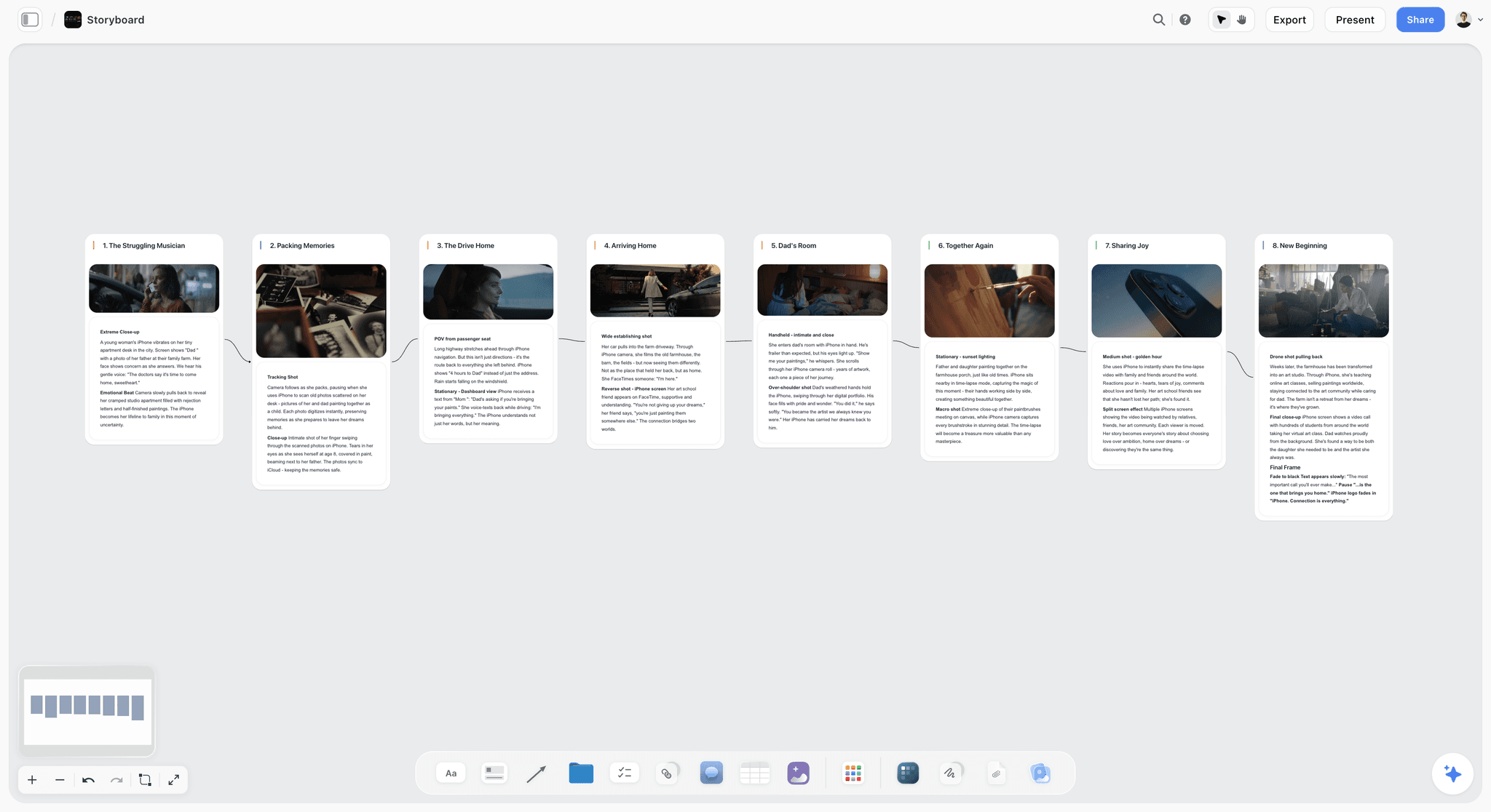

Storyflow is an infinite canvas where a team maps together and the map does not have to leave the board to become a plan. You start a branch, teammates add nodes beside you in real time, you drag in reference images and links, and the same board holds the outline, the task cards, and the schedule the brainstorm turns into. Instead of a map in one app and a plan in another, the whole journey from spark to shipped decision stays in one view the team keeps coming back to.
The part that changes how teams work is the AI. It reads everything on the current canvas board by default, so when someone types "cluster these branches by theme" or "turn this map into a three-week plan," it answers from the actual map on screen, not from a blank prompt. You can also @-mention up to 1 Tactic and up to 3 documents to pull in extra context. That means the map you built together in the workshop is the thing the AI develops afterward, which is exactly the moment other tools drop the ball. On Plus and above, the library of 200+ Story Blueprints (real structures like Hero's Journey, AIDA, and Retention Hooks) gives the AI proven frameworks to shape a raw brainstorm into something structured.
The reason it ranks first for teams is the collaboration economics. The Free plan, launching before the end of 2026, will include unlimited shared boards and unlimited collaboration, so an entire team can map together without anyone hitting a guest paywall mid-workshop. There is no per-seat charge to invite the intern, the client, or the freelancer into the session; a paid member can invite collaborators free right now, even during early access. When a team needs governance, Max ($39/mo annual) adds a team workspace with roles and permissions, but the core act of mapping together is not fenced behind a Team tier. That removes the most common reason a team map dies: half the people could not get into it.
Key features
- Real-time multiplayer canvas with unlimited shared boards on every plan, including the Free plan once it launches
- AI that reads the entire current board, plus up to 1 @-mentioned Tactic and up to 3 documents
- 200+ Story Blueprints (Hero's Journey, AIDA, Retention Hooks) on Plus and above
- One board holds the map, the outline, task cards, references, and the schedule together
- Roles and permissions via a team workspace on Max
Pricing
Paid-only during early access: Plus $7.99/mo annual ($9.99 monthly) for the full Blueprint library and unlimited uploads; Pro $14/mo annual; Max $39/mo annual for a team workspace with roles and permissions. Billed per account, not per user. The Free plan (unlimited shared boards and unlimited collaboration) launches before the end of 2026.
Pros
- Once the Free plan launches, the whole team maps together with no per-guest charge for workshop participants; a paid member can invite collaborators free today
- The AI understands the map you actually built, so the brainstorm becomes a plan without re-entering it elsewhere
- Map and plan live on one canvas, so nothing dies in a screenshot after the session
Cons
- It is not a dedicated radial mind-map tool, so XMind and MindMeister produce cleaner, more automatic classic tree structures and tighter keyboard-driven outlining
- It is a newer, smaller platform than Miro or Lucidchart, so it has fewer third-party integrations and a shorter track record
- The 200+ Blueprint library is gated to paid plans, so free teams get the canvas and collaboration but not the full framework set
- No built-in formal-diagram notation (BPMN, flowchart shape libraries) if your team needs strict process-diagram standards
2. Miro
Miro is the strongest large-workshop surface on this list. When twenty people join a quarterly planning session and you need voting dots, timers, sticky-note clustering, and facilitation controls, Miro is built for exactly that room. Its real-time collaboration is mature and dependable, and the mind-map widget snaps branches into place while everyone watches cursors move.
The friction shows up after the workshop. Miro is a phenomenal room to think in, but it is a room, not a home. The map is a canvas artifact, and turning it into an owned plan usually means exporting decisions into Jira, a doc, or a project tool somewhere else. Its AI helps at the sticky-note and diagram level rather than reading your whole map as a plan. For a team whose main job is the live session itself, that is fine. For a team that needs the map to keep working on Monday, the handoff is manual.
Key features
- Best-in-class facilitation: voting, timers, frames, and workshop templates
- Reliable real-time multiplayer at large scale
- Huge template and integrations ecosystem
- Mind-map widget with auto-layout
Pricing
Free plan with 3 editable boards; paid from around $8/user/mo billed annually.
Pros
- Excellent for big, facilitated live sessions
- Mature, stable co-editing with strong facilitation tools
- Deep integrations with the rest of the stack
Cons
- Per-user pricing gets expensive once the whole team needs edit access
- The map rarely becomes the plan inside Miro, so decisions migrate elsewhere
- AI assists at the widget level, not across the whole map as context
3. MindMeister
MindMeister is the cleanest classic mind-map tool a team can share. If what you want is a proper radial tree, with the central node branching out in tidy, automatically arranged limbs, MindMeister does that better than the canvas-first tools above. Multiple people can edit a map together, and the structure stays neat no matter how fast branches grow.
Its strength is also its ceiling. MindMeister is a mind-map tool, so the map is the deliverable rather than a stage in a plan. It pairs with MeisterTask for handoff, but that is a second tool and a second bill. For a team that genuinely thinks in radial hierarchies and wants a shared, always-tidy map, it is an easy pick. For one that needs the map to sit next to references, tasks, and a schedule, it stays narrow.
Key features
- Automatic radial layout that stays clean as maps grow
- Real-time co-editing on shared maps
- Presentation mode that turns a map into slides
- MeisterTask integration for task handoff
Pricing
Free plan with up to 3 maps; paid from around $4.99/user/mo billed annually.
Pros
- The cleanest classic radial structure on this list
- Low entry price per user
- Presentation mode is a genuine map-to-slides bridge
Cons
- The map stays a map; turning it into a broader plan needs a second tool
- Free plan caps at 3 maps, which a busy team outgrows quickly
- AI is lighter than the canvas-plus-AI tools
4. Whimsical
Whimsical is the fast, tidy option for small product teams. Its mind maps, flowcharts, and wireframes all share one calm visual style, and building a map is quick enough that you can do it live in a standup without breaking flow. Co-editing is smooth, and the opinionated design means nobody's map looks like a tangle.
The trade-off is scope and scale. Whimsical is happiest with small, focused teams and medium-sized maps; huge workshops and sprawling boards are not its strength. And like most diagram tools, the map is the artifact rather than a living plan the team keeps developing. It is a lovely place to draw a quick shared map. It is less of a place where that map turns into weeks of tracked work.
Key features
- Fast mind maps, flowcharts, and wireframes in one consistent style
- Smooth real-time co-editing
- Opinionated design that keeps maps readable
- Docs feature for pairing notes with diagrams
Pricing
Free plan with limited items; paid from around $10/user/mo.
Pros
- Very fast to build clean maps live
- Consistent, readable visual style out of the box
- Good fit for small product teams
Cons
- Weaker for very large workshops and sprawling boards
- The map does not become a tracked plan inside the tool
- Per-user pricing adds up for bigger teams
5. Ayoa
Ayoa is one of the few tools that deliberately bridges mind mapping and task management. You brainstorm in a colorful, organic map, then convert branches into tasks on a board so the ideas actually get owners and due dates. For a team whose problem is specifically that maps never become to-dos, that built-in handoff is the whole reason to look here.
The cost is polish and focus. Ayoa tries to be a mind-map tool, a task tool, and a whiteboard at once, and the breadth can make it feel busier than a single-purpose tool. Real-time collaboration works but is not as fluid as Miro's. Still, for a team that wants the map-to-task jump to live inside one product, Ayoa earns its slot.
Key features
- Organic, colorful mind maps with a distinctive style
- Built-in conversion from map branches to tasks
- Task boards and workflow views alongside maps
- AI assistance for expanding branches
Pricing
Free plan; paid from around $10/user/mo billed annually.
Pros
- Real map-to-task handoff inside one tool
- Distinctive, engaging mapping style
- Bridges brainstorming and follow-through
Cons
- Feature breadth can feel busy and less focused
- Co-editing is less fluid than the top tools
- Interface has a steeper learning curve for new teammates
6. XMind
XMind is the tool for people who think in outlines. Its keyboard-driven flow lets you build a deep, structured map at typing speed, tabbing and entering your way through branches without touching the mouse. The layouts are professional, the export options are strong, and for a single mapper producing a polished tree, it is excellent.
For teams, the honest limit is live co-editing. XMind is desktop-first and historically single-player at heart, with collaboration added on rather than built in, so it is weaker than the canvas tools when five people need to edit the same map at once. If your team's mapping is mostly one person structuring thinking that others review, XMind shines. If it is a live free-for-all, the canvas-first tools handle the room better.
Key features
- Fast, keyboard-driven outlining and map building
- Professional layouts and themes
- Strong export options (PDF, image, outline)
- Cross-platform desktop and mobile apps
Pricing
Free desktop version; paid from around $5.99/mo.
Pros
- The best keyboard-driven outlining on this list
- Clean, professional map output
- Works well offline on desktop
Cons
- Real-time multiplayer editing is weaker than canvas-first tools
- Desktop-first model fits solo structuring more than live workshops
- Collaboration feels bolted on rather than native
7. Milanote
Milanote is the mapping tool for creative teams that think in images. Instead of a strict radial tree, you arrange notes, screenshots, links, and swatches in space until the idea has a visual shape, which suits agency moodboards, campaign concepts, and film pre-production better than a wireframe-style diagram tool. A team can build a shared board that feels like a physical wall.
The two limits are the free plan and the AI. The free tier caps at 100 notes, which a working team hits fast, and there is no canvas-aware AI to turn the visual map into a structured plan. Milanote gathers and arranges beautifully; the developing into tasks and schedules still happens somewhere else.
Key features
- Visual, moodboard-style boards mixing notes, images, and links
- Flexible spatial arrangement rather than forced tree layout
- Creative-brief and storyboard templates
- Real-time shared boards
Pricing
Free plan capped at 100 notes; Pro around $12.50/mo billed annually.
Pros
- The most visual, creative mapping surface here
- Natural fit for agency and pre-production work
- Pleasant, tactile board feel
Cons
- Free 100-note cap is hit quickly by an active team
- No canvas-aware AI to turn the map into a plan
- Less suited to structured hierarchical mapping
8. FigJam
FigJam is the natural brainstorming canvas for teams that already live in Figma. Sticky notes, connectors, stamps, and cursor chat make live sessions fun, and design and product teams love that the brainstorm sits one tab away from the actual design files. Real-time collaboration is excellent, as you would expect from Figma.
The limit is the same as Miro's, plus a design-team bias. FigJam is a workshop surface, not a place where the map becomes an owned, tracked plan, and its mapping is sticky-note-and-connector rather than structured radial. For design and product teams it is a joy. For teams outside the Figma world, adopting it just for mapping is a bigger commitment than the job requires.
Key features
- Sticky notes, connectors, and stamps for live brainstorming
- Tight integration with Figma design files
- Excellent real-time collaboration and cursor chat
- Templates for retros, flows, and planning
Pricing
Free plan; paid from around $3/user/mo billed annually.
Pros
- Delightful live brainstorming for design and product teams
- Sits next to Figma design work
- Strong, reliable co-editing
Cons
- Map stays a canvas artifact, not a tracked plan
- Sticky-note style rather than structured radial mapping
- Most valuable only if the team is already in Figma
9. Lucidchart
Lucidchart is the pick when a team needs formal, precise diagrams. Org charts, process flows, system architecture, and structured mind maps all follow strict shape libraries and clean connectors, and the result looks corporate-ready. Multiple people can edit together, and integrations with the usual enterprise suites are solid.
The trade-off is that formality slows down the messy, fast, generative part of brainstorming. Lucidchart rewards structure, which is great for documenting a decided process and less great for the free-flowing early session where ideas are still colliding. Its AI is diagram-oriented rather than a map-reading planner. For teams that map to document, it fits. For teams that map to discover, it can feel rigid.
Key features
- Precise shape libraries for formal diagrams
- Structured mind maps and process flows
- Strong enterprise integrations and permissions
- Real-time co-editing
Pricing
Free plan with up to 3 documents; paid from around $7.95/user/mo.
Pros
- Best for formal, precise, corporate-ready diagrams
- Solid permissions and enterprise integrations
- Reliable structured layouts
Cons
- Formality slows down messy early brainstorming
- AI is diagram-focused, not a map-aware planner
- Free plan caps documents quickly
10. Coggle
Coggle is the simplest shared radial map on this list, and simplicity is the point. There is almost nothing to learn: you make a central node, branches flow out in flowing curves, and you share a link for others to edit. For a team that just wants a quick collaborative map without adopting a whole platform, it is refreshingly low-commitment.
The flip side of that minimalism is a low ceiling. There is little in the way of AI, task handoff, or map-to-plan structure, and the free tier caps you at three private diagrams. Coggle is a fine place to draw a shared map fast. It is not a place that helps that map become the team's ongoing work.
Key features
- Dead-simple radial mind maps
- Share-a-link real-time collaboration
- Flowing, readable branch style
- History and revert on maps
Pricing
Free plan with up to 3 private diagrams; paid from around $5/user/mo.
Pros
- Almost zero learning curve
- Fast to share and co-edit
- Clean, readable output
Cons
- Minimal AI and no real map-to-plan handoff
- Free tier caps private diagrams at 3
- Limited depth for serious ongoing team work
Quick Picks by Team Need
- Best for maps that keep dying after the workshop: Storyflow
- Best for large facilitated remote workshops: Miro
- Best for a clean classic radial tree: MindMeister
- Best for fast tidy diagrams in a small product team: Whimsical
- Best for mapping straight into tasks: Ayoa
- Best for keyboard-driven outlining: XMind
- Best for image-led creative mapping: Milanote
- Best for design teams in Figma: FigJam
- Best for formal process and org maps: Lucidchart
- Best for a simple no-setup shared map: Coggle
- Best way for a whole team to map together once free: Storyflow (unlimited shared boards and collaboration on the Free plan, landing before the end of 2026; paid-only during early access)
The Bottom Line
A team mind map is only worth building if it outlives the meeting that made it. Most tools give you a beautiful branching diagram and then let it die in a screenshot the moment the call ends, so the same territory gets brainstormed again next week and the decisions never arrive. The shift that fixes this is not a fancier notation. It is a living shared canvas: a map the whole team can edit in real time and that keeps working as the plan after everyone logs off.
Storyflow ranks first because it closes that gap directly. A whole team maps together free on one canvas, the AI reads the entire board to turn the brainstorm into a plan, and the map, outline, tasks, and schedule all live in the same view instead of scattering across apps. Miro still owns the big live workshop, MindMeister and XMind still draw the cleanest classic trees, and Ayoa still handles map-to-task best. But if your maps keep dying after the session, the honest fix is a map that never has to leave the board to become the work. The map should not die in a screenshot. It should become the plan.
FAQ: Mind Mapping Tools for Teams
What is the best mind mapping tool for teams in 2026?
Storyflow is the best mind mapping tool for teams that want the map to survive the meeting, because a team maps together in real time on one canvas and the AI reads the whole board to turn that brainstorm into a plan. Miro leads for large facilitated workshops, MindMeister for clean radial maps, and Whimsical for fast diagrams in small product teams.
Can a whole team mind map together in real time for free?
Not during early access. Storyflow's Free plan, which launches before the end of 2026, will include unlimited shared boards and unlimited collaboration, so an entire team can map on the same canvas with no per-guest charge. Miro, FigJam, and Coggle also offer free tiers, though they cap the number of boards or documents. If cost of inviting everyone is your blocker, a canvas with unlimited free collaboration removes it.
Why do team mind maps die after the workshop?
Because most mind-map tools are single-purpose: they produce a map, then the map is a static artifact someone screenshots and forgets. The decisions never become tasks, owners, or dates inside the same tool, so the map and the plan live apart. The fix is a living shared canvas where the map turns into the plan on the same board, instead of being abandoned next to it.
What is the best free mind mapping tool for teams?
For a simple radial map today, Coggle and MindMeister offer free tiers capped at three diagrams. For large sticky-note workshops, FigJam's free plan is generous. Storyflow is paid-only during early access, but its upcoming Free plan, launching before the end of 2026, will be the strongest for unlimited team collaboration: unlimited shared boards, unlimited collaborators, and basic AI. The right free pick today depends on whether you need a specific map style now or can wait for unlimited seats.
Miro vs Storyflow for team mind mapping: which is better?
Miro is better for large facilitated workshops with voting, timers, and twenty live participants. Storyflow is better when the map has to become a plan afterward, because its AI reads the whole board and the map, outline, tasks, and schedule live on one canvas. Miro is the room you think in; Storyflow is the home the map keeps living in after the session.
How does AI help teams with mind mapping?
Good mapping AI reads the whole map, not one node, so it can cluster branches by theme, expand a thin branch, or convert the map into an outline or plan. Storyflow's AI reads everything on the current canvas board plus up to 1 @-mentioned Tactic and 3 documents, so it develops the map your team actually built rather than autocompleting isolated text.
What is the best mind mapping tool for remote teams?
Remote teams need reliable real-time co-editing and a map that survives across time zones. Storyflow, Miro, and FigJam all handle live multiplayer editing well. Storyflow adds the advantage that async teammates open the same canvas later and see the map already becoming a plan, with AI that can catch them up, so nobody depends on being in the live call to contribute.
Which mind mapping tool turns maps into project plans?
Ayoa converts map branches directly into tasks, and Storyflow keeps the map, outline, task cards, and schedule on one canvas so the plan grows out of the brainstorm without export. MindMeister pairs with MeisterTask for handoff. If turning the map into tracked work is your bottleneck, prioritize these over pure diagram tools like Coggle or Lucidchart.
Is Miro or Whimsical better for team mind maps?
Miro is better for large, facilitated workshops and sprawling boards with many participants and facilitation tools. Whimsical is better for small product teams that want fast, tidy diagrams in a consistent style without workshop overhead. Choose Miro when the session is big and live; choose Whimsical when the team is small and you value speed and a clean look.
How much does a team mind mapping tool cost?
Most charge per user per month: Miro around $8, Whimsical around $10, Lucidchart around $7.95, FigJam around $3, all billed annually. Per-seat pricing multiplies as the team grows. Storyflow bills per account not per user: paid-only during early access, Plus at $7.99/mo annual ($9.99 monthly), Pro at $14/mo annual, Max at $39/mo annual, with a Free plan launching before the end of 2026, so adding teammates does not multiply the bill.
Do I need a dedicated mind mapping tool or is a canvas enough?
If your team needs strict radial trees and keyboard-driven outlining, a dedicated tool like XMind or MindMeister gives cleaner classic structure. If your team needs the map to become a plan with references, tasks, and a schedule, a canvas like Storyflow serves the whole job better. Teams often map on a canvas and only reach for a dedicated mind-map tool when hierarchy is the entire point.
What should a product team use for brainstorming and mapping?
A product team's strongest setup is a real-time canvas where the whole team maps together and the brainstorm turns into a plan on the same board: Storyflow for map-to-plan on one canvas, or FigJam if the team already lives in Figma. Add Ayoa when converting branches straight into tasks is the priority. Avoid tools where the map becomes a static screenshot the team never reopens.
Table of Contents
Templates to check out for this topic


Mind mapping and ideation templates you can use in Storyflow
Map ideas in space, then ask the AI to restructure, expand, or connect them. Open any of these boards and start thinking visually instead of in lists.


See Storyflow in Action
A visual AI workspace where every feature lives inside one canvas. No tab-switching, no context lost.
Build your entire board from a single message
Type what you need in the AI chat at the bottom of your canvas. The AI adds cards, headings, and structure directly onto your board.
Use expert frameworks as AI context
Type @ in the AI chat and choose any Tactic. The AI tailors every response to that framework instead of giving generic advice.
Turn your board into a mind map in seconds
Ask the AI to restructure your canvas as a mindmap. It connects your ideas into a visual hierarchy so you can see how everything relates.
Why Storyflow Exists
Storyflow actually began as a personal tool while working on creative and research projects.
We kept running into the same problem: ideas were scattered everywhere: notes, documents, and whiteboards.
Nothing helped us see how everything connected.
So we started building a workspace designed around how ideas actually grow.
→ Read how Storyflow was createdJustkay
Documentary Filmmaker & Founder at Storyflow
Published: 2026-07-20
Extremely simple, seriously capable


See how easy it is to get started
Watch a real project come together, from a blank board to a finished plan, clicked through step by step.
Start creating with AI and become more productive
Transform your creative workflow with AI-powered tools. Generate ideas, create content, and boost your productivity in minutes instead of hours.