The 11 Best Async Collaboration Tools for Creative Teams in 2026 (We Tested Them All)
Time zones do not kill async work. Round trips do. Eleven tools ranked by whether they remove a cycle of ask, wait, answer, act, or merely make one slightly faster.

Category
Productivity
Author

Sara de Klein
Head of Product at Storyflow
Topics
2026-08-12
•
18 min read
•
Productivity- best async collaboration tools
- async tools for creative teams
- Loom alternatives 2026
- remote creative team workflow
- async feedback tools
- distributed team collaboration
What are the best async collaboration tools for creative teams in 2026?
Time zones do not kill async work. Round trips do. Eleven tools ranked by whether they remove a cycle of ask, wait, answer, act, or merely make one slightly faster.

Full disclosure: Storyflow is our own product and we rank it #3 here, below two tools we do not make, because it only addresses one side of the round trip problem. It front-loads context; it does not help you respond. It is not a messaging tool at all: no channels, no DMs, no notification stream, so it does not replace Slack and teams run it alongside whatever they already use to talk. It has no video review, no timecoded comments and no version stacking, which means for the single most expensive recurring cycle in video work Frame.io is the answer and we are not. Loom ranks above it because showing collapses more cycles than any canvas, and a three-minute recording routinely replaces a six-message thread. Storyflow is also cloud-only, which is a real weakness for async resilience, and paid-only during early access while Google Docs, email and a written decision log cost nothing. We link to every tool so you can judge the fit yourself.
Quick Comparison
These four attack the round trip from different sides: showing instead of describing, anchoring feedback so it cannot be misread, front-loading context so the question never gets asked, and recording conclusions so nobody asks twice.
| Tool | Best For | AI Features | Price |
|---|---|---|---|
| Loom | Explaining visual work without a meeting | Transcripts and summaries | Free tier / from ~$15 user mo |
| Frame.io | Timecoded comments on video versions | Light | Free tier / paid via Adobe |
| Storyflow | Asking the canvas instead of a colleague | Reads the whole canvas | $7.99 mo annual (free plan late 2026) |
| Notion | Durable, searchable written decisions | General writing assistance | Free tier / from ~$10 mo annual |
Key Takeaways
- Time zones do not kill async work. Round trips do.
- The real unit of cost is the round trip: a question asked, answered, and acted on. A team eight hours apart needing one round trip ships faster than a team in one office needing six.
- Almost every tool competes on round trip latency (faster notifications, faster chat). The win is in reducing the count, which is a different problem and a much larger one.
- Loom ranks first because a three-minute recording routinely replaces a six-message clarification thread, which is the cheapest round trip elimination available.
- Storyflow is our own product and ranks third. It is not a messaging tool, has no video review, and is cloud-only.
Let people ask the canvas instead of waiting for you
The most expensive async round trip is the one where only one person knows the answer and they are asleep. Storyflow's AI reads the whole canvas, so a collaborator starting their day can ask what was decided, what is still open and what a direction replaced, and keep working. It is not a chat tool and it does not do video review. Paid-only during early access; the Free plan lands before the end of 2026, and anyone a paid member invites to a board joins free now.

The Round Trip
Async collaboration is usually discussed in terms of time zones, which is the least interesting part of it. The thing that actually determines whether distributed creative work is fast or agonising is the round trip.
A round trip is one complete cycle: somebody needs something, asks, waits, receives an answer, and can now act. That is the atomic unit of async cost, and it has two variables.
Latency per round trip is how long the cycle takes. Across an eight-hour offset, one round trip costs roughly a day. Within one office it costs about four minutes.
Round trip count is how many cycles a piece of work requires before it is done. A design handed over with full context, clear constraints, and the reasoning behind the brief might need zero. The same design handed over as "can you make this more premium" needs four before anyone knows what premium means here.
Do the arithmetic and the conclusion is uncomfortable for most tooling decisions. A team spread across eight hours that needs one round trip finishes in a day. A co-located team that needs six finishes in half an hour of elapsed conversation but consumes six interruptions and usually more than a day of calendar time, because those cycles do not actually happen back to back.
Time zones do not kill async work. Round trips do.
This reframes what to buy. The entire messaging category competes on latency: faster notifications, better mobile, presence indicators, threads that load quicker. All of that shaves seconds off a cycle that costs hours, while doing nothing about how many cycles the work needs. Worse, tools optimised for cheap messaging actively increase the count, because when asking is free, people ask instead of front-loading.
The tools that genuinely help do one of two things. They front-load context so questions do not need asking, or they collapse ambiguity so an answer lands unmistakably the first time. The ranking below is ordered by how much of each a tool delivers.
At a Glance: The 11 Tools Compared
| Tool | How it reduces round trips | Searchable later | Price |
|---|---|---|---|
Loom | Front-loads context by showing, not describing | Weakly, via transcript | Free tier / from ~$15 user mo |
Frame.io | Collapses ambiguity with timecoded comments | Yes, per asset | Free tier / paid via Adobe |
Storyflow | Front-loads context on a readable canvas | Yes, by asking the AI | $7.99 mo annual (free plan late 2026) |
Notion | Front-loads context in writing | Yes, strong search | Free tier / from ~$10 mo annual |
Figma | Collapses ambiguity with anchored comments | Yes, per file | Free tier / from ~$16 editor mo |
Linear | Collapses ambiguity with structured state | Yes | Free tier / from ~$8 user mo |
Google Docs | Front-loads context, universally openable | Yes | Free with Workspace |
Slack | Increases the count, honestly | Poorly | Free tier / from ~$7 user mo |
Miro | Neither, without a facilitator | Weakly | Free tier / from ~$8 member mo |
Front-loads by forcing completeness | Yes | Usually free | |
A decision log | Eliminates repeat questions entirely | Yes | Free |
Prices are the publicly listed rates at the time of writing and change often. Check before committing a team.
How I Ranked These
Seven of these (Loom, Notion, Figma, Slack, Google Docs, email, Storyflow) I have used across genuinely distributed creative work, including projects spanning six or more time zones where a wasted round trip cost a day. Frame.io, Linear, and Miro I evaluated hands-on against the same criteria. Where a claim rests on documentation rather than my own use, the review says so.
Five criteria, in this order:
- Round trip elimination. Does the tool remove the need for a cycle, rather than speeding one up. Weighted highest, for the arithmetic above.
- Ambiguity collapse. When an answer does come back, is it unmistakable. Anchored, timecoded, or visual feedback beats prose describing a location.
- Retrievability. Can somebody find the answer six weeks later without asking again. A tool that reduces round trips today and creates retrieval debt tomorrow has moved the cost, not removed it.
- Contribution without presence. Whether a person who was never online at the same time as anyone else can still meaningfully participate.
- Honest cost per seat at team scale, including the tools you will end up running alongside it.
Deliberately not weighted: real-time features. They are the opposite of what this list is about, and a tool that is excellent live is frequently mediocre async.
The Retrieval Debt Problem
There is a trap in optimising purely for round trip elimination, and it is worth naming because the tool that ranks first here falls into it.
Rich context is expensive to search. A three-minute Loom that answers a question perfectly today is, six weeks later, three minutes of video somebody has to scrub through, in a library of four hundred similar recordings, with a title like "quick walkthrough". The round trip was eliminated at the moment it mattered, and a new one was created later, when somebody needs the same answer and cannot find it.
The same applies to a voice note, a recorded call, and to some extent a sprawling canvas.
Text does not have this problem, which is the underrated argument for written async culture. A written decision is searchable, skimmable, quotable, and linkable. It is slower to produce and dramatically cheaper to consume repeatedly.
The practical resolution is not to pick a side but to pair them deliberately:
Rich media for the explanation, text for the conclusion. Record the Loom that walks through the reasoning, then write three lines saying what was decided, and put those three lines where people look. The video answers "why", the text answers "what", and only the text needs to survive.
Title recordings as answers, not as artifacts. "Why the hero crop changed" beats "Loom recording 14 March". This costs four seconds and is the difference between a searchable library and a pile.
Teams that do only the first half feel fast for a quarter and then start asking each other questions that were definitively answered in month two.
Quick Picks by Situation
- Best overall async tool for creative teams: Loom, because showing collapses more round trips than any amount of writing.
- Best for video and edit feedback: Frame.io, where timecoded comments end the "which bit do you mean" cycle.
- Best for keeping project context readable: Storyflow, our own product, ranked third.
- Best for written decisions that survive: Notion, and the retrieval quality is the point.
- Best for design feedback: Figma, with comments anchored to coordinates.
- Best for structured work handoff: Linear, where state removes the status-check round trip entirely.
- Best free option: Google Docs plus a disciplined decision log, which costs nothing and beats most purchases.
- Most overrated for async: Slack, for reasons stated plainly below.
1. Loom
Loom ranks first because it is the cheapest way to eliminate a round trip in creative work, and creative work is unusually resistant to being described in text.
The mechanism is simple. Explaining a visual change in writing is slow, imprecise, and generates clarification. Recording your screen while pointing at the thing and talking for three minutes transfers the same information with almost no ambiguity, in less time than writing the message would have taken. A single Loom routinely replaces a six-message thread spread over two days.
For creative teams specifically it is stronger than for most disciplines, because so much of the work is visual and positional. "The spacing above the headline feels heavy" is four round trips waiting to happen. Showing it is zero.
Transcripts and AI summaries have improved the retrieval story considerably, and the free tier is genuinely usable for individuals and small teams.
Against it: this is the retrieval debt problem in its purest form. Video is the least skimmable format there is, and a library of untitled recordings is unsearchable in practice regardless of transcripts. It also fails for anything requiring precision that must be referenced repeatedly, like specs, values, or decisions people need to quote. And it can become a way of avoiding writing things down, which feels efficient and quietly accumulates cost.
Pair it with written conclusions and it is the strongest tool here. Use it alone and you will feel fast for a quarter.
Pricing: Free tier with recording limits. Paid from around $15/user/month.
2. Frame.io
Frame.io ranks second because it eliminates a specific, expensive, extremely common round trip: locating the thing being discussed.
In video work, feedback without a timecode is nearly useless. "The transition in the middle feels abrupt" requires the editor to guess which transition, then confirm, then wait. A comment anchored at 01:14:08 removes the cycle entirely. Multiply that by forty notes per review and the saving is not marginal, it is the difference between a review round taking an hour and taking two days.
Version stacking means feedback attaches to a specific cut rather than floating, so the second round does not repeat the first, and the Adobe integration puts comments inside Premiere and After Effects where the work happens rather than in a browser the editor has to remember to check.
Against it: it is video-specific, so it solves one discipline's round trips and none of the others. Client-side accounts add friction that costs some responses, and the pricing sits inside the Adobe ecosystem, which is a factor if you are not already there.
For any team whose main creative artifact is a video, this is the highest-value async purchase available.
Pricing: Free tier. Paid plans via Adobe.
3. Storyflow
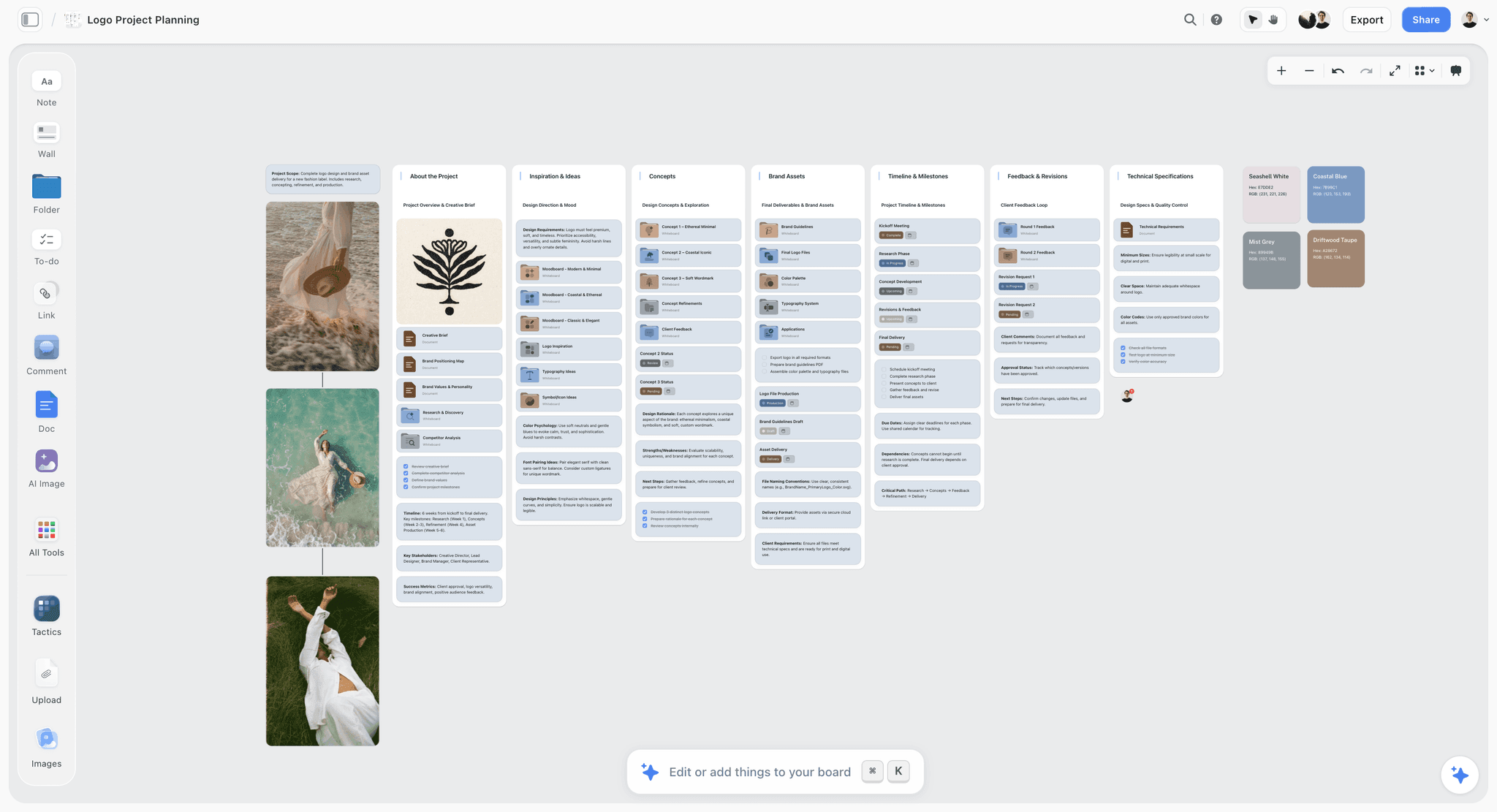
Storyflow is our own product and it ranks third, on the front-loading side rather than the responding side.
The round trips it targets are the ones that begin with somebody not having context. What did we decide about the second concept. Why is the palette warm when the brief said cool. What has already been rejected. In most teams each of those is a message to a specific person, a wait, and an answer that only that person could give, which makes them a bottleneck for everything.
Storyflow is a visual canvas where images, notes, links, and documents share a board, and the AI reads that whole board. So a collaborator arriving cold can ask the canvas rather than a colleague: what has been decided here, what is still open, what did this direction replace. That converts a round trip with a human into a query against a surface, which is the strongest form of elimination available, because it removes the dependency rather than shortening it.
It also helps with the timezone-shaped version of the problem. Somebody picking up work at the start of their day, when the rest of the team is asleep, either has enough context to proceed or loses the day. A readable canvas is what determines which.
The sharing model suits rotating creative collaborators: anyone a paid member invites to a board signs up free and can invite others, so freelancers do not require seat purchases for short engagements.
Where Storyflow loses
Four limitations, and the first two mean it never replaces the tools above it.
It is not a messaging tool. There is no channel, no DM, no notification stream for conversation. It does not replace Slack and does not try to; teams run it alongside whatever they already use to talk.
It has no video review. No timecoded comments, no version stacking, no frame-accurate feedback. For the single most expensive round trip in video work, Frame.io is the answer and this is not.
It is cloud-only, so a collaborator with no connection has no context at all, which is exactly the failure mode async work is supposed to be resilient to.
It is paid-only during early access, with the Free plan arriving before the end of 2026. Google Docs, email, and a written decision log cost nothing and eliminate a surprising share of round trips on their own.
Pricing: Plus $7.99/mo annual ($9.99 monthly) for the Story blueprints library and unlimited uploads. Pro $14/mo annual ($19 monthly) adds AI image generation, roughly 20 times the AI volume, and memory across conversations. Max $39/mo annual ($49 monthly) adds roughly 40 times the AI volume plus a team workspace with roles and permissions. Plus adds no AI volume over the trial allowance, so Pro is the real entry point if the AI reading is why you are here.
4. Notion
Notion is the strongest tool here on the retrieval side, which is the half that decides whether async gains compound or evaporate.
A written decision in Notion is searchable, linkable, quotable, and permanent. Six weeks later somebody finds it without asking anyone, which is the round trip that never happens and therefore never gets counted. Teams that write well in Notion have a genuinely different cost curve from teams that do not, and the difference is invisible in any given week.
Databases give structure to recurring async artifacts (decisions, briefs, project status), and permissions let clients and freelancers see exactly what they should.
Against it: writing is slow, and it is slowest exactly where creative work is most visual. Describing a spacing problem in a Notion page is worse in every way than a fifteen-second Loom. It also degrades quietly, because a workspace nobody prunes becomes a place where search returns nine outdated pages and one current one, which regenerates the round trips it was meant to remove.
Use it for conclusions and durable context, not for explaining visual changes.
Pricing: Free tier. Paid from around $10/month annual.
5. Figma
Figma does for design what Frame.io does for video: it kills the locating round trip by anchoring comments to a specific point.
A comment pinned to a coordinate on a specific frame is unambiguous. A comment in Slack saying "the card component on the pricing page feels cramped" is a hunt, then a confirmation, then an answer. The anchoring alone is worth more to async design teams than any number of notification improvements.
Version history and branching mean feedback attaches to a state rather than to a moving target, which stops the second round repeating the first.
Against it: it is design-file specific, so it handles one artifact type and nothing else. Non-designers can find it foreign enough that their feedback goes to Slack anyway, which quietly undoes the benefit, and getting clients to comment in Figma rather than by email is a recurring cultural battle.
Pricing: Free tier. Paid from around $16/editor/month; viewers and commenters are free, which matters here.
6. Linear
Linear earns a place because it eliminates one of the most frequent round trips in any distributed team: the status check.
When state is explicit and current, nobody has to ask how something is going. That single question, multiplied across a team and a week, is a substantial share of async messaging volume, and structured work tracking removes it rather than accelerating it.
It is fast, opinionated, and keyboard-driven in a way that means people actually keep it current, which is the failure mode of every other tracker.
For creative teams the fit is partial. It is built for software work, and creative deliverables map onto issues awkwardly: a video edit is not a ticket, and forcing it into one loses more than the structure gains. Teams with a production or engineering component get real value; pure creative studios usually find it foreign.
I evaluated this hands-on against these criteria rather than across a long creative engagement.
Pricing: Free tier. Paid from around $8/user/month.
7. Google Docs
Google Docs deserves its place on universality, which is an underrated async property.
Everyone can open it, including the client, the freelancer, and the stakeholder who refuses to make an account for anything. Comments and suggestions are understood by all of them without explanation, threading works, and version history is automatic and genuinely good. For a brief, a script, a decision log, or a set of notes, it removes round trips at zero cost and with zero adoption friction.
The adoption point is the whole argument. A better tool that a third of your collaborators will not open produces more round trips than a mediocre tool everyone already uses.
It is weak on structure at scale, poor for visual work, and a folder of documents becomes unsearchable without naming discipline. But a decision log in a Google Doc, kept current, outperforms most of the paid tools on this list for the specific job of preventing repeat questions.
Pricing: Free with a Google account, included with Workspace.
8. Slack
Slack is the most used async tool in creative teams and it ranks eighth, which requires an explanation rather than an apology.
What it does well is real: it is where the team already is, huddles and clips cover quick synchronous needs, and integrations mean other tools can push updates to where people look. Adoption is not a question.
The problem is structural against this article's criterion. Slack makes asking almost free, and when asking is free the round trip count rises. Rather than writing a brief that anticipates questions, people send a short message and handle the questions as they arrive, which feels efficient and is the most expensive pattern in distributed work. Then answers scroll away, so the same question gets asked again by the next person, generating a fresh cycle for an already-solved problem.
It is also a poor retrieval surface. Search technically works and practically fails, because the answer is one message inside a thread inside a channel with no title.
The fix is not to remove Slack. It is to treat it as conversation rather than record: decisions leave Slack and land somewhere durable the same day. Teams that do this get most of its benefits and few of its costs.
Pricing: Free tier with message history limits. Paid from around $7/user/month.
9. Miro
Miro is excellent live and mediocre async, and it is on this list to make that distinction concrete.
Async, a Miro board has weak notification of change, no currency signalling, and no linear order, so a contributor arriving alone frequently cannot tell what is new, what is agreed, or where they should add anything. Boards built in a facilitated session and left alone tend to be read once and abandoned.
Where it does help async is as a persistent artifact of a session that people can revisit, and its AI clustering can make a large board more approachable.
If your async need is a shared visual surface rather than a workshop record, the canvas comparison in the related reading covers that question directly.
Pricing: Free tier. Paid from around $8/member/month annual.
10. Email
Email is a serious async tool and its unfashionability is not an argument against it.
Its underrated property is that the medium enforces completeness. Because a reply costs a cycle and everyone knows it, people write fuller messages than they would in chat. That is exactly the front-loading behaviour this whole article argues for, produced by the format rather than by discipline.
It is also universal, permanently searchable, threaded, works with clients and freelancers with no onboarding, and has no seat cost.
Its weaknesses are equally real: no shared state, no anchoring to a specific point in an artifact, and threads that fork into parallel realities where two groups hold different conclusions. It is poor for anything visual or positional.
Included because a team that writes genuinely complete emails outperforms a team with excellent tooling and lazy handoffs, and that comparison goes the way people do not expect.
Pricing: Usually free or included.
11. A Decision Log
The eleventh entry is not software. It is a dated list of what was decided, why, and by whom, kept in whatever tool you already have.
It ranks here because it eliminates the highest-frequency round trip in creative work, which is somebody asking a question that was definitively answered weeks ago by people who have since moved on. That cycle is invisible in any tooling analysis because nobody logs it, and it is a genuinely large share of async messaging.
Five lines per decision, added the same day, in a document everyone can open. It costs nothing, requires no procurement, and is the single highest-leverage change most distributed creative teams can make.
Its limits: somebody has to maintain it, it goes stale silently if nobody does, and it captures conclusions rather than nuance. Pair it with the richer formats above, which is the pairing this article keeps arguing for.
Pricing: Free.
What to Actually Pay For
Pay for ambiguity collapse in your main artifact. If you work in video, Frame.io. If you work in design files, Figma's commenting. This is where money most directly removes cycles.
Pay for Loom if your work is visual. It is the cheapest round trip elimination available and it is not close for creative disciplines.
Do not pay to make messaging faster. Latency is the small variable. Tools sold on speed of conversation are optimising the wrong term.
Count viewer and commenter seats before choosing. Figma commenters are free; several alternatives charge for them. Across clients and freelancers this changes the total substantially.
Spend the free fix first. A decision log and a habit of titling recordings as answers cost nothing and remove more round trips than most subscriptions.
Tools to Avoid for This Job
A group chat as the record. Answers scroll away, so the same question regenerates a cycle every time a new person needs it.
Meetings scheduled to resolve ambiguity that a Loom would fix. A recurring sync that exists because handoffs are unclear is the round trip problem wearing a calendar invite.
Untitled screen recordings. They eliminate today's cycle and create tomorrow's, which is moving cost rather than removing it.
A second messaging tool. Fragmenting conversation across two apps guarantees that half the team misses half the answers.
What No Tool on This List Does
None of them make people write complete handoffs. Every tool here supports a thorough brief and none requires one. The difference between a team that needs one round trip and one that needs six is almost entirely a writing habit, and no purchase installs it.
None of them tell you a decision has been superseded. Storyflow gets closest, because you can ask a canvas which of its conclusions conflict, and that still requires somebody to think to ask. Stale answers look exactly like current ones in every tool here, and acting on a superseded decision is more expensive than any round trip.
None of them fix a timezone overlap of zero. Tools reduce how many cycles you need; they cannot make a cycle faster than the offset. Below about two hours of overlap, teams need to change how they scope handoffs, and that is a management decision rather than a software one.
The Bottom Line
Async collaboration is sold as a time zone problem and bought as a messaging problem, and it is neither. It is a round trip problem.
Every cycle of ask, wait, answer, act is the unit of cost, and across an offset each one is roughly a day. Which means the tools worth paying for are the ones that remove cycles: by front-loading context so the question never gets asked, or by making feedback so unambiguous that the answer lands the first time.
Loom ranks first because showing collapses more cycles than writing ever will, and creative work is stubbornly visual. Frame.io ranks second because a timecode ends the most expensive recurring cycle in video work. Storyflow, which we make, ranks third for keeping project context readable enough that a colleague is not the only source of truth, and it is not a messaging tool, has no video review, and is cloud-only.
Then do the free things, which beat most of the paid ones: keep a dated decision log, title your recordings as answers, and write the handoff as though nobody can ask you anything for the next eight hours.
Time zones do not kill async work. Round trips do.
FAQ: Async Collaboration Tools for Creative Teams
What are the best async collaboration tools for creative teams in 2026?
Loom for explaining visual work without a meeting, Frame.io for video feedback with timecodes, and Storyflow, which is our own product, for keeping project context readable so people do not have to ask. Most effective setups combine a rich-media tool for explanation with a written surface for conclusions.
What is the best free async collaboration tool?
Google Docs plus a dated decision log, which costs nothing and prevents more repeat questions than most paid tools. Loom's free tier is genuinely usable for individuals. Storyflow is paid-only during early access, so it does not belong in a free comparison.
How do you make async work faster for creative teams?
Reduce the number of round trips rather than the speed of each one. Front-load context so questions do not need asking, and make feedback unambiguous (timecodes, anchored comments, screen recordings) so an answer lands the first time. Faster notifications do almost nothing.
Is Slack good for async collaboration?
It is where the team already is, which counts for a lot, but it works against the thing that matters. Free messaging encourages asking instead of front-loading, which raises the round trip count, and answers scroll away so the same question recurs. Use it for conversation and move decisions somewhere durable the same day.
How do you give creative feedback asynchronously?
Anchor it to a location: a timecode, a pinned comment, or a screen recording where you point at the thing. Then say what the problem is and what outcome you want, rather than prescribing a fix. Unanchored prose feedback is the single largest generator of avoidable round trips in creative work.
Is Storyflow good for async collaboration?
For the front-loading half, yes, and that is why we rank it third. Its AI reads the whole canvas, so a collaborator arriving cold can ask what has been decided and what is open instead of messaging a colleague and waiting. It is not a messaging tool, has no video review or timecoded comments, and is cloud-only, so it sits alongside Slack and Frame.io rather than replacing them.
How much timezone overlap does a creative team need?
Less than most teams assume, if handoffs are complete. Two to three hours of overlap is comfortable with good written context. Below that, work needs to be scoped so each person can complete a meaningful unit without waiting, which is a planning change rather than a tooling one.
Are Loom videos better than written updates?
For explaining visual or positional things, yes and substantially. For conclusions people will need to reference again, no, because video is the least searchable format there is. The reliable pattern is a recording for the reasoning and three written lines for the decision.
How do you stop asking the same questions repeatedly?
Keep a dated decision log and put answers there the day they are decided. Most repeat questions are not knowledge gaps, they are retrieval failures: the answer exists in a thread nobody can find. Five lines in a document everyone can open removes the cycle permanently.
What is the biggest mistake creative teams make with async?
Treating async as synchronous work with delays, so handoffs stay as thin as they would be in an office where clarification is four minutes away. Across eight hours that same thin handoff costs a day. The handoff has to carry the context the conversation would have supplied.
Do async tools replace meetings?
They replace status meetings and most clarification meetings, which is where the value is. They do not replace decisions with genuine disagreement, or conversations that need trust and nuance. Trying to run a hard creative disagreement entirely async usually costs more than the meeting would have.
What is the single change worth making to how our team works async?
Write the handoff as though the person receiving it cannot ask you anything, because functionally they cannot for the next eight hours. That one habit does more than every tool on this list combined.
Table of Contents
- Key Takeaways
- The Round Trip
- At a Glance: The 11 Tools Compared
- How I Ranked These
- The Retrieval Debt Problem
- Quick Picks by Situation
- 1. Loom
- 2. Frame.io
- 3. Storyflow
- 4. Notion
- 5. Figma
- 6. Linear
- 7. Google Docs
- 8. Slack
- 9. Miro
- 10. Email
- 11. A Decision Log
- What to Actually Pay For
- Tools to Avoid for This Job
- What No Tool on This List Does
- The Bottom Line
- FAQ: Async Collaboration Tools for Creative Teams
- Related Reading
Templates to check out for this topic


Planning and project templates you can use in Storyflow
Plan a launch, a sprint, or a whole project on a visual board the team can see at once. Open one of these templates and start from real structure.


See Storyflow in Action
A visual AI workspace where every feature lives inside one canvas. No tab-switching, no context lost.
Build your entire board from a single message
Type what you need in the AI chat at the bottom of your canvas. The AI adds cards, headings, and structure directly onto your board.
Use expert frameworks as AI context
Type @ in the AI chat and choose any Tactic. The AI tailors every response to that framework instead of giving generic advice.
Turn your board into a mind map in seconds
Ask the AI to restructure your canvas as a mindmap. It connects your ideas into a visual hierarchy so you can see how everything relates.
Why Storyflow Exists
Storyflow actually began as a personal tool while working on creative and research projects.
We kept running into the same problem: ideas were scattered everywhere: notes, documents, and whiteboards.
Nothing helped us see how everything connected.
So we started building a workspace designed around how ideas actually grow.
→ Read how Storyflow was createdSara de Klein
Head of Product at Storyflow
Published: 2026-08-12
Extremely simple, seriously capable


See how easy it is to get started
Watch a real project come together, from a blank board to a finished plan, clicked through step by step.
Start creating with AI and become more productive
Transform your creative workflow with AI-powered tools. Generate ideas, create content, and boost your productivity in minutes instead of hours.