
Category
Project Management
Author

Justkay
Documentary Filmmaker & Founder at Storyflow
Topics
2026-05-18
•
Updated May 18, 2026
•
15 min read
•
Project Management- best AI tools for product managers 2026
- AI tools for product managers
- AI for product management
- AI for PRDs
- AI for product roadmaps
- AI for product discovery
What are the best AI tools for product managers in 2026?
The best AI tools for product managers in 2026 are Storyflow (best for the discovery and strategy canvas where the AI reads your full board), Claude (best for PRDs and product writing), Productboard (best for AI-clustered customer feedback and roadmaps), and Jira with Atlassian Intelligence (best for engineering delivery). Most working PMs run three or four tools, one per phase of the job.

All 12 AI Tools for Product Managers, Ranked
- Storyflow: best for the discovery and strategy canvas where the AI reads your full board
- Claude: best for PRDs, specs, and nuanced product writing
- ChatGPT: best for fast ideation, drafts, and custom GPTs
- Productboard: best for AI-clustered customer feedback and roadmaps
- Jira (Atlassian Intelligence): best for engineering delivery and sprint execution
- Perplexity: best for sourced market and competitor research
- Linear: best for fast issue tracking with triage AI
- Dovetail: best for an AI-tagged user research repository
- Notion AI: best for docs and wikis with AI inside
- Miro AI: best for workshop and journey-mapping canvases
- FigJam AI: best for lightweight diagramming and brainstorming
- ClickUp Brain: best for an all-in-one PM workspace with AI
Full disclosure: Storyflow is our own product, and we rank it #1 for one job: the discovery and strategy canvas, where the AI reads your whole board instead of a single prompt. For writing PRDs and specs Claude is stronger, and for AI-clustered customer feedback and roadmaps Productboard is purpose-built. Storyflow is not an engineering delivery tool, so for sprints and issue tracking you still need Jira or Linear. We link to every tool so you can judge the fit.
Quick Comparison: Best AI Tools for Product Managers
These four cover the jobs PMs switch between: discovery and strategy, writing PRDs and specs, fast ideation and drafts, and customer feedback and roadmaps.
| Tool | Best For | AI Features | Price |
|---|---|---|---|
| Storyflow | Discovery and strategy canvas | Canvas AI reads your full board | $7.99 mo annual (free plan late 2026) |
| Claude | PRDs, specs, and product writing | Claude chat with large context | Free / $20 mo |
| ChatGPT | Fast ideation and custom GPTs | GPT chat with custom GPTs | Free / $20 mo |
| Productboard | AI-clustered feedback and roadmaps | AI feedback clustering | Free / $19 maker mo |
1) Quick Answer: The Best AI Tools for Product Managers in 2026
The best AI tools for product managers in 2026 are Storyflow (best for the discovery and strategy canvas where the AI reads your full board), Claude (best for PRDs and product writing), Productboard (best for AI-clustered customer feedback and roadmaps), and Jira with Atlassian Intelligence (best for engineering delivery). Storyflow stands out because the AI reads your entire active canvas, the research notes, the persona clusters, the strategy map, instead of the one prompt fragment you pasted into a chat tab.
The short version: for fast drafts, ChatGPT or Claude. If customer feedback is the bottleneck, Productboard or Dovetail. If delivery is the bottleneck, Jira or Linear. For a visual canvas where discovery and strategy live, Storyflow. Most working PMs run three or four together.
For adjacent reading, see Mind Mapping for Product Managers in 2026 and The Best AI Project Management Tools in 2026.
2) Comparison Table: 12 AI Tools for Product Managers Compared
Rating criteria: Tested across the five phases of the product job (discovery, strategy, roadmapping, specs, delivery), rated on whether they moved real work forward, not demo polish. Pricing verified in May 2026; AI features and credit limits change often, so verify current terms.
3) Why PMs Need a Different AI Stack
A product manager and a marketer can both use AI to write, yet their stacks should look nothing alike. Three structural facts about the PM job shape which tools earn a slot.
Product work is phase-shaped, not document-shaped. The job runs through five phases: discovery, strategy, roadmapping, specs, and delivery. A chat tool handles a slice of one phase. The PM stack needs coverage across all five, which is why most PMs run three or four tools.
Product work has a context layer. A PRD is only as good as the discovery behind it; a roadmap is only as good as the strategy behind it. The AI that does not see the customer interviews, the persona clusters, and the strategy map produces a confident PRD for the wrong problem. The expensive PM mistake is not a slow draft. It is a fast draft of the wrong thing.
Product work is visual before it is verbal. A PM thinks in journey maps, opportunity trees, and persona clusters before any of it becomes a document. Tools that only read text are blind to most of discovery and strategy.
The familiar approach is to open ChatGPT, paste a few interview quotes, and ask for a PRD. It works for a first paragraph and fails the moment the PRD needs to reflect six interviews and last week's strategy bet. The product approach is to build the discovery and strategy on a canvas, then let the AI read all of it before it writes anything.
For the architectural argument, see The Single-Prompt Fallacy.
4) How We Evaluated These Tools
Every tool here was tested against the real product job, not synthetic prompts. The lens is the five-phase PM stack: discovery, strategy, roadmapping, specs, delivery. Five criteria:
- Phase coverage and depth. Which phases does the tool serve, and how deeply? A tool that does one phase well beats a tool that does five shallowly.
- Context scope. Does the AI read the project context (research, strategy, prior decisions), or only the current prompt? This separates a draft for the right problem from a plausible one for the wrong problem.
- Time saved versus rework. Did the output ship, or did fixing it take longer than writing it cold? A 2025 Productboard survey of 379 enterprise product professionals found 94% of PMs use AI daily and report saving around four hours per task.
- Fit with how PMs already work. Does the tool slot into the existing stack, or demand a migration?
- Pricing transparency at team scale. Several PM tools moved AI behind credit systems or paid add-ons in 2026.
5) Quick Picks by PM Phase
If you want the short list, organize by phase of the product job.
Discovery (interviews, feedback, signals): Storyflow for the research canvas where notes, quotes, and persona clusters live together and the AI reads all of it. Dovetail for a dedicated AI-tagged repository. Perplexity for sourced market research.
Strategy (positioning, bets, the why): Storyflow for the strategy canvas with frameworks from the Story Blueprints library. Claude for pressure-testing a strategy narrative.
Roadmapping (sequencing and trade-offs): Productboard for AI-clustered feedback feeding a prioritized roadmap. Storyflow for the visual roadmap sketch. See The Best Roadmap Tools in 2026.
Specs (PRDs, acceptance criteria): Claude for nuanced PRD drafting. ChatGPT for fast first drafts and custom GPTs. Notion AI if your specs live in Notion.
Delivery (tickets, sprints, status): Jira with Atlassian Intelligence for engineering execution at scale. Linear for fast, low-friction issue tracking.
Workshops and Mapping: Miro AI for collaborative journey mapping. FigJam AI for lightweight diagramming alongside design.
6) Detailed Reviews: 12 AI Tools for Product Managers in 2026
1. Storyflow
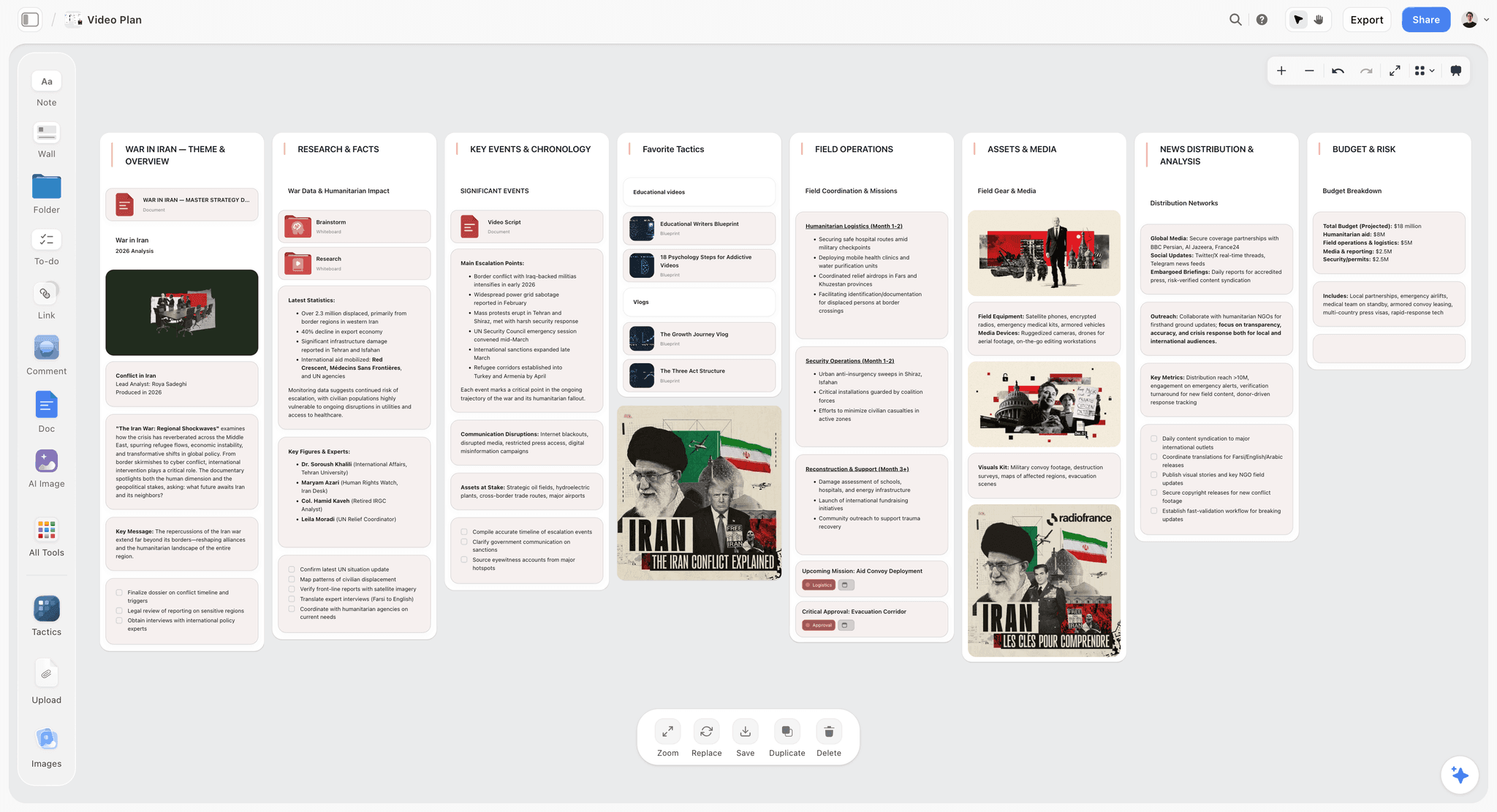
Storyflow is a visual workspace where the AI reads your full active canvas board, so discovery notes, persona clusters, and the strategy map all feed the same AI in one place. It is the pick for the discovery-and-strategy half of the PM job.
Best for: Product managers running discovery and strategy, founders doing product, and small teams who think visually before they think in documents.
Verdict: The strongest AI tool for the discovery and strategy phases. Not a ticketing or roadmap-database tool, so it pairs with Jira or Productboard.
Key features
- Board-aware AI by default. The AI reads the full active canvas board (interview notes, quotes, persona clusters, opportunity tree, strategy map). Add up to 1 Tactic and up to 3 Documents via @-mention for extra grounding.
- 200+ Story Blueprints on Plus and above. The blueprint library includes product strategy frameworks you can drop onto the canvas and work inside. Free does not include the 200+ library.
- Multi-format canvas. Notes, images, links, mind maps, and clustered sticky notes on one infinite board.
- Unlimited shared boards and collaboration on every plan. The Max plan adds a team workspace with permissions and roles.
Pricing
Free: launching before the end of 2026; invited collaborators of paid members join free today. Unlimited notes, images, links, unlimited shared boards, unlimited collaboration, basic AI, 20 file uploads. Plus: $7.99/mo annual or $9.99/mo monthly (200+ Story Blueprints, unlimited uploads). Pro: $14/mo annual or $19/mo monthly (adds AI image generation, 20x more AI than Plus). Max: $39/mo annual or $49/mo monthly (adds 40x more AI plus a team workspace with permissions and roles).
Pros
- The AI reads the full discovery-and-strategy canvas, so drafts and summaries stay grounded in your real product context.
- The free plan is genuinely usable for discovery: unlimited boards, unlimited collaboration, basic AI, no credit card.
- Cheaper at the entry tier than most dedicated PM tools, covering two phases where the rest of the stack is weak.
Cons
- Storyflow is not a ticketing or sprint tool; pair it with Jira or Linear for engineering execution.
- No native roadmap or release database like Productboard; it handles the visual sketch, not the structured release plan.
- Cloud-only, a newer platform with a smaller ecosystem, and built for individuals and small teams rather than large product orgs.
2. Claude (Anthropic)
Claude is the strongest pure-chat AI for product writing in 2026. The pick when the job is a PRD, a strategy narrative, or a careful spec.
Best for: PRD drafting, spec writing, acceptance criteria, and summarizing dense research.
Verdict: The strongest pure-chat AI for the specs phase. The chat substrate still loses project context across long cycles.
Pricing: Claude Pro: $20/mo. Higher tiers for heavier use. Free tier with daily message limits. Verify current tiers on Anthropic's pricing page.
Pros: Frequently rated the best AI for the careful writing PRDs demand; calibrated tone, less prone to hype; the Projects feature gives persistent context.
Cons: Chat substrate loses wider product context across a multi-month cycle; no native roadmap, ticket, or research-repository structure; smaller ecosystem than ChatGPT.
3. ChatGPT
ChatGPT is still the broadest AI tool a PM reaches for in 2026. The pick for fast ideation, quick drafts, and custom GPTs.
Best for: First-draft PRDs, brainstorming, competitive teardown summaries, and custom GPTs for recurring tasks.
Verdict: The default AI most PMs already use. Capable, just the wrong shape for context-heavy work that spans weeks.
Pricing: ChatGPT Plus: $20/mo. Higher tier for heavy use. Free tier with daily limits. Verify current tiers on OpenAI's pricing page.
Pros: Broadest ecosystem, slotting into almost any PM workflow; custom GPTs let a team encode its PRD format once; fast for one-off generation.
Cons: Loses context on multi-turn product work, covered in Why ChatGPT Loses the Plot; no native product structure (roadmap, research repo, tickets); PRD quality depends on how much context you paste in.
4. Productboard
Productboard is the dedicated product-management platform built around customer feedback, prioritization, and roadmaps. Its AI clusters feedback into themes so the roadmap reflects real signal, not the loudest stakeholder.
Best for: Product teams whose bottleneck is making sense of high-volume customer feedback and tying it to a defensible roadmap.
Verdict: The strongest tool for the roadmapping phase when feedback volume is high. Overkill for a solo PM or small team.
Pricing: Starter: free tier. Essentials: $19/maker/month annual. Spark, the AI-focused plan: $15/maker/month annual or $19 monthly. Pro: $59/maker/month annual. Enterprise: custom. Only "makers" (editors) are paid seats.
Pros: AI feedback clustering (themes, topics, and the Pulse voice-of-customer layer) reduces manual triage at scale; the roadmap stays connected to customer insights; strong for orgs that have outgrown spreadsheets.
Cons: Per-maker pricing scales steeply for larger teams; heavy for a solo or early-stage team; it is a roadmap-and-feedback system, not a discovery canvas or spec tool.
5. Jira (Atlassian Intelligence)
Jira with Atlassian Intelligence is the engineering-delivery backbone for most product teams. The AI drafts issues, summarizes threads, and writes JQL inside the tool engineers already live in.
Best for: Product managers whose delivery phase runs through engineering teams already on Jira.
Verdict: The strongest tool for the delivery phase at scale. A delivery system, not a discovery or strategy tool.
Pricing: Free for up to 10 users. Atlassian Intelligence and Rovo (search, chat, agents) are bundled into Standard, Premium, and Enterprise plans, each with a monthly AI credit allowance (more on higher tiers). As of May 2026 Atlassian was not billing for usage above the included allowance.
Pros: The AI is woven into the tool engineers already use, so adoption friction is low; issue drafting and thread summarization save real time; bundled AI credits mean no separate AI line item on most plans today.
Cons: Jira is a delivery tool, doing little for discovery or strategy; the credit system adds cost uncertainty once overage billing begins; Jira feels heavy for small teams. See The Best Jira Alternatives in 2026.
6. Perplexity
Perplexity is the answer engine that ships every response with sources. For PMs, it is the fastest path to sourced market sizing and competitor research.
Best for: Market research, competitive analysis, and any discovery work that needs citations to survive a stakeholder review.
Verdict: The strongest research-grade AI for the discovery phase. Citations are the feature; it is not built for writing or roadmapping.
Pricing: Perplexity Pro: $20/mo. Free tier with limited Pro searches. Verify current tiers on Perplexity's site.
Pros: Citations matter when a PM pitches a market opportunity to leadership; strong on "what is the latest on X" queries where a chat tool goes stale; Pro Search is a real time-saver for competitive teardowns.
Cons: Not built for generation, so pair with Claude or ChatGPT; Spaces are lighter than a real canvas or research repository; the free tier limits Pro Search heavily.
7. Linear
Linear is the fast, opinionated issue tracker product and engineering teams choose for low-friction delivery. Its AI handles triage, search, and routing so the backlog stays sane.
Best for: Product teams that want delivery tooling with less configuration weight than Jira.
Verdict: The strongest lightweight delivery tool. A delivery tool, not a discovery, strategy, or roadmap tool.
Pricing: Free: unlimited members, up to 250 issues, 2 teams. Basic: $10/user/month annual. Business: $16/user/month, where the full AI (Triage Intelligence, semantic search, MCP agents) and unlimited teams unlock. Enterprise: custom. Linear cut its Business tier sharply in early 2026, so verify current pricing.
Pros: Genuinely low-friction, adopted without a rollout project; triage AI keeps the backlog from drowning the team; aggressive 2026 price cuts made the AI tier far more affordable.
Cons: A delivery tool only, with no discovery, strategy, or research features; lighter roadmap capabilities than a dedicated platform; the 250-issue Free cap is reached quickly.
8. Dovetail
Dovetail is the dedicated user-research repository. Its AI tags and clusters interview transcripts and feedback so insights stay findable instead of decaying in scattered docs.
Best for: Product teams with a continuous-discovery practice and enough research volume to need a real repository.
Verdict: The strongest dedicated research repository for the discovery phase. Built for one phase, and priced for teams that need it.
Pricing: Free plan available. Professional: around $39/user/month as of a May 2026 update, with Channels for data ingestion priced separately. Enterprise: custom.
Pros: AI tagging makes a large research corpus searchable; insights stay linked to source quotes, protecting against cherry-picking; strong for dedicated UX research teams.
Cons: Per-user pricing scales quickly as PMs, designers, and researchers all need access; single-phase, not a strategy, roadmap, or spec tool; overkill for a team without a steady research cadence.
9. Notion AI
Notion AI is the AI inside Notion docs, wikis, and databases. For PMs whose PRDs and product wikis already live in Notion, it brings AI to the knowledge base.
Best for: Product teams who run their specs, wikis, and meeting notes in Notion.
Verdict: Solid if you already live in Notion. Less compelling as a standalone PM AI tool.
Pricing: Free and Plus get a limited AI trial. The full AI suite (Notion Agent, AI search, AI meeting notes) is bundled into Business at $20/user/month annual ($24 monthly); Enterprise is custom. Custom Agents bill on a credit system as of May 2026.
Pros: Best AI experience for Notion-native teams; AI meeting notes and enterprise search are useful for PM admin; the doc-and-database model fits some teams well.
Cons: Doc-shaped, not canvas-shaped, so visual discovery work is awkward; the full AI suite sits behind the $20 Business tier plus credit-metered agents; the AI works on a page, not the whole product context.
10. Miro AI
Miro AI is the AI layer inside Miro's collaborative whiteboard. For PMs, it speeds up workshop facilitation, journey mapping, and turning sticky notes into structured output.
Best for: Product managers who run live discovery workshops and journey-mapping sessions.
Verdict: The strongest tool for collaborative workshops. Whiteboard-first, so it is weaker for sustained solo PM work.
Pricing: Free: 3 boards, 10 AI credits/month. Starter: $8/user/month annual, 25 credits. Business: $20/user/month annual, 50 credits and AI Workflows (Sidekicks and visual Flows). Enterprise: custom, 30-seat minimum.
Pros: Excellent for live, multiplayer workshops; AI clustering turns a messy sticky-note board into structured output fast; a deep template library lowers setup time.
Cons: AI is metered by credits, and the Free and Starter allowances are small; whiteboard-first, not a roadmap, repository, or spec tool; best in live sessions, not a solo daily driver.
11. FigJam AI
FigJam AI is the AI inside Figma's lightweight whiteboard. For PMs who work closely with design, it is a low-friction surface for diagramming and quick flows.
Best for: Product managers embedded with a design team already on Figma.
Verdict: A solid lightweight whiteboard for PM-and-design collaboration. Not a full PM tool.
Pricing: FigJam runs roughly $3 to $5/user/month on Professional, or via Collab seats at $5/month on higher tiers. The free Starter plan includes up to 3 FigJam files. Figma AI features draw on a monthly credit allowance, strictly enforced as of March 2026.
Pros: Cheap and frictionless for PM-and-design collaboration; sits next to design files; the free tier is enough to evaluate it.
Cons: Lightweight by design, not a discovery repository, roadmap, or spec tool; AI is metered by Figma's strictly enforced credit system; value drops sharply outside the Figma ecosystem.
12. ClickUp Brain
ClickUp Brain is the AI layer inside ClickUp's all-in-one work platform. For PMs who want tasks, docs, and roadmaps in one tool, Brain adds AI across it.
Best for: Small product teams that want a single all-in-one workspace rather than a stack of specialized tools.
Verdict: Reasonable for all-in-one teams. The AI is an add-on, and the breadth costs depth in any single phase.
Pricing: ClickUp's core plans run from Free to around $12/user/month. ClickUp Brain is a paid add-on: AI Standard at $9/user/month annual, or AI Autopilot at $28/user/month annual. The Free plan gets a Brain trial only.
Pros: Everything in one platform, which suits small teams that dislike tool sprawl; the AI covers tasks, docs, and updates in one place; competitively priced core plans.
Cons: The AI add-on raises the per-user cost; all-in-one breadth means no single phase gets best-in-class depth; can feel heavy for a PM who wants a focused tool.
For the broader comparison, see The Best AI Project Management Tools for Creative Teams in 2026.
7) PM-Type Recommendations
1. Solo PM / Founder Doing Product
Top picks: Storyflow + ChatGPT
Storyflow for the discovery-and-strategy canvas where interviews, persona clusters, and the strategy map live. ChatGPT for fast PRD drafts. The minimum viable stack for one person, mostly free-tier.
2. Discovery-Focused PM
Top picks: Storyflow + Dovetail + Perplexity
Storyflow for the canvas where raw research becomes clustered insight. Dovetail for a dedicated AI-tagged repository once volume is high. Perplexity for sourced market and competitor research.
3. Roadmapping / Prioritization PM
Top picks: Productboard + Storyflow
Productboard for AI-clustered feedback feeding a prioritized roadmap. Storyflow for the visual roadmap sketch and the strategy reasoning behind the sequence.
4. Delivery-Focused PM
Top picks: Jira (Atlassian Intelligence) + Claude
Jira for engineering execution with AI-drafted issues and thread summaries. Claude for the PRDs and acceptance criteria that feed delivery.
5. PM at a Fast Startup
Top picks: Linear + Storyflow + Claude
Linear for low-friction delivery with triage AI. Storyflow for discovery and strategy. Claude for specs. A lean stack with no heavy configuration.
6. PM Embedded With Design
Top picks: FigJam AI + Storyflow + Claude
FigJam AI for lightweight collaboration next to design files. Storyflow for the deeper discovery-and-strategy canvas. Claude for PRDs.
8) Honorable Mentions
A few tools that came close but did not make the main twelve:
- ChatPRD: A focused AI tool for PRD writing, purpose-built for the spec phase.
- Amplitude / Mixpanel AI: Product analytics with AI querying, essential for the measurement phase.
- Aha!: A roadmap and strategy platform, a heavier Productboard alternative.
- Asana Intelligence: Solid work-management AI, less product-specific than Jira or Linear.
- Whimsical: A clean diagramming and flow tool, lighter than Miro for journey maps.
- Gemini: A capable general AI, strong if your org is on Google Workspace.
Their phase coverage is narrower than the main list.
9) Where AI Does Not Help PMs Yet
Honest accounting matters. There are parts of the product job where AI is still weak.
- The actual prioritization call. AI scores features and surfaces trade-offs. The decision about what ships next, under real constraints and politics, is human judgment.
- Talking to customers. AI summarizes transcripts well. It does not replace sitting across from ten customers a quarter and hearing the thing they did not know how to say.
- Reading the room. Stakeholder alignment, executive buy-in, and team morale are relationship work.
- Original product strategy. AI pressure-tests a strategy. The bet itself, the non-obvious wedge into a market, comes from human insight.
- Knowing which problem is worth solving. AI will happily draft a perfect PRD for a problem that does not matter. Choosing the right problem is the core PM skill.
- Owning the outcome. AI has no accountability. When the launch misses, a person carries it.
The right AI use is upstream (research synthesis, strategy structure, draft generation) and downstream-supporting (status summaries, ticket drafting). The middle, the judgment calls, stays with the PM.
11) The Bottom Line
The best AI tool for product managers in 2026 depends on which phase of the job is the bottleneck. Storyflow is the strongest pick for the discovery and strategy canvas. Claude is strongest for PRDs and specs. Productboard is strongest for AI-clustered feedback and roadmaps. Jira with Atlassian Intelligence is strongest for engineering delivery. Perplexity is strongest for sourced research.
Most working PMs run three or four tools, one per phase. The thread running through all of it is context. The expensive PM mistake is not a slow draft. It is a fast draft of the wrong thing. The AI tools worth paying for are the ones that see enough of your product context to keep you working on the right problem. The judgment stays yours.
To test the architecture, take one active initiative and rebuild its discovery and strategy on a Storyflow canvas for two weeks. Generate a customer persona with AI to seed the discovery, then start a Storyflow workspace.
10) FAQ: AI Tools for Product Managers in 2026
What is the best AI tool for product managers in 2026?
It depends on the phase. For the discovery and strategy canvas, Storyflow. For PRDs and specs, Claude. For AI-clustered feedback and roadmaps, Productboard. For engineering delivery, Jira with Atlassian Intelligence. Most working PMs run three or four tools, one per phase.
Are AI tools actually worth it for product managers?
Yes, with realistic expectations. A 2025 Productboard survey of 379 enterprise product professionals found every respondent uses AI tools, 94% daily, and PMs report saving around four hours per task. The savings are real for research synthesis, drafting, and admin, not for the judgment calls.
What is the best free AI tool for product managers?
Storyflow's Free plan, which launches before the end of 2026, will be the strongest free option for discovery and strategy: unlimited boards, unlimited collaboration, basic AI, and 20 file uploads. Claude and ChatGPT have free tiers with daily limits. Linear's free plan covers light delivery up to 250 issues.
Which AI tool is best for writing PRDs?
Claude is the strongest for nuanced PRD and spec writing, with reliable structured output for user stories and acceptance criteria. ChatGPT is faster for first drafts. The catch with both is context: a PRD is only as good as the discovery behind it, the gap a canvas tool like Storyflow closes.
Which AI tool is best for product roadmaps?
Productboard is the strongest for roadmaps tied to AI-clustered customer feedback, suited to teams with high feedback volume. For the visual roadmap sketch before it becomes a structured database, Storyflow works well.
Will AI replace product managers?
No. AI is replacing specific tasks (transcript summarization, ticket drafting, status updates, first-draft PRDs) and amplifying others (research synthesis, strategy pressure-testing). The core PM job, choosing the right problem, making the call, aligning stakeholders, and owning the outcome, stays human.
Is ChatGPT enough for a product manager?
For fast drafts and brainstorming, yes. For context-heavy work where a PRD must reflect six interviews and last week's strategy bet, no. ChatGPT loses that context across long cycles. Pair it with a tool that holds the project context.
Where does Storyflow lose for product managers?
Storyflow is not a ticketing or sprint tool, so engineering execution belongs in Jira or Linear. It has no native roadmap or release database like Productboard. It is cloud-only, it is a newer platform with a smaller ecosystem, and it is built for individuals and small teams rather than large product orgs with deep governance needs. It is the discovery and strategy layer, not the whole stack.
Which AI tool is best for user research?
Dovetail is the strongest dedicated research repository, with AI tagging across transcripts and feedback, suited to teams with a steady research cadence. Perplexity is best for sourced secondary research. Storyflow works well for the discovery canvas where raw research becomes clustered insight.
What is the smallest test I can run?
Take your most active initiative currently running through ChatGPT context-pasting. Move the interview notes, persona clusters, and a competitor teardown onto a Storyflow canvas, the free tier is enough. Ask the AI three questions on the canvas instead of in a chat tab. Most PMs see the difference within an hour. Try a Storyflow workspace.
Table of Contents
- Quick Answer: The Best AI Tools for Product Managers in 2026
- Comparison Table: 12 AI Tools for Product Managers Compared
- Why PMs Need a Different AI Stack
- How We Evaluated These Tools
- Quick Picks by PM Phase
- Detailed Reviews: 12 AI Tools for Product Managers in 2026
- PM-Type Recommendations
- Honorable Mentions
- Where AI Does Not Help PMs Yet
- FAQ: AI Tools for Product Managers in 2026
- The Bottom Line
- Author
- Related Reading
Templates to check out for this topic


Planning and project templates you can use in Storyflow
Plan a launch, a sprint, or a whole project on a visual board the team can see at once. Open one of these templates and start from real structure.


See Storyflow in Action
A visual AI workspace where every feature lives inside one canvas. No tab-switching, no context lost.
Build your entire board from a single message
Type what you need in the AI chat at the bottom of your canvas. The AI adds cards, headings, and structure directly onto your board.
Use expert frameworks as AI context
Type @ in the AI chat and choose any Tactic. The AI tailors every response to that framework instead of giving generic advice.
Turn your board into a mind map in seconds
Ask the AI to restructure your canvas as a mindmap. It connects your ideas into a visual hierarchy so you can see how everything relates.
Why Storyflow Exists
Storyflow actually began as a personal tool while working on creative and research projects.
We kept running into the same problem: ideas were scattered everywhere: notes, documents, and whiteboards.
Nothing helped us see how everything connected.
So we started building a workspace designed around how ideas actually grow.
→ Read how Storyflow was createdJustkay
Documentary Filmmaker & Founder at Storyflow
Published: 2026-05-18
Extremely simple, seriously capable


See how easy it is to get started
Watch a real project come together, from a blank board to a finished plan, clicked through step by step.
Start creating with AI and become more productive
Transform your creative workflow with AI-powered tools. Generate ideas, create content, and boost your productivity in minutes instead of hours.