
Category
Product
Author

Justkay
Documentary Filmmaker & Founder at Storyflow
Topics
2026-05-18
•
Updated May 18, 2026
•
13 min read
•
Product- what is product strategy
- product strategy guide
- product strategy framework
- vision vs strategy vs roadmap
- product strategy elements
- Rumelt strategy kernel
What is product strategy?
Product strategy is the set of deliberate choices that explain how a product will win: which customer it serves, which problem it solves, how it stands apart from alternatives, and which business outcome it drives. It connects the long-range product vision to the near-term roadmap. A real product strategy is not a feature list or a backlog. It is a diagnosis of the situation, a guiding policy for how to act, and a coherent set of actions that reinforce each other.
1) Quick Answer: What is Product Strategy?
Product strategy is the set of deliberate choices that explain how a product will win: which customer it serves, which problem it solves, how it stands apart from alternatives, and which business outcome it drives. It connects the long-range product vision (the future you are building toward) to the near-term roadmap (the work you ship next). A real product strategy is not a list of features or a backlog. It is a diagnosis of the situation, a guiding policy for how to act, and a coherent set of actions that reinforce each other.
The simplest test of whether you have a strategy: it should tell you what to say no to. A roadmap is not a strategy. A roadmap lists what you will build. A strategy explains why that work, for that customer, beats every other thing you could have built instead. If your "strategy" is a timeline of features with no underlying logic about who you serve and how you win, you have a plan, not a strategy.
This guide separates vision, strategy, and roadmap, walks through the named frameworks product leaders actually use (Richard Rumelt's strategy kernel, Marty Cagan and the Silicon Valley Product Group, Roman Pichler's product vision board, Melissa Perri's build trap), and gives a step-by-step process for building a strategy from scratch.
I build Storyflow, a visual workspace used by founders and product teams to develop strategy, and I have run multiple creative and product projects through the messy early stage where the strategy is still forming. The hardest part is rarely writing the strategy document. It is holding the vision, the market evidence, the positioning, and the trade-offs in view at the same time so the choices stay coherent. This guide is written from that practice.
2) Vision vs Strategy vs Roadmap
The single most common confusion in product work is treating these three as interchangeable. They are not. They sit at different time horizons and answer different questions. Roman Pichler frames the relationship cleanly: as you move from vision to roadmap, the decisions become more specific and the time frames get shorter.
Here is the distinction in one table.
Read the table top to bottom and the logic is clear. The vision is the destination. The strategy is the route you have chosen over the other routes. The roadmap is the next set of turns. A roadmap is not a strategy. A roadmap with no strategy behind it is just a list of turns with no destination, which is how teams end up busy and lost at the same time.
The failure mode runs the other way too. A vision with no strategy is a poster on the wall. It inspires for a week and guides nothing, because it never gets translated into the hard choices about which customer comes first and what you will refuse to build. The strategy is the layer that does the translating. Skip it and the vision and the roadmap never connect.
One practical signal: if your roadmap changes and your strategy document does not need to change, the roadmap was probably never derived from the strategy in the first place. The roadmap should be a consequence of the strategy, not a parallel artifact maintained on its own.
3) The Elements of a Good Product Strategy
A product strategy is not a single statement. It is a small set of connected decisions. Roman Pichler's product strategy work and the SVPG body of work converge on roughly the same components. A complete strategy answers each of these.
Target customer
Who is this product for, specifically? Not "businesses" or "creators" but a named segment with a shared situation. The narrower the better at the start. A strategy that serves everyone serves no one well enough to win. Naming the customer is the first hard choice, because it is also a choice about who you are not serving yet.
The problem and the job to be done
What problem does this customer have that is painful, frequent, and currently solved badly? The strategy should name the job the customer is hiring the product to do. If you cannot state the problem in one sentence the customer would recognize, the strategy is built on a guess.
The differentiation
Why would this customer choose you over the alternative, including the alternative of doing nothing? Differentiation is not a feature list. It is the one or two things you do that competitors structurally cannot copy quickly. If your edge is something any competitor could ship next quarter, it is not a strategic edge.
The business goal
What outcome does the product drive for the business: revenue, retention, market share, a new segment? Melissa Perri defines product strategy as a system of goals and visions that align the team around outcomes for both the business and the customer. A strategy that only describes customer value with no business outcome is incomplete, and a strategy that only describes business outcomes with no customer value is a quota.
The guiding principles
What rules will the team use to make decisions when the strategy does not give a direct answer? Guiding principles are how strategy survives contact with daily trade-offs. "We optimize for the solo user before the team user" is a principle that resolves a hundred small arguments without another meeting.
What you will not do
The most underrated element. A strategy that does not name what it excludes is not a strategy. Every yes is funded by a no. A roadmap is not a strategy precisely because roadmaps tend to list only the yeses. The strategy is where the no lives.
A good test: hand the strategy to a new team member and ask them to reject a feature request using only the document. If they can, the strategy is doing its job. If they cannot, it is a description, not a strategy.
4) Product Strategy Frameworks
You do not have to invent a strategy structure from scratch. Four frameworks, from four named thinkers, cover the field. Most strong product strategies borrow from more than one.
Richard Rumelt: the strategy kernel
In "Good Strategy Bad Strategy," Richard Rumelt argues that real strategy has a kernel of three parts. A diagnosis that names the actual challenge. A guiding policy that says, at a high level, how you will address that challenge. And a set of coherent actions that carry out the guiding policy and reinforce each other.
Rumelt's contribution is the warning about bad strategy: goals dressed up as strategy ("grow revenue 40 percent"), fluff that sounds profound and means nothing, and a refusal to name the hard part of the problem. For product teams, the diagnosis step is the one most often skipped. Teams jump to "build these features" without first naming, honestly, what is actually standing between the product and success.
Marty Cagan and SVPG: strategy as focus
Marty Cagan and the Silicon Valley Product Group frame product strategy as how you decide which problems to solve to best accomplish your goals. The core idea is focus: a strategy works by concentrating effort on a small number of pivotal problems rather than spreading thin across many. SVPG also stresses that strategy is the bridge between product vision and the work of product teams, and that the four risks (value, usability, feasibility, business viability) must be addressed before a team commits to a solution.
Cagan's lens is useful when a team has too many priorities. The framework forces the question: of everything we could do, which few problems, if solved, unlock the most?
Roman Pichler: the product vision board
Roman Pichler's product vision board is a practical canvas for capturing the vision and the strategy together. It has a vision at the top, then four columns underneath: the target group, the needs the product addresses, the product itself and what makes it stand out, and the business goals. Pichler's product strategy answers four questions directly: who is the product for, why would people want it, what kind of product is it and what makes it stand out, and what are the business goals.
The vision board is the most concrete starting artifact on this list. If you have never written a product strategy before, filling in a vision board is the fastest way to surface the choices you have not yet made.
Melissa Perri: escaping the build trap
In "Escaping the Build Trap," Melissa Perri names the failure mode that makes strategy matter: organizations that measure success by features shipped rather than value created. The build trap is what happens when there is no real strategy. Teams default to output because output is easy to count.
Perri's antidote is a clear strategy that cascades from company goals to product goals to team work, connected by outcomes rather than feature lists. Her framework is less a template and more a diagnosis of what a missing strategy costs you. It pairs naturally with Rumelt: the build trap is what a missing diagnosis looks like in practice.
These four are not competing. Rumelt gives you the shape of any strategy. Cagan gives you the discipline of focus. Pichler gives you a canvas to draft on. Perri tells you what happens if you skip the work. Use the vision board to draft, the kernel to pressure-test, the focus lens to cut, and the build trap as the warning label.
5) How to Build a Product Strategy Step by Step
A strategy is built, not declared. Here is a sequence that works whether you are a solo founder or a product manager at a larger company. It moves from understanding to choices to communication.
- Write the diagnosis first. Before any solution, name the actual challenge. What is genuinely standing between this product and success? Be specific and honest. "Users do not understand the value in the first session" is a diagnosis. "We need more features" is an evasion. This is the Rumelt step teams skip most.
- Clarify the vision. State, in one or two sentences, the change the product exists to create over the next five to ten years. The strategy has to serve a vision, so the vision has to exist before the strategy is meaningful. If the vision is fuzzy, the strategy will be too.
- Research the market and the customer. Gather what you actually know: customer interviews, support themes, competitor positioning, market size, the alternatives customers use today including doing nothing. The strategy is only as good as the evidence under it. Separate what you know from what you are assuming.
- Name the target customer and the job. Choose the specific segment you will win first, and state the job they are hiring the product to do. This is a choice, which means it excludes other segments for now. Write the exclusion down.
- Define the differentiation. Decide what you will do that competitors structurally cannot copy fast. Pressure-test it: if a well-funded competitor could match it in a quarter, it is a feature, not an edge. Keep looking until you find the durable one.
- Set the business goal and the guiding policy. Name the outcome the product drives for the business, and the high-level approach for how you will get there. This is the guiding policy in Rumelt's kernel: not the actions yet, but the rule the actions will follow.
- Derive the coherent actions. Now, and only now, list the major moves: the few pivotal problems to solve, in roughly what order. Each action should reinforce the others. If two planned moves pull in different directions, the strategy is not coherent yet.
- Translate into a roadmap. Turn the coherent actions into product goals and a 6 to 12 month roadmap. The roadmap is the output of this process, not a separate exercise. If the roadmap does not trace cleanly back to the actions, the actions back to the policy, and the policy back to the diagnosis, the chain is broken somewhere.
- Communicate and revisit. A strategy that lives in one person's head is not a strategy. Make it visible to the whole team, and revisit it on a fixed cadence (quarterly is common) or whenever the market shifts. Strategy is a living set of choices, not a document you write once.
The hard part of this sequence is not any single step. It is keeping all of it connected. The diagnosis, the vision, the market evidence, the customer choice, the differentiation, and the actions all have to stay in view at once, because a change to one ripples through the rest. That is a thinking problem before it is a writing problem, and it is the part where the right workspace makes a real difference.
6) Common Product Strategy Mistakes
Most failed product strategies fail in predictable ways. Here are the ones that recur, with the fix for each.
Mistake 1: the build trap
The most common failure, named by Melissa Perri. The team measures itself by features shipped and velocity, not by outcomes created. Without a strategy that names the few pivotal problems, the team defaults to output because output is easy to count. The fix is a strategy that cascades from company goals to product goals to team work, with success defined as customer and business outcomes rather than tickets closed.
Mistake 2: confusing the roadmap for the strategy
The team has a detailed, color-coded roadmap and calls it a strategy. A roadmap is not a strategy. The roadmap lists what; the strategy explains why that what beats every other what. If you have a roadmap and no document that explains the underlying choices about customer, problem, and differentiation, you have a plan with no strategy behind it.
Mistake 3: skipping the diagnosis
The team jumps straight to solutions without honestly naming the real challenge. Rumelt calls this a hallmark of bad strategy. The result is a list of actions that address symptoms or, worse, address nothing in particular. The fix is to force the diagnosis step: write down what is actually blocking success before anyone proposes a feature.
Mistake 4: a strategy that excludes nothing
If the strategy says yes to every segment and every use case, it is not a strategy. A strategy is a set of choices, and a choice with no alternative rejected is not a choice. The fix is to write the explicit "not now" list and treat it as a core part of the document, not an afterthought.
Mistake 5: fluff instead of substance
Rumelt's term for strategy that sounds impressive and says nothing. "We will leverage our synergies to delight customers and drive growth" is fluff. It survives because no one can argue with it, which is exactly the problem. The fix is specificity: name the customer, name the problem, name the edge, name the number.
Mistake 6: the strategy nobody can see
The strategy lives in a slide deck shown once at an offsite, or in the founder's head. Teams cannot use a strategy they cannot see. The fix is to make the strategy a visible, shared artifact that the team can point to when they make decisions, and to revisit it on a regular cadence so it stays current.
The thread connecting all six: a real strategy is a small set of connected, specific, visible choices that tell the team what to do and what to refuse. Anything vaguer than that, however polished, is one of these six mistakes wearing a nicer outfit.
7) Tools for Product Strategy
Product strategy is a thinking discipline before it is a documentation one, so the tool that matters most is the one where the thinking happens. Most teams split the work across three kinds of tools.
For delivery tracking and the release roadmap, dedicated roadmap and project tools are the right home: they handle timelines, dependencies, and execution. For strategy documents themselves, a doc or wiki is the usual choice. The gap is in the middle, in the actual work of developing the strategy, where the vision, the market evidence, the positioning, and the trade-offs all have to be held in view at once. That is a connected-thinking problem, and a document, which forces a linear order, is the wrong shape for it.
This is where Storyflow fits.

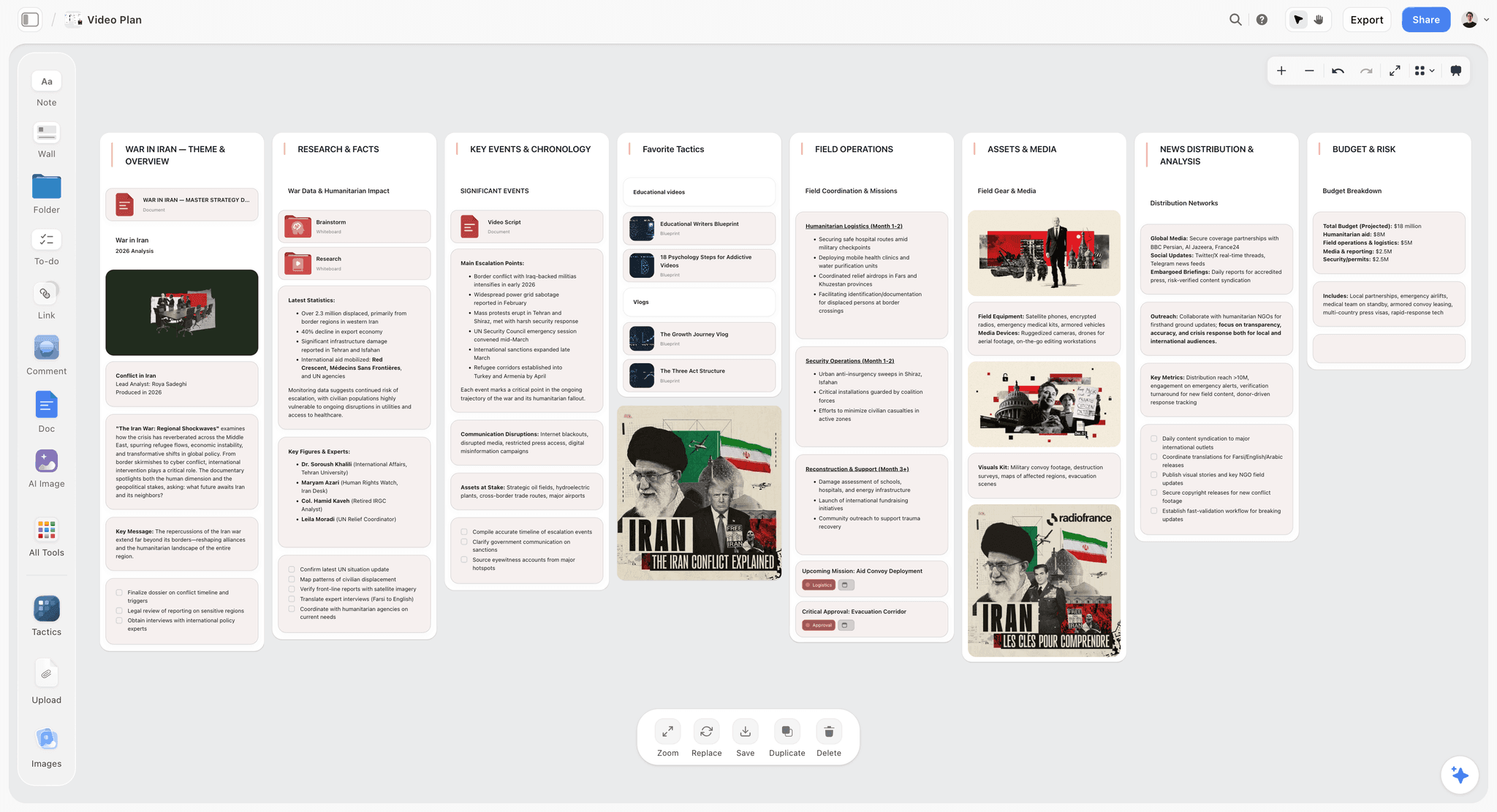
Storyflow is an AI-powered visual workspace built on an infinite canvas. Instead of forcing the strategy into a linear document, it lets you lay the whole strategy out as connected thinking: the vision at the top, the market and customer research as its own cluster of cards, the positioning and differentiation as another, the diagnosis, the guiding policy, and the coherent actions all visible and linked at the same time. When you change the customer choice, you can see, on the canvas, every downstream card it touches.
Three things make it well suited to strategy work specifically. First, the AI is context-aware: it reads your full active canvas board, plus up to 1 Tactic and up to 3 @-mentioned Documents, so when you ask it to pressure-test your diagnosis or stress your differentiation, it is reasoning about your actual strategy, not a generic prompt. Second, it ships with 200+ expert framework templates, called Story Blueprints, so you can start from a structured canvas instead of a blank one. Third, the canvas itself matches how strategy actually gets built: as clusters of related thinking that connect, not as a paragraph that commits you to an order before you have one.
For pricing, the Free plan is free from late 2026 and includes unlimited notes, images, and links, unlimited shared boards, basic AI, 20 file uploads, and unlimited collaboration, which is enough to draft a first strategy canvas end to end. The Plus plan at $7.99/month (annual) or $9.99/month (monthly) unlocks the full 200+ Story Blueprints library, and unlimited uploads. Pro is $14/month (annual) and Max is $39/month (annual).
One honest caveat: for the ongoing release roadmap and delivery tracking, Storyflow is not the tool. Pair it with a dedicated roadmap tool for timelines and execution. Storyflow is the strategy-thinking layer, the place the choices get made, not the place the sprints get tracked.
If you are about to write or rewrite a product strategy, the fastest way to see the difference is to build the strategy as a canvas instead of a doc. Put your vision, your market research, your customer choice, and your differentiation on one board and let the AI pressure-test the chain. Start a Storyflow workspace and draft your strategy canvas this week.
9) The Bottom Line
Product strategy is not a document and not a roadmap. It is a small set of connected choices that explain how a product will win: the customer it serves, the problem it solves, the edge it holds, the outcome it drives, and the things it will refuse to do. The vision is the destination, the strategy is the route, and the roadmap is the next set of turns. A roadmap is not a strategy. Keep those three layers distinct and the rest of product work gets clearer.
The frameworks are settled enough to lean on. Use Roman Pichler's product vision board to draft, Richard Rumelt's kernel (diagnosis, guiding policy, coherent action) to pressure-test, Marty Cagan and SVPG's focus discipline to cut, and Melissa Perri's build trap as the warning of what a missing strategy costs. The mistakes are predictable too: the build trap, mistaking the roadmap for the strategy, skipping the diagnosis, excluding nothing, fluff, and a strategy nobody can see.
The real difficulty is not writing any single layer. It is keeping the diagnosis, the vision, the market evidence, the customer choice, the differentiation, and the actions connected and visible at once, because a change to one ripples through all of them. That is connected thinking, and it is the wrong job for a linear document. If you are developing or rewriting a product strategy, build it as a canvas: lay the vision, the research, the positioning, and the trade-offs out together and let a context-aware AI pressure-test the chain. Start a Storyflow workspace and draft your strategy as connected thinking instead of a doc.
8) FAQ: Product Strategy
What is product strategy in simple terms?
Product strategy is the set of choices that explain how a product will win: which customer it serves, which problem it solves, how it stands apart, and which business outcome it drives. In plain terms, it is the reasoning that connects the long-term vision to the near-term work. It is not a feature list and not a roadmap. It is the logic that explains why a specific set of work, for a specific customer, beats every alternative.
What is the difference between product vision and product strategy?
The vision is the destination: the change the product exists to create over the next five to ten years, and it rarely changes. The strategy is the route: how you intend to realize that vision and win, including who you serve first and what makes you different, and it is revisited yearly or when the market shifts. The vision inspires. The strategy translates that inspiration into hard choices.
Is a roadmap the same as a product strategy?
No. A roadmap is not a strategy. A roadmap lists what you will build and roughly when. A strategy explains why that work, for that customer, is the right work. The roadmap should be derived from the strategy. If your roadmap can change without your strategy changing, the two were never connected, which usually means the strategy does not really exist.
What are the elements of a good product strategy?
A complete product strategy names six things: the target customer, the problem or job to be done, the differentiation, the business goal, the guiding principles for decisions, and what you will explicitly not do. The last element is the most often skipped and the most important. A strategy that excludes nothing is not a strategy, because a choice with no rejected alternative is not a choice.
What is Richard Rumelt's strategy kernel?
In "Good Strategy Bad Strategy," Richard Rumelt argues that real strategy has a kernel of three parts: a diagnosis that names the actual challenge, a guiding policy that says at a high level how you will address it, and a set of coherent actions that carry out the policy and reinforce each other. For product teams, the diagnosis is the step most often skipped, and skipping it is what Rumelt calls bad strategy.
What is the build trap?
The build trap, named by Melissa Perri in "Escaping the Build Trap," is the failure mode where an organization measures success by features shipped rather than value created. It happens when there is no real strategy, so teams default to output because output is easy to count. The fix is a clear strategy that cascades from company goals to product goals to team work, defined by outcomes rather than feature counts.
How do I build a product strategy from scratch?
Start with the diagnosis: honestly name what is blocking the product from success. Then clarify the vision, research the market and customer, choose the specific target customer and job, define a durable differentiation, set the business goal and guiding policy, derive the coherent actions, and only then translate the actions into a roadmap. Finally, make the strategy visible to the team and revisit it on a fixed cadence. The hard part is keeping every layer connected.
What is the product vision board?
The product vision board is a canvas created by Roman Pichler for capturing the product vision and strategy together. It places the vision at the top, then four columns underneath: the target group, the needs the product addresses, the product itself and what makes it stand out, and the business goals. It is the most concrete starting artifact for a first product strategy, because filling it in surfaces the choices you have not yet made.
How often should product strategy change?
The vision should rarely change. The strategy is typically revisited yearly, or sooner when the market shifts, a major assumption is proven wrong, or the business goal changes. The roadmap, which is downstream of the strategy, changes most often, usually quarterly. A strategy that you never revisit goes stale; a strategy you rewrite every month was probably never a real set of committed choices.
Who is responsible for product strategy?
In most companies, the head of product or the product manager owns the product strategy, working closely with the founder or leadership team who own the company vision and business goals. On a smaller team or a startup, the founder often owns both. The key is single, clear ownership: a strategy owned by a committee tends to become fluff, because every hard choice gets softened until no one objects.
What makes a bad product strategy?
Richard Rumelt names the signs of bad strategy: goals presented as strategy ("grow 40 percent"), fluff that sounds profound and means nothing, a failure to name the real challenge, and a refusal to make hard choices. In product specifically, the most common bad strategy is a detailed roadmap with no underlying logic about customer, problem, and differentiation. It looks like a plan, but there is no strategy beneath it.
Can AI help with product strategy?
AI helps most with the analysis and pressure-testing around strategy, not the final judgment. It can synthesize customer research, summarize competitor positioning, stress-test a diagnosis, and surface gaps in a guiding policy. The strategic choices, which customer to serve and what to refuse, remain human decisions grounded in real customer conversations. A context-aware AI that can read your actual strategy canvas is more useful here than a generic chat prompt, because it reasons about your situation rather than a hypothetical one.
Table of Contents
Templates to check out for this topic


Templates you can use in Storyflow
Every Storyflow board starts from real structure and an AI that reads the whole canvas. Open one of these templates and make it yours.


See Storyflow in Action
A visual AI workspace where every feature lives inside one canvas. No tab-switching, no context lost.
Build your entire board from a single message
Type what you need in the AI chat at the bottom of your canvas. The AI adds cards, headings, and structure directly onto your board.
Use expert frameworks as AI context
Type @ in the AI chat and choose any Tactic. The AI tailors every response to that framework instead of giving generic advice.
Turn your board into a mind map in seconds
Ask the AI to restructure your canvas as a mindmap. It connects your ideas into a visual hierarchy so you can see how everything relates.
Why Storyflow Exists
Storyflow actually began as a personal tool while working on creative and research projects.
We kept running into the same problem: ideas were scattered everywhere: notes, documents, and whiteboards.
Nothing helped us see how everything connected.
So we started building a workspace designed around how ideas actually grow.
→ Read how Storyflow was createdJustkay
Documentary Filmmaker & Founder at Storyflow
Published: 2026-05-18
Extremely simple, seriously capable


See how easy it is to get started
Watch a real project come together, from a blank board to a finished plan, clicked through step by step.
Start creating with AI and become more productive
Transform your creative workflow with AI-powered tools. Generate ideas, create content, and boost your productivity in minutes instead of hours.