
Mind Mapping for Product Managers in 2026 (Tools, Methods, and Real Workflows)
Mind mapping fits PM work because the job is decomposition. The cognitive science, the five real PM use cases, the tools that fit each, and a discovery sprint workflow that actually ships.

Category
Visual Thinking
Author

Justkay
Documentary Filmmaker & Founder at Storyflow
Topics
2026-05-10
•
14 min read
•
Visual Thinking- mind mapping for product managers
- PM mind mapping 2026
- opportunity solution tree
- OKR cascade mind map
- discovery sprint
How should product managers use mind mapping in 2026?
Product managers use mind maps to decompose OKR cascades, opportunity solution trees, and requirements before anything becomes a ticket. The 2026 shift: AI reads the map as project context. Storyflow's AI reads the full active canvas plus @-mentioned briefs, then drafts PRDs and acceptance criteria from the structure.
A senior PM I have advised through three discovery sprints opened her laptop last quarter to show me something she was embarrassed about. Her Jira board was clean. Her Linear cycles were tagged. Her Notion docs were tidy. And buried in a separate Figma file, almost apologetically, was a hand-drawn mind map of the actual product strategy. The clean systems were not where the thinking lived. They were where the thinking went to be reported on. The thinking lived on a messy radial diagram she would not show her director. That gap between where PMs think and where PMs report is exactly the gap mind mapping fills, and most product teams are quietly using it without quite admitting it. The rest of this article is what to do about that.
Key Takeaways
- Product management runs on decomposition. A vague directive becomes an OKR, an opportunity, a solution, a feature, a story, and a ticket, and every step is a hierarchical breakdown a mind map makes visible.
- Ticketing tools report; mind maps think. Jira and Linear assume the decomposition is already done, while the mind map is the scratch space where it actually happens first.
- The cognitive basis is working memory. Cowan's research put average capacity at around four chunks, so a mind map externalises the chunks and holds the relationships your head cannot.
- Five PM use cases benefit most: decomposing requirements, OKR cascades, opportunity solution trees, customer journey mapping, and sprint retrospectives.
- An opportunity solution tree is a mind map by another name, with the outcome at the centre, opportunities as branches, solutions as sub-branches, and experiments as leaves.
- The 2026 shift is that AI now reads the canvas, which turns the map from personal scratch space into a shared, machine-readable planning artefact.
- AI adds three things: it auto-decomposes a problem into branches, surfaces gaps a human would miss, and drafts downstream artefacts like PRDs and acceptance criteria from the tree.
- Tool choice depends on where the map lives. If it needs to sit next to briefs and transcripts, an open canvas fits; if not, a dedicated mind mapper like MindMeister or XMind is cleanest.
Why Mind Mapping Fits PM Work in 2026
Product management is a job that runs on decomposition. A vague directive from leadership becomes an OKR, which becomes an opportunity, which becomes a solution, which becomes a feature, which becomes a story, which becomes a ticket. Every step is a hierarchical breakdown. McKinsey's 2012 research on knowledge workers put time spent searching for, gathering, and organising information at around 19% of the working week, which is the largest non-productive bucket in the study. PMs sit at the centre of that gathering, and the cost of doing it badly is paid downstream by every engineer, designer, and stakeholder who has to act on incomplete decomposition.
There is real cognitive science underneath the appeal of a mind map for this work. Nelson Cowan's 2001 review of working memory put the average capacity at around four chunks at a time, well below the older "seven plus or minus two" estimate. A PM holding an OKR cascade in their head is almost always overflowing that limit. A mind map externalises the chunks into spatial branches so working memory can hold the relationships between them, not the items themselves. That is why the senior PM had a hidden Figma file. Her brain was using the mind map as scratch space her ticketing system could not provide.
It is not that Jira and Linear are wrong tools. It is that they are reporting tools, and reporting tools assume the decomposition has already happened. Mind mapping is the visual scratch space where the decomposition gets done in the first place, before the tickets, before the cycles, before the slide deck the director will see.
Tony Buzan, the British psychologist who popularised the modern mind map in the 1970s, argued that the radial structure mirrors how the brain associates ideas: from a centre, by category, with hierarchy. For PMs that hierarchy is the job. A clean radial map of an opportunity is a map of every conversation you will have for the next six weeks.
The bottom-line shift in 2026 is that AI now reads the canvas. A mind map of your product strategy is no longer just for you. It is a context document an AI can use to draft PRDs, suggest acceptance criteria, and surface gaps in the decomposition you missed. That changes mind mapping from a personal scratch tool to a shared planning artefact, and it is the single biggest reason PMs should revisit the method this year.
Five Ways PMs Use Mind Maps
Mind mapping shows up in five concrete places in real product work. Each one is a known PM activity that quietly benefits from a radial structure and visibly suffers without one.
1. Decomposing requirements
A "log in with Google" request from leadership is not a feature. It is a question with about fourteen sub-questions hiding inside it. Sessions, edge cases, account linking, error states, security review, mobile parity, observability. A mind map of the request as a central node, with each sub-question as a branch, surfaces the whole tree in 20 minutes. The PMs I have advised who skip this step end up rediscovering the same branches in standup three weeks later, after engineering has already started.
The trick is to keep the central node abstract enough to hold the full problem and concrete enough to fit in one sentence. "Add Google sign-in to the web app" works. "Improve auth" does not.
2. OKR cascades
OKRs are hierarchical by construction. Company objective, team objective, key result, initiative, project, ticket. Drawing this as a mind map instead of a Notion table reveals two things a table hides: which initiatives ladder up to nothing (and should be cut), and which key results have only one initiative supporting them (and are at single-point-of-failure risk).
I have seen PM teams that ran their entire quarterly planning off a shared mind map and then exported the resulting hierarchy as the basis for their tracker. The map was where the negotiation happened. The tracker was where the agreed result lived.
3. Opportunity solution trees
Teresa Torres formalised the opportunity solution tree as a discovery framework, and the structure is fundamentally a mind map. Outcome at the top, opportunities as branches, solutions as sub-branches, experiments as leaf nodes. PMs who try to hold this structure in a flat document lose the visual relationship between opportunities and the outcome they ladder up to. PMs who hold it on a canvas keep the relationship visible and can prune solutions that no longer serve the outcome they were supposed to.
This is the use case where mind mapping most clearly beats the alternatives. A flat list of solutions cannot show you which opportunity each solution belongs to without redundant labelling. A radial map shows it for free.
4. Customer journey mapping
A customer journey is a map of stages, touchpoints, jobs to be done, pain points, and metrics. Pair it with the Customer Persona template so the segments you are mapping stay visible next to the journey itself. The traditional flat journey map crammed into a spreadsheet hides the connections between stages. A radial mind map with the customer at the centre and stages as branches lets the connections breathe. It is also faster to update when research surfaces a new touchpoint.
PMs running discovery sprints often start with a journey mind map, layer interview findings as branches, and export the map to share with design and research afterwards. The map becomes the shared artefact across the three disciplines.
5. Sprint retrospectives
A retrospective produces a mess of observations that need to be grouped. Mind mapping the retro after the meeting (not during it) imposes structure on what was generated freely. Branches by theme, sub-branches by specific observation, leaf nodes by proposed action. The structure surfaces patterns that a flat list of sticky notes cannot show.
Retrospectives without structured follow-up tend to surface the same recurring issues quarter after quarter, because the observations never get organised into something the team acts on. A mind map is the structured follow-up that closes that loop.
Take whichever of these five you do most often this quarter (most PMs say opportunity solution trees) and run your next one as a mind map on a Storyflow canvas instead of in a doc. One real decomposition is enough to tell whether the radial structure earns its place in your workflow.

The same canvas holds five different PM mind maps. The structure is the strategy.
Tools That Fit Each PM Use Case
Below is a ranked list of tools PMs are actually using for mind mapping in 2026, with notes on which of the five use cases above each one fits best. The ranking weights honest fit for product work, not generic mind-map polish.
1. Storyflow
Storyflow is a project canvas where mind maps live alongside the rest of your product thinking. The same canvas holds an opportunity solution tree, a customer journey mind map, a discovery brief, and the AI Tactic that scaffolds whichever methodology you are using. AI reads the active canvas plus one @-mentioned Tactic and three Documents, which means a discovery brief or research transcript can be pulled into context while you decompose. The fastest way to test it is to open the Mindmap template, drop your current feature request in as the central node, and ask the AI what branches are missing.
Friction first. Storyflow is not a PM-specific tool. There is no native Jira or Linear sync, no roadmap-as-Gantt timeline, and no story-point estimation. If you need a ticketing system that ladders up to a portfolio view, Storyflow is not that. What it is, is the place where the strategic decomposition happens before the tickets get written, and where AI can read that decomposition as project context. Plus is $7.99 per month annual ($9.99 monthly), Pro is $14 per month annual ($19 monthly) and adds AI image generation and 20× more AI than Plus, Max is $39 per month annual ($49 monthly) and adds a team workspace with roles and permissions, and Free includes unlimited projects, basic AI usage, and 20 file uploads. The Plus plan unlocks 200+ Tactics including discovery briefs, opportunity solution trees, and customer journey scaffolds.
Best for: opportunity solution trees, customer journey mapping, requirements decomposition.
2. MindMeister
MindMeister is the cleanest dedicated mind-mapping tool on the market. Keyboard-driven branch creation, clean radial layouts, presentation mode, and reasonable export. PMs who do nothing but mind mapping tend to land here because the structure is exactly what the tool is built for. The weakness is that everything outside a mind map (briefs, transcripts, decisions) lives somewhere else.
Best for: OKR cascades, requirements decomposition.
3. Miro
Miro is a brainstorming-first whiteboard that holds a mind map but does not specialise in one. It is the tool most PM teams already have for retros and journey mapping, which makes it the path of least resistance. Mind maps inside Miro tend to look hand-assembled because the radial layout is something you build, not something the tool produces.
Best for: sprint retrospectives, customer journey mapping.
4. XMind
XMind is the desktop-first mind-mapping tool with the best structural rigour. Multiple layout modes, fishbone diagrams, matrix views, and the ZEN mode for focused thinking. PMs who grew up on outliners often prefer XMind because the keyboard model rewards fast structure. The weakness is collaboration, which is fine for solo PMs and limited for cross-functional work.
Best for: OKR cascades, requirements decomposition.
5. Whimsical
Whimsical sits between flowcharting and mind mapping with a clean visual style. Mind maps are quick to build and look good in shared documents. The tool does not have AI that reads project context, so the map is a static artefact rather than a working surface.
Best for: customer journey mapping, requirements decomposition.
6. Lucidchart
Lucidchart is a diagramming workhorse. PMs use it for system diagrams more than mind maps, but mind mapping is supported and the export options are strong for stakeholder presentations. Better for documenting decomposition that is already done than for the live thinking process.
Best for: opportunity solution trees, OKR cascades.
7. Coggle
Coggle is a free, browser-based mind mapper with an unusually clean radial style. The collaborative editing is solid for its tier. Limited beyond mind mapping, which is the point.
Best for: requirements decomposition, sprint retrospectives.
8. Mindomo
Mindomo blends mind mapping with task management, which makes it appealing on paper for PMs and frustrating in practice because the task layer is shallow compared to dedicated PM tools. Useful as a hybrid for solo PMs running small projects.
Best for: requirements decomposition, sprint retrospectives.
For a deeper category breakdown of these tools, see the best mind mapping tools 2026 listicle, or the student-focused breakdown if you are evaluating educational fits.
Turn your next decomposition into a plan
Drop the problem statement on a canvas, let AI read the full board plus your @-mentioned discovery brief, and get a structured project plan instead of a blank page. One real OKR cascade or solution tree is enough to test it.

A Real PM Workflow: Discovery Sprint Decomposition
Here is how I have seen the strongest PM teams sequence mind mapping inside a five-day discovery sprint. The example is a real one, anonymised: a Series B SaaS product team kicking off discovery on a churn problem the data team had flagged but not explained.
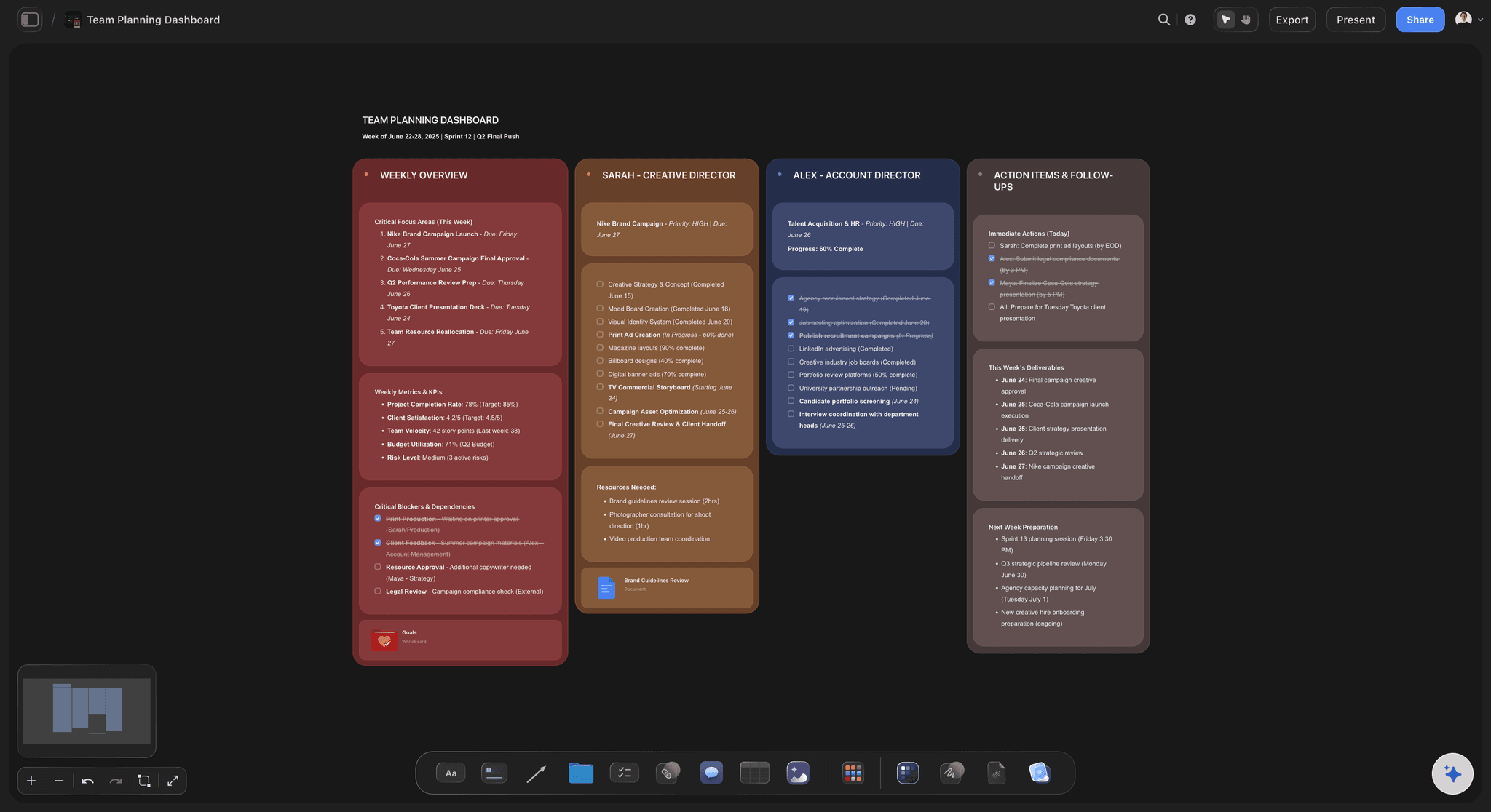
Day one was a mind map of the problem space. The PM opened a fresh canvas (the Team Planning Dashboard template works as the sprint container if you want the tracking structure pre-built), dropped "Why are paid users churning at month four" as the central node, and built four primary branches: product reasons, pricing reasons, onboarding reasons, customer-segment reasons. Each branch got three to five sub-branches drawn from the existing churn analytics, sales conversations, and support tickets. The map was deliberately broad and obviously incomplete. The point was to surface what the team did not know, not what it did.
Day two was customer interviews. The map sat in the corner of the canvas as context. Interview notes went in as new leaf nodes attached to whichever branch the customer was actually talking about. By the end of day two, the shape of the map had shifted. One branch (onboarding reasons) had thirty leaves. Another (pricing reasons) had three. The visual asymmetry was the finding.
Day three was an opportunity solution tree. The PM took the heaviest branch, "onboarding reasons", and rebuilt it as a proper opportunity solution tree with the outcome at the top, opportunities as branches, and solutions as sub-branches. AI read the canvas and a discovery brief Tactic, then suggested two opportunities the team had not surfaced, both grounded in patterns from the interview transcripts.
Day four was solution evaluation. The team scored each solution against effort and confidence, pruning the branches that did not survive scrutiny. The map became a smaller, sharper tree.
Day five was the brief. The PM exported the surviving structure into a written discovery brief and a Linear cycle for the next sprint. The mind map was not the deliverable. The mind map was the thinking that produced the deliverable.
The sequence is the point. Without the day-one map, the interviews would have collected unstructured data the team would have struggled to organise. Without the day-three solution tree, the interview findings would have produced a list of features instead of a strategy. The mind map at each stage was the cognitive scaffolding that let the next stage do better work.
For a deeper look at when mind mapping beats unstructured ideation in PM work, see mind mapping vs brainstorming in 2026.
Day one map, day three opportunity solution tree, day five exported brief. The map is the thinking. The tickets are the result.
How AI Changes PM Mind Mapping in 2026
In 2026, AI changes mind mapping for PMs in three concrete ways without changing what mind mapping is for.
First, AI auto-decomposes a problem statement into branches. Drop in "Why are paid users churning at month four" and a capable AI will produce six to eight plausible primary branches in seconds. This is genuinely useful for skipping the blank-canvas stall, but the branches are generic until you ground them in your specific data. The right move is to use AI for first-pass structure and then prune, rearrange, and add the things only your team knows. AI without project context produces a textbook decomposition. AI with the canvas plus an @-mentioned discovery brief and three customer interview transcripts produces a decomposition that fits your actual product.
Second, AI surfaces gaps a human would miss. A mind map is a finite structure, and finite structures have edges. Asking an AI to look at the map and suggest what is missing is the closest thing PMs have to a free critic. The senior PMs I have advised treat this as a quality gate before sharing the map upstream.
Third, AI drafts the downstream artefacts directly from the map. PRDs, acceptance criteria, user stories, and stakeholder summaries can all be generated from the structured tree of nodes. The map becomes the source of truth, and the artefacts become projections of it. This is the shift that makes mind mapping a strategic tool rather than a personal one.
It is not that AI replaces the cognitive work of decomposition. It is that AI reduces the cost of doing it carefully, which makes doing it carelessly harder to justify.
For a step-by-step on the first capability, see how to create a mind map with AI, or the broader AI mind map generator review if you are evaluating tools.

AI Planner produces first-pass branches for a churn problem. The PM then prunes and adds context.

The finished opportunity solution tree becomes the source AI uses to draft PRDs and acceptance criteria.
The Bottom Line
Mind mapping fits product management because product management is decomposition, and a radial structure externalises decomposition better than any flat document can. The five use cases (requirements, OKRs, opportunity solution trees, customer journeys, and retrospectives) are already happening in most PM workflows, just hidden in scratch files no one shares. Making the map visible changes mind mapping from personal scratch space into a strategic artefact, especially in 2026, when AI can read the canvas as project context and draft the downstream documents from it. Tool choice depends on whether the map needs to live next to other product thinking. If it does, an open canvas with AI and Tactics fits better than a dedicated mind mapper. If it does not, MindMeister or XMind will give you the cleanest result. Either way, the cognitive work is the same one PMs have always done. The visible map is what makes the work shareable, the AI is what makes it actionable, and the next sprint is what proves the structure was right.
FAQ: Mind Mapping for Product Managers
Why should product managers use mind mapping?
Product managers should use mind mapping because the job is fundamentally hierarchical decomposition, and a radial structure externalises that hierarchy in a way working memory cannot hold on its own. Cowan's 2001 working-memory research put average capacity at around four chunks, and a typical OKR cascade or opportunity solution tree exceeds that limit immediately. A mind map keeps the structure visible while the PM does the cognitive work of pruning, prioritising, and explaining it. The shift in 2026 is that AI can read the map as project context, which makes mind mapping a shared artefact rather than personal scratch space.
What is the best mind mapping tool for product managers in 2026?
The best mind mapping tool for product managers depends on whether the use case is dedicated mind mapping or strategic decomposition that ladders into other artefacts. For dedicated mind mapping, MindMeister and XMind have the cleanest structural rigour. For PM work where the map needs to live next to interview transcripts, discovery briefs, and AI that can draft downstream documents, an open canvas with optional scaffolding fits better. Storyflow is in that category, with 200+ Tactics that scaffold methodologies like opportunity solution trees and discovery briefs. Plus is $7.99 per month annual.
Is mind mapping still relevant for PMs in 2026?
Mind mapping is more relevant for PMs in 2026 than it was a decade ago, because AI can now read a map as project context and use it to draft PRDs, acceptance criteria, and stakeholder summaries. The map shifts from a personal scratch tool to a strategic planning artefact. The cognitive science is unchanged. Buzan's radial principle and Cowan's working-memory research still apply. What is new is that the map itself is now machine-readable, which changes the value calculus of investing time in one.
How do I mind map an OKR cascade?
To mind map an OKR cascade, place the company objective at the centre, each team objective as a primary branch, key results as sub-branches, and supporting initiatives as leaves. The structure exposes two things a flat document hides: initiatives that ladder up to nothing (and should be cut) and key results with only one initiative supporting them (which are at single-point-of-failure risk). The map is the negotiation surface during planning. The exported hierarchy is the basis for the tracker the team uses afterwards.
Can I use mind mapping for opportunity solution trees?
Yes, an opportunity solution tree is a mind map by another name. The outcome sits at the centre or top, opportunities radiate as primary branches, solutions sit as sub-branches, and experiments live as leaf nodes. The radial layout preserves the visual relationship between solutions and the opportunity each one belongs to, which a flat list cannot show without redundant labelling. PMs running discovery sprints get more out of an opportunity solution tree on a canvas than the same content in a Notion table, because the visual structure is the artefact.
What is the difference between a mind map and a roadmap for PMs?
A mind map is a hierarchical decomposition of a problem or strategy, and a roadmap is a time-ordered plan of what will ship when. The two are complementary. A mind map produces the structure that a roadmap then schedules. PMs who skip the mind-mapping step tend to produce roadmaps that look organised but are missing branches, because the decomposition was never visible. PMs who skip the roadmap step tend to produce maps that never become commitments. The two artefacts solve different problems and should not be conflated.
How long should a PM mind mapping session take?
A focused PM mind mapping session usually runs between 30 and 90 minutes depending on the scope. A requirements decomposition for a single feature can fit in 30 minutes. An OKR cascade or opportunity solution tree for a quarter usually needs 60 to 90 minutes, often broken into two sessions with a gap to let the structure settle. Sessions longer than 90 minutes tend to drift into discussion, which is a sign the cognitive mode has shifted from organising to deliberating. When that happens, stop, export the map, and resume in a separate session.
Is mind mapping better than brainstorming for product strategy?
Mind mapping and brainstorming serve opposite cognitive modes, so the better question is which one fits your current situation. Mind mapping is best when the topic is known and needs decomposition. Brainstorming is best when the question is open and needs divergent ideas. Most strong product workflows alternate the two: brainstorm to discover the problem, mind map to structure it, brainstorm at finer granularity, mind map to integrate. Doing only one method misses half the work. For a deeper breakdown, see mind mapping vs brainstorming in 2026.
Does Storyflow integrate with Jira or Linear?
Storyflow does not currently offer native Jira or Linear sync, story-point estimation, or roadmap-as-Gantt timelines. It is not a PM-specific ticketing tool. It is a project canvas where the strategic decomposition happens before tickets get written, with AI that reads the canvas plus one @-mentioned Tactic and three Documents. PM teams using Storyflow typically export the structured tree into Jira or Linear manually once the decomposition is settled. If native ticketing sync is a hard requirement, a dedicated PM tool fits better.
What AI can do for PM mind mapping that humans cannot?
AI can decompose a problem statement into plausible branches in seconds, which compresses the blank-canvas stall a human would otherwise sit in. AI can also surface gaps in a finished map by treating the structure as a finite set and asking what is missing. The cognitive work of evaluating which branches matter for your specific product, your specific customers, and your specific quarter is still human work. AI accelerates the structure. Humans decide what the structure means.
Table of Contents
Templates to check out for this topic


Mind mapping and ideation templates you can use in Storyflow
Map ideas in space, then ask the AI to restructure, expand, or connect them. Open any of these boards and start thinking visually instead of in lists.


See Storyflow in Action
A visual AI workspace where every feature lives inside one canvas. No tab-switching, no context lost.
Build your entire board from a single message
Type what you need in the AI chat at the bottom of your canvas. The AI adds cards, headings, and structure directly onto your board.
Use expert frameworks as AI context
Type @ in the AI chat and choose any Tactic. The AI tailors every response to that framework instead of giving generic advice.
Turn your board into a mind map in seconds
Ask the AI to restructure your canvas as a mindmap. It connects your ideas into a visual hierarchy so you can see how everything relates.
Why Storyflow Exists
Storyflow actually began as a personal tool while working on creative and research projects.
We kept running into the same problem: ideas were scattered everywhere: notes, documents, and whiteboards.
Nothing helped us see how everything connected.
So we started building a workspace designed around how ideas actually grow.
→ Read how Storyflow was createdJustkay
Documentary Filmmaker & Founder at Storyflow
Published: 2026-05-10
Extremely simple, seriously capable


See how easy it is to get started
Watch a real project come together, from a blank board to a finished plan, clicked through step by step.
Start creating with AI and become more productive
Transform your creative workflow with AI-powered tools. Generate ideas, create content, and boost your productivity in minutes instead of hours.