
What Screenwriters Actually Do Before Page One (2026)
Screenwriting software starts at page one. Almost everything that determines whether a script works happens before that. The five artefacts that exist before the first slugline, and why the work is spatial.

Category
Screenwriting
Author

Justkay
Documentary Filmmaker & Founder at Storyflow
Topics
2026-08-26
•
16 min read
•
Screenwriting- what tools do screenwriters use to plan stories
- screenplay development process
- before writing a screenplay
- screenwriting index cards
- screenplay outline how detailed
- Final Draft outlining
What tools do screenwriters use to plan their stories?
Screenwriting software starts at page one. Almost everything that determines whether a script works happens before that. The five artefacts that exist before the first slugline, and why the work is spatial.
Key Takeaways
- Screenwriting software starts at page one. Almost everything that determines whether a script works happens before that, in tools that were not built for it.
- Five artefacts exist before the first slugline: the want, the ending, the shape, the world file, and the scene list. Most first drafts fail because two or three of them were skipped.
- The most common skip is the ending, and it is the most expensive, because a scene's job is only definable once you know what it is building toward.
- Almost nobody does this in Final Draft or Highland, and they are right not to: page-one software is for the draft, not the development, and forcing development into it produces an outline pretending to be a script.
- The stage is spatial before it is linear. Index cards persist in screenwriting for the same reason they persist in editing: comparison requires seeing everything at once.
Page One Is the Middle of the Process
Ask a screenwriter what they use and you get Final Draft, Highland, Fade In, WriterDuet, or Scrivener. All of those are page-one tools: they exist to produce correctly formatted pages, and they are good at it.
Then ask what they were doing for the six weeks before they opened one, and the answer is a notebook, a wall, a Notion page, a pile of index cards, a document called `thoughts.txt`, and a lot of walking.
That gap is not a tooling failure so much as an unexamined one. The work that determines whether a script functions almost entirely precedes page one, and it is done in improvised systems because the software everyone names starts too late.
Five artefacts exist in that space. They are not a process to follow in order, and a first draft that fails usually turns out to be missing two or three of them.
The Five Artefacts
One: the want
What the protagonist is trying to get, stated as an action rather than a feeling.
"She wants to be respected" is a feeling and it generates no scenes, because nothing can be attempted. "She wants her name on the paper she wrote" is an action, and it generates scenes immediately: things she can try, people who can refuse her, ways she can escalate.
The test: can you write down three things she does to get it, and can somebody stop her doing them? If not, the want is not yet a want, and this is the single most common root cause of a script where nothing seems to happen despite events occurring.
Two: the ending
How it finishes, concretely: the last image, what has changed, and what the audience knows now that they did not.
This is the most commonly deferred artefact and the most expensive to defer, because a scene's job is only definable relative to what it is building toward. Without an ending, you cannot know whether scene eleven is doing work or filling space, so the middle collapses and the writer blames the middle.
The ending is allowed to change. Almost every one does. What matters is that one exists, because a provisional ending organises the writing and no ending does not.
Three: the shape
The five to nine turns, not a full beat sheet. The points where the direction changes: the thing that forces the story to start, the reversal, the point of no return, the lowest moment, the choice at the end.
Whatever model you use, or none, the shape is where pacing lives. Turns clustered together produce a rushed section; a long gap between them is the flat middle everybody suspects and cannot locate.
Keep this loose. A full forty-beat sheet before drafting is where scripts go to become transcription, and transcription is flat, because the discoveries that make a scene alive happen while writing it.
Four: the world file
Everything you need consistent: names, ages, timeline, geography, who knows what and when, the rules if there are rules.
This one is unglamorous and it prevents the specific humiliation of the continuity error found by a reader in draft three. It is also where research lives for anything with a real subject.
The rule that matters: the world file is a reference, not a creative document. Time spent expanding it is usually time spent avoiding the script, and worldbuilding is the most respectable procrastination available to a writer.
Five: the scene list
One line per scene: who is in it, where, and what changes by the end.
That last clause is the whole value. A scene where nothing changes is a scene where nothing happens however good the dialogue is, and writing the line forces the admission. A scene list is also the first artefact that can be reordered cheaply, which is where structural problems become visible.
Fifty to seventy lines for a feature, eight to fifteen for a short.
Why It Is Spatial
The reason index cards have survived every generation of screenwriting software is not nostalgia. It is that four of the five artefacts require comparison, and comparison requires seeing everything at once.
You cannot tell that scenes fourteen and twenty-two do the same work by reading them in order, because reading is sequential and the observation is spatial. You cannot see that the protagonist stops making choices for six consecutive scenes when you can only see two on screen. You cannot notice that a subplot vanishes for a third of the middle by scrolling a list.
A document holds the sequence. A wall holds the structure. They are different views of the same material and only one of them shows you the problems.
This is why the standard setup persists: cards or a wall for development, then a page-one tool for the draft, then back to the wall when the draft has a problem nobody can locate.
What Screenwriters Actually Use
| Stage | What is commonly used | What it is good at | Free option |
|---|---|---|---|
The want and the ending | Notebook, a document, a walk | Nothing beats writing it badly and reading it aloud | Free |
The shape | Index cards, a wall, a whiteboard | Seeing turns spaced out at once | Cards |
The world file | Notion, Obsidian, a document | Search and consistency | Both free tiers |
The scene list | Index cards, Scrivener corkboard, a spreadsheet | Cheap reordering | Cards, Sheets |
The draft | Final Draft, Highland, Fade In, WriterDuet, Scrivener | Formatting and revision tracking | Highland free tier, Fade In trial |
Diagnosis after draft one | The wall again | Comparison across the whole script | Cards |
Two honest observations from this table.
Scrivener is the tool that spans the most of it, because its corkboard sits directly on the manuscript, so a card is a scene rather than a picture of one. For writers who dislike running four tools, it is the strongest single answer at around $59 once.
Nothing in the page-one category serves the development stage, and that is a reasonable scope rather than a flaw. Trying to develop in Final Draft produces an outline formatted like a script, which reads as progress and is not.
For the spatial half, a canvas that persists is useful because development happens over months with gaps, and a wall gets taken down. Storyflow, which we make, holds the shape, the scene list, the world file and the research on one board the AI reads, so questions like which scenes do the same work, where the protagonist stops choosing, and which threads go quiet longest are answerable from the material rather than by rereading. It is not a screenwriting tool and the draft belongs in Final Draft or Highland. It is paid-only during early access from $7.99 a month annual, with the Free plan landing before the end of 2026, and index cards on a table remain excellent and cost almost nothing.
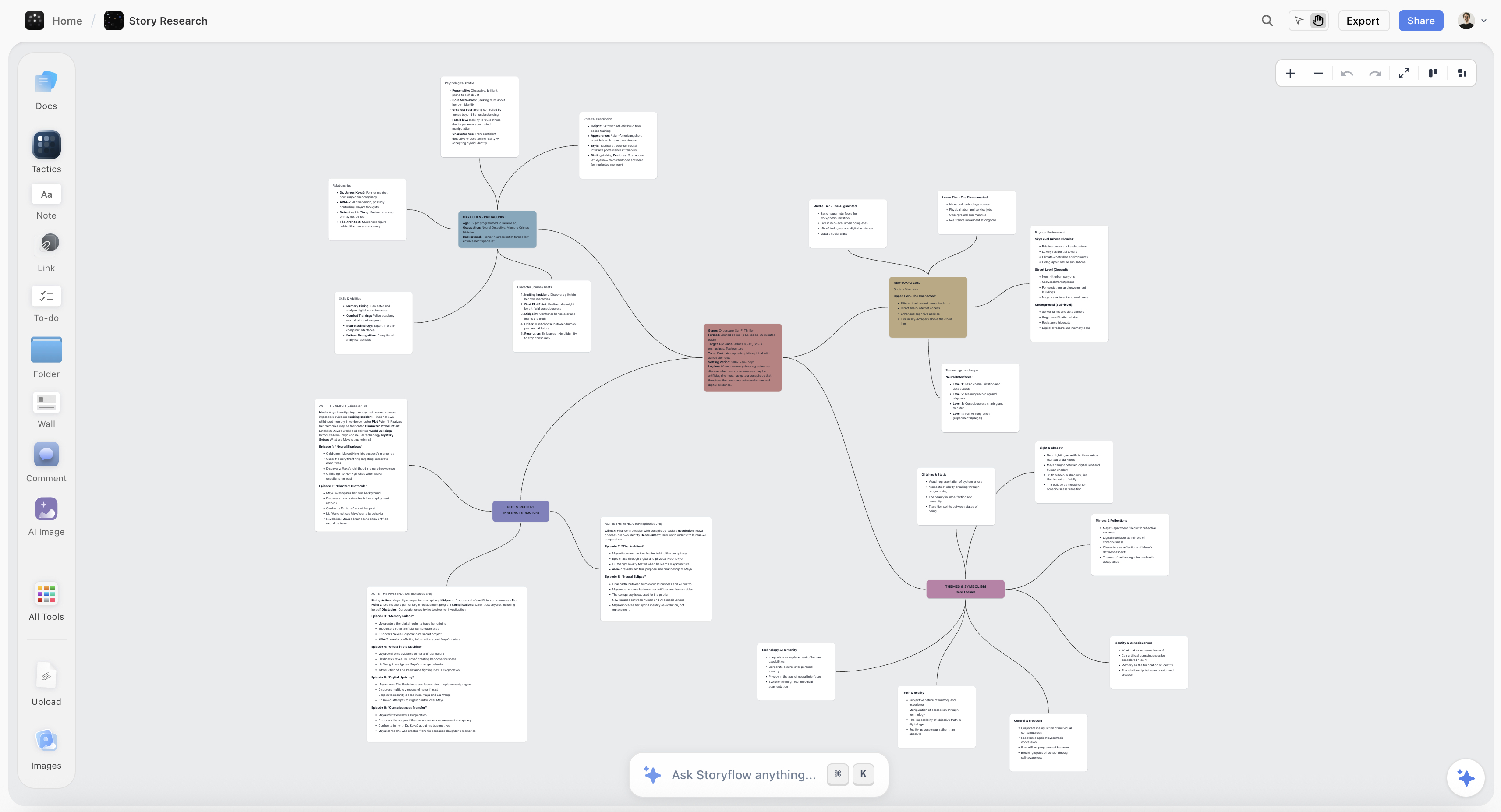
The shape, scene list and world file for a screenplay held together on a Storyflow canvas before the draft begins
A document holds the sequence, a wall holds the shape
You cannot tell that two scenes do the same work by reading them in order, because the observation is spatial. Storyflow keeps the shape, the scene list and the world file on one canvas the AI reads, so where the protagonist stops choosing is a question. The draft still belongs in Final Draft; index cards work too.

Where AI Helps and Where It Does Not
On the want, as an interrogator. Give it your protagonist's want and ask what three actions it generates and who can block them. If it struggles, the want is a feeling.
On the ending, adversarially. Describe your ending and ask it to argue that nothing has changed. If that case is easy to make, you have a mood rather than an ending.
On the scene list, diagnostically. Reading fifty scene lines and reporting which do the same work, where the protagonist stops making choices, and which characters vanish is comparison across the whole set, which is slow by hand and exactly what the wall is for. This only works if the model can see all of them at once.
On the world file, as search. Answering "how old is she in the second act" from your own notes.
Not on the pages. Generated screenplay dialogue is competent and dead, and it is competent in a way that is recognisable to anybody who reads scripts professionally, which is the audience.
Not on the shape. A generated structure is the median structure for your genre, which is what you were presumably trying to escape.
What Goes Wrong
Starting at page one. The script gets written from an idea rather than from a want and an ending, and it collapses somewhere in the middle for reasons that feel mysterious and are structural.
No ending. Every scene becomes undecidable, and the middle takes the blame.
A full beat sheet before drafting. Writing becomes transcription and the prose goes flat.
Worldbuilding as avoidance. The most respectable procrastination in writing, and the world file grows while the script does not.
A want that is a feeling. Nothing can be attempted, so nothing can be blocked, so there is no story despite plenty of events.
Developing in a document. The sequence is visible and the structure is not, so scenes doing duplicate work stay invisible until a reader points them out.
No "what changes" on the scene list. Without it a scene where nothing happens looks identical to one where something does.
Never rebuilding the wall after draft one. The diagnostic is most valuable on an existing draft, and almost nobody goes back to it, which is when it would repay most.
The Bottom Line
Screenwriting has excellent software that begins at exactly the wrong moment. Final Draft, Highland, and Fade In are all good at producing formatted pages, and by the time you need them, the decisions that determine whether the script works have already been made or skipped.
Five artefacts live before page one. What the protagonist is trying to get, stated as something they can attempt. How it ends. The five to nine turns. The reference file for whatever must stay consistent. And a scene list where every line says what changes.
The two most commonly skipped are the ending and the want, and skipping either produces the same symptom: a script full of events where nothing seems to be happening, and a middle that collapses for reasons that feel mysterious and are entirely structural.
None of that work is linear, which is why index cards outlived every piece of software that was supposed to replace them. A document shows you the order. A wall shows you the shape, and the shape is where the problems are.
So do the five things somewhere you can see all of them at once. Then open the page-one software, which is genuinely excellent at the job it was built for, and which was never built for this one.
FAQ: What Screenwriters Do Before Page One
What tools do screenwriters use to plan stories?
Rarely their screenwriting software, because page-one tools start after the planning. In practice: index cards or a wall for the shape and the scene list, a notebook or document for the want and the ending, Notion or Obsidian for the world file, and Scrivener when a writer wants the corkboard and the manuscript in one place. Final Draft and Highland come in at the draft.
What should you do before writing a screenplay?
Settle five things: what the protagonist is trying to get stated as an action, how it ends concretely, the five to nine turns, a world file for anything that must stay consistent, and a scene list with what changes in each. Most failed first drafts turn out to be missing two or three of those, and the ending is the most commonly and expensively skipped.
Can you write a screenplay without an outline?
Yes, and the thing you cannot skip is the ending, which is not the same as an outline. A provisional ending makes each scene's job definable; without one, you cannot tell whether a scene is doing work, which is why the middle collapses. Many writers who dislike outlining have no objection to knowing where they are going.
Should you use Final Draft for outlining?
It is not built for it and outlining there produces something formatted like a script that reads as progress without being any. Development is spatial and page-one software is linear by design. Use cards, a wall, or a canvas for the shape and the scene list, then move into Final Draft or Highland for the draft.
How detailed should a screenplay outline be?
Loose enough that the writing still discovers something. Five to nine turns and a scene list with one line each is usually right. A full forty-beat sheet before drafting turns writing into transcription, and transcription is flat, because the things that make a scene alive are found while writing it rather than while planning it.
Why do screenwriters use index cards?
Because four of the five pre-draft artefacts require comparison, and comparison requires seeing everything at once. You cannot notice that two scenes do the same work by reading them in order, or that the protagonist stops making choices for six consecutive scenes when only two are on screen. A document holds the sequence; a wall holds the structure.
What is the difference between a want and a theme?
A want is what the character is trying to get, stated as an action, and it generates scenes because it can be attempted and blocked. A theme is what the script is about, and it generates nothing directly. Scripts built on a theme without a want tend to have events and no story, which is the most common structural failure in unproduced work.
What is a world file?
The reference document for everything that has to stay consistent: names, ages, timeline, geography, who knows what and when, and any rules of the world. It exists to prevent the continuity error a reader finds in draft three. It is a reference rather than a creative document, and time spent expanding it is usually time spent avoiding the script.
Can AI help plan a screenplay?
Usefully as an interrogator and a diagnostic, badly as a writer. Ask it to argue that your ending changes nothing, or to read fifty scene lines and report which do the same work and where the protagonist stops choosing. Generated pages are competent and recognisably dead to anybody who reads scripts professionally, and a generated structure is the median for the genre.
Is Storyflow a screenwriting tool?
No. It has no screenplay formatting, no revision marks, no production drafts, and the script belongs in Final Draft, Highland or Fade In. It covers the stage before that: the shape, the scene list, the world file and the research on one canvas the AI reads, so which scenes duplicate each other and where a thread goes quiet are answerable from the material. It is paid-only during early access, from $7.99/month annual.
How long should development take before you start writing?
Long enough to have the want, the ending, and a loose shape, which for most writers is days rather than months. Beyond that the returns fall sharply and the risk of over-planning rises. The signal you have gone too far is that the plan is more interesting to work on than the draft.
What do you do when the middle of your script is not working?
Rebuild the wall on the draft you have rather than the one you intended. Lay out the scene list, mark who wants what in each, and look for the run of consecutive scenes where the protagonist reacts rather than chooses. That run is almost always the problem, and it is invisible in a document because the observation requires seeing scenes that are far apart at the same time.
Table of Contents
Templates to check out for this topic


Story and writing templates you can use in Storyflow
Start your next script, novel, or world from a ready-made Storyflow board instead of an empty page. The AI reads the whole canvas, so every suggestion is grounded in your story.


See Storyflow in Action
A visual AI workspace where every feature lives inside one canvas. No tab-switching, no context lost.
Build your entire board from a single message
Type what you need in the AI chat at the bottom of your canvas. The AI adds cards, headings, and structure directly onto your board.
Use expert frameworks as AI context
Type @ in the AI chat and choose any Tactic. The AI tailors every response to that framework instead of giving generic advice.
Turn your board into a mind map in seconds
Ask the AI to restructure your canvas as a mindmap. It connects your ideas into a visual hierarchy so you can see how everything relates.
Why Storyflow Exists
Storyflow actually began as a personal tool while working on creative and research projects.
We kept running into the same problem: ideas were scattered everywhere: notes, documents, and whiteboards.
Nothing helped us see how everything connected.
So we started building a workspace designed around how ideas actually grow.
→ Read how Storyflow was createdJustkay
Documentary Filmmaker & Founder at Storyflow
Published: 2026-08-26
Extremely simple, seriously capable


See how easy it is to get started
Watch a real project come together, from a blank board to a finished plan, clicked through step by step.
Start creating with AI and become more productive
Transform your creative workflow with AI-powered tools. Generate ideas, create content, and boost your productivity in minutes instead of hours.