
Category
Design
Author

Justkay
Documentary Filmmaker & Founder at Storyflow
Topics
2026-05-18
•
Updated May 18, 2026
•
13 min read
•
Design- what is design thinking
- design thinking process
- five stages of design thinking
- Double Diamond
- design thinking definition
- human-centered design
What is design thinking?
Design thinking is a human-centered problem-solving approach that runs through five repeatable stages: Empathize, Define, Ideate, Prototype, and Test. It starts with the people affected by a problem rather than a solution, and treats every solution as a hypothesis to test with real users. The point is to understand the real problem deeply before committing to an answer, so the team avoids the expensive mistake of solving the wrong problem confidently.
1) Quick Answer: What is Design Thinking?
Design thinking is a problem-solving approach that starts with the people you are designing for, not the solution you already have in mind. It runs through five repeatable stages (Empathize, Define, Ideate, Prototype, Test) and treats every solution as a hypothesis to be tested with real users rather than a decision to be defended in a meeting. The point is to delay commitment: you understand the human problem deeply before you allow yourself to pick an answer.
It is not a creativity trick and it is not a workshop format. Design thinking is a discipline for staying with the problem longer than feels comfortable. Most failed projects do not fail because the team had bad ideas. They fail because the team solved the wrong problem confidently. The five stages exist to make that mistake harder.
I have run multiple documentary projects from research through pre-production, and the same pattern shows up every time: the version of the film you imagine on day one is almost never the film the material actually wants to be. Design thinking is the formal name for the habit of letting the material talk back before you lock the plan. This guide explains the five stages in depth, the Double Diamond model, real examples, the honest critique of the method, and how to run it without the theater.
For adjacent reading, see What is Ideation? The Complete Guide and What is Brainstorming? The Complete Guide.
2) Where Design Thinking Came From
Design thinking did not appear fully formed. It assembled over roughly fifty years from design practice, cognitive science, and a few influential firms that needed a name for what they were already doing.
The intellectual roots reach back to the 1960s and 1970s, when researchers like Herbert Simon (his 1969 book The Sciences of the Artificial described design as a "way of thinking") and later Robert McKim at Stanford began treating design as a structured cognitive process rather than pure artistic intuition. Rolf Faste, also at Stanford, adapted McKim's work into a teachable method through the 1980s and 1990s.
The popularization came from two places. The first is IDEO, the design firm, and its CEO Tim Brown. Brown's 2008 Harvard Business Review article and his 2009 book Change by Design moved design thinking out of design schools and into boardrooms. IDEO's argument was simple and persuasive: the methods designers use to make products could be applied to services, organizations, and "wicked problems" that have no clean definition.
The second is the Stanford d.school (formally the Hasso Plattner Institute of Design), founded in 2005. The d.school turned the approach into the five-stage model that most people now mean when they say design thinking: Empathize, Define, Ideate, Prototype, Test.
Around the same time, the British Design Council was running its own study. In the early 2000s it examined how design teams at innovative companies (IDEO, Fjord, and Seymourpowell among them) actually worked, and in 2005 it published the Double Diamond as a shared model. So by the late 2000s there were two dominant maps of the same territory: the d.school five stages and the Design Council Double Diamond. Both are covered in this guide because practitioners use both, often without noticing they have switched.
3) The Five Stages of Design Thinking
The five-stage model from the Stanford d.school is the version most teams learn first. The stages are real phases of work, but the single most common mistake is treating them as a straight line. They are not. Teams run them in parallel, jump backward when a prototype reveals a bad assumption, and repeat the whole loop more than once. The numbering is for teaching, not for scheduling.
Stage 1: Empathize
Empathize is the research stage. You set aside what you assume about the people you are designing for and go find out what is actually true. That means interviews, observation, and watching people do the thing rather than asking them to describe it.
The reason this stage comes first is structural. Every later decision inherits the quality of the understanding you build here. A sharp prototype built on a shallow understanding of the user is still a wrong answer, just a faster one. The output of Empathize is not a deliverable. It is a pile of specific, concrete observations: things people said, things they did, moments where they got stuck or improvised.
The discipline here is resisting the urge to interpret too early. When a user says "I would never use this," the empathy move is to ask why three more times, not to write down "feature rejected."
Stage 2: Define
Define is where you turn the research pile into one clear problem statement. This is the stage most teams rush, and rushing it is the most expensive mistake in the whole process.
A good problem statement is specific, human, and actionable. The d.school teaches it as a point-of-view statement: a specific user needs a specific outcome because of a specific insight. "Busy parents need a faster school-morning routine" is weak. "A parent of two needs to reduce the number of decisions made before 8am because every decision is a chance for the morning to derail" is a problem you can actually design against.
Design thinking is a discipline for staying with the problem longer than feels comfortable, and Define is the stage where that discipline is tested. The temptation is to define the problem as the absence of your favorite solution. Resist it. The problem statement should be solvable in more than one way, or you have not written a problem, you have written a spec.
Stage 3: Ideate
Ideate is the divergent stage: you generate as many possible solutions as you can before judging any of them. This is the stage people associate with design thinking because it is the most visible, the sticky notes and the whiteboards and the timed sprints.
The structural feature of good ideation is that it separates generating from judging. When you evaluate ideas as they appear, the second idea is shaped by your reaction to the first, and the team converges on a safe answer before the interesting ones have a chance to surface. Ideation methods (brainstorming, brainwriting, worst-possible-idea, mind mapping) all share one job: keep the team in generation mode long enough that the obvious answers get exhausted and the non-obvious ones appear.
The output of Ideate is a wide field of options tied directly to the Define problem statement. If an idea does not address the stated problem, it is a good idea for a different project. This stage works best on a visual canvas where ideas can be moved, grouped, and connected back to the problem in real time. A workspace like Storyflow lets you run that spatial brainstorm and keep every idea tied to the Define card it answers. For a deeper treatment of this stage specifically, see What is Ideation? The Complete Guide.
Stage 4: Prototype
Prototype is where ideas become things you can put in front of a person. The key word is cheap. A prototype is not a finished product. It is the smallest, fastest artifact that lets you test one assumption.
A prototype can be a paper sketch, a clickable mockup, a roleplay of a service interaction, a cardboard model, or a one-page description. The fidelity should match the question. If you are testing whether people understand a concept, a sketch is enough. If you are testing whether a flow feels right, you need something interactive. McKinsey's 2018 Business Value of Design study found that almost 60 percent of companies used prototypes only for internal-production testing late in development, which is exactly backward. The point of a prototype is to fail in front of a user early, while failing is still cheap.
The output of Prototype is something testable, plus a clear statement of what each prototype is designed to learn.
Stage 5: Test
Test is where you put the prototype in front of real users and watch what happens. The goal is not validation. The goal is information.
A test that confirms everything you believed is usually a test that asked leading questions. A good test surfaces friction: the place where the user hesitated, misread the interface, or used the thing in a way you did not design for. Those moments are the most valuable output of the entire process, because they feed straight back into an earlier stage.
This is why design thinking is a loop, not a line. Test often sends you back to Define (the real problem was different) or back to Ideate (the concept was right but the execution missed). A team that runs the five stages once and ships has not done design thinking. They have done a single pass and called it a process.
4) The Double Diamond: A Different Map of the Same Territory
The Double Diamond, published by the British Design Council in 2005, is the other model practitioners use constantly. It maps the same work as the five stages but emphasizes a different idea: the rhythm of widening and narrowing.
The model is two diamonds side by side. Each diamond is a divergent phase (widening the options) followed by a convergent phase (narrowing to a decision). The four phases are named Discover, Define, Develop, and Deliver.
- Discover is divergent. You widen your understanding of the problem, gather insight, and resist early conclusions. This maps to Empathize.
- Define is convergent. You narrow the research into a focused problem statement. This is the same Define as the five-stage model.
- Develop is divergent again. You widen the field of possible solutions through ideation and prototyping.
- Deliver is convergent. You narrow to the solution that works, test it, and ship.
The reason the Double Diamond is useful even if you already know the five stages is the shape itself. It makes one thing visually obvious: there are two separate moments of divergence, and skipping either one is the most common way projects go wrong. Teams that skip the first diamond solve the wrong problem well. Teams that skip the second diamond solve the right problem with the first idea they had.
It is not that the five stages are wrong and the Double Diamond is right. It is that the five stages teach the sequence of activities and the Double Diamond teaches the rhythm. A practitioner who understands both has a checklist and a tempo.
5) Design Thinking Examples That Actually Happened
Abstract process descriptions are forgettable. Concrete cases are not. Here are examples that show the method working and one that shows its limits.
The IDEO shopping cart. The most-cited example, from a 1999 ABC Nightline segment, is IDEO redesigning the shopping cart in five days. The team did not start by sketching carts. They spent the early time observing shoppers, talking to store managers, and watching how carts actually got used and abused. The redesign that resulted (modular baskets, a child-safety feature, better maneuverability) came directly from the Empathize stage. The lesson that survives the dated example: the interesting design decisions came from observation, not from the design team's taste.
GE Healthcare's MRI scanners for children. Designer Doug Dietz noticed that young children were terrified of MRI machines, often to the point of needing sedation. Rather than redesigning the machine's engineering, he reframed the problem (a Define move) as a fear problem, and the team prototyped the "Adventure Series," scan rooms decorated as pirate ships and space adventures. The number of pediatric patients needing sedation dropped sharply. The example is instructive because the breakthrough was the reframe, not the build.
Airbnb's professional photography fix. Early Airbnb was nearly failing. Founders noticed listings with poor photos were not booking. Instead of building a feature, they did the unscalable thing: they traveled to New York and personally photographed listings. Bookings rose. The design thinking lesson is that the prototype was a human action, not a product, and it tested a real hypothesis about the problem.
The honest counter-example. Maggie Gram, a cultural historian and design lead, has written critically about an IDEO design thinking project in Gainesville, Florida, arguing that the process, not iterated far enough, produced a workshop and a set of recommendations rather than a lasting solution to a hard social problem. The example matters because it shows the failure mode: design thinking applied as a short engagement to a deep structural problem can generate the appearance of progress (sticky notes, a report, a sense of momentum) without changing anything. That is the critique the next section takes seriously.
6) Common Misconceptions and the Honest Critique
Design thinking has been oversold, and a guide that pretends otherwise is not worth reading. Here are the misconceptions, followed by the legitimate critique.
Misconception: design thinking is brainstorming with sticky notes
Ideation is one stage of five. A team that books a room, generates ideas, and clusters notes has done one phase and skipped the four that make it work. The sticky notes are the most photographable part of design thinking and the least important.
Misconception: design thinking is only for designers
The whole premise, from IDEO onward, is that the methods transfer. Product managers, marketers, teachers, and founders use the process. The "designer" in design thinking refers to a mode of working, not a job title.
Misconception: it is a linear five-step recipe
Covered above, but worth repeating because it is the most damaging error. The stages loop. A project that runs the sequence once has not finished the process.
The honest critique: design thinking gets oversold
Since around 2018, and louder since 2023, a serious critique has formed. Natasha Jen, a partner at the design firm Pentagram, gave a widely shared talk arguing that design thinking, as practiced, lacks "crit" (critical, evidence-based feedback) and that it reduces a deep craft to a set of sticky-note rituals that anyone can perform badly. Her sharper recent point is that design has fallen into "a monoculture of metrics."
The critique has three legitimate parts.
- Process theater. A team can perform all five stages, fill the wall with notes, and produce nothing. The method is easy to fake because the visible artifacts (the workshop, the journey map) are mistaken for the outcome.
- Shallow empathy. A two-hour persona exercise is not the same as understanding people. When design thinking is sold as a one-day workshop, the Empathize stage gets compressed into something cosmetic.
- It does not replace expertise. Design thinking is a process for structuring problem-solving. It does not give a team the domain knowledge, craft skill, or judgment that a hard problem requires. Applied to a genuinely difficult structural problem in a short engagement, it can produce the feeling of progress without the substance.
The honest position is this: design thinking is a genuinely useful structure, and it is routinely misused as a substitute for depth. The method is not dead. The workshop-in-a-box version of it should be. Use the five stages as a discipline, give each stage real time, and treat the critique as a quality bar rather than a reason to dismiss the whole thing.
7) How to Actually Run Design Thinking
Knowing the five stages does not tell you how to run them. Here is the practical version, plus the tools that make it work.
Start by giving each stage real time. The single biggest predictor of whether a design thinking effort produces anything is whether Empathize and Define got days rather than an afternoon. If you only have one day, do not run all five stages badly. Run Empathize and Define properly and treat the rest as a follow-up.
Make the work visible. Design thinking is a spatial activity. Research observations, the problem statement, the field of ideas, the prototypes, and the test notes all need to live somewhere you can see them at once, because the method depends on connecting things across stages. A research quote that explains why a prototype failed is only useful if you can see both at the same time.
This is where a canvas matters more than a document. A document forces the work into a linear order before the order exists. A canvas lets the structure emerge. For the deeper version of that argument, see What is Visual Thinking? The Complete Guide.

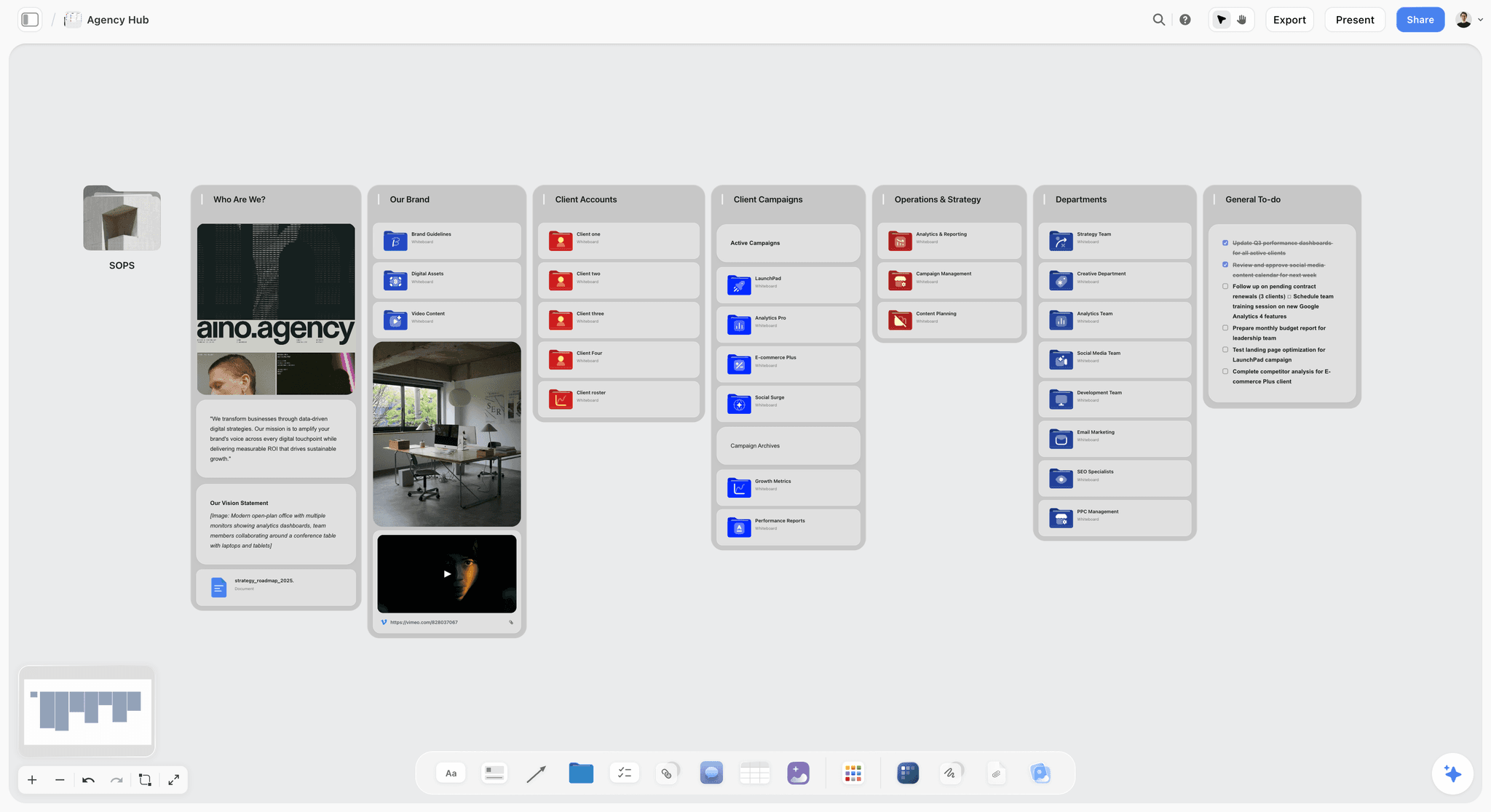
For solo practitioners and small teams, Storyflow is the tool I recommend for actually running design thinking. It is an AI-aware visual workspace built on an infinite canvas, and it is built for exactly this kind of cross-stage work. You run the whole process on one board: cluster Empathize research notes into an affinity map, write the Define problem statement as a card the whole team can see, draft How Might We statements, run Ideate as a spatial brainstorm, sketch low-fidelity prototypes, and lay out a journey map of the user experience. Because every stage lives on the same canvas, the connections that make the method work (a test note that points back to a research quote, an empathy map that reframes a problem) stay visible instead of buried in separate files.
What makes Storyflow stand out for design thinking is that the AI reads your full active canvas board. It can synthesize a wall of research notes into themes, pull empathy-map patterns into a sharp How Might We statement, or pressure-test your problem definition before you commit to it. The Story Blueprints library (200+ creative templates on the Plus plan and above) gives you ready starting structures for empathy maps, affinity clusters, ideation grids, and journey maps, so you are not building every board from a blank canvas. The free plan (free from late 2026, unlimited notes and boards, unlimited collaboration, basic AI, 20 file uploads) is enough to run a complete real project, and the Plus plan ($7.99/mo billed annually) unlocks the full Blueprints library and unlimited file uploads when you need it. One soft caveat: if you are facilitating a large in-person workshop, pair Storyflow with physical sticky notes on the day and use the canvas as the synthesis home before and after.
Start a free design thinking board at storyflow.so and run your next project on one canvas the AI can read. For a fuller comparison of options, see The Best Brainstorming Tools in 2026 and The Best AI Tools for UX Researchers in 2026.
Whatever tool you use, the rule is the same. The tool should make the work visible and the connections traceable. It does not do the thinking. Design thinking is a discipline for staying with the problem longer than feels comfortable, and no software changes that. It just gives the discipline somewhere to live.
9) The Bottom Line
Design thinking is a five-stage, human-centered approach to solving problems where the right answer is not obvious: Empathize, Define, Ideate, Prototype, Test, run as a loop rather than a line. The Double Diamond teaches the same work as a rhythm of widening and narrowing, twice. Both models exist to enforce one habit: understand the human problem deeply before you allow yourself to commit to a solution.
The method is genuinely useful and genuinely oversold. The critique from people like Natasha Jen is correct about the failure mode: design thinking performed as a one-day workshop produces sticky notes and the feeling of progress without the substance. The fix is not to abandon the method. It is to give each stage real time, especially Empathize and Define, and to treat the visible artifacts as a byproduct rather than the goal.
If you want to run a real design thinking project, the practical move is to give the work a home where every stage stays visible and the cross-stage connections are traceable. For solo practitioners and small teams, Storyflow is the tool I recommend for that: an AI-aware visual canvas where your empathy maps, How Might We statements, ideation, prototypes, and journey maps all sit on one board the AI can read and help synthesize. Take your current project, put the research, the problem statement, the ideas, and the prototypes on one canvas, and run the loop properly. Start a Storyflow workspace at storyflow.so and give your next design thinking project a real home.
8) FAQ: Design Thinking in 2026
What is design thinking in simple terms?
Design thinking is a way of solving problems that starts with the people affected by the problem rather than with a solution. You research the human need deeply, define the real problem clearly, generate many possible solutions, build cheap prototypes, and test them with real users. It is a structured way to avoid the most expensive mistake in any project: solving the wrong problem confidently.
What are the five stages of design thinking?
The five stages, from the Stanford d.school model, are Empathize (research the people you are designing for), Define (turn that research into a clear problem statement), Ideate (generate many possible solutions), Prototype (build cheap, fast versions to test), and Test (put prototypes in front of real users and learn). They are not linear. Teams loop back through them as testing reveals new information.
Who invented design thinking?
No single person invented it. It assembled over decades from work by Herbert Simon, Robert McKim, and Rolf Faste at Stanford. It was popularized in the 2000s by the design firm IDEO and its CEO Tim Brown, and turned into the well-known five-stage model by the Stanford d.school, founded in 2005. The British Design Council published its parallel Double Diamond model the same year.
What is the difference between the five stages and the Double Diamond?
They map the same work differently. The five stages (Empathize, Define, Ideate, Prototype, Test) teach the sequence of activities. The Double Diamond (Discover, Define, Develop, Deliver) teaches the rhythm: two cycles of widening then narrowing. The Double Diamond makes it visually clear that there are two separate moments of divergence, and skipping either one is a common way projects fail. Practitioners use both.
Is design thinking the same as brainstorming?
No. Brainstorming is one technique used inside the Ideate stage, which is one of five stages. A team that books a room and generates ideas has done a fraction of design thinking and skipped the research, problem definition, prototyping, and testing that make the ideas useful. Brainstorming generates options; design thinking decides which problem those options should address.
Is design thinking dead?
No, but the workshop-in-a-box version of it deserves to be. Critics like Natasha Jen of Pentagram have argued, since around 2018 and louder since 2023, that design thinking is often performed as shallow sticky-note theater that lacks rigorous critical feedback. The critique is fair when design thinking is sold as a one-day workshop. The underlying discipline (research the problem, delay commitment, test with real users) remains genuinely useful when each stage gets real time.
What is design thinking used for?
It is used for problems where the right answer is not obvious and the people affected matter. Common applications include product design, service design, user experience work, organizational change, education, public-sector projects, and marketing strategy. It is most valuable for "wicked problems" that resist a clean definition. It is less useful for well-defined technical problems that already have a known method.
How long does a design thinking process take?
It depends on the problem. A focused product question can run in a one-week design sprint. A complex service or organizational problem can take months across several loops. The danger is compression: running all five stages in a single day almost always means the Empathize and Define stages got skipped. If time is short, do those two stages properly rather than doing all five badly.
Do you need to be a designer to use design thinking?
No. The premise of design thinking is that the methods transfer beyond the design profession. Product managers, founders, teachers, marketers, and engineers all use it. The "designer" in the name refers to a way of working (people-first, prototype-driven, comfortable with ambiguity) rather than a job title.
What is a prototype in design thinking?
A prototype is the smallest, cheapest artifact that lets you test one assumption with a real person. It can be a paper sketch, a clickable mockup, a roleplay of a service interaction, a cardboard model, or a one-page written concept. The fidelity should match the question you are asking. The purpose is to fail early and cheaply, while changing direction still costs almost nothing.
What tools do you need for design thinking?
You need a way to make the work visible and the connections traceable across stages. That can be a physical wall of sticky notes for a co-located team, or a visual canvas tool for distributed work. A visual workspace like Storyflow lets you run affinity mapping, problem statements, ideation, and journey maps on one infinite canvas, with AI that reads the board to help synthesize research. Document tools work poorly because design thinking is spatial, not linear.
How is design thinking different from the design process?
The design process is the broader craft of designing something well, including the technical and aesthetic skill that comes from training and experience. Design thinking is specifically the human-centered, problem-framing structure that sits at the front of that work. Design thinking helps a team find and frame the right problem. It does not replace the expertise needed to solve it well, which is the heart of the honest critique of the method.
Table of Contents
- Quick Answer: What is Design Thinking?
- Where Design Thinking Came From
- The Five Stages of Design Thinking
- The Double Diamond: A Different Map of the Same Territory
- Design Thinking Examples That Actually Happened
- Common Misconceptions and the Honest Critique
- How to Actually Run Design Thinking
- FAQ: Design Thinking in 2026
- The Bottom Line
- Author
- Related Reading
Templates to check out for this topic


Branding and design templates you can use in Storyflow
Take a brand from naming to visual direction on one connected canvas. Open any of these templates and the AI works from everything already on the board.


See Storyflow in Action
A visual AI workspace where every feature lives inside one canvas. No tab-switching, no context lost.
Build your entire board from a single message
Type what you need in the AI chat at the bottom of your canvas. The AI adds cards, headings, and structure directly onto your board.
Use expert frameworks as AI context
Type @ in the AI chat and choose any Tactic. The AI tailors every response to that framework instead of giving generic advice.
Turn your board into a mind map in seconds
Ask the AI to restructure your canvas as a mindmap. It connects your ideas into a visual hierarchy so you can see how everything relates.
Why Storyflow Exists
Storyflow actually began as a personal tool while working on creative and research projects.
We kept running into the same problem: ideas were scattered everywhere: notes, documents, and whiteboards.
Nothing helped us see how everything connected.
So we started building a workspace designed around how ideas actually grow.
→ Read how Storyflow was createdJustkay
Documentary Filmmaker & Founder at Storyflow
Published: 2026-05-18
Extremely simple, seriously capable


See how easy it is to get started
Watch a real project come together, from a blank board to a finished plan, clicked through step by step.
Start creating with AI and become more productive
Transform your creative workflow with AI-powered tools. Generate ideas, create content, and boost your productivity in minutes instead of hours.