
Category
Visual Thinking
Author

Justkay
Documentary Filmmaker & Founder at Storyflow
Topics
2026-07-01
•
Updated July 1, 2026
•
11 min read
•
Visual Thinking- what is a vision board
- vision board
- vision board vs mood board
- digital vision board
- brand vision board
- how to make a vision board
What is a vision board?
A vision board is a visual arrangement of images, words, and references that represents a direction you are committing to, in your life, your brand, or a creative project. The common framing, a collage of things you wish for, is why most vision boards fail. The useful version is a visual argument about a direction: every image earns its place by supporting a specific choice about where you are going. A vision board is not a wish list you look at. It is a direction you build toward.
A vision board is a direction, not a wish list.
Storyflow keeps your references on an infinite canvas so you can group them by direction, name the intent, and let the AI turn the whole board into a plan, on the same canvas, without a rebuild.

1) Quick Answer: What is a Vision Board?
A vision board is a visual arrangement of images, words, and references that represents a direction you are committing to, whether that is a life you want to build, a brand you are shaping, or a creative project you are steering. Most people are taught it is a collage of things they wish for. That framing is why most vision boards fail. The useful version is sharper: a vision board is not a wish list you look at. It is a direction you build toward.
The distinction is the whole point of this guide. A wish is passive: you pin a picture of a house, a beach, a book deal, and you hope the pinning does something. A direction is an argument: every image is evidence for a specific choice about where you are going and how the pieces fit. Built as a direction, a vision board stops being decoration on a bedroom wall and starts being a reference you actually use, in planning, in decisions, and in the work.
I have built vision boards for documentary projects for years, and the ones that mattered were never the pretty ones. They were the ones that answered a question: what is this film about, what does it feel like, what am I actually going for. This guide is written for creatives, designers, and goal-setters who want a vision board they will use, not one they will make once and forget. It covers what a vision board is, the three types that matter, how to build one that functions as a direction, and where a visual canvas beats a paper collage.
For adjacent tools and workflows, see The 12 Best Vision Board Apps in 2026 and the mood board pillar, What is a Mood Board? The Complete Guide.
2) Vision Board vs Mood Board vs Goal List
Three artifacts get confused constantly, and the confusion is why people build the wrong one. Here is the honest separation.
A mood board is about feel: color, texture, typography, the emotional register of a project. It answers "what does this look and feel like." A goal list is about steps: the checklist, the milestones, the tasks you can tick. It answers "what do I do next." A vision board sits above both. It answers "where am I going, and why does this direction hold together." It is more committed than a mood board and more visual than a goal list.
This matters because people reach for a vision board when they actually need a goal list, or build a goal list when they need the direction a vision board provides. A vision board is not a substitute for planning. It is the thing planning points at. The clearest test: if you can tick it off, it is a goal. If it sets the feel of one project, it is a mood board. If it defines the direction a whole season of your work or life is moving in, it is a vision board.
3) A Wish vs A Direction: The Framework
The single most useful frame for vision boards is the difference between a wish and a direction. Get this right and everything else follows.
A wish is a picture of an outcome you do not control. A mansion. A stranger's book on a bestseller shelf. A beach you saw on someone else's feed. Wishes feel good to collect because they are aspirational and require nothing of you. This is the version self-help culture sold, and it is why the practice has a reputation for magical thinking. Pinning a Ferrari does not summon a Ferrari.
A direction is a visual argument about a choice you are making. It is not "I wish I were a filmmaker." It is "I am becoming the kind of filmmaker who makes intimate character documentaries, and here is the evidence: these three films I want mine to sit beside, this tone, this subject matter, this first project." A direction has a claim in it. Every image earns its place by supporting the claim, not by being nice to look at.
The practical difference shows up in how the board behaves. A wish board is static: you look at it, feel briefly motivated, and nothing changes. A direction board is generative. It produces decisions: this project fits the direction, that one does not; this opportunity moves me toward it, that one is a detour. A vision board is not a wish list you look at. It is a direction you build toward. When you catch yourself pinning something because you want it rather than because it argues for where you are going, you have slipped from direction back into wish, and the board goes dead.
Here is the working test for every element on the board. Ask: does this represent an outcome I am hoping arrives, or a direction I am steering toward? A hoped-for arrival is a wish, and it belongs in a daydream, not a vision board. A direction you can take a step toward this month earns its place. The best vision boards are almost aggressive about this. They are less "here is my dream life" and more "here is the argument for the next chapter, and here is why these pieces belong to it."
4) The Three Types of Vision Board
Vision boards are not one thing. The word covers three genuinely different artifacts, and knowing which one you are building changes what goes on it.
The life and goals board
This is the classic personal vision board, done right. It represents the direction your life is moving: the work you are building toward, the way you want to spend your days, the relationships and health and place that matter. The failure mode here is pure wishing, so the discipline is to convert every wish into a direction. Not "a big house" but "I am building toward owning a home in this kind of place, and my work and savings are the path." The images stay aspirational, but each is tied to a direction you can move along, not an outcome you passively await.
The brand vision board
This is a vision board for a business, a personal brand, or a product. It defines the direction the brand is heading: the customer it is for, the feeling it should create, the space it wants to own, the brands it wants to be mentioned beside. It is more committed than a brand mood board: a mood board fixes the visual identity, while a vision board fixes the direction the whole brand is steering, of which the visuals are one expression. Designers and founders use it to keep a brand coherent as it grows, checking every new campaign and product against a single direction.
The creative or project direction board
This is the one I use most as a filmmaker. It sets the direction for a specific creative project: a film, a book, a channel, a design system. It is more than a mood board because it captures not just the feel but the whole intent: what this project is about, who it is for, what it should sit beside when it is finished. For a documentary, that means the subject and the stance, not just the color grade. For a novel, the shape of the story and the writers it is in conversation with, not just the cover vibe. It is the reference you return to every time a decision threatens to pull the project off course.
All three share the same spine. A vision board is not a wish list you look at. It is a direction you build toward. The life board directs a life, the brand board directs a business, the project board directs a piece of work, but in each case the job is to make the direction visible enough that it guides real choices.
5) What Goes on a Vision Board That Works
A vision board that functions as a direction has more on it than pretty pictures. The mix is what makes it usable:
- Reference images that argue for the direction. Not aspirational stock photos, but specific visual evidence: the three films yours should sit beside, the brands you want to be mentioned with, the aesthetic you are steering toward.
- Words that name the direction. A vision board is not only images. A few sharp words, the claim itself, a defining phrase, an identity statement, anchor the visuals so the direction is unmistakable.
- A named intent. One line at the center saying what this direction is. "Intimate character documentaries." "A calm, premium wellness brand for people over forty." "A literary sci-fi novel about memory." The intent is the claim every other element supports.
- Anti-references. The strongest boards include what the direction is not: the tone you are avoiding, the market you are not chasing, the cliche you refuse. Naming the opposite sharpens the direction more than another aspirational image.
- A first concrete step. The bridge from direction to action: the one project or piece of work that starts moving you along the direction now.
The difference between this and a wish board is that every item is load-bearing. Remove a random photo from a wish board and nothing changes; remove the named intent or the anti-references from a direction board and the whole thing loses its shape. The pieces are connected by an argument, not just arranged on a surface.
6) Build a Vision Board in Storyflow

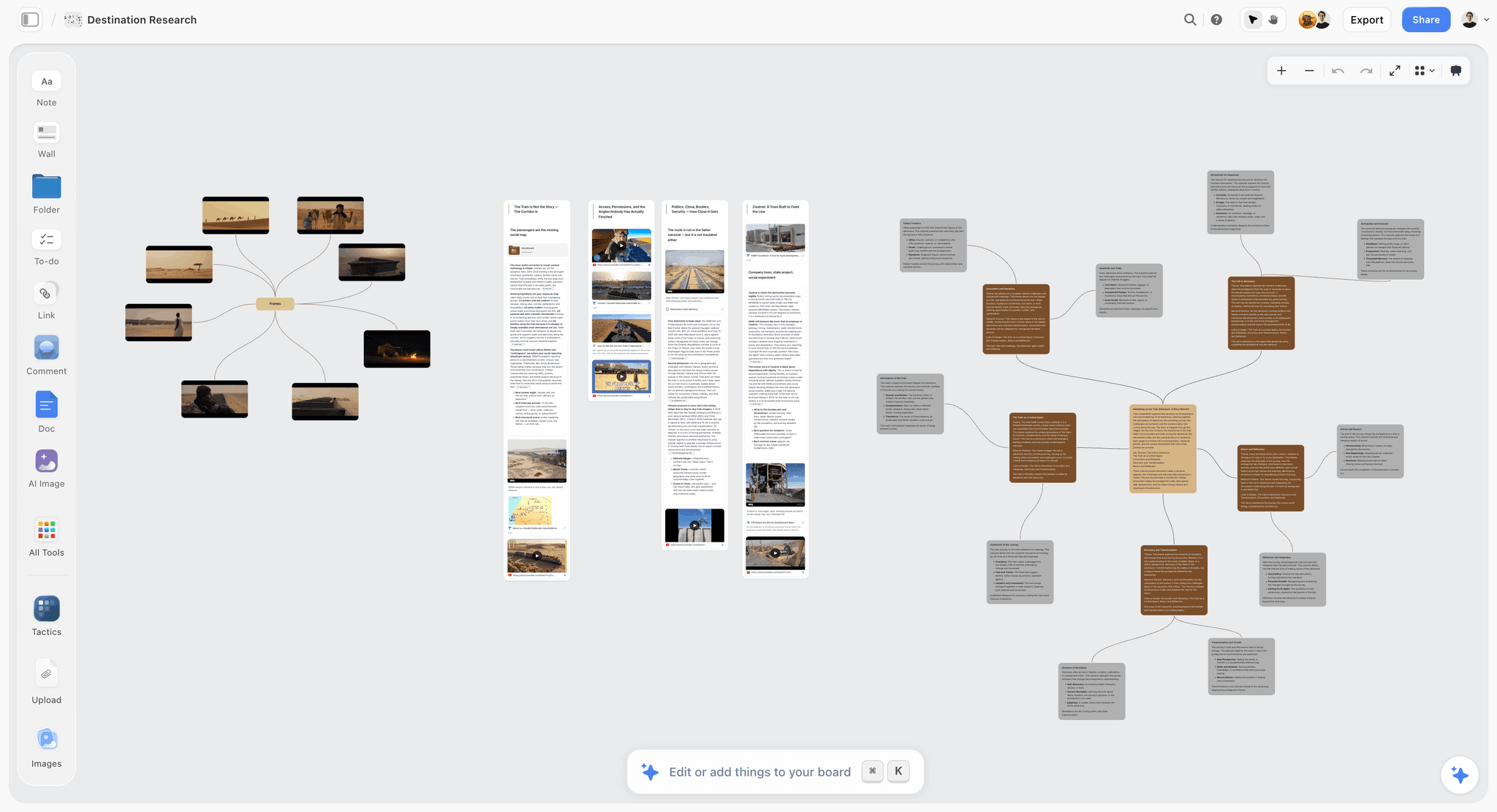
Most vision board tools are collage makers: you arrange images on a surface and stop there, which is exactly the wish-board trap, a nice arrangement you look at and never build on. Storyflow is a visual workspace, so the vision board is not the end of the canvas. It is the start of it. Here is how a direction-first board comes together, concretely.
Pull references onto the canvas. Drop images, screenshots, links, and notes straight onto an infinite canvas. Bring in the three films you want yours to sit beside, the brand shots you are steering toward, the words that name the direction. Everything lives in one place instead of scattered across a folder, a Pinterest board, and your camera roll.
Group by direction, not by vibe. This is the move that makes it a vision board rather than a mood board. Cluster the references into the arguments they support: this cluster is the subject and stance, this one is the tone, this one is the anti-references, this one is the first project. On a freeform canvas you arrange the clusters spatially so the direction is legible at a glance, and re-cluster the moment it sharpens. Add note cards for the named intent at the center and for what the direction is not, so those claims carry weight and the AI can read them.
Let AI turn it into a plan. Storyflow's AI reads your entire active canvas board by default, plus up to 1 Tactic and up to 3 Documents you @-mention in the chat. So once the direction is on the board, you can ask the AI to turn it into a plan: a project outline, the first three steps, a shot list or a content calendar that moves you along it. The vision board stops being a picture you look at and becomes the input to the work, on the same canvas, without a rebuild. A vision board is not a wish list you look at. It is a direction you build toward, and this is the tool where the building actually happens.
Where Storyflow is honestly the wrong tool. Three limitations, stated plainly. First, it does not make a printed, physical board; if your goal is a framed collage on a bedroom wall, a print-focused collage app or literal scissors and a corkboard will serve you better. Second, it is cloud-only with no offline mode, so building on a plane or under strict local-first requirements is a real constraint. Third, it is a newer platform than dedicated collage apps like Milanote or Canva, so its template library is smaller and some collage-specific niceties are thinner. If a polished collage is the entire deliverable and you never need to build past it, a dedicated collage tool is the closer fit. Storyflow earns its place when the vision board is the beginning of real work, not the end of it.
7) How to Make a Vision Board: The Workflow
The steps below work for any of the three types. They are built to keep you on the direction side of the framework and off the wish side.
- Name the direction in one sentence first. Before a single image, write the claim. "I am becoming X." "This brand is heading toward Y." "This project is about Z." If you cannot write the sentence, you are not ready to collect images. The sentence is the spine.
- Collect references against the claim. Gather images, words, and links, but only ones that argue for the sentence. Every time you add something, say how it supports the direction. If you cannot, it is a wish, and it does not go on.
- Add the anti-references. Write down, and where you can show, what the direction is not. This step is what separates a direction board from a wish board, and almost nobody does it.
- Group by argument. Cluster the references into the pieces of the direction they support: subject, tone, audience, first step. Spatial grouping is what makes the direction legible instead of a soup of nice images.
- Place the first concrete step on the board. Add the one real project or action that starts moving you along the direction this month. A direction with no first step is still a wish.
- Turn it into a plan. Convert the board into action: an outline, a checklist, a calendar. In a workspace like Storyflow you do this on the same canvas with the AI reading the board; on paper you copy it into whatever you plan with. Either way, the board is not finished until it has produced a next move.
- Return and revise. A vision board is a living reference, not a one-time craft project. Revisit it when a decision is hard, check the choice against the direction, and re-cluster when the direction sharpens.
The whole workflow is designed around one idea. A vision board is not a wish list you look at. It is a direction you build toward. Every step either sharpens the direction or turns it into a move.
8) Digital vs Physical Vision Boards
Both formats work, and the right one depends on what you want the board to do.
A physical board, a corkboard or a posterboard collage, has one real strength: presence. It hangs where you see it every day, and that ambient reminder is genuinely useful for personal, life-direction boards. The cost is that it is static. It does not turn into a plan, update easily, or connect to the actual work. For a life and goals board that lives on your wall as a daily nudge, physical is a legitimate choice.
A digital board trades ambient presence for capability. It is easy to update, holds far more than a corkboard, travels with you, and on a real workspace becomes the input to the work rather than the end of it. For brand and project boards, where the direction feeds directly into planning and production, digital wins clearly. You are not going to run a documentary's direction off a posterboard.
The honest recommendation: if the board's only job is a daily reminder of a life direction, a physical board on the wall is fine and even preferable. If it needs to become a plan, involve collaborators, or feed a real project, build it digitally. If you want both, keep the working board digital and print a snapshot to hang up. That gives you the presence without freezing the direction.
9) Common Vision Board Mistakes
The failure modes are consistent, and every one of them is a version of slipping from direction back into wish.
Collecting outcomes you do not control. The classic error: a board of mansions, awards, and other people's success. Outcomes are wishes; directions are what you steer toward. Convert every outcome into the direction that would produce it.
No named intent. A board with no sentence at the center is just a collage. Without the claim, there is nothing for the images to argue for, and the board cannot generate decisions. Write the sentence.
Skipping the anti-references. Boards that only show what you want are softer than boards that also show what you refuse. Most people skip this step, and their boards stay vague because of it.
Building it once and never returning. A vision board is a reference, not a craft project. The single biggest mistake is treating it as finished. Boards that work get revisited when decisions are hard and revised when the direction moves.
No first step. A direction with no concrete first action is indistinguishable from a wish. The board is not done until one real, near-term step lives on it.
Confusing it with a mood board. If the board only captures feel, it is a mood board, which is fine, but do not expect it to give you direction. A vision board carries the whole intent, not just the aesthetic.
Every one of these is a version of the same drift: when the board goes dead, it is almost always because it slipped back into a list of wishes.
11) The Bottom Line
A vision board is worth building only if you build the right thing. The version self-help culture sold, a collage of mansions and beaches you look at and hope, does nothing, and that is why the practice has a reputation for magical thinking. The version that works is sharper and more demanding: a visual argument about a direction you are committing to, where every image earns its place, the intent is named, the anti-references are drawn, and a first concrete step lives on the board.
Whether you are building a life board, a brand vision board, or a creative project direction board, the spine is the same. A vision board is not a wish list you look at. It is a direction you build toward. Build it as a direction, group your references by the arguments they make, name what the direction is and what it is not, and turn it into a plan instead of leaving it as a picture.
If your vision board needs to become real work, build it on Storyflow's free canvas: pull your references in, group them by direction, and let the AI turn the direction into a plan on the same board.
10) FAQ: Vision Boards
What is a vision board in simple terms?
A vision board is a visual arrangement of images and words that represents a direction you are committing to, in your life, your brand, or a creative project. The useful version is not a collage of things you wish for. It is a visual argument about where you are going, where every image earns its place by supporting a specific direction you can take a step toward.
What is the difference between a vision board and a mood board?
A mood board answers "what does this feel like": color, texture, tone, aesthetic, usually for a single project. A vision board answers "where am I going": the whole direction and intent, over months or years. A mood board fixes the look; a vision board fixes the direction the look is one expression of. Creatives often build both, the mood board serving the vision board's direction.
Do vision boards actually work?
They work when they are built as a direction rather than a wish list, and they do nothing when they are a collage of outcomes you do not control. A board of mansions and awards is magical thinking. A board that names a direction, argues for it with specific references, and includes a first concrete step becomes a real reference you use in planning and decisions. The mechanism is clarity and repeated attention, not magic.
What should I put on a vision board?
Put reference images that argue for your direction, words that name the direction, one sentence stating the intent at the center, anti-references showing what the direction is not, and one concrete first step. Avoid generic aspirational stock photos and outcomes you cannot control. The test for every element: does it represent a direction I can steer toward, or an outcome I am passively hoping arrives.
Should a vision board be digital or physical?
Physical boards win on ambient presence: they hang where you see them daily, which suits life-direction boards. Digital boards win on capability: they update easily, hold more, travel with you, and on a real workspace become the input to the work. For brand and project boards that feed planning and production, digital is clearly better. A good middle path is to keep the working board digital and print a snapshot to hang up.
How is a vision board different from a goal list?
A goal list is about steps you can tick off; a vision board is about the direction those steps serve. A goal list answers "what do I do next," a vision board answers "where am I going and why does this hold together." They are complementary: the vision board sets the direction, the goal list breaks the near-term into tasks. If you can check it off, it is a goal; if it defines where a whole chapter is heading, it is a vision.
How do I make a vision board with AI?
Collect your references on a canvas, name the direction, group the references by the argument they support, then let an AI read the whole board and turn it into a plan. In a workspace like Storyflow, the AI reads your active canvas plus any Tactic and documents you @-mention, so it can convert a grouped, named direction into an outline, a first set of steps, or a content plan on the same canvas. See How to Create a Mood Board with AI for the adjacent workflow.
What is the biggest mistake people make with vision boards?
Filling the board with outcomes they do not control instead of directions they can steer toward. A photo of a mansion is a wish; the direction that would produce it is something you can act on. The second biggest mistake is treating the board as finished after building it once. A vision board is not a wish list you look at, it is a direction you build toward, so it only works if you keep using it.
Table of Contents
- Quick Answer: What is a Vision Board?
- Vision Board vs Mood Board vs Goal List
- A Wish vs A Direction: The Framework
- The Three Types of Vision Board
- What Goes on a Vision Board That Works
- Build a Vision Board in Storyflow
- How to Make a Vision Board: The Workflow
- Digital vs Physical Vision Boards
- Common Vision Board Mistakes
- FAQ: Vision Boards
- The Bottom Line
- Author
- Related Reading
Templates to check out for this topic


Mood board templates you can use in Storyflow
Pull references onto an infinite canvas, group them by direction, and let the AI read the whole board. Open any of these mood board templates and start dropping in images.


See Storyflow in Action
A visual AI workspace where every feature lives inside one canvas. No tab-switching, no context lost.
Build your entire board from a single message
Type what you need in the AI chat at the bottom of your canvas. The AI adds cards, headings, and structure directly onto your board.
Use expert frameworks as AI context
Type @ in the AI chat and choose any Tactic. The AI tailors every response to that framework instead of giving generic advice.
Turn your board into a mind map in seconds
Ask the AI to restructure your canvas as a mindmap. It connects your ideas into a visual hierarchy so you can see how everything relates.
Why Storyflow Exists
Storyflow actually began as a personal tool while working on creative and research projects.
We kept running into the same problem: ideas were scattered everywhere: notes, documents, and whiteboards.
Nothing helped us see how everything connected.
So we started building a workspace designed around how ideas actually grow.
→ Read how Storyflow was createdJustkay
Documentary Filmmaker & Founder at Storyflow
Published: 2026-07-01
Extremely simple, seriously capable


See how easy it is to get started
Watch a real project come together, from a blank board to a finished plan, clicked through step by step.
Start creating with AI and become more productive
Transform your creative workflow with AI-powered tools. Generate ideas, create content, and boost your productivity in minutes instead of hours.