The 8 Best Visual Collaboration Tools for Teams in 2026 (What Breaks at 5, 15 and 50 People)
The best visual collaboration tool for a team of five is a bad choice for a team of fifty, and the failure is predictable enough to plan around. The failures arrive in a fixed order across every product in the category.

Category
Tools
Author

Justkay
Documentary Filmmaker & Founder at Storyflow
Topics
2026-09-07
•
23 min read
•
Tools- best visual collaboration tool for teams
- which whiteboard tool scales with team size
- miro or figjam for a team of twenty
- when do free whiteboard tiers stop working
- how much does a team whiteboard cost
What is the best visual collaboration tool for teams?
The best visual collaboration tool for a team of five is a bad choice for a team of fifty, and the failure is predictable enough to plan around. Below five people everything works and the tool barely matters. Between five and fifteen the first thing to break is findability, because boards multiply faster than anyone names them. Between fifteen and fifty, duplication and permissions break, because two people now build the same board without knowing the other exists. Above fifty the constraint stops being the tool and becomes governance, which no product solves. Pick for the threshold you are approaching rather than the one you are in, because migrations always land at the worst possible moment.
Full disclosure: Storyflow is our product. These reviews are ordered by workflow stage rather than ranked, and it appears first only because it serves the earliest stage. It has no folder-level permissions, no admin inventory of boards, no SSO and no retention policy, so it does not address the third and fourth thresholds this article is scored on. Miro is recommended above fifteen people.
Quick Comparison
Four thresholds, four failures, and the order is the same across every product in the category.
| Tool | Best For | AI Features | Price |
|---|---|---|---|
| Under 5 | Nothing breaks | Take a free tier | Threshold 1 |
| 5 to 15 | Findability breaks | Buy the organisation layer | Threshold 2 |
| 15 to 50 | Duplication, then permissions | Buy folder permissions | Threshold 3 |
| Over 50 | Governance breaks | Fund a person, not a tier | Threshold 4 |
Key Takeaways
- Team size predicts which failure you get, and the failures arrive in a fixed order: findability, then duplication, then permissions, then governance.
- Under five people, tool choice is close to irrelevant. Anything with a canvas and a share link works, and switching later is cheap.
- The five-to-fifteen threshold breaks findability first. The symptom is people asking in chat where a board is, which is a search problem wearing a collaboration costume.
- The fifteen-to-fifty threshold breaks duplication. Two people build the same board in the same month, and neither is wrong.
- Above fifty, the tool stops being the variable. Every product in this category works at that size if someone owns naming, archiving and access; none works if nobody does.
- Free tiers are capped on boards, not on people, which is why teams outgrow them at exactly the wrong moment: mid-project, with the board they need locked.
- Per-seat pricing changes the calculus at fifteen people, where the annual bill crosses the threshold at which somebody starts asking what it is for.
- Migrating a visual workspace is harder than migrating documents, because a board's value is in its arrangement and arrangement is what exports lose.
Why Team Size Predicts the Failure
Most comparisons of visual collaboration tools rank on features: infinite canvas, templates, video chat, voting, timers, integrations. That ranking is nearly useless for choosing, because the top six products have converged. Miro, Mural, FigJam, Lucidspark and Canva all have an infinite canvas, sticky notes, templates, cursors, comments and a timer. Choosing between them on features means choosing on details you will not notice after the first week.
What does differ, and what teams actually hit, is how each product behaves as the number of people using it grows. Collaboration tools do not fail at a feature, they fail at a headcount. The same board that felt effortless with six people becomes unusable with twenty, and nothing about the board changed.
The reason is that a visual workspace has a hidden cost that scales with people rather than with content: the cost of knowing what exists. A document tool solves this with folders and search, both of which work well on prose. A canvas does not have that luxury. Boards are visual, their content is spatial, and search on a canvas returns the sticky note but not the reason it is there.
So the failures arrive in order, and the order is the same across every product in the category.
First, findability breaks. Somewhere around eight to twelve people, the number of boards passes the number anybody holds in their head. The symptom is a message in chat: "where's the board from the kickoff?"
Second, duplication breaks. Around fifteen to twenty-five, two people independently create the same board because neither could find the other's. Now there are two, both partly correct, and merging them costs more than either was worth.
Third, permissions break. Around thirty to fifty, the workspace contains material that not everyone should see: hiring, budgets, client work under NDA. The default of everything-open stops being a virtue.
Fourth, governance breaks. Above fifty, the previous three failures compound faster than any individual can fix them, and the only working answer is a person whose job includes the workspace.
Knowing which failure is next tells you what to buy for. Buying for a failure two thresholds away is overpaying; buying for the one you are already past is why teams migrate mid-project.
Threshold One: Under Five People
Nothing breaks. This is worth saying plainly, because a lot of comparison content implies a small team needs to choose carefully, and it does not.
At four people everyone knows every board, because there are maybe nine of them and three people made all nine. Findability is solved by asking the person next to you. Duplication does not happen because everyone saw the board get made. Permissions are unnecessary because everyone is allowed to see everything. Governance is a word nobody has used.
The only decision that matters at this size is cost, and the second is exit. Cost, because free tiers are genuinely sufficient here. Exit, because whatever you pick now, you will probably leave it at fifteen people, and the cost of leaving depends on how much arrangement you built.
The practical advice for a team under five:
- Take the free tier of whatever the team already knows. Familiarity beats capability at this size.
- Do not build a naming convention. You will not follow it and it costs a meeting.
- Do keep the number of boards low enough to see on one screen. This is the only discipline that pays off later.
- Assume you will move. Do not invest in structure you cannot rebuild in an afternoon.
The mistake at this size is over-buying. A five-person team on a business tier with permissions, SSO and admin controls is paying for problems it does not have and will not have for two years.
Threshold Two: Five to Fifteen People
The first genuine threshold, and the one most teams are standing on when they search for a better tool.
What breaks: findability. The board count crosses roughly forty, nobody made most of them, and half have titles like "Untitled" or "Workshop" or "Q2 stuff". Search helps if you remember a word that is on the board, which you usually do not, because what you remember is that it was the one with the timeline in the middle.
The symptoms are specific:
- Someone asks in chat where a board is, at least weekly.
- New starters are given a link to a board rather than a way to find boards.
- Somebody has a private list of the important links, kept in a document.
- A board gets rebuilt because finding the old one took longer than starting again.
What actually fixes it. Not a better tool, in most cases. The three things that work are a flat naming convention that includes the project, an archive that is used rather than admired, and one board that is a map of the other boards. All three are free and none is fun.
Where the tool does matter at this threshold is in how the product organises boards above the board. Miro's spaces, Mural's rooms, FigJam's project structure inside Figma files and Lucidspark's folders are all attempts at the same thing, and they differ enough to matter. A product that gives you one flat list of boards is a product that will fail here at exactly this headcount.
What it costs. This is also the threshold where free tiers stop working, and the way they stop is worth understanding: most free tiers cap editable boards, not collaborators. Miro's free tier allows three editable boards. Lucidspark's is similar. What that means in practice is that a team of nine hits the wall not when the tenth person joins but when the fourth project starts, which is usually mid-quarter with a live board that suddenly goes read-only.
At ten people, per-seat pricing is roughly $80 to $160 a month depending on tier, which nobody questions. That changes at the next threshold.
Threshold Three: Fifteen to Fifty People
The threshold where a tool choice actually gets made, usually badly, usually under time pressure.
What breaks: duplication, then permissions.
Duplication is the sharper of the two. Two people build a board for the same purpose in the same month. Neither did anything wrong: the workspace has three hundred boards, search returned nothing useful, and building was faster than looking. Now the organisation has two campaign boards, two onboarding maps, two competitor grids, and each has content the other lacks.
The cost of duplication is not the wasted hour of rebuilding. It is that from then on, nobody trusts any board to be the current one. That distrust is what actually kills a workspace, and it is nearly irreversible. Once people assume the board they find might be stale, they stop reading boards, and a visual workspace that nobody reads is an expensive archive.
Permissions break more slowly and more quietly. At thirty people the workspace contains hiring notes, salary bands, a board about a reorganisation, and client work covered by an NDA. The default in most of these products is that everyone in the workspace sees everything, which was the right default at eight people and is a liability at forty.
What to look for at this threshold:
- Board-level and folder-level permissions, not just workspace-level. Most products have this only on their business or enterprise tier, which is where the price jumps.
- An admin view of what exists. Being able to list every board, sorted by last opened, is the single most useful governance feature in this category and is often buried.
- Guest access that is genuinely restricted, because at this size you are sharing boards with clients and freelancers weekly.
- A real archive, meaning something that removes a board from view without deleting it. Teams that cannot archive safely never archive.
What it costs. At thirty people, a business tier at roughly $16 per user per month annual is about $5,800 a year. That is the number at which somebody asks what the tool is for, and it is the number that starts most migrations. The migration usually fails to save money, because the alternative also charges per seat, and it usually costs a quarter of somebody's time.
Threshold Four: Over Fifty People
Above fifty people, the honest answer is that the tool is no longer the variable.
Every product in this category works at that size, and every product fails at that size, and which one you get depends entirely on whether one person owns naming, archiving and access. That person does not need to be full time on it. They need it to be an explicit part of a role, with time attached, and they need the authority to delete things.
The failures above fifty are organisational, and they present as tool complaints.
"Search is terrible" usually means nothing has been named consistently for two years.
"It is too slow" is sometimes genuinely the product on a very large board, and is more often a board that has been accreting for eighteen months because nobody is allowed to archive.
"Nobody uses it" usually means the workspace has enough stale content that the expected value of opening it is negative.
What to buy at this size, if you are buying:
- SSO and centralised provisioning, because manual account management at this headcount leaks access.
- Audit and admin reporting, at minimum a list of boards by last activity.
- A retention or archive policy the product can enforce, rather than one that relies on people.
- Enterprise support, which matters mostly because it gives you someone to escalate to when something is genuinely broken.
What not to expect: that any of it fixes the underlying problem. The underlying problem is that a visual workspace has no natural pressure toward tidiness, and above fifty people the entropy outruns goodwill. The tool that works at this size is the one somebody is looking after.
A Worked Example: A Team Crossing Fifteen People
A design and content team inside a 60-person company, growing from nine people to nineteen over eleven months.
At nine people, month zero. 34 boards, all made by four people, everyone knows what exists. The free tier's three-board cap had already been passed, so they were on a paid plan at roughly $90 a month and nobody thought about it.
At thirteen people, month five. 71 boards. The first symptom appeared in chat rather than in the tool: someone asked where the Q2 planning board was, and two people sent different links. Both were real, both were partly current.
At sixteen people, month eight. 118 boards. Two people built a competitor grid within nine days of each other. Neither had done anything wrong; search returned eleven boards with "competitor" in the title and none was obviously the current one.
The intervention, month nine. Not a migration. Three rules: every board title starts with the project name, one index board maps the rest, and anything untouched for six months archives automatically. Plus one named owner with a stated half day a month.
At nineteen people, month eleven. 96 boards, down from 140, because archiving finally happened. The duplication stopped. The tool never changed, and the annual bill went up by $600 while the problem it was blamed for went away for free.
What the team nearly did instead. Priced a migration to a competitor at one quarter of a person's time, triggered by the invoice rather than by the duplication. The invoice and the problem arrived in the same month and were unrelated, which is the most common reason teams migrate for no benefit.
Comparison Table: Tools Against the Thresholds
| Under 5 | 5 to 15 | 15 to 50 | Over 50 | Free tier | Roughly, per user annual | |
|---|---|---|---|---|---|---|
Storyflow | Yes, strong | Good | Adequate | Poor | Late 2026 | $7.99 to $39 flat |
Miro | Yes, strong | Yes, strong | Yes, strong | Yes, strong | 3 editable boards | About $8 to $16 |
FigJam | Yes, strong | Yes, strong | Good | Good | Generous | About $5 |
Mural | Good | Yes, strong | Yes, strong | Good | Limited | About $12 |
Lucidspark | Good | Good | Good | Good | 3 boards | About $9 |
Canva Whiteboards | Yes, strong | Good | Adequate | Poor | Yes, generous | About $10 |
Microsoft Whiteboard | Adequate | Adequate | Adequate | Good | With Microsoft 365 | Bundled |
Notion | Good | Good | Good | Adequate | Yes | About $10 |
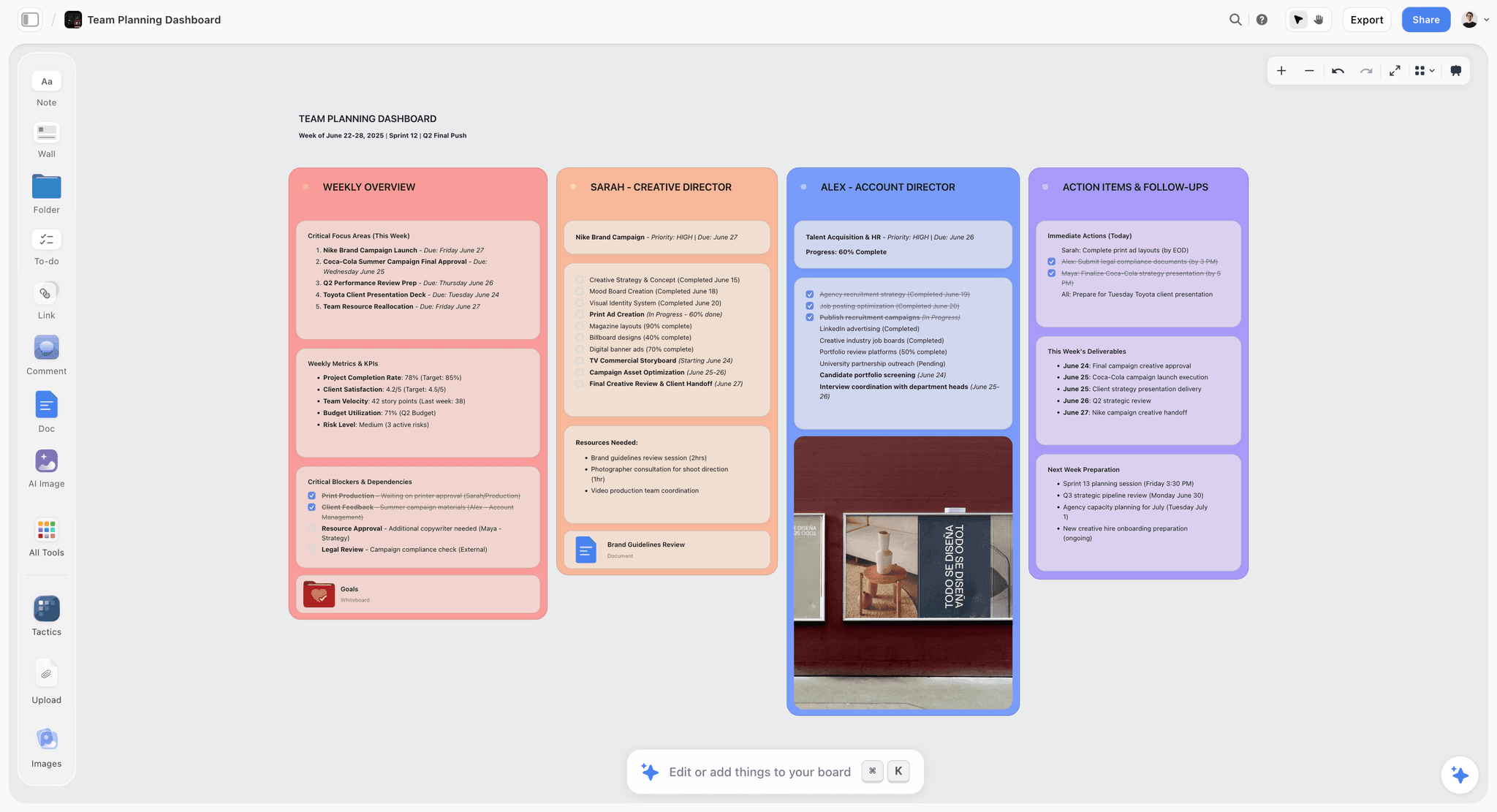
A team plan held on one board over months
A board that is a project, not a meeting
Most whiteboard tools are built for the hour a group spends in them. A board that holds a project's actual material is a different object, and it is what the AI reads.

How We Evaluated
Four criteria, chosen because they are the four that change with headcount.
Organisation above the board. Whether the product has a real structure between the workspace and the individual board, and whether that structure is usable rather than nominal. This is the criterion that decides the five-to-fifteen threshold, and it is the one feature comparisons routinely omit because every product claims folders.
Permission granularity. Whether access can be set below the workspace level, on which tier, and whether guests can be given genuinely limited access. This decides the fifteen-to-fifty threshold.
Cost shape rather than cost level. Per-seat products get expensive linearly with headcount, which is fine until it is not. Flat-rate and bundled products behave differently at scale. We care about the shape because the shape is what surprises people.
Exit cost. What an export actually contains. A board's value is in its arrangement, and every export in this category loses some of it. A product whose export is an image is a product you cannot leave without retyping.
We did not weight real-time performance heavily, because every product here is adequate on a normal board and every product degrades on an enormous one. We did not weight template libraries at all, because template count is the least predictive number in this category.
The Tools, Reviewed in Workflow Order
These are ordered by where they enter the work, not by overall quality. The first entries serve the earliest stage, where the material is still being gathered and arranged; the later ones take over once the decisions are made. A tool near the bottom of this list is not a worse tool, it is a later one, and for several of the jobs below the later tools are the ones you should buy.
1. Storyflow

The verdict: built for a small creative team holding one project's material on one board, and the wrong shape above about twenty people.
Best for: creative teams under fifteen where the board is a project rather than a meeting.
Pricing: paid-only during early access at $7.99 per month on the Plus tier billed annually, $14 on Pro and $39 on Max. The Free plan launches before the end of 2026. Anyone a paid member invites to a board joins free now and can invite others, which is the one genuinely free path today.
Why it comes first. These reviews run in workflow order, and this is the earliest entry: the stage before a workspace needs scaling at all, when a small team is still working out what the project is. The difference at that stage is not the canvas. The AI reads everything on the current board, so a board holding the project's actual material becomes context rather than decoration, and you can bring in up to one Tactic and up to three documents by mentioning them in the chat. For a team of six holding a campaign or a film in one place, that changes what the board is for: it stops being a record of a meeting and becomes the thing the work is done in.
Where it loses, and above fifteen people it is not close: there is no folder-level permission model, no admin inventory of every board by last activity, no SSO, and no retention policy. At forty people you would hit the duplication failure with no tooling to answer it. On the criteria this article is scored on, Miro beats it at every threshold above fifteen and we do not recommend it there.
Strengths:
- The board is context for the AI, not just a picture of a discussion.
- Flat pricing rather than per seat, which is unusual in this category.
- Built around a project living on a board over months rather than an hour-long session.
Limitations:
- No folder-level permissions, admin inventory, SSO or retention controls, so the third and fourth thresholds are unaddressed.
- No live facilitation toolkit: no summon, no follow-me, no voting.
- Paid-only during early access, which makes trialling it across a team costlier than the free tiers here.
2. Miro
The verdict: the safest choice at every threshold, and the one you will overpay for at the small end.
Best for: teams that are already past fifteen people or expect to be within a year.
Roughly: free tier with three editable boards; paid tiers from about $8 per user per month annual, with the permission controls most teams need on the business tier at roughly double that.
Why it is here. Miro is the only product here that is genuinely good at all four thresholds. The organisation layer above boards is real, the admin view of what exists is usable, permissions go below workspace level, and the product does not fall over on a large board as readily as its competitors. It is also the one everyone has used, which is worth more than it sounds: at forty people, the training cost of an unfamiliar tool is a real number.
Strengths:
- Board organisation that survives several hundred boards.
- The widest integration surface in the category, which matters at the sizes where the workspace has to talk to Jira, Slack and the rest.
- Genuinely large boards work, within reason.
- Guest and visitor access is well thought through.
Limitations:
- Expensive at scale, and the features you need at thirty people are on the tier that costs double.
- The interface has accumulated fifteen years of features and shows it.
- Overkill below ten people, where the free tier's three-board cap arrives faster than expected.
3. FigJam
The verdict: the best value in the category if your team is already in Figma, and an odd purchase if it is not.
Best for: product and design teams up to about thirty people.
Roughly: a generous free tier; paid access is bundled into Figma's seat model at roughly $5 per editor per month, which is the lowest real cost here.
Why it is here. For a team that already pays for Figma, FigJam is close to free and sits next to the design files, which removes the most common reason boards go stale: they are somewhere nobody goes. The product itself is lighter than Miro, which is a virtue below thirty people and a limitation above it.
Strengths:
- Cheapest genuine option for teams already on Figma.
- Lives beside design work, so the board is on the path people already walk.
- Fast, clean, and much easier to learn than Miro.
- Organisation inherits Figma's project and file structure, which is better than a flat list.
Limitations:
- Organisation is Figma's, which is designed for design files and fits boards imperfectly.
- Weaker admin and reporting than Miro at the sizes where you need them.
- Buying Figma seats for non-designers to use FigJam is a strange bill to defend.
4. Mural
The verdict: the facilitation specialist, and the right answer if workshops are a job rather than an event.
Best for: teams of fifteen to fifty where someone facilitates sessions regularly.
Roughly: limited free tier; paid from about $12 per user per month annual.
Why it is here. Mural's facilitation features are better than Miro's: the summon, the follow-me, the timers, the structured methods. If your organisation runs workshops as a discipline rather than occasionally, that difference compounds. The rooms structure is also a genuinely good answer to the findability failure at the second threshold.
Strengths:
- The strongest facilitation toolkit in the category.
- Rooms give real organisation above the board.
- Method templates that are actually methods rather than decorated grids.
Limitations:
- More expensive than FigJam for a smaller feature surface outside facilitation.
- Smaller ecosystem and fewer integrations than Miro.
- Less appealing if workshops are rare, which for most teams they are.
5. Lucidspark
The verdict: the choice when the organisation already runs on Lucidchart.
Best for: teams inside companies with an existing Lucid relationship.
Roughly: free tier with three boards; paid from about $9 per user per month annual.
Why it is here. Lucidspark is competent everywhere and best nowhere, which sounds like faint praise and is actually a reasonable position. The real argument for it is the diagramming adjacency: if your organisation makes architecture diagrams and process maps in Lucidchart, having the ideation surface in the same account removes a procurement conversation.
Strengths:
- Tight integration with Lucidchart for teams that need both.
- Reasonable folder organisation.
- Enterprise controls at a lower tier than some competitors.
Limitations:
- Little reason to choose it absent the Lucidchart relationship.
- Smaller community and template ecosystem.
- Weaker at the very large board sizes.
6. Canva Whiteboards
The verdict: excellent for a team under fifteen that also makes things, and structurally wrong above thirty.
Best for: marketing and content teams under fifteen people.
Roughly: genuinely generous free tier; team pricing around $10 per user per month.
Why it is here. The whiteboard is good and the free tier is the most generous here, but the reason to choose it is the adjacency: the board is in the same product as the deck, the social post and the document, so a workshop output becomes a deliverable without a handoff. That is a real advantage below fifteen people. Above thirty, the organisation and permission model is the weakest in this list, because Canva is designed around assets rather than around a workspace.
Strengths:
- The most generous free tier in the category.
- Output and ideation in the same product.
- The easiest for non-technical teams to adopt.
Limitations:
- Organisation above the board is weak, and it is weak in exactly the way that fails at the second threshold.
- Permissions are asset-shaped rather than workspace-shaped.
- Not built for the workshop as a discipline.
7. Microsoft Whiteboard
The verdict: the answer when procurement is the binding constraint.
Best for: organisations over fifty people already standardised on Microsoft 365.
Roughly: bundled with Microsoft 365, so the marginal cost is zero.
Why it is here. On features it is behind everything above it. On the two things that decide large-organisation adoption, cost and identity, it wins outright: it is already paid for, and access is already governed by the directory everyone is in. For a five-hundred-person company, that is not a small advantage, and it is why so many enterprise boards live here despite the product being the weakest on this list.
Strengths:
- No incremental cost, no procurement, no new vendor review.
- Identity, provisioning and retention inherit from the tenant.
- Adequate for meeting-adjacent visual work in Teams.
Limitations:
- Genuinely behind on canvas capability, templates and facilitation.
- Weak outside the Microsoft context.
- Poor as a durable workspace rather than a meeting surface.
8. Notion
The verdict: not a visual collaboration tool, and frequently the right thing to use instead of one.
Best for: teams whose visual work is mostly structure rather than spatial arrangement.
Roughly: free personal tier; team pricing around $10 per user per month.
Why it is here. A large share of teams searching for a visual collaboration tool need a shared, organised place to think, and reach for a canvas because canvases are what the category is called. Notion is worse at spatial arrangement and much better at findability, which is the failure that actually arrives first. If your problem is that nobody can find anything, a canvas will make it worse and Notion will make it better.
Strengths:
- Findability is its strongest suit, which is the second threshold's failure.
- Permissions below the workspace level on affordable tiers.
- One product for documents, tracking and reference.
Limitations:
- Genuinely poor at spatial arrangement, which is the reason to buy a canvas.
- Its own maintenance cost is high, and it grows with team size.
- Not usable for a live workshop.
The Three Migration Windows
Teams migrate visual workspaces at three predictable moments, and two of them are bad.
Window one: at the free-tier wall, around eight people. This is the good one. Little has been built, the arrangement that would be lost is small, and moving costs an afternoon. The mistake here is migrating to the tool with the most features rather than the one whose organisation layer suits the next threshold.
Window two: at the price shock, around thirty people. This is the bad one. It is triggered by an invoice rather than by a problem, it happens under time pressure, and the destination is chosen on price. Two years of arrangement has to be moved, exports lose most of it, and the migration typically consumes a quarter of somebody's time to arrive at a workspace nobody likes as much. If you are in this window, price the migration honestly before you start: a quarter of a person's time at thirty-person scale usually exceeds the annual saving.
Window three: at the trust collapse, any size above twenty. This is the worst one. Nobody trusts the boards any more, so the team decides to start clean somewhere else. It feels like a fresh start and it is a repeat, because the reason boards stopped being trusted was that nobody owned naming and archiving, and nothing in the migration changes that. Nine months later the new tool looks like the old one.
The general rule: migrate at window one, plan at window two, and at window three fix ownership rather than tooling.
What Actually Fails: A Field Inventory
Ranked by how often it is the real problem, rather than by how often it is the stated complaint.
Nobody names boards consistently. The single largest cause of the findability failure, and free to fix on the day somebody decides to. The convention that works is boring: project, then type, then date. "Northwind, retro, 2026-03" beats anything clever.
Nothing is ever archived. Teams archive nothing because archiving feels like deleting and nobody wants to be the one who hid something. The fix is an explicit rule that boards untouched for six months are archived automatically and can be restored by anyone. The automatic part matters, because it removes the decision from a person.
The board outgrew the room. A board that started as a workshop and became a two-year project accretes until it is slow and unreadable. The answer is to split it, and teams resist because the arrangement is load-bearing. Split it anyway, at a natural seam, and leave a link.
There is no map. One board that indexes the others, kept current, solves more of the findability failure than any search feature. It takes twenty minutes a month.
Access is all or nothing. Once the workspace holds anything sensitive, the everything-open default becomes a reason to keep important work outside the workspace, which is the beginning of the end for it.
Two tools do the same job. Frequently a team has both a canvas and a document tool, and neither is authoritative for a given piece of work. The fix is a rule, not a migration: decisions live in the document, thinking lives on the board.
Persona Recommendations
Two-to-four-person studio. Take the free tier of the tool you already know. Canva if you make things, FigJam if you already have Figma. Do not build structure yet.
Eight-person marketing team. FigJam if design is already in Figma, Canva if not. Introduce the naming convention now, before the board count crosses forty. Budget for the three-board free-tier wall arriving mid-project.
Twelve-person agency. Miro or Mural, depending on whether you run workshops as a discipline. This is the threshold at which the organisation layer above the board starts earning its keep, and it is worth paying for the tier that has it.
Thirty-person product organisation. Miro on a tier with folder-level permissions, or FigJam if the whole organisation already lives in Figma and you can accept weaker admin tooling. Name an owner in the same month you buy it.
Sixty-plus-person company. Miro or Microsoft Whiteboard, and the choice between them is procurement rather than product. Whichever you pick, the deciding factor is that somebody owns naming, archiving and access as part of a real role.
Six-person creative team on one long project. A canvas that holds the project's material rather than a meeting's output, which is the case Storyflow is built for and the one where per-seat products fit badly.
Do You Need a Visual Collaboration Tool At All?
A genuine question, and for a meaningful share of teams the answer is no.
If your visual work is one workshop a quarter, you do not need a subscription. The free tier of anything covers four workshops a year, and the board's afterlife is a screenshot in a document, which is what happens to it anyway.
If your actual problem is findability, a canvas will make it worse. Canvases are the least findable format there is. The right purchase is a document tool with good search, and the right project is a naming convention.
If your actual problem is that decisions do not get made, no tool addresses it. Boards are excellent at generating options and structurally bad at closing them, because everything on a canvas has equal standing. The fix is a person who writes down what was decided, in prose, somewhere else.
If your team is under four people and co-located, paper and a wall genuinely competes, and it has the best latency in the industry. The reason to go digital at that size is a remote member or a need to keep the artifact, not the canvas itself.
Where a tool is genuinely required: distributed teams doing structured group work, any team where the artifact matters after the session, and any work where spatial arrangement carries meaning that a list cannot.
Frequently Asked: Visual Collaboration Tools for Teams
What is the best visual collaboration tool for teams?
Miro for teams above fifteen people, because it is the only product that handles findability, duplication and permissions well at that scale. FigJam for teams under thirty that already pay for Figma, where it is both cheaper and better placed. Mural if workshops are a regular discipline rather than an occasional event. Canva for marketing teams under fifteen who want the board and the deliverable in one product. Below five people the choice barely matters, so take the free tier of whatever the team already knows.
At what team size do free tiers stop working?
Usually between eight and twelve people, and the trigger is rarely headcount. Most free tiers cap editable boards rather than collaborators: Miro allows three, Lucidspark similar. A team hits that wall when the fourth project starts, which is usually mid-quarter with a live board that suddenly goes read-only. Canva's and FigJam's free tiers are the most generous and stretch further, which is worth knowing if you expect to stay small for another year.
Is Miro or FigJam better for a team of twenty?
FigJam if the team already pays for Figma, Miro otherwise. At twenty people you are entering the duplication threshold, where the organisation layer above the board starts to matter and Miro's is better. But buying Figma seats for twenty non-designers to use FigJam is hard to justify, and paying for Miro when everyone is in Figma daily means the board is somewhere nobody goes. The deciding question is where your team already spends its day.
Why do our boards keep getting duplicated?
Because searching returned nothing useful and building was faster than looking. That is a findability failure showing up as duplication, and it starts around fifteen to twenty-five people. The fix is not a better search feature. It is a naming convention that includes the project name, an index board that maps the others, and an archive rule that removes stale boards from view. The real cost of duplication is that people stop trusting any board to be current.
How much does a visual collaboration tool cost for 30 people?
Roughly $3,000 to $6,000 a year depending on tier, and the higher end is the realistic one because the permission controls a thirty-person team needs are usually on the business tier. FigJam is the cheapest at roughly $5 per editor per month, Miro's business tier roughly triple that, Mural around $12. Microsoft Whiteboard is bundled with Microsoft 365 and therefore free at the margin, which is why it wins so many large deployments on cost alone.
Do we need per-board permissions?
Not below about thirty people, and clearly yes above forty. The trigger is content rather than headcount: the first time the workspace contains hiring notes, salary information, a reorganisation plan or client work under NDA, workspace-wide visibility becomes a liability. The practical risk is not a leak, it is that people start keeping sensitive work outside the workspace, which fragments it. Check which tier the feature is on before you commit, because it is usually the expensive one.
Should we migrate to a cheaper tool to save money?
Price the migration first, because it usually costs more than it saves. Moving a mature workspace consumes something like a quarter of one person's time, exports lose the arrangement that made boards valuable, and the destination charges per seat too. Migration is cheap at the free-tier wall around eight people and expensive after that. If the trigger is an invoice rather than a problem, negotiate the invoice before you plan the move.
What happens to boards after a workshop?
In most teams, nothing, and that is the correct outcome for a genuinely one-off session. The board that needs an afterlife is the one holding an ongoing project, and it needs three things: a name that includes the project, a link from wherever the project actually lives, and someone who updates it. Without those, a board is a photograph of an hour. Deciding up front which kind of board you are making saves arguing about it later.
Is Notion a visual collaboration tool?
No, and that is often a point in its favour. Notion has no meaningful canvas and cannot run a live workshop. What it does have is findability, which is the failure that arrives first as a team grows, and permissions below the workspace level on affordable tiers. If the actual problem is that nobody can find anything, a canvas makes it worse and Notion makes it better. If the problem is that arrangement carries meaning, Notion is the wrong shape.
Can a visual collaboration tool replace project management?
Not above about ten people. A canvas is excellent at holding a plan and structurally bad at tracking one, because everything on a board has equal standing and nothing expires. Teams that try this end up with a beautiful board and a separate spreadsheet of what is actually happening. The workable split is that the board holds thinking and structure, and a task tool holds who is doing what by when.
What breaks first as a team grows?
Findability, at around eight to twelve people. Then duplication, at fifteen to twenty-five. Then permissions, at thirty to fifty. Then governance, above fifty. The order is the same across every product in this category because the underlying cause is the same: the cost of knowing what exists scales with people, and a canvas is the least searchable format there is. Buying for the threshold you are approaching, rather than the one you are in, is the whole trick.
Is Storyflow good for a large team?
Not for the failures this article is about. There is no folder-level permission model, no admin inventory of boards by last activity, no SSO and no retention policy, so a forty-person workspace would hit duplication with no tooling to answer it. Miro is the better recommendation above fifteen people. Storyflow is built for a small creative team holding one project's material on one board over months, where the AI reading the board's actual content is the point.
Is Storyflow free for small teams?
Not during early access. Storyflow is paid-only right now, with Plus at $7.99 per month billed annually, Pro at $14 and Max at $39. The Free plan launches before the end of 2026. There is one genuinely free path today: anyone a paid member invites to a board signs up free and can invite others, so a team can collaborate on a single paid seat. For a whole-team trial against free tiers like Canva's or FigJam's, that is a real cost difference to weigh.
How do we stop our workspace from decaying?
Name one person, give them stated time, and give them permission to delete. That is the intervention that works and the one every migration plan omits. The supporting rules are cheap: a flat naming convention including the project, an automatic archive for anything untouched in six months, and one index board that maps the rest. None of this is a tool feature, which is why changing tools does not fix it and why the new workspace looks like the old one within a year.
Does board size affect performance?
Yes, and it is the most common genuine product complaint at scale. Every product in this category slows on a board with thousands of objects, and boards reach that size by accretion rather than by design, usually because nobody is allowed to archive. Splitting a large board at a natural seam and leaving a link is the fix, and teams resist it because the arrangement feels load-bearing. Split it anyway. A board nobody can open is worth less than two boards that load.
Should a five-person team pay for a business tier?
No. At five people you have none of the failures those tiers address: findability is solved by asking, duplication does not happen, and permissions are unnecessary because everyone is allowed to see everything. A free tier is genuinely sufficient, and the only discipline worth keeping is a board count low enough to see on one screen. Assume you will move at fifteen people and avoid building structure you cannot rebuild in an afternoon.
The Bottom Line
Stop comparing feature lists. The products in this category converged years ago, and the thing that will actually determine whether your workspace works in two years is not on any comparison table: it is whether the tool's organisation layer matches the threshold you are about to cross, and whether one person owns naming, archiving and access.
Under five people, take a free tier and build nothing. Between five and fifteen, buy for the organisation layer above the board and introduce a naming convention before the board count crosses forty. Between fifteen and fifty, buy folder-level permissions and an admin view of what exists, and expect the invoice to trigger a migration conversation you should probably decline. Above fifty, the tool is not the variable, and the money is better spent on a person than on a tier.
Miro is the right default above fifteen people, FigJam is the right value if you already pay for Figma, Mural is right if workshops are a discipline, and below five people it genuinely does not matter.
Table of Contents
- Key Takeaways
- Why Team Size Predicts the Failure
- Threshold One: Under Five People
- Threshold Two: Five to Fifteen People
- Threshold Three: Fifteen to Fifty People
- Threshold Four: Over Fifty People
- A Worked Example: A Team Crossing Fifteen People
- Comparison Table: Tools Against the Thresholds
- How We Evaluated
- The Tools, Reviewed in Workflow Order
- The Three Migration Windows
- What Actually Fails: A Field Inventory
- Persona Recommendations
- Do You Need a Visual Collaboration Tool At All?
- Frequently Asked: Visual Collaboration Tools for Teams
- The Bottom Line
- Related Reading
Templates to check out for this topic


Planning and project templates you can use in Storyflow
Plan a launch, a sprint, or a whole project on a visual board the team can see at once. Open one of these templates and start from real structure.


See Storyflow in Action
A visual AI workspace where every feature lives inside one canvas. No tab-switching, no context lost.
Build your entire board from a single message
Type what you need in the AI chat at the bottom of your canvas. The AI adds cards, headings, and structure directly onto your board.
Use expert frameworks as AI context
Type @ in the AI chat and choose any Tactic. The AI tailors every response to that framework instead of giving generic advice.
Turn your board into a mind map in seconds
Ask the AI to restructure your canvas as a mindmap. It connects your ideas into a visual hierarchy so you can see how everything relates.
Why Storyflow Exists
Storyflow actually began as a personal tool while working on creative and research projects.
We kept running into the same problem: ideas were scattered everywhere: notes, documents, and whiteboards.
Nothing helped us see how everything connected.
So we started building a workspace designed around how ideas actually grow.
→ Read how Storyflow was createdJustkay
Documentary Filmmaker & Founder at Storyflow
Published: 2026-09-07
Extremely simple, seriously capable


See how easy it is to get started
Watch a real project come together, from a blank board to a finished plan, clicked through step by step.
Start creating with AI and become more productive
Transform your creative workflow with AI-powered tools. Generate ideas, create content, and boost your productivity in minutes instead of hours.