
Category
Visual Thinking
Author

Justkay
Documentary Filmmaker & Founder at Storyflow
Topics
2026-07-01
•
Updated July 1, 2026
•
13 min read
•
Visual Thinking- storyflow vs xmind
- xmind alternative
- xmind vs storyflow
- best mind mapping tool 2026
- ai mind mapping
- xmind ai
Is Storyflow or XMind better for mind mapping in 2026?
XMind is the better tool if a single, polished, structured map is the deliverable: it has rigorous auto-laid-out layouts (org chart, fishbone, matrix), local files, offline use, and a built-in presentation mode. Storyflow is the better tool if the map is the start of the work: the mind map lives on an infinite canvas next to your plan, research, and draft, with an AI that reads the whole board. XMind helps you draw the map; Storyflow helps you do the work the map points to.
When the map is done but the work is not.
XMind perfects the diagram. Storyflow keeps the map on an infinite canvas next to the plan, the research, and the draft, with an AI that reads all of it, so a branch becomes the next artifact without a rebuild.

1) Quick Answer: Storyflow vs XMind
Storyflow and XMind both start with a node and some branches, but they treat that map very differently. XMind is a dedicated mind mapping app: it makes one beautiful, structured map, in the layout you choose (tree, org chart, fishbone, matrix), and it makes exporting and presenting that map effortless. Storyflow is an AI visual workspace: the mind map is one region of an infinite canvas that also holds your plan, your research, your assets, and your writing, with an AI that reads the whole board before it answers. XMind is the better tool if the map itself is the deliverable. Storyflow is the better tool if the map is where the real work starts.
The distinction that decides your choice is what happens after the branches exist. XMind helps you draw the map. Storyflow helps you do the work the map points to. In XMind, a finished map is the output: you export it, present it, or paste it into a doc. In Storyflow, a finished map is an input: you keep going on the same canvas, turning branches into a shot list, a beat sheet, a campaign board, or a draft, with the AI building on everything already there.
I have used dedicated mind mappers for years on documentary projects, and the pattern that always held is that the map was never the point. The map was how I found the structure, and then I had to rebuild that structure somewhere I could actually produce. On one film, I spent an afternoon building a gorgeous XMind tree of the story's timeline, exported it as a PNG, and then rebuilt the same beats by hand in a separate doc, a separate research folder, and a separate shot list. The map was finished; the work had barely started. That gap, between the polished diagram and the real production, is the whole subject of this comparison.
So rather than score these two tools on a generic feature grid, I ran both through the same real job (mapping a short documentary from a single idea to a working plan) and watched where each one stopped being useful. XMind stopped the moment the map looked done. Storyflow kept going. That does not make XMind worse. It makes it a different kind of tool, and the rest of this piece is about which kind you actually need.
For the wider field, see The 12 Best XMind Alternatives in 2026 and the flagship 12 Best Mind Mapping Tools.
2) Comparison Table: Storyflow vs XMind at a Glance
Prices above are the published rates at the time of writing and move often, so check the vendor's own page before you commit. The shape of each plan (free tier, subscription, or one-time licence) is more stable than the number. The load-bearing row is "beyond the map." XMind is built to make one map excellent. Storyflow is built so the map is step one of a longer job.
3) How We Compared Them
A comparison is only worth reading if you know what it measured. Feature checklists are easy to game, so instead of counting features I ran both tools through the same project and scored them on five things that decide real work, not demos.
1. Time to a usable map. How fast can you get from a blank start to a legible map you would actually keep? This measures the core mind mapping loop: add a node, branch it, rearrange, repeat. Both tools are fast here, so this criterion rarely separates them. It only matters when one of them adds friction to the basic move.
2. Structure quality. Does the tool give you real structural layouts (tree, org chart, fishbone, matrix, timeline) that auto-arrange, or do you place nodes by hand on a freeform surface? This is where a dedicated mapper earns its keep, and it is XMind's strongest column.
3. AI usefulness. Not "does it have AI," but what the AI can actually see and do. An AI that suggests three more branch labels is a different tool from an AI that reads your whole board and turns a branch into a plan. The gap between those two is the single biggest difference in this comparison.
4. The rebuild tax. When the map is done, what does it cost to get to the next artifact (a plan, a shot list, a brief, a draft)? Zero cost means you keep working in the same place. High cost means you export the map and rebuild its structure by hand somewhere else. This is the criterion most feature grids ignore, and it is the one that changed how I work.
5. Ownership and constraints. Local files, offline access, account requirements, platform reach, and price predictability. These are the practical constraints that override every other score when they apply. If you cannot use a cloud tool for policy reasons, nothing else on the list matters.
I weighted the rebuild tax and AI usefulness heaviest, because those are the two places where the tools genuinely diverge. On the first two criteria (speed and structure) they are close, with XMind ahead on structure. On the last three the answer depends entirely on your job, which is exactly why this piece keeps refusing to name a single winner. The honest output of the test is a decision rule, not a trophy.
4) The Map vs The Workspace
There are two honest philosophies of mind mapping, and most arguments about tools are really arguments about which one you believe.
The Map philosophy. A mind map is a finished artifact. You brainstorm, you branch, you arrange, and the value is the clean, legible diagram at the end. You export it as an image, drop it into a deck, or present it to a room. XMind is the best expression of this philosophy in 2026: it makes the map beautiful, gives you real structural layouts, and gets it out of the app cleanly.
The Workspace philosophy. A mind map is a thinking move, not a deliverable. The branches are how you find the shape of the thing, and the moment you have the shape, you want to keep going in the same place: expand a branch into a real plan, pull in references, start writing, hand it to a collaborator. Storyflow is built for this philosophy: the map lives on an infinite canvas next to everything else the project needs.
Here is the rule that decides the tool. If your map ends at the map, use the map tool. If your map is the start of the work, use the workspace. A student mapping a topic for revision, a facilitator diagramming a system for a slide, a writer sketching a single hierarchy, those are Map jobs, and XMind wins them. A filmmaker mapping a documentary that then needs a research board, a shot list, and a treatment, or a marketer mapping a campaign that then needs a brief and a calendar, those are Workspace jobs, and Storyflow wins them.
The reason this matters is the rebuild tax. When the map is finished in a Map tool, the next step almost always happens somewhere else: a doc, a spreadsheet, a project tool. You rebuild the structure you just made, by hand, in a new shape. A mind map that the AI can build on is not a diagram. It is a workspace. That is the difference this comparison keeps returning to.
5) Where XMind Wins
An honest accounting of what XMind does better. These are real wins, not throat-clearing.
Structured map layouts. XMind ships genuine structural layouts: org charts, fishbone (cause and effect) diagrams, tree tables, matrices, and timelines, each with automatic layout so the map arranges itself cleanly. If your thinking needs a specific rigorous structure, XMind's layouts are stronger and more automatic than a freeform canvas.
Single-map polish. For one clean, legible mind map, XMind is hard to beat. The typography, the themes, the auto-balancing of branches, and the export to crisp images all serve the goal of a diagram you are proud to show. When the map is the deliverable, that polish is the product.
Local files and offline. XMind saves real files on your machine and works with no internet. For users who need local-first ownership, who work on planes and in dead zones, or who have privacy or IT constraints against cloud tools, this is decisive. Storyflow is cloud-only, and for these users that alone settles it.
Presentation and outline modes. XMind's ZEN focus mode and Pitch feature turn a map into a distraction-free view or a slideshow without leaving the app. If you regularly present your maps, that built-in path from map to slides is genuinely useful.
Price predictability for pure mapping. If all you want is a mind mapping app, XMind's single annual price is simple and does one job well. You are not paying for canvas, AI, or collaboration you will not use.
6) Where Storyflow Wins

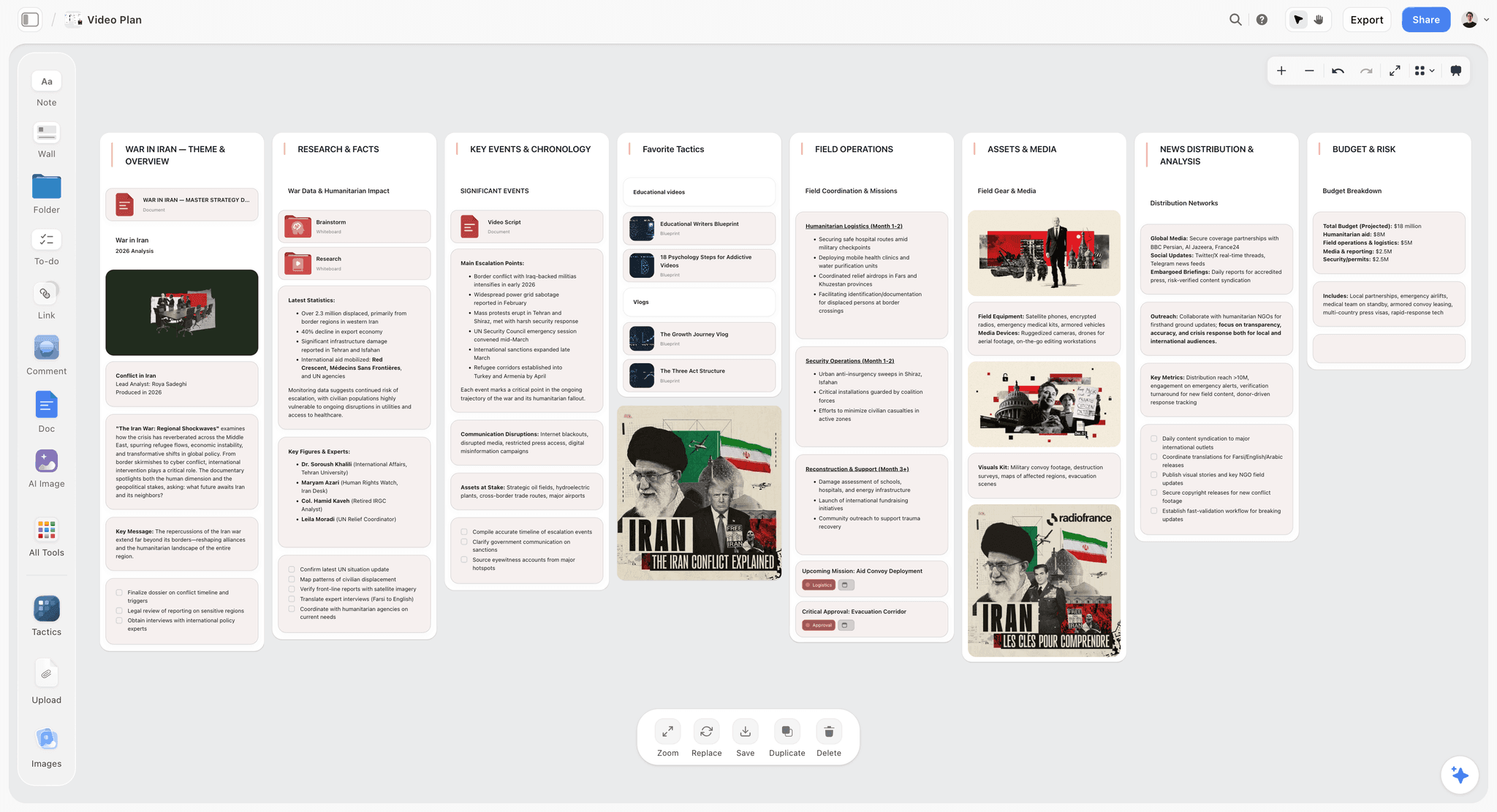
Where Storyflow pulls ahead is everything that happens after the branches exist.
The map is one region of an infinite canvas. In Storyflow the mind map sits next to a kanban board, a storyboard, a mood board, a beat sheet, and documents, all on the same infinite canvas. You do not export the map to keep working. You keep working beside it. The branch you just drew becomes a column, a scene, a card, a paragraph, in the same place.
Full-board AI context. Storyflow's AI reads your entire active canvas board by default, plus up to 1 Tactic and up to 3 Documents you @-mention in the chat. So you can ask it to turn a branch into a plan, find the weak spot in your structure, or draft from a cluster of nodes, and it answers with the whole board as context. XMind's AI can suggest branch ideas; Storyflow's AI can act on the whole map and everything around it. Be precise about the scope, though: the AI reads the active board plus what you @-mention, not your entire workspace or every board you own. That boundary is deliberate. It keeps the context tight enough that answers stay grounded in the project in front of you instead of drifting across everything you have ever made.
Here is what that looks like in the documentary test. I mapped the film as a central node with five branches: subject, timeline, access, visual language, and open questions. In XMind that map is where I would stop and export. In Storyflow I selected the "open questions" branch and asked the AI to turn each one into a research task with a suggested source. It read the subject and timeline branches I had already drawn, so the tasks came back specific to my film, not generic. Then I dropped a StoryBrand blueprint next to the map and asked it to draft a one-paragraph logline from the whole board. The map did not become a screenshot. It became the first two artifacts of the actual project, in the same place, in about ten minutes. That is the rebuild tax dropping to zero, and it is the single behavior that no dedicated mapper on the market matches.
Unlimited real-time collaboration on the Free plan (launching late 2026). Storyflow's Free plan, which launches before the end of 2026, will include unlimited collaboration on shared boards, so a writing partner, an editor, or a teammate can be in the same map with you at no cost. Mapping stops being a solo diagram and becomes a shared surface.
200+ Story Blueprints. On the Plus, Pro, and Max tiers, Storyflow's Story Blueprints library gives you 200+ ready-made boards, from beat sheets to campaign plans to mood boards, so a map does not stay a map. It becomes the next artifact with structure already there.
Multi-format output. The honest test of a workspace is whether the map turns into the deliverable without a rebuild. In Storyflow it does, because the deliverable formats live on the same canvas. That is the entire point of the Workspace philosophy, and it is where a dedicated map tool cannot follow.
To be clear about the trade, Storyflow is not the tool for a purist single tree. It is cloud-only with no offline files, its freeform canvas does not auto-arrange a fishbone or org chart the way XMind's structural layouts do, and it is a newer platform than XMind's long-established app. If you want one rigorous, auto-laid-out diagram and nothing more, XMind is the better fit.
7) Feature-by-Feature Comparison
Read the table by your job. If most of your rows are about making one map excellent and getting it out cleanly, XMind wins them. If most are about what the map becomes next, Storyflow wins them.
8) Pricing Comparison
Storyflow (verified at storyflow.so/pricing, as of July 2026):
- Free: Paid-only during early access; the Free plan launches before the end of 2026 with unlimited notes, images, and links, unlimited shared boards, unlimited collaboration, basic AI, and 20 file uploads.
- Plus: $7.99/mo annual ($9.99 monthly). 200+ Story Blueprints, unlimited file uploads.
- Pro: $14/mo annual ($19 monthly). AI image generation, 20x more AI usage.
- Max: $39/mo annual ($49 monthly). 40x more AI and a team workspace with permissions and roles.
XMind: XMind sells a single subscription for the full app across desktop and mobile, roughly $60 per year, with a limited free tier for basic map creation. There is no per-seat creative-team tier in the way Storyflow's Max provides one.
The honest read: for pure mind mapping, XMind's one price is simple. Storyflow is paid-only during early access; once the Free plan launches before the end of 2026, it will start free with unlimited collaboration and scale into AI and team features. Today, its paid tiers already buy far more than mapping.
One clarification on Storyflow's pricing that trips people up: the plans are flat per account, not per seat. There is no team-size multiplier, so a two-person project and a ten-person project pay the same. That matters whether you're on a paid tier today or the Free plan once it launches before the end of 2026, since unlimited collaboration means you can add the whole crew without any of them counting against a limit. XMind's model is per user in the traditional app sense: you buy the app for yourself. Neither is wrong, but they answer different questions. XMind asks "what does one mapper need." Storyflow asks "what does one project need."
9) Which One Should You Pick?
The five-criteria test resolves into a handful of clear personas. Find the one closest to your work.
The student or researcher mapping a topic. You want one clean map to revise from or attach to an assignment. The map is the deliverable, you are working solo, and offline access is a plus. XMind. Its auto-layouts and export-to-image make a legible map fast, and you never touch the parts of Storyflow that would justify the switch.
The facilitator or consultant diagramming a system. You map a process, a fishbone of causes, or an org structure, and you present it. You want rigorous structure and a built-in path from map to slides. XMind's structural layouts and Pitch mode are built for exactly this, and Storyflow's freeform canvas would make you place those nodes by hand.
The filmmaker or writer developing a project. You map a story, and then the map has to become a research board, a beat sheet, a shot list, and a treatment. The map is the first move, not the last. Storyflow. The whole point is that the branches you just drew turn into the next artifacts on the same canvas, with the AI reading all of it.
The marketer or founder planning a campaign or launch. You map the idea, then you need a brief, a content calendar, a kanban board, and a draft, with people in the room. Storyflow. Unlimited collaboration, on paid plans today and on the Free plan once it launches, plus full-board AI mean the map is a shared, working surface rather than a diagram someone screenshots into Slack.
The team that plans together. Multiple people, ongoing projects, a need for roles and permissions. Storyflow's Max tier adds a team workspace, and even Plus lets the whole group into a shared board without a seat fee (the Free plan will do the same once it launches before the end of 2026). XMind supports sharing on paid tiers, but it is architected around one person's map, not a team's canvas.
The privacy-first or offline user. IT policy against cloud tools, frequent work on planes, or a hard requirement to own local files. XMind, and it is not close. Storyflow is cloud-only, so this constraint overrides every other score. If this is you, stop reading and pick XMind.
If two personas describe you, weight the one tied to your actual output. A student who also runs a side project that needs execution should test Storyflow before deciding, because the second job is the one that exposes the rebuild tax.
10) When to Pick XMind
Pick XMind if your work matches the Map philosophy.
- You want one clean, structured map as the deliverable.
- You need rigorous auto-laid-out structures: org charts, fishbone diagrams, matrices, timelines.
- You need local files and offline access for ownership, travel, or IT policy.
- You present your maps and want ZEN focus and built-in Pitch slides.
- You want a single-purpose mind mapping app and nothing more.
For XMind specifically against the field, The 12 Best XMind Alternatives in 2026 covers where each rival is stronger.
11) When to Pick Storyflow
Pick Storyflow if your work matches the Workspace philosophy.
- Your map is the start of the work, not the end of it.
- You want the AI to read the whole board and act on it, not just suggest branches.
- You need the map to become a plan, a shot list, a beat sheet, a campaign board, or a draft, on the same canvas.
- You collaborate, and you want real-time shared boards without paying per seat to start.
- You work across formats (mind map, kanban, storyboard, mood board, docs) and want them in one place.
The fastest way to feel the difference is to map something real. Take a project you would normally map in XMind, build it in Storyflow's free canvas, and then keep going past the map. The moment you turn a branch into the next artifact without leaving the board is the moment the Workspace philosophy stops being an argument and becomes obvious.
12) FAQ: Storyflow vs XMind
Is Storyflow or XMind better for mind mapping?
For a single, polished, structured map that is the deliverable, XMind is better. For mapping that turns into a plan, a script, a board, or a draft on the same canvas, Storyflow is better. XMind perfects the map; Storyflow lets you keep working past it. Choose by whether your map ends at the map or starts the work.
Does XMind have AI?
XMind has added an AI copilot that can suggest branches and expand a map, but it works at the level of the map's nodes. Storyflow's AI reads the entire active canvas board plus up to 1 Tactic and 3 Documents you @-mention, so it can act on the whole map and everything around it, not just propose more branches.
Can Storyflow make structured diagrams like fishbone or org charts?
Storyflow's canvas is freeform, so you build clusters and hierarchies by hand rather than choosing a rigid auto-laid-out structure. XMind is stronger for automatic fishbone, org chart, and matrix layouts. If those specific structures are the point of your work, XMind is the better tool.
Is Storyflow free?
Not during early access. Storyflow's Free plan, which launches before the end of 2026, will include unlimited notes, images, and links, unlimited shared boards, unlimited collaboration, and basic AI. Paid tiers start at Plus for $7.99/mo (annual), which adds 200+ Story Blueprints and unlimited file uploads.
Does Storyflow work offline?
No. Storyflow is cloud-based and needs an internet connection. XMind saves local files and works offline, which is a real advantage for users who travel, have privacy constraints, or want local-first ownership. If offline use is a hard requirement, XMind is the safer pick.
Can I present a mind map in Storyflow?
You can share and present the board itself, but Storyflow does not have a dedicated slideshow mode like XMind's Pitch. If presenting maps as slides is a core part of your workflow, XMind's built-in presentation path is stronger.
Which is better for a creative team?
Storyflow, in most cases. Its Free tier includes unlimited real-time collaboration, and its Max tier adds a team workspace with permissions and roles. XMind supports sharing and co-editing on paid tiers, but it is built around a single map rather than a shared, multi-format canvas the whole team works on.
Can I move my XMind maps into Storyflow?
You can recreate a map's structure in Storyflow quickly, and XMind exports to images and Markdown you can bring in as reference. There is no one-click XMind import, so treat the move as a chance to keep going past the map rather than a pure copy of the diagram.
Is XMind good for brainstorming?
Yes. XMind is a strong solo brainstorming tool: fast branching, clean structure, and focus mode for getting ideas down. Storyflow is stronger when the brainstorm needs to become the plan and involve other people, because the ideas stay on a canvas the AI and your collaborators can build on.
Which has better templates?
They serve different ends. XMind's templates are map layouts and themes for making a good map. Storyflow's 200+ Story Blueprints are full boards, from beat sheets to campaign plans, for turning a map into the next artifact. If you want map templates, XMind; if you want workspace templates, Storyflow.
Is Storyflow a real XMind alternative?
Yes, for people whose mapping is the start of a larger job. If you only ever want a single structured map, a dedicated mapper like XMind is the closer fit. If you keep hitting the wall where the map is done but the work is not, Storyflow is the alternative built for exactly that moment.
What is the main difference in one sentence?
XMind is the best place to make a mind map; Storyflow is the best place to do the work the mind map was for.
13) The Bottom Line
Storyflow and XMind are both good at what they are for, and they are for different things. XMind is the Map tool: a dedicated mind mapper that makes one structured diagram excellent and gets it out cleanly. Storyflow is the Workspace: an AI canvas where the map is the first move in a longer job, and the AI reads the whole board as you keep going.
Choose by the question this whole comparison turns on. If your map ends at the map, XMind is the better and simpler tool. If your map is the start of the work, Storyflow is built for what comes next. XMind helps you draw the map. Storyflow helps you do the work the map points to.
If your maps keep turning into bigger projects, start mapping in Storyflow's free canvas and keep going past the map, on the same board, with the AI reading all of it.
Table of Contents
- Quick Answer: Storyflow vs XMind
- Comparison Table: Storyflow vs XMind at a Glance
- How We Compared Them
- The Map vs The Workspace
- Where XMind Wins
- Where Storyflow Wins
- Feature-by-Feature Comparison
- Pricing Comparison
- Which One Should You Pick?
- When to Pick XMind
- When to Pick Storyflow
- FAQ: Storyflow vs XMind
- The Bottom Line
- Author
- Related Reading
Templates to check out for this topic


Mind mapping and ideation templates you can use in Storyflow
Map ideas in space, then ask the AI to restructure, expand, or connect them. Open any of these boards and start thinking visually instead of in lists.


See Storyflow in Action
A visual AI workspace where every feature lives inside one canvas. No tab-switching, no context lost.
Build your entire board from a single message
Type what you need in the AI chat at the bottom of your canvas. The AI adds cards, headings, and structure directly onto your board.
Use expert frameworks as AI context
Type @ in the AI chat and choose any Tactic. The AI tailors every response to that framework instead of giving generic advice.
Turn your board into a mind map in seconds
Ask the AI to restructure your canvas as a mindmap. It connects your ideas into a visual hierarchy so you can see how everything relates.
Why Storyflow Exists
Storyflow actually began as a personal tool while working on creative and research projects.
We kept running into the same problem: ideas were scattered everywhere: notes, documents, and whiteboards.
Nothing helped us see how everything connected.
So we started building a workspace designed around how ideas actually grow.
→ Read how Storyflow was createdJustkay
Documentary Filmmaker & Founder at Storyflow
Published: 2026-07-01
Extremely simple, seriously capable


See how easy it is to get started
Watch a real project come together, from a blank board to a finished plan, clicked through step by step.
Start creating with AI and become more productive
Transform your creative workflow with AI-powered tools. Generate ideas, create content, and boost your productivity in minutes instead of hours.