How Storyflow Compares to Scrivener, Zotero, and Obsidian for Research-Heavy Books
How Storyflow compares to Scrivener, Zotero, Obsidian and Notion for research-heavy books, and which stack to run for nonfiction, memoir, biography, and complex novels.

Category
Writing
Author

Justkay
Documentary Filmmaker & Founder at Storyflow
Topics
2026-08-08
•
Updated August 8, 2026
•
16 min read
•
Writing- Storyflow vs Scrivener
- Storyflow vs Zotero
- Storyflow vs Obsidian
- book research stack
- research heavy books
- organize research for writing a book
How does Storyflow compare to Scrivener, Zotero, and Obsidian for research-heavy books?
They own different layers, so most authors run two or three together rather than choosing one. Scrivener owns the manuscript layer, Zotero owns citations and is free, Obsidian owns linked plain-text notes you keep forever, and Notion owns structured research databases. Storyflow owns only the visual connection layer, where sources, people, places, and timelines sit on one canvas and the AI reads the whole board. It replaces none of the four.

Full disclosure: Storyflow is our own product, and this comparison is written to talk you out of it when it does not fit. Scrivener beats it for drafting beside research and costs $59.99 once. Zotero beats it at citations and is free. Obsidian beats it on durability and is free for personal use. Storyflow owns one layer, the visual connection layer, and it is a two-week tool for most books: used hard while the shape of the argument is still unknown, then correctly retired. Section 10 lists everything it does not do, and section 11 says plainly that our cheapest tier adds no extra AI.
Which Layer Each Tool Owns
Read this as four layers rather than four rivals. The question is not which tool wins, it is which layer is currently blocking your book.
| Tool | Best For | AI Features | Price |
|---|---|---|---|
| Scrivener | Compose: manuscript with research beside it | No | $59.99 one-time |
| Zotero | Collect: citations and source records | Limited | Free |
| Obsidian | Connect: linked plain-text you own on disk | Via plugins | Free / Sync $4 mo |
| Notion | Structure: databases once shapes are known | Yes, workspace AI | Free / $10 mo |
| Storyflow | Connect visually: 400 items at once, whole-board AI | Yes, reads the whole board | Plus $7.99 mo annual (free plan late 2026) |
For the layer none of the four covers
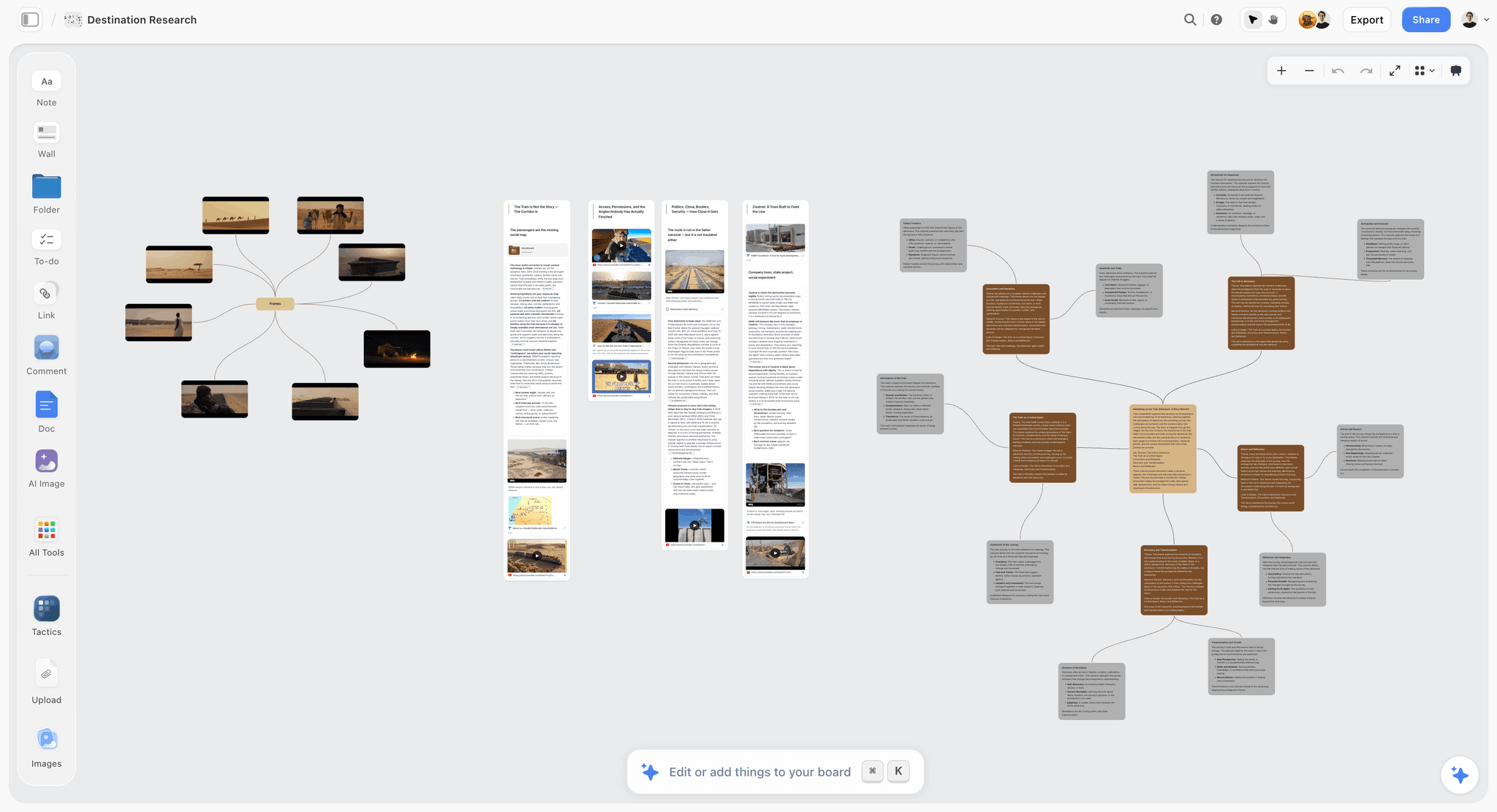
If your sources are organized and the book still has no shape, that is the visual layer. Storyflow puts every source, person, place, and date on one canvas and the AI reads the whole board before answering. Plus from $7.99 a month billed annually; invited collaborators join at no cost.

1) Quick Answer: Where Each Tool Belongs
For a research-heavy book, these tools are not competitors. They own different layers, and the writers who finish books tend to run two or three of them together. Scrivener owns the manuscript layer: research sits in the binder beside the chapters that use it. Zotero owns the citation layer, it is free, and for anything with endnotes it is close to non-negotiable. Obsidian owns the linked-text layer: plain files you keep forever, with backlinks between them. Notion owns the structured-database layer, best when your research has repeating shapes like sources, interviews, and locations. Storyflow owns one narrower layer: the visual connection layer, where sources, people, places, and timelines sit spread out on one canvas and an AI reads the whole board at once.
If you only want the recommendation: research-heavy nonfiction runs Zotero plus Scrivener, and adds Storyflow when the problem is that the argument has no shape yet. A complex novel runs Obsidian plus Scrivener, and adds Storyflow when the worldbuilding has outgrown a folder of notes. Nobody should run all five.
Storyflow does not replace any of the four. It has no citation manager, it does not compile a manuscript, and it is not a plain-text vault you own on disk. It is the board you stand in front of before you know what the chapters are. If your research problem is retrieval while drafting, Scrivener solves that better. If your problem is that you have read 200 sources and still cannot see the book, that is the problem this canvas is for.
Key takeaways:
- These are layers, not rivals: collect (Zotero), connect (Obsidian, Storyflow), structure (Notion, Storyflow), compose (Scrivener).
- The tool that helps you collect is rarely the tool that helps you see. Collecting is easy and feels productive; seeing the shape of an argument is the hard part and almost no research tool is built for it.
- Zotero is free and owns citations. Do not pay anything to solve a citation problem.
- Scrivener is a one-time purchase and owns drafting beside research. For most authors it is the single most valuable purchase on this page.
- Storyflow is the visual layer only, is paid-only during early access, and says no to citations and manuscripts on purpose.
- The honest test for adding a fifth tool: it must remove a step, not add a place where notes can hide.
2) Comparison Table: The Four Incumbents and the Canvas
Every price above was checked on August 8, 2026. Zotero, Obsidian, and Notion all have genuinely usable free tiers. Storyflow does not, and that is covered honestly in section 11.
3) Why the Answer Is a Stack and Not a Winner
Ask any experienced nonfiction writer what they use and you will get two or three tool names, not one. That is not indecision. It is a reflection of the fact that book research is four different jobs that happen at four different times, and the tool that is excellent at one is usually mediocre at the others.
Collect. You are reading and saving. What matters is speed of capture, PDF handling, and whether the citation survives. Zotero is built for exactly this and is free.
Connect. You are noticing that the thing in chapter 2 contradicts the thing in chapter 9. What matters is whether relationships between pieces are visible. Obsidian does this with links between text files. A canvas does it spatially, by letting you put two things next to each other.
Structure. You are deciding what the chapters are. What matters is being able to move big pieces around cheaply. Notion does this as a database. A canvas does it as an arrangement you can see all at once.
Compose. You are writing sentences. What matters is that the research is open beside the draft and that the manuscript compiles at the end. This is Scrivener, and nothing else on this page is close.
The mistake I see most often is buying a tool for the wrong job. Someone whose real problem is that they cannot see their argument buys a better collector, collects 80 more sources, and feels further from the book than before. Collecting is the part that feels like progress and the part that is almost never the bottleneck.
4) Storyflow vs Scrivener
Scrivener is the strongest single purchase on this page and it is not close. A one-time $59.99 buys the binder, the split view, the corkboard, the compile step, and thirty years of accumulated craft. If you are writing a book and you own nothing yet, buy Scrivener first.
What Scrivener does that Storyflow does not. It compiles. A manuscript in Scrivener becomes a formatted DOCX, EPUB, or PDF with front matter and consistent styles, which is the actual artifact a publisher wants. It holds research inside the same project as the draft, so the interview transcript is one click from the paragraph quoting it. It has snapshots, so you can revert a scene. Storyflow does none of this and is not trying to.
What Storyflow does that Scrivener does not. The binder is a tree, and a tree can only express one relationship: parent and child. Research does not have that shape. When your problem is that four sources across three chapters all circle the same unnamed idea, a tree actively hides it, because those four items live in four different folders. On a canvas you drag them next to each other and the pattern becomes a thing you can see. Storyflow's AI then reads the whole board at once, including those four items and their arrangement, which is a different operation from asking a chat window about a document you paste in.
The honest verdict. If you can only have one, have Scrivener. Add a canvas when the shape of the book is the problem, not when the draft is the problem. Many writers do the shaping in a canvas for two weeks, decide the chapter list, and then live in Scrivener for a year. That is a healthy sequence, and the canvas being a separate tool is fine, because you stop opening it once the structure is settled.
5) Storyflow vs Zotero
This is the least competitive pairing on the page, because Zotero does one job that Storyflow does not attempt at all.
Zotero captures a source from a browser with one click, stores the PDF, keeps the metadata clean, lets you annotate, and generates a bibliography in whichever style your publisher demands. It is free, open source, and run by a non-profit. For any book with endnotes, a bibliography, or a fact-checker, Zotero is the correct answer and there is no argument to have.
Storyflow has no citation manager. It will hold a link, a PDF, an image, and a note about a source, and it will let you arrange those things spatially and reason across them with AI. What it will not do is track that this quote came from page 214 of a specific edition and then format that correctly in Chicago style. If you need that, and research-heavy nonfiction almost always does, you need Zotero regardless of what else you run.
The honest verdict. Not a choice. Run Zotero for citations. It is free, so the only cost of running both is the cost of switching windows. Where they touch productively: Zotero holds the canonical source record, and the canvas holds the *argument* you are building out of those sources, with links back to the Zotero items.
6) Storyflow vs Obsidian
Obsidian is the most philosophically similar tool here, and the comparison is the most interesting one. Both are built on the belief that the connections between notes matter more than the notes.
Where Obsidian is stronger. The files are markdown on your disk. You own them, they will open in 2050, and no company's pricing decision can take them from you. For a book that may take five years, that durability is a real argument and I will not talk anyone out of it. Backlinks are excellent, the plugin ecosystem is enormous, and it is free for personal use.
Where a canvas is stronger. Obsidian is text-first. A research-heavy book is frequently not text-first: it has photographs, maps, screenshots of documents, video stills, scans of letters. In Obsidian those are attachments referenced from text. On a canvas they are the primary objects, at the size you want them, next to each other. If your research is visual, the difference is not cosmetic.
The second difference is the AI model. Obsidian's AI plugins generally operate on a note or a selection. Storyflow's AI reads the entire current board, and can additionally take one Tactic and up to three documents you @-mention. In practice that means you can ask a question about the whole shape of your research rather than about one file. It is worth being precise about the limit: it reads the current board, not every board in your account.
The honest verdict. If you are text-first and durability matters most, Obsidian, and it is free. If your research is visual and the problem is seeing the whole thing at once, the canvas. Writers who use both usually keep the long-term vault in Obsidian and use the canvas as a working surface for one book at a time.
7) Storyflow vs Notion
Notion is the best structured-database tool of the group. When your research has repeating shapes, and a lot of nonfiction does, a Notion database is genuinely excellent: every interview as a row, with fields for subject, date, location, transcript status, and which chapter it serves. Filter to unprocessed interviews, sort by chapter, done. Nothing on a canvas competes with that.
Where Notion struggles is the part before the shapes are known. Building the database requires deciding the fields, and deciding the fields requires already understanding the research. Early on, that is exactly what you do not have, and the common failure is spending a week building a beautiful system that encodes assumptions you abandon in month three. The second struggle is spatial: Notion is a document and a table, and a table cannot show you that two things are near each other.
The honest verdict. Once your research has stable categories, a Notion database will beat a canvas on retrieval and bulk operations. Before that, the canvas is the better thinking surface. A sequence that works: shape it visually, discover the real categories, then build the Notion database from categories you actually trust. See Storyflow vs Notion for the fuller head to head.
8) The Stack by Book Type
The right stack depends less on your taste than on what kind of book it is.
Research-heavy nonfiction with endnotes
Zotero plus Scrivener, add a canvas for the argument. Zotero is not optional here. Scrivener holds the draft with the sources beside it. The canvas earns its place only if you are struggling to see the through-line, which for a book making an argument across 300 pages is common. Drop it once the chapter list stops changing.
Biography and history
Zotero plus a canvas plus Scrivener. This is the type where the visual layer earns its keep most clearly, because the research is dominated by chronology and by people who intersect. A timeline you can see, with people arranged around it and documents pinned to dates, answers questions that a folder tree cannot. Then Scrivener to write.
Memoir
Scrivener alone, or a canvas plus Scrivener. Memoir has few citations, so Zotero is usually pointless. What it does have is a hard structural problem: the events happened in one order and the book needs them in another. Arranging scenes spatially until the order feels right is genuinely useful, then Scrivener.
Complex novel with heavy worldbuilding
Obsidian plus Scrivener, or a canvas plus Scrivener. Pick based on whether your worldbuilding is text or images. A linguistic and historical invented world is Obsidian. A world you are designing visually, with maps, character faces, and moodboards, is a canvas. See How to Organize Research for a Book for the method that sits under either.
Academic monograph
Zotero plus Scrivener, and probably nothing else. The structure is largely given by the discipline, the citation load is heavy, and the marginal value of a visual layer is lower than in trade nonfiction. Do not buy a fourth tool to solve a problem your field has already solved for you.
Put one book's research on a board
Lay the interviews, places, and open questions out on a Storyflow canvas and ask the AI what connects them. The gap and the spine tend to show up on the board before they show up in the outline.
9) A Worked Example: 400 Sources for a Documentary Book
The reason I care about this problem is that I hit it. A documentary project I worked on generated roughly 400 items: interview transcripts, archive photographs, scanned correspondence, location scouting shots, and a long tail of news clippings. It was heading toward a book. My research was, at that point, technically well organized and functionally useless.
Everything was in folders, named consistently, and searchable. I could find any single item in under thirty seconds. What I could not do was answer the question the book needed answering, which was: what is this actually about? Search finds a thing you can already name. It cannot find a pattern you have not named yet.
What changed it was mundane. I put the interview subjects across a canvas roughly by the year they entered the story, pinned the photographs and documents that involved each one underneath them, and stepped back. Two things became visible within a morning. First, a five-year gap in the middle where I had almost nothing, which was a research gap I had not noticed because each individual folder looked healthy. Second, three subjects I had thought were peripheral all connected to the same institution, which turned out to be the spine of the book.
Neither of those was a retrieval problem. Scrivener would not have surfaced them, because both items sat in different branches of the tree. Zotero would not have, because it is a source list. The insight came from arrangement, from being able to see 400 things at once and notice a hole and a cluster.
Then the AI pass, which is the part that saved actual weeks. Asking the board directly, with all 400 items on it, what the recurring threads were produced a list of six, four of which I already knew and two of which I did not. This is the specific difference between whole-board AI and pasting a document into a chat window: it is reasoning over the corpus and its arrangement, not over one file.
I want to be precise about what this did not do. It did not write anything. It did not manage a single citation. When it came time to draft, I moved to a manuscript tool and the canvas became a reference I opened once a week and eventually not at all. The canvas earned two weeks of its life and then correctly got out of the way. That is the honest scope of the thing.
10) What Storyflow Does Not Do
Writing this section is the point of the post, so here it is without hedging.
- No citation management. No styles, no bibliography generation, no page-level source tracking. Use Zotero.
- No manuscript compilation. Nothing here produces a formatted DOCX or EPUB with front matter. Use Scrivener.
- No offline plain-text vault. Your work is not markdown files on your disk. If ownership and 2050-readability are your top requirement, use Obsidian.
- No structured database queries. No filtered views over typed fields. Use Notion.
- AI reads the current board, not your whole account. It reads the board you are on, plus up to one Tactic and three documents you @-mention. It is not omniscient across everything you have ever made.
- No free plan today. Covered next.
If two or more of those are dealbreakers, the honest recommendation is to skip Storyflow for this project. A tool that owns one layer is only worth adding when that layer is your actual bottleneck.
11) Price Reality Across the Stack
The cheapest genuinely good stack on this page is free plus $59.99: Zotero for citations, Obsidian for notes, and a one-time Scrivener licence. That is a complete, professional book research setup for the price of one dinner, and if budget is the constraint, run it and ignore everything else here.
Storyflow is the only tool on this page with no free tier today. It is paid-only during early access, with Plus at $7.99 a month billed annually ($9.99 monthly). A Free plan launches before the end of 2026. There is one genuinely free path in the meantime: anyone a paid member invites to a board signs up free, and can invite others, so a co-author or researcher on someone else's board pays nothing.
For the record, because a book project is a long commitment and pricing matters:
Worth knowing before you pick: Plus adds no extra AI over the trial allowance, so if the AI pass over your research is the reason you are here, Pro is the tier that matters. That is an awkward thing to write on our own blog and it is true.
12) The Retrieval Test: Five Questions for Your Current Setup
Before adding any tool, run your existing setup against these five questions. If it passes all five, you have a system and your problem is writing, not tooling. If it fails one, you now know which layer to spend on. This takes about ten minutes and has talked me out of more purchases than it has talked me into.
- Can you find the source of a specific claim in under a minute? Pick a factual assertion you plan to make in chapter 4 and find the source that supports it, including the page. If this takes five minutes, your collect layer is broken. Fix with Zotero, free.
- Can you list every source that touches one theme? Name a theme in your book and produce every item that relates to it. If your answer is "I would have to remember them," your connect layer is broken. Fix with Obsidian links or a canvas.
- Can you see where your research is thin? Point at the part of your book with the least support. If you cannot answer without reading everything again, you have no overview. This is the specific failure a spatial layer fixes, and it is the one most writers do not know they have.
- Is your research open while you draft? Not findable, open. If you write with your sources in another application behind the window, you will paraphrase from memory and introduce errors. Fix with Scrivener's split view.
- Would a fact-checker be able to follow your trail? If someone else had to verify chapter 6 from your files alone, could they? If not, provenance is missing, and adding provenance later costs multiples of adding it now.
Most writers who feel disorganized fail question 3 and only question 3. They then buy a better collector, which fixes nothing, because their collect layer was already fine. Diagnose before you buy, because every layer has a free or cheap answer and none of them is the answer to a different layer's problem.
13) Moving Between Layers Without Losing the Trail
The real cost of a multi-tool stack is not money, it is the handoffs. Here is what actually breaks, and what to do about it, based on running this badly before running it well.
Zotero to anywhere. Zotero item links are stable, so paste the item link rather than retyping the citation. In practice that means a note on your canvas or in your vault carries a link back to the canonical record, and you never end up with two slightly different versions of the same citation. The failure mode is retyping, which produces a second source of truth. Do not retype.
Canvas to Scrivener. The temptation is to move everything across. Do not. What should move is the structure you decided, which is usually a chapter list and a per-chapter note about what it argues and which sources it uses. The research itself can stay where it is, with the canvas open on a second screen or checked once a week. Moving 400 items into a binder recreates the original problem in a new tool.
Obsidian and a canvas together. Keep one directional rule: the vault is the archive, the canvas is the working surface for the current book. Notes flow vault to canvas when you are shaping, and any conclusion you reach on the canvas gets written back to the vault as a note. If you skip the write-back, the thinking dies with the board, which is the single most common way people lose work across two tools.
Notion after the fact. If you build the database late, build it from categories the research actually revealed rather than the ones you assumed at the start. The whole reason to delay is to get those categories right, so do not import your early guesses.
The rule that covers all four handoffs: every item should have exactly one home and every other mention of it should be a link to that home. Duplicated content across two tools is how a book loses six weeks in year two.
15) The Bottom Line
There is no single best tool for organizing research for a research-heavy book, and the answers that name one are usually naming a manuscript tool, which is a different job. What exists is a stack of four layers. Zotero collects and cites, for free. Obsidian connects text you own forever. Notion structures research once you know its shape. Scrivener composes, and is the one purchase almost every author should make.
Storyflow sits in the layer nobody else is really trying to fill: spreading everything out, seeing 400 things at once, and asking AI a question about the whole board rather than one file. It is a two-week tool for most books, used hard at the shaping stage and then quietly retired, and it is honest work to say so. A pile of sources is not research, and neither is a beautiful system. Research is a shape you can see.
If you are starting today: buy Scrivener, install Zotero, and only add a fifth window when you can name the job it is doing.
14) FAQ: Storyflow vs Scrivener, Zotero, and Obsidian
Can Storyflow replace Scrivener for writing a book?
No. Storyflow has no manuscript compilation, no snapshots, and no split-screen drafting view, which are the three things Scrivener is bought for. Storyflow handles the layer before drafting: arranging research spatially and deciding what the chapters are. Most writers who use both do the shaping in Storyflow and the writing in Scrivener.
Do I still need Zotero if I use Storyflow?
Yes, for anything with citations. Storyflow has no citation manager, no bibliography generation, and no page-level source tracking. Zotero is free and does all three, so there is no reason to choose between them. Keep the canonical source records in Zotero and use the canvas for the argument you are building from them.
Is Storyflow better than Obsidian for book research?
It depends on whether your research is visual. Obsidian is stronger for text-first research, for durability (plain markdown files you own on disk), and it is free. Storyflow is stronger when the research is photographs, maps, documents, and timelines that need to be seen at real size next to each other, and when you want AI to read the entire board at once rather than one note.
What is the cheapest good setup for organizing book research?
Zotero (free) for citations, Obsidian (free for personal use) for linked notes, and a one-time $59.99 Scrivener licence for drafting. That covers collecting, connecting, and composing for under $60 total, with no subscription.
Is Storyflow free for authors?
Not during early access. Storyflow is paid-only right now, with Plus at $7.99 a month billed annually, and a Free plan launching before the end of 2026. The one free path today is being invited to a board by a paid member, which lets a co-author or researcher join at no cost.
Should I use all of these tools together?
No. Two or three is normal, four is unusual, and five is a symptom. Every additional tool adds a place where a note can hide, which is the exact failure mode you are trying to avoid. Start with the layer that is actually blocking you and add only when a specific job has no home.
Which tool is best for a biography with a lot of archival material?
Zotero for the archive citations, a visual canvas for the chronology and the web of people, and Scrivener to write. Biography is the book type where a spatial layer pays off most, because the research is dominated by dates and by people who intersect, and a folder tree hides both.
Table of Contents
- Quick Answer: Where Each Tool Belongs
- Comparison Table: The Four Incumbents and the Canvas
- Why the Answer Is a Stack and Not a Winner
- Storyflow vs Scrivener
- Storyflow vs Zotero
- Storyflow vs Obsidian
- Storyflow vs Notion
- The Stack by Book Type
- A Worked Example: 400 Sources for a Documentary Book
- What Storyflow Does Not Do
- Price Reality Across the Stack
- The Retrieval Test: Five Questions for Your Current Setup
- Moving Between Layers Without Losing the Trail
- FAQ: Storyflow vs Scrivener, Zotero, and Obsidian
- The Bottom Line
- Author
- Related Reading
Templates to check out for this topic


Story and writing templates you can use in Storyflow
Start your next script, novel, or world from a ready-made Storyflow board instead of an empty page. The AI reads the whole canvas, so every suggestion is grounded in your story.


See Storyflow in Action
A visual AI workspace where every feature lives inside one canvas. No tab-switching, no context lost.
Build your entire board from a single message
Type what you need in the AI chat at the bottom of your canvas. The AI adds cards, headings, and structure directly onto your board.
Use expert frameworks as AI context
Type @ in the AI chat and choose any Tactic. The AI tailors every response to that framework instead of giving generic advice.
Turn your board into a mind map in seconds
Ask the AI to restructure your canvas as a mindmap. It connects your ideas into a visual hierarchy so you can see how everything relates.
Why Storyflow Exists
Storyflow actually began as a personal tool while working on creative and research projects.
We kept running into the same problem: ideas were scattered everywhere: notes, documents, and whiteboards.
Nothing helped us see how everything connected.
So we started building a workspace designed around how ideas actually grow.
→ Read how Storyflow was createdJustkay
Documentary Filmmaker & Founder at Storyflow
Published: 2026-08-08
Extremely simple, seriously capable


See how easy it is to get started
Watch a real project come together, from a blank board to a finished plan, clicked through step by step.
Start creating with AI and become more productive
Transform your creative workflow with AI-powered tools. Generate ideas, create content, and boost your productivity in minutes instead of hours.