The Novel Plotting Checklist (2026): Nine Checks Before You Draft
Novels stall about a third of the way in and the cause is visible before chapter one. Nine checks, each catching a specific failure, and the fourth of them, a missing midpoint, is the one that produces the stall.

Category
Writing
Author

Justkay
Documentary Filmmaker & Founder at Storyflow
Topics
2026-09-02
•
15 min read
•
Writing- novel plotting checklist
- novel midpoint
- why novels stall
- best app to visually plot a novel
- story structure diagnostic
What should I check before drafting a novel?
Most novels that stall stall in the same place, roughly a third of the way in, and the cause is almost always visible before the first chapter is written. The nine checks below each catch a specific failure: no engine (the protagonist wants nothing urgent enough), no opposition (the antagonist is a circumstance rather than a will), no escalation (things happen but do not get worse), no midpoint (the middle has no hinge, which is the third-of-the-way stall), no cost (the protagonist never loses anything), no change (they end as they began), an unearned ending, a subplot that does not touch the main plot, and a structure the story does not actually have. Running them takes an afternoon and each failure is cheaper to fix now than at eighty thousand words. Milanote and Storyflow are where the spatial version of this work happens, Plottr is purpose-built for the timeline, and Scrivener holds it alongside the draft at a one-off price that beats every subscription here.

Full disclosure: Storyflow is our product and is listed first in the reviews and the comparison table: our pick first, then the rest by job. The quick-answer list places it fourth, after Scrivener, Plottr and Milanote. The article states that Storyflow is not a writing application, that it has no manuscript editor, no word-count tracking and no compile or export to manuscript format, and that the novel itself should be written in Scrivener, Word or Google Docs.
How the novel planning tools compare on trust, innovation, ratings and pricing
Which novel planning tools are the most trusted?
Scrivener, by a wide margin, because the corkboard rearranges and the editor writes and it holds research alongside, at a one-off price across a project that runs years. Plottr is trusted for timeline-shaped structural work. Milanote is trusted for spatial plotting and character boards. Index cards remain genuinely trusted and are still unbeaten for rearranging forty scenes by hand.
Which novel planning tools have fair and transparent pricing?
Scrivener at around $60 one-off is the best value in the category by a distance, since a novel runs for years and a subscription compounds. Plottr's one-off tier is similarly honest. Obsidian and Google Docs are free and both do real jobs. Storyflow is a subscription from $7.99 per month billed annually and is paid-only during early access.
Which novel planning tools are the most innovative in 2026?
Storyflow for whole-board AI context, where the assistant reads all forty scenes on the canvas before answering, so a question about a thin middle gets an answer about your scenes rather than a general note on second acts. Plottr for how quickly a multi-thread timeline with character arcs can be built and rearranged.
Which plotting practices are underrated?
Writing the story's central question as it stands at 20% and again at 60%, which takes two minutes and diagnoses the missing midpoint that causes most stalls. And using structure frameworks as diagnostics rather than templates, opening one only when the middle feels thin, to find out what your story is missing rather than what beats to insert.
When choosing a novel planning tool, which would you recommend?
Scrivener if you want one tool for the plotting and the draft, and the one-off price makes it the easiest recommendation here. Add Plottr if timeline and arcs are the specific problem, or a board if you think spatially. Do not buy anything before running the nine checks, because most of them are answered on paper in an afternoon.
Quick Comparison
Four tools across the two halves: rearranging the shape and writing the draft.
| Tool | Best For | AI Features | Price |
|---|---|---|---|
| Scrivener | Corkboard plus a real editor | None | ~$60 one-off |
| Plottr | Timelines and arcs | None | ~$25 one-off tier |
| Milanote | Scenes as cards on a canvas | Light AI | Free / $9.99 mo |
| Storyflow | AI reading all forty scenes | Whole-board context | $7.99 mo annual (free plan late 2026) |
Article Metadata
By Justkay, Documentary Filmmaker and Founder of Storyflow Published September 2, 2026 · 15 min read · Writing
Table of Contents
- Where Novels Actually Stall
- The Nine Checks
- The Midpoint Test
- Plotter, Pantser, and the Useful Middle
- Structure as a Diagnostic, Not a Template
- 9 Tools for Plotting a Novel
- How We Evaluated These Tools
- Tool Reviews
- When to Stop Plotting and Write
- FAQ: Novel Plotting
- The Bottom Line
- Author
- Related Reading
Key Takeaways
- Novels stall about a third of the way in, and the cause is usually a missing midpoint rather than a missing idea.
- An antagonist that is a circumstance rather than a will produces a plot with nothing pushing back.
- Escalation means each setback is worse than the last. Events in sequence are not escalation.
- Structure frameworks are diagnostics for what your middle is missing, not templates to fill.
- Stop plotting when the next scene is obvious and you are still adding detail.
Where Novels Actually Stall
Around 25,000 to 35,000 words, which is roughly a third of a novel, and consistently enough that it has a name in every writing community.
The usual explanation is discipline. The actual cause is almost always structural and visible in advance: the opening question has been answered and no larger one has replaced it. The setup carried you, the first complication carried you, and then there is nothing pulling forward because the middle was never designed.
That is why the checks below exist and why they are worth an afternoon. Every one of them is a question you can answer before writing chapter one, and each failure found now costs a page of notes rather than three months.
The Nine Checks
1. Is there an engine? Can you name what the protagonist wants, urgently, in one sentence, and why they cannot simply have it? "Wants to be happy" is not an engine. "Has to sell the house her brother is living in" is.
Fails when: you can describe the situation but not the want.
2. Is there opposition with a will? Something actively pushing back that makes choices, rather than a circumstance that merely exists. Weather, grief and poverty are conditions; they can shape a story and they do not push.
Fails when: your antagonist is a situation. Add a person who benefits from the protagonist failing.
3. Does it escalate? Each setback worse than the last, stakes rising, options narrowing. Events in sequence are not escalation.
Fails when: you can reorder chapters five through twelve without breaking anything.
4. Is there a midpoint? A hinge in the middle where the protagonist stops reacting and starts acting, or learns something that changes the goal. Without it the middle is a corridor.
Fails when: the middle is a list of obstacles rather than a turn. This is the stall.
5. Is there a cost? The protagonist has to lose something real and irreversible. Not a scare, an actual loss.
Fails when: everything is recoverable, which makes the ending feel unearned no matter how it is written.
6. Do they change? The person at the end is not the person at the start, and the change is caused by the plot rather than announced.
Fails when: you can swap the first and last chapter's characterisation and nothing reads wrong.
7. Is the ending earned? Every element of the resolution set up earlier. The reader should feel it was inevitable and not predictable.
Fails when: something arrives in the last act that was not planted, or the protagonist is rescued rather than deciding.
8. Does the subplot touch the main plot? A subplot must complicate, mirror or resolve something in the main line. A parallel story that merely runs alongside is a different book.
Fails when: removing the subplot changes nothing.
9. Does the structure match the story you have? Not whether you followed a framework, but whether the shape you have chosen is the shape this story is.
Fails when: you are forcing beats into positions because a template says so.
The Midpoint Test
Check four is the one that catches the stall, so it is worth doing properly.
A midpoint is not "something big happens halfway". It is a change in the protagonist's relationship to the problem. Before it they are responding to events; after it they are pursuing something. Or: before it they misunderstand the situation; after it they see it.
The test: write the story's central question as it stands at 20% and again at 60%. If it is the same question, there is no midpoint and the middle will sag.
Examples of a real turn:
- She has been trying to prove she did not do it; now she knows who did, and is trying to prove that instead.
- He has been trying to keep the family together; now he understands they do not want to be, and is trying to leave without destroying it.
Both change what the protagonist is doing, not just how badly it is going.
If you find no midpoint, the fix is usually not to add an event. It is to work out what the protagonist believes at the start that is wrong, and let the middle be where they find out.
Plotter, Pantser, and the Useful Middle
The debate is less useful than it looks, because these checks do not require an outline.
If you outline, the checks are a review pass. Run them on the outline and fix what fails.
If you discover as you write, run the checks as questions rather than as a plan. You do not need to know what the midpoint is; you need to know that the story has room for one and to notice when you have written past where it should have been. Discovery writers stall at the same point as everybody else, and usually for check four.
The middle position that works for most people: know the engine, the opposition, the midpoint turn and the ending. Discover everything between those. Four fixed points and freedom in between removes the stall without removing the pleasure of finding out.
Structure as a Diagnostic, Not a Template
Three-act, the Hero's Journey, Save the Cat, the seven-point structure and Story Grid all describe shapes that recur because they work. None of them is a form to fill in.
Use them like this: when the middle feels thin, open a framework and ask what it says should be happening there. Usually it names something your story is missing, and you can then invent your own version rather than borrowing theirs.
Do not use them like this: deciding the midpoint goes at 50% and inserting an event there because the diagram says so. That produces a novel that hits its marks and feels manufactured, which is a harder problem to diagnose than a saggy middle.
The one structural rule worth keeping regardless of framework: the protagonist must make the decision that resolves the story. Not receive help, not be rescued, not have the situation resolve itself. If your ending happens to your protagonist rather than because of them, no framework will fix it.
9 Tools for Plotting a Novel
The work splits: some of it wants to be rearranged, and some wants to be written straight through.
| Tool | Best for | Rearranging | Writing | Price |
|---|---|---|---|---|
Storyflow | Spatial plotting with whole-board AI | Excellent | Fair | $7.99 mo annual (free plan late 2026) |
Scrivener | The whole novel plus its plotting | Good (corkboard) | Excellent | ~$60 one-off |
Plottr | Timeline-shaped plotting | Excellent | Weak | ~$25 one-off tier |
Milanote | Spatial plotting and character boards | Excellent | Fair | Free / $9.99 mo |
Obsidian | Linked worldbuilding and research | Fair | Very good | Free |
Campfire | Worldbuilding-heavy fiction | Good | Good | Modular pricing |
Notion | Plot and character as databases | Fair | Very good | Free / $10 seat mo |
Google Docs | Writing and getting notes | Weak | Excellent | Free |
Index cards | Beat and scene rearranging | Best | None | Nearly free |
Prices are publicly listed as of early 2026 and change often.
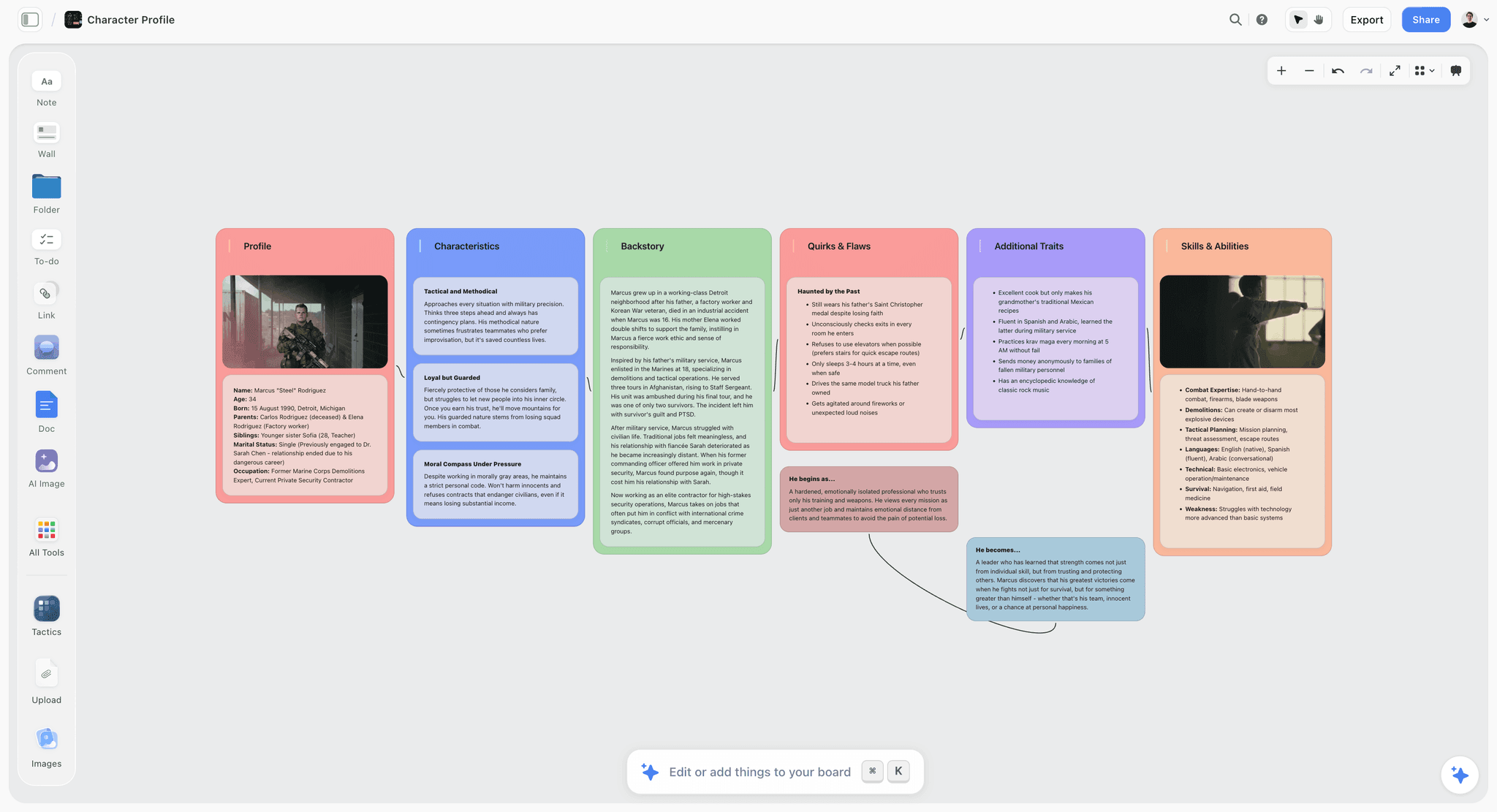
Scenes and character arcs laid out spatially so a thin middle is visible before drafting
Write the central question at 20% and at 60%
If it is the same question, there is no midpoint and the middle will sag. The fix is rarely another event: it is working out what the protagonist believes at the start that is wrong, and letting the middle be where they find out.

How We Evaluated These Tools
Four criteria:
- Does it support the checks? Specifically whether you can see the whole shape at once, which is what checks three, four and eight require.
- Rearranging. Moving forty scenes should be fluid, because that is how structural problems get found.
- Writing. Most of these tools are used for years and a bad writing experience compounds.
- Cost over a multi-year project, where a one-off purchase behaves very differently from a subscription.
Tool Reviews
1. Storyflow
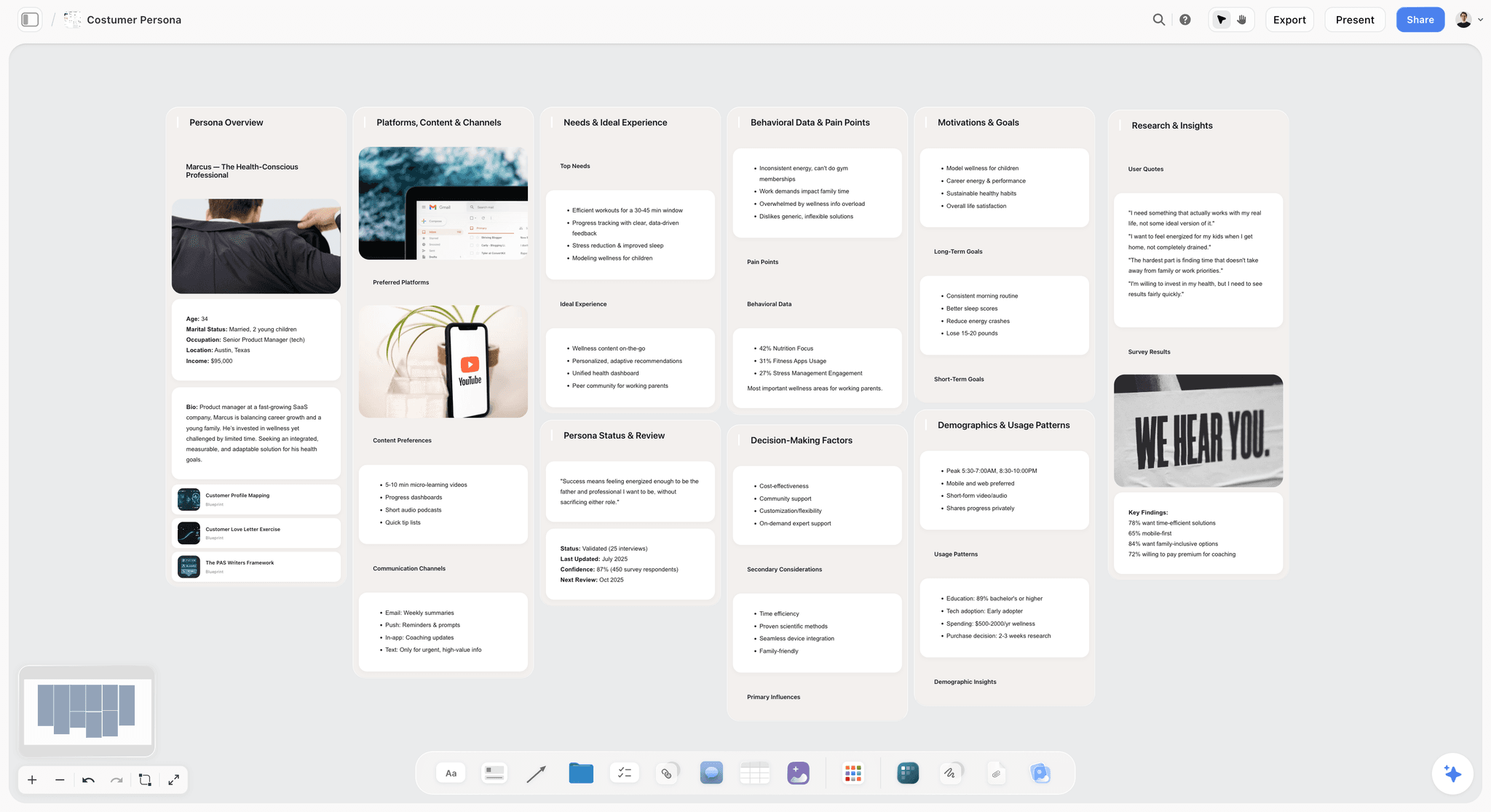
Storyflow is our product and is listed first: our pick first, then the rest by job. It is not a writing application: there is no manuscript editor, no word-count tracking, no compile or export to manuscript format, so the novel itself is written in Scrivener, Word or Docs and this article recommends that.
Its case is the same slot as Milanote with one difference: the AI reads the whole board before answering, so laying out forty scenes and asking what the middle is missing produces an answer about your scenes rather than a general note on second acts. Story blueprints include the Hero's Journey among others. For a writer who already works spatially it is worth comparing with Milanote; for one who does not, neither is necessary.
Storyflow is paid-only during early access; its Free plan launches before the end of 2026, and anyone a paid member invites to a board joins free now.
Pricing: Plus $7.99 per month billed annually ($9.99 monthly); Pro $14; Max $39.
Pros: whole-board AI context on your actual scenes; story blueprints; collaborators join free.
Cons: no manuscript editor, word count, compile or export; a subscription against Scrivener's one-off; weak for long prose.
2. Scrivener
Still the strongest single tool for a novel and its plotting, and the corkboard is why: scenes as cards you rearrange, with a real editor behind them, plus somewhere to keep research and character notes. A one-off price of around $60 across a project that runs years is the best value in this list by a wide margin.
Dated interface, a genuine learning curve, and essentially no collaboration.
Pros: covers the whole job; corkboard plus a real editor; one-off price; excellent for research.
Cons: dated; learning curve; no collaboration.
3. Plottr
Purpose-built for exactly this article's subject, and it shows. Multiple timelines, character arcs against plot, and templates for common structures used as diagnostics. For checks three, four and eight it is the fastest tool here.
You write elsewhere, so it is an addition rather than a home.
Pros: the fastest structural plotting; arcs against timeline; one-off pricing tier.
Cons: not a writing tool; narrow; another thing to keep in sync.
4. Milanote
The best board here for spatial plotting: scenes as cards on a canvas, character boards, and visual research, all readable at a glance months later because Milanote constrains layout. For writers who think in space rather than in lists, this is where check three becomes obvious.
Poor for long prose and its 100-item free tier is reached by one act.
Pricing: Free for 100 items; Pro $9.99 per month.
Pros: the most readable board; excellent for character and research; flat pricing.
Cons: weak for prose; free tier caps early; you write elsewhere.
5. Obsidian
Excellent for worldbuilding and research where the value is connections between things, and free with files you own. Weak for spatial rearranging despite Canvas, and it has no novel-specific structure.
Pros: free; the best linked worldbuilding; durable local files.
Cons: setup effort; weak rearranging; no structural templates.
6. Campfire
Built for worldbuilding-heavy fiction, with modules for characters, magic systems, locations and timelines. Its modular pricing means you buy what you use, which suits some writers and annoys others.
Pros: the deepest worldbuilding modules; buy only what you need.
Cons: modular pricing adds up; heavier than a contemporary novel needs.
7. Notion
Plot and character as databases works, and it reads well afterwards. Rearranging by dragging database rows is not the same operation as moving cards in space, which is what checks three and four need.
Pricing: Free for personal use; Plus $10 per user per month billed annually.
Pros: strong character and research databases; good prose; usable free tier.
Cons: poor spatial rearranging; no novel structure; per-seat if collaborating.
8. Google Docs
Where the draft often ends up, and the best place to get notes from a reader or an editor. No plotting features at all.
Pros: free; the best commenting; universal.
Cons: no structure, no board, no rearranging.
9. Index cards
Still unbeaten for the specific act of rearranging forty scenes with both hands, which is how check three usually gets answered. They do not back up, search or share.
Pros: the fastest rearranging; no software; no distraction.
Cons: no backup or search; physical only.
When to Stop Plotting and Write
Plotting has a diminishing return and a failure mode of its own, which is planning as a way of not writing.
Stop when the next scene is obvious and you are still adding detail. That is the signal that plotting has become avoidance.
Stop when you can answer the nine checks, even if several answers are provisional. Provisional answers are fine; absent ones are the problem.
Stop when the outline is telling you nothing new. A plotting session that produces no surprise has stopped being useful.
And keep the plot revisable. A novel that survives contact with its own draft is one where the writer allowed the midpoint to change when the writing found a better one. The checks are for catching structural absence, not for locking a story before it has been written.
The Bottom Line
Run the nine checks in an afternoon before chapter one, and pay particular attention to the fourth, because a missing midpoint is what produces the stall a third of the way in. Frameworks are diagnostics for what your middle lacks, not templates to fill. Keep the plotting somewhere you can rearrange it, keep the draft somewhere you can write in, and stop plotting when the next scene is obvious and you are still adding detail.
FAQ: Novel Plotting
Why do novels stall a third of the way in?
Because the opening question has been answered and no larger one has replaced it. The setup and the first complication carry you to roughly 25,000 to 35,000 words, and then the middle has to pull, which it can only do if there is a turn in it. That turn is the midpoint, and its absence is the single most common cause of the stall.
What is a midpoint and how do I know if I have one?
A change in the protagonist's relationship to the problem: before it they are reacting, after it they are pursuing, or before it they misunderstand the situation and after it they see it. The test is to write the story's central question as it stands at 20% and again at 60%. If it is the same question, you have no midpoint and the middle will sag.
What should I check before drafting a novel?
Nine things: that there is an engine, that the opposition has a will rather than being a circumstance, that setbacks escalate, that there is a midpoint turn, that the protagonist pays a real irreversible cost, that they change and the plot causes it, that the ending is set up rather than delivered, that the subplot touches the main plot, and that the structure matches the story you actually have.
Do I need to outline to write a novel?
No, and these checks do not require one. Discovery writers stall at the same point as outliners and usually for the same reason. The middle position that works for most people is knowing four things, the engine, the opposition, the midpoint turn and the ending, and discovering everything between them. Four fixed points removes the stall without removing the pleasure.
Should I use Save the Cat or the Hero's Journey?
As diagnostics rather than templates. When the middle feels thin, open a framework and ask what it says should be happening there; it usually names something your story is missing and then you invent your own version. Deciding the midpoint goes at 50% and inserting an event because the diagram says so produces a novel that hits its marks and reads as manufactured.
What is the best app to visually plot a novel?
Scrivener for the whole job, since the corkboard rearranges and the editor writes, at a one-off price that beats every subscription here. Plottr if the timeline and character arcs are the specific problem. Milanote or Storyflow if you think spatially and want scenes as cards on a canvas. Index cards remain unbeaten for the raw act of rearranging forty scenes.
Is Storyflow a novel writing app?
No. Storyflow has no manuscript editor, no word-count tracking and no compile or export to manuscript format, so the novel is written in Scrivener, Word or Google Docs, and this article's quick answer puts Scrivener first for that reason. Storyflow holds the spatial plotting: scenes and characters on a canvas whose whole contents the AI reads before answering.
Is Storyflow free?
Not during early access. It is paid-only today from $7.99 per month billed annually on Plus, and its Free plan launches before the end of 2026. Anyone a paid member invites to a board signs up free and can invite others, which covers a writing partner or an editor working on the same board.
How do I know if my subplot is working?
Remove it and see what changes. A subplot must complicate, mirror or resolve something in the main line, so deleting it should break or weaken something. If the main plot proceeds unaffected, you have two stories in one manuscript, and the usual fix is to connect the subplot's outcome to a decision the protagonist has to make in the main line.
What does escalation actually mean?
Each setback is worse than the last, the stakes rise, and options narrow. The test is whether you can reorder chapters five through twelve without breaking anything. If you can, you have events in sequence rather than escalation, and the reader feels it as a middle that does not build even though things keep happening.
When should I stop plotting and start writing?
When the next scene is obvious and you are still adding detail, which is the signal that plotting has become avoidance. Also when you can answer the nine checks, even provisionally, since provisional answers are fine and absent ones are the problem. And when a plotting session produces no surprise, because at that point it has stopped telling you anything.
Can the plot change once I start writing?
It should be allowed to. A novel that survives contact with its own draft is usually one where the writer let the midpoint change when the writing found a better one. The checks exist to catch structural absence before it costs three months, not to lock a story before it has been written. Re-run them after the first draft; different ones fail the second time.
Table of Contents
- Article Metadata
- Breadcrumb
- Table of Contents
- Key Takeaways
- Where Novels Actually Stall
- The Nine Checks
- The Midpoint Test
- Plotter, Pantser, and the Useful Middle
- Structure as a Diagnostic, Not a Template
- 9 Tools for Plotting a Novel
- How We Evaluated These Tools
- Tool Reviews
- 1. Storyflow
- 2. Scrivener
- 3. Plottr
- 4. Milanote
- 5. Obsidian
- 6. Campfire
- 7. Notion
- 8. Google Docs
- 9. Index cards
- When to Stop Plotting and Write
- The Bottom Line
- Author
- FAQ: Novel Plotting
- Related Reading
Templates to check out for this topic


Story and writing templates you can use in Storyflow
Start your next script, novel, or world from a ready-made Storyflow board instead of an empty page. The AI reads the whole canvas, so every suggestion is grounded in your story.


See Storyflow in Action
A visual AI workspace where every feature lives inside one canvas. No tab-switching, no context lost.
Build your entire board from a single message
Type what you need in the AI chat at the bottom of your canvas. The AI adds cards, headings, and structure directly onto your board.
Use expert frameworks as AI context
Type @ in the AI chat and choose any Tactic. The AI tailors every response to that framework instead of giving generic advice.
Turn your board into a mind map in seconds
Ask the AI to restructure your canvas as a mindmap. It connects your ideas into a visual hierarchy so you can see how everything relates.
Why Storyflow Exists
Storyflow actually began as a personal tool while working on creative and research projects.
We kept running into the same problem: ideas were scattered everywhere: notes, documents, and whiteboards.
Nothing helped us see how everything connected.
So we started building a workspace designed around how ideas actually grow.
→ Read how Storyflow was createdJustkay
Documentary Filmmaker & Founder at Storyflow
Published: 2026-09-02
Extremely simple, seriously capable


See how easy it is to get started
Watch a real project come together, from a blank board to a finished plan, clicked through step by step.
Start creating with AI and become more productive
Transform your creative workflow with AI-powered tools. Generate ideas, create content, and boost your productivity in minutes instead of hours.