How to Turn a Transcript Into a Visual Board
Turn a transcript into a visual board by extracting four things and discarding the rest: decisions, actions, open questions and the reasoning behind each. A transcript is a complete record and a useless artifact, because eleven thousand words of conversation is not something anyone reads twice, which means the meeting'

Category
AI Workflows
Author

Justkay
Documentary Filmmaker & Founder at Storyflow
Topics
2026-08-29
•
12 min read
•
AI Workflows- how to turn a transcript into a visual board
- transcripts
- ai workflow
- meeting notes
- visual planning
- research
- Storyflow
How do you turn a meeting transcript into a visual board?
Turn a transcript into a visual board by extracting four things and discarding the rest: decisions, actions, open questions and the reasoning behind each. A transcript is a complete record and a useless artifact, because eleven thousand words of conversation is not something anyone reads twice, which means the meeting's output effectively evaporates a day later. The extraction is mechanical enough that AI does the first pass well and human judgement is needed only for the corrections. Storyflow is what I use because you can bring the transcript in and have its AI lay the extracted material out as a board on the canvas, which means the meeting's output becomes something you can work from rather than something you could theoretically search.
Key Takeaways
- A transcript is a record, not an output. Nobody re-reads eleven thousand words.
- Extract four things: decisions, actions, open questions, and the reasoning behind each.
- Reasoning is the highest-value extraction and the one every summary tool drops.
- Do it within a day. Attribution and context decay fast, and the corrections you need are memory-dependent.
- AI does the first pass well and gets confidence wrong. It will state a floated idea as a decision.
- Keep the transcript linked, not deleted. It is the evidence when the board is disputed.
Turn talk into a board
A transcript is a complete record and a useless artifact, because nobody reads eleven thousand words again. Storyflow can read a transcript you bring in and lay its decisions and open questions out as a board you can actually work from.

Why Transcripts Do Not Get Used
Automatic transcription solved capture and created a new problem: teams now hold complete records of every conversation and act on almost none of it.
Length is the whole issue. An hour of conversation is around nine to eleven thousand words. Nobody reads that again, so the transcript exists as an insurance policy rather than a working document.
Search fails in a specific way. Searching a transcript requires knowing the words used, and people rarely remember the phrasing of a decision. They remember that the pricing thing was settled, not that someone said "let us just go with the annual-only option for now".
Speech is structurally unlike a document. Conversations circle, backtrack, contain abandoned threads, and reach conclusions in fragments across twenty minutes. The decision is rarely in one place; it is assembled from three exchanges separated by tangents.
AI summaries help and do not solve it. A summary paragraph tells you what the meeting was about. It does not tell you what to do, who owns it, or why the choice was made, and it flattens a floated suggestion and a firm decision into the same confident prose.
A useful diagnostic: open a transcript from six weeks ago and try to extract one actionable decision in under two minutes. If it fails, every meeting you have recorded since is in the same state.
Extract Four Things
Everything worth keeping from a conversation is one of four kinds.
Decisions. Something settled. Recorded with what it rules out, because the ruling-out is what stops it being reopened. "We are going annual-only at launch. This rules out monthly billing and the trial-to-monthly path we discussed."
Actions. Work somebody does, with a person and a date. Meetings generate a lot of implied actions and very few explicit ones, so this extraction usually requires inference and then confirmation.
Open questions. Things raised and not resolved. The highest-value category and the one that vanishes, because unresolved items feel like the meeting failing rather than the meeting working.
Reasoning. Why each decision was made. This is the single most valuable extraction and no summary tool produces it, because it is scattered across the conversation rather than adjacent to the conclusion. Six weeks later, a decision without its reason can only be obeyed or overturned, never re-evaluated.
Everything else goes. Pleasantries, tangents, the thing someone explained twice, the abandoned thread. A transcript is perhaps five percent signal, and being ruthless is what makes the board readable.
The Method

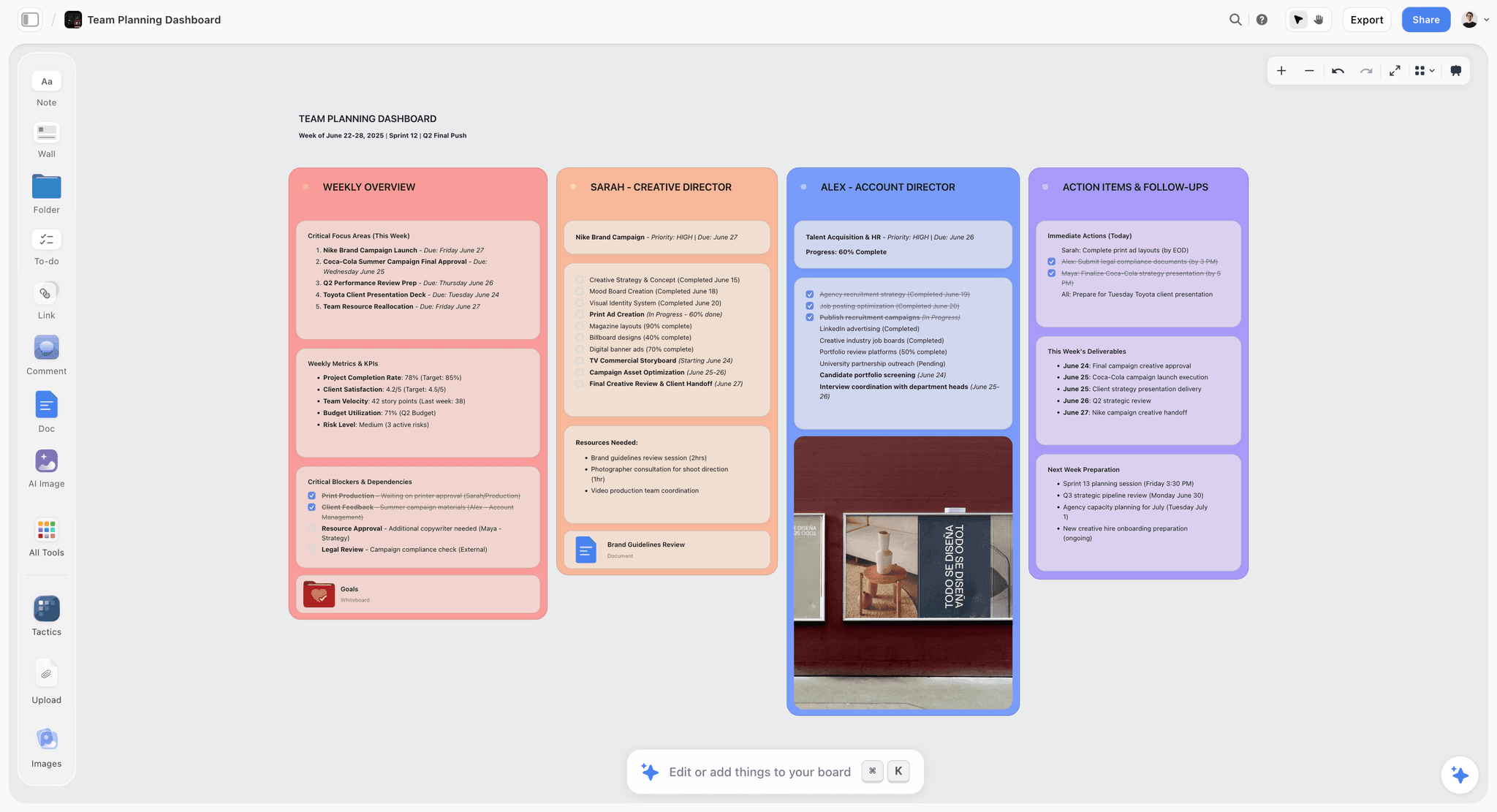
Do it within twenty-four hours. Not because the transcript decays, but because your ability to correct it does. The corrections that matter (this was floated not decided, that was sarcasm, this action is really someone else's) depend on memory of the room.
Run an AI first pass. This is genuinely good work for a model: identify decisions, actions and questions, and pull the surrounding reasoning. Bring the transcript into the board and ask for the four categories laid out separately.
Storyflow's AI reads the whole board plus the documents you bring in, so with the transcript attached it can produce the four groups on the canvas rather than a paragraph of summary. That is the difference that matters: a board of separated, movable items is something you can correct and work from, whereas a summary is something you read once.
Then correct it, and expect to. AI first passes fail in consistent ways, described below. Budget fifteen to twenty minutes.
Arrange spatially. Decisions in one region, actions in another, open questions in a third, with the reasoning attached to the decision it supports rather than in a separate list. Spatial grouping is what makes it scannable, which is the whole point of moving off the transcript.
Link the transcript to the board. Do not delete it. When someone disputes a decision, the transcript is the evidence, and it settles the question in a minute.
Send the board to attendees with a correction deadline. "Corrections by Thursday, otherwise this is the record." The deadline is what makes silence a usable signal.
| Transcript content | Extract as | Keep? |
|---|---|---|
A settled choice | Decision, with what it rules out | Yes |
Someone agreeing to do something | Action, with owner and date | Yes |
An unresolved disagreement | Open question, with owner | Yes |
The argument behind a choice | Reasoning, attached to the decision | Yes, highest value |
A floated idea nobody picked up | Nothing, or a parked note | Usually not |
Explanation of context everyone knew | Nothing | No |
Tangents and pleasantries | Nothing | No |
Where AI Gets It Wrong
The first pass is worth having and it fails predictably. Knowing how makes the correction fast.
It cannot judge confidence. A model reads "maybe we should just do annual" and "right, annual only then" as similar statements. It will promote floated suggestions into decisions, and this is the most dangerous failure because the resulting board looks authoritative. Check every extracted decision against whether it was actually settled.
It misattributes. Especially where the transcript's speaker labels are imperfect, which they usually are with more than three people. An action assigned to the wrong person does not get done.
It flattens disagreement. Models tend toward consensus narrative, so a genuine unresolved argument gets summarised as an agreement. This is the second most damaging failure, because unresolved disagreement is exactly what you needed to capture.
It misses reasoning that is separated from the decision. When the argument happens twenty minutes before the conclusion, the connection is often lost. This is the extraction most worth doing by hand.
It cannot tell sarcasm or hypotheticals from statements. "Sure, let us just rebuild the whole thing" is not a decision.
The reliable division of labour: AI does the finding and the sorting, you do the confidence, the attribution and the disagreement.
What Goes Wrong
Nothing is extracted. The transcript sits as an unread insurance policy and the meeting's output is lost.
Only a summary is produced. Tells you what the meeting was about, not what to do.
Reasoning is dropped. Decisions survive without their why, and cannot be re-evaluated when circumstances change.
AI output accepted uncorrected. Floated ideas become decisions, disagreements become agreements.
Open questions omitted. They looked like loose ends and they are what comes back expensive.
The transcript is deleted. No evidence when the board is disputed.
No correction deadline. No responses, and the record's authority is never established.
The Bottom Line
A transcript records everything and delivers nothing, because length makes it unreadable and speech scatters conclusions across the conversation.
Extract decisions with what they rule out, actions with owners and dates, open questions, and above all the reasoning. Let AI do the first pass and correct it for confidence, attribution and disagreement, which are the three things it consistently gets wrong. Arrange it spatially, keep the transcript linked as evidence, and send it round with a deadline.
FAQ: Transcripts to Visual Boards
Can AI turn a transcript into a board automatically?
It can do a strong first pass at finding and sorting decisions, actions and questions, and it reliably gets confidence wrong, promoting floated ideas into settled decisions. Treat the output as a draft that needs fifteen minutes of correction by someone who was in the room.
How long after a meeting should I do this?
Within twenty-four hours. The transcript does not decay but your ability to correct it does, and the corrections that matter most (what was actually decided versus merely discussed) depend on remembering the room.
What should I do with the original transcript?
Keep it and link it from the board. It is the evidence when someone disputes what was decided, and that dispute is resolved in a minute with the transcript and not at all without it. What you should not do is treat it as the deliverable.
What is the most valuable thing to extract?
The reasoning behind each decision. Summary tools do not produce it because it is scattered through the conversation rather than sitting next to the conclusion, and it is what lets a team re-evaluate a decision later instead of merely obeying or overturning it.
Is Storyflow free for this?
Not during early access. Storyflow is paid-only right now, with Plus at $7.99 per month billed annually and Pro at $14 which adds twenty times more AI usage and memory across conversations. The Free plan launches before the end of 2026, and anyone a paid member invites to a board joins free.
Does this work for interviews and research calls too?
Yes, with different categories. For research the four become observations, quotes worth keeping, patterns across participants, and open questions. The method is identical: extract, arrange spatially, correct, and keep the source linked.
Table of Contents
Templates to check out for this topic


Templates you can use in Storyflow
Every Storyflow board starts from real structure and an AI that reads the whole canvas. Open one of these templates and make it yours.


See Storyflow in Action
A visual AI workspace where every feature lives inside one canvas. No tab-switching, no context lost.
Build your entire board from a single message
Type what you need in the AI chat at the bottom of your canvas. The AI adds cards, headings, and structure directly onto your board.
Use expert frameworks as AI context
Type @ in the AI chat and choose any Tactic. The AI tailors every response to that framework instead of giving generic advice.
Turn your board into a mind map in seconds
Ask the AI to restructure your canvas as a mindmap. It connects your ideas into a visual hierarchy so you can see how everything relates.
Why Storyflow Exists
Storyflow actually began as a personal tool while working on creative and research projects.
We kept running into the same problem: ideas were scattered everywhere: notes, documents, and whiteboards.
Nothing helped us see how everything connected.
So we started building a workspace designed around how ideas actually grow.
→ Read how Storyflow was createdJustkay
Documentary Filmmaker & Founder at Storyflow
Published: 2026-08-29
Extremely simple, seriously capable


See how easy it is to get started
Watch a real project come together, from a blank board to a finished plan, clicked through step by step.
Start creating with AI and become more productive
Transform your creative workflow with AI-powered tools. Generate ideas, create content, and boost your productivity in minutes instead of hours.