How to Plan a Quarter of Content in One Session
You can plan a quarter of content in one session by choosing three themes first and generating within them, rather than trying to think of sixty individual ideas.

Category
Content Strategy
Author

Justkay
Documentary Filmmaker & Founder at Storyflow
Topics
2026-08-29
•
12 min read
•
Content Strategy- how to plan a quarter of content in one session
- content planning
- content calendars
- creator workflow
- batching
- content strategy
- Storyflow
How do you plan a quarter of content in a single session?
You can plan a quarter of content in one session by choosing three themes first and generating within them, rather than trying to think of sixty individual ideas. Sixty ideas from a standing start is an impossible task and it is why quarterly planning sessions collapse into a thin list padded with whatever the team could remember. Three themes, each with a reason to exist and each producing fifteen to twenty pieces, is a tractable task that finishes in about three hours and produces a quarter that argues something. Storyflow is what I use because the themes and the pieces stay grouped on a canvas until the dates get assigned, which is the order that works and the order a calendar tool will not let you follow.
Key Takeaways
- Choose three themes before generating anything. Generating sixty loose ideas does not work and never has.
- Group by theme first, assign dates last. Date-first planning produces a schedule with no through-line.
- Plan formats after ideas. Deciding the format first constrains the idea to fit it.
- Batch by production type, not by publish date. It is what makes a quarter of content actually producible.
- Leave a quarter to a third of slots open for reactive work and for doubling down on what lands.
- Bring data to the session. Planning from memory over-weights whatever you published most recently.
Group by theme before you date it
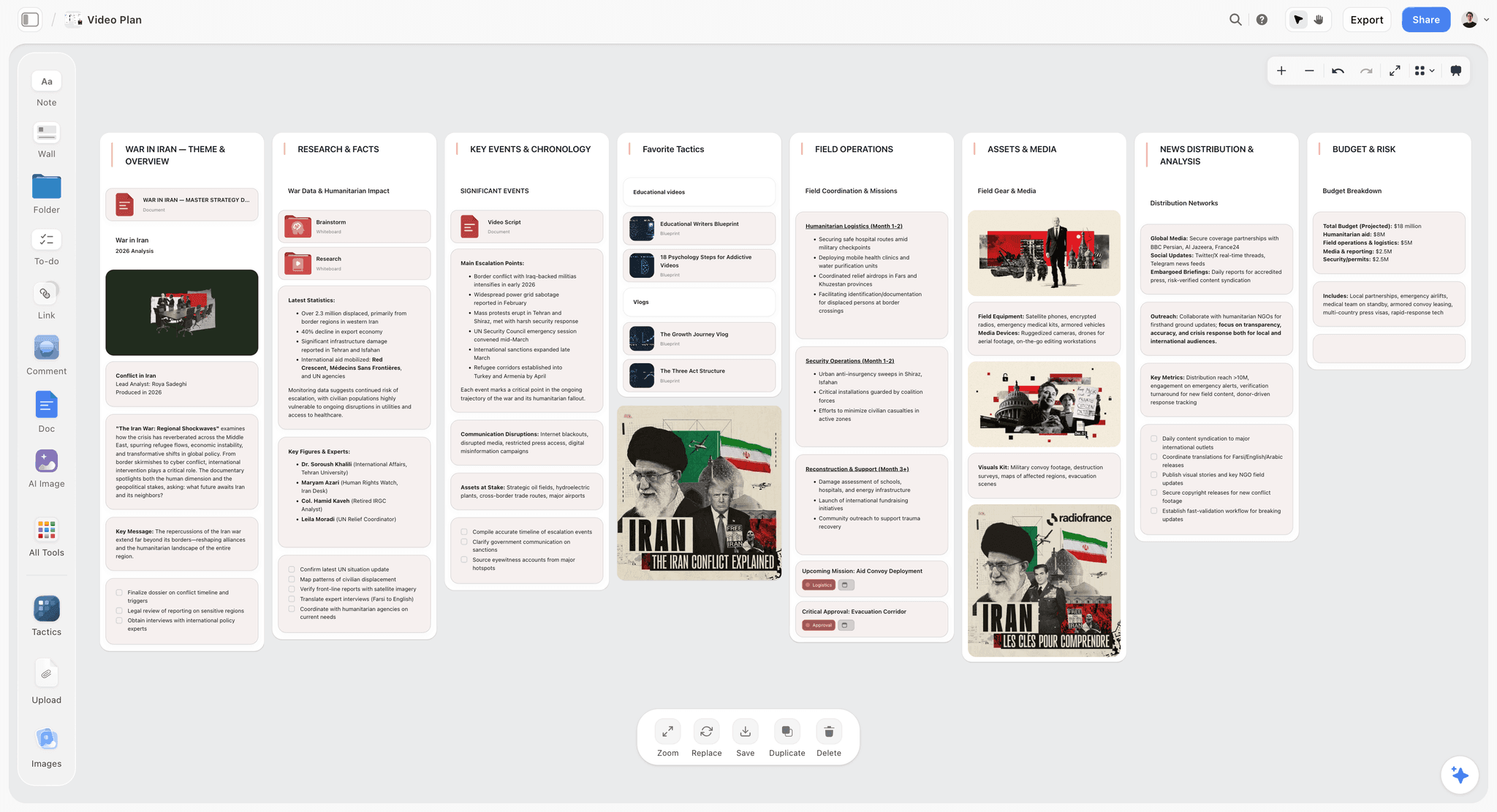
Planning date by date produces a calendar with no argument running through it. Storyflow lets a quarter be grouped into themes on a canvas first, so the dates get assigned to a plan rather than replacing one.

Why Sixty Ideas Is the Wrong Task
Ask a team to generate a quarter of content and they will produce twelve good ideas in the first forty minutes and then stall.
The stall is structural. Unconstrained idea generation has no retrieval cue. "What should we post about" offers the brain nothing to search against, so people surface whatever is most available: what they published recently, what a competitor did last week, what is currently annoying them. Availability is not a content strategy.
What follows is padding. The list gets to sixty by adding weak variations, and the weak items consume the same production time as the strong ones.
A theme is a retrieval cue. "Fifteen pieces about why implementations fail" is a question the brain can answer, because it constrains the search. Teams that stall at twelve ideas in the open version will produce eighteen inside a theme in twenty minutes.
A useful diagnostic: look at last quarter's content and try to state the three arguments it made. If you cannot, it was generated rather than planned, and the audience got variety instead of a case.
Before the Session
Ninety minutes of preparation makes the difference between a three-hour session and a wasted afternoon.
Pull the data. Last quarter's performance by piece, with the metric that actually matters rather than impressions. What over-performed, what under-performed, and what surprised you. Bring the top ten and bottom ten.
Planning from memory systematically over-weights recent and emotionally memorable content, and it usually misses the quiet piece that outperformed everything.
Write the quarter's objective. One sentence. What this quarter's content is for. "Establish that we serve teams above fifty people, not just solo users." Without it, themes get chosen by interest rather than by need.
Collect the raw material. The questions sales heard repeatedly, the support tickets that recur, the customer calls worth mining, anything already half-made. Most teams walk into planning having ignored the best source of topics they own.
Send all of it round beforehand. People who arrive having read it contribute in the first ten minutes rather than the fortieth.
The Session
Three hours for a group of three to six. Longer produces more items and not better ones.
Minutes 0 to 30: choose three themes
Read the objective. Read the data. Then choose three themes for the quarter.
Each theme needs a reason. Not "video content" (a format) and not "productivity" (a topic area). A theme is an argument the quarter will make: "implementation is faster than you have been told", "the incumbent's pricing punishes growth", "here is what good looks like at scale".
Three is the number. Two under-fills a quarter. Four or more and each gets too little weight to register with an audience that sees a fraction of what you publish.
Weight them explicitly: maybe fifty percent of output on the primary theme, thirty and twenty on the others. Deciding this now prevents the drift where the easiest theme quietly takes over.
Minutes 30 to 90: generate inside the themes
Twenty minutes per theme. Silent individual writing first, then share.
The silence matters for the same reason it does in any ideation: out-loud generation converges early on whatever the first confident person said.
Aim for fifteen to twenty per theme, which over-generates on purpose. You want to cut roughly a third, because cutting is what raises the average quality of what remains.
Do not decide formats yet. An idea constrained to a format at birth is a smaller idea. "A post about onboarding time" becomes, at format stage, a customer video, a data graphic and a written teardown, which is three pieces from one idea.
Minutes 90 to 120: cut and cluster

Cut the bottom third. Be decisive: an idea nobody can immediately say something interesting about will not improve during production.
Then cluster within each theme. Several ideas will be the same idea, and several will be a series, which is worth spotting because a series is easier to produce and lands better than three unconnected pieces.
This is the stage where a canvas earns its place over a spreadsheet. A spreadsheet forces a row order, which is a sequence, which is a date, and you are not ready for dates. On a Storyflow canvas the ideas sit in theme clusters and get moved around until the shape is right, and because its AI reads the whole board you can ask which theme is under-filled or which ideas are duplicates, which is the pass nobody wants to do by hand at hour two.
Minutes 120 to 150: assign formats and batch
Now decide formats, and immediately group by production type rather than by publish date.
All the video in one group. All the writing in another. All the design in a third.
This is what makes a quarter actually producible. Filming six customer interviews in two days is a fraction of the cost of filming six interviews across twelve weeks, and the same is true of design and of writing. Teams that plan by publish date produce by publish date, which is the most expensive possible order.
Mark the pieces with long lead times: anything needing a customer, legal review, external talent or data you do not have yet. Those start now, whatever their publish date.
Minutes 150 to 180: assign dates, partially
Distribute across the quarter, weighted as agreed, front-loading the strongest pieces.
Fill about seventy percent. The rest stays explicitly reserved for reactive work and for doubling down on whatever is working by week four. A full calendar cannot respond to its own results.
| Stage | Time | Output | Common mistake |
|---|---|---|---|
Prep | 90 min, before | Data, objective, raw material | Walking in cold |
Choose themes | 30 min | 3 weighted themes | Picking topics or formats |
Generate | 60 min | 45 to 60 raw ideas | Deciding formats too early |
Cut and cluster | 30 min | ~40 ideas, series spotted | Keeping everything |
Format and batch | 30 min | Production groups | Batching by publish date |
Date | 30 min | ~70% of slots filled | Filling every slot |
After the Session
Start the long-lead items this week. Customer interviews and anything requiring another person's calendar are what slip, and they slip into the slot where you had planned your strongest piece.
Book the batch days. Get the filming days and the design blocks into calendars while the session's energy is still there. A batch that is not booked becomes twelve individual sessions.
Review at week four. Not to replan, but to spend the reserved slots on whatever is working. This is the entire reason the slots were reserved, and it is routinely forgotten.
What Goes Wrong
No themes. Sixty loose ideas, a stall at twelve, and padding.
Themes are topics or formats. "Video" and "productivity" cannot be argued, so they do not constrain generation usefully.
Formats decided during generation. Shrinks the ideas.
Batching by publish date. Makes the quarter far more expensive to produce than it needs to be.
Every slot filled. No capacity to respond to results.
Planning from memory. Over-weights recent content and misses the quiet outperformer.
Long-lead items treated by publish date. They slip, and the best pieces are the ones that fall out.
The Bottom Line
Do not try to think of sixty things. Choose three themes that each make an argument, generate fifteen to twenty inside each, cut the weakest third, then decide formats and batch by production type rather than by publish date.
Assign dates last, fill about seventy percent, and start the long-lead items the same week. Three hours, one quarter, and a body of content that argues three things instead of covering sixty.
FAQ: Quarterly Content Planning
How long should a quarterly content planning session take?
About three hours with three to six people, plus ninety minutes of preparation beforehand. Sessions that run all day produce more items rather than better ones, and the last two hours are almost entirely padding.
How many themes should a quarter have?
Three, explicitly weighted. Two does not fill a quarter with enough range, and four or more means no theme accumulates enough weight for an audience that only sees a fraction of your output to notice any of them.
Should I plan every slot in the quarter?
No, fill about seventy percent. The reserved slots are what let you double down when one theme lands harder than expected, and a calendar with no slack simply publishes its plan regardless of what the first month showed.
What data should I bring to the session?
Last quarter's top and bottom ten pieces by the metric that matters to the business, plus recurring questions from sales and support. Planning from memory reliably over-weights whatever you published most recently and misses quiet outperformers.
Is Storyflow free for content planning?
Not during early access. Storyflow is paid-only right now, with Plus at $7.99 per month billed annually, and the Free plan launches before the end of 2026. Anyone a paid member invites to a board joins free, so the wider team can contribute ideas to the board without paying.
What if the team runs out of ideas inside a theme?
That usually means the theme is too narrow or is not really an argument. Check that it is a claim someone could disagree with. A theme phrased as a belief generates readily; one phrased as a category does not.
Table of Contents
Templates to check out for this topic


Templates you can use in Storyflow
Every Storyflow board starts from real structure and an AI that reads the whole canvas. Open one of these templates and make it yours.


See Storyflow in Action
A visual AI workspace where every feature lives inside one canvas. No tab-switching, no context lost.
Build your entire board from a single message
Type what you need in the AI chat at the bottom of your canvas. The AI adds cards, headings, and structure directly onto your board.
Use expert frameworks as AI context
Type @ in the AI chat and choose any Tactic. The AI tailors every response to that framework instead of giving generic advice.
Turn your board into a mind map in seconds
Ask the AI to restructure your canvas as a mindmap. It connects your ideas into a visual hierarchy so you can see how everything relates.
Why Storyflow Exists
Storyflow actually began as a personal tool while working on creative and research projects.
We kept running into the same problem: ideas were scattered everywhere: notes, documents, and whiteboards.
Nothing helped us see how everything connected.
So we started building a workspace designed around how ideas actually grow.
→ Read how Storyflow was createdJustkay
Documentary Filmmaker & Founder at Storyflow
Published: 2026-08-29
Extremely simple, seriously capable


See how easy it is to get started
Watch a real project come together, from a blank board to a finished plan, clicked through step by step.
Start creating with AI and become more productive
Transform your creative workflow with AI-powered tools. Generate ideas, create content, and boost your productivity in minutes instead of hours.