How to Connect Grok to Your Project Board (2026): Custom Connector Setup, Admin Step, 12 Prompts and Fixes
Connect Grok to a Storyflow project board in seven steps, handle the admin step on Grok Business and Enterprise, and see how Linear, Notion, Google Workspace and GitHub compare.

Category
AI Tools
Author

Storyflow Team
Product & Research Team
Topics
2026-10-10
•
42 min read
•
AI Tools- Grok
- project board
- custom connector
- MCP
- Storyflow
- xAI
how to connect Grok to a project board
To connect Grok to a project board, open grok.com/connectors, click New Connector, choose Custom, paste https://mcp.storyflow.so/mcp and sign in to Storyflow. Storyflow is the project board to connect to Grok, because Grok can then build a visual plan on it (notes, tables, kanban, mind maps, charts and slide decks) and read back what changed and who changed it. On Grok Business and Enterprise, a team admin adds the connector in the xAI console first. Linear is the better connection when the project is an issue backlog, Notion when the plan lives in pages and databases, and Google Workspace when it is a spreadsheet and a calendar.
Full disclosure: Storyflow is our product. It ranks first because the job here is building and reading a visual plan from Grok, and its MCP server places tables, kanban, mind maps, charts and decks on one board and reports what changed and who changed it. Its main limits: it is a custom connector you add by address (an admin adds it first on Grok Business and Enterprise), while xAI lists the others itself, and it is paid-only during early access.
How the project boards that connect to Grok compare on trust, innovation, ratings and pricing
Which project boards that connect to Grok are the most trusted?
Google Workspace, Notion, Linear and GitHub have the longest records as work tools, and xAI lists each of them as a Grok connector, with the Google connectors maintained by xAI itself. Storyflow is newer: its MCP server launched in October 2026, so its track record is shorter. It earns trust on control. You pick projects and read-only or changes at sign-in, removing the connection ends access within a minute, and every connection expires after 30 days.
Which project boards that connect to Grok have fair and transparent pricing?
Linear publishes a free plan with 250 issues and Basic at $10 per user a month billed yearly. Notion publishes a free plan and Plus at $10 per member a month billed annually. Storyflow publishes flat plans with no per-seat pricing, from $7.99 a month billed annually, with no MCP limit on paid plans. It is paid-only during early access; its Free plan launches before the end of 2026 and invited collaborators join free now.
Which project boards that connect to Grok are the most innovative in 2026?
Storyflow goes furthest on what Grok can build and read: placed sections, tables, kanban, mind maps, charts, diagrams and slide decks on one canvas, plus a read of what changed on a board in the last day, week or month and who changed it. Linear's connector is strong on structured issues and sprint summaries. xAI's own Google Workspace integration is notable for covering Gmail, Drive, Docs, Sheets and Calendar in one connection.
Which project boards that connect to Grok have a strong history of consistent performance?
Linear, Notion, GitHub and Google Workspace have years of steady use behind them, and that tenure is theirs. Grok's connectors only launched in May 2026, so every Grok connection is young, whichever board sits behind it. Storyflow's MCP server is younger still, live since October 2026. Judge it on what you can test yourself: connect one project read-only and ask Grok what is on the board.
Which project boards that connect to Grok would you recommend for planning a creative project or launch?
Storyflow, because a launch or campaign plan mixes a brief, a timeline, a task board, references and a deck, and Grok builds each of those as its own shape on one board. Add Grok's Google Workspace connector beside it if the brief lives in Drive. Choose Linear if the project is really an issue backlog, and Notion if the plan already lives in pages and databases your team maintains.
Which project boards that connect to Grok are underrated?
Storyflow is the least known of the five, partly because it is a custom connector you add by address and not an entry in Grok's menu. Its read-back is the overlooked part: Grok can report what changed on a board and who changed it. A plain Google Sheet is underrated too. For a one-person project with eight tasks, a Sheet that Grok writes to through Google Workspace is enough.
Quick Comparison
Five boards connect to Grok, one as a custom connector and four listed by xAI. Here is the short version, ranked for planning a creative or launch project.
| Tool | Best For | AI Features | Price |
|---|---|---|---|
| Storyflow | Visual project plans built and read by Grok | Custom MCP connector: builds sections, tables, kanban, mind maps, charts, decks; reads changes and who made them | $7.99 mo annual (paid-only today; Free plan due before the end of 2026) |
| Linear | Issue backlogs and sprints | Grok connector listed by xAI: searches the backlog, summarises sprints, creates issues | Free plan (250 issues); Basic $10 per user mo billed yearly |
| Notion | Pages, databases and wikis | Grok connector listed by xAI: searches and edits pages, databases and wikis | Free plan; Plus $10 per member mo annual ($12 monthly) |
| Google Workspace | Sheets, Docs and Calendar plans | Grok integration by xAI: reads and writes emails, documents, spreadsheets and events | Free on a personal Google account |
Key Takeaways
- Storyflow is the project board Grok builds best on: one custom connector at https://mcp.storyflow.so/mcp lets Grok place notes, tables, kanban, mind maps, charts and decks on a shared canvas, then read the board and its change history back.
- The setup is four moves: grok.com/connectors, New Connector, Custom, paste the address. Then you sign in to Storyflow and pick what Grok may use.
- xAI's documentation says all Grok users can use connectors. The only extra step is on Grok Business and Enterprise, where a team admin adds the connector in console.x.ai before members can connect.
- Grok also has connectors xAI lists itself: Google Workspace, Notion, GitHub and Linear in the launch post, plus Microsoft and Salesforce connectors in the docs. They take fewer clicks than a custom connector, which is their real advantage.
- You choose three permissions at the Storyflow sign-in: which projects, whether Grok may make changes, and whether it may use documents outside projects. Start read-only on client work.
- The connection runs on Grok's own model, so it spends no Storyflow AI credits. Storyflow Plus, Pro and Max have no MCP limit; a free invited account gets 25 actions a week.
- The connector cannot generate images and cannot read comment threads, and a connection ends after 30 days until you sign in again.
- Storyflow is paid-only during early access and runs in the browser. If you need a free board today, Linear's free plan and a personal Google account both work with Grok connectors.
What Connecting Grok to a Project Board Changes
Grok is fast at research and at a first draft of a plan. It is poor at keeping that plan. The answer scrolls away, the next question starts cold, and the person you work with sees a screenshot at best. A connector fixes the second half of the job: it gives Grok a place to put the plan and a place to read it from next week.
A chat is a log, a board is a state
Every revision in a chat lands under the previous one. The current plan is whichever message you scroll back to. We described how that drift happens in Why ChatGPT Loses the Plot After the Third Reply, and Grok is no different. When Grok writes to a board, the board is the current plan, and the chat becomes the way you change it.
Grok stops retyping and starts placing
Without a connector, you ask for a timeline, copy the text and rebuild the table by hand. With one, Grok creates the table as a table, the kanban as a kanban and the deck as slides. Nothing has to be rebuilt after a paste, and nothing loses its columns on the way.
The board answers questions the chat cannot
Grok knows nothing about what your teammate did yesterday. A connected board does. You can ask "what changed on the campaign board in the last week, and who changed it?" and Grok answers from the board's own change history, not from memory of the conversation.
What MCP means here, in one paragraph
A custom connector in Grok is a remote server that speaks the Model Context Protocol, the open standard assistants use to call another product's tools. xAI calls the option Bring Your Own MCP in its connectors launch post. You give Grok one web address. Grok discovers the tools behind it and uses them when your question calls for them. If you want the difference between apps, connectors and MCP servers spelled out, read ChatGPT Apps vs Connectors vs MCP Servers, Explained.
The point is not a smarter Grok. The point is a Grok whose output has somewhere to live.
What You Need Before You Start
Four things decide whether the setup goes through in one pass or stalls. Check them in this order.
A Grok account
xAI's connector documentation states that all Grok users can use connectors, and it describes custom MCP connectors on the same page as the built-in ones. It does not list a plan requirement for custom connectors. If your account belongs to a Grok Business or Enterprise team, read the admin section below before you try, because the order of the steps is different.
A Storyflow account
You sign in with Storyflow during the connection. Storyflow is paid-only during early access; its Free plan launches before the end of 2026, and anyone a paid member invites to a board joins free now. An invited free account can connect Grok and gets 25 actions a week. Plans and prices are on the pricing page.
A browser
Do the setup at grok.com in a browser. xAI's launch post says connectors are live on Grok Web, iOS and Android, but the documented path for a custom connector is the grok.com/connectors page. Storyflow itself runs in the browser only, so you will want a second tab for the board anyway.
A decision about scope
Decide before you click which projects Grok may see and whether it may change them. Storyflow asks at sign-in. Changing your mind later means disconnecting and connecting again, which interrupts the work.
| Check | Where to look | What you need to see |
|---|---|---|
Grok account type | Your Grok account or team settings | Personal account, or a team with an admin you can reach |
Storyflow sign-in | storyflow.so | An account you can sign in to in the same browser |
The address | Storyflow, Settings, then Storyflow MCP | https://mcp.storyflow.so/mcp |
First project | Your Storyflow project list | One project you are happy to let Grok read |
Mode | Your own judgement | Read-only for client work, changes for your own boards |
How We Judged Which Project Board to Connect to Grok
The install is the easy part of any connector. What matters is what Grok can do afterwards, and whether a teammate can work with what it made. We scored five boards Grok can reach on six criteria, weighted for one job: planning a creative or launch project in Grok and keeping the plan on a board other people open.
Storyflow's row comes from its own server and help article. For the others we worked from xAI's launch post and documentation and each vendor's own pages, so every score reflects what is documented, not a lab test.
| Criterion | Weight | What earns full marks |
|---|---|---|
Builds a visible plan | 30% | Grok creates tables, kanban, mind maps, charts and decks placed on a board, not one page of text |
Reads the board back | 20% | Grok can read the board, a summary of it, and what changed and who changed it |
Scope control at connection | 15% | You pick projects and choose read-only or changes when you connect |
Setup effort in Grok | 15% | Listed by xAI, chosen from a menu, no address to paste |
Works beyond Grok | 10% | The same connection method works in Claude, ChatGPT and Gemini, so the board survives a change of assistant |
Cost to start | 10% | A published price and a way to begin without paying |
Why a visible plan carries the most weight
A project board earns its place by showing the plan at a glance. If Grok can only write a page or a list into a tool, you still do the layout. Planning work for a shoot, a launch or a campaign mixes a timeline, a task board, references and a deck, so the first criterion carries almost a third of the score.
The score sheet
Each score is out of 10, and the total is the weighted sum. The scores are our reading of what each vendor and xAI document, not measurements.
| Board | Visible plan 30% | Reads back 20% | Scope 15% | Setup 15% | Beyond Grok 10% | Cost to start 10% | Total |
|---|---|---|---|---|---|---|---|
Storyflow | 10 | 9 | 10 | 5 | 10 | 5 | 8.55 |
Linear | 6 | 6 | 7 | 10 | 8 | 9 | 7.25 |
Notion | 6 | 6 | 6 | 10 | 8 | 9 | 7.10 |
Google Workspace | 4 | 5 | 6 | 10 | 7 | 10 | 6.30 |
GitHub | 3 | 5 | 6 | 10 | 8 | 9 | 6.00 |
Where Storyflow loses points
Storyflow scores lowest of the five on setup effort, because it is a custom connector with an address to paste while xAI lists the others itself. It also loses on cost to start: there is no free plan yet. We kept both weights at a level that hurts, and Storyflow still leads, because the job is the plan and not the install.
What we did not score
We did not score Grok's model quality, since the connector does not change it. We did not score code review, email triage or calendar booking, which are good reasons to connect GitHub or Google Workspace but are not project boards. And we did not score tools we could not find a documented Grok path for. Milanote is one: we found no connector for it on xAI's pages or its own.
Comparison Table: Storyflow, Linear, Notion, GitHub and Google Workspace Connected to Grok
| Board | How it gets into Grok | What Grok does with it | Reads change history | Scope you choose | Starting price | Score /10 |
|---|---|---|---|---|---|---|
Storyflow | Custom connector at grok.com/connectors | Builds sections, tables, kanban, mind maps, charts, diagrams, decks; reads boards and documents | Yes, last day, week or month, with who changed it | Projects, read-only or changes, documents outside projects | $7.99 mo annual (paid-only today; Free plan due before the end of 2026) | 8.55 |
Linear | Listed by xAI in the launch post | Searches the backlog, summarises sprint progress, drafts updates, creates issues | Not documented for Grok | Read-only endpoint exists on Linear's own MCP server | Free plan; Basic $10 per user mo billed yearly | 7.25 |
Notion | Listed by xAI in the launch post | Searches and edits pages, databases and wikis | Not documented for Grok | Set at Notion's sign-in | Free plan; Plus $10 per member mo annual ($12 monthly) | 7.1 |
Google Workspace | Listed by xAI, one integration | Reads and writes emails, documents, spreadsheets and events | Not documented for Grok | Set at Google's sign-in | Personal Google account is free | 6.3 |
GitHub | Listed by xAI in the launch post | Searches code, summarises pull requests, reviews changes | Not documented for Grok | Set at GitHub's sign-in | Free plan includes Issues and Projects | 6.0 |
Sources for the Grok column: xAI's launch post and connector docs. The two pages do not list the same set. The launch post names SharePoint, Outlook, OneDrive, Google Workspace, Notion, GitHub and Linear. The docs page lists Gmail and Google Calendar, Google Drive, OneDrive, Outlook, Microsoft Teams, SharePoint and Salesforce as built-in, and points to a catalog of third-party connectors at grok.com/connectors. Check the catalog in your own account before you plan around a connector.

Storyflow MCP connectors linking Grok and other assistants to a Storyflow board
Give Grok a board to build on
Add https://mcp.storyflow.so/mcp as a custom connector at grok.com/connectors, connect one project read-only, and ask what is on the board. Plans start at $7.99 a month billed annually.

How to Connect Grok to a Storyflow Project Board, Step by Step
This is the path for a personal Grok account. It is seven steps and most of them are one click. If you are on Grok Business or Enterprise, do the admin section that follows first, then come back to step 1.
Step 1: Copy the Storyflow address
The address is https://mcp.storyflow.so/mcp. You can copy it from here or from Storyflow under Settings, then Storyflow MCP, where it sits next to the steps for each assistant. It is the same address for every assistant, and it must end in /mcp.
Step 2: Open grok.com/connectors
Sign in to Grok in a browser and go to grok.com/connectors. xAI's launch post describes a second way in on the web: click the plus button in the chat box, select Connectors, then Add connector. Both lead to the same list.
Step 3: Click New Connector, then Custom
The New Connector menu shows the services xAI lists. Custom is the option for any MCP server that is not in the list. xAI's docs describe it in three lines: go to grok.com/connectors, click New Connector and select Custom, then enter the MCP server URL and complete any required authentication.
Step 4: Paste the address
Paste https://mcp.storyflow.so/mcp into the server URL field. If the form asks for a name, call it Storyflow so you can refer to it by name in prompts. Storyflow's server is on the public internet and speaks Streamable HTTP, which is what Grok needs. You do not need a tunnel; xAI's tunneling guide only applies to servers running on your own machine.
Step 5: Sign in to Storyflow
Grok sends you to Storyflow to sign in. Use the account that owns or shares the projects you want Grok to work on. If Storyflow does not recognise the app asking to connect, it shows a warning and you tick "I trust this app" before you can continue. Only tick it when you started the connection yourself, a moment ago, from Grok.
Step 6: Choose what Grok may use
Storyflow asks three questions. Which projects: all of them or only the ones you pick. Whether Grok may make changes: without this it can only read. Whether it may also use your documents outside projects: your private documents and the ones shared with you. That last one starts on when you allow all projects and off when you pick projects, and you can flip it either way.
Step 7: Test with a read, then a write
Start a new Grok chat and ask: "Using Storyflow, list my projects and the boards in each." If you get your real project names back, the connection works. Then open a board in a second browser tab and ask Grok to add one note to it. What Grok adds appears on the open board while you watch, which is the quickest proof that changes are allowed.
| Step | Where | What you do | Time |
|---|---|---|---|
1 | Storyflow or this page | Copy https://mcp.storyflow.so/mcp | A few seconds |
2 | grok.com/connectors | Sign in and open the page | A few seconds |
3 | Grok | New Connector, then Custom | One click each |
4 | Grok | Paste the address | A few seconds |
5 | Storyflow | Sign in | As long as your sign-in takes |
6 | Storyflow | Pick projects, changes, documents | The only step worth slowing down for |
7 | Grok | Read test, then write test | Two prompts |
The Admin Step on Grok Business and Enterprise
On a team account the order flips: the admin adds the connector for the team, then each member connects their own Storyflow account. xAI's docs put it plainly: a team admin must first provision a connector before members can use it. This applies to Business and Enterprise teams only. A personal Grok account skips this whole section.
What the admin does in console.x.ai
xAI's connector management page gives the path:
- Log in to console.x.ai and select the team.
- Go to Grok Business, then Connectors.
- Click Add Connector.
- Select Other, which is the option for a custom MCP server.
- Enter https://mcp.storyflow.so/mcp and complete the required authentication.
Who is allowed to do it
Adding or removing a connector needs Team Read-Write permission on the xAI team, which team admins normally hold. If you do not have it, the docs tell you to ask a team admin. Send them the five steps above and the address; nothing else is needed from Storyflow's side.
What members do afterwards
Once the admin has added it, the connector appears in the team's list, and each member connects their own account at grok.com/connectors. That matters for Storyflow: every person signs in as themselves and picks their own projects and their own read-only or changes setting. The admin adding the connector does not hand anyone access to anyone else's boards.
What Remove does
The management page says Remove deletes the connector from the team and members lose access. Treat it as a team-wide switch. To cut off one person, or one assistant, use Storyflow's side: Settings, then Connected apps.
| Question an admin asks | Answer |
|---|---|
What is this server? | Storyflow's MCP server, a remote server on the public internet |
What transport does it use? | Streamable HTTP. It does not serve SSE |
How do users authenticate? | Each user signs in to Storyflow and picks projects and permissions |
Can it write? | Only if the user allows changes at sign-in. Otherwise read-only |
How does access end? | Per user in Storyflow under Settings, then Connected apps, within a minute; every connection also ends after 30 days |
Does it cost the team anything in Storyflow AI credits? | No. It runs on Grok's model |
The Five Project Boards Grok Can Connect To, Reviewed
Each review covers what Grok does once connected, what it costs, and where it stops. Storyflow is our product, and it ranks first on the weighting above. The other four are listed by xAI, which makes them quicker to add.
1. Storyflow
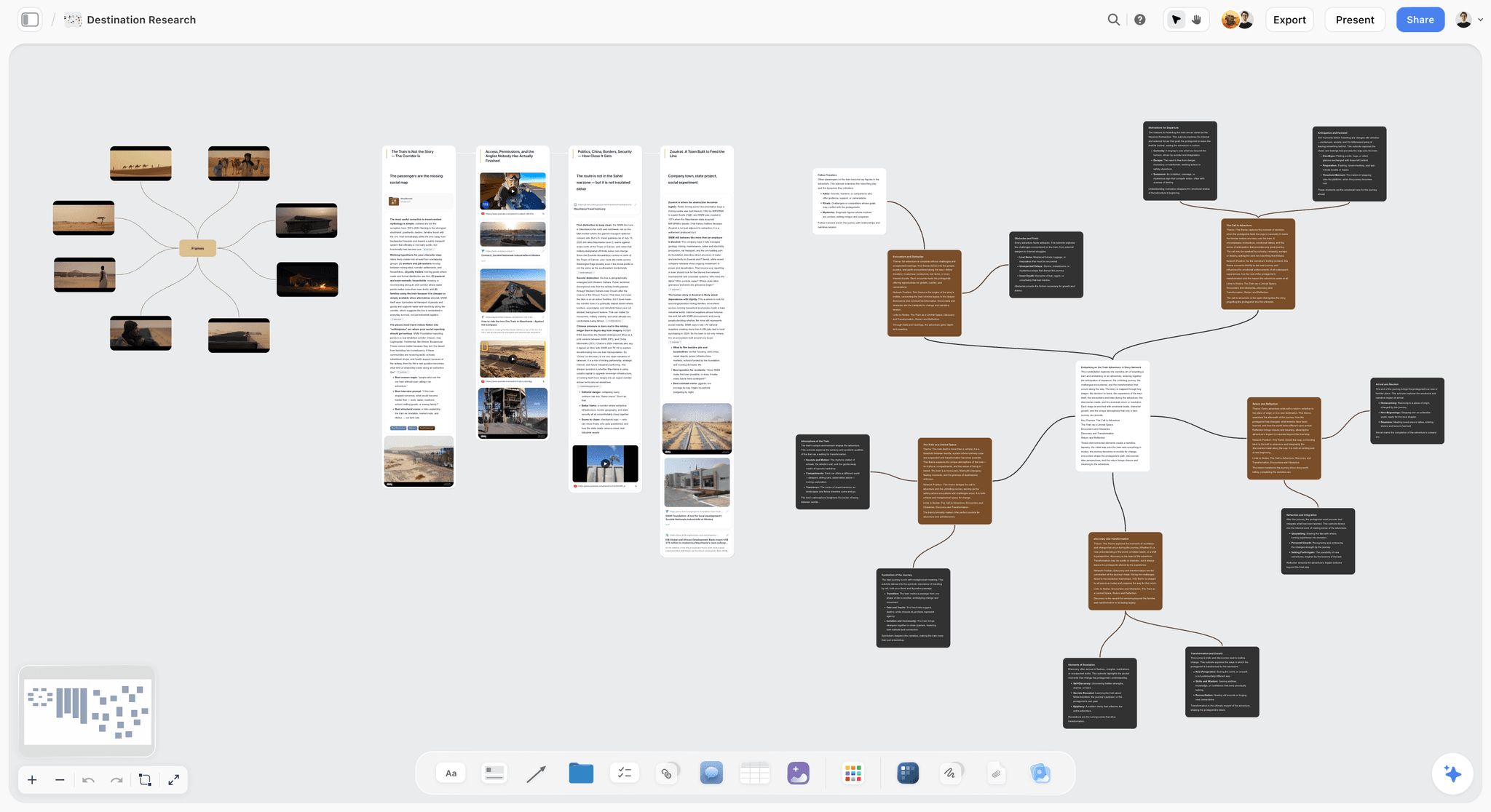
Verdict: the board to connect when you want Grok to build a plan people can see, and read it back a week later.
Best for: founders, small creative teams and solo studios planning launches, campaigns, shoots and content in Grok.
Price: Plus $7.99 a month billed annually ($9.99 monthly), Pro $14 a month annual ($19 monthly), Max $39 a month annual ($49 monthly). Paid-only during early access; the Free plan launches before the end of 2026, and invited collaborators join free now.
Storyflow is a visual project planning workspace for creative work: an infinite canvas board that holds notes, tables, documents, images, moodboards, storyboards, mind maps, kanban, charts and slide decks. Its MCP server launched in October 2026 and works with any assistant that can add a remote MCP server, Grok included.
Connected to Grok, it does two things the listed connectors do not document. First, it builds mixed planning sections on a canvas. Ask for a campaign board and the build_section tool places a goal block, a timeline table and a kanban (a row of column walls holding tickets) where they belong on the board. Other tools add mind maps, charts, diagrams, colour palettes, shot cards, strip boards, carousel pages and slide decks, or apply a board template. Second, it reads back. get_board_summary gives Grok the shape of a board, and get_board_changes reports what changed in the last day, week or month and who changed it.
What works well
- One address, the same in Grok, Claude, ChatGPT and Gemini, so the board outlives a change of assistant.
- Three permissions at sign-in, including a true read-only mode.
- What Grok adds appears live on an open board.
- No per-seat pricing, and no MCP limit on Plus, Pro and Max.
Limits
- A custom connector: you paste an address, and on team accounts an admin adds it first.
- No free plan yet.
- The connector cannot generate images (image generation is the built-in agent on Pro and Max) and cannot read comment threads.
- Browser only. There is no offline mode.
2. Linear
Verdict: the board to connect when the project is a backlog of issues with owners and cycles.
Best for: product and engineering teams, and studios that run production as tickets.
Price: Linear's pricing page lists a Free plan with unlimited members, 2 teams and 250 issues, Basic at $10 per user a month billed yearly, and Business at $16 per user a month billed yearly.
xAI's launch post lists Linear among Grok's connectors and says Grok can search the backlog, summarise sprint progress, draft updates and create issues. Linear's own MCP documentation describes tools for finding, creating and updating issues, projects and comments, with a separate read-only endpoint. Linear's page does not list Grok among its documented clients, so the xAI connector is the supported route.
What works well
- Listed by xAI: chosen from the New Connector menu, no address.
- Creates real issues with the structure Linear is known for.
- A free plan that covers a small team's first 250 issues.
Limits
- A list of issues, not a canvas. There is no place for a moodboard, a mind map or a deck.
- A creative brief or a shot list has to be forced into ticket shape.
- We found no documented way for Grok to ask Linear what changed and who changed it across a project.
3. Notion
Verdict: the board to connect when the plan already lives in Notion pages and databases.
Best for: teams with an existing Notion wiki who want Grok to search it and add to it.
Price: Free plan; Plus $10 per member a month billed annually ($12 monthly); Business $20 per member a month billed annually ($24 monthly). See Notion's pricing page.
xAI's launch post says the Notion connector searches or edits pages, databases and wikis in a Notion workspace. Notion describes its own MCP server as a remote server hosted by Notion that can read, create and update content you can access, including pages and databases. A Notion database with a board view is a workable kanban, and Grok can add rows to it.
What works well
- Listed by xAI, with read and edit access.
- Strong when the source material is long-form writing: briefs, meeting notes, wikis.
- A free plan to start on.
Limits
- Pages and databases are structured text. Visual planning (references next to the schedule next to the deck) is not what Notion is built for.
- Per-member pricing adds up for a team that only needs a few people to edit.
- Workspace owners manage which clients may connect in Notion's Settings, under Connections, so a locked-down workspace may block you.
4. Google Workspace
Verdict: the connection for a plan that is a spreadsheet, a document and some calendar events.
Best for: anyone whose brief is already in Drive and whose deadlines are already in Calendar.
Price: a personal Google account costs nothing. Business plans are priced per user; see Google Workspace pricing for your region.
xAI's launch post describes Google Workspace as a single integration covering Gmail, Drive, Docs, Sheets and Calendar, where Grok can read and write emails, documents, spreadsheets and events. xAI's docs list Gmail and Google Calendar and Google Drive as built-in connectors that xAI maintains. A Sheet with task, owner, due and status columns is the simplest project board there is, and Grok can write to it.
What works well
- Built in and maintained by xAI.
- Real calendar events, which Storyflow does not have.
- Free to start on a personal account.
Limits
- A spreadsheet is a table, not a board. There are no kanban columns, no canvas and no deck sitting next to the plan.
- The plan is spread across three or four files that Grok has to find each time.
- It is the best companion to a board, not a replacement: read the brief from Drive, build the plan somewhere visual.
5. GitHub
Verdict: the connection for software projects where the work is already issues and pull requests.
Best for: developers who want Grok to search code and summarise changes.
Price: GitHub's pricing page lists a Free plan that includes Issues and Projects, and Team at $4 per user a month, shown as a first-12-months price.
xAI's launch post says the GitHub connector connects repositories, issues and pull requests, and that Grok can search code, summarise pull requests, review changes and support development workflows. GitHub maintains its own MCP server and gives creating an issue as an example of what it does. xAI's description does not mention GitHub Projects boards, so we do not count board editing as documented.
What works well
- Listed by xAI.
- The right place to ask "what shipped in the last week?" for a codebase.
- Free plan with issues included.
Limits
- Built around code. A campaign, a shoot or a launch plan does not belong in a repository.
- No documented board building from Grok.
- Non-technical collaborators rarely have GitHub accounts.
Choosing Permissions for Grok: Read-Only, Changes and Which Projects
The Storyflow sign-in is where you decide how much Grok can do. It is three choices, and the safe default differs by whose board it is.
| Situation | Projects | Changes | Documents outside projects |
|---|---|---|---|
First test | One project you own | Off | Off |
Your own planning | The projects you plan in | On | Off unless you need them |
Client project, review only | That client's project only | Off | Off |
Client project, you build with Grok | That client's project only | On | Off |
Solo studio, everything in Storyflow | All projects | On | On |
Read-only is a full way of working
With changes off, Grok can still list projects and boards, read notes, tables and documents, summarise a board and report what changed in the last day, week or month. That covers status questions, gap checks and briefing yourself before a call. Many people never need more on a client project.
Picking projects keeps mistakes small
If Grok can only see one project, the worst a vague prompt can do is add something to the wrong board in that project. Pick projects by default. Allow all projects only when you work alone and everything in the account is yours.
Changes means edits and moves, not only additions
With changes on, Grok can add elements, edit them and move them, remove deck slides and clear table cells. There is no general tool for removing an element from a board, so deleting things is done by you. That does not make changes harmless: an edit to a table cell is a real edit. Keep the board open while Grok works so you see each change land.
Documents outside projects deserve a second look
This setting covers your private documents and documents shared with you. With changes allowed, Grok can edit them and add them to a board. It starts on when you allow all projects. If your private documents hold contracts, rates or notes about clients, switch it off.
Ending access
Open Storyflow, go to Settings, then Connected apps, and remove Grok. Access ends within a minute. Every connection also ends on its own after 30 days, and Grok asks you to sign in again. On a Grok team, an admin's Remove in the console ends it for every member at once.
A Worked Example: A Five-Week Crowdfunding Campaign Board Built From Grok
This is an illustrative example, written to show the sequence and the kind of numbers involved. The studio, the counts and the action totals are invented, not measured.
The starting point
A two-person tabletop studio is launching a card game on a crowdfunding platform in five weeks. The goal is $18,000. They have a one-page brief in Google Drive, 14 product photos, and no plan. One of them lives in Grok for research. They connect two things: Grok's Google Workspace connector, and Storyflow as a custom connector with changes allowed on one project, "Card game campaign".
Prompt one: research, then the board
You ask: "Read the campaign brief in my Google Drive. Look at how three recent card game campaigns structured their reward tiers. Then, using Storyflow, build a board in the Card game campaign project with five sections: goal and numbers, audience, reward tiers as a table, a five-week timeline table with rows kept in date order, and open questions."
Grok reads the brief through Google Workspace, does its research, then calls Storyflow: one call to list projects, one to list boards, and five build_section calls. That is 7 Storyflow actions. The reward table comes back with 5 tiers from $12 to $95, and the timeline has 22 rows.
Prompt two: the task board
You ask: "On the same board, add a kanban with To do, Doing and Done, and put the 22 timeline tasks in To do as tickets with the owner and due date on each."
One build_section call creates the row of column walls and the tickets. The two founders now have a board they can both open, drag tickets across, and edit by hand.
Prompt three: the mind map and the chart
You ask: "Add a mind map of launch-day content with four branches (page, email, social, press) and four ideas on each. Then add a bar chart of tasks per week from the timeline."
Two actions: create_mindmap and create_chart. The chart shows week 4 holding 9 of the 22 tasks, which is the first time either founder sees that the plan is back-loaded. They move three tasks to week 2 by hand.
Prompt four: the deck for a retail partner
You ask: "Build a 6-slide deck on the board from what is already there: the game, the audience, reward tiers, timeline, what we need from a retail partner, next steps."
One create_deck action. The deck sits on the board next to the plan it was built from. They present it fullscreen from the board on a call, and share a view-only link the retailer opens with no account (the retailer signs in to comment).
Week two: the read-back
A week later, with no memory of the earlier chat, you ask: "Using Storyflow, what changed on the Card game campaign board in the last week, and who changed it? Then list every ticket still in To do that was due in the last week."
Grok calls get_board_changes with the last-week window and reads the board. It reports that one founder moved 6 tickets to Done and edited the reward table, that the other added 4 notes under open questions, and that 2 tickets are overdue. That is the weekly status check, done from the board and not from anyone's recollection.
| Prompt | What Grok built or read | Storyflow actions (illustrative) |
|---|---|---|
Research and board | 5 sections, 5-tier table, 22-row timeline | 7 |
Task board | Kanban with 22 tickets | 1 |
Mind map and chart | 16-idea mind map, tasks-per-week chart | 2 |
Partner deck | 6-slide deck | 1 |
Week-two status | Change history and overdue tickets | 3 |
Total | One shared board | 14 |
What the connection could not do in this example
The 14 product photos did not travel through the chat. A photo attached in Grok does not reach Storyflow; the connector's request_photo_upload tool gives you an upload link, and add_images places pictures from web addresses. Grok could not generate campaign artwork through the connector either. And when the retailer signed in and left comments on the board, Grok could not read that thread, so the founders read the comments themselves.
What it cost
On Storyflow Plus the 14 actions cost nothing extra, since paid plans have no MCP limit and the work ran on Grok's model. On a free invited account they would have used 14 of the week's 25 actions. Either way the board is $7.99 a month billed annually for the founder who owns it, and the second founder joins by invitation.
12 Grok Prompts That Work on a Connected Project Board
Each prompt names Storyflow, names the board, and says what shape you want. Copy them and change the nouns.
| Job | Prompt to paste into Grok | Needs changes on? |
|---|---|---|
Inventory | Using Storyflow, list my projects and the boards in each, with one line on what every board holds. | No |
Board summary | Using Storyflow, summarise the [board] board in 10 lines: what is decided, what is open, what has a date. | No |
Weekly status | Using Storyflow, what changed on the [board] board in the last week, and who changed it? Group it by person. | No |
Gap check | Read the [board] board in Storyflow and list every task with no owner or no date, and every open question nobody has answered. | No |
Research to board | Research [topic] and put the five findings that matter on the [board] board in Storyflow as a group of notes, each with its source link. | Yes |
Brief to board | Read the brief document in my [project] in Storyflow. Build a board with goal, audience, deliverables, timeline table and open questions as separate sections. | Yes |
Kanban | On the [board] board in Storyflow, build a kanban with To do, Doing and Done and add these tasks as tickets with owner and due date: [list]. | Yes |
Timeline | Add a timeline table to the [board] board in Storyflow, working back from [date], with rows kept in date order. | Yes |
Mind map | Add a mind map of [topic] to the [board] board in Storyflow, 4 branches with 4 ideas each. | Yes |
Chart | Add a bar chart of tasks per week to the [board] board in Storyflow, counted from the timeline table. | Yes |
Deck | Build a 6-slide deck on the [board] board in Storyflow from the plan already on it: goal, audience, plan, timeline, risks, next steps. | Yes |
Template start | Using Storyflow, find a board template for a [product launch / content plan / shoot] and apply it to my [project]. | Yes |
Say "Storyflow" in the prompt
xAI's docs say Grok uses a connector's tools automatically when a question relates to that service. Grok also has the web to search. If you ask "what is on my launch board?" without naming the connector, Grok has to guess which source you mean. Naming Storyflow removes the guess.
Ask for shapes, not for "a plan"
"Make a plan" gets you paragraphs. "A timeline table, a kanban with three columns and a mind map with four branches" gets you a board. The connector has separate tools for sections, charts, mind maps, diagrams and decks, and Grok picks the right one when you name the shape.
Read first, then write
On a board other people edit, ask for the summary before you ask for changes. It costs one or two actions and stops Grok adding a second timeline next to the one your teammate built yesterday.
Use Grok's research, then make it stay
Grok's strength is pulling in current information. The weakness is that the findings vanish up the thread. The "research to board" prompt is the one that plays to Grok: findings land as notes with source links, next to the plan they inform.
What It Costs to Run Grok With a Project Board
The connector itself costs nothing in any of these tools. You pay for the assistant, if you are on a paid Grok plan, and for the board.
| Board | Board cost for one person | Board cost for a team of four | Extra cost of the Grok connection |
|---|---|---|---|
Storyflow | $7.99 mo annual on Plus ($9.99 monthly) | One paid member, three invited collaborators join free now; Max at $39 mo annual adds a team workspace with roles | None. No MCP limit on paid plans; 25 actions a week on a free invited account |
Linear | $0 on Free (250 issues) | $40 mo on Basic, billed yearly | None listed by xAI |
Notion | $0 on Free | $40 mo on Plus billed annually ($48 monthly) | None listed by xAI |
Google Workspace | $0 on a personal account | See Google's pricing page for business plans | None listed by xAI |
GitHub | $0 on Free | $16 mo on Team at the listed first-year price | None listed by xAI |
How to read the table
Storyflow has no per-seat price, so the team column depends on how you work. Four people editing shared boards can run on one paid plan plus invitations today. A team that wants its own workspace with roles and permissions moves to Max. The per-seat tools scale in a straight line: four people, four seats.
What we left out
We have not quoted Grok's own subscription prices, because xAI's connector pages do not state them and we did not verify them elsewhere. xAI's docs say all Grok users can use connectors, so check your plan on x.ai if you hit a limit.
The cost that is not in the table
The expensive part of a disconnected setup is the rebuilding: copying a plan out of chat, fixing the table, and doing it again after every revision. A connected board removes that step. Whether that is worth $7.99 a month depends on how often you plan in Grok. If it is once a quarter, a spreadsheet is fine.
Decision Rules: Which Board to Connect to Grok for Which Job
If the plan is visual and mixed, connect Storyflow
A launch, a campaign, a shoot or a content plan has a brief, a timeline, tasks, references and a deck. Storyflow holds all of them on one canvas and Grok builds each as its own shape. This is also the pick if you switch between Grok and another assistant, because the same address works in each. Our guides for ChatGPT and Claude cover those setups.
If the project is a backlog, connect Linear
When the unit of work is an issue with an owner, an estimate and a cycle, Linear is the right board, and xAI lists it. Use Grok to draft issues and summarise sprint progress.
If the plan is documentation, connect Notion
When the team's knowledge is in Notion pages and the "board" is a database view, connect Notion and let Grok search and edit there. Do not move a working wiki to make a connector happy.
If the plan is a spreadsheet and a calendar, connect Google Workspace
A one-person project with eight tasks does not need a canvas. A Sheet and Calendar events will do, and Grok writes to both.
If the work is code, connect GitHub
Software projects are tracked where the code is. Connect GitHub for those, and keep the launch plan for the same product on a board made for planning.
If you need two, connect two
Connectors are not exclusive. The worked example used Google Workspace to read the brief and Storyflow to hold the plan. A product team can use Linear for issues and Storyflow for the launch around them. For a wider ranking across assistants, see the best MCP servers for project management and the best Gemini and Grok connectors.
Troubleshooting: When Grok and Your Board Do Not Talk
| Symptom | Likely cause | Fix |
|---|---|---|
On a team account, you cannot add or use the connector | The admin has not added it | Ask a team admin to add it in console.x.ai under Grok Business, Connectors, Add Connector, Other |
Grok rejects the address | A typo, or a local or private address | Paste https://mcp.storyflow.so/mcp exactly. Grok only reaches servers on the public internet |
Grok answers from the web, not the board | The prompt did not name the connector | Start the prompt with "Using Storyflow" |
Grok asks you to sign in again | The connection reached 30 days or was removed | Sign in again and choose projects |
Grok cannot see a project | It was not picked at sign-in | Disconnect in Storyflow, connect again, pick it |
Grok cannot change anything | The connection is read-only | Connect again and allow changes |
Grok says the week's actions are used up | A free account reached 25 actions | Wait for the Monday reset (UTC) or work from a paid plan |
The connector saved but no tools show up
Check the address ends in /mcp and not /sse. Storyflow speaks Streamable HTTP only and does not serve SSE. xAI's tunneling guide mentions both transports, so a guide written for another server may have sent you to an SSE address out of habit.
Storyflow shows a warning about the app
That is the unknown-app warning. Storyflow shows it when it does not recognise the app asking to connect, and you tick "I trust this app" to go on. If you did not start a connection from Grok in the last minute, close the page and do not tick it.
Grok built it in the wrong place
Grok chose a board because the prompt did not name one. Say the project and the board by name. If you have several boards with similar names, ask Grok to list them first and then refer to the one you want exactly as listed.
Nothing happened when the actions ran out
That is by design. When a free account's weekly actions are used up, the next call is refused, Grok tells you, and that call changes nothing on your boards. Calls that ran before the limit stay as they are, so a build that needed several calls can stop part way: check the board and finish it after the Monday reset or from a paid plan.
It works on the web but you cannot find it on your phone
xAI's launch post says connectors are available on iOS and Android under Settings, then Connectors. The custom connector steps xAI documents are for grok.com/connectors, so add Storyflow there first. Remember the board itself opens in a browser, not in a Storyflow phone app.
Common Mistakes When Connecting Grok to a Project Board
Mistake 1: Skipping the admin on a team account
On Grok Business and Enterprise, members cannot connect a service the admin has not added. Retrying the personal steps will not get past it. Send the admin the address and the five console steps first.
Mistake 2: Allowing all projects on the first try
It is one click and it is the wrong default. Connect one project, read-only, and run the inventory prompt. Widen the scope once you have seen what Grok does with it.
Mistake 3: Leaving changes on for client boards you only review
If your job on a client board is to check status, connect read-only. An edit you did not intend on a client's table is a conversation you do not want to have.
Mistake 4: Expecting Grok to find the board unprompted
Grok decides when a connector is relevant. A prompt that never mentions Storyflow or a board name gives it little to go on. Name both.
Mistake 5: Sending pictures through the chat
A photo attached in Grok does not reach Storyflow. Ask for the upload link, or drop the files on the board yourself. For pictures already online, give Grok the addresses and ask it to add them.
Mistake 6: Treating the chat as the record
If a decision matters, it goes on the board as a note, a ticket or a table row. Next week's Grok chat starts empty, and the board is the only thing both of you can read.
Mistake 7: Forgetting the 30 days
The connection ends after 30 days. It is a safety measure, not a fault. Sign in again, and use the moment to check the project list is still the one you want.
When Storyflow Is Not the Right Choice
Storyflow ranks first for building and reading a visual plan from Grok. It is the wrong pick in these cases, and saying so is more useful than pretending otherwise.
You need a free board today
Storyflow is paid-only during early access. Its Free plan launches before the end of 2026, and until then the only free route is an invitation from a paid member. If you need to start at zero cost with no invitation, use Linear's free plan or a Google Sheet with Grok's own connectors.
Your project is issues, sprints and estimates
Storyflow has kanban and tables, but it is not an issue tracker. It has no cycles, estimates or backlog automation. A software team should connect Linear or GitHub and keep Storyflow for the planning around the build, if at all.
Your team cannot add custom connectors
If your xAI team admin will not add a custom MCP server, you are limited to what xAI lists. In that case Notion or Linear is the practical answer, whatever the scores say.
You need a calendar, publishing or approvals
Storyflow has no calendar tool: dates live in table date cells, tickets and kanban, with rows kept in date order by whoever builds them. It does not publish or schedule social posts, and it has no formal approval step with versions. Google Calendar through Grok's Google Workspace connector covers the first of those.
You need mobile apps or offline work
Storyflow runs in the browser. There are no phone or desktop apps and no offline mode. If you plan on a plane or on a phone between meetings, pick a tool with an app.
You need Grok to read client comments
The connector does not read comment threads. If the job is "summarise what the client said in the comments", you will be reading them yourself.
Template: The Grok-Ready Project Board
A board Grok works well with has named sections and predictable tables. Build it once by hand, or have Grok build it with the prompt at the end. Storyflow's brief to project board workflow and its AI project plan generator start from the same idea inside the app.
The layout
- Goal and numbers: one sentence, three numbers, one date.
- Research: a group of notes, each with a source link. This is where Grok's findings go.
- Timeline: a table with rows kept in date order.
- Kanban: To do, Doing, Done.
- References: pictures and links.
- Open questions: one note each, with an owner.
- Updates: an empty area for decks.
The timeline table columns
| Column | Type | Why it helps Grok |
|---|---|---|
Task | Text, starting with a verb | A clear thing to report on |
Owner | Text | Answers "what is on Dana's plate this week?" |
Due | Date | Lets Grok count load per week and spot overdue rows |
Status | To do, Doing, Done | Matches the kanban columns |
Source | Link or document | Gives Grok something to read before it answers |
The names that make prompts short
Give the project and the board plain, distinct names: "Card game campaign", not "New board 3". Name sections the way you will ask for them. A prompt like "add this to Research on the Card game campaign board" only works if both names exist exactly once.
The prompt that builds it
Paste this into Grok with changes allowed: "Using Storyflow, in my [project], build a board with seven sections: goal and numbers, research notes, a timeline table with Task, Owner, Due, Status and Source columns and rows kept in date order, a kanban with To do, Doing and Done, references, open questions with an owner on each, and an empty area for update decks." If you would rather start from a kanban alone, the AI kanban board generator page shows what that looks like.
The weekly routine
Monday: run the weekly status prompt and the gap check, both read-only. Midweek: add research with the research-to-board prompt. Friday: ask for a short update deck built from the board. That is three chats a week. In the illustrative example above, the whole build and the first status check came to 14 actions.
The Bottom Line
Connecting Grok to a project board takes one page and one address: grok.com/connectors, New Connector, Custom, https://mcp.storyflow.so/mcp, then a Storyflow sign-in where you pick projects and permissions. On a Grok Business or Enterprise team, the admin adds it in console.x.ai first. Storyflow is the board to connect when the plan is visual and mixed, because Grok builds the timeline, the kanban, the mind map and the deck as separate things on one canvas and reads the change history back a week later. Linear, Notion, Google Workspace and GitHub are quicker to add and better for backlogs, wikis, spreadsheets and code. Start read-only on one project, run the inventory prompt, and widen from there. The Storyflow MCP page has the overview and the connection guide has the steps for every assistant.
FAQ: Connecting Grok to a Project Board
How do I connect Grok to a project board?
Open grok.com/connectors, click New Connector, choose Custom, and paste https://mcp.storyflow.so/mcp. Sign in to Storyflow when asked, then pick which projects Grok may use and whether it may make changes. Test it by asking Grok to list your Storyflow projects. On Grok Business and Enterprise, a team admin adds the connector in the xAI console before you can do this.
Does Grok support custom MCP connectors?
Yes. xAI's connector documentation describes adding a custom MCP connector at grok.com/connectors by clicking New Connector, selecting Custom and entering the server URL. xAI's launch post calls the option Bring Your Own MCP. The server must be reachable over the public internet. Storyflow's server is public, so it needs no tunnel.
Do I need a paid Grok plan to use connectors?
xAI's documentation says all Grok users can use connectors, and it does not list a plan requirement for custom ones. The one condition it states is for Grok Business and Enterprise teams, where an admin provisions a connector before members can use it. If you hit a limit, check your plan details on x.ai.
What does the admin have to do on Grok Business or Enterprise?
The admin logs in to console.x.ai, selects the team, opens Grok Business and then Connectors, clicks Add Connector, selects Other, and enters https://mcp.storyflow.so/mcp. It needs Team Read-Write permission. After that, each member connects their own Storyflow account at grok.com/connectors and chooses their own projects and permissions.
Which connectors does Grok have built in?
xAI's launch post names SharePoint, Outlook, OneDrive, Google Workspace, Notion, GitHub and Linear. Its docs page lists Gmail and Google Calendar, Google Drive, OneDrive, Outlook, Microsoft Teams, SharePoint and Salesforce as built-in connectors xAI maintains, plus a catalog of third-party connectors. The two lists differ, so check the New Connector menu in your own account.
Can Grok create a project board for me?
Yes, with Storyflow connected and changes allowed. Grok can create a project, build planning sections, tables, a kanban, mind maps, charts, diagrams and slide decks, and apply a board template. Name the shapes you want in the prompt. What it builds appears on the board while you have it open in another browser tab.
Is it safe to connect Grok to my project board?
You control the scope. At the Storyflow sign-in you pick which projects Grok may use, whether it may make changes, and whether it may use documents outside projects. Read-only is a real mode. You can remove the connection in Storyflow under Settings, then Connected apps, and access ends within a minute. Every connection also ends after 30 days.
Can Grok delete things on my Storyflow board?
Grok adds and edits; removing elements from a board is done by you. With changes allowed it can edit and move elements, remove slides from a deck and clear table cells, so it can alter content. There is no general tool for deleting a board element. Connect read-only if you want no changes at all.
Does connecting Grok use my Storyflow AI credits?
No. The connection runs on Grok's own model, so it does not spend Storyflow AI credits. Storyflow Plus, Pro and Max have no MCP limit. A free account, which today means one invited by a paid member, gets 25 actions a week, where each read and each change counts as one. The count resets every Monday, UTC.
Can Grok see all my Storyflow boards?
Only the boards in projects you allowed at sign-in. You choose all projects or pick specific ones. Documents outside projects are a separate choice, on by default when you allow all projects and off when you pick. To add a project later, disconnect in Storyflow and connect again with the new selection.
Can Grok tell me what changed on a board?
Yes. Ask what changed on a named board in the last day, the last week or the last month, and who changed it. Those three windows are the ones the connector supports, so phrase the question with one of them. Grok cannot read comment threads on the board, so comments are not part of the answer.
Can I connect Grok to Notion, Linear or GitHub instead?
Yes. xAI's launch post lists all three as Grok connectors: Notion for searching and editing pages, databases and wikis, Linear for searching the backlog and creating issues, and GitHub for repositories, issues and pull requests. They are chosen from the New Connector menu. You can connect them alongside Storyflow, since connectors are not exclusive.
Does the Storyflow connector work in the Grok mobile app?
xAI says connectors are available on Grok for iOS and Android under Settings, then Connectors. The custom connector steps xAI documents use grok.com/connectors in a browser, so add Storyflow there. Storyflow boards open in a browser too, as there is no Storyflow phone app, so plan to view what Grok builds in a browser tab.
Why does Grok keep asking me to sign in to Storyflow?
Every Storyflow connection ends on its own after 30 days, and Grok asks you to sign in again. It also happens if you, or someone with access to your account, removed Grok under Settings, then Connected apps. Sign in again and choose your projects. Your boards are unaffected by an expired connection.
Can I send a photo from Grok to my Storyflow board?
Not through the chat. A photo attached in Grok does not reach Storyflow. Ask Grok for the upload link, which the connector provides for a named board, and add the photo there. For images that are already online, give Grok the addresses and it can place them on the board.
Can Grok generate images onto my Storyflow board?
Not through the connector. The Storyflow MCP server has no image generation tool. Image generation in Storyflow is part of the built-in AI agent on the Pro and Max plans. From Grok, you can place existing pictures on a board from their web addresses, or use the upload link for files on your computer.
What is the Storyflow MCP address for Grok?
The address is https://mcp.storyflow.so/mcp. It is the same for Grok, Claude, ChatGPT, Gemini and every other assistant, and you can copy it in Storyflow under Settings, then Storyflow MCP. It uses Streamable HTTP and does not serve SSE, so make sure the address you paste ends in /mcp.
Table of Contents
- Key Takeaways
- What Connecting Grok to a Project Board Changes
- What You Need Before You Start
- How We Judged Which Project Board to Connect to Grok
- Comparison Table: Storyflow, Linear, Notion, GitHub and Google Workspace Connected to Grok
- How to Connect Grok to a Storyflow Project Board, Step by Step
- Step 1: Copy the Storyflow address
- Step 2: Open grok.com/connectors
- Step 3: Click New Connector, then Custom
- Step 4: Paste the address
- Step 5: Sign in to Storyflow
- Step 6: Choose what Grok may use
- Step 7: Test with a read, then a write
- The Admin Step on Grok Business and Enterprise
- The Five Project Boards Grok Can Connect To, Reviewed
- Choosing Permissions for Grok: Read-Only, Changes and Which Projects
- A Worked Example: A Five-Week Crowdfunding Campaign Board Built From Grok
- 12 Grok Prompts That Work on a Connected Project Board
- What It Costs to Run Grok With a Project Board
- Decision Rules: Which Board to Connect to Grok for Which Job
- Troubleshooting: When Grok and Your Board Do Not Talk
- Common Mistakes When Connecting Grok to a Project Board
- When Storyflow Is Not the Right Choice
- Template: The Grok-Ready Project Board
- The Bottom Line
- FAQ: Connecting Grok to a Project Board
- Related Reading
Templates to check out for this topic


Templates you can use in Storyflow
Every Storyflow board starts from real structure and an AI that reads the whole canvas. Open one of these templates and make it yours.


See Storyflow in Action
A visual AI workspace where every feature lives inside one canvas. No tab-switching, no context lost.
Build your entire board from a single message
Type what you need in the AI chat at the bottom of your canvas. The AI adds cards, headings, and structure directly onto your board.
Use expert frameworks as AI context
Type @ in the AI chat and choose any Tactic. The AI tailors every response to that framework instead of giving generic advice.
Turn your board into a mind map in seconds
Ask the AI to restructure your canvas as a mindmap. It connects your ideas into a visual hierarchy so you can see how everything relates.
Why Storyflow Exists
Storyflow actually began as a personal tool while working on creative and research projects.
We kept running into the same problem: ideas were scattered everywhere: notes, documents, and whiteboards.
Nothing helped us see how everything connected.
So we started building a workspace designed around how ideas actually grow.
→ Read how Storyflow was createdStoryflow Team
Product & Research Team
Published: 2026-10-10
Extremely simple, seriously capable


See how easy it is to get started
Watch a real project come together, from a blank board to a finished plan, clicked through step by step.
Start creating with AI and become more productive
Transform your creative workflow with AI-powered tools. Generate ideas, create content, and boost your productivity in minutes instead of hours.