
How Much Pre-Production Does an Indie Film Actually Need? (2026)
Prep is not a cost, it is a loan. An hour skipped is repaid on the shoot day at roughly four to one. Which prep repays enormously, which repays almost nothing, and the debt that never comes due.

Category
Filmmaking
Author

Justkay
Documentary Filmmaker & Founder at Storyflow
Topics
2026-08-26
•
16 min read
•
Filmmaking- how much pre-production does a film need
- pre-production planning tool indie filmmakers
- indie film prep time
- days of prep per shoot day
- what to skip in pre-production
- why indie shoots run over
How much pre-production does an indie film need?
Prep is not a cost, it is a loan. An hour skipped is repaid on the shoot day at roughly four to one. Which prep repays enormously, which repays almost nothing, and the debt that never comes due.
Key Takeaways
- Prep is not a cost, it is a loan. Every hour of pre-production you skip is borrowed, and it gets repaid on the shoot day at roughly four times the amount.
- The exchange rate is consistent enough to plan around: an hour of prep saves about four hours of shoot day, and a shoot-day hour costs whatever your whole crew costs per hour.
- Not all prep repays equally. Locking a location and counting setups honestly repay enormously. Detailed storyboarding of ordinary coverage and elaborate budget spreadsheets repay almost nothing at indie scale.
- The rough guide: three to five days of real prep per shoot day for narrative, less for documentary, and the work has to be the high-repayment kind or the ratio means nothing.
- The most expensive prep debt is not skipped paperwork. It is a decision left open, because open decisions cannot be scheduled around and they compound daily.
Prep Debt
Every indie film I have watched go badly went badly in the same shape: the shoot day was chaotic, and every piece of the chaos traced back to something that was cheap to decide three weeks earlier and expensive to decide at 9am with eleven people standing around.
That relationship is consistent enough to be treated as arithmetic.
An hour of prep is a loan against the shoot day, and the interest is roughly 300 percent. One hour skipped costs about four hours on the day, because on the day everything is more expensive: everybody is present and being paid or being owed a favour, the light is running out, and every decision blocks people.
Concretely, this is what the exchange looks like:
- Twenty minutes confirming call times in writing. Ninety minutes lost when one person arrives at the wrong hour and the setup that needed them waits.
- One hour scouting at the shoot hour. Half a day relighting your way out of a window facing the wrong direction.
- Thirty minutes counting setups honestly. Two setups lost at 5pm, and they are the ones at the end of the list, which is where the ambitious ones live.
- Two hours locking the location in writing. A cancelled shoot day and every associated re-booking.
- Fifteen minutes deciding the weather answer. A day abandoned because the decision got made at 7am in the rain.
None of that is unusual and none of it requires anything going dramatically wrong. It is the normal cost of arriving with open questions.
Not All Prep Repays
The reason "how much prep" is a hard question is that the ratio only holds for the right kind of work, and indie productions routinely do the low-repayment kind because it is more enjoyable.
High repayment, always do it:
- Locking the location, in writing, with a date. The single highest-return hour in indie filmmaking. An unlocked location is not a risk, it is a shoot that has not been scheduled yet.
- Confirming every person in writing with time and address. Twenty minutes, and it catches the wrong-day problem that is close to universal.
- Counting setups and converting to hours. Thirty minutes, and it is the difference between a plan and a wish.
- Scouting at the shoot hour. One hour, prevents the most common unfixable problem.
- Deciding the ending, the one image, and what the film is about. These are creative rather than logistical and they repay the most of anything on this list, because every small decision on the day is faster when you know what the film is.
- A weather and dropout answer. Fifteen minutes.
Low repayment at indie scale, do it only if you have spare time:
- Storyboarding ordinary dialogue coverage. A shot list is faster and equally sufficient. Board the sequences where geography or timing is genuinely unclear, and skip the rest.
- Detailed budget spreadsheets on a film with almost no budget. Track what you are spending, and the elaborate version is theatre.
- Full script breakdowns in professional software for a ten-page short. The breakdown matters; the software does not.
- Elaborate call sheets for a crew of four who are all in the same group chat. The information matters; the format is for crews who expect a format.
- Polishing the script past the point where the location is locked. Draft seven with no confirmed room is worse than draft two with a date.
The pattern: prep that closes a decision repays enormously. Prep that documents a decision already made repays little. Most indie productions do a lot of the second and skip a lot of the first, because documenting is calm work and closing decisions means asking somebody for something.
The Rough Numbers
Ratios, with the usual caveat that the type of work matters more than the number.
Narrative short or feature: three to five days of prep per shoot day. A three-day short is nine to fifteen days of prep. That sounds enormous and most of it is not full days; it is a week of evenings chasing locations, confirming people, and closing decisions.
Documentary: less, and differently shaped. Prep is research and access rather than scheduling, and access is the location problem in another form: an unconfirmed interview is an unlocked location.
Commercial or branded content: more per shoot day, usually two to four days, because approval cycles sit inside prep and they are slow for reasons unrelated to you.
A one-day self-shoot: one to two days. The ratio drops because there is less coordination, and the location and light rules still apply completely.
The honest test, which is better than any ratio: list every question the shoot day depends on. Where, when, who, what happens if it rains, how many setups, what is essential. If any of them is unanswered, you have prep debt regardless of how many days you have spent.
What Actually Gets Skipped
In roughly the order they get dropped when time runs short, and the order is almost exactly backwards.
First to go: the setup count. Because it produces a number nobody wants, which is that the day does not fit. Skipping it does not make the day fit; it makes you discover at 4pm.
Second: scouting at the right hour. Because scouting once feels like scouting.
Third: the failure plan. Because it feels pessimistic, and because deciding what happens if it rains means admitting it might.
Fourth: written confirmations. Because everybody said yes verbally and it seems distrustful to ask again in writing. This is the one that most reliably costs a whole day.
Last to go, and it should be first: detailed boards and paperwork. The enjoyable, low-repayment prep survives longest because it can be done alone at a desk, which is precisely why it is the wrong thing to protect.
If you have half the prep time you wanted, protect the four items above and cut the boards. Almost everybody does the opposite.
Where Prep Lives
| Artefact | Repayment | Where |
|---|---|---|
Location confirmations | Highest | Written message, saved somewhere findable |
People confirmations with time and address | Highest | Same |
Setup count converted to hours | High | Anywhere you will look at it, a sheet is fine |
Light note per location and hour | High | With the shot list |
The ending, the one image, what the film is about | Highest | The project board |
Shot list ordered by setup, essentials marked | High | Printed for the day |
Weather and dropout answer | High | On the call sheet |
Storyboards for unclear sequences only | Medium | Photographed, numbered to the shot list |
Full breakdowns and budgets | Low at indie scale | Only if the production is big enough to need them |
The practical setup for most indie productions is one project home plus one printed page per shoot day. The project home holds the creative decisions and the references so that returning after a gap does not mean reconstructing; Milanote's free tier and Notion both do this for nothing. Storyflow, which we make, holds the same material on a canvas the AI reads, so asking what is still unconfirmed and whether every essential shot has a setup is a question rather than a manual pass. It is paid-only during early access from $7.99 a month annual, with the Free plan landing before the end of 2026, and it drafts the call sheet as a PDF but does not send it or track confirmations, so StudioBinder or a template handles distribution on the day.
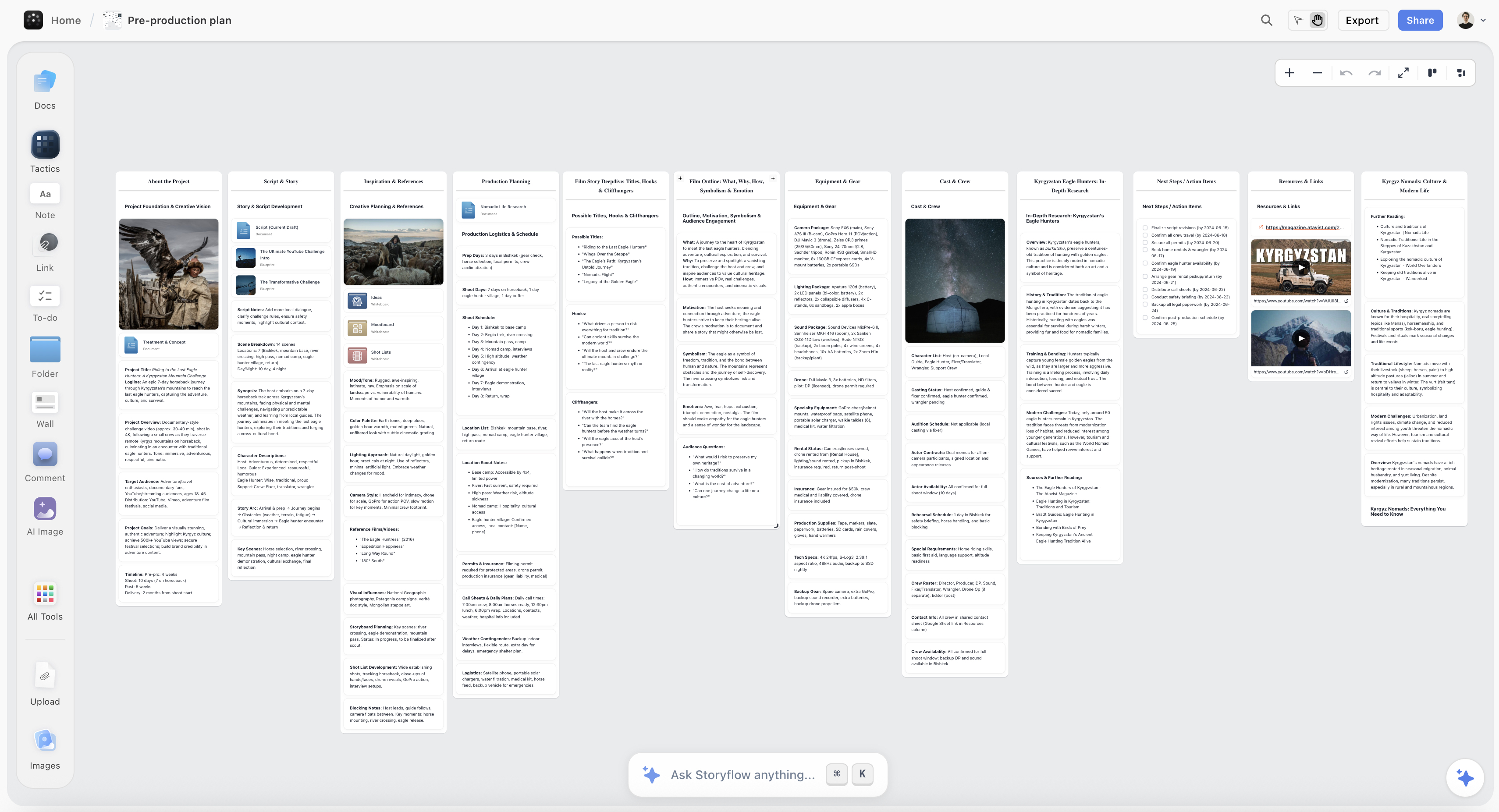
An indie film's prep held on one Storyflow canvas, with the ending, references, shot list and confirmations in the same place
An open decision has no repayment date
A film with an unconfirmed location and an undecided ending is not behind schedule, it has no schedule, and it can stay that way for years. Storyflow keeps the decisions, references and shot list on one canvas the AI reads, so what is still unconfirmed is a question you can ask. It drafts a call sheet PDF but does not send it; Milanote's free tier covers the same job for nothing.

The Debt You Cannot Repay
One kind of prep debt does not convert into shoot-day hours. It compounds instead, and it is the reason films die rather than run over.
An open decision cannot be scheduled around.
If the ending is undecided, you cannot write the shot list. If the location is unconfirmed, you cannot book the crew. If the lead is "probably Sam," you cannot set a date. So the project does not progress, and because it cannot progress, what gets worked on is whatever can be worked on alone, which is usually the script.
Then a month passes. Then three. The film is not cancelled, it is permanently about to start.
This is why the highest-repayment prep on the list is the creative and logistical decisions rather than the paperwork. Paperwork documents a plan. Decisions create the possibility of one, and a decision left open is the only prep debt with no fixed repayment date, because it charges interest for as long as the project stays alive.
The Bottom Line
The question is usually asked as though the answer is a number of days, and the number is the less useful half.
Prep is a loan. Every hour skipped is borrowed against the shoot day and repaid at roughly four to one, because on the day everybody is present, the light is finite, and open questions block people. Three to five prep days per shoot day is the rough guide for narrative work.
But the ratio only holds if the prep is the kind that closes a decision. Locking a location in writing, confirming people with a time and an address, counting setups honestly, scouting at the actual shoot hour, and deciding what the film is about all repay enormously. Detailed boards of ordinary coverage and elaborate budgets on a film with no budget repay almost nothing, and they are what survives when time gets short, because they can be done alone at a desk.
So if you have half the prep time you wanted, protect the confirmations and the arithmetic and cut the paperwork. Almost everybody does the reverse.
And the debt with no repayment date is the open decision. A film with an unconfirmed location and an undecided ending is not behind schedule; it has no schedule, and it can stay in that condition for years without anybody deciding to cancel it.
FAQ: Pre-Production for Indie Films
How much pre-production does an indie film need?
Three to five days of prep per shoot day for narrative work, one to two for a one-day self-shoot, and two to four for commercial work where approval cycles sit inside prep. The ratio matters less than the type: prep that closes a decision repays about four hours of shoot day per hour spent, and prep that documents a decision already made repays very little.
What is the most important part of pre-production?
Locking the location in writing with a date, and confirming every person in writing with a time and an address. Those two hours prevent more lost shoot days than anything else available, because an unconfirmed location is not a risk, it is a shoot that has not been scheduled, and the wrong-call-time problem is close to universal on small productions.
What can you skip in indie film pre-production?
Storyboarding ordinary dialogue coverage, elaborate budget spreadsheets on a film with almost no budget, full breakdowns in professional software for a ten-page short, and formal call sheets for a crew of four who are all in one group chat. Board only the sequences where geography or timing is genuinely unclear, and a shot list covers the rest faster.
Why do indie shoots always run over?
Because the setup count was never done honestly. A confident plan of twelve looks is frequently seven setups' worth of real time, and the discovery happens at 4pm when the light is going. The half hour of arithmetic in prep does not make the day fit, and it tells you in advance so you can cut deliberately rather than by default.
What is prep debt?
Prep skipped is prep borrowed. An hour not spent in pre-production costs roughly four hours on the shoot day, because on the day everybody is present, the light is finite, and every open decision blocks people. The exchange rate is consistent enough to plan around, which makes prep an investment decision rather than a discipline question.
How long should you spend planning a short film?
For a two-day short, roughly six to ten days of prep, mostly evenings rather than full days. The bulk of it is not paperwork: it is chasing a location until somebody says yes with a date, confirming cast in writing, deciding the ending, and counting setups. If those four are done, the rest can be thin and the shoot will still work.
What pre-production tools do indie filmmakers need?
Fewer than the market suggests. One project home for the creative decisions and references, a shot list, and one printed page per shoot day. StudioBinder becomes worth it once call sheets are a recurring bottleneck, which means shooting regularly with real crew. Milanote's free tier and Notion cover the project home for nothing; Storyflow does it with AI that reads the board and is paid-only during early access.
Can you shoot without pre-production?
You can shoot, and what you get is determined by whatever happened to be available, which is a legitimate approach for documentary and improvisational work and a poor one for anything with a schedule and other people's time. The unavoidable minimum is a confirmed location, confirmed people, and a known essential shot list, and that is about two hours.
What should you do first in pre-production?
Decide the ending and lock the location, in that order, because everything else is undecidable without them. Script polish, shot lists, storyboards, and schedules are all downstream, and doing them first is the most common way an indie film stays permanently about to start.
Why does more prep not always help?
Because the low-repayment kind is more enjoyable and expands to fill the time. Elaborate boards, detailed budgets, and full breakdowns can consume weeks while the location remains unconfirmed, and that combination is the worst possible state: heavily documented and unschedulable. Prep only helps when it closes questions the shoot day depends on.
How do you know when pre-production is finished?
List every question the shoot day depends on: where, when, who, how many setups, what is essential, what happens if it rains. When all of them have answers, prep is done regardless of how few days it took. When any of them is open, prep is not done regardless of how many.
Is Storyflow useful for indie film pre-production?
For the project home, where the ending, the one image, the references, the script and the shot list live so that returning after a gap does not mean reconstructing, and its AI reads the board so what is still unconfirmed is a question you can ask. It drafts a call sheet PDF but does not send it, track confirmations or schedule crew. It is paid-only during early access, from $7.99/month annual, and Milanote's free tier or Notion cover the same job for nothing.
Table of Contents
Templates to check out for this topic


Filmmaking templates you can use in Storyflow
Skip the blank canvas. Open one of these filmmaking boards in Storyflow and the AI builds on the structure that is already there, from research through the shot list.


See Storyflow in Action
A visual AI workspace where every feature lives inside one canvas. No tab-switching, no context lost.
Build your entire board from a single message
Type what you need in the AI chat at the bottom of your canvas. The AI adds cards, headings, and structure directly onto your board.
Use expert frameworks as AI context
Type @ in the AI chat and choose any Tactic. The AI tailors every response to that framework instead of giving generic advice.
Turn your board into a mind map in seconds
Ask the AI to restructure your canvas as a mindmap. It connects your ideas into a visual hierarchy so you can see how everything relates.
Why Storyflow Exists
Storyflow actually began as a personal tool while working on creative and research projects.
We kept running into the same problem: ideas were scattered everywhere: notes, documents, and whiteboards.
Nothing helped us see how everything connected.
So we started building a workspace designed around how ideas actually grow.
→ Read how Storyflow was createdJustkay
Documentary Filmmaker & Founder at Storyflow
Published: 2026-08-26
Extremely simple, seriously capable


See how easy it is to get started
Watch a real project come together, from a blank board to a finished plan, clicked through step by step.
Start creating with AI and become more productive
Transform your creative workflow with AI-powered tools. Generate ideas, create content, and boost your productivity in minutes instead of hours.