FigJam vs Miro vs Mural vs Whimsical (2026): The Four-Way Comparison That Ends in a Split
FigJam wins on price at $3 an editor against Miro's $8 and Mural's $9.99, and the capability gap is not three-fold. Miro wins on facilitation depth, Mural above ten participants, and Whimsical is a different category that beats all three at fast diagrams.

Category
Visual Collaboration
Author

Justkay
Documentary Filmmaker & Founder at Storyflow
Topics
2026-09-02
•
15 min read
•
Visual Collaboration- figjam vs miro
- miro vs mural
- whimsical vs figjam
- best figjam alternatives
- online whiteboard comparison 2026
Which is better, FigJam, Miro, Mural or Whimsical?
FigJam wins on price and it is not close, at $3 per editor against Miro's $8 and Mural's $9.99, and for most teams whose whiteboard need is workshops and diagrams that settles it. Miro wins on facilitation depth and template breadth, and its private mode genuinely changes what a session produces by stopping the first speaker anchoring the room. Mural is the better choice above roughly ten participants, where its structure and facilitator controls beat Miro's. Whimsical is not really in the same category and wins outright on one thing: drawing a clean flowchart fast, where its constraints make it two or three times quicker than any infinite canvas. The comparison usually ends in a split rather than a winner: teams inside Figma take FigJam and stop reading, teams running facilitated sessions at size take Miro or Mural, and anyone whose boards are mostly diagrams should look at Whimsical regardless. Below is the four-way on price, facilitation, diagramming and what happens to the board three weeks later, which is where all four fail the same way.
Full disclosure: Storyflow is our product and it is ranked fifth, outside the four in the title. The article states that it has no private mode, no voting and no timers, that it has no facilitation features at all, that it is the wrong tool for a live workshop, and that it has no free tier until late 2026.
How the online whiteboard tools compare on trust, innovation, ratings and pricing
Which online whiteboard tools are the most trusted?
Miro is the most trusted for facilitated sessions and has been the category default for years. Mural is trusted by professional facilitators, particularly above ten participants. FigJam is trusted by teams inside Figma and has become the value default. Whimsical is trusted for diagrams specifically rather than as a whiteboard.
Which online whiteboards have fair and transparent pricing?
FigJam at $3 per editor is the clearest value in the category by a wide margin, roughly a third of Miro's $8 and Mural's $9.99. All four cap their free tiers at three boards or files, which is deliberately not enough for sustained use. Storyflow prices flat per account rather than per editor, and is paid-only during early access from $7.99 per month billed annually.
Which whiteboard tools are the most innovative in 2026?
Miro for facilitation depth, and private mode specifically, which measurably increases the number of distinct ideas a divergent session produces by stopping the first speaker anchoring the room. Whimsical for how much speed its constraints buy on diagrams. Storyflow for whole-board AI context, where the assistant reads the entire canvas before answering.
Which whiteboard tools are underrated?
FigJam on price, which most comparisons bury at the bottom even though the gap is three-fold and the capability gap is not. And Whimsical, which is usually excluded from whiteboard comparisons for not being one, while being two to three times faster than any of them for the flowcharts and wireframes many teams are actually drawing.
When choosing an online whiteboard, which would you recommend?
Start with price, because the three-fold gap is not matched by capability. FigJam unless facilitation is genuinely somebody's job, Miro if it is, Mural above ten participants, Whimsical if your boards are really diagrams. Then accept that all four go stale three weeks after a workshop and fix that with a named owner and a habit rather than a more expensive licence.
Quick Comparison
Four tools, and the price gap that decides more of this than the feature list does.
| Tool | Best For | AI Features | Price |
|---|---|---|---|
| FigJam | Value and Figma integration | FigJam AI | Free / $3 editor mo |
| Miro | Private mode and templates | Miro AI | Free / $8 member mo |
| Mural | Large facilitated sessions | Mural AI | Free / $9.99 member mo |
| Whimsical | Fast clean diagrams | Light AI | Free / $10 editor mo |
Article Metadata
By Justkay, Documentary Filmmaker and Founder of Storyflow Published September 2, 2026 · 15 min read · Visual Collaboration
Table of Contents
- The Short Answer by Team
- Price, Which Decides More Than People Admit
- Facilitation
- Diagramming
- Templates and Getting Started
- The Failure All Four Share
- The Free Tier Trap
- Comparison Table
- How We Evaluated These Tools
- Tool Reviews
- FAQ: FigJam vs Miro vs Mural vs Whimsical
- The Bottom Line
- Author
- Related Reading
Key Takeaways
- FigJam at $3 per editor is roughly a third of Miro's price for most of the same job.
- Miro's private mode is the one facilitation feature that measurably changes session output.
- Mural pulls ahead above about ten participants, and is more apparatus than a team of five needs.
- Whimsical is a different category and beats all three at fast, clean diagrams.
- All four go stale three weeks after a workshop, and no feature fixes that.
The Short Answer by Team
| Your situation | Pick | Because |
|---|---|---|
Already paying for Figma | FigJam | Cheapest by far and already in the account |
Small team, cost matters | FigJam | $3 per editor |
Facilitated workshops, 4 to 10 people | Miro | Private mode, voting, timers, deepest templates |
Sessions above 10 people | Mural | Better structure and facilitator controls at size |
Mostly flowcharts and wireframes | Whimsical | Two to three times faster for a clean diagram |
Enterprise with procurement requirements | Miro or Mural | Both have the compliance and admin story |
Boards that must stay current for months | None of them alone | All four go stale; this is a habit problem |
Price, Which Decides More Than People Admit
Most four-way comparisons put price last. For these tools it should be near the top, because the gap is large and the capability gap is not.
| Tool | Free tier | Paid, per editor per month (annual) |
|---|---|---|
FigJam | Up to 3 files | $3 |
Miro | 3 boards | $8 Starter, $16 Business |
Mural | 3 murals | $9.99 Starter, $17.99 Plus |
Whimsical | 3 boards | $10 |
For a team of eight, that is $288 a year on FigJam against $768 on Miro Starter and $959 on Mural Starter. FigJam does most of what Miro does for roughly a third of the price, and the honest question is whether the facilitation gap is worth the difference. For a team running a workshop a month, usually not. For a team whose job is running workshops, usually yes.
All four free tiers cap at three boards or files, which is not enough for real use and is designed not to be.
Facilitation
This is Miro's and Mural's actual case, and it is a real one.
Private mode is the feature that matters most and the one people underrate. Participants add ideas without seeing each other's until you reveal them, which stops the first contribution anchoring the room. On any session where you want divergent thinking, this measurably changes what comes out. Miro and Mural both have it. FigJam does not, and Whimsical does not.
Voting resolves "which of these thirty do we act on" in four minutes instead of twenty. Miro and Mural have it properly; FigJam has a lighter version.
Timers and attention control. Miro and Mural let a facilitator bring everyone to a point on the board. On a call with twelve people this is the difference between a session and a scramble.
Mural above ten people. Mural's structure, facilitator controls and its handling of large murals hold up better than Miro's at size. Below ten, that structure is overhead.
The honest framing: if nobody on your team facilitates, the facilitation features are not worth $5 per editor per month. If somebody does, they are worth more than that.
Diagramming
Whimsical's category, and it wins it clearly.
An infinite canvas gives you total freedom and total responsibility for layout. Whimsical constrains: connectors snap, boxes align, and a twelve-node flowchart takes two or three minutes rather than ten. For flowcharts, user flows and wireframes, that constraint is the feature.
Miro and FigJam both diagram adequately and neither is fast. Mural is the weakest of the four at diagrams.
Where Whimsical loses: anything image-heavy, anything sprawling, and anything facilitated. It is not a workshop tool and does not try to be.
Templates and Getting Started
Miro has the deepest template library by a distance, and for a team that does not have a facilitator this partly substitutes for one. Retro, sprint planning, journey mapping, and dozens of frameworks arrive with instructions.
Mural has fewer templates and better-structured ones, several designed with facilitation methods attached.
FigJam has a decent library, weighted toward design and product work.
Whimsical has few templates and needs few, because its constraints make a blank board fast.
If your team's blocker is "we do not know how to run this session", Miro's library is a genuine reason to pay the difference.
The Free Tier Trap
All four cap free use at three boards or files, and that number is chosen deliberately. It is enough to evaluate the tool and not enough to use it, and the moment it bites is predictable: the third workshop.
What actually happens is worse than being asked to pay. Teams hit the cap mid-project and start reusing boards, so the retro from March gets overwritten by the retro from April and the record is gone. Or somebody creates a second free account, and now the board the team needs is owned by someone's personal login.
Three things worth knowing before you rely on a free tier:
The cap counts boards, not activity. One board used for a year costs the same as one used once, so a team with a single long-running board can stay free indefinitely and a team that runs a workshop a month cannot.
Archiving does not usually free a slot. On most of these plans an archived board still counts, which surprises people at exactly the wrong moment.
Read access usually survives. Downgrading generally leaves old boards readable rather than deleting them, which matters if you are evaluating whether to leave. Export anything load-bearing first anyway, because that behaviour is a policy rather than a promise.
The honest advice: if a whiteboard is part of how your team works, budget for it in month one. FigJam at $3 per editor makes that a small decision, which is a real argument for it beyond the headline price. If a whiteboard is genuinely occasional, three boards is workable provided you export each one when the session ends and treat the board as disposable.
Comparison Table
| FigJam | Miro | Mural | Whimsical | |
|---|---|---|---|---|
Price per editor (annual) | $3 | $8 | $9.99 | $10 |
Free tier | 3 files | 3 boards | 3 murals | 3 boards |
Private mode | No | Yes | Yes | No |
Voting | Light | Yes | Yes | Light |
Timers and attention | Basic | Yes | Yes | No |
Template depth | Good | Best | Good, structured | Minimal |
Diagramming speed | Fair | Fair | Weak | Best |
Image-heavy boards | Good | Good | Good | Weak |
Large sessions, 10+ | Fair | Good | Best | Poor |
Design-tool integration | Best, native Figma | Good | Fair | Fair |
Stays current after 3 weeks | No | No | No | No |
Rating (/10) | 8.6/10 | 8.5/10 | 8.0/10 | 7.8/10 |
Prices are publicly listed plans as of early 2026 and change often. Ratings weigh price against capability for a team of five to ten, which is the shape most of these comparisons are actually about.
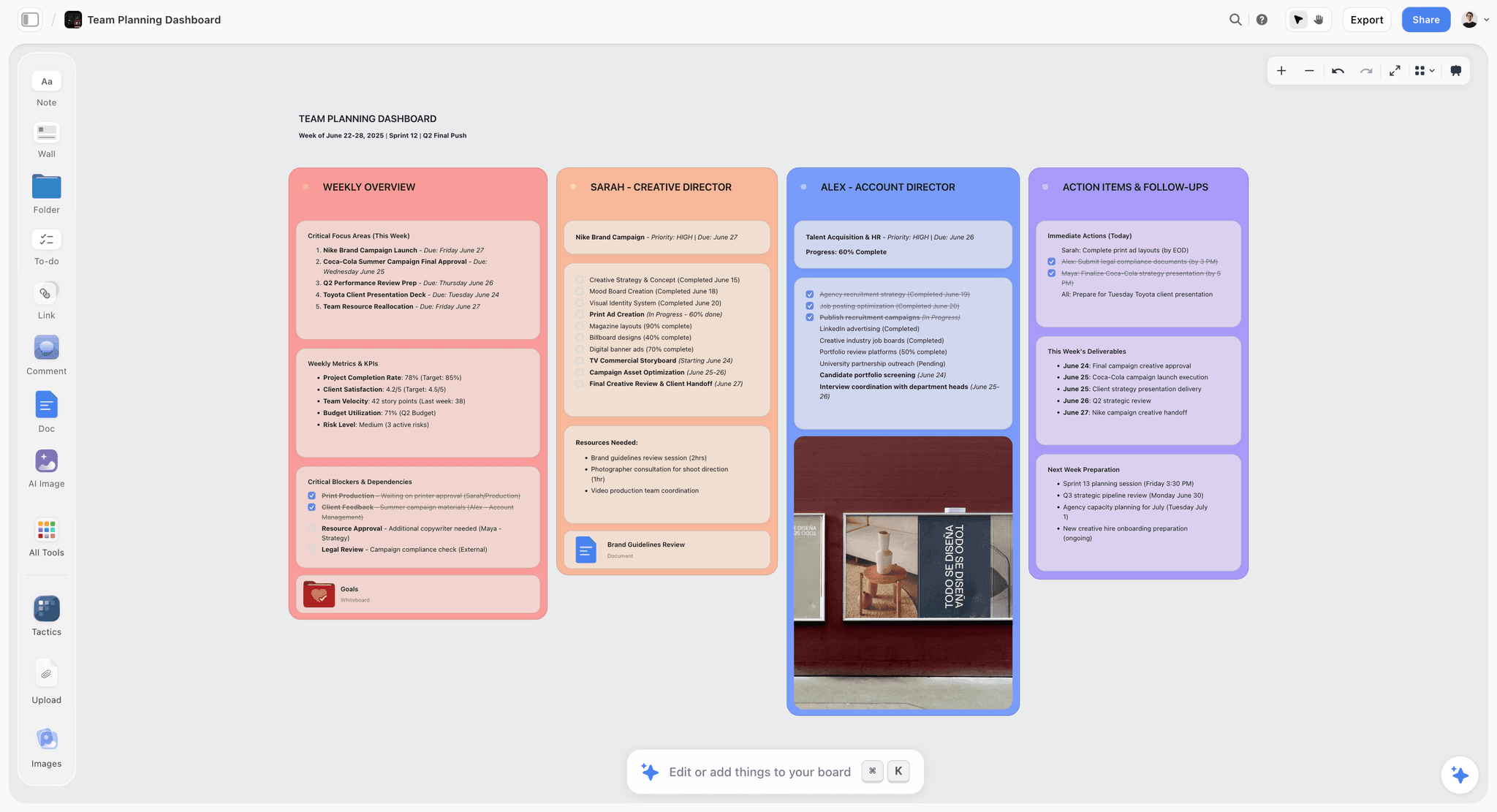
A board where the reasoning sits next to the layout, so it is still readable three weeks later
All four go stale in three weeks
A whiteboard has no owners and nothing that nags, so it is a photograph of a conversation. Give the board one named owner, write the reasoning on it rather than only the nouns, and move the decisions into a tracker within a day.

How We Evaluated These Tools
Four criteria:
- Price at a realistic team size, because the spread here is three-fold and the capability spread is not.
- Facilitation depth, tested by running the same divergent-thinking session in each and comparing the number of distinct ideas produced.
- Time to a clean twelve-node diagram, from blank.
- Whether the board still described reality three weeks later, which none of them passed.
Tool Reviews
1. FigJam
The value winner and the right default for most teams. At $3 per editor it is roughly a third of Miro's price for most of the same job: infinite canvas, stickies, sections, decent templates, excellent multiplayer. If your team already pays for Figma, it is effectively free and the comparison is over.
What you give up is facilitation depth, specifically private mode, and some template breadth. For a team running a workshop a month rather than weekly, that is a fair trade.
Pricing: Free for up to 3 files; Collab $3 per editor per month billed annually.
Pros: the price; excellent multiplayer; native Figma integration; genuinely capable canvas.
Cons: no private mode; lighter voting and timers; three-file free tier.
2. Miro
The most capable of the four and the right choice if facilitation is a real job on your team. Private mode is the standout and it changes what a divergent session produces. The template library is the deepest here and partly substitutes for facilitation experience.
The price is nearly three times FigJam's, boards sprawl, and the three-board free tier bites immediately.
Pricing: Free for 3 boards; Starter $8 per member per month billed annually; Business $16.
Pros: the best facilitation set; deepest templates; strong ecosystem and integrations.
Cons: roughly 3x FigJam's price; boards sprawl and go stale; tight free tier.
3. Mural
Better than Miro above about ten participants, where its structure and facilitator controls hold up and Miro's start to feel loose. Its templates are fewer and better structured, often with a method attached rather than just a layout.
Below ten people it is more apparatus than the work needs, its diagramming is the weakest of the four, and it is the most expensive at entry.
Pricing: Free for 3 murals; Starter $9.99 per member per month billed annually; Plus $17.99.
Pros: the best facilitation at size; method-led templates; strong enterprise story.
Cons: heavier than small teams need; weakest diagramming; highest entry price.
4. Whimsical
A different category that gets compared here anyway, and it wins its own one. A clean twelve-node flowchart takes two or three minutes because connectors snap and boxes align, where an infinite canvas gives you freedom you did not want. For user flows, wireframes and structure diagrams it is the fastest thing here.
It is not a workshop tool: no private mode, no timers, weak with images, and it constrains exactly where a sprawling exploratory board wants to sprawl.
Pricing: Free for 3 boards; Pro $10 per editor per month.
Pros: two to three times faster for clean diagrams; opinionated in a useful way; tidy output.
Cons: not a facilitation tool; weak with image-heavy boards; three-board free tier.
5. Storyflow

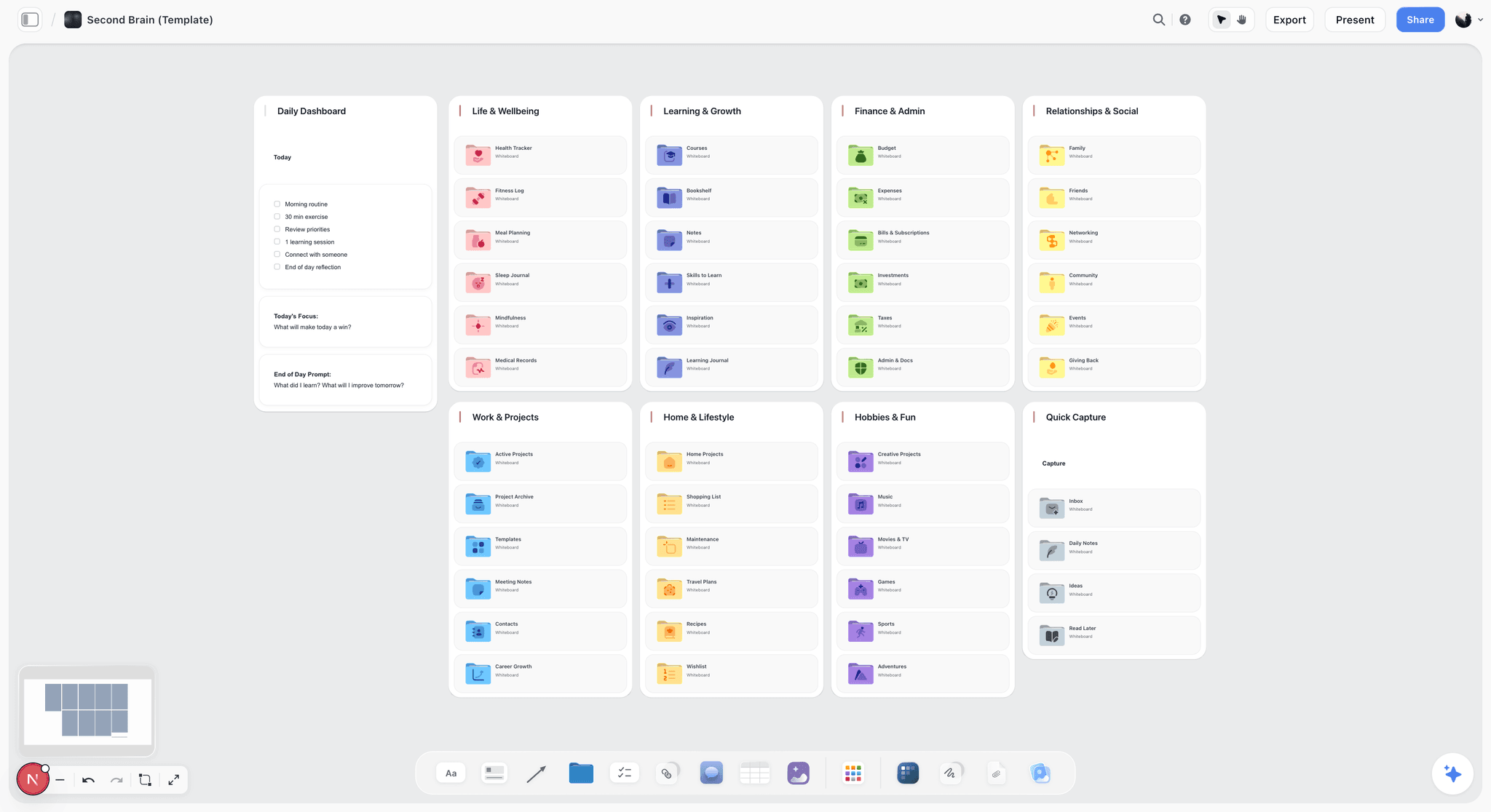
Storyflow is our product and it is not one of the four, because it is not a whiteboard in this sense: it has no private mode, no voting, no timers and no facilitation features at all, so for the live-session job that this comparison is mostly about, Miro or Mural is the right purchase and FigJam is the right budget one.
It appears here for the failure all four share. Storyflow's case is the board that has to stay current after the workshop, because the reasoning sits next to the layout and the AI reads the whole canvas before answering, so a board can be interrogated rather than just remembered. That is one narrow claim against a category limit, not an argument that it replaces a whiteboard.
Storyflow is paid-only during early access; its Free plan launches before the end of 2026, and anyone a paid member invites to a board joins free now.
Pricing: Plus $7.99 per month billed annually ($9.99 monthly); Pro $14; Max $39.
Pros: flat per-account pricing rather than per editor; the reasoning stays attached to the board; whole-board AI context.
Cons: no facilitation features whatsoever; no free tier until late 2026; wrong tool for a live workshop.
The Bottom Line
Start with price, because the three-fold gap is not matched by a three-fold capability gap. FigJam unless facilitation is somebody's actual job, Miro if it is, Mural if sessions run above ten people, Whimsical if your boards are really diagrams. Then accept that all four go stale three weeks after the workshop, and fix that with a named owner and a habit rather than by buying the more expensive one.
FAQ: FigJam vs Miro vs Mural vs Whimsical
Which is better, FigJam or Miro?
FigJam for most teams, because it costs $3 per editor against Miro's $8 and does most of the same job. Miro if facilitation is genuinely part of someone's role, since private mode, real voting and attention control change what a session produces and FigJam has none of them properly. If your team already pays for Figma, FigJam is effectively free and there is little reason to look further.
What is private mode and does it matter?
Participants add ideas without seeing each other's contributions until they are revealed, which stops the first person to speak anchoring everyone else. On a divergent session it measurably increases the number of distinct ideas produced. Miro and Mural have it, FigJam and Whimsical do not, and it is the single facilitation feature most worth paying for if you run sessions regularly.
Is Mural better than Miro?
Above about ten participants, yes: its structure and facilitator controls hold up where Miro's begin to feel loose, and its templates are fewer but better structured with a method attached. Below ten people Mural is more apparatus than the session needs, its diagramming is the weakest of the four, and it is the most expensive at entry.
Is Whimsical a whiteboard?
Not really, and it is better for it. Whimsical constrains layout so a twelve-node flowchart takes two or three minutes instead of ten, which is the opposite of what an infinite canvas offers. If your boards are mostly flows, wireframes and structure diagrams, it beats all three whiteboards. If they are sprawling, image-heavy or facilitated, it is the wrong tool.
Which is cheapest?
FigJam at $3 per editor per month billed annually, which is roughly a third of Miro and Mural. For a team of eight that is $288 a year against $768 on Miro Starter and $959 on Mural Starter. All four free tiers cap at three boards or files, which is deliberately not enough for sustained use.
Which has the best templates?
Miro, by a distance, and it matters more than a template count suggests: for a team without a facilitator, a template that arrives with instructions partly substitutes for the skill. Mural has fewer and better-structured ones with methods attached. FigJam's are decent and weighted toward design and product. Whimsical has few and needs few.
Do any of them keep a board current after the workshop?
No, and this is a category limit rather than a feature gap. A whiteboard has no owners, no due dates and nothing that nags, so it is a photograph of a conversation and conversations move. Three fixes work in all four: give the board one named owner, write the reasoning on it rather than only the nouns, and move decisions into a tracker within a day of the session.
Is Storyflow an alternative to these?
Not for the live-session job. Storyflow has no private mode, no voting and no timers, so for facilitated workshops Miro or Mural is the right purchase and FigJam the right budget one. Its narrower claim is the board that has to stay current afterwards, since the reasoning sits next to the layout and its AI reads the whole canvas before answering.
Is Storyflow free?
Not during early access. It is paid-only today from $7.99 per month billed annually on Plus, and its Free plan launches before the end of 2026. Anyone a paid member invites to a board signs up free and can invite others. It prices flat per account rather than per editor, which is the opposite model to all four tools compared here.
Which should a design team choose?
FigJam, almost always, because the Figma integration is native and the cost is negligible next to the Figma seats already being paid for. The exception is a design team that runs facilitated research or workshop sessions as a core activity, where Miro's private mode and template depth earn the difference.
Which handles large workshops best?
Mural above roughly ten participants, then Miro. Both give a facilitator real attention control, the ability to bring everyone to a point on the board and structured breakouts. FigJam degrades at that size because it has no facilitator controls to speak of, and Whimsical is not built for group sessions at all.
Can I use two of them?
Commonly, and it is a reasonable outcome. Whimsical for diagrams plus FigJam or Miro for workshops is a frequent split, because the diagramming and facilitation jobs are genuinely different and no tool leads both. What is rarely worth it is running Miro and Mural together, since they overlap almost completely.
Table of Contents
- Article Metadata
- Breadcrumb
- Table of Contents
- Key Takeaways
- The Short Answer by Team
- Price, Which Decides More Than People Admit
- Facilitation
- Diagramming
- Templates and Getting Started
- The Failure All Four Share
- The Free Tier Trap
- Comparison Table
- How We Evaluated These Tools
- Tool Reviews
- 1. FigJam
- 2. Miro
- 3. Mural
- 4. Whimsical
- 5. Storyflow
- The Bottom Line
- Author
- FAQ: FigJam vs Miro vs Mural vs Whimsical
- Related Reading
Templates to check out for this topic


Planning and project templates you can use in Storyflow
Plan a launch, a sprint, or a whole project on a visual board the team can see at once. Open one of these templates and start from real structure.


See Storyflow in Action
A visual AI workspace where every feature lives inside one canvas. No tab-switching, no context lost.
Build your entire board from a single message
Type what you need in the AI chat at the bottom of your canvas. The AI adds cards, headings, and structure directly onto your board.
Use expert frameworks as AI context
Type @ in the AI chat and choose any Tactic. The AI tailors every response to that framework instead of giving generic advice.
Turn your board into a mind map in seconds
Ask the AI to restructure your canvas as a mindmap. It connects your ideas into a visual hierarchy so you can see how everything relates.
Why Storyflow Exists
Storyflow actually began as a personal tool while working on creative and research projects.
We kept running into the same problem: ideas were scattered everywhere: notes, documents, and whiteboards.
Nothing helped us see how everything connected.
So we started building a workspace designed around how ideas actually grow.
→ Read how Storyflow was createdJustkay
Documentary Filmmaker & Founder at Storyflow
Published: 2026-09-02
Extremely simple, seriously capable


See how easy it is to get started
Watch a real project come together, from a blank board to a finished plan, clicked through step by step.
Start creating with AI and become more productive
Transform your creative workflow with AI-powered tools. Generate ideas, create content, and boost your productivity in minutes instead of hours.