The 11 Best Tools for Influencer Brand Collaborations in 2026
Creators lose money on collaborations they delivered perfectly, because the deal was never only about the post. Eleven tools ranked by which of the three contracts each one protects.

Category
Content Creation
Author

Sara de Klein
Head of Product at Storyflow
Topics
2026-08-10
•
18 min read
•
Content Creation- best tools for influencer brand collaborations
- creator brand deal tracker
- influencer usage rights and exclusivity
- best AI tools for content creators
- brand collaboration pitch tool
- influencer campaign reporting tool
What are the best tools for influencer brand collaborations in 2026?
The best tool for the creative half of a brand collaboration is Storyflow, because the thing that wins a partnership and then survives the brand's revision round is a concept the brand can see, and Storyflow is the only tool here that holds the pitch, the references and the deliverables on one surface. Notion wins the deal database outright, and this post does not pretend otherwise. HoneyBook and Bonsai win contracts and invoicing. Later and Metricool win the reporting a brand asks for afterwards. This ranking covers pitching and producing a collaboration, names the boundary of every tool, and is explicit that the money problem in this business is not a creative one.

Full disclosure: Two tools here are ours. Storyflow is our visual workspace, ranked first for the pitch and the concept only, and it tracks no usage rights, sends no contracts and produces no reporting. Framekit is our all-in-one toolkit for freelancers, ranked sixth and below Canva on purpose: Canva will get a good-looking media kit out of you in an afternoon and Framekit will not. Framekit earns its slot for the kit that stays current at one URL, and it holds no contract and reports nothing, which is two of the three contracts this article is built around. HoneyBook, Bonsai, Metricool and Later own the ground neither of ours touches.
Key Takeaways
- Creators lose money on collaborations they delivered perfectly, because the deal was never only about the post.
- Three contracts sit inside every partnership: the deliverables, the usage rights and the exclusivity. Creators track the first, get surprised by the second and get quietly damaged by the third.
- Storyflow ranks first for the pitch and concept stage, which is the half that decides whether you get the deal and how many revision rounds follow.
- Notion is the correct tool for the deal database and this post ranks it second for that reason. A usage window that expires is a date, and dates belong in a database.
- Storyflow sends no contracts, issues no invoices, tracks no rights windows and produces no performance reports. Four different tools here do those.
- A media kit built from screenshots of your best month is the single most common self-inflicted wound in this category.
Show the concept, do not describe it
Most brand revision rounds come from two people agreeing to a sentence and picturing different videos. Storyflow puts three reference frames and the hook for each deliverable on one shareable board, so the picture is agreed before production. Paid-only during early access; the Free plan lands before the end of 2026.

The Three Contracts
The public version of influencer work is about audience size. The working version is about paperwork, and the paperwork has three layers that behave differently.
Creators lose money on collaborations they delivered perfectly, because the deal was never only about the post.
The deliverables contract is what you agreed to make. Two Reels, one carousel, three Stories with a link. This is the layer every creator tracks, because it is concrete, it has a deadline, and failing it is obvious. It is also the least likely of the three to cause a problem.
The usage rights contract is what the brand may do with the work, and for how long. Organic use on their own channels is one thing. Paid amplification, where they run your face as an advertisement against a cold audience, is a different thing with a different price. Whitelisting, where they run ads from your handle, is a third. Each has a duration, and the duration is the part creators forget, because it expires silently months after the invoice was paid. A brand still running your content eighteen months later under a six month licence is not a rare event, and it is only ever discovered by accident.
The exclusivity contract is what you may not do, and for how long. Usually a category restriction: no competing skincare brands for ninety days. This is the layer that does real financial damage, because its cost is invisible. You never see the deal you could not take. Creators routinely sign six month category exclusivity for a fee that assumed one month of work.
The pattern is consistent. The deliverables get a project management system. The rights and the exclusivity get an email attachment nobody opens again. That asymmetry is why this category has a tooling problem that is not really about content.
A useful diagnostic: name the expiry date of the usage licence on your last three paid collaborations. Most creators cannot name one.
A worked example of the invisible loss
A creator signs a partnership with a mid-size skincare brand. Two Reels and three Stories, delivered on time, everyone pleased. The deal reads as a clean success and gets counted as one.
The deliverables were the smallest part of it. The usage clause granted paid amplification for twelve months, so the brand ran the better Reel as an advertisement across the whole of that year, against audiences that were never yours. A licence for advertising use is worth a multiple of the organic fee, and the fee here was quoted for a post. That gap is not a mistake anyone made, it is a term nobody priced.
The exclusivity clause ran six months across the category. Four months in, a larger brand in the same category approached with a longer retainer, and the answer had to be no. The creator never framed that as a cost of the first deal, because it did not arrive as a bill. It arrived as an email that was politely declined.
Add the two together and the partnership that read as a success was the most expensive month of the year. Nothing in it was a delivery failure, and no project management tool would have flagged any of it, because both losses live in dates rather than in tasks.
At a Glance: The 11 Tools Compared
| Tool | Best for | Contract it serves | Shape |
|---|---|---|---|
Storyflow | The pitch, concept and deliverables in one view | Deliverables | Visual canvas with AI |
Notion | Deal database with rights and exclusivity dates | Usage, exclusivity | Docs and databases |
HoneyBook | Proposals, contracts and payment | All three | Client management |
Bonsai | Freelance contracts built for creative work | Usage, exclusivity | Contracts and invoicing |
Canva | The media kit and the pitch deck | None | Design |
Framekit | The media kit and pitch page as a living link | Deliverables | All-in-one creative toolkit |
Later | Scheduling plus the report the brand wants | Deliverables | Scheduler |
Metricool | Reporting that survives a brand's scrutiny | Deliverables | Scheduler and analytics |
Frame.io | The revision round on video deliverables | Deliverables | Review and approval |
Google Sheets | The shared tracker a manager can open | Deliverables | Spreadsheet |
Dropbox | Delivering the files and the raw assets | Deliverables | File storage |
How I Ranked These
Five criteria, in order.
1. Does it prevent an invisible loss? The losses in this business are silent: an expired licence still being used, an exclusivity clause blocking a better deal. Tools that surface those rank above tools that organise work you would have done anyway.
2. Does it help you win the deal? A pitch that shows the brand what the content will feel like converts better than one describing it. This is a real commercial advantage and most creators skip it.
3. Does it reduce revision rounds? The brand's feedback is usually a proxy for something never agreed in the first place. Alignment before production is worth more than any review tool afterwards.
4. Can a brand-side marketer use it without an account? Your contact is managing eleven creators and will not sign up for anything. If they cannot open it in a browser, it did not happen.
5. What does it honestly not do? Every tool here stops somewhere, and in this category the gaps are expensive rather than inconvenient.
Competitor pricing is described by shape rather than exact figures, because these tools change tiers often. Storyflow's numbers are stated exactly because they can be verified.
1. Storyflow
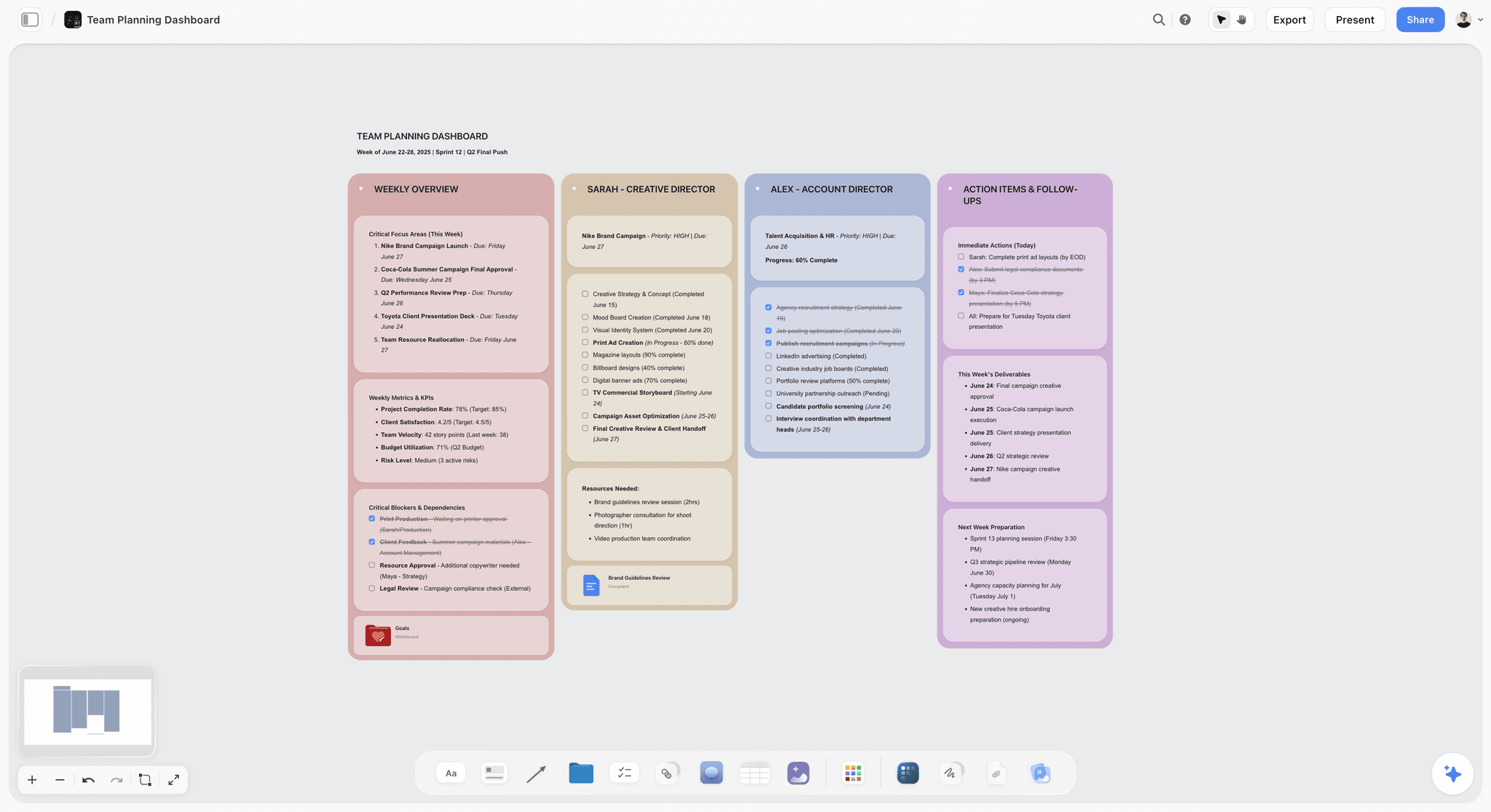
Best for: the pitch and the concept, which decide both whether you win and how badly the revisions go.
Storyflow is an AI visual workspace on an infinite canvas. For a collaboration, the arrangement that earns its place is one board per partnership: the concept, the reference images showing the intended look, the deliverables laid out as they will actually appear, and the brand's own campaign materials sitting beside them for comparison.
It ranks first on criteria two and three. Most creators pitch in an email or a deck describing content that does not exist yet, and a brand marketer reading a description is guessing. A board showing three reference frames and the hook for each Reel converts better, because the brand can see the thing rather than imagine it.
The revision reduction is the same mechanism arriving later. The overwhelming majority of brand feedback on creator content is not about the content, it is about a mismatch between what the brand pictured and what you made. Both parties agreed to a sentence and pictured different videos. Getting the picture agreed before production removes the round entirely.
The AI reads across the whole board rather than one card at a time, so with the brand's guidelines and your existing formats on the canvas it can draft concepts shaped by both. Storyflow's Tactics library adds 200+ expert creative frameworks, including campaign structures that translate into a pitch.
A board shares as a read-only link, which matters more here than anywhere else on this list, because your contact will not create an account for you.
Pricing: Plus is $7.99 per month billed annually, or $9.99 monthly, and adds the 200+ Tactics library and unlimited uploads. Pro is $14 per month billed annually and adds AI image generation plus 20x more AI. Storyflow is paid-only during early access. The Free plan lands before the end of 2026, and anyone a paid member invites to a board joins free now, which covers a brand contact or a manager.
Where Storyflow loses, plainly:
- It tracks no dates and will not warn you. No rights window, no exclusivity expiry, no reminder. This is the single most valuable function in this category and Storyflow does not perform it. Notion does.
- No contracts or invoicing. It sends nothing, signs nothing and collects no payment. HoneyBook and Bonsai own that.
- No analytics or reporting. The performance report a brand asks for at the end comes from Metricool, Later or the native platform.
- No file delivery. Raw assets and finals go through Dropbox or a transfer service.
Try this: on your next pitch, replace the paragraph describing the concept with three reference frames and the hook for each deliverable. The response rate difference is the clearest single change available in this work.
2. Notion
Best for: the deal database, which is where the money is actually lost.
This is the tool that prevents the invisible losses, and it earns second place on the first criterion outright.
The build is simple and almost nobody does it. One database, one row per collaboration, with fields for the fee, the deliverables, the usage type, the usage start and end dates, the exclusivity category and the exclusivity end date. Add a filtered view of everything expiring in the next sixty days. That view is worth more than every other feature on this page combined, because it turns an invisible loss into a visible one.
It also answers the question that arrives when a competing brand approaches you, which is whether you are currently free to take it. Most creators answer that from memory and are sometimes wrong.
Pricing shape: free personal tier, then per-seat monthly plans. The personal tier covers this comfortably.
Where it loses: the creative half. It turns a visual concept into a page of text, which is the wrong shape for a pitch and the reason it ranks below Storyflow for the stage that wins deals. Its canvas arrived late and it shows.
3. HoneyBook
Best for: proposal to contract to payment, in one flow.
For creators doing enough partnerships that the paperwork is a real time cost, HoneyBook collapses proposal, contract, signature and invoice into a single sequence. Payment reminders happen without you being the person chasing.
The professionalism signal is real too. A creator who sends a proper contract and a proper invoice is treated differently by brand procurement than one sending a PayPal link.
Pricing shape: tiered monthly subscription with an annual discount, priced per business.
Where it loses: it is not creator-specific. Usage rights and exclusivity are the defining terms in this business and HoneyBook has no native concept of either, so they live in the contract body as text.
4. Bonsai
Best for: contracts written for creative freelance work.
Bonsai's templates and clause library are closer to the shape of creative work than a generic contract tool, and its combination of contracts, invoicing and light time tracking suits solo operators.
Pricing shape: tiered monthly plans by feature set.
Where it loses: same gap as HoneyBook on the two contracts that matter most. A clause is not a tracked date, and a tracked date is what saves you.
5. Canva
Best for: the media kit, and the trap inside it.
Every creator needs a media kit and Canva is the fastest way to make one that looks credible.
The trap is worth naming because it is the most common self-inflicted wound in this category. A media kit built from screenshots of your best month sets an expectation your average month cannot meet, and the brand measures the campaign against the kit. Creators who show honest averages get fewer deals and better relationships, and the second one is what pays over a career.
Pricing shape: free tier, then per-person paid plans.
Where it loses: a deck is a snapshot. It is stale the moment your numbers move, and the version circulating in a brand's inbox is the version quoted back at you six months later.
6. Framekit
Best for: the media kit and the pitch page as a living link rather than an attachment.
Framekit is an all-in-one creative toolkit for freelancers, and on this list it answers a specific complaint every creator has about media kits: a PDF is out of date the day after you send it, and a brand's marketing manager forwards it to three people who each open a different version.
A media kit built as a Framekit page is a URL on your own domain. When last quarter's numbers change, you change the page and every link anyone holds is now correct. A per-brand pitch page is the same mechanism aimed at one pursuit: the concept, the references, the deliverables, and the numbers that matter to that brand, at a link you can send in a DM. The account also carries client galleries and timecoded video review, which is the delivery half of the deliverables contract, and a store if you sell presets or templates alongside partnerships.
The reason it sits below Canva rather than above it is honest: Canva's template library will get a good-looking kit out of you in an afternoon with no taste required, and Framekit will not. What Framekit gives instead is a kit that stays true and a place for the work to land.
Pricing: Free covers 10 pages, unlimited client galleries with 3GB of photo storage, and video review with 2GB of video storage. Starter is $9 per month, or $7 billed annually, and adds a custom domain, custom fonts, and branding removal. Pro is $19 per month, or $15 annually. Business is $39 per month, or $31 annually, with zero transaction fees on the store. Flat per account.
Where Framekit loses, plainly:
- It holds no contract. Nothing here tracks usage rights or exclusivity dates, which are two of the three contracts this article is built around. HoneyBook, Bonsai, and a Notion database own that ground.
- It reports nothing. No analytics, no post-campaign numbers. Metricool and Later own the report a brand actually asks for.
- The kit is only as honest as you are. A living page makes it easier to keep averages current, and just as easy to keep a peak month up permanently.
- Design depth is thinner than Canva's. Templates and AI generation get you a clean page, not an art-directed one.
Try this: rebuild your media kit as a page instead of a PDF, then send the link the next three times you are asked for a kit. The first time you update a number without re-exporting anything is the moment the format justifies itself.
7. Metricool
Best for: the report a brand will actually accept.
The end of a collaboration involves proving what happened. Metricool's reporting is presentable, exportable and covers the metrics brands ask for, including the ones creators underweight such as saves and shares.
Pricing shape: free tier with limits, then tiered monthly plans by connected accounts.
Where it loses: it starts once content exists. No pitching, no deal tracking, no contracts.
8. Later
Best for: scheduling the deliverables, particularly across a multi-post campaign.
When a partnership runs across six posts over three weeks, having them queued removes the daily risk of missing a contractual deadline. Later's grid preview also lets you check that three sponsored posts are not landing next to each other on the profile, which brands notice and audiences notice more.
Pricing shape: tiered monthly plans by social set and user count.
Where it loses: posting only. Nothing upstream.
9. Frame.io
Best for: the revision round on video deliverables.
If the brand has notes on a video, having them land as timestamped comments on the asset rather than as a paragraph of prose saves a round. It also creates a record of what was approved, which occasionally matters.
Pricing shape: free tier with limits, then per-seat plans, and included with some Adobe subscriptions.
Where it loses: it assumes the video exists and the deal is done. It is the narrowest tool here and good within its range.
10. Google Sheets
Best for: the tracker a manager or agency will open without asking questions.
If you work with a manager, a shared sheet remains the lowest-friction shared surface. For deliverables and deadlines across several live partnerships it is entirely adequate.
Pricing shape: free with a Google account.
Where it loses: no reminders, so the expiry dates sit in a column nobody looks at. A date that does not notify you is a date you will miss.
11. Dropbox
Best for: delivering finals and, when the deal includes them, raws.
Large files, expiring links, folder structure. Unremarkable and necessary.
Pricing shape: tiered storage subscriptions.
Where it loses: it is storage. Using a shared folder as an approval surface is how a clean deliverable turns into nine days of comments.
Tools to Avoid for This Job
Creator marketplaces as your only source of work. They are useful for a first partnership and structurally bad as a business model, because they compete on price by design and the brand relationship belongs to the platform rather than to you. The deals worth having come from direct contact and repeat work.
Any tool that automates outreach to brands. Mass-personalised pitches to marketing inboxes perform exactly as well as they deserve to, and the reputational cost is paid in the small world of a niche.
A follower-count analytics tool as the centre of your reporting. Brands stopped buying reach some time ago. A report leading with follower growth reads as a creator who has not noticed.
What No Tool on This List Does
No tool tells you the brand's marketing lead is about to leave and take your relationship with them. No tool tells you the exclusivity clause you just signed covers a category broad enough to block half your inbound. No tool notices that you have taken four partnerships in a row and your audience has started to disengage.
Software only makes the terms visible. Choose the combination that makes the invisible losses visible, then read what you signed.
The Bottom Line
Influencer collaboration is described as a creative business and operated as a licensing one. Creators lose money on collaborations they delivered perfectly, because the deal was never only about the post.
Run two systems. A deal database with the usage window and the exclusivity expiry in it, and a view of what is expiring soon, which is Notion's job and the highest-return hour in this list. And a visual surface for the pitch and the concept, where the brand can see the content before it exists, because that is what wins the partnership and removes the revision round that follows. That second job is the one Storyflow does better than anything else here, and it is the only claim this post makes for it.
FAQ: Tools for Influencer Brand Collaborations
What is the best tool for managing brand collaborations?
Two, doing different jobs. Storyflow for the pitch and concept, which is what wins the deal and reduces revision rounds. Notion for the deal database holding the usage window and the exclusivity expiry, which is where the money is quietly lost. Storyflow does not track dates and Notion is the wrong shape for a visual pitch.
What are usage rights and why do they matter so much?
Usage rights define what the brand may do with your content and for how long. Organic use on their own channels is the cheapest. Paid amplification, running your content as advertising, is worth substantially more. Whitelisting, running ads from your handle, more again. Each has a duration, and content still running after the licence expired is common and almost always discovered by accident.
How long should exclusivity last?
Shorter than what is first offered, and priced separately from the content. The cost of exclusivity is the deals you cannot take, which is invisible and often larger than the fee. If a brand wants ninety days of category exclusivity, that is a line item, not a courtesy.
Do I need a contract for a small collaboration?
Yes, and gifted collaborations are where this bites hardest, because creators skip paperwork when no money changes hands and then find the content running as a paid advertisement. A short written agreement covering deliverables, usage and duration takes ten minutes.
What should be in a media kit?
Honest averages, the audience demographics a brand actually buys, and examples of previous work with real results. Not your best month. A kit built from peak screenshots sets an expectation your average cannot meet, and the campaign gets measured against the kit. Format matters more than creators expect. A PDF is stale the moment a number moves, and a brand forwards it to people who each end up holding a different version. A media kit built as a page (Framekit, or any site builder you already pay for) is one URL that stays correct, and it lets you keep a per-brand version without re-exporting anything.
What is Framekit and where does it fit in a brand deal?
Framekit is an all-in-one creative toolkit for freelancers: an AI website builder, client galleries, timecoded video review, and a store for digital products on one flat per-account bill. In a collaboration it covers the pitch and the delivery: the media kit and per-brand pitch page as links on your own domain, and the gallery or review link the finished assets land in. It holds no contract, tracks no usage rights or exclusivity dates, and produces no reporting, so it sits alongside HoneyBook or Bonsai and a scheduler rather than replacing either.
How do I reduce revision rounds with brands?
Get the picture agreed before production rather than the sentence. Most brand feedback is a mismatch between what they imagined and what you made, from a description both parties read differently. Three reference frames and a hook per deliverable, approved in advance, removes most of it.
Does Storyflow track my deal deadlines?
No. It has no dates, no reminders, no rights windows and no exclusivity tracking. That is the most valuable function in this category and it belongs in Notion or a spreadsheet with notifications. Storyflow covers the creative half only.
Should I use a creator marketplace?
For a first partnership, possibly. As a business model, no. Marketplaces compete on price structurally and the brand relationship belongs to the platform. Direct relationships and repeat work are where the rates are.
How do I report results to a brand?
Lead with saves, shares and comments rather than reach, and include the qualitative signal, meaning what people said. Metricool or Later export something presentable. Brands buying purely on reach are the ones paying the least anyway.
What is the biggest mistake creators make?
Signing the deliverables and skimming everything else. The deliverables are the part that is obvious and the part least likely to hurt you. The damage is in a usage window that outlives the fee and an exclusivity clause that quietly closes a category.
Can I run all of this on free tiers?
Mostly, and the free tier that matters is Notion's, which covers the deal database comfortably. Spend money where it saves time on paperwork you are currently doing by hand, not on analytics you will read once.
What is the single change worth making this quarter?
Build the sixty-day expiry view. One database, one filter, five minutes of setup. It is the only thing on this page that finds money you have already earned.
Table of Contents
- Key Takeaways
- The Three Contracts
- At a Glance: The 11 Tools Compared
- How I Ranked These
- 1. Storyflow
- 2. Notion
- 3. HoneyBook
- 4. Bonsai
- 5. Canva
- 6. Framekit
- 7. Metricool
- 8. Later
- 9. Frame.io
- 10. Google Sheets
- 11. Dropbox
- Tools to Avoid for This Job
- What No Tool on This List Does
- The Bottom Line
- FAQ: Tools for Influencer Brand Collaborations
- Related Reading
Templates to check out for this topic


Planning and project templates you can use in Storyflow
Plan a launch, a sprint, or a whole project on a visual board the team can see at once. Open one of these templates and start from real structure.


See Storyflow in Action
A visual AI workspace where every feature lives inside one canvas. No tab-switching, no context lost.
Build your entire board from a single message
Type what you need in the AI chat at the bottom of your canvas. The AI adds cards, headings, and structure directly onto your board.
Use expert frameworks as AI context
Type @ in the AI chat and choose any Tactic. The AI tailors every response to that framework instead of giving generic advice.
Turn your board into a mind map in seconds
Ask the AI to restructure your canvas as a mindmap. It connects your ideas into a visual hierarchy so you can see how everything relates.
Why Storyflow Exists
Storyflow actually began as a personal tool while working on creative and research projects.
We kept running into the same problem: ideas were scattered everywhere: notes, documents, and whiteboards.
Nothing helped us see how everything connected.
So we started building a workspace designed around how ideas actually grow.
→ Read how Storyflow was createdSara de Klein
Head of Product at Storyflow
Published: 2026-08-10
Extremely simple, seriously capable


See how easy it is to get started
Watch a real project come together, from a blank board to a finished plan, clicked through step by step.
Start creating with AI and become more productive
Transform your creative workflow with AI-powered tools. Generate ideas, create content, and boost your productivity in minutes instead of hours.