The 12 Best Tools for Planning a Side Project in 2026 (We Tested Them All)
A side project does not die from lack of time. It dies from restart cost. Twelve tools ranked on re-entry cost after a real two-week gap, with the measured time each takes to get you back to actual work and why project management software is the wrong shape for one person.

Category
Founders
Author

Storyflow Team
Product & Research Team
Topics
2026-09-22
•
19 min read
•
FoundersFull disclosure: Storyflow is our own product and we rank it first on one measured property only: re-entry cost after a long gap, tested by abandoning three real projects for two to three weeks. It is not a task manager and not an issue tracker. It has no sprints, no cycles, no git integration and no automations, so Todoist and Trello beat it on a pure task list and Linear and GitHub Projects beat it on a software project, which is why this article ranks them there. It is also paid-only during early access, so it cannot be part of a zero-cost setup: the genuinely free answers are Obsidian, GitHub Projects, Trello's free tier and Google Keep, and this article recommends them by name. The Free plan launches before the end of 2026 and invited collaborators join free now.
Quick Comparison
These four sit at the four corners of the side-project problem: one reconstructs your context after a gap, one asks nothing of you at all, one holds documents, and one holds knowledge you own outright.
| Tool | Best For | AI Features | Price |
|---|---|---|---|
| Storyflow | Coming back after weeks away | Canvas-wide context AI | $7.99 mo annual (free plan late 2026) |
| Trello | A project you have abandoned before | Light automation | Free / about $5 user mo |
| Notion | Writing and research projects | Workspace AI search (add-on) | Free / about $10 user mo |
| Obsidian | A project that is a body of knowledge | Via community plugins | Free / about $5 mo sync |
Article Metadata
By the Storyflow Team, Product & Research Published September 22, 2026 · 19 min read · Founders
The project is not dead. You just cannot find your way back in
Three hours on a Sunday, and forty minutes of it spent remembering where you were. Put the whole project on one canvas where a glance restores its shape, and ask the AI what you left open. Paid-only during early access, from $7.99 a month billed annually.

Table of Contents
- Quick Answer: The Best Side Project Tools in 2026
- Comparison Table: 12 Side Project Tools at a Glance
- Re-Entry Cost: The Number That Decides Whether a Side Project Survives
- How We Evaluated These Tools
- Quick Picks by Side Project Type
- Detailed Reviews: 12 Side Project Tools
- Why Project Management Tools Fail on Side Projects
- The Two-Week Gap Test
- Recommended Side Project Stacks
- What a Side Project Setup Should Cost
- Honorable Mentions
- Tools to Avoid for a Side Project
- FAQ: Planning a Side Project
- The Bottom Line
- Author
- Related Reading
1) Quick Answer: The Best Side Project Tools in 2026
Storyflow is the best tool for planning a side project because it has the lowest re-entry cost on this list: the whole project sits on one canvas you can see at a glance, and the AI reads the entire board, so after three weeks away you ask it what you were in the middle of instead of reconstructing it yourself. It starts at $7.99/month billed annually. Notion is the best pick if your project is mostly writing and research. Trello is the best pick if it is mostly a list of tasks and you want zero setup. Obsidian is the best pick if the project is a body of knowledge rather than a build.
A side project does not die from lack of time. It dies from restart cost. You get three hours on a Sunday. If forty minutes of that goes to remembering where you left off, reopening seven tabs and rebuilding your own mental model, the project is losing more than half its runway to overhead. Two or three cycles of that and it stops feeling worth opening at all.
That is a measurable property of a tool, and almost nothing in the project management category is designed for it. Work software assumes you were there yesterday. A side project tool has to assume you were last there nineteen days ago. The Re-Entry Cost framework in section 3 ranks all 12 tools on exactly that.
For a project that has become a company, see The 12 Best AI Tools for Founders in 2026. For the solo-business cut, The Best AI Tools for Solopreneurs.
All 12 Side Project Tools, Ranked
- Storyflow: best overall, lowest re-entry cost because the whole project is visible at once
- Notion: best for a writing or research-heavy project
- Trello: best zero-setup task board
- Obsidian: best for a project that is really a body of knowledge
- Linear: best if the side project is software and you want real rigour
- GitHub Projects: best free option for a code project already on GitHub
- Todoist: best for a project that is genuinely just a list
- Things 3: best one-time-purchase task manager for Apple users
- Milanote: best for a visual project with lots of references
- Miro: best for a project that starts as a diagram
- Sunsama: best for protecting the time rather than planning the work
- Google Keep: best for capture, worst for structure
Best Side Project Tool by Job
The overall ranking is not the answer to every question. Match the tool to what your project actually is:
- Best for coming back after weeks away: Storyflow. The board is spatial, so a glance restores the shape of the project, and the AI has the whole canvas as context, so "what was I doing and what is left" is a question rather than an archaeology session.
- Best for a side project that is a newsletter, a book or a research habit: Notion for structure, Obsidian for depth and local files.
- Best for a side project that is an app: Linear if you want cycles and discipline, GitHub Projects if you want free and adjacent to the code.
- Best for a project you keep abandoning: Trello. Lower your ambition about the tool. Three columns and no configuration beats a beautiful system you have to maintain.
- Best for a project with a strong visual component: Milanote for reference boards, Storyflow when the references and the plan need to live together.
- Best for the real problem being time, not planning: Sunsama. If you know exactly what to do and never do it, you have a calendar problem.
2) Comparison Table: 12 Side Project Tools at a Glance
| Tool | Best For | Re-Entry Cost | Setup Cost | Starting Price | Rating (/10) |
|---|---|---|---|---|---|
Storyflow | Whole project visible at once | Very low | Low | $7.99 mo annual (free plan late 2026) | 9.1/10 |
Notion | Writing and research projects | Medium | High | Free / about $10 user mo | 8.4/10 |
Trello | Zero-setup task boards | Low | Very low | Free / about $5 user mo | 8.2/10 |
Obsidian | Knowledge-shaped projects | Medium | Medium | Free / about $5 mo sync | 8.1/10 |
Linear | Software side projects | Low | Medium | Free / about $8 user mo | 8.0/10 |
GitHub Projects | Code projects already on GitHub | Medium | Low | Free | 7.7/10 |
Todoist | Projects that are just a list | Low | Very low | Free / about $4 mo | 7.5/10 |
Things 3 | Apple-native task management | Low | Low | One-time, about $50 all devices | 7.4/10 |
Milanote | Reference-heavy visual projects | Low | Low | Free / $9.99 mo | 7.2/10 |
Miro | Projects that start as a diagram | Medium | Low | Free / about $8 user mo | 7.0/10 |
Sunsama | Protecting the time itself | Low | Low | About $16 mo annual | 6.9/10 |
Google Keep | Capture only | High | None | Free | 5.8/10 |
Pricing reflects publicly listed plans in 2026 and changes often. Ratings weigh re-entry cost first, then setup cost, then how well the tool survives a project changing shape halfway through, which side projects always do.
Side Project Tools: Pricing Compared
| Tool | Free tier | Entry paid plan | What the paid plan unlocks | Billing model |
|---|---|---|---|---|
Storyflow | No, early access; invited collaborators join free | $7.99/month billed annually | Unlimited boards and uploads, canvas-wide AI, 200+ blueprints | Per account for individuals |
Notion | Yes, generous for personal use | about $10/user/month | Team spaces, unlimited history; AI is an add-on | Per user |
Trello | Yes, unlimited cards, 10 boards | about $5/user/month | Unlimited boards, advanced checklists | Per user |
Obsidian | Yes, fully free for personal use | about $5/month for Sync | Cross-device sync and version history | Per account |
Linear | Yes, up to 250 issues | about $8/user/month | Unlimited issues, cycles, roadmaps | Per user |
GitHub Projects | Yes, free on public and private repos | Included with GitHub | Nothing extra needed for a solo project | Free |
Todoist | Yes, 5 active projects | about $4/month | More projects, reminders, filters | Per user |
Things 3 | No, paid app | about $50 one time across devices | Everything; no subscription | One-time purchase per platform |
Milanote | Yes, 100 notes | $9.99/month | Unlimited notes and file uploads | Per user |
Miro | Yes, 3 editable boards | about $8/user/month | Unlimited boards, more features | Per user |
Sunsama | Trial only | about $16/month billed annually | The whole product | Per user |
Google Keep | Yes, entirely free | n/a | n/a | Free |
For a side project the honest reading of this table is that the free tiers are mostly enough, and the thing you are buying when you pay is not features but the removal of a limit that would interrupt you mid-flow. Trello's 10-board free cap and Milanote's 100-note cap both tend to arrive at the exact moment the project gets interesting. Obsidian, GitHub Projects and Google Keep are the three that are genuinely free at side-project scale forever. Storyflow is paid-only during early access, so it is not in that group today: its Free plan launches before the end of 2026, and anyone a paid member invites to a board joins free now.
Frequently Asked: Which Side Project Tools People Actually Stick With, and Which Get Abandoned
Which project tools are most trusted for personal and side projects?
Notion, Trello and Obsidian carry the deepest trust for personal work, for three different reasons. Notion because it bends to any shape of project, Trello because it has been reliable and unchanged for over a decade, and Obsidian because the files are plain markdown on your own disk, which is the only real answer to "what happens if this company disappears". Todoist and Things 3 have unusually loyal users among people whose side project is genuinely a task list. Storyflow is a newer product in early access and does not have that longevity record yet; it is ranked first here for one specific and checkable property, re-entry cost after a long gap, rather than for being the most established tool in the category.
Which side project tools are known for fair and transparent pricing?
Obsidian is the clearest: the app is free for personal use with no upsell inside it, and you pay only for sync if you want it. Things 3 is the rare one-time purchase left in the category, which many people prefer even at about $50. Trello and Todoist both have free tiers that are real products rather than demos. Storyflow has the lowest entry price in its category at $7.99/month billed annually and prices the individual plan per account. The two to read carefully are Notion, where AI is priced on top of the per-user seat, and Sunsama, which has no free tier at all and is the most expensive tool here for a project nobody is paying you for.
Which side project tools have improved the most recently?
Obsidian has moved fastest on making local-first work across devices without friction. Linear keeps widening beyond engineering teams while resisting the urge to become a suite. Notion has made its AI search genuinely useful across a large workspace, which is the feature that most reduces its re-entry cost. Trello has changed least, and for a side project that is arguably a feature. Storyflow is in early access and ships weekly, so it moves quickly and is correspondingly less settled.
When choosing a tool for a side project, which would you recommend?
Start from how long your gaps are, which is the argument of this page. If you work on it most days, almost anything works and you should take the free tier of whatever you already know. If you disappear for two or three weeks at a time, re-entry cost dominates everything else and you want a tool where the whole project is visible in one view: Storyflow if you want the AI to reconstruct context for you, Trello if you want the cheapest possible version of the same idea, Milanote if the project is visual. If your project is code and already on GitHub, GitHub Projects is free and adjacent, which beats anything you have to remember to update separately.
Where is Storyflow not the right answer?
A side project that is purely a task list. If what you need is "seven things, tick them off", Todoist or Trello will do it better with less. Storyflow is also not an issue tracker: it has no sprints, no cycles, no git integration and no automated workflows, so a software project wanting real engineering rigour should take Linear or GitHub Projects, and this article ranks them for that. And it is not free today, which rules it out of a strictly zero-cost setup; Obsidian, GitHub Projects and Trello's free tier are the honest answers there.
3) Re-Entry Cost: The Number That Decides Whether a Side Project Survives
Every tool comparison in this category measures the wrong thing. They measure what happens when you are working. For a side project, almost all the interesting variance happens in the gap.
Re-entry cost is the time between opening the project and doing useful work on it. Not opening the app. Doing the work. It is the minutes spent reading your own notes, remembering which of three approaches you had settled on, finding the file, reconstructing why the thing you half-built is half-built.
Here is why it dominates. A side project typically gets somewhere between two and six hours a week, in one or two blocks, with irregular gaps. Say you get a three-hour Sunday. If re-entry costs ten minutes, you get 94% of the session. If it costs forty-five minutes, you get 75%. That sounds survivable until you notice the second effect, which is the one that actually kills projects: a high re-entry cost makes starting feel expensive, so you start less often, which makes the gaps longer, which makes re-entry cost higher. It compounds against you.
Three properties drive it, and they are the three things this ranking weighs:
1. Whether the whole project is visible in one view. A canvas or a board where you can see everything at once restores the shape of a project in seconds, because you are using spatial memory rather than reading. A nested page hierarchy does the opposite: you have to navigate to remember, and navigating requires remembering where things are, which is exactly what you lost. This is the single largest factor and it is why the visual tools cluster at the top.
2. Whether the tool can tell you what you were doing. A tool that holds the whole project as context can answer "where was I" directly. This is new in 2026 and it is the clearest practical case for AI in personal work: not generating the project, but reconstructing your own state. It is the only feature on this list that attacks re-entry cost head on.
3. Whether anything rots while you are gone. A system with maintenance overhead punishes absence. Come back to a Notion workspace after a month and the database views are stale, the inbox is full and there is a tidying job standing between you and the work. A three-column Trello board has no such tax, which is why a simpler tool often beats a better one here.
And one property that does not matter at all, despite being what most comparisons measure: feature depth. Sprints, dependencies, automations, custom fields and burndown charts are all answers to coordination problems. A side project has one person. There is nothing to coordinate. Every feature of that kind is pure setup cost charged against a project that may not survive the month.
4) How We Evaluated These Tools
Five criteria, weighted in this order:
- Re-entry cost after a long gap. Measured directly: open the project after two weeks away, time how long until real work starts.
- Setup cost before the first useful thing exists. Anything requiring a schema before it holds a thought is marked down.
- Tolerance for the project changing shape. Side projects mutate. A tool that only works if the plan holds is the wrong tool.
- Maintenance tax. What rots while you are absent, and how long tidying it takes.
- Price for something nobody is paying you for. Free tiers are weighted heavily here in a way they would not be for work software.
Testing ran three real side projects over a quarter: a newsletter, a small web app built at weekends, and a non-fiction writing project, each deliberately abandoned for two to three weeks mid-test to measure re-entry honestly.
5) Quick Picks by Side Project Type
Best overall for a side project: Storyflow. One canvas, whole project visible, AI that can tell you where you were.
Best for a newsletter or writing project: Notion for structure and publishing, Obsidian if you want plain files you own.
Best for a weekend app: Linear if you want discipline, GitHub Projects if you want free and next to the code.
Best for a project you have already abandoned twice: Trello. Three columns. No configuration. The bar is low on purpose.
Best for a visual or design-led project: Milanote for references, Storyflow when references and plan belong together.
Best genuinely free setup: Obsidian for the notes, GitHub Projects for the tasks, Google Keep for capture on the move. Zero cost, indefinitely. Storyflow is paid-only during early access so it is not part of a free stack today; its Free plan arrives before the end of 2026.
Best cheapest paid setup: Storyflow at $7.99/month billed annually holding the whole project, with Todoist free for the task list.
6) Detailed Reviews: 12 Side Project Tools
1. Storyflow
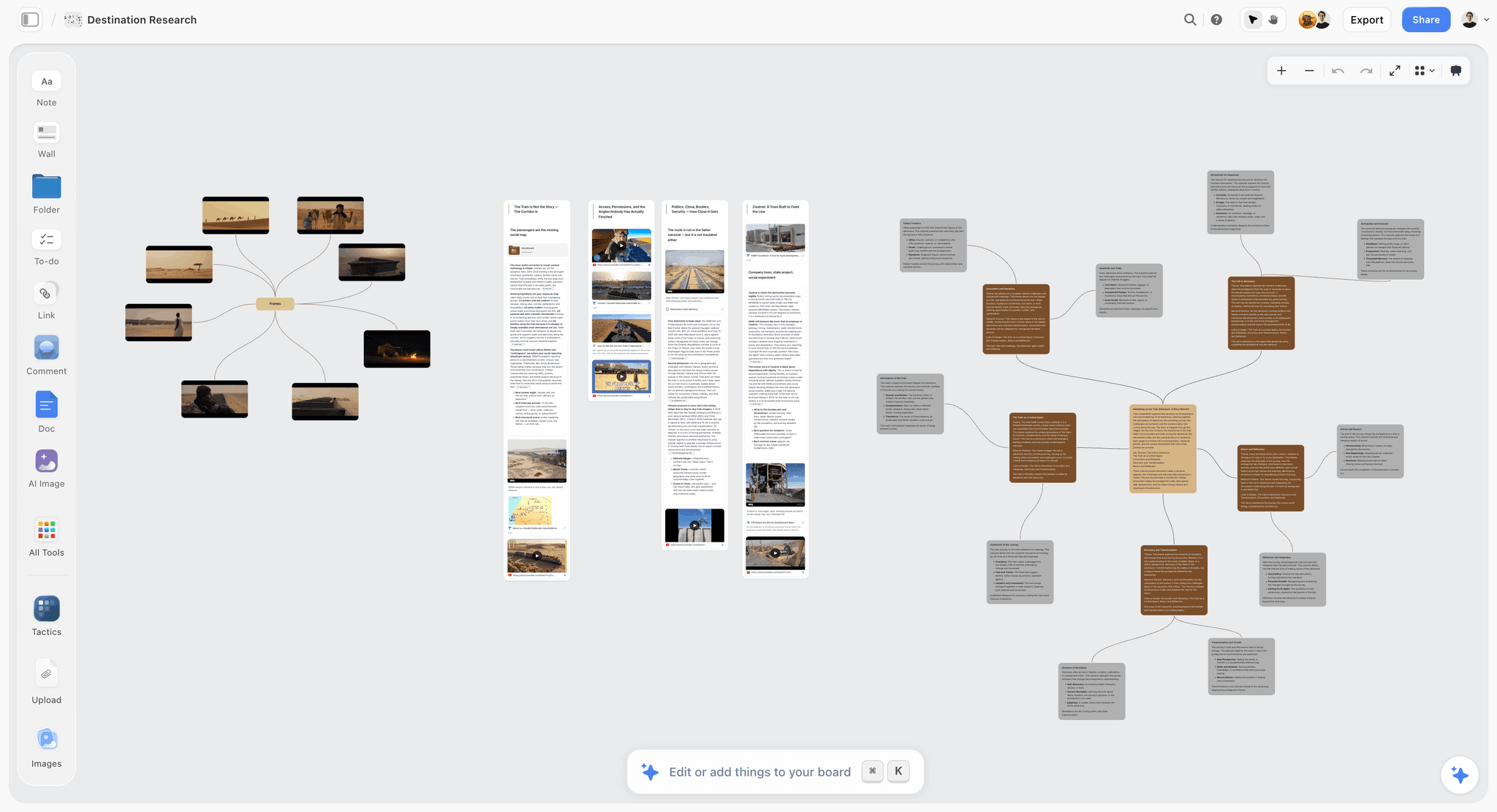
Storyflow is an infinite canvas where the whole side project lives in one view: the idea, the research, the plan, the half-finished draft and the list of what is next, all placed next to each other rather than nested inside each other. That spatial layout is what makes re-entry fast, because a glance restores the shape of the project without reading. The AI reads the entire current board as context, plus up to five attached documents and three other boards, so after a long gap you can ask what you were in the middle of and what is still open, and it answers from the board rather than guessing. The AI project plan generator turns a scrappy idea note into milestones on the same canvas.
Best for: Anyone whose side project gets irregular attention and keeps dying at the restart rather than in the work.
Verdict: The lowest re-entry cost on this list, and the only tool that actively reconstructs your context rather than merely storing it. It is not a task manager and not an issue tracker.
Key features
- Infinite canvas holding notes, images, checklists, timelines and kanban together.
- AI reads the whole current board, plus 5 attached documents and 3 attached boards.
- 200+ story blueprints to start a project with structure already in place.
- Anyone a paid member invites to a board joins free.
Pricing
Early access: every plan is paid for now. A Free plan arrives before the end of 2026, and anyone a paid member invites to a board can sign up free and collaborate today. Plus: $7.99/mo annual, $9.99/mo monthly. Unlimited boards and uploads. Pro: $14/mo annual, $19/mo monthly. AI image generation, more AI usage, memory across conversations. Max: $39/mo annual, $49/mo monthly. Team workspace with roles and permissions.
Pros
- Whole project visible at once, which is the largest single factor in re-entry cost.
- The AI can answer "where was I" from the board itself.
- Nothing rots while you are away; there is no inbox and no maintenance ritual.
Cons
- Paid-only during early access, so it cannot be part of a zero-cost setup today.
- No sprints, cycles, git integration or automations.
- Overkill if the project is honestly just seven tasks.
2. Notion
Notion is the default side project home for good reason: it holds documents, databases, tasks and notes in one place and bends to any project shape. Its weakness for this specific job is structural rather than a missing feature. Nested pages mean the project is never visible all at once, so re-entry is navigation, and navigation is exactly what a long gap breaks.
Best for: Writing, research and publishing projects where the output is documents.
Verdict: The most capable tool here, and the one with the highest maintenance tax. See Is Notion Good for Visual Project Planning? for where it stops.
Key features
- Pages, databases and views in one flexible workspace.
- AI search across the workspace.
- Enormous template library for almost any project type.
Pricing
Genuinely generous free tier for personal use. Paid from about $10/user/month; AI is a separate add-on.
Pros
- Handles any project shape without you changing tools.
- Free tier is enough for nearly every solo side project.
- Best-in-class template ecosystem to start from.
Cons
- Nested structure means the project is never visible at once.
- Real maintenance tax: views and databases go stale while you are gone.
- Easy to spend the session building the system instead of the project.
3. Trello
Trello is three columns and some cards, and for a side project that constraint is worth more than it looks. There is nothing to configure, nothing to maintain, and the whole project is visible in one screen, which puts its re-entry cost surprisingly close to the top of this list despite being the least sophisticated tool here.
Best for: Projects you have abandoned before, where the tool needs to ask nothing of you.
Verdict: The best zero-setup option. It holds tasks well and ideas, references and reasoning badly.
Key features
- Boards, lists and cards with almost no learning curve.
- Checklists, due dates and attachments on cards.
- Free tier with unlimited cards.
Pricing
Free with 10 boards and unlimited cards. Paid from about $5/user/month.
Pros
- Nothing to set up and nothing to maintain.
- Whole board visible at a glance.
- Free tier genuinely sufficient for a solo project.
Cons
- Cards are a poor home for long-form thinking.
- Ten-board free cap arrives if you run several projects.
- No real place for references, research or visual material.
4. Obsidian
Obsidian stores plain markdown files on your own disk and links them into a graph. For a side project that is fundamentally a body of knowledge, a research habit or a long piece of writing, it is the strongest tool here and the only one where you unambiguously own the output.
Best for: Research, writing and learning projects that accumulate rather than ship.
Verdict: The best local-first option and free for personal use. Its re-entry cost is middling because a graph of notes still has to be navigated.
Key features
- Local plain-markdown files with full linking and backlinks.
- Large community plugin ecosystem, including canvas and task plugins.
- Optional paid sync across devices.
Pricing
Free for personal use. Sync is about $5/month if you want it.
Pros
- You own the files outright, with no lock-in of any kind.
- Free for personal use with no functional ceiling.
- Excellent for compounding knowledge over years.
Cons
- Plugins mean setup and occasional breakage.
- Weak at tasks and timelines without configuration.
- A graph does not show you the shape of a project at a glance.
5. Linear
Linear brings genuine engineering discipline to a solo software project: issues, cycles, a roadmap and fast keyboard-driven everything. The free tier holds 250 issues, which is more than most side projects will ever produce.
Best for: Software side projects where you want to actually ship rather than drift.
Verdict: The best tool here if your project is code and you want rigour. Its structure is also the thing that makes it feel heavy on a project with no deadline.
Key features
- Fast issue tracking with cycles and projects.
- Roadmap views and triage.
- Generous free tier at side-project scale.
Pricing
Free up to 250 issues. Paid from about $8/user/month.
Pros
- Imposes useful discipline on a project with no external pressure.
- The fastest tool of its kind to actually operate.
- Free tier covers a solo project indefinitely.
Cons
- Software-shaped, so a non-code project gets little from it.
- Cycles create artificial deadlines you may simply ignore.
- No home for research, references or visual thinking.
6. GitHub Projects
If the side project is code and already on GitHub, GitHub Projects is free, sits next to the repository and links issues to pull requests automatically. That adjacency is its whole advantage: a tracker you do not have to remember to open separately is a tracker that stays current.
Best for: Code projects already living on GitHub.
Verdict: The best free option for software side projects. As a general planning tool outside code it is weak.
Key features
- Boards and tables linked to issues and pull requests.
- Free on public and private repositories.
- Automation via built-in workflows.
Pricing
Free, included with GitHub.
Pros
- Completely free at any side-project scale.
- Lives where the work already is, so it stays in sync.
- Issues connect to commits and pull requests automatically.
Cons
- Only useful if the project is code.
- Clunkier than a dedicated tracker.
- No place for the thinking that precedes the issues.
7. Todoist
Todoist is a task manager that has stayed good for a decade. Natural-language dates, fast capture, and a genuinely clean free tier. For a side project that is honestly just a sequence of things to do, it beats every more ambitious tool on this list.
Best for: Projects where the plan is a list and always was.
Verdict: The best pure task manager for a side project. It holds what to do and nothing about why.
Key features
- Natural-language scheduling and quick capture.
- Projects, labels and filters.
- Reliable apps across every platform.
Pricing
Free with 5 active projects. Paid from about $4/month.
Pros
- Capture is near instantaneous, which keeps it current.
- Cheapest paid tier in this comparison.
- Extremely stable and well maintained.
Cons
- Five-project free cap is tight if you juggle several.
- No place for notes, references or reasoning.
- A flat list does not restore project shape after a gap.
8. Things 3
Things 3 is the best-designed task manager on Apple platforms and one of the last serious one-time purchases in the category. For an Apple-only side project owner who resents subscriptions, it is a rational and durable choice.
Best for: Apple users who want a beautiful task manager they buy once.
Verdict: The nicest task management experience here. Apple-only, and it does tasks and nothing else.
Key features
- Areas, projects and a well-judged Today view.
- Quick entry from anywhere in the system.
- One-time purchase, no subscription.
Pricing
About $50 one time to cover Mac, iPhone and iPad; priced per platform.
Pros
- No subscription, ever.
- Exceptional interface design and reliability.
- Low friction to capture and to review.
Cons
- Apple platforms only.
- No collaboration and no web access.
- Tasks only: no notes, references or visual thinking.
9. Milanote
Milanote is a visual board for collecting references, images and notes, and it is genuinely pleasant for a project with a strong aesthetic component. Its re-entry cost is low for the same reason Storyflow's is: you can see everything at once.
Best for: Visual side projects heavy on references and inspiration.
Verdict: A strong reference board. The 100-note free cap arrives quickly and it has no AI that reads the board, so it stores your context rather than reconstructing it.
Key features
- Drag-and-drop boards for images, notes and links.
- Web clipper for collecting references.
- Attractive templates for creative work.
Pricing
Free up to 100 notes. Paid at $9.99/month per person.
Pros
- Visually pleasant and fast to collect into.
- Whole board visible at a glance.
- Good web clipper for reference gathering.
Cons
- Hundred-note free cap tends to hit mid-project.
- Weak at tasks, dates and anything schedule-shaped.
- No AI reading the board, so context is stored but not reconstructed.
10. Miro
Miro is the infinite whiteboard most people have used at work. For a side project it is a good place to think a problem through visually and a poor place to keep a plan, because boards get large and unnavigable and the free tier allows only three editable ones.
Best for: Projects that begin as a diagram or a systems sketch.
Verdict: Excellent for one thinking session, weak as a project's permanent home.
Key features
- Infinite canvas with a deep shape and diagram library.
- Large template gallery.
- Strong real-time collaboration if anyone joins you.
Pricing
Free with 3 editable boards. Paid from about $8/user/month.
Pros
- The best pure diagramming surface in this comparison.
- Fast for sketching a system or a flow.
- Huge template library.
Cons
- Three-board free cap is restrictive.
- Large boards become hard to navigate rather than easy to read.
- Built for live sessions with other people, which a side project does not have.
11. Sunsama
Sunsama is a daily planner that makes you pull tasks into a calendar and commit to how long each will take. It is on this list because for a lot of side projects the real constraint is not planning at all, it is that the hours never happen.
Best for: People who know exactly what to do and consistently do not do it.
Verdict: The best tool here for protecting time rather than organising work. Expensive for a project nobody pays you for, and it has no free tier.
Key features
- Daily planning ritual pulling tasks onto a calendar.
- Integrations with task tools and calendars.
- Time estimates and shutdown review.
Pricing
Trial only, then about $16/month billed annually.
Pros
- Directly attacks the problem of the hours not existing.
- Forces honest time estimates.
- Pulls from tools you already use rather than replacing them.
Cons
- The most expensive tool here and there is no free tier.
- The daily ritual is itself a habit that has to survive.
- Plans time; does not hold the project.
12. Google Keep
Google Keep is free, instant and everywhere, which makes it an excellent capture tool and a poor project home. It is on this list because a great many side projects genuinely live here, and it is worth being clear about what that costs.
Best for: Catching an idea in twenty seconds before it evaporates.
Verdict: The best capture tool and the worst re-entry experience here. Use it as an inbox feeding something else.
Key features
- Instant notes, lists and voice capture.
- Available on every platform, free.
- Labels and colours for light organisation.
Pricing
Free.
Pros
- Fastest capture of anything on this list.
- Free forever with no limits worth mentioning.
- Available wherever you are when the idea arrives.
Cons
- No structure, so a project becomes an undifferentiated pile.
- Highest re-entry cost here: you must read everything to remember anything.
- No dates, dependencies or progress of any kind.
7) Why Project Management Tools Fail on Side Projects
Project management software is built to solve coordination, and a side project has nobody to coordinate with. Nearly every frustration in this category follows from that mismatch.
Consider what the features are actually for. Dependencies exist so one person is not blocked waiting on another. Assignees exist because there is more than one person. Status columns exist so someone else can see progress without asking. Sprints exist to create a shared cadence across a team. Notifications exist because you were not watching. Every one of those is an answer to a question a solo project does not ask.
What you get instead is setup cost charged up front against a project with an uncertain future. You spend the first session configuring, and configuration feels like progress while producing none. Then the project changes shape, as side projects always do, and the configuration is now wrong, so there is a tidying job before any work can happen. That tidying job is where a great many side projects quietly end.
There is a second failure that is subtler and worse. A work tool assumes continuity. It is designed for someone who was there yesterday and will be there tomorrow, so it optimises for the incremental update: move this card, close that issue, check this box. It does not optimise for the person returning after nineteen days who needs the whole model restored. Those are different products, and only one of them exists in most of the category.
The tools that do well on side projects are therefore an odd-looking group. Trello does well because it is too simple to have a maintenance tax. Obsidian does well because plain files never go stale. Storyflow does well because a canvas is read at a glance rather than navigated, and because an AI holding the whole board can rebuild your context for you. None of those are "better project management". They are answers to a different question.
The practical rule: for a solo side project, every feature you are not using is not free. It is visual noise, a setup decision you had to make, and a thing that can be wrong later. Pick the least tool that holds the project.
8) The Two-Week Gap Test
The test we ran on all 12 tools, which you can run yourself in one minute per candidate.
Set the project up in the tool. Work on it normally for two sessions. Then close it and do not open it for at least two weeks. When you come back, start a timer, open the tool, and stop the timer when you have begun real work on the project rather than administration of it.
What we measured across three projects:
| Tool | Time to real work | What the gap cost | Recovers by |
|---|---|---|---|
Storyflow | under 2 minutes | Nothing rotted | Reading the board; asking the AI what was open |
Trello | 2 to 4 minutes | Nothing rotted | Reading three columns |
Milanote | 2 to 4 minutes | Nothing rotted | Looking at the board |
Things 3 | 3 to 5 minutes | Overdue dates piled up | Clearing the Today view |
Todoist | 3 to 5 minutes | Overdue dates piled up | Clearing overdue, re-reading the list |
Linear | 5 to 8 minutes | Cycle had ended and rolled over | Re-triaging the backlog |
Obsidian | 6 to 10 minutes | Nothing rotted | Re-reading the most recent notes |
GitHub Projects | 6 to 10 minutes | Stale branches and open PRs | Reading issues and branch state |
Miro | 8 to 12 minutes | Nothing rotted | Panning around a large board |
Notion | 10 to 15 minutes | Stale views, half-filled databases | Navigating the hierarchy and tidying |
Sunsama | 10 to 15 minutes | A fortnight of unplanned days | Rebuilding the daily plan |
Google Keep | 15 minutes or more | Notes lost their ordering | Reading everything |
Three patterns fall out of that table, and they are the whole finding.
Seeing beats reading, and reading beats navigating. The top of the table is tools where one look restores the shape. The bottom is tools where you have to move through a structure to remember what the structure was.
Date-driven tools punish absence. Todoist, Things and Sunsama all greet you with a debt: a stack of overdue items generated by the fact that you were living your life. That debt is demoralising out of proportion to its actual meaning, and clearing it is the first tax on the session.
Flexibility costs re-entry time. Notion places last among the serious tools here precisely because it can be anything, which means you have to remember what you made it into. That is a genuine trade rather than a defect, and it is why Notion is still the right answer for a project whose output is documents.
9) Recommended Side Project Stacks
Stack 1: The weekend app. Storyflow (the plan, the idea, the open questions) + GitHub Projects (issues, free) + Obsidian or plain files for notes. About $8/month.
Stack 2: The newsletter or writing project. Notion (drafts and publishing) + Storyflow (the arc of the whole thing, visible at once) + Google Keep (capture on the move). About $8/month if Notion stays free.
Stack 3: The visual or design project. Storyflow (plan plus references together) + Milanote free tier for overflow collection. About $8/month.
Stack 4: The genuinely free setup. Obsidian (notes, free) + GitHub Projects or Trello (tasks, free) + Google Keep (capture, free). Zero, indefinitely.
Stack 5: The minimum that works. Trello free tier, one board, three columns. Zero. Do not underestimate this.
| Project shape | Holds the thinking | Holds the tasks | Captures on the move | Monthly cost |
|---|---|---|---|---|
Weekend app | Storyflow | GitHub Projects | Google Keep | $7.99 |
Newsletter or writing | Notion + Storyflow | Notion | Google Keep | $7.99 |
Visual or design | Storyflow | Storyflow | Milanote free | $7.99 |
Genuinely free | Obsidian | Trello free | Google Keep | $0 |
Absolute minimum | Trello free | Trello free | Trello free | $0 |
The pattern: one place that holds the shape of the project and one place that holds the next actions, and those two are allowed to be the same tool but never three tools. Most side projects that die of tooling died of three tools.
10) What a Side Project Setup Should Cost
The honest answer is somewhere between zero and about ten dollars a month, and the reason to be strict about this is not the money.
A subscription creates an obligation, and obligation is the wrong relationship to have with a side project. Paying $40 a month for a project nobody is waiting for converts a pleasure into a debt, and people abandon debts faster than they abandon hobbies. The tools that work here are cheap or free, and the ones that fail on this list fail partly on price: Sunsama at about $16 a month is an excellent product priced for work.
Three specific traps:
The free-tier cliff. Trello's 10 boards, Milanote's 100 notes and Miro's 3 editable boards are all limits you hit mid-project rather than at the start, which makes them an interruption rather than a decision. Either pick a tool whose free tier has no cliff in your path (Obsidian, GitHub Projects, Todoist within 5 projects) or accept the paid tier up front.
Paying per user for one user. Notion, Linear, Miro and Trello all price per seat, which is fine at one seat but means their pricing model is not designed around you. Tools priced per account are a better fit for solo work; Storyflow's individual plan is per account and invited collaborators join free, which matters the day you pull a friend in.
Buying a system instead of building a project. The most expensive thing in this category is not any subscription. It is the four sessions spent evaluating, configuring and migrating rather than doing the work. If you are reading a tool comparison for the second time this month, the tool is not the problem.
| Cost trap | Tools affected | What it actually costs | The move |
|---|---|---|---|
Free-tier cliff | Trello, Milanote, Miro | An interruption mid-project | Check the cap against your project size first |
Per-seat pricing for one seat | Notion, Linear, Miro, Trello | Little now, doubles the day you collaborate | Prefer per-account pricing |
Work-priced tools | Sunsama | About $16/mo of obligation | Only if time, not planning, is the real problem |
Evaluation time | All of them | Several sessions of actual project time | Pick one from this list and start today |
11) Honorable Mentions
- Apple Notes and Reminders. Free, fast, already on the device, and better than they were. A perfectly respectable home for a small project.
- Height. An AI-forward project tool that is worth watching, particularly for solo software work.
- Craft. Beautiful documents with a lighter touch than Notion.
- TickTick. Todoist's closest rival, with a built-in calendar and pomodoro timer.
- Excalidraw. Free, instant, sketchy diagrams. Excellent for thinking out a structure in five minutes.
- Tana and Capacities. Newer note tools with real ideas about structure; worth a look if Obsidian nearly fits.
- A single text file. Genuinely underrated for a project under about twenty tasks, and it has a re-entry cost of nearly zero.
12) Tools to Avoid for a Side Project
- Anything with sprints, for a project with no team. A cadence exists to synchronise people. Alone, it only manufactures guilt.
- A tool you have to configure before it holds a thought. If the first useful thing requires a schema, the schema will outlive the project.
- Three tools. One for tasks, one for notes, one for references, and by the third week nothing is current. Two is the practical maximum.
- Anything that emails you. Notifications for a project only you care about are just a reminder that you are behind.
- A tool you picked because it would be right if the project got big. It will not be big for a long time, and optimising for a future that may not arrive is how the present one dies.
- A new tool, when you have already abandoned the project twice. The tool was not why.
14) The Bottom Line
The best tools for planning a side project in 2026 are the ones with the lowest re-entry cost, and that is a different ranking from the best project management tools. Storyflow is the best overall because the whole project is visible at a glance and the AI reads the board, so coming back after three weeks is a question rather than an excavation. Trello is the best zero-setup free option. Notion wins if the project is documents. Obsidian wins if it is knowledge.
A side project does not die from lack of time. It dies from restart cost. Pick the least tool that holds the whole project in one view, write down the next concrete action before you close it, and stop evaluating tools, which is itself the most expensive thing in this category.
To start, open a Storyflow canvas, put the idea, the research and the next three steps on one board, and leave a note at the top saying what you were in the middle of. That note is the entire technique.
FAQ: Planning a Side Project
What is the best tool for planning a side project in 2026?
Storyflow is the best tool for planning a side project because it has the lowest re-entry cost measured here: the whole project sits on one canvas you take in at a glance, and the AI reads the entire board, so after weeks away you can ask what you were in the middle of rather than reconstructing it by hand. It starts at $7.99/month billed annually and anyone a paid member invites to a board joins free. Trello is the best free zero-setup alternative, Notion is stronger if the project is mostly writing, and Obsidian is the best choice if it is really a body of knowledge. The mistake to avoid is a full project management tool, because its features all solve coordination problems a solo project does not have.
What is the best project management tool for personal side projects?
For personal projects the useful ranking is almost the inverse of the work-software ranking. Trello and Storyflow come top because the whole project is visible at once, Linear and GitHub Projects are the right answers if the project is code, and Notion is the right answer if it is documents. Full project management suites with dependencies, assignees and sprints are built for teams and add setup cost without adding value when there is one person.
Is there a free tool for planning a side project?
Yes, several, and they are genuinely free rather than demos. Obsidian is free for personal use with no functional ceiling, GitHub Projects is free on public and private repositories, Trello's free tier gives unlimited cards across 10 boards, and Google Keep is free for capture. Storyflow is paid-only during early access so it is not part of a zero-cost setup today; its Free plan launches before the end of 2026, and anyone a paid member invites to a board joins free right now.
Why do I keep abandoning my side projects?
Most often because re-entry costs too much. If forty minutes of a three-hour session goes to remembering where you were, starting starts to feel expensive, so you start less often, so the gaps grow, so re-entry costs more. It compounds. The fix is structural rather than motivational: use a tool where the whole project is visible in one view, and leave yourself a single note saying what the next concrete action is before you close it.
How do I get back into a side project after months away?
Do not try to reconstruct everything. Open the project, spend five minutes reading only the most recent material, and pick one small concrete thing you can finish in that session. Finishing something restores momentum better than re-planning does. If your tool holds the whole project as AI-readable context, asking it to summarise what was open and what was decided is a legitimate shortcut and it is the strongest practical argument for a canvas-based tool.
Should I use Notion or Trello for a side project?
Trello if the project is a set of things to do and you want to start in the next two minutes. Notion if the project produces documents, research or writing and you want one home for all of it. The trade is real: Trello has almost no setup and no maintenance but nowhere to think, while Notion can be anything and therefore requires you to remember what you made it into, which is exactly what a long gap destroys.
What is the best tool for a side project that is an app?
GitHub Projects if it is already on GitHub, because free and adjacent beats better and separate. Linear if you want genuine discipline and a cadence, with a free tier that holds 250 issues. Pair either with somewhere to keep the thinking that precedes the issues, because an issue tracker records decisions and does not hold the reasoning behind them.
How much should I spend on side project tools?
Zero to about ten dollars a month. The constraint is not affordability, it is that a subscription converts a hobby into an obligation, and obligations get abandoned faster than hobbies do. A genuinely free stack of Obsidian, Trello and Google Keep is a serious setup; Storyflow at $7.99/month billed annually is the cheapest paid option in its category.
Do I need AI for a side project?
Not for generating the project, which is the least valuable thing AI does here. The genuinely useful case is reconstructing your own context after a gap: a tool that holds the whole project and can answer what you were doing and what is unfinished attacks the single biggest reason side projects die. That requires the AI to see the whole project, which is a property of the workspace rather than the model.
What is the simplest way to plan a side project?
One board, three columns: doing now, next, someday. One note at the top saying what the very next action is. Close it with that note updated. This takes two minutes to set up in Trello or on a Storyflow canvas, and it beats an elaborate system you will not maintain.
How do I plan a side project when I only have a few hours a week?
Plan in sessions rather than in tasks. Decide what one session can finish, write it down as the next action, and make that the only thing waiting for you. A backlog of forty items is demoralising on a Sunday morning; one concrete next step is not. Whatever tool you use should show that next step without you having to look for it.
Should I use the same tool for work and my side project?
Usually not, and for an unexpected reason: the side project inherits the work tool's associations and its shape. A tool full of deadlines and status columns brings a work posture to something you are doing for pleasure. A different surface, particularly a visual one, keeps the two mentally separate, which matters more than the feature differences.
What should I write down before I stop working on a side project?
One sentence: what you were in the middle of, and what the next concrete action is. This single habit removes more re-entry cost than any tool choice on this list. Everything else about your setup is optimising the remainder.
Can a side project tool grow with the project if it becomes a business?
Some do. Notion, Linear and Storyflow all scale past one person, and Storyflow's individual plan is priced per account with invited collaborators joining free, so bringing in a co-founder does not force an immediate migration. But do not choose on this basis. Choose for the project you have, because the cost of migrating later is small and the cost of an overwrought tool today is that there is no project to migrate.
Table of Contents
- Article Metadata
- Breadcrumb
- Table of Contents
- 1) Quick Answer: The Best Side Project Tools in 2026
- All 12 Side Project Tools, Ranked
- 2) Comparison Table: 12 Side Project Tools at a Glance
- Frequently Asked: Which Side Project Tools People Actually Stick With, and Which Get Abandoned
- 3) Re-Entry Cost: The Number That Decides Whether a Side Project Survives
- 4) How We Evaluated These Tools
- 5) Quick Picks by Side Project Type
- 6) Detailed Reviews: 12 Side Project Tools
- 7) Why Project Management Tools Fail on Side Projects
- 8) The Two-Week Gap Test
- 9) Recommended Side Project Stacks
- 10) What a Side Project Setup Should Cost
- 11) Honorable Mentions
- 12) Tools to Avoid for a Side Project
- 14) The Bottom Line
- 15) Author
- 16) Related Reading
- FAQ: Planning a Side Project
Templates to check out for this topic


Templates you can use in Storyflow
Every Storyflow board starts from real structure and an AI that reads the whole canvas. Open one of these templates and make it yours.


See Storyflow in Action
A visual AI workspace where every feature lives inside one canvas. No tab-switching, no context lost.
Build your entire board from a single message
Type what you need in the AI chat at the bottom of your canvas. The AI adds cards, headings, and structure directly onto your board.
Use expert frameworks as AI context
Type @ in the AI chat and choose any Tactic. The AI tailors every response to that framework instead of giving generic advice.
Turn your board into a mind map in seconds
Ask the AI to restructure your canvas as a mindmap. It connects your ideas into a visual hierarchy so you can see how everything relates.
Why Storyflow Exists
Storyflow actually began as a personal tool while working on creative and research projects.
We kept running into the same problem: ideas were scattered everywhere: notes, documents, and whiteboards.
Nothing helped us see how everything connected.
So we started building a workspace designed around how ideas actually grow.
→ Read how Storyflow was createdStoryflow Team
Product & Research Team
Published: 2026-09-22
Extremely simple, seriously capable


See how easy it is to get started
Watch a real project come together, from a blank board to a finished plan, clicked through step by step.
Start creating with AI and become more productive
Transform your creative workflow with AI-powered tools. Generate ideas, create content, and boost your productivity in minutes instead of hours.