10 Best StoryboardThat Alternatives in 2026 (Tested and Ranked)
The best StoryboardThat alternatives in 2026, tested on real pre-production. Storyboarding tools compared on AI context, connected canvas, free tier, and price.

Category
Filmmaking
Author

Justkay
Documentary Filmmaker & Founder at Storyflow
Topics
2026-06-11
•
Updated July 3, 2026
•
15 min read
•
Filmmaking- best StoryboardThat alternatives 2026
- StoryboardThat alternative
- alternatives to StoryboardThat
- StoryboardThat vs Storyflow
- free StoryboardThat alternative
- storyboarding software
- AI storyboarding tool
What is the best StoryboardThat alternative in 2026?
The best StoryboardThat alternative in 2026 is Storyflow (best overall: the storyboard shares one canvas with the script, beats, and shot list, and the AI reads all of it). Storyboarder is the best free drawing tool, and Canva the closest polished drag-and-drop match. You only need an alternative when the board has to become a real film.

Full disclosure: Storyflow is our own product, and we rank it #1 for one job: keeping the storyboard on the same canvas as the script, beats, and shot list, where the AI reads all of it. For a dedicated panel-and-animatic timeline Boords is more purpose-built, for free offline drawing Storyboarder is the stronger pick, and StoryboardThat itself still owns the fastest no-skill clip-art panel. Storyflow has no built-in stock clip-art library and no timed animatic playback, and it is cloud-only, so if you just need a quick comms board, StoryboardThat is fine. We link to every tool so you can judge the fit.
Quick Comparison: Best StoryboardThat Alternatives
These four cover the reasons people leave StoryboardThat for a film board: a connected canvas, a dedicated panel-and-animatic tool, a free drawing app, and collaborative boards plus shot lists.
| Tool | Best For | AI Features | Price |
|---|---|---|---|
| Storyflow | Storyboards connected to the whole project | Reads full board + @-docs and Tactics | $7.99 mo annual (free plan late 2026) |
| Boords | Dedicated panels and animatics | Light AI assistance | Limited free / ~$12 mo |
| Storyboarder | Free desktop drawing storyboards | No AI | Free, open source |
| Plot | Collaborative boards and shot lists | Light AI | Limited free / ~$10 mo |
A storyboard tool that starts from your script, not clip art
StoryboardThat leans on drag-and-drop characters; Storyflow drafts frames from your actual scene text on a canvas you can restage and annotate for a real shoot.

1) Quick Answer: The Best StoryboardThat Alternative in 2026
The best StoryboardThat alternative in 2026 is Storyflow if you want the storyboard to live on the same canvas as the script, the beats, and the shot list, because its AI reads the whole board and helps the whole project move forward instead of only filling panels. If you want a free desktop drawing tool, Storyboarder is the strongest pick, and Canva is the closest match if you want a polished drag-and-drop board with a familiar template library.
The short version: StoryboardThat is genuinely good at what it was built for. Drag clip-art characters, scenes, and props into panels, add speech bubbles, and you have a clear board in minutes with no drawing skill, which is why classrooms and comms teams love it. You only need an alternative when the board has to become a film. A clip-art panel communicates an idea. A film board has to agree with the script, the shots, and the budget.
For the wider category, see The Best Storyboarding Software in 2026 and The Best AI Storyboarding Tools in 2026.
All 10 StoryboardThat Alternatives, Ranked
- Storyflow (9.3/10): best overall; storyboard, script, beats, and shot list on one canvas the AI reads
- Boords (8.6/10): best dedicated panel-and-animatic workflow
- Storyboarder (8.5/10): best free desktop drawing tool, open source
- Plot (8.2/10): best collaborative boards plus shot lists
- Milanote (8.1/10): best visual pre-production reference boards
- Canva (8.0/10): best polished drag-and-drop boards, no drawing
- Runway (8.0/10): best AI-generated frames with motion
- Krea (7.9/10): best real-time generative concept frames
- ShotPro (7.9/10): best 3D previs and camera blocking
- Make Storyboard (7.8/10): best like-for-like drag-and-drop swap
2) Comparison Table: 10 StoryboardThat Alternatives Compared
Prices above are the published rates at the time of writing and move often, so check the vendor's own page before you commit. The shape of each plan (free tier, subscription, or one-time licence) is more stable than the number. Rating criteria: tested on real pre-production work between 2024 and 2026: documentary planning, narrative short boards, commercial pitch frames, and educator and business-comms boards. Competitor pricing carries "verify" because storyboarding-tool plans change often; confirm current pricing on each tool's official page before buying. Storyflow pricing is exact and current as of June 2026.
3) The Two Boards: A Comms Board vs a Film Board
Before ranking tools, it helps to see why so many StoryboardThat users hit a wall: they are building one kind of board with a tool made for the other.
A comms board explains an idea to a person. A teacher mapping a story for a class, a manager walking a team through a process, a marketer sketching a 30-second explainer. The job is clarity, fast, with no drawing skill, and stock clip art is perfect because nobody needs the panel to be cinematic. They need it legible, and StoryboardThat is genuinely good at it.
A film board is a production decision. It tells a director and a DP how a sequence will cut, where the eyeline lands, what the lens implies. It has to agree with the script, the shot list, the schedule, and the budget, because when a scene changes, all of those change with it. Clip art cannot carry that weight, and a panel in its own app cannot stay in sync.
The taxonomy that organizes this article is simple: a clip-art panel communicates an idea, a film board has to agree with the script, the shots, and the budget. StoryboardThat, Canva, and Make Storyboard make legible comms panels fast. Boords and Storyboarder are film-board drawing tools. Storyflow, Milanote, and Plot are canvas-first tools where the board sits beside the rest of the project. Most people who outgrow StoryboardThat are not unhappy with the clip art. They are tired of a board that connects to nothing.
4) Why People Look for a StoryboardThat Alternative
People do not leave StoryboardThat because the tool is bad. They leave for frictions that show up once the board has to do more than explain.
The first reason is the clip-art ceiling. Stock characters and scenes are fast, but they read as stock. The moment you need a cinematic frame, a specific location, or a real reference, drag-and-drop clip art stops being enough and you reach for drawing, photography, or AI generation.
The second reason is the island problem. The script is in a Google Doc, the shot list is in a spreadsheet, the schedule is in another app, and the storyboard agrees with none of them automatically. Every change to the project is one you re-make by hand in four places.
The third reason is no real AI and a use-case mismatch. StoryboardThat assembles hand-built panels, centered on education and business comms. If your bottleneck is generating frames from a prompt, reworking a sequence across the whole project, or getting cinematic frames with shot numbering tied to the script and beats, you are using a comms tool for a production job, and the seams show.
5) How We Evaluated These Tools
Every tool here was tested on real pre-production work between 2024 and 2026: documentary planning, a narrative short, a commercial pitch deck, and an educator and business-comms board. No synthetic benchmarks. Six criteria, weighted in this order.
- Connected to the rest of the project, or an island? Can the storyboard sit beside the script, the beats, the shot list, and the mood board, or does it force manual syncing?
- AI context scope. If there is an AI, what can it see? A whole project, the active board, or only the single frame you are generating?
- Frame quality and speed. How good and fast is the boarding, and does it read as cinematic when it needs to?
- Drawing skill needed. Can someone with no drawing ability still build a clear board, the way StoryboardThat allows?
- Free tier and price. Is there a usable free plan, and does the price match how much of the project the tool moves?
- Who it fits. Educator, marketer, documentary, narrative, commercial, or student.
The rankings reflect how each tool felt over weeks, not a 30-second demo, once the board had to agree with everything else on the project.
We also weighted how StoryboardThat itself performs against each criterion, so the comparison is fair to the tool people are leaving, not just flattering to the alternatives.
6) Quick Picks by Job to Be Done
If you want the short list, organize by the job, not the brand.
- Storyboards connected to the whole project: Storyflow. Frames on the same canvas as the script, beats, and shot list, with an AI that reads all of it.
- Dedicated panels and animatics: Boords. The most purpose-built film boarding workflow.
- Free storyboarding tool: Storyboarder. A capable desktop drawing tool, fully free and open source.
- Polished drag-and-drop board, no drawing: Canva. The closest familiar replacement for StoryboardThat's ease.
- Visual pre-production boards: Milanote, or Plot for collaborative boards plus shot lists.
- Generative cinematic frames: Krea and Runway from prompts; ShotPro for 3D camera blocking.
Put the storyboard on the same canvas as the script
The reason people outgrow clip-art panels is not the art, it is the island. Build your next board where the frames, beats, and shot list sit together and the AI reads all of it, free, with no drawing skill required.
7) Detailed Reviews: 10 StoryboardThat Alternatives in 2026
1. Storyflow
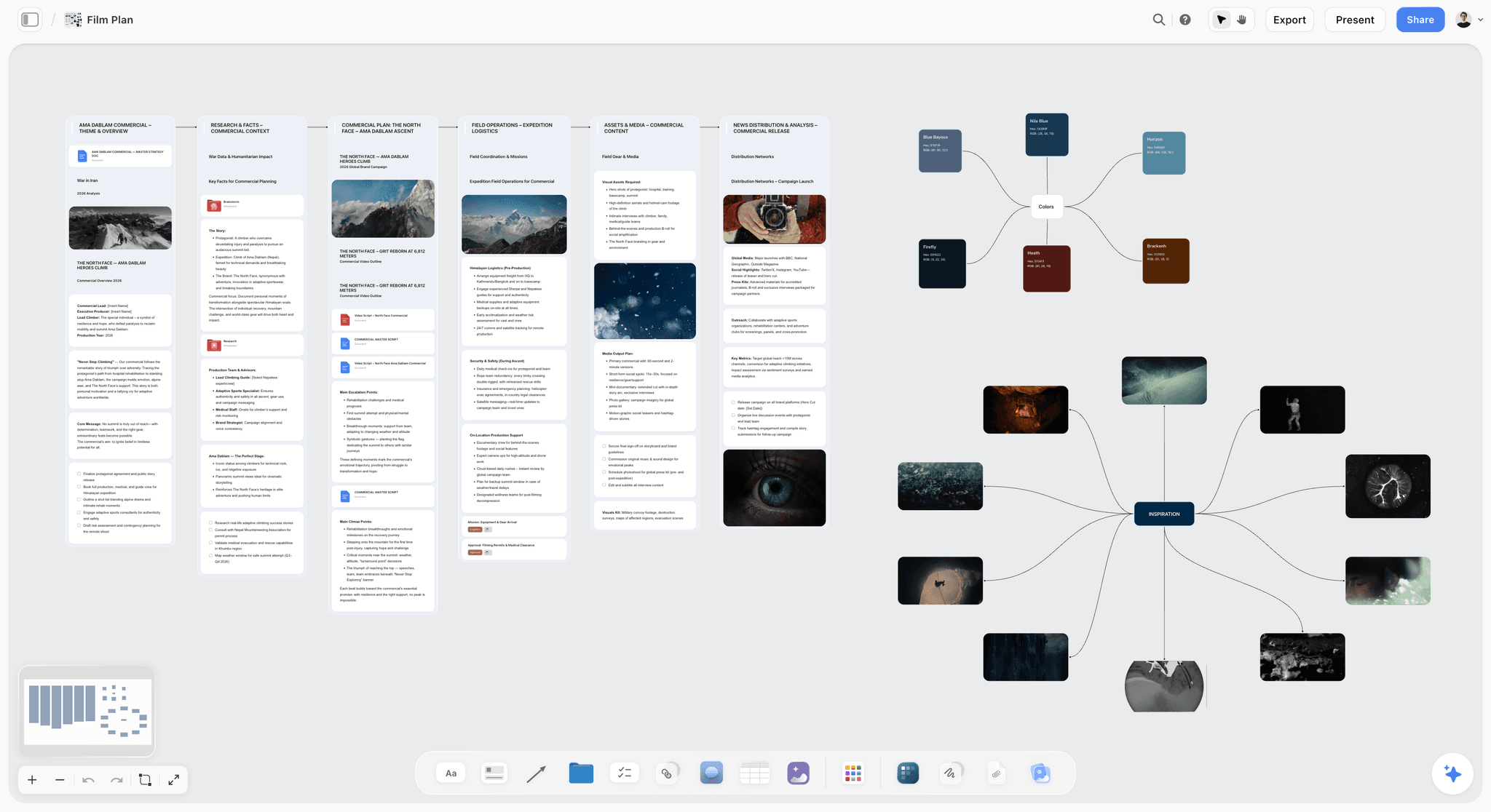
Storyflow is the alternative to pick when the problem is not how fast you can assemble a panel but how disconnected that panel is from everything else. It is an AI-powered visual workspace: one infinite canvas where the storyboard frames sit beside the script, the mood board, the character cards, and the structural beats, and the AI reads the whole board. It keeps what StoryboardThat users want, a fast way to lay out how a sequence reads without drawing, and adds the job StoryboardThat ignores by design: connecting the board to everything else in the project.
The difference shows up when a scene changes. In StoryboardThat, you rebuild the panels, then re-edit the script and the shot list by hand. In Storyflow, the frames, beats, and shots are cards on one canvas, so when you ask the AI to "rework scene four so the reveal lands later," it reads all three together and helps you move them at once. A clip-art panel communicates an idea. A film board has to agree with the script, the shots, and the budget, and Storyflow keeps that agreement intact across every card on the canvas.
Best for: Documentary, narrative, commercial, and educator-to-creator users whose storyboard keeps drifting out of sync with the script, the shot list, and the schedule.
Verdict: The strongest StoryboardThat alternative for storyboards that have to agree with the rest of the project. For a built-in stock clip-art library and the fastest no-skill panel, StoryboardThat is still more specialized. Storyflow earns its place the moment the storyboard has to stop being an island.
Key features
- Canvas-aware AI by default. The AI reads your full active canvas board (every card, frame, note, image, and link on it), plus up to 1 Tactic and up to 3 Documents you @-mention in the AI chat.
- Storyboard frames beside the script and beats. The frames are cards on the same canvas as the screenplay, structural beats, mood board, and shot list, so the project is one connected artifact instead of five disconnected files.
- 200+ Story Blueprints. An expert-built template library covering creative and structural frameworks, including the Hero's Journey, on the Plus tier and above.
- Unlimited shared boards and collaboration on every plan, including Free. The Max plan adds a team workspace with permissions and roles.
Pricing
Free: launching before the end of 2026, and invited collaborators of paid members join free today (unlimited boards, cards, and collaboration, basic AI, 20 file uploads, no Story Blueprints library). Plus: $7.99/mo annual or $9.99/mo monthly (adds 200+ Story Blueprints, unlimited uploads). Pro: $14/mo annual or $19/mo monthly (adds AI image generation, 20x more AI). Max: $39/mo annual or $49/mo monthly (adds 40x more AI, team workspace with roles). Pricing current as of June 2026.
Pros
- The frames live on the same canvas as the script, beats, mood board, and shot list, so the storyboard stops being an island.
- The AI reads the whole board and helps rework a sequence across the script, frames, and beats at once.
- The Free plan is genuinely usable: unlimited boards, cards, and collaboration, forever, with no drawing skill required.
Cons
- There is no built-in stock-character and scene clip-art library the way StoryboardThat offers, so the fastest no-skill clip-art panel still belongs to StoryboardThat.
- Frames are canvas cards, not a dedicated panel-and-animatic timeline, so for timed animatic playback Boords is more purpose-built.
- The storyboarding-specific template library is newer and smaller than a panel-purpose tool's.
- Cloud-only; there is no local-first or offline desktop mode the way Storyboarder offers.
The fastest way to test the connected-canvas idea is to skip the blank board: open the Storyboard template for the frames, or the Film Plan template when you want the script, beats, and board scaffolded together from the start.
If your storyboard keeps drifting out of sync, rebuild your most disconnected project on a Storyflow canvas for a week. Start a Storyflow workspace and ask the AI to rework a scene across the script and frames at once.
2. Boords
Boords is the StoryboardThat alternative for people who want a dedicated film storyboarding tool instead of a comms board. It is built around panel-by-panel frames, a timed animatic player for previsualizing pacing, clean comments, and client approvals, so the board reads as a production artifact rather than a clip-art layout.
Best for: Narrative and commercial filmmakers who want focused panels and animatics.
Verdict: The most purpose-built dedicated boarding workflow here, and a clear step up from clip art for film work. The trade-offs: the board still lives apart from your script and shot list, its AI is light, and the subscription costs more than a comms tool. Paid plans start around $12 per month. See our Boords alternatives ranking for a deeper look. Pricing current as of June 2026.
3. Storyboarder
Storyboarder, by Wonder Unit, is the strongest free StoryboardThat alternative. It is an open-source desktop app built specifically for drawing storyboards, with a purpose-built frame editor, posable wooden-figure characters for quick blocking, and export straight to PDF, Premiere, Final Cut, and Fountain. It is made by working filmmakers, so the workflow feels right.
Best for: Filmmakers and students who want a real, capable storyboarding tool for free.
Verdict: The best free storyboarding tool there is, and a genuine local-first desktop app good for privacy and offline work. The limits: it expects you to sketch rather than drag clip art, it is desktop-only with no real-time collaboration, it has no AI, and the board still lives apart from your script and shot list. Free and open source. Pricing current as of June 2026.
4. Canva
Canva is the most familiar landing spot for anyone leaving StoryboardThat for drag-and-drop reasons. It is not film-specific, but its storyboard templates, huge stock-asset and illustration library, and Magic Studio AI tools make a clean, presentable board fast, and almost everyone already knows it.
Best for: Educators, marketers, and creators who want a polished board without drawing or film tooling.
Verdict: The closest familiar replacement for StoryboardThat's ease, with a larger asset library and more polished output. The trade-off: no shot numbering, no animatic, and no connection to a script or shot list, so the board looks finished without being a working part of a production. Canva Pro starts around $15 per month, with a usable free tier. Pricing current as of June 2026.
5. Milanote
Milanote is the StoryboardThat alternative for people who want the storyboard to sit inside a wider pre-production board. It is an elegant, low-friction visual workspace where frames, references, notes, and links share one calm surface, with storyboard and film templates and clean sharing.
Best for: Directors and creatives arranging frames alongside references and notes.
Verdict: The most pleasant surface here for arranging visual references, where frames sit beside the mood board instead of in a separate app. It is not a dedicated storyboarding tool: no AI doing real lifting, no timed animatic or shot numbering, so the board arranges the project but does not move it forward. Free tier, then paid plans around $12.50 per month. Pricing current as of June 2026.
6. Plot
Plot is the StoryboardThat alternative built for teams that want storyboards and shot lists in one collaborative place. It pairs a board for frames with structured shot data and real-time collaboration, so the visual plan and the production plan stay closer together in a modern, film-aware interface.
Best for: Production teams who need boards and shot lists side by side.
Verdict: A strong collaborative alternative that closes part of the island gap by putting boards and shot lists in one tool. It is a younger product with a thinner ecosystem, the script and schedule still live elsewhere, and its AI is lighter than Storyflow's. Limited free use, then paid plans around $10 per month. Pricing current as of June 2026.
7. Krea
Krea is for people who want to generate cinematic frames instead of assembling clip art. It is a real-time generative image tool that turns prompts and reference images into frames fast, with style control, upscaling, and quick iteration, useful for pitch boards and concept frames that need to look real rather than stock.
Best for: Directors and agencies generating concept and pitch frames quickly.
Verdict: A strong generative frame source that produces cinematic concept frames in seconds, where clip art cannot. It generates images, not a structured, numbered storyboard; character consistency is still hard; and there is no animatic, sharing, or shot-list workflow. Limited free use, then paid plans starting around $10 per month. Pricing current as of June 2026.
8. Runway
Runway is for people who want AI-generated frames that can also move. It generates images and short video clips with motion and camera-style controls, plus a wider suite of editing and VFX tools, so a storyboard panel can become a moving previs shot.
Best for: Directors and editors exploring generative frames and motion previs.
Verdict: The most ambitious generative option, bridging frames and motion in a deep, fast-moving toolset far beyond clip art. It is not a structured storyboard or shot-planning tool, generation cost and consistency take management, and there is no script, board, or approval workflow. Limited free use, then paid plans around $12 per month. Pricing current as of June 2026.
9. Make Storyboard
Make Storyboard is the closest direct competitor to StoryboardThat's drag-and-drop model for film. It is a browser tool for assembling panels with uploaded or drawn frames, characters, and assets, with comments and sharing aimed at production teams rather than classrooms.
Best for: Small teams wanting a drag-and-drop board built for film handoff.
Verdict: A capable like-for-like swap if you want StoryboardThat's assemble-don't-draw approach with a more film-oriented sharing flow. It is lighter on stock clip art, has no real AI, and the board still lives apart from the script and shot list. Limited free use, then paid plans starting around $12 per month. Pricing current as of June 2026.
10. ShotPro
ShotPro is the StoryboardThat alternative for directors who want to block shots in 3D rather than assemble clip art. You place characters, cameras, and sets in a three-dimensional scene with real lens and angle simulation, then pull frames from accurate camera positions for storyboards and shot lists.
Best for: Directors and DPs planning camera blocking and coverage in 3D.
Verdict: The best 3D previs alternative for blocking, far more precise than stock panels for coverage planning. The cost is a steeper learning curve, overkill for simple comms boards, and previs that still lives apart from the script and schedule. ShotPro is subscription-based. Pricing current as of June 2026.
8) Which StoryboardThat Alternative Fits Which Creator?
1. Documentary Filmmaker (Solo)
Top picks: Storyflow + Storyboarder
Documentaries rarely board every scene, but the sequences you do plan have to agree with your interview list, your structure, and your edit, and clip art rarely fits. Use Storyflow to keep the frames beside the beats and the research on one canvas the AI can read (the Pre-Production Board template opens with that structure in place), and Storyboarder when you want to sketch a sequence offline for free.
2. Narrative Short / Feature Director
Top picks: Storyflow + Boords
Narrative work needs cinematic frames and a real animatic, where StoryboardThat's stock panels run out. Use Boords for its dedicated panel-and-animatic workflow, and Storyflow so the boards sit beside the screenplay, beats, and shot list, and a scene change updates the whole film instead of just the panels.
3. Commercial / Agency Filmmaker
Top picks: Storyflow + Krea
Pitch boards have to look good fast and tie to a brief, and clip art rarely sells a concept to a client. Generate cinematic concept frames in Krea, then drop them onto a Storyflow canvas beside the brief, treatment, and shot list so the whole pitch is one client-ready board.
4. Music-Video Director
Top picks: Storyflow + Runway
Music videos live on sequence and motion, which clip-art panels cannot carry. Use Runway for generative moving frames, and Storyflow to lay the sequence beside the song structure and shot list so the visual idea and the timing stay connected.
5. Student / Film-School Filmmaker
Top picks: Storyboarder + Storyflow
Start free. Storyboarder gives you a real drawing tool at zero cost, and Storyflow's Free plan keeps the boards, script, and schedule on one canvas without paying. It is the cheapest way to work like a connected production from day one.
6. Educator / Business Comms
Top picks: Canva + StoryboardThat
This is the one persona where StoryboardThat is often still the right answer. If your job is a clear, legible board for a class or a team and nobody needs it cinematic, StoryboardThat's drag-and-drop clip art is hard to beat, and Canva is the strongest alternative when you want a more polished, on-brand look. You do not need a film tool for a comms board.
9) Where StoryboardThat Still Wins (An Honest Accounting)
A list of StoryboardThat alternatives that pretended StoryboardThat was beaten would not be worth reading. Here is where StoryboardThat is still the right tool.
StoryboardThat wins on no-skill speed. Drag a character, drop a scene, add a speech bubble, and you have a clear panel in seconds with zero drawing ability. For a teacher or a comms team on a deadline, that is hard to beat.
StoryboardThat wins on the built-in clip-art library. Its stock characters, poses, props, and scenes are exactly what a comms board needs, and no canvas-first tool ships that library out of the box.
StoryboardThat wins on classroom and business comms. It is built for education and explainer use, with the templates, sharing, and simplicity those audiences want.
The point is not that StoryboardThat is bad. For a comms board explained to a person, it is a genuinely good, focused tool. The point is the film board: a production storyboard has to stay connected to the script, the shot list, and the schedule, and a clip-art comms tool cannot. That is the gap a canvas-first workspace like Storyflow is built to close.
11) The Bottom Line
The best StoryboardThat alternative in 2026 depends on whether you are building a comms board or a film board. Canva is the closest familiar drag-and-drop swap, Boords the dedicated panel-and-animatic tool, Storyboarder the best free drawing tool, Krea and Runway the generative frame sources, Milanote the calm reference board, and ShotPro the 3D blocking option.
But the most common reason people leave StoryboardThat is not that they want different clip art. It is that the board has to become a production: connected to the script, the shot list, and the schedule, and cinematic when it needs to be. A clip-art panel communicates an idea. A film board has to agree with the script, the shots, and the budget. That is why Storyflow ranks first. It keeps the no-drawing speed StoryboardThat users want and puts the frames on one canvas beside the script, the beats, and the shot list, with an AI that reads all of it.
If your storyboard keeps drifting out of sync, take one project and rebuild it on a canvas for a week. Try the AI storyboard generator to turn your script into a first board, then start a Storyflow workspace and ask the AI to rework a scene across the script and the frames at once.
10) FAQ: StoryboardThat Alternatives in 2026
What is the best StoryboardThat alternative in 2026?
The best StoryboardThat alternative in 2026 is Storyflow if you want the storyboard connected to the rest of the project, because its AI reads the whole canvas where the frames sit beside the script, the beats, and the shot list. For a free desktop drawing tool, Storyboarder is the strongest pick, and Canva is the closest match if you want polished drag-and-drop panels without drawing. The right choice depends on whether you are building a comms board or a film board.
Is there a free StoryboardThat alternative?
Yes. Storyboarder by Wonder Unit is fully free and open source, and it is the strongest free dedicated drawing tool. Storyflow's Free plan, which launches before the end of 2026, will be the strongest for connected pre-production: unlimited boards, cards, and collaboration, basic AI, and 20 file uploads and no drawing skill required. Canva and Milanote also have free tiers, and StoryboardThat itself allows limited free use before a subscription.
What does StoryboardThat cost?
StoryboardThat offers limited free use and then paid plans that vary by individual, business, and education tier and by billing period. People weigh that against tools that either cost nothing, like Storyboarder, or do more of the project for a similar price, like Storyflow at $7.99/mo annual for Plus.
How is Storyflow different from StoryboardThat?
StoryboardThat is a drag-and-drop comms tool: you assemble clip-art characters and scenes into simple panels, fast, with no drawing. Storyflow is canvas-first: the frames are cards on one infinite canvas beside the script, beats, mood board, and shot list, and the AI reads the whole board. StoryboardThat is faster for a no-skill comms board; Storyflow keeps the storyboard connected to the rest of the project and helps a scene change ripple across the script and shots at once.
Which StoryboardThat alternative is best for filmmakers?
For filmmakers, the strongest pairing is Storyflow plus Boords. StoryboardThat's clip-art panels rarely read as cinematic, so film work needs dedicated drawing or generation. Boords gives you a purpose-built panel-and-animatic workflow, and Storyflow keeps those boards connected to the script, beats, and shot list on one canvas the AI can read. For generated cinematic frames, add Krea or Runway.
Does StoryboardThat have AI?
StoryboardThat is built around hand-assembled drag-and-drop panels rather than an AI-first workflow, though it has experimented with AI features over time. If you want an AI that reads your whole project, Storyflow's AI reads the full active canvas by default plus up to 1 Tactic and 3 Documents you @-mention, while generative tools like Krea and Runway focus their AI on the frame imagery itself.
Which StoryboardThat alternative is best for educators?
For educators and business comms, StoryboardThat is often still the right tool, and Canva is the strongest alternative. Both build a clear, legible board with no drawing skill and a large template-and-asset library, and Canva adds a more polished, on-brand look. You only need a film-oriented tool if your boards have to become a real production rather than explain an idea.
Which StoryboardThat alternative needs no drawing skill?
Several. Canva and Make Storyboard, like StoryboardThat, assemble panels from drag-and-drop assets with no sketching. Storyflow needs no drawing either: you arrange frames, notes, and images as cards on a canvas and can generate or import imagery rather than draw it. Krea and Runway generate frames from prompts. The only picks that expect drawing are Storyboarder and, optionally, Boords.
Do I need to replace StoryboardThat completely?
It depends on the job. If you only build comms boards for classes or teams, StoryboardThat may be all you need. If your boards have to become a film, the common move is a connected canvas like Storyflow for the script, beats, shot list, and frames together, plus Krea or Runway when you need cinematic imagery. The two tools do genuinely different jobs.
What is the smallest test I can run before switching?
Take one project where the storyboard keeps drifting out of sync, or where clip art is no longer cinematic enough. Rebuild it on a Storyflow canvas with the frames, beats, and shot list side by side, and ask the AI to rework one scene across all of them at once. Try a Storyflow workspace and you will usually see whether the connected canvas fits within an hour.
Table of Contents
- Quick Answer: The Best StoryboardThat Alternative in 2026
- Comparison Table: 10 StoryboardThat Alternatives Compared
- The Two Boards: A Comms Board vs a Film Board
- Why People Look for a StoryboardThat Alternative
- How We Evaluated These Tools
- Quick Picks by Job to Be Done
- Detailed Reviews: 10 StoryboardThat Alternatives in 2026
- Which StoryboardThat Alternative Fits Which Creator?
- Where StoryboardThat Still Wins (An Honest Accounting)
- FAQ: StoryboardThat Alternatives in 2026
- The Bottom Line
- Author
- Related Reading
Templates to check out for this topic


Filmmaking templates you can use in Storyflow
Skip the blank canvas. Open one of these filmmaking boards in Storyflow and the AI builds on the structure that is already there, from research through the shot list.


See Storyflow in Action
A visual AI workspace where every feature lives inside one canvas. No tab-switching, no context lost.
Build your entire board from a single message
Type what you need in the AI chat at the bottom of your canvas. The AI adds cards, headings, and structure directly onto your board.
Use expert frameworks as AI context
Type @ in the AI chat and choose any Tactic. The AI tailors every response to that framework instead of giving generic advice.
Turn your board into a mind map in seconds
Ask the AI to restructure your canvas as a mindmap. It connects your ideas into a visual hierarchy so you can see how everything relates.
Why Storyflow Exists
Storyflow actually began as a personal tool while working on creative and research projects.
We kept running into the same problem: ideas were scattered everywhere: notes, documents, and whiteboards.
Nothing helped us see how everything connected.
So we started building a workspace designed around how ideas actually grow.
→ Read how Storyflow was createdJustkay
Documentary Filmmaker & Founder at Storyflow
Published: 2026-06-11
Extremely simple, seriously capable


See how easy it is to get started
Watch a real project come together, from a blank board to a finished plan, clicked through step by step.
Start creating with AI and become more productive
Transform your creative workflow with AI-powered tools. Generate ideas, create content, and boost your productivity in minutes instead of hours.