
Category
Writing Tools
Author

Justkay
Documentary Filmmaker & Founder at Storyflow
Topics
2026-05-18
•
Updated May 18, 2026
•
15 min read
•
Writing Tools- best Google Docs alternatives 2026
- Google Docs alternatives
- Google Docs competitors
- free Google Docs alternative
- Google Docs alternative for writers
- Google Docs alternative for privacy
What is the best Google Docs alternative in 2026?
The best Google Docs alternatives in 2026 are Notion (best all-in-one workspace for teams that live in docs and databases), Storyflow (best for writers who want documents that sit next to research, planning, and visual thinking on one AI-aware canvas), Microsoft Word (best for formatting-heavy and offline document work), and Craft (best for beautiful single-author documents). Most people who leave Google Docs do not want a different word processor; they want their writing to stop being an isolated tab.

All 12 Google Docs Alternatives, Ranked
- Notion: an all-in-one docs and database workspace
- Storyflow: writing connected to research and visual thinking
- Microsoft Word: formatting-heavy, offline document work
- Craft: beautiful single-author documents
- Coda: docs that behave like apps
- Obsidian: private, local-first long-form writing
- ONLYOFFICE: self-hosted, MS-compatible documents
- Zoho Writer: a free full-featured cloud word processor
- Apple Pages: Mac and iPhone document writing
- Nuclino: a lightweight team wiki and docs
- Dropbox Paper: simple shared docs inside Dropbox
- Quip: docs plus chat for Salesforce teams
Full disclosure: Storyflow is our own product, so here is the honest ranking: Notion takes #1 as the all-in-one docs-and-database workspace most Google Docs leavers actually want, and we rank Storyflow #2 for writers who want documents sitting next to research and visual thinking on one canvas. For formatting-heavy or offline work, Microsoft Word still wins. Storyflow is cloud-only and canvas-first, not a traditional page-layout word processor, so if you need track changes, precise print formatting, or offline editing, Word or Craft fit better. We link to every tool so you can judge the fit.
How the Google Docs alternatives compare on trust, innovation, ratings and pricing
Which Google Docs alternatives are the most trusted?
Microsoft Word remains the most trusted alternative, because it is what a document will eventually be opened in by someone outside your organisation. LibreOffice Writer is the most trusted where the file must stay on your own machine and cost nothing. Notion is the most trusted of the newer names for internal documents that are never printed. Storyflow is not a word processor and is not a Google Docs replacement; it plans the project a document comes out of.
Which Google Docs alternatives are the most innovative?
Coda and Notion are the most innovative on what a document can be, turning a page into something closer to an application than a sheet of paper. Craft is the most innovative on writing experience and design. LibreOffice innovates least and preserves most, which is the right priority for an archive. Nothing in this category has meaningfully improved on Google Docs at real-time collaboration, which is the honest reason most people who try to leave come back.
Which Google Docs alternatives are the most highly rated?
Microsoft Word and Notion carry the highest ratings by volume, both on very large review counts. Craft rates highest on writing experience among people who left by choice. LibreOffice rates high on capability and low on interface. Ratings reward compatibility first, because every one of these is judged on whether it opens what someone else sent.
Which Google Docs alternatives have fair and transparent pricing?
LibreOffice is free and open source with nothing withheld, the fairest in the set. Notion and Craft both publish real free tiers and clear per-seat pricing. Microsoft 365 is the most expensive path and the least flexible, since the useful features are bundled with a suite. Zoho Writer is free for individuals and priced clearly for teams.
Which Google Docs alternative brands have performed consistently over the years?
LibreOffice traces to OpenOffice in 2000 and Microsoft Word predates almost everything else in software, and both still open documents from decades ago. Notion has been stable since 2016 but stores documents in its own service rather than as files, which is the trade to weigh for anything that has to outlive the company. Zoho has run since 1996.
Quick Comparison: Best Google Docs Alternatives
These four cover why people leave Google Docs: an all-in-one workspace, writing joined to research and visual thinking, offline formatting power, and beautiful single-author docs.
| Tool | Best For | AI Features | Price |
|---|---|---|---|
| Notion | All-in-one docs and database workspace | Notion AI in docs | Free / $10 mo |
| Storyflow | Writing next to research and visual thinking | Canvas-aware AI reads the board | $7.99 mo annual (free plan late 2026) |
| Microsoft Word | Formatting-heavy, offline documents | Copilot (paid add-on) | $129.99/yr (365) |
| Craft | Beautiful single-author documents | Craft AI assistant | Free / $8 mo |
1) Quick Answer: The Best Google Docs Alternatives in 2026
The best Google Docs alternatives in 2026 are Notion (best all-in-one workspace for teams that live in docs and databases), Storyflow (best for writers who want documents that sit next to research, planning, and visual thinking on one AI-aware canvas), Microsoft Word (best for formatting-heavy and offline document work), and Craft (best for beautiful single-author documents). Most people who leave Google Docs do not actually want a different word processor. They want their writing to stop being an isolated tab, so the right pick depends on what the document needs to connect to.
The short version: if you want a team knowledge base, Notion. If you want writing connected to research and planning, Storyflow. If you want pure formatting control offline, Microsoft Word. If you want privacy and local files, Obsidian or ONLYOFFICE. Most writers in 2026 do not need a Google Docs clone. They need a tool shaped like the work.
For the wider tool picture, see The 12 Best Notion Alternatives in 2026 and The 12 Best Note-Taking Apps in 2026.
2) Comparison Table: 12 Google Docs Alternatives Compared
Rating criteria: Tested on real writing projects between 2024 and 2026. Tools were rated on the editing model, AI, collaboration, privacy, offline support, and how well the document connects to the work around it, not on feature-count alone. Pricing verified on each tool's official pricing page in May 2026; re-verify before quoting.
3) Why People Leave Google Docs
Google Docs is genuinely good software. More than one billion people use it every month, and Google Workspace holds just over half of the productivity software market according to 6sense's 2026 category data. The real-time collaboration is excellent, it costs nothing for individuals, and it runs in any browser. For a lot of writing, it is the correct tool and switching would be a downgrade.
But people leave it anyway, and the reasons cluster into three patterns.
The document is an island. You write a chapter, an article, or a brief in Google Docs. The research lives in browser tabs. The outline lives in a different file. The mood board lives in a Pinterest board. The Google Doc holds the prose and nothing else. Every time you need context, you tab away from the writing. The document does not know about the project it belongs to. A document that cannot see your research is a worse document.
Privacy and ownership. Your writing lives on Google's servers. For journalists, lawyers, people in regulated industries, and anyone who simply does not want a search company indexing their drafts, that is a problem. On r/selfhosted, the recurring recommendation for this exact frustration is a local-first or self-hosted tool, because the only real fix is to stop the file from living in someone else's cloud.
The AI is bolted on, not built in. Gemini inside Google Docs can summarize and draft, but it reads the current document. It does not read your research, your notes, your plan, or your reference material, because those are not in the document. Chat-style AI in a doc tab produces generic prose for the same reason: it cannot see the project.
The familiar approach is to open a blank Google Doc and start typing, with research in twelve other tabs. It works for a quick memo. It fragments the moment the writing is part of something larger: a book, a film, a content program, a launch. The better approach is to put the writing on the same surface as everything it depends on. That is the shift this list is really about.
4) How We Evaluated These Tools
Every tool here was tested on real writing work between 2024 and 2026: documentary research write-ups, long-form articles, scripts, project briefs, and a recurring content program. No synthetic checklists. Six criteria, weighted in this order:
- Editing model. Does the writing experience hold up for real long-form work? Cursor behavior, formatting, comments, version history, and whether the tool fights you when a document gets long.
- Connection to the work around it. Can the document see research, notes, planning, and references, or is it an isolated file? This is the criterion most "Google Docs clone" comparisons skip, and it is the one that matters most.
- AI depth. Does the AI read more than the current document? Generic chat AI bolted onto a doc is not depth. AI that reads the surrounding project is.
- Collaboration. Real-time co-editing, comments, sharing, and how it behaves with non-technical collaborators.
- Privacy and offline. Local files, self-hosting, offline editing. For a meaningful share of people leaving Google Docs, this is the entire reason.
- Pricing honesty. What the tool actually costs at the tier a real writer or small team needs, not the headline number.
Tested workflows: a documentary research dossier, a 12-part article series, a feature-length script, a brand launch brief, and a two-person editorial calendar.
5) Quick Picks by Use Case
If you want the short list, organize by what the document has to do.
Best all-in-one team workspace: Notion. Docs, databases, and wikis on one surface for teams that think in pages.
Best for writing connected to research and planning: Storyflow. Documents live on an infinite canvas next to research cards, outlines, and mood boards, and the AI reads the whole board.
Best for formatting-heavy and offline work: Microsoft Word. Still the standard for documents that need precise layout, track changes, and full offline editing.
Best for beautiful single-author documents: Craft. The nicest-looking editor in the category for solo writers.
Best for docs that act like apps: Coda. When a document needs tables, buttons, and logic.
Best for private, local-first writing: Obsidian. Plain-text Markdown files on your own disk, no cloud required.
Best self-hosted option: ONLYOFFICE. Microsoft-compatible documents you can run on your own server.
Best free cloud word processor: Zoho Writer. A genuinely full-featured editor at no cost.
Best for Apple users: Apple Pages. Free core editing across Mac, iPhone, and iPad.
6) Detailed Reviews: 12 Google Docs Alternatives in 2026
1. Storyflow
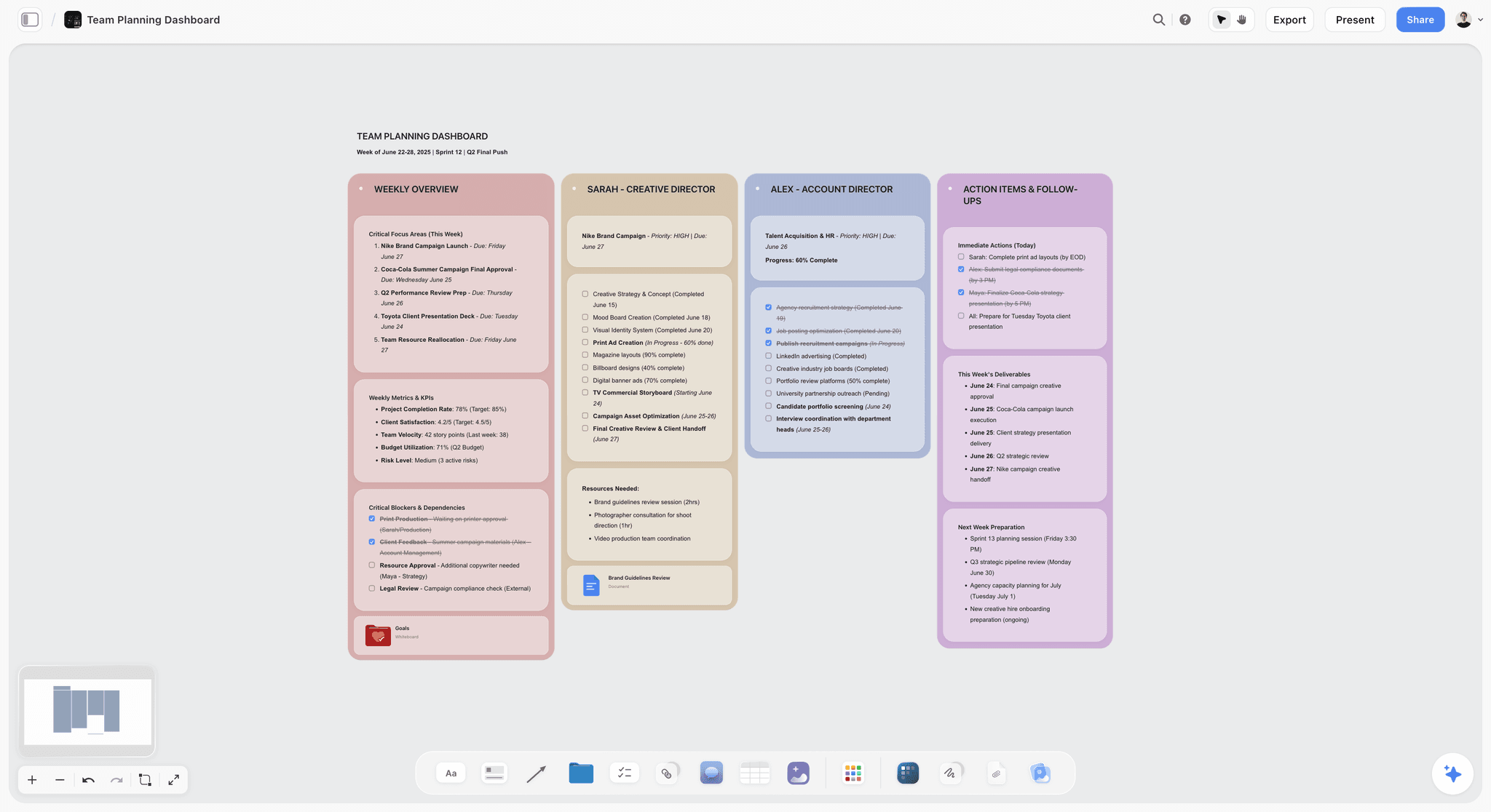
Storyflow is an AI-powered visual creative workspace: an infinite canvas with structured cards, real documents, context-aware AI, and a library of expert framework templates. It is the Google Docs alternative to pick when your writing is part of a bigger project, and you are tired of the document being an isolated tab while the research, the outline, and the plan live somewhere else.
Storyflow has documents, the same as Google Docs. The difference is where the document lives. In Google Docs, the document is the whole world, and everything it depends on sits in other tabs. In Storyflow, the document sits on a canvas next to research cards, mood boards, outlines, and a project plan, and the AI can read all of it. The writing stops being an island.
Best for: Writers, filmmakers, content teams, and founders whose documents are part of a larger project: a book, a film, a content program, a launch.
Verdict: The strongest pick for writing that connects to research and visual thinking. A pure linear word processor is simpler when the writing genuinely stands alone.
Key features
- Documents on a canvas. Real documents live on an infinite canvas next to research cards, images, links, mind maps, and a project plan, instead of in an isolated file.
- Context-aware AI. The AI reads your full active canvas board, plus up to 5 documents and 3 boards you attach. It can see the research and the plan, not just the paragraph you are writing.
- Expert framework templates. Structures including the Hero's Journey, AIDA, and Retention Hooks, available on Plus and above, so structure is something you start from instead of something you fight for.
- Unlimited shared boards and unlimited collaboration on every plan, including the upcoming free tier.
Pricing
Paid-only during early access: Plus: $7.99/month annual or $9.99/month monthly, which adds unlimited uploads. Pro: $14/month annual or $19/month monthly, which adds AI image generation and 20x more AI than Plus. Max: $39/month annual or $49/month monthly, which adds 40x more AI and a team workspace with permissions and roles. The Free plan (unlimited notes, images, and links, unlimited shared boards, unlimited collaboration, basic AI usage, and 20 file uploads) launches before the end of 2026.
Pros
- The document sits next to its research, outline, and plan, so context is one glance away instead of one tab away.
- The AI reads the whole board, so drafts and edits are grounded in the actual project, not a blank prompt.
- Framework templates give you proven structure for scripts, articles, and campaigns instead of a blank page.
- The Free plan, launching before the end of 2026, will be genuinely usable: unlimited boards, unlimited collaboration, no credit card.
Cons
- For a pure linear word processor with the exact Google Docs editing model, a traditional doc tool is simpler. Storyflow shines when the writing connects to a wider project, not when a one-page memo is the entire job.
- Cloud-only, with no local-first or self-hosted option, so privacy-driven switchers should look at Obsidian or ONLYOFFICE.
- The framework template library is a paid feature; the Free plan, once it launches, will ship without it.
If your writing keeps getting pulled apart by tabs, the test is simple. Take your most active writing project, the one with research scattered across files and browser windows, and rebuild it on a Storyflow canvas for one week. Put the document, the research, and the outline on one board, and let the AI read all of it. Start a Storyflow workspace and run that test.
2. Notion
Notion is the all-in-one workspace where documents, databases, and wikis share one surface. It is the strongest Google Docs alternative for teams whose writing belongs inside a larger knowledge base rather than in standalone files.
Best for: Teams and individuals who want docs, project tracking, and a wiki in one tool.
Verdict: The most complete Google Docs alternative for team knowledge work. The trade-off is that it is a workspace first and a writing tool second.
Key features
- Block-based editor where any page can hold text, tables, embeds, and databases.
- Databases that turn pages into trackable, filterable collections.
- Real-time collaboration, comments, and granular sharing.
- Notion AI for drafting, summarizing, and Q&A across connected pages.
Pricing
Free plan (generous, good for individuals and small teams). Plus: $10/user/month annual or $12/user/month monthly. Business: $20/user/month annual or $24/user/month monthly, which is also where full AI now lives. Enterprise: custom. Verified on Notion's pricing page in May 2026.
Pros
- The block model makes a single page as flexible as you need it to be.
- Databases connect writing to structured project data.
- Strong free plan for individuals.
Cons
- The editor is good but not built for sustained long-form prose the way a dedicated writing tool is.
- Full AI now requires the Business tier at $20/user/month.
- Offline support is limited compared to a true desktop word processor.
For the deeper comparison, see The 12 Best Notion Alternatives in 2026.
3. Microsoft Word
Microsoft Word is still the standard for formatting-heavy document work in 2026. It is the Google Docs alternative for anyone whose documents need precise layout, full track changes, and reliable offline editing.
Best for: Writers and professionals who need precise formatting, track changes, and offline document control.
Verdict: The most capable word processor in the category. The trade-off is the subscription model and a doc-first design that does not connect to wider project work.
Key features
- The deepest formatting, styling, and layout control of any tool here.
- Mature track changes and commenting for editorial workflows.
- Full offline editing on desktop, with cloud sync via OneDrive.
- Copilot AI assistance built into Microsoft 365.
Pricing
Microsoft 365 Family is $129.99/year (up to 6 people). Microsoft 365 Personal is priced higher than it once was, with promotional discounts in some regions, so verify the current rate at checkout. A limited free web version of Word exists with a Microsoft account. Verified in May 2026.
Pros
- Unmatched formatting precision for documents that need exact layout.
- Best-in-class track changes for serious editorial work.
- Genuine offline editing, not a degraded offline mode.
Cons
- A subscription is required for the full desktop app.
- The document is doc-shaped only; it does not connect to research or project planning.
- Real-time collaboration works but is less smooth than Google Docs or Notion.
4. Craft
Craft is the most beautiful document editor in this comparison. It is the Google Docs alternative for solo writers who care about how the document looks and feels while they write.
Best for: Solo writers, note-takers, and professionals who want a polished, focused writing surface.
Verdict: The nicest single-author writing experience in the category. Less suited to heavy multi-person collaboration.
Key features
- A genuinely beautiful, fast block-based editor with strong typography.
- Native apps across Mac, iPhone, iPad, Windows, and web.
- Daily notes, document linking, and a clean folder structure.
- Built-in AI assistant for drafting and editing.
Pricing
Free plan: up to 10 documents with 2 added weekly, 1 GB storage. Plus: $8/month annual or $10/month monthly, for unlimited documents and storage plus 500 AI requests per member monthly. Family: $15/month annual or $18/month monthly for up to five Plus accounts. Verified on Craft's pricing page in May 2026.
Pros
- The best-looking writing surface in the comparison.
- Fast native apps on every Apple and Windows device.
- Document linking gives a light second-brain feel.
Cons
- Collaboration is functional but not its strength.
- The free plan caps documents, which solo writers hit quickly.
- It is a document tool, not a project workspace.
5. Coda
Coda is the document that behaves like an app. It is the Google Docs alternative for people whose documents need tables, buttons, and logic, not just prose.
Best for: Teams building interactive docs: trackers, dashboards, and lightweight internal tools.
Verdict: The most powerful tool here for structured, interactive documents. Overkill if you mostly write prose.
Key features
- Documents that combine text with tables, buttons, and automations.
- Packs that connect docs to Slack, Jira, Gmail, and other services.
- Coda AI for generating and analyzing content inside docs.
- Per-Doc-Maker pricing, so editors and viewers collaborate free.
Pricing
Free plan (generous, with unlimited editors and viewers). Pro: $10/month per Doc Maker annual or $12/month monthly. Team: $30/month per Doc Maker annual or $36/month monthly. Enterprise: custom. Verified in May 2026.
Pros
- The most flexible structured-document tool in the comparison.
- The Doc Maker pricing model keeps costs down for teams with many viewers.
- Packs make docs genuinely interactive.
Cons
- For straightforward prose writing, it is more tool than the job needs.
- The learning curve is steeper than a normal word processor.
- Per-Doc-Maker pricing adds up once several people create docs.
For the deeper comparison, see The 12 Best Coda Alternatives in 2026.
6. Obsidian
Obsidian is the private, local-first writing tool. It is the Google Docs alternative for anyone whose first reason for leaving is that they do not want their drafts living in Google's cloud.
Best for: Privacy-focused writers, researchers, and long-form thinkers who want plain-text files they own.
Verdict: The strongest privacy and ownership pick. The trade-off is that collaboration and out-of-the-box polish are not its priorities.
Key features
- Plain-text Markdown files stored locally on your own device.
- Backlinks and a graph view for connecting notes and research.
- Canvas and the Bases database feature included in the free core app.
- A large community plugin ecosystem for almost any workflow.
Pricing
The core app is free for all use, including commercial use as of February 2026. Optional add-ons: Sync at $4/month annual ($5 monthly) and Publish at $8/month annual ($10 monthly). Verified on Obsidian's pricing page in May 2026.
Pros
- Your files are plain text on your own disk, fully owned and offline.
- The free core app has no feature restrictions.
- Backlinks make it a strong tool for research-heavy writing.
Cons
- Real-time collaboration is not a native strength.
- It rewards setup; out of the box it is barer than Notion or Craft.
- Sync across devices is a paid add-on.
7. ONLYOFFICE
ONLYOFFICE is the self-hosted, Microsoft-compatible document suite. It is the Google Docs alternative for teams that want collaborative documents on infrastructure they control.
Best for: Privacy-conscious teams and organizations that want to self-host their document editing.
Verdict: The strongest self-hosted option, with excellent Microsoft format compatibility. The trade-off is that the free path involves running it yourself.
Key features
- High-fidelity editing of Word, Excel, and PowerPoint formats.
- Real-time collaborative editing for documents.
- Open-source community edition under AGPL v3, free to self-host.
- DocSpace cloud option with a free Startup tier.
Pricing
The open-source community edition is free to self-host. DocSpace Cloud has a free Startup plan and a Business plan at $20/admin/month. Docs SaaS Business is around $8/user/month. Verified in May 2026.
Pros
- Genuine ownership: run the whole suite on your own server.
- The best Microsoft Office format compatibility outside Microsoft itself.
- A real free path for technically comfortable teams.
Cons
- Self-hosting requires technical setup and maintenance.
- The cloud editions are priced for organizations, not solo writers.
- The interface is more utilitarian than Craft or Notion.
8. Zoho Writer
Zoho Writer is the genuinely free, full-featured cloud word processor. It is the Google Docs alternative for anyone who wants a complete editing experience without paying anything.
Best for: Individuals and small teams who want a free, capable cloud word processor.
Verdict: The best free cloud word processor in the comparison. The trade-off is that it pulls you toward the wider Zoho ecosystem.
Key features
- A complete word processor that is free for individuals and organizations.
- Real-time collaboration, comments, and track changes.
- Document automation for generating files from business data (paid credits).
- Zia AI assistance for writing and grammar.
Pricing
Zoho Writer itself is free, with all core features included on sign-up. Document automation uses paid credits. The broader Zoho Workplace suite starts with a free 5-user plan, then Standard at $3/user/month. Verified in May 2026.
Pros
- A full word processor at no cost, not a stripped-down free tier.
- Strong real-time collaboration and editorial features.
- Clean, focused writing interface.
Cons
- It works best if you adopt other Zoho apps too.
- AI features are competent but not class-leading.
- It is a word processor; it does not connect to project research.
9. Apple Pages
Apple Pages is the free document editor built into the Apple ecosystem. It is the Google Docs alternative for writers who work mainly on a Mac, iPhone, and iPad.
Best for: Apple users who want a polished, free word processor with strong design templates.
Verdict: The best free option for Apple-first writers. The trade-off is that it is weakest outside the Apple ecosystem.
Key features
- Free core editing, creating, and collaboration across Apple devices.
- Strong design templates and page-layout capabilities.
- iCloud sync and a usable web version for non-Apple collaborators.
- Optional premium AI and content features via Apple Creator Studio.
Pricing
Pages remains free for core create, edit, and collaborate features. Apple Creator Studio, a subscription at $12.99/month or $129/year, adds premium templates and OpenAI-powered image features. Verified in May 2026.
Pros
- Genuinely free for the core writing experience.
- Excellent templates and layout control for visual documents.
- Smooth across Mac, iPhone, and iPad.
Cons
- The experience is weakest for non-Apple collaborators.
- Some newer features now sit behind the Creator Studio subscription.
- It is a standalone document tool with no project-level context.
10. Nuclino
Nuclino is the lightweight team wiki and document tool. It is the Google Docs alternative for small teams who want shared documents without the weight of a full workspace platform.
Best for: Small teams who want a fast, simple shared knowledge base.
Verdict: The cleanest lightweight team-docs tool here. The trade-off is that it is built for short pages, not long-form writing.
Key features
- A fast, distraction-free collaborative editor.
- Four content views: list, board, table, and graph.
- Backlinks and a graph view for connecting team knowledge.
- Sidekick AI for content generation and Q&A on paid tiers.
Pricing
Free plan: up to 50 items, 3 canvases, 2 GB storage, unlimited members. Starter: $6/user/month annual ($8 monthly). Business: around $10/user/month with full Sidekick AI. Verified in May 2026.
Pros
- Genuinely fast and simple to adopt across a small team.
- Multiple content views fit different kinds of knowledge.
- A usable free plan for small teams.
Cons
- Built for short wiki pages, not long-form documents.
- The free plan's 50-item limit is reached quickly.
- It is a team wiki, so solo writers may find it thin.
11. Dropbox Paper
Dropbox Paper is the simple collaborative document tool inside Dropbox. It is the Google Docs alternative for Dropbox users who want lightweight shared docs at no extra cost.
Best for: Existing Dropbox users who want simple, free collaborative documents.
Verdict: A clean, free option for Dropbox users. The trade-off is an uncertain long-term roadmap and web-only access.
Key features
- A minimal, distraction-free collaborative editor.
- Task lists, comments, and media embeds.
- Included with a Dropbox account at no extra charge.
- Templates for meeting notes and project planning.
Pricing
Free with a Dropbox account. As of October 2025, the mobile and desktop Paper apps were discontinued, and Paper is now web-only at paper.dropbox.com. Verified in May 2026.
Pros
- A clean, simple writing experience.
- No extra cost for existing Dropbox users.
- Good for lightweight notes and shared planning.
Cons
- The desktop and mobile apps were discontinued; it is web-only now.
- The long-term roadmap is uncertain, which is a real risk for important documents.
- Light on advanced formatting and structure.
12. Quip
Quip is the Salesforce-owned tool that combines documents, spreadsheets, and chat. It is the Google Docs alternative for teams already inside the Salesforce ecosystem.
Best for: Sales and service teams that work inside Salesforce.
Verdict: A reasonable fit for Salesforce-centric teams, and a harder sell for anyone else.
Key features
- Documents and spreadsheets with built-in team chat.
- Live apps and embedded data inside documents.
- Two-way Salesforce data sync on higher tiers.
- Mobile and desktop apps.
Pricing
Starter: $10/user/month annual ($12 monthly). Plus: $25/user/month. Advanced: $100/user/month with Salesforce-specific features. No free plan. Verified in May 2026.
Pros
- The document-plus-chat model suits some team workflows.
- Deep Salesforce integration on the Advanced tier.
- Solid mobile experience.
Cons
- No free plan, unlike most tools here.
- The value depends heavily on being a Salesforce shop.
- Outside the Salesforce ecosystem, stronger and cheaper options exist.
7) Writer-Type Recommendations
13. Solo Long-Form Writer / Author
Top picks: Storyflow + Craft
Storyflow for the book or manuscript that needs research, outline, and chapters on one canvas. Craft for the days when you just want the most beautiful place to write a single document. Together they cover both halves of the work.
14. Documentary Filmmaker / Video Creator
Top picks: Storyflow + Obsidian
Storyflow for the project canvas where the script, the research dossier, the interview notes, and the shot list all live together and the AI can read across them. Obsidian for a private, local archive of source material. This is the stack I use for my own film work.
15. Content Marketer / Editorial Team
Top picks: Storyflow + Notion
Storyflow for the editorial calendar, audience research, and the drafts themselves on one AI-aware board. Notion for the team wiki and process documentation. The writing connects to the plan instead of sitting in a separate file.
16. Privacy-First Professional
Top picks: Obsidian + ONLYOFFICE
Obsidian for plain-text files you own on your own disk. ONLYOFFICE when you need Microsoft-compatible collaborative documents on infrastructure you control. Neither puts your drafts in a search company's cloud.
17. Apple-Ecosystem Writer
Top picks: Apple Pages + Craft
Pages for the free, native, design-friendly document tool already on every Apple device. Craft for a more focused, link-friendly writing surface when the document is part of a larger set of notes.
18. Small Team / Startup
Top picks: Notion + Storyflow
Notion for the shared knowledge base, docs, and project tracking. Storyflow for the moments when a piece of writing needs research and visual planning around it. Notion has a real free plan; Storyflow is paid-only during early access (Plus at $7.99/month annual), with its own Free plan launching before the end of 2026.
8) Honorable Mentions
A few tools that came close but did not make the main twelve:
- LibreOffice Writer: A free, open-source, fully offline word processor. Did not make the list because it is a desktop-only experience with no real collaboration.
- Bear: A beautiful Markdown writing app for Apple users. Narrower than Craft and Apple-only.
- Slite: A clean team-docs and knowledge-base tool. Overlaps heavily with Nuclino.
- Confluence: Atlassian's team wiki. Strong for engineering orgs, heavier than most writers need.
- Google Docs itself, used differently: For a real share of people, the fix is not a new tool but pairing Google Docs with a separate canvas for research and planning.
These are not bad tools. Their audience or use case is narrower than the main list.
9) Where Google Docs Is Still the Right Answer
Honest accounting matters. There are cases where leaving Google Docs is a mistake, and pretending otherwise wastes the reader's time.
- Pure, fast, free collaboration. If you need to drop a link and have five people editing the same document in seconds, with zero setup and zero cost, Google Docs is still the best in the world at exactly that.
- A one-off memo or letter. When the document genuinely stands alone and connects to nothing, a blank Google Doc is the right shape. You do not need a workspace for a thank-you note.
- Universal familiarity. Almost everyone already knows Google Docs. For documents shared with clients, contractors, or family, that zero-friction familiarity has real value.
- Tight Google Workspace integration. If your organization runs on Gmail, Drive, and Calendar, Google Docs is the path of least resistance.
The honest test is this: ask whether the document needs to see anything else. If a document genuinely stands alone, Google Docs is hard to beat. If the document is part of a project (a book, a film, a campaign, a launch), and it keeps getting pulled apart by tabs, that is when an alternative earns the switch.
11) The Bottom Line
The best Google Docs alternative in 2026 depends on what the document has to do. Notion is the strongest all-in-one workspace for teams that live in docs and databases. Storyflow is the strongest pick for writers and teams who want documents that sit next to research, planning, and visual thinking on one AI-aware canvas. Microsoft Word is the strongest for formatting-heavy offline work. Obsidian and ONLYOFFICE are the strongest for privacy and local-first writing. Craft is the most beautiful single-author editor.
Here is the pattern underneath the whole list. Most people who leave Google Docs do not actually want a different word processor. They want their writing to stop being an island. The research, the outline, the plan, and the references should not live in twelve other tabs while the document sits alone. A document that cannot see your research is a worse document. The tool that fixes that is the tool worth switching to.
If your writing keeps getting pulled apart by tabs, the move is to take one active project and rebuild it on a canvas where the document, the research, and the plan live together. Start a Storyflow workspace and run that test for one week.
10) FAQ: Google Docs Alternatives in 2026
What is the best Google Docs alternative in 2026?
It depends on what the document has to do. For an all-in-one team workspace, Notion. For writing that connects to research and visual planning, Storyflow. For formatting-heavy offline work, Microsoft Word. For privacy and local files, Obsidian. Most people leaving Google Docs do not want a different word processor; they want their writing to stop being an isolated tab.
Is there a free alternative to Google Docs?
Yes, several. Zoho Writer is a full-featured cloud word processor that is genuinely free. Apple Pages is free for core editing on Apple devices. Obsidian's core app is free. ONLYOFFICE's community edition is free to self-host. Storyflow is paid-only during early access, with Plus at $7.99/month annual; its Free plan (unlimited boards and unlimited collaboration) launches before the end of 2026.
What is the best Google Docs alternative for privacy?
Obsidian for local-first, plain-text files you own on your own disk. ONLYOFFICE if you want Microsoft-compatible collaborative documents you can self-host on your own server. Both keep your drafts off a search company's cloud, which is the actual reason most privacy-driven switchers leave Google Docs.
Is Microsoft Word better than Google Docs?
For formatting precision, track changes, and offline editing, Word is stronger. For instant, free, zero-setup collaboration, Google Docs is stronger. Word requires a Microsoft 365 subscription for the full desktop app, while Google Docs is free for individuals. Pick by whether layout control or frictionless collaboration matters more for your work.
Can Storyflow replace Google Docs?
Storyflow has real documents, so for project-based writing it can replace Google Docs and add what Docs lacks: the document sits on a canvas next to research, outlines, and a plan, and the AI reads all of it. For a pure linear word processor with the exact Google Docs editing model on a standalone one-page memo, a traditional doc tool is simpler. Storyflow shines when the writing is part of a wider project.
What is the best Google Docs alternative for writers?
For long-form writing tied to research and planning, Storyflow, because the manuscript, the research, and the outline live on one canvas and the AI can read across them. For a beautiful single-author surface, Craft. For private local files, Obsidian. The right pick depends on whether the writing needs to connect to a wider project.
Is Notion a good replacement for Google Docs?
For teams, yes. Notion's block editor handles documents well, and databases connect writing to structured project data. The trade-off is that Notion is a workspace first and a writing tool second, so sustained long-form prose is smoother in a dedicated writing tool. Full AI also now sits on the Business tier at $20/user/month.
What is the best offline Google Docs alternative?
Microsoft Word for full desktop offline editing, Obsidian for local plain-text Markdown files, and Apple Pages for offline editing on Apple devices. LibreOffice Writer is a free, fully offline option as well. Cloud-first tools like Notion and Google Docs only offer limited offline modes.
How much does Storyflow cost?
Storyflow is paid-only during early access. Plus is $7.99/month annual or $9.99/month monthly and adds unlimited uploads. Pro is $14/month annual. Max is $39/month annual and adds 40x more AI plus a team workspace with permissions and roles. The Free plan (unlimited notes, images, links, shared boards, unlimited collaboration, basic AI, and 20 file uploads) launches before the end of 2026.
Is Dropbox Paper being discontinued?
Dropbox Paper is still available in 2026, but only through the web at paper.dropbox.com. The mobile and desktop Paper apps were discontinued in October 2025. For an important long-term document workflow, the uncertain roadmap is a real reason to choose something else.
Which Google Docs alternative is best for teams?
Notion for an all-in-one knowledge base with docs, databases, and a wiki. Storyflow when team writing needs research and visual planning around it on one AI-aware canvas. Notion has a strong free plan; Storyflow is paid-only during early access, with a Free plan launching before the end of 2026. Quip is a reasonable fit only for teams already inside the Salesforce ecosystem.
What is the smallest test I can run before switching?
Take the writing project that currently has research scattered across the most browser tabs and files. Move the document, the research notes, and the outline onto one Storyflow canvas, free tier, and write for one week with the AI reading the whole board. Most writers can tell within a few days whether the document being an island was the real problem. Try a Storyflow workspace to run that test.
Table of Contents
- Quick Answer: The Best Google Docs Alternatives in 2026
- Comparison Table: 12 Google Docs Alternatives Compared
- Why People Leave Google Docs
- How We Evaluated These Tools
- Quick Picks by Use Case
- Detailed Reviews: 12 Google Docs Alternatives in 2026
- Writer-Type Recommendations
- Honorable Mentions
- Where Google Docs Is Still the Right Answer
- FAQ: Google Docs Alternatives in 2026
- The Bottom Line
- Author
- Related Reading
Templates to check out for this topic


Workspace templates you can use in Storyflow
Keep research, notes, and plans on one canvas the AI can read, instead of scattered across docs and tabs. Open a template and make it your second brain.


See Storyflow in Action
A visual AI workspace where every feature lives inside one canvas. No tab-switching, no context lost.
Build your entire board from a single message
Type what you need in the AI chat at the bottom of your canvas. The AI adds cards, headings, and structure directly onto your board.
Use expert frameworks as AI context
Type @ in the AI chat and choose any Tactic. The AI tailors every response to that framework instead of giving generic advice.
Turn your board into a mind map in seconds
Ask the AI to restructure your canvas as a mindmap. It connects your ideas into a visual hierarchy so you can see how everything relates.
Why Storyflow Exists
Storyflow actually began as a personal tool while working on creative and research projects.
We kept running into the same problem: ideas were scattered everywhere: notes, documents, and whiteboards.
Nothing helped us see how everything connected.
So we started building a workspace designed around how ideas actually grow.
→ Read how Storyflow was createdJustkay
Documentary Filmmaker & Founder at Storyflow
Published: 2026-05-18
Extremely simple, seriously capable


See how easy it is to get started
Watch a real project come together, from a blank board to a finished plan, clicked through step by step.
Start creating with AI and become more productive
Transform your creative workflow with AI-powered tools. Generate ideas, create content, and boost your productivity in minutes instead of hours.