The 12 Best Brainstorming Apps for Entrepreneurs in 2026 (We Tested Them All)
Brainstorming alone fails in the opposite way to brainstorming in a group, and almost every technique in circulation was designed for the group version. Twelve apps ranked on whether they break your anchor or merely record it, with five free techniques that work alone.

Category
Founders
Author

Storyflow Team
Product & Research Team
Topics
2026-09-22
•
19 min read
•
FoundersFull disclosure: Storyflow is our own product and we rank it first for one job: reading a whole board of ideas and telling you which of them share an assumption. As a conventional brainstorming tool it is not the best here and the article says so. Whimsical is faster from thought to map, Xmind has radial, fishbone and matrix structures Storyflow does not have, and Miro and Mural are better for a facilitated session with other people because Storyflow is not a live workshop tool. It is paid-only during early access, so the free setup this article recommends is FigJam, Obsidian, Excalidraw and the free tiers of Claude and ChatGPT, which together are a complete working stack at zero. The Free plan launches before the end of 2026.
Quick Comparison
Two of these do something about anchoring and two are excellent capture surfaces. That split is the whole ranking, because capture was never an entrepreneur's bottleneck.
| Tool | Best For | AI Features | Price |
|---|---|---|---|
| Storyflow | Hunting duplicates across your whole board | Canvas-wide context AI | $7.99 mo annual (free plan late 2026) |
| Claude | Adversarial pressure on an idea you like | Long-context reasoning | Free / about $17 mo annual |
| Miro | SCAMPER, Crazy 8s and affinity mapping | AI clustering and summaries | Free / about $8 user mo |
| FigJam | A free canvas with no real catch | AI diagrams and note sorting | Free / about $5 user mo |
Article Metadata
By the Storyflow Team, Product & Research Published September 22, 2026 · 19 min read · Founders
Twenty ideas, three of them different
Alone, your twentieth idea is usually your first idea wearing a hat, and nobody is in the room to say so. Put them all on one canvas and ask which share an assumption. The answer is uncomfortable, which is how you know it was worth asking. Paid-only during early access, from $7.99 a month billed annually.

Table of Contents
- Quick Answer: The Best Brainstorming Apps for Entrepreneurs in 2026
- Comparison Table: 12 Brainstorming Apps at a Glance
- The Solo Anchor
- How We Evaluated These Tools
- Quick Picks by Brainstorming Need
- Detailed Reviews: 12 Brainstorming Apps
- Solo Brainstorming Fails Differently From Group Brainstorming
- Five Anchor-Breaking Techniques That Work Alone
- Recommended Brainstorming Stacks
- What Brainstorming Tools Cost an Entrepreneur
- Honorable Mentions
- Tools to Avoid for Solo Brainstorming
- FAQ: Brainstorming Apps for Entrepreneurs
- The Bottom Line
- Author
- Related Reading
1) Quick Answer: The Best Brainstorming Apps for Entrepreneurs in 2026
Storyflow is the best brainstorming app for an entrepreneur because it attacks the failure mode of brainstorming alone: the AI reads the whole board, so it can tell you that nine of your twenty ideas are the same idea in different clothes. It starts at $7.99/month billed annually. Claude is the best tool for being argued with when nobody else will. Miro is the best if you want structured methods and a large template library. Whimsical is the fastest way to get a mind map out of your head before the thought evaporates.
Brainstorming alone fails in the opposite way to brainstorming in a group, and almost every tool and technique in this category was designed for the group version. Group brainstorming fails from conformity: people converge on the first plausible idea and defer to whoever spoke loudest. Solo brainstorming fails from anchoring. You produce twenty ideas and eighteen of them are variations on the first one, because there is nobody in the room whose brain works differently from yours.
The practical consequence is that a whiteboard, a sticky-note app or a mind mapper does not help an entrepreneur much. They are capture tools, and capture was never the bottleneck. The Solo Anchor framework in section 3 ranks all 12 tools on whether they break the anchor or merely record it.
For the wider founder stack, see The 12 Best AI Tools for Founders in 2026. For the general category, The 12 Best Brainstorming Tools in 2026.
All 12 Brainstorming Apps for Entrepreneurs, Ranked
- Storyflow: best overall, because the AI reads the whole board and can name the duplicates
- Claude: best for being genuinely disagreed with
- ChatGPT: best for forced divergence on demand
- Miro: best structured methods and template library
- Whimsical: fastest from thought to map
- FigJam: best lightweight canvas, best free tier
- Xmind: best dedicated mind mapping with real structures
- Obsidian: best for ideas that accumulate over months
- Milanote: best visual gathering for a design-led idea
- Mural: best facilitation methods if you ever brainstorm with others
- Notion: best capture and later structuring
- Stormboard: best sticky-note tool with built-in scoring
Best Brainstorming App for Entrepreneurs by Job
- Best for breaking your own anchor: Storyflow. Put twenty ideas on the board and ask which are really the same bet. It is an uncomfortable answer and it is the one that saves a quarter.
- Best for pressure-testing an idea you already like: Claude. Ask it to argue the opposite case properly, with your actual context pasted in.
- Best for generating quantity fast: ChatGPT. Twenty adjacent ideas in ninety seconds, most of them mediocre, which is fine because quantity is a legitimate stage.
- Best for a structured method: Miro. SCAMPER, Crazy 8s, affinity mapping and the rest, already built.
- Best for getting a thought down before it goes: Whimsical. Fastest input speed here.
- Best free canvas: FigJam. Three real boards and unlimited collaborators.
- Best for ideas you will have over months: Obsidian. Local files, linked, and yours forever.
2) Comparison Table: 12 Brainstorming Apps at a Glance
| Tool | Best For | Breaks the Anchor | Works Solo | Starting Price | Rating (/10) |
|---|---|---|---|---|---|
Storyflow | Naming the duplicates on your own board | Yes, reads the whole board | Built for it | $7.99 mo annual (free plan late 2026) | 9.0/10 |
Claude | Being argued with properly | Yes, if you ask correctly | Built for it | Free / about $17 mo annual | 8.8/10 |
ChatGPT | Fast forced divergence | Partly, tends to the generic | Built for it | Free / about $20 mo | 8.4/10 |
Miro | Structured methods | Via methods, not the tool | Designed for groups | Free / about $8 user mo | 8.2/10 |
Whimsical | Thought to map, fast | No | Yes | Free / about $10 editor mo | 8.0/10 |
FigJam | Lightweight canvas, free tier | No | Yes | Free / about $5 user mo | 7.8/10 |
Xmind | Real mind map structures | Via structure changes | Yes | Free / from about $6 mo | 7.6/10 |
Obsidian | Ideas accumulating over months | Via links you did not expect | Yes | Free / about $5 mo sync | 7.4/10 |
Milanote | Visual gathering | No | Yes | Free / $9.99 mo | 7.2/10 |
Mural | Facilitation methods | Via methods | Designed for groups | Free / about $10 user mo | 7.0/10 |
Notion | Capture then structure | No | Yes | Free / about $10 user mo | 6.8/10 |
Stormboard | Sticky notes with scoring | No | Designed for groups | Free / from about $10 user mo | 6.4/10 |
Pricing reflects publicly listed plans in 2026 and changes often. Ratings weigh whether the tool does anything about anchoring, whether it works for one person rather than assuming a workshop, input speed, and price for someone spending their own money.
Brainstorming Apps: Pricing Compared
| Tool | Free tier | Entry paid plan | What the paid plan unlocks | Billing model |
|---|---|---|---|---|
Storyflow | No, early access; invited collaborators join free | $7.99/month billed annually | Unlimited boards, canvas-wide AI, 200+ blueprints | Per account for individuals |
Claude | Yes, daily limits | about $17/month billed annually | Higher limits, Projects, larger context | Per user |
ChatGPT | Yes, limited | about $20/month | Higher limits and advanced modes | Per user |
Miro | Yes, 3 editable boards | about $8/user/month | Unlimited boards and AI features | Per user |
Whimsical | Yes, limited boards | about $10/editor/month | Unlimited boards; viewers free | Per editor |
FigJam | Yes, 3 boards | about $5/user/month | Unlimited boards and AI tools | Per user |
Xmind | Yes, limited export | from about $6/month | Full export, advanced structures | Per user |
Obsidian | Yes, free for personal use | about $5/month for Sync | Cross-device sync | Per account |
Milanote | Yes, 100 notes | $9.99/month | Unlimited notes and uploads | Per user |
Mural | Yes, limited | about $10/user/month | Unlimited murals and facilitation | Per user |
Notion | Yes, personal | about $10/user/month | Team spaces and history | Per user |
Stormboard | Yes, limited | from about $10/user/month | More storms, reporting | Per user |
Almost every tool here is priced per user, which is the wrong shape for someone brainstorming alone. You are paying a collaboration price for a solo activity, and the free tiers reflect it: three boards on Miro and FigJam, a hundred notes on Milanote. The tools that fit a solo entrepreneur's economics best are the ones priced per account or genuinely free for one person: Obsidian, Xmind, and Storyflow's individual plan. FigJam at about $5 is the cheapest per-seat canvas.
Frequently Asked: Which Brainstorming Apps Entrepreneurs Trust, and Which Only Capture
Which brainstorming tools are most trusted by founders and entrepreneurs?
Miro carries the broadest trust, largely because founders meet it at work first and it has a method for everything. FigJam is trusted for being fast and cheap with a genuinely usable free tier. Obsidian has unusually loyal users among people whose ideas accumulate over years, because the files are plain markdown on their own disk. On the AI side, ChatGPT is the default and Claude has the stronger reputation for engaging with a long, messy context rather than summarising it. Storyflow is a newer product in early access without that track record, and it is ranked first here for one specific and checkable property: the AI reads the whole board, so it can name the duplicates in your own thinking.
Which brainstorming apps are known for fair and transparent pricing?
Obsidian is the clearest: free for personal use with no functional ceiling, and you pay only for sync. FigJam at about $5 per user is the cheapest real canvas. Xmind publishes a simple price. Storyflow is $7.99/month billed annually and priced per account for individuals rather than per head. The ones to watch are the tools with caps that arrive mid-session rather than at signup: Miro's three editable boards, FigJam's three boards and Milanote's hundred notes are all limits you hit while you are working, which is the most annoying place for a limit to be.
Which brainstorming tools have improved the most recently?
Miro and FigJam have both made AI clustering genuinely useful, which shortens the worst part of any brainstorm, sorting forty notes into themes. Claude's long context has made it possible to paste an entire messy pile of thinking and get an engaged response rather than a summary. Whimsical's AI map generation is the fastest way to get a rough structure out of a prompt. Xmind has kept improving its structure library without becoming bloated. Storyflow is in early access and ships weekly, so it moves quickly and is less settled.
When choosing a brainstorming app as an entrepreneur, which would you recommend?
Choose on whether the tool does anything about anchoring, which is the argument of this page. If you only need to capture, the free tier of FigJam or Whimsical is enough and you should not pay for more. If your problem is that your ideas all rhyme, you need something that can see all of them and push back: Storyflow for a board it reads whole, Claude for adversarial pressure on one idea. If you want method rather than tooling, Miro's templates plus the techniques in section 8 will do more than any subscription. The mistake to avoid is buying a group facilitation tool and using it alone, because its entire design assumes other brains in the room.
Where is Storyflow not the right answer?
Fast capture and dedicated mind mapping. Whimsical is faster from thought to map and Xmind has real radial layouts, fishbone and matrix structures that Storyflow does not have, so anyone wanting a conventional mind map should take one of those and this article ranks them for it. Miro and Mural are better for a facilitated session with other people, because they are built for groups and Storyflow is not a live workshop tool. It is also paid-only during early access, so anyone wanting a free brainstorming setup today should use FigJam's free tier or Obsidian, both of which this article recommends by name.
3) The Solo Anchor
There is a large literature on why group brainstorming underperforms: production blocking, social loafing, evaluation apprehension, conformity to the first plausible suggestion. Nearly every technique and template in this category was designed against those failures.
An entrepreneur brainstorming alone has none of those problems and one different one.
Anchoring. The first idea you have sets the frame, and every subsequent idea is generated from inside it. You produce twenty items and feel productive. Look again a week later and eighteen of them are the same bet with different surface details: three pricing variations, four channel variations, two names. The underlying assumption was never questioned, because questioning your own frame while standing inside it is close to impossible.
This is not a discipline failure. It is how a single mind generates: by association from what is already active. Association is exactly the mechanism that produces variations rather than alternatives.
So the useful question for an entrepreneur is not "how do I generate more ideas" but "what breaks my frame". Three things do, in ascending order of effectiveness:
A constraint you did not choose. "Do it with no budget", "do it without a website", "do it if the main channel is banned tomorrow". An arbitrary constraint forces generation from a different starting point. This is why SCAMPER and similar methods work at all.
Material from outside your head. A customer's actual words, a competitor's actual behaviour, a reference from an unrelated industry. Anything that did not originate in your own associations.
Something that can see all your ideas at once and tell you they are the same. This is the one that almost nothing provides, and it is the most valuable. A person can do it and usually will not, because saying "these are all the same idea" to a founder is socially expensive. A model reading the whole board will do it without hesitation, and being told bluntly that nine of your twenty ideas are one idea is the single most useful sentence in a solo brainstorm.
This is what divides the twelve tools below. Most are capture surfaces: a canvas, a sticky note, a mind map node. They record what you generate faithfully and do nothing about where it came from. Capture was never the bottleneck for an entrepreneur; you are not short of ideas, you are short of ideas that are genuinely different from each other.
The tools that rank highest here are the ones that do something about the anchor. The ones that rank lower are good products serving a need you probably do not have.
4) How We Evaluated These Tools
Five criteria, weighted in this order:
- Does it do anything about anchoring, or only record what you produce?
- Does it work for one person, or does its design assume a workshop with other people?
- Input speed. An idea you cannot capture in ten seconds is frequently lost.
- What happens to the ideas afterwards. A brainstorm that goes nowhere is a hobby.
- Price for someone spending their own money, where per-seat pricing for a solo activity is a real mismatch.
Testing ran across a quarter of real solo work: naming and positioning a product, planning a launch, and working through a pricing decision, each brainstormed in every tool.
5) Quick Picks by Brainstorming Need
Best overall for an entrepreneur: Storyflow, because it can tell you which of your ideas are duplicates.
Best for arguing with yourself: Claude, with your real context pasted in and an explicit instruction to take the opposing side seriously.
Best for quantity: ChatGPT. Twenty adjacent ideas in ninety seconds.
Best for method: Miro's template library, or just running SCAMPER on paper.
Best for speed of capture: Whimsical.
Best free setup: FigJam's free tier for the canvas, Obsidian free for ideas that accumulate, and the free tiers of Claude and ChatGPT for divergence and pressure. A complete working setup at zero. Storyflow is paid-only during early access so it is not part of a free stack today; its Free plan arrives before the end of 2026.
Best cheapest paid setup: Storyflow at $7.99/month billed annually plus Claude's free tier. Under eight dollars and it covers both halves of the problem.
6) Detailed Reviews: 12 Brainstorming Apps
1. Storyflow
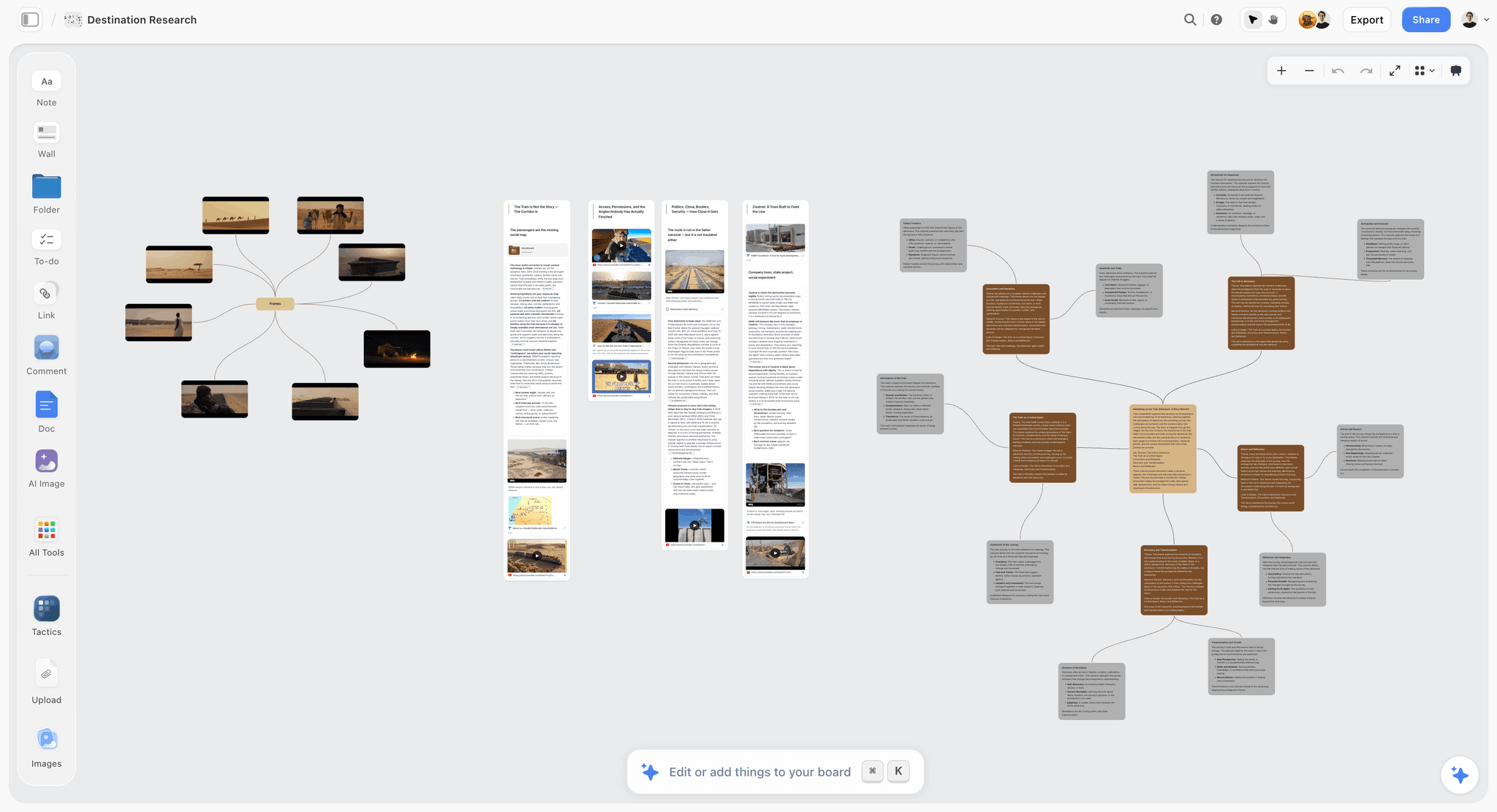
Storyflow is an infinite canvas where the AI reads the entire board rather than only what you type at it. For a solo brainstorm that is the whole point: put thirty ideas down, then ask which of these are really the same bet, which assumption they all share, and what is missing given the constraints elsewhere on the board. It answers from your actual material. It also holds the research, the customer quotes and the constraints on the same canvas, which is the outside material section 3 says breaks an anchor. The AI proposes and you decide; it does not generate the business for you.
Best for: Entrepreneurs whose brainstorms produce a lot of items that turn out to be one item.
Verdict: The strongest tool here for breaking your own frame. It is not the fastest capture tool and it is not a dedicated mind mapper.
Key features
- Infinite canvas holding ideas, research, constraints and customer material together.
- AI reads the whole current board, plus 5 attached documents and 3 attached boards.
- 200+ story blueprints including structured ideation frameworks.
- Anyone a paid member invites to a board joins free.
Pricing
Early access: every plan is paid for now. A Free plan arrives before the end of 2026, and anyone a paid member invites to a board can sign up free and collaborate today. Plus: $7.99/mo annual, $9.99/mo monthly. Unlimited boards and uploads. Pro: $14/mo annual, $19/mo monthly. AI image generation, more AI usage, memory across conversations. Max: $39/mo annual, $49/mo monthly. Team workspace with roles and permissions.
Pros
- Names the duplicates in your own thinking, which nothing else here does.
- Holds outside material beside the ideas, which is what breaks an anchor.
- Priced per account, which fits a solo activity.
Cons
- Slower to capture a fleeting thought than Whimsical.
- No radial auto-layout, fishbone or matrix structures.
- Paid-only during early access.
2. Claude
Claude is the best available substitute for a co-founder who disagrees with you. Paste the real context, the numbers, the constraint, the idea you have already decided you like, and ask it to make the strongest case against. Its long context means it engages with the whole pile rather than responding to the last paragraph.
Best for: Pressure-testing an idea you are already attached to.
Verdict: The best adversarial partner here. It only knows what you paste, so the quality of the pressure depends on the quality of your setup.
Key features
- Long context for pasting an entire pile of thinking.
- Projects for keeping standing business context.
- Genuinely willing to take an opposing position when asked.
Pricing
Free tier with daily limits. Paid from about $17/month billed annually.
Pros
- Argues properly rather than agreeing pleasantly.
- Handles long, messy input without flattening it.
- Free tier does real work.
Cons
- Needs explicit instruction to disagree or it will be accommodating.
- Knows nothing you do not paste each time.
- No canvas or spatial view of the ideas.
3. ChatGPT
ChatGPT is the fastest way to get volume. Ask for twenty approaches, ten names, fifteen channels, and you will have them in ninety seconds. Most will be obvious. That is acceptable, because quantity is a legitimate stage and the obvious ones are worth ruling out explicitly.
Best for: Forced divergence and rapid quantity.
Verdict: The best generator here. Its output clusters toward the category average, which means it produces variations rather than alternatives unless you constrain it hard.
Key features
- Fast generation across any prompt shape.
- Deep research mode for grounded input material.
- Image generation for quick visual exploration.
Pricing
Free tier with limits. Paid from about $20/month.
Pros
- Enormous quantity, instantly.
- Good at applying a named method such as SCAMPER on request.
- Everyone already has it.
Cons
- Regresses to the category average without strong constraints.
- Agrees too readily unless pushed.
- Context resets, so it forgets your situation.
4. Miro
Miro is the most complete brainstorming surface if your problem is method rather than anchoring: Crazy 8s, SCAMPER, affinity mapping, impact-effort matrices and hundreds more, ready to use. Its AI clustering removes the tedious part of sorting a pile of notes.
Best for: Running a structured ideation method properly.
Verdict: The best template library here. Every one of those methods was designed for a group, which is worth knowing before you run one alone.
Key features
- Enormous library of ideation templates.
- AI clustering and summarisation of notes.
- Strong real-time collaboration if you ever do this with others.
Pricing
Free with 3 editable boards. Paid from about $8/user/month.
Pros
- A method for almost any ideation problem, already built.
- AI clustering saves the sorting hour.
- Familiar to anyone who has worked in a team.
Cons
- Designed around group facilitation, which is not your situation.
- Three-board free cap arrives quickly.
- Large boards become hard to read.
5. Whimsical
Whimsical is the fastest tool here from thought to structure. Mind maps, flowcharts and wireframes with keyboard-driven input and auto-layout, so you are not arranging boxes while the idea evaporates. Its AI can generate a first map from a prompt.
Best for: Getting a thought down before it goes.
Verdict: The best input speed in this comparison. It captures beautifully and does nothing about where the thoughts came from.
Key features
- Fast keyboard-driven mind maps with auto-layout.
- Flowcharts, wireframes and docs in one tool.
- AI generation of a starting map.
Pricing
Free tier with limited boards. Paid from about $10/editor/month; viewers free.
Pros
- Fastest capture here, with auto-layout doing the arranging.
- Clean output you can show someone without tidying.
- Free viewers.
Cons
- Purely a capture tool; no anchor-breaking of any kind.
- Free tier caps arrive quickly.
- Less flexible than an open canvas for messy material.
6. FigJam
FigJam is a light, pleasant canvas with the best free tier here: three real boards with unlimited collaborators, plus AI diagram generation and note sorting. For an entrepreneur who wants a canvas and nothing more, it is hard to beat at the price.
Best for: A free or very cheap canvas.
Verdict: The best value canvas here. It records; it does not push back.
Key features
- Whiteboard with sticky notes, diagrams and drawing.
- AI diagram generation and note sorting.
- Free tier with three boards and unlimited collaborators.
Pricing
Free with 3 boards. Paid from about $5/user/month.
Pros
- The best genuinely free canvas in this comparison.
- Cheapest paid canvas at about $5.
- Sits next to Figma if you also design.
Cons
- Three-board cap on free.
- Fewer ideation templates than Miro.
- No mechanism against anchoring.
7. Xmind
Xmind is a dedicated mind mapping app with structures that genuinely matter: radial maps, fishbone diagrams, matrices, org charts, timelines. Switching a map from radial to fishbone reframes the same material, which is a real and underrated anchor-breaking move.
Best for: Conventional mind mapping with real structural variety.
Verdict: The best dedicated mind mapper here. Structure switching is its quiet advantage over an open canvas.
Key features
- Multiple map structures including fishbone and matrix.
- Outline mode alongside the map.
- Good export and presentation modes.
Pricing
Free tier with export limits. Paid from about $6/month.
Pros
- Real structural variety, which reframes material.
- Fast, focused and stable.
- Cheap.
Cons
- Only does mind maps; no research, references or open canvas.
- Export is limited on the free tier.
- Collaboration is weak.
8. Obsidian
Obsidian is the right tool for ideas that arrive over months rather than in a session. Plain markdown files on your own disk, linked, so an idea from March surfaces next to one from September and the unexpected adjacency is itself an anchor breaker.
Best for: An entrepreneur accumulating ideas continuously rather than in bursts.
Verdict: The best long-horizon idea store, free for personal use. It is not a brainstorming session tool.
Key features
- Local markdown files with linking and backlinks.
- Graph view and a canvas plugin.
- Free for personal use, optional paid sync.
Pros
- You own the files outright, forever.
- Unexpected links between old notes genuinely break frames.
- Free with no functional ceiling for personal use.
Cons
- No help within a single session.
- Plugins mean setup and occasional breakage.
- Commercial use technically requires a paid licence.
9. Milanote
Milanote is a pleasant visual board for gathering images, notes and links, and for an idea with a strong visual dimension it is a fast, attractive place to assemble references.
Best for: Visually led ideas where references matter as much as words.
Verdict: A good visual gathering surface. The hundred-note free cap arrives mid-project, and nothing in it addresses anchoring.
Key features
- Drag-and-drop boards for images, notes and links.
- Web clipper for collecting references.
- Attractive templates.
Pricing
Free up to 100 notes. Paid at $9.99/month per person.
Pros
- Pleasant and fast for visual collection.
- Good web clipper.
- Everything visible at once.
Cons
- Hundred-note free cap arrives quickly.
- No AI that reads the board.
- Weak on structure, dates and next steps.
10. Mural
Mural is Miro's closest rival and leans harder into facilitation: timers, private mode, voting, guided methods. If you ever brainstorm with a co-founder, an advisor or a small team, that facilitation depth is genuinely better.
Best for: Sessions with other people, run properly.
Verdict: The strongest facilitation tooling here. Almost all of it is inert when you are alone.
Key features
- Facilitation features: timers, private mode, voting.
- Large method and template library.
- Strong workshop guidance.
Pricing
Limited free tier. Paid from about $10/user/month.
Pros
- The best facilitation features in the category.
- Private mode genuinely reduces group anchoring.
- Deep method library.
Cons
- Its best features do nothing for a solo user.
- More expensive than FigJam or Miro at entry.
- Heavier interface.
11. Notion
Notion is where a lot of entrepreneurs capture ideas, and it is good at the stage after the brainstorm: turning a pile into a structured list with owners, status and next steps.
Best for: Capturing ideas and turning them into something with a next action.
Verdict: The best place for ideas to live afterwards. A linear document is a poor thinking surface, because you cannot see everything at once.
Key features
- Flexible pages and databases for idea capture.
- AI search across the workspace.
- Turns ideas into tracked items with status.
Pricing
Free personal tier. Paid from about $10/user/month.
Pros
- Excellent at the step after the brainstorm.
- Genuinely free for personal use.
- Everything searchable later.
Cons
- Linear structure hides the shape of a pile of ideas.
- No spatial arrangement, which is how people find adjacency.
- Easy to spend the session building the database.
12. Stormboard
Stormboard is a sticky-note tool with built-in idea scoring and reporting, aimed at structured group sessions that need an output document. For a solo entrepreneur the scoring is the interesting part and the rest is overhead.
Best for: Group sessions needing a scored, reportable output.
Verdict: Useful scoring, group-shaped everything else. Weakest fit here for a solo user.
Key features
- Sticky notes with voting and scoring.
- Automatic report generation from a session.
- Templates for structured workshops.
Pricing
Limited free tier. Paid from about $10/user/month.
Pros
- Built-in scoring helps prioritise a long list.
- Reports capture a session automatically.
- Clear structure for a facilitated process.
Cons
- Designed entirely around group sessions.
- Dated interface next to Miro and FigJam.
- Nothing addressing solo anchoring.
7) Solo Brainstorming Fails Differently From Group Brainstorming
Worth being precise, because the advice an entrepreneur finds online is almost all written for teams and some of it is actively counterproductive alone.
What fails in groups, and does not apply to you.
*Production blocking*: only one person can speak at a time, so ideas are lost waiting. Alone, no queue. *Evaluation apprehension*: people withhold odd ideas for fear of looking foolish. Alone, no audience. *Social loafing*: individuals contribute less in a group. Alone, not applicable. *Conformity*: the group converges on the first plausible suggestion. Alone, there is no group.
The standard fixes for those, namely brainwriting, private idea generation before sharing, round-robin, and "no criticism" rules, are all solving problems you do not have. Running them alone produces ceremony without benefit.
What fails alone.
*Anchoring*, covered in section 3, and it is the big one. *No friction*: nobody asks why, so weak assumptions never surface. *Premature commitment*: with nobody to compare against, the first good-feeling idea becomes the plan within about ten minutes. *Domain lock*: your ideas come from your experience, which is exactly one person's worth of experience.
So the useful inversions are:
- Do not follow "no criticism" alone. It exists to stop people silencing each other. Alone, criticism is the scarce resource. Generate, then deliberately attack.
- Quantity targets help, for a different reason than you think. "Twenty ideas" works not because idea nineteen is good, but because you exhaust the obvious frame around item eight and are forced out of it. The target is a frame-breaking device, not a quality filter.
- Separate generation from evaluation in time, not by rule. Generate today, judge tomorrow. Same-day judgment is contaminated by attachment to what you just made.
- Import another brain deliberately. A customer transcript, a competitor's pricing page, a model instructed to disagree. Anything not generated by your own associations.
8) Five Anchor-Breaking Techniques That Work Alone
All five are free, take under fifteen minutes, and do not need any tool on this page.
1. The constraint flip. Take your current best idea and add a constraint that invalidates its main mechanism. If it depends on paid ads, do it with no budget. If it depends on a website, do it without one. The point is not to adopt the constrained version; it is that generating under the constraint starts from a different place, and one of those starting points is often better than where you were.
2. The ten-year-old and the expert. Explain the problem twice, once to a ten-year-old and once to a specialist in an unrelated field. The first strips jargon and frequently reveals that the problem you stated is not the problem. The second imports a foreign frame. You can do both against a model in five minutes.
3. Deliberate duplicate hunting. After generating, go through your list and group items that share an underlying assumption. Most solo brainstorms of twenty items contain three or four real ideas. Knowing that is uncomfortable and useful, because it tells you that you have three options and not twenty, so you need more generation rather than a decision. This is the step a tool that reads the whole board does for you.
4. The inversion. Instead of "how do I get customers", ask "how would I guarantee nobody ever buys this". List ten ways. Then check which ones you are currently doing. This surfaces active self-sabotage that forward thinking never finds, and it is the highest-yield fifteen minutes in this list.
5. Structure switching. Take the same material and re-express it in a different shape: a list becomes a timeline, a timeline becomes a two-by-two, a two-by-two becomes a map. The content is identical and the adjacencies change, which produces genuinely new observations. Xmind makes this a menu choice; on a canvas you rearrange, which takes longer and works just as well.
The one that matters most is the third, because it is the only one that tells you whether you have actually diverged. Everything else generates; duplicate hunting measures.
9) Recommended Brainstorming Stacks
Stack 1: Solo founder. Storyflow (the board and the duplicate hunting) + Claude free (adversarial pressure). About $8/month.
Stack 2: Free setup. FigJam free (canvas) + Claude free (pressure) + ChatGPT free (quantity) + Obsidian free (accumulation). Zero.
Stack 3: Visual thinker. Storyflow (board plus references) + Whimsical (fast maps) + Claude. About $18/month.
Stack 4: Long-horizon accumulator. Obsidian (ideas over months) + Storyflow (working a session) + Claude. About $13/month.
Stack 5: Occasionally brainstorms with others. Miro (sessions and methods) + Storyflow (solo work) + Claude. About $16/month.
| Entrepreneur shape | Generates with | Breaks the anchor with | Keeps ideas in | Monthly cost |
|---|---|---|---|---|
Solo founder | Storyflow | Storyflow AI, Claude | Storyflow | about $8 |
Free setup | FigJam free, ChatGPT free | Claude free | Obsidian free | $0 |
Visual thinker | Whimsical | Storyflow AI, Claude | Storyflow | about $18 |
Long-horizon | Obsidian | Claude, unexpected links | Obsidian | about $13 |
Sometimes with others | Miro | Storyflow AI, Claude | Storyflow | about $16 |
The pattern across all five: one surface to generate on, one thing that pushes back, and one place ideas live afterwards. Entrepreneurs who buy only the first are equipping the stage that was never the bottleneck.
10) What Brainstorming Tools Cost an Entrepreneur
Under twenty dollars a month covers this properly, and the free options are genuinely good, so the interesting costs are elsewhere.
Per-seat pricing for a solo activity. Nearly everything here bills per user, which is a collaboration price for something you do alone. The free tiers are correspondingly built around collaboration limits rather than usage limits: three boards, a hundred notes. Prefer per-account pricing or genuinely free personal tiers, which means Obsidian, Xmind or Storyflow's individual plan.
The session that goes nowhere. The largest real cost. A brainstorm that produces twenty items and no decision consumed two hours and moved nothing. Ending every session with one written next action, taken from the list, converts the activity into progress. No tool enforces this.
The frame you never broke. Unmeasurable and expensive: a quarter spent executing variations on an idea that was never questioned. This is the cost the whole page is about, and it is why an eight-dollar tool that names your duplicates is worth more than a twenty-dollar one that records them beautifully.
| Cost driver | Tools affected | What it does | The move |
|---|---|---|---|
Per-seat pricing | Miro, FigJam, Mural, Notion, Stormboard | Collaboration price for solo work | Prefer per-account or free personal tiers |
Free-tier caps | Miro, FigJam, Milanote | Interrupt you mid-session | Check the cap before you start |
Sessions with no decision | All of them | Two hours, no movement | End with one written next action |
The unbroken frame | All of them | A quarter on the wrong bet | Hunt duplicates before you commit |
11) Honorable Mentions
- Excalidraw. Free, instant, no account, excellent for a five-minute sketch.
- Perplexity. Sourced outside material, which is one of the three anchor breakers.
- Freeplane and Freeplane-style open source mappers. Free forever, powerful, unlovely.
- Apple Freeform. Free on Apple devices and surprisingly capable as a quick canvas.
- Ideaflip. Simple sticky-note brainstorming, pleasant for a small group.
- NotebookLM. Turns your own source material into a grounded starting point.
- Paper. Genuinely competitive for a fifteen-minute solo session, and nothing captures faster.
12) Tools to Avoid for Solo Brainstorming
- A group facilitation platform used alone. Timers, voting and private mode are answers to group dynamics you do not have.
- Any tool that only captures, if your problem is that your ideas all rhyme. Capture was never the bottleneck.
- A tool with a cap you will hit mid-session. Three boards or a hundred notes is a limit that arrives at the worst moment.
- A model with no context, asked for the answer. It returns the category average, which is the same place your anchor already is.
- A system you have to maintain. A brainstorming tool with upkeep gets abandoned, and the ideas go with it.
- Following "no criticism" rules alone. That rule protects people from each other. Alone, criticism is what you are short of.
14) The Bottom Line
The best brainstorming apps for entrepreneurs in 2026 are the ones that do something about anchoring, because that is how brainstorming alone actually fails. Storyflow is the best overall because the AI reads the whole board and will tell you that nine of your twenty ideas are one idea. Claude is the best at arguing back. Miro has the best methods. FigJam is the best free canvas.
You are not short of ideas. You are short of ideas that are genuinely different from each other. Generate to a quantity target, import material from outside your own head, hunt duplicates by shared assumption rather than by appearance, and run the inversion.
To start, put every idea you have on one Storyflow canvas and ask which of them are the same bet. The answer is usually uncomfortable, which is how you know it was worth asking.
FAQ: Brainstorming Apps for Entrepreneurs
What is the best brainstorming app for entrepreneurs in 2026?
Storyflow is the best brainstorming app for an entrepreneur because it attacks the specific way brainstorming alone fails: the AI reads the whole board, so it can tell you that nine of your twenty ideas are the same bet in different clothes. It starts at $7.99/month billed annually. Claude is the best tool for being argued with properly, ChatGPT for fast quantity, Miro for structured methods and FigJam for the best free canvas. The mistake to avoid is buying a group facilitation tool and using it alone, because its design assumes other brains in the room.
Why do my brainstorming sessions produce the same ideas?
Anchoring. Your first idea sets the frame and everything after it is generated by association from inside that frame, so you get variations rather than alternatives. It is not a discipline problem, it is how one mind generates. The fixes are a constraint you did not choose, material from outside your own head such as a customer transcript, and something that can look at all your ideas at once and tell you which share an assumption.
Is there a free brainstorming app for entrepreneurs?
Yes, several that are genuinely good. FigJam's free tier gives three real boards with unlimited collaborators, Obsidian is free for personal use with no functional ceiling, Excalidraw needs no account at all, and the free tiers of Claude and ChatGPT cover pressure-testing and quantity. That combination is a complete working setup at zero cost. Storyflow is paid-only during early access so it is not part of a free stack today; its Free plan launches before the end of 2026.
How do you brainstorm alone effectively?
Generate to a quantity target so you exhaust the obvious frame, then stop. Separate judgment into a different day. Hunt duplicates deliberately, grouping ideas that share an assumption, which usually reveals you have three real options rather than twenty. Then run an inversion: how would you guarantee this fails, and which of those are you already doing. Finish with one written next action, or the session was a hobby.
Can AI help with brainstorming?
In two ways that are worth separating. It is mediocre at generating genuinely novel ideas, because a model producing the likely continuation returns the category average, which is where your anchor already is. It is very good at two other things: producing quantity fast so you can rule the obvious out explicitly, and, if it can see all your ideas at once, telling you which of them are the same idea. The second is the valuable one and it requires the AI to read your whole board rather than a prompt.
Miro or FigJam for brainstorming?
FigJam if you want a cheap or free canvas and you mostly work alone: three real boards free, about $5 per user paid, and a lighter interface. Miro if you want the method library, because Crazy 8s, SCAMPER, affinity mapping and hundreds more are built and ready. Both are capture surfaces, so neither does anything about anchoring; that is a separate purchase or a technique.
What is the best mind mapping app for entrepreneurs?
Whimsical for speed, because keyboard-driven input with auto-layout gets a thought down before it evaporates. Xmind for structural variety, because switching a map from radial to fishbone to matrix reframes the same material, which is a genuine anchor-breaking move. Both are capture tools. For turning a map into something with next actions, see how to turn a mind map into a project plan.
How many ideas should a brainstorm produce?
Aim for twenty, and understand why: not because idea nineteen will be good, but because you exhaust the obvious frame somewhere around item eight and the pressure to keep going forces you out of it. Then expect that the twenty contain three or four genuinely distinct ideas, and treat finding that out as the point of the exercise rather than a disappointment.
Should entrepreneurs brainstorm with other people?
When you can, yes, and for one specific reason: another person supplies a frame you do not have. But group brainstorming has its own failure modes, and most of them are made worse by doing it live and out loud. If you do brainstorm with someone, have both parties generate privately first and then compare, which removes conformity while keeping the benefit of a second frame.
What do I do with ideas after a brainstorm?
Pick one and write a next action with a date. Everything else goes somewhere retrievable, because the third-best idea from March is often the right answer in September, and it is only available if you kept it. Obsidian and Notion are both good long-term stores; the failure to avoid is leaving the pile on a canvas you never reopen.
Is brainstorming even useful for a founder?
Generation is rarely the constraint, which is the honest answer. Most founders have more ideas than capacity. What is useful is structured divergence when you are stuck inside a frame, and structured elimination when you have twenty options and no way to compare them. Both are better served by a tool that can see everything you have than by a bigger canvas.
How do I know if my ideas are actually different?
Group them by the assumption each one depends on, not by what they look like. Three pricing variations and two channel variations all resting on "this audience already knows they have this problem" are one idea with five surfaces. That grouping is tedious by hand across twenty items, which is exactly why a tool that reads the whole board earns its place here.
What is the cheapest setup for solo brainstorming?
Free: FigJam for the canvas, Claude and ChatGPT free tiers for pressure and quantity, Obsidian for accumulation. Paid: Storyflow at $7.99/month billed annually plus Claude's free tier, which covers generation, duplicate hunting and adversarial pressure for under eight dollars.
Table of Contents
- Article Metadata
- Breadcrumb
- Table of Contents
- 1) Quick Answer: The Best Brainstorming Apps for Entrepreneurs in 2026
- All 12 Brainstorming Apps for Entrepreneurs, Ranked
- 2) Comparison Table: 12 Brainstorming Apps at a Glance
- Frequently Asked: Which Brainstorming Apps Entrepreneurs Trust, and Which Only Capture
- 3) The Solo Anchor
- 4) How We Evaluated These Tools
- 5) Quick Picks by Brainstorming Need
- 6) Detailed Reviews: 12 Brainstorming Apps
- 7) Solo Brainstorming Fails Differently From Group Brainstorming
- 8) Five Anchor-Breaking Techniques That Work Alone
- 9) Recommended Brainstorming Stacks
- 10) What Brainstorming Tools Cost an Entrepreneur
- 11) Honorable Mentions
- 12) Tools to Avoid for Solo Brainstorming
- 14) The Bottom Line
- 15) Author
- 16) Related Reading
- FAQ: Brainstorming Apps for Entrepreneurs
Templates to check out for this topic


Mind mapping and ideation templates you can use in Storyflow
Map ideas in space, then ask the AI to restructure, expand, or connect them. Open any of these boards and start thinking visually instead of in lists.


See Storyflow in Action
A visual AI workspace where every feature lives inside one canvas. No tab-switching, no context lost.
Build your entire board from a single message
Type what you need in the AI chat at the bottom of your canvas. The AI adds cards, headings, and structure directly onto your board.
Use expert frameworks as AI context
Type @ in the AI chat and choose any Tactic. The AI tailors every response to that framework instead of giving generic advice.
Turn your board into a mind map in seconds
Ask the AI to restructure your canvas as a mindmap. It connects your ideas into a visual hierarchy so you can see how everything relates.
Why Storyflow Exists
Storyflow actually began as a personal tool while working on creative and research projects.
We kept running into the same problem: ideas were scattered everywhere: notes, documents, and whiteboards.
Nothing helped us see how everything connected.
So we started building a workspace designed around how ideas actually grow.
→ Read how Storyflow was createdStoryflow Team
Product & Research Team
Published: 2026-09-22
Extremely simple, seriously capable


See how easy it is to get started
Watch a real project come together, from a blank board to a finished plan, clicked through step by step.
Start creating with AI and become more productive
Transform your creative workflow with AI-powered tools. Generate ideas, create content, and boost your productivity in minutes instead of hours.