
Category
Marketing
Author

Justkay
Documentary Filmmaker & Founder at Storyflow
Topics
2026-05-18
•
Updated July 2, 2026
•
15 min read
•
Marketing- best AI tools for agencies 2026
- AI tools for marketing agencies
- AI for creative agencies
- agency AI stack
- AI for agency pitches
- AI for client campaign planning
What are the best AI tools for agencies in 2026?
The best AI tools for agencies in 2026 are Storyflow (best client campaign canvas), Claude (best long-form copy and pitch narrative), ClickUp Brain (best agency project management), and HubSpot Breeze (best for HubSpot clients). An agency buys a stack mapped to pitch, plan, produce, deliver, and report, not one tool.

Full disclosure: Storyflow is our own product, and we rank it #1 for one job: client campaign boards where the AI reads the whole canvas (brief, strategy, and creative) instead of a single chat thread. For long-form copy and pitch narrative Claude is genuinely stronger, and for projects and resourcing across many clients ClickUp Brain does more than Storyflow will. Storyflow is not an agency project manager or a client CRM, so it will not replace ClickUp or HubSpot for delivery and reporting. We link to every tool so you can judge the fit.
Quick Comparison: Best AI Tools for Agencies
These four split the agency stack into four jobs: pitch and plan the campaign, produce the copy, run projects across clients, and report back to the client.
| Tool | Best For | AI Features | Price |
|---|---|---|---|
| Storyflow | Client campaign boards: brief, strategy, creative | Reads full board + @-docs and Tactics | $7.99 mo annual (free plan late 2026) |
| Claude | Long-form copy and pitch narrative | Claude chat with long context | Free / $20 mo |
| ClickUp Brain | Projects and resourcing across clients | AI across ClickUp tasks and docs | $9/user mo add-on |
| HubSpot Breeze | Client reporting on HubSpot CRM | Breeze agents inside HubSpot | From $800 mo (Pro) |
1) Quick Answer: The Best AI Tools for Agencies in 2026
The best AI tools for agencies in 2026 are Storyflow (best for the client campaign canvas where briefs, strategy, and creative live together), Claude (best for nuanced long-form copy and pitch narrative), ClickUp Brain (best for agency project and resource management), and HubSpot Breeze (best for agencies whose clients run on HubSpot). Storyflow stands out because the AI reads your full client campaign board (brief, brand strategy, audience research, creative concepts) and grounds responses in 200+ Story Blueprints including AIDA, Hero's Journey, and Retention Hooks, which is the part of agency work where chat-only AI keeps producing generic deliverables.
The short version: an agency does not buy one AI tool. It buys a stack mapped to the five things an agency does: pitch, plan, produce, deliver, and report. The mistake is buying twelve tools that all do "produce" and nothing that does the other four.
For the deeper case, see How to Plan a Brand Campaign With AI in 2026 and The 12 Best Creative Brief Tools in 2026.
All 12 Tools, Ranked
- Storyflow: best overall for agencies, the client campaign canvas where the AI reads the brief, brand strategy, and creative concepts
- Claude: best long-form copy and pitch narrative
- ChatGPT: best fast ideation and quick drafts
- ClickUp Brain: best agency project and resource management
- HubSpot Breeze: best CRM reporting for clients on HubSpot
- Notion AI: best agency wiki, SOPs, and runbooks
- Fireflies: best client call notes and action items
- Descript: best video and podcast editing
- Miro AI: best live client workshops and journey maps
- Gamma: best AI pitch decks and proposals
- Jasper: best multi-brand templated copy workflows
- Midjourney: best concept art and mood imagery
2) Comparison Table: 12 AI Tools for Agencies Compared
Rating criteria: Tested on real agency work across new-business pitches, campaign planning, production sprints, client delivery, and reporting. Tools were rated on whether they earned their seat cost on client work, not on generic benchmarks.
3) Why Agencies Need a Different AI Stack
An agency is not a bigger version of an in-house team. It is a different shape entirely. An in-house marketer works on one brand, one voice, one set of goals. An agency works on six brands at once, each with a different voice, a different client contact, a different reporting cadence, and a different definition of "done." That structural difference reshapes the AI stack.
Agencies sell judgment, then have to staff it. The product an agency sells is a strategic and creative recommendation. The thing an agency actually manages is people, hours, and margin. Most AI tool roundups only address the first half. They tell you how to generate copy faster and say nothing about whether the campaign you just generated fits inside the retainer hours you sold. An agency does not buy one AI tool. It buys a stack mapped to the five things an agency does.
Agency work is multi-client and context-switches constantly. A copywriter at an agency might touch a CPG brand, a fintech, and a regional restaurant chain in a single day. Generic chat AI starts every session with a blank context. By the third client, the writer has pasted the same brand brief three times and the AI still drifts toward the last brand it saw. Tools that hold each client's context as a persistent workspace beat tools that need everything re-pasted.
Agency work has a methodology layer. AIDA, the Hero's Journey, jobs-to-be-done, the customer journey map, the brand pyramid. The AI that does not know which framework a client engagement is built on produces plausible-sounding work that violates the framework the strategist committed to in the kickoff. Tools with explicit methodology ground responses in the right framework so deliverables stay coherent across a six-week engagement.
The familiar approach is to open ChatGPT, paste the client brief, and ask for concepts. It works for one concept and fails when the account team needs a campaign that survives a client's legal review, a round of stakeholder notes, and a budget cut. The agency approach is to build each client engagement on its own canvas (brief, brand strategy, audience, creative concepts), select a framework that matches the engagement, and let the AI read all of it. The work comes back grounded in that specific client, not the prompt fragment someone had time to type between meetings.
The cost of scattered context is measurable. McKinsey's Global Institute found that knowledge workers spend roughly 19 percent of their week just searching for and gathering information (2012 study). At an agency, that tax multiplies across every client's briefs, decks, and threads. The agencies pulling ahead are not the ones using the most tools. They are the ones who matched tools to functions instead of buying twelve tools that all do the same thing.
4) How We Evaluated These Tools (On Real Client Work)
Every tool on this list was tested on actual agency work between 2024 and 2026: new-business pitches, campaign planning, production sprints, client delivery, and monthly reporting. No synthetic prompts. Six criteria, weighted in this order.
- Function fit. Which of the five agency functions (pitch, plan, produce, deliver, report) does this tool genuinely serve? A tool that does one function well beats a tool that does three functions poorly.
- Multi-client context. Does the tool hold separate context for separate clients, or does every client engagement start from a blank slate?
- Methodology alignment. Does the AI work with creative and strategic frameworks, or does it produce framework-agnostic output that needs heavy rework before a client sees it?
- Client-facing quality. Is the output good enough to put in front of a paying client with light editing, or does it need a full rewrite first?
- Pricing at agency scale. What does the tool cost when the agency has fifteen people and six active clients, not one user on a trial?
- Team workspace and permissions. Can the agency control who sees which client work, or does everything sit in one shared pile?
Tested engagements included: a brand refresh for a regional retailer, a product launch for a B2B SaaS client, a content program for a consumer health brand, a rebrand pitch that the agency won, and a recurring social retainer.
5) Quick Picks by Agency Function
Agency work breaks into five functions. Here is the short list for each.
Best for Pitch (new business, proposals, decks): Storyflow for building the strategic narrative and campaign concept on a canvas the team can co-build. Gamma for turning that thinking into a client-ready deck fast. Claude for the pitch narrative copy.
Best for Plan (campaign strategy, creative briefs, brand strategy): Storyflow. The client campaign canvas holds the brief, brand strategy, audience research, and creative concepts on one board, with Story Blueprints that ground the AI in frameworks like AIDA and the Hero's Journey.
Best for Produce (copy, video, imagery): Claude for long-form copy. ChatGPT for fast ideation and variants. Descript for video and podcast editing. Midjourney for concept art and mood imagery. Jasper for multi-brand templated copy workflows.
Best for Deliver (project management, resourcing, client workspaces): ClickUp Brain for tasks, timelines, and resourcing across clients. Notion AI for the agency wiki, SOPs, and client runbooks.
Best for Report (client updates, call notes, performance): Fireflies for client call transcription and action items. HubSpot Breeze for performance reporting and CRM-driven insight when the client runs on HubSpot.
Notice that no tool wins more than two functions. An agency does not buy one AI tool. It buys a stack mapped to the five things an agency does.
Give every client engagement its own campaign board
Put the client brief, brand strategy, and channel plan on one canvas, @-mention the campaign brief in AI chat, and the AI pitches concepts grounded in that client instead of the last brand it saw.

6) Detailed Reviews: 12 AI Tools for Agencies in 2026
1. Storyflow
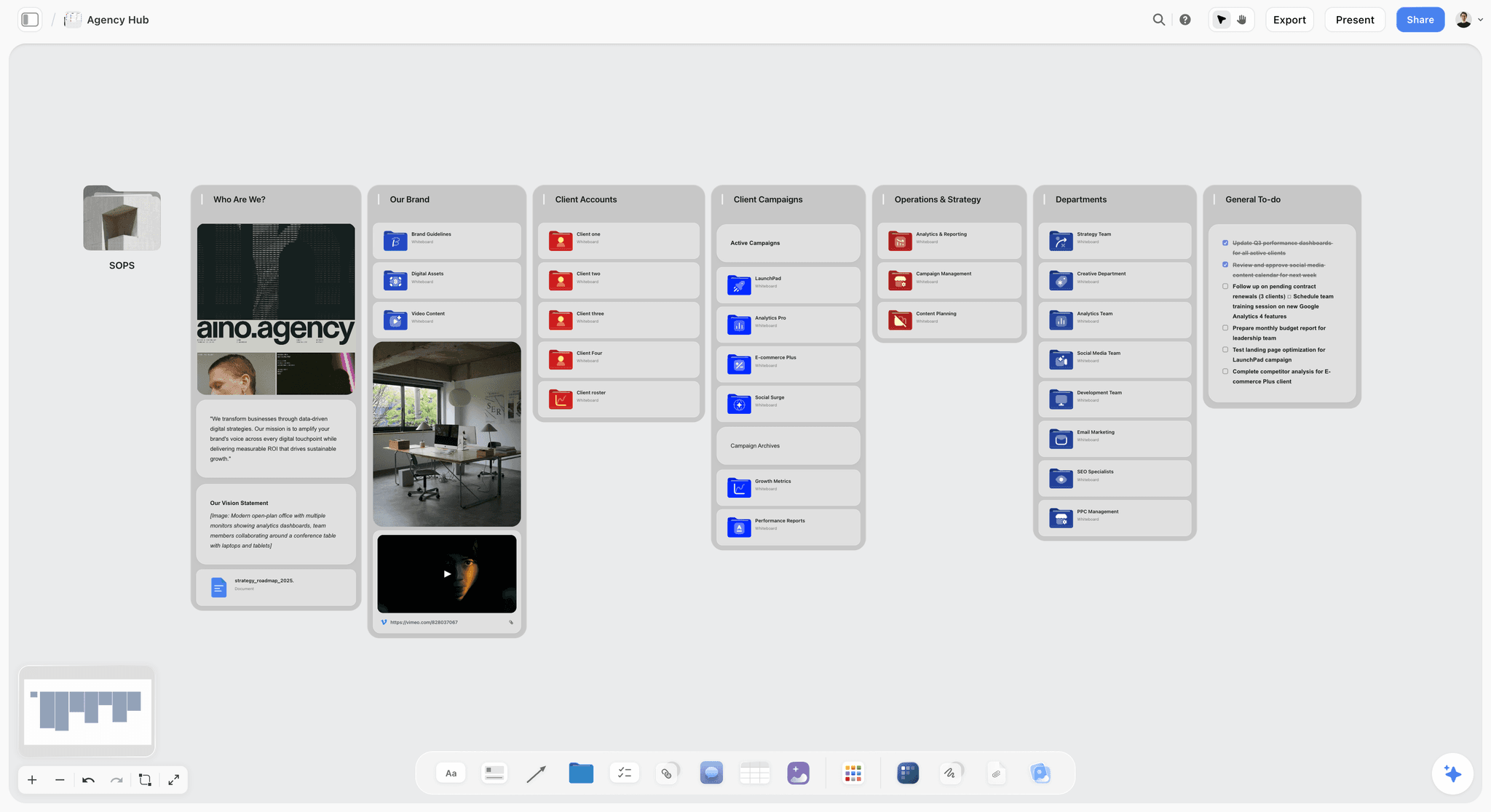
Storyflow is a visual workspace where the AI reads your full active client campaign board and Story Blueprints scaffold responses on frameworks like AIDA, the Hero's Journey, and Retention Hooks. It is the tool to pick when chat-only AI keeps producing generic concepts that ignore a specific client's brief and brand. The fastest setup: start each account from the Agency Hub template, drop the client's campaign brief on the board, and @-mention that brief in AI chat so every concept comes back grounded in the client's audience, channels, and constraints.
Best for: Creative agencies, marketing and digital agencies, content studios, and boutique shops running multi-week client engagements that move from brief to strategy to creative concept.
Verdict: The strongest AI tool for the pitch and plan half of agency work. It is not the tool for the deliver and report half, where ClickUp Brain and HubSpot Breeze win.
Key features
- Client-context AI by default. The AI reads the full active canvas board (brief, brand strategy, audience research, creative concepts). Each client engagement gets its own board, so context never bleeds between accounts. Add up to 1 Tactic and up to 3 Documents via @-mention for extra grounding.
- 200+ Story Blueprints on Plus and above. AIDA, Hero's Journey, Retention Hooks, and a 200-plus library of expert creative frameworks. The Free plan does not include the full Story Blueprints library.
- Multi-format canvas. Mood boards, mind maps, copy cards, audience clusters, and campaign concepts all live on one board, which is how creative teams actually think.
- Team workspace on the Max plan. Max adds a team workspace with permissions and roles, so an agency can control which client work each person sees.
Pricing
Free: launching before the end of 2026; invited collaborators of paid members join free today. Unlimited notes, images, and links, unlimited shared boards, basic AI usage, 20 file uploads, and unlimited collaboration. Plus: $7.99/mo annual or $9.99/mo monthly (full 200+ Story Blueprints library, unlimited file uploads). Pro: $14/mo annual or $19/mo monthly (adds AI image generation and 20x more AI than Plus). Max: $39/mo annual or $49/mo monthly (adds 40x more AI plus the team workspace with permissions and roles, which is the agency tier).
Pros
- The AI reads the full client campaign board, so concepts stay on-brief and on-brand for that specific account.
- Story Blueprints ground responses in real creative frameworks instead of generic prose.
- The Max plan's team workspace with roles fits how agencies separate client work; cheaper per seat than most agency-scale tools.
Cons
- Storyflow is not an agency-operations tool. It has no time tracking, no resourcing, and no client billing. Pair it with ClickUp Brain or a dedicated PM tool for that.
- Storyflow is not a CRM. If a client runs on HubSpot, the reporting and lifecycle work belongs in HubSpot Breeze, not here.
- Cloud-only, with no local-first option, and a newer platform than Miro or Notion. It is built for small teams and boutiques; a large agency needs dedicated PM and ops tooling alongside it.
2. Claude (Anthropic)
Claude is the strongest pure-chat AI for nuanced long-form copy and pitch narrative in 2026. It is the pick when the work is text-heavy and the writing needs to read like a person, not a template, wrote it.
Best for: Pitch narratives, manifesto copy, long-form content, brand voice work, and any deliverable where tone carries the work.
Verdict: The strongest pure-chat AI for agency copy. The chat substrate still drifts on sustained multi-week client work.
Key features
- Long context window for ingesting full brand decks and prior client work.
- Projects feature for persistent memory across sessions on one client.
- Strong at matching a brand voice when given examples.
Pricing
Claude Pro: $20/mo. Claude Max: $200/mo. Free tier with daily message limits.
Pros
- Frequently rated the best AI at real-world writing tasks.
- Carefully calibrated tone, less prone to the hype register that gets cut in client review.
- Projects reduce the context-pasting tax for single-client work.
Cons
- The chat substrate drifts on long campaigns; it is not a campaign canvas.
- No image generation in the consumer product.
- Smaller plugin ecosystem than ChatGPT.
3. ChatGPT
ChatGPT is still the broadest AI tool an agency reaches for in 2026. It is the pick for fast ideation, quick drafts, and ecosystem breadth.
Best for: Headline brainstorming, quick social drafts, exploratory ideation, and custom GPTs for repeated agency workflows.
Verdict: The default AI most agency teams open first. Genuinely useful, just the wrong shape for sustained client-engagement work.
Key features
- Image generation alongside text in the same product.
- Custom GPTs and the GPT Store for building repeatable agency workflows.
- Voice mode and multimodal input.
- The largest plugin and integration ecosystem.
Pricing
ChatGPT Plus: $20/mo. ChatGPT Pro: $200/mo. Free tier with daily limits.
Pros
- The broadest AI ecosystem in 2026.
- Custom GPTs let an agency encode brand rules into a reusable assistant.
- Image generation in the same product is convenient for quick concepting.
Cons
- Loses context on multi-turn client work, the failure mode covered in Why ChatGPT Loses the Plot.
- No native framework awareness; output is generic until heavily prompted.
- Maintaining six client voices requires careful prompt discipline.
4. ClickUp Brain
ClickUp Brain is the AI layered into ClickUp's project management platform. For agencies, this is the deliver-function tool: tasks, timelines, and resourcing across every active client.
Best for: Agencies that need one place to manage projects, deadlines, and team capacity across multiple clients.
Verdict: The strongest AI-assisted project management tool for agency operations. It is not where creative thinking happens.
Key features
- AI inside tasks, docs, and project views for summaries and updates.
- AI Notetaker for meeting transcription and Autopilot Agents for task automation.
- Resource and workload views for capacity planning across clients.
- Custom statuses and templates for repeatable agency workflows.
Pricing
ClickUp Brain is an add-on. Standard Brain AI is around $9/user/month on top of a paid ClickUp plan; the higher Everything AI tier is around $28/user/month. Verify current pricing at clickup.com, since the AI add-on structure changed in 2026.
Pros
- Genuinely useful for the resourcing and delivery half of agency work that creative tools ignore.
- AI summaries on tasks and docs cut status-update overhead.
- One platform for projects across all clients.
Cons
- The per-seat AI add-on stacks on top of the base plan, so the real cost is higher than the headline number.
- Strong at operations, weak as a creative or strategic canvas.
- The interface is dense; onboarding a full agency takes real time.
5. HubSpot Breeze
HubSpot Breeze is the AI woven through HubSpot's CRM, marketing, and service tools. For agencies, it matters when a client runs on HubSpot and the agency manages that instance.
Best for: Agencies that manage client HubSpot portals and need AI-driven reporting, lifecycle work, and customer-facing agents.
Verdict: The strongest CRM-integrated AI for agencies whose clients are on HubSpot. Outside HubSpot, the value collapses.
Key features
- Breeze Assistant for generating and summarizing inside HubSpot.
- Breeze Agents for prospecting and customer service, now on outcome-based pricing.
- Content Hub AI for SEO-aware content.
- Native CRM data context so the AI knows the client's contacts and pipeline.
Pricing
Breeze is bundled into HubSpot's paid tiers. Marketing Hub Professional starts around $800/month, and Breeze Agents moved to outcome-based pricing in 2026 (for example, around $0.50 per resolved customer conversation). Verify current pricing at hubspot.com.
Pros
- Deep CRM integration is genuinely valuable when the agency manages a client's HubSpot.
- Breeze Agents handle real workflow automation, not just generation.
- Outcome-based agent pricing can be cost-efficient at volume.
Cons
- Outside HubSpot, there is no reason to use it.
- The base subscription cost is steep for small agencies.
- AI generation quality lags standalone tools on pure creative output.
6. Notion AI
Notion AI is the AI inside Notion docs and databases. For agencies, it is the deliver-function tool for the agency wiki: SOPs, client runbooks, and onboarding docs.
Best for: Agencies whose internal knowledge base, SOPs, and client runbooks already live in Notion.
Verdict: Solid for the agency knowledge layer if the agency already runs on Notion. Limited if it does not.
Key features
- AI inside Notion pages, databases, and wikis.
- Ask Notion queries across connected sources including Drive and Slack.
- AI Meeting Notes and Agents in the 2026 suite.
- Templates for agency playbooks and client onboarding.
Pricing
Full Notion AI is bundled into the Business plan at $20/user/month annual or $24/month monthly. The standalone AI add-on was retired in 2025; Free and Plus tiers only get a limited trial allocation.
Pros
- The strongest AI experience for agencies already deep in Notion.
- Cross-source search is genuinely useful for finding client history.
- The doc-and-database primitive fits SOPs and runbooks well.
Cons
- Doc-shaped, not canvas-shaped, so visual campaign concepting is awkward.
- Full AI now requires the Business plan, which raises the per-seat cost.
- AI works on the page, not on a project-level creative canvas.
7. Fireflies
Fireflies is the AI meeting assistant that joins client calls, transcribes them, and extracts action items. For agencies, it is a report-function tool: the record of what the client actually asked for.
Best for: Account teams who need accurate client call notes and action items without manual minute-taking.
Verdict: The strongest meeting-notes tool for agency client calls. A narrow job, done well.
Key features
- Automatic transcription and AI summaries of client calls.
- Action item extraction so nothing from a client call gets lost.
- Searchable archive of every client conversation.
- Integrations with Zoom, Meet, and Teams.
Pricing
Free: $0 with 800 transcription minutes per month. Pro: $10/user/month annual or $18/month monthly. Business: $19/user/month annual or $29/month monthly. Enterprise from $39/user/month.
Pros
- Accurate client call records reduce scope disputes later.
- Action item extraction keeps account teams accountable to what was promised.
- The free tier is genuinely usable for a small agency.
Cons
- It is a transcription and notes tool, not a strategy or production tool.
- AI summary credits are capped; heavy use needs add-on credits.
- Recording client calls needs consent and a clear policy.
8. Descript
Descript is the AI-powered video and audio editor that edits media by editing a transcript. For agencies, it is a produce-function tool for video and podcast deliverables.
Best for: Content studios and agencies producing video, podcasts, and social clips for clients.
Verdict: The strongest AI editing tool for agency video and audio work that does not need a full post-production suite.
Key features
- Edit video and audio by editing the transcript text.
- AI tools for filler-word removal, studio sound, and overdub.
- Templates and brand kits for client-specific output.
- Multi-track timeline for fuller edits.
Pricing
Free: $0 with about 60 media minutes per month. Hobbyist: $16/user/month annual or $24/month monthly. Creator: $24/user/month annual or $35/month monthly. Business: $50/user/month annual or $65/month monthly.
Pros
- Transcript-based editing is genuinely fast for talking-head and podcast work.
- AI cleanup tools cut hours from rough-cut editing.
- Brand kits keep client output consistent.
Cons
- The 2025 shift to metered media minutes makes real cost harder to predict.
- Not a replacement for a full editing suite on high-end client video.
- Per-seat cost adds up for a full production team.
9. Miro AI
Miro AI is the AI inside Miro's collaborative whiteboard. For agencies, it is a plan-function tool for client workshops, journey maps, and discovery sessions.
Best for: Agencies running collaborative client workshops, journey mapping, and discovery sprints.
Verdict: Strong for the workshop and diagramming side of planning. Less suited to copy-and-concept-heavy campaign work.
Key features
- AI Sidekicks and Flows for generating diagrams, tables, and docs on the canvas.
- A large template library for workshops and journey maps.
- Real-time collaboration built for live client sessions.
- Integrations with Jira and Azure DevOps.
Pricing
Free: $0 with 3 editable boards. Starter: $8/member/month annual or $10/month monthly. Business: $20/member/month annual or $25/month monthly. Enterprise: custom with a 30-member minimum.
Pros
- The strongest tool for live, collaborative client workshops.
- AI Flows generate workshop artifacts fast.
- Mature and stable, with a deep template library.
Cons
- Built for diagramming and workshops, not for sustained copy and concept development.
- AI features are credit-metered per member.
- The board model can sprawl without discipline.
10. Gamma
Gamma is the AI presentation tool that turns prompts and outlines into formatted decks. For agencies, it is a pitch-function tool: turning campaign thinking into a client-ready proposal fast.
Best for: Agencies that need to produce pitch decks, proposals, and client presentations quickly.
Verdict: The fastest path from a campaign outline to a presentable deck. It does not do the strategic thinking, only the formatting.
Key features
- AI deck generation from a prompt or outline.
- Editable, on-brand templates and themes.
- Web-based decks that work as links, not just files.
- Analytics on how clients engage with a shared deck.
Pricing
Free: $0 with 400 lifetime AI credits. Plus: $8/month annual or $10/month monthly. Pro: $15/month annual or $20/month monthly. Team plans start around $20/seat/month with a minimum seat count.
Pros
- Genuinely fast at turning thinking into a presentable deck.
- Web-based decks are easy to share and track.
- Lowers the design tax on routine proposals.
Cons
- The free tier's credits are a one-time lifetime allotment, not a monthly refill.
- It formats thinking; it does not generate strategy.
- Output still needs an editing pass before a high-stakes pitch.
11. Jasper
Jasper is the marketing-copy AI platform with multi-brand and workflow features. For agencies, it is a produce-function tool when copy volume across many client brands is the bottleneck.
Best for: Agencies producing high copy volume across many client brands that want brand-voice modeling per client.
Verdict: Solid for multi-brand templated copy. The value gap versus general AI tools has narrowed.
Key features
- Brand Voice modeling, with unlimited brand voices on the Business tier.
- Templates and Workflows for repeatable copy production.
- Groups and roles for agency team structure.
- API access and integrations on the Business tier.
Pricing
Jasper's agency-oriented Business plan is custom-priced and negotiated by headcount and usage. Lower individual tiers exist; verify current pricing at jasper.ai. A 7-day trial is available.
Pros
- Per-client brand voices fit how agencies manage many accounts.
- Workflows handle some campaign-level context.
- A marketing-shaped UI lowers onboarding friction for non-AI-native staff.
Cons
- Business-tier pricing is custom and opaque; budget carefully.
- Output quality depends on the underlying model; you pay for the wrapper.
- General AI tools have caught up on core copy generation.
For the head-to-head, see Jasper Alternative.
12. Midjourney
Midjourney is the AI image generator known for the strongest aesthetic quality in the market. For agencies, it is a produce-function tool for concept art, mood imagery, and pitch visuals.
Best for: Creative agencies and content studios generating concept imagery, mood boards, and pitch visuals.
Verdict: The strongest AI image quality for concept and mood work. Use it for exploration, not final client-licensed assets.
Key features
- High-quality image generation across styles.
- Style references for consistent visual direction.
- Stealth mode on higher tiers for client confidentiality.
- A web interface alongside the original Discord workflow.
Pricing
Basic: $10/month or $8/month annual. Standard: $30/month or $24/month annual. Pro: $60/month or $48/month annual. Mega: $120/month or $96/month annual. There is no free plan. Agencies with revenue over $1M must use the Pro or Mega plan for commercial use.
Pros
- The strongest aesthetic quality among image generators.
- Excellent for fast mood and concept exploration in pitches.
- Stealth mode on higher tiers protects confidential client work.
Cons
- No free plan, and commercial use above a revenue threshold forces a higher tier.
- Image rights and client licensing need careful handling.
- It is an image tool only; it has no role in copy or strategy.
7) Agency-Type Recommendations
1. Creative Agency
Top picks: Storyflow Max + Claude + Midjourney
Storyflow Max for the client campaign canvas where briefs, brand strategy, and creative concepts live, with the team workspace separating client accounts; the Brand Strategy template is the fastest start for positioning engagements. Claude for the long-form copy and pitch narrative. Midjourney for concept art and mood imagery. Add Gamma when a pitch deck is due.
2. Marketing / Digital Agency
Top picks: Storyflow + ClickUp Brain + HubSpot Breeze
Storyflow for campaign planning and creative briefs. ClickUp Brain for project and resource management across clients. HubSpot Breeze for the clients who run on HubSpot. This is the stack that covers all five functions, not just produce.
3. Content Studio
Top picks: Storyflow + Descript + Claude
Storyflow for the content strategy and editorial canvas. Descript for video and podcast editing. Claude for long-form written deliverables. Add Fireflies so client call notes feed the content brief.
4. Solo / Boutique Agency
Top picks: Storyflow + ChatGPT
Storyflow for the client campaign canvas and Story Blueprints. ChatGPT for fast variants and ideation. This is the minimum viable AI stack for a one-or-two-person shop, and both have usable free or low-cost tiers. Add Gamma when a proposal is due.
5. Production House
Top picks: Descript + Storyflow + ClickUp Brain
Descript for the video and audio editing core. Storyflow for the pre-production planning canvas, shot thinking, and treatments; the Filmmaking Agency Hub template opens with that structure already on the board. ClickUp Brain for scheduling crew and managing client deliverables. Midjourney for visual concepting when a pitch needs it.
8) Honorable Mentions
A few tools that came close but did not make the main twelve.
- Perplexity: Sourced research with citations; useful for agency competitive and category research, narrower than a full stack tool.
- ElevenLabs: AI voice for ad VO and dubbing; strong but a single-function add-on.
- Canva Magic Studio: AI-assisted design; useful for fast social production, less suited to bespoke creative.
- Surfer: SEO content optimization; valuable for agencies running SEO programs specifically.
- Synthesia: AI avatar video; useful for explainer and training content at scale.
- Asana AI: Project management AI; a ClickUp Brain alternative for agencies already on Asana.
- Otter.ai: Meeting transcription; a Fireflies alternative.
- Runway: AI video generation; strong for motion concepting in creative agencies.
These are not weak tools. Their use case is narrower than the main list, or they overlap with a tool already chosen.
9) Where AI Does Not Help Agencies Yet
Honest accounting matters. There are agency jobs where AI is still bad, and pretending otherwise burns client trust and team time.
- Winning the room. A pitch is won by a person reading a client's reaction and adjusting in real time. AI builds the deck. It does not win the meeting.
- Original strategic positioning. AI can pressure-test a positioning, but the actual decision about how a client's brand stands apart comes from human judgment grounded in client conversations.
- Client relationship management. Trust, candor, and knowing when to push back on a client are human work. No agent replaces the account director.
- Resourcing and margin calls. AI can surface that a project is over hours. The decision to absorb the overage, renegotiate scope, or have the hard conversation is a human one.
- Truly original creative concepts. AI generates plausible concepts fast. The breakthrough idea that defines a campaign still comes from human craft.
- Crisis and sensitive communication. Client crises, layoffs, regulated claims, and legal-sensitive copy need human and legal judgment, not an agent.
If an agency's AI use is concentrated in these areas, it is using AI for the wrong jobs. The right AI use is upstream (research, strategy structure, concept generation, deck drafting) and downstream-supporting (call notes, reporting, status summaries, content adaptation). The middle, where the agency's actual judgment lives, stays human.
11) The Bottom Line
The best AI tools for agencies in 2026 are not a single product. They are a stack mapped to the five functions of agency work. Storyflow is the strongest pick for pitch and plan, with the client campaign canvas and 200+ Story Blueprints grounding the AI in frameworks like AIDA and the Hero's Journey. Claude and ChatGPT are the strongest for produce. ClickUp Brain is the strongest for deliver. HubSpot Breeze and Fireflies are the strongest for report. The honest note: Storyflow does not do the deliver and report half. It has no time tracking, no resourcing, and no client billing, and a large agency needs dedicated PM and ops tooling alongside it.
Most agencies in 2026 run three to five tools, not one. The agencies pulling ahead are not the ones with the most tools. An agency does not buy one AI tool. It buys a stack mapped to the five things an agency does. Buy for function, not for hype, and the stack stays small, coherent, and cheap.
For agencies that want to test the canvas side, take one active client engagement and rebuild it on a Storyflow canvas for two weeks. Start a Storyflow workspace to run that test.
10) FAQ: AI Tools for Agencies in 2026
What is the best AI tool for agencies in 2026?
There is no single best tool, because an agency does five different jobs. For the client campaign canvas where briefs and creative live, Storyflow. For copy, Claude. For project and resource management, ClickUp Brain. For client CRM and reporting, HubSpot Breeze. Most agencies in 2026 run a stack of three to five tools mapped to the five functions of pitch, plan, produce, deliver, and report.
How many AI tools does an agency actually need?
Three to five, mapped to function. A typical efficient stack is one canvas tool for pitch and plan (Storyflow), one or two production tools (Claude, plus Descript or Midjourney depending on output), one delivery tool (ClickUp Brain), and one reporting tool (Fireflies or HubSpot Breeze). The mistake is buying twelve tools that all do produce and nothing that does the other four functions.
Is Storyflow good for running an agency?
Storyflow is strong for the creative and strategic half of agency work: client campaign canvas, creative briefs, brand strategy, and a Max-tier team workspace with roles. It is not an agency-operations tool. It has no time tracking, no resourcing, and no client billing. Pair it with ClickUp Brain or a dedicated PM tool for the operations side.
What is the best free AI tool for agencies?
Storyflow's Free plan, which launches before the end of 2026, will be the strongest free tier for the creative-planning side: unlimited boards, unlimited cards, unlimited collaboration, basic AI, and 20 file uploads. Claude and ChatGPT have free tiers with daily limits that work for one-off generation. Fireflies offers 800 free transcription minutes a month. The free Story Blueprints library is limited; the full 200-plus library is on Plus and above.
Which AI tool is best for agency pitches and new business?
Storyflow for building the strategic narrative and campaign concept on a canvas the team co-builds, Gamma for turning that into a client-ready deck fast, and Claude for the pitch narrative copy. AI builds the deck; the person in the room still wins the meeting.
How much should a small agency budget for AI tools per month?
A boutique agency can run a functional stack for roughly $50 to $150 per user per month, depending on which production and delivery tools it needs. Storyflow Plus or Max, a Claude or ChatGPT seat, and one delivery tool cover most of it. Larger agencies pay more because HubSpot and enterprise PM tiers scale steeply.
Can AI replace agency staff?
No, but AI is replacing specific agency tasks: deck formatting, first-draft copy, call transcription, status summaries, and concept exploration. It is amplifying others: strategy thinking with framework support, research synthesis, and production speed. The work that defines an agency, winning the room, original strategy, original creative, and client trust, stays human.
Which AI tool is best for managing multiple clients at once?
ClickUp Brain for projects and resourcing across clients, and Storyflow for keeping each client's creative work on its own dedicated canvas so context never bleeds between accounts. The combination covers both the operations and the creative sides of multi-client work.
Is HubSpot Breeze worth it for agencies?
For agencies that manage client HubSpot portals, yes. The CRM integration and reporting are genuinely valuable when the client already runs on HubSpot. For agencies whose clients are not on HubSpot, the base subscription cost is hard to justify against standalone tools.
What AI tools do creative agencies use specifically?
Creative agencies lean on Storyflow for the campaign canvas and creative briefs, Claude for copy and narrative, Midjourney for concept and mood imagery, and Gamma for pitch decks. The common thread is tools that support concepting and craft rather than pure operations.
Should agencies disclose AI use to clients?
Most agencies in 2026 disclose AI use as a process matter, especially for generated imagery and copy that ships in client work. Clients increasingly expect transparency, and AI-generated visuals carry licensing considerations. A clear AI policy in the engagement protects the relationship.
What is the smallest test an agency can run?
Take your most active client engagement currently running through ChatGPT context-pasting. Move the brief, brand strategy, and three references onto a Storyflow canvas (the free tier is enough). Select a Story Blueprint that matches the engagement. Ask the three questions you would normally ask in ChatGPT, but ask them on the canvas. Most agency teams see the difference within an hour. Try a Storyflow workspace to run that test.
Table of Contents
- Quick Answer: The Best AI Tools for Agencies in 2026
- Comparison Table: 12 AI Tools for Agencies Compared
- Why Agencies Need a Different AI Stack
- How We Evaluated These Tools (On Real Client Work)
- Quick Picks by Agency Function
- Detailed Reviews: 12 AI Tools for Agencies in 2026
- Agency-Type Recommendations
- Honorable Mentions
- Where AI Does Not Help Agencies Yet
- FAQ: AI Tools for Agencies in 2026
- The Bottom Line
- Author
- Related Reading
Templates to check out for this topic


Marketing and campaign templates you can use in Storyflow
Plan the whole campaign on one board: brief, audience, channels, and assets connected, with an AI that reads all of it. Open a template and start from real structure.


See Storyflow in Action
A visual AI workspace where every feature lives inside one canvas. No tab-switching, no context lost.
Build your entire board from a single message
Type what you need in the AI chat at the bottom of your canvas. The AI adds cards, headings, and structure directly onto your board.
Use expert frameworks as AI context
Type @ in the AI chat and choose any Tactic. The AI tailors every response to that framework instead of giving generic advice.
Turn your board into a mind map in seconds
Ask the AI to restructure your canvas as a mindmap. It connects your ideas into a visual hierarchy so you can see how everything relates.
Why Storyflow Exists
Storyflow actually began as a personal tool while working on creative and research projects.
We kept running into the same problem: ideas were scattered everywhere: notes, documents, and whiteboards.
Nothing helped us see how everything connected.
So we started building a workspace designed around how ideas actually grow.
→ Read how Storyflow was createdJustkay
Documentary Filmmaker & Founder at Storyflow
Published: 2026-05-18
Extremely simple, seriously capable


See how easy it is to get started
Watch a real project come together, from a blank board to a finished plan, clicked through step by step.
Start creating with AI and become more productive
Transform your creative workflow with AI-powered tools. Generate ideas, create content, and boost your productivity in minutes instead of hours.