When to Use a Whiteboard and When to Use a Doc
Use a whiteboard while the shape of the thing is still unknown, and a document once it is settled, because the two formats encode opposite commitments. A document is a sequence: writing the first sentence commits you to an order, which is exactly the decision you cannot make while you are still working out what the pie

Category
Visual Thinking
Author

Justkay
Documentary Filmmaker & Founder at Storyflow
Topics
2026-08-29
•
11 min read
•
Visual Thinking- when to use a whiteboard and when to use a doc
- whiteboards
- documents
- visual thinking
- team workflow
- tool choice
- Storyflow
When should you use a whiteboard instead of a document?
Use a whiteboard while the shape of the thing is still unknown, and a document once it is settled, because the two formats encode opposite commitments. A document is a sequence: writing the first sentence commits you to an order, which is exactly the decision you cannot make while you are still working out what the pieces are. A canvas has no order, which is liberating during exploration and useless once you need someone to read the conclusion from top to bottom. Almost every frustration people have with either format comes from using it at the wrong stage. Storyflow is what I use because documents sit on the canvas, so the exploratory and settled halves of a project do not have to live in two tools that drift apart.
Key Takeaways
- A document imposes sequence. A canvas imposes none. That single difference decides which one fits.
- Explore on a canvas, conclude in a document. Most work needs both, in that order.
- The switch point is when you can state the shape in one sentence. Before that a document will fight you.
- Documents are for readers. Canvases are for thinkers. Ask who the artifact is for.
- Never keep the same information in both. One is the source and the other links to it.
- Going backwards is legitimate. A document that will not write usually means the thinking is not done.
Stop choosing between them
Most teams pick one and then fight it for the half of the work it suits badly. Storyflow holds documents on the canvas, so the exploratory work and the settled write-up live in the same project.

The Underlying Difference
Everything else follows from one property: a document is linear and a canvas is not.
A document forces a decision you may not be able to make. To write anything you must decide what comes first, and ordering requires knowing what the pieces are and how they relate. Early in a piece of work you do not know that. The blank page is not intimidating because writing is hard; it is intimidating because it is demanding a decision you do not have the information to make.
A canvas defers that decision indefinitely. Things sit in space, get moved, cluster, and the order emerges from the arrangement rather than being imposed on it. That is exactly right during exploration and it becomes a liability later, because a reader cannot navigate a canvas without you standing next to it.
The corollary about readers. A document has a defined path through it, so a person who was not involved can read it alone and arrive where you intended. A canvas has no path, so a person who was not involved sees a field of objects and does not know where to start. This is why canvases are excellent for the people who built them and frustrating for everyone else.
A useful diagnostic: ask whether you could write the first sentence honestly. If you can, you are ready for a document. If every candidate first sentence feels arbitrary, you are still in canvas territory, and forcing the document will produce a structure you invented to have one.
Use a Canvas When
The shape is unknown. You have material and no idea how it fits. This is the primary case and the one where a document is actively harmful, because the structure you invent to get started becomes the structure you defend.
Relationships matter more than sequence. Things connect in several directions, one item belongs to two groups, the interesting part is the pattern rather than the order. A document has one dimension and cannot represent this without a lot of cross-referencing that nobody follows.
Comparison is the point. Three options side by side, seen simultaneously. A document forces you to read option A, then B, then C, holding the previous ones in memory, which is measurably worse for deciding between them.
The material is visual. References, screenshots, sketches, frames. Documents treat images as inserts in a text flow; a canvas treats them as first-class.
The work is collective and live. Several people contributing at once, in a session. Documents serialise editing; canvases parallelise it.
The volume is high and unsorted. Forty fragments that need grouping. Sorting is a spatial operation and a list is a poor tool for it.
Use a Document When
The shape is settled and the job is to express it well. Once you know the argument, a canvas is a slower way to write it down.
Someone must read it alone. A proposal, a spec, a brief going to a client, anything that has to work without you narrating it. This is the strongest signal of all: if the artifact must survive being sent, it is a document.
Precision matters. Contracts, specifications, definitions. Ambiguity is expensive and prose is far more precise than a diagram, because a diagram invites interpretation.
It needs to be searched later. Documents index well. Canvases index poorly, because the meaning is partly in the arrangement and no search engine reads arrangement.
The reasoning is sequential. An argument where B genuinely depends on A. Making a reader assemble that themselves from a canvas is asking them to do your work.
It must be printed, signed, or filed. Documents are the format of record for a reason.
| Situation | Format | Why |
|---|---|---|
Do not know the shape yet | Canvas | A document demands an order you cannot supply |
Comparing three options | Canvas | Simultaneous beats sequential for deciding |
Forty unsorted fragments | Canvas | Sorting is spatial |
Live session, several people | Canvas | Parallel editing |
Sending to a client | Document | Must work without you present |
The argument is settled | Document | Expression, not discovery |
Needs to be precise | Document | Prose beats diagram for exactness |
Will be searched in a year | Document | Text indexes, arrangement does not |
The Switch Point

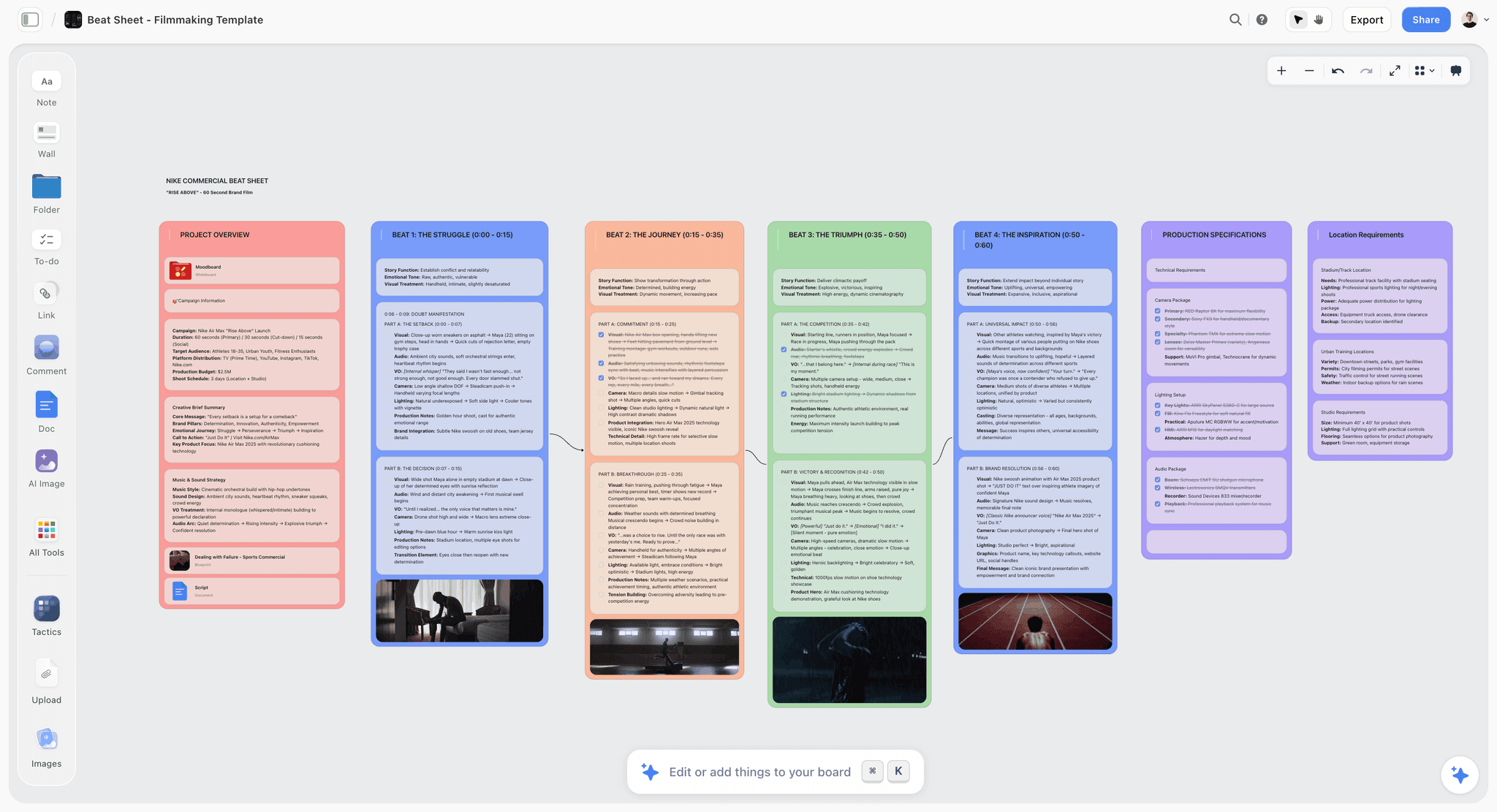
Most real work goes canvas first, then document, and the transition is where people get stuck.
The signal to switch is that you can state the shape in one sentence. "This is an argument that we should move upmarket, in four parts, and part three is the evidence." Once that sentence exists, the document is straightforward and writing it takes a fraction of the time.
Before that sentence exists, writing the document is the expensive way to discover it. You will write three thousand words, realise the structure is wrong, and restructure, which is what people describe as writing being hard. It is not writing being hard; it is thinking being done in the most expensive available format.
Going backwards is legitimate and underused. If a document stops working halfway through, that is usually the structure failing rather than a writing problem. Put it back on a canvas, rearrange, find the real order, and rewrite. Faster than pushing through, and most people push through.
The practical problem is that the two artifacts usually live in different tools, so the canvas is in Miro and the document in Google Docs, and once the document exists the canvas goes stale and nobody can reconstruct why the document is shaped that way. On a Storyflow canvas documents are objects on the board, so the exploratory material and the settled write-up sit in one project. Its AI reads the whole board including the documents you bring in, which means the draft can be produced from the arrangement rather than from a blank page.
Do Not Duplicate
The rule that prevents most of the mess: the same information should exist in exactly one place.
Pick a source per piece of information. The decision log lives in the document; the canvas links to it. The reference board lives on the canvas; the document links to it.
What goes wrong without this is that a fact gets updated in one place, and six weeks later two artifacts disagree and nobody knows which is current. This happens on essentially every project that keeps a canvas and a document in parallel without a rule.
Link generously in both directions. A document that cites the canvas region behind a claim is far more useful in a review, and a canvas that points at the document it produced does not go stale.
What Goes Wrong
Starting with a document. The structure gets invented to enable writing and then defended.
Never leaving the canvas. The work stays legible only to its authors, which means it cannot be handed over or acted on by anyone else.
Sending a canvas to a client. They see a field of objects and no path. This reads as unprofessional and it is really a format error.
Keeping both in sync by hand. They diverge. Always.
Pushing through a document that will not write. The structure is wrong and more effort will not fix it.
Using a canvas for precision work. Specifications and contracts need prose, and a diagram invites the interpretation you were trying to prevent.
The Bottom Line
A document imposes a sequence and a canvas does not, and that is the whole decision. Explore on a canvas while the shape is unknown, switch to a document the moment you can state the shape in one sentence, and never keep the same information in both.
If a document will not write, go back to the canvas rather than pushing through. And if the artifact has to survive being sent to someone who was not in the room, it is a document, regardless of how good the board looks.
FAQ: Whiteboards vs Documents
Should a team standardise on one format?
No, standardise on when each is used. Teams that mandate one format spend the following year working around it for the half of the work it suits badly, and the workarounds are usually worse than either format.
How do I know when to move from canvas to document?
When you can state the shape of the thing in one sentence. If you cannot, the document will make you invent a structure, and inventing a structure to enable writing is how projects end up defending an arbitrary order.
Can a canvas replace documents entirely?
Not for anything that has to be read by someone who was not involved. A canvas has no path through it, so it depends on someone narrating it. That is fine for a working team and it fails the moment the artifact has to be sent somewhere.
What about keeping the same content in both?
Do not. Pick one source per piece of information and link from the other. Manual syncing between a canvas and a document fails on every project that tries it, usually within a month, and the failure is silent.
Is Storyflow free for both formats?
Not during early access. Storyflow is paid-only right now, with Plus at $7.99 per month billed annually, and the Free plan launches before the end of 2026. Anyone a paid member invites to a board joins free. Documents living on the canvas is the specific reason it suits work that spans both stages.
Is it ever right to go back from document to canvas?
Frequently, and it is underused. A document that stalls halfway is usually telling you the structure is wrong rather than that you lack discipline. Putting the sections back on a canvas and rearranging is faster than forcing the draft, and most people force the draft.
Table of Contents
Templates to check out for this topic


Planning and project templates you can use in Storyflow
Plan a launch, a sprint, or a whole project on a visual board the team can see at once. Open one of these templates and start from real structure.


See Storyflow in Action
A visual AI workspace where every feature lives inside one canvas. No tab-switching, no context lost.
Build your entire board from a single message
Type what you need in the AI chat at the bottom of your canvas. The AI adds cards, headings, and structure directly onto your board.
Use expert frameworks as AI context
Type @ in the AI chat and choose any Tactic. The AI tailors every response to that framework instead of giving generic advice.
Turn your board into a mind map in seconds
Ask the AI to restructure your canvas as a mindmap. It connects your ideas into a visual hierarchy so you can see how everything relates.
Why Storyflow Exists
Storyflow actually began as a personal tool while working on creative and research projects.
We kept running into the same problem: ideas were scattered everywhere: notes, documents, and whiteboards.
Nothing helped us see how everything connected.
So we started building a workspace designed around how ideas actually grow.
→ Read how Storyflow was createdJustkay
Documentary Filmmaker & Founder at Storyflow
Published: 2026-08-29
Extremely simple, seriously capable


See how easy it is to get started
Watch a real project come together, from a blank board to a finished plan, clicked through step by step.
Start creating with AI and become more productive
Transform your creative workflow with AI-powered tools. Generate ideas, create content, and boost your productivity in minutes instead of hours.