What to Look For in an AI Creative Tool (2026)
The question that separates useful AI creative tools from the rest is not what the model can generate, it is how much of your project the AI can see before it generates anything.

Category
AI Tools
Author

Justkay
Documentary Filmmaker & Founder at Storyflow
Topics
2026-08-29
•
12 min read
•
AI Tools- what to look for in an ai creative tool
- ai tools
- creative software
- buying guide
- ai workflow
- evaluation
- Storyflow
What should you look for in an AI creative tool?
The question that separates useful AI creative tools from the rest is not what the model can generate, it is how much of your project the AI can see before it generates anything. Nearly every creative tool shipped an AI feature between 2024 and 2026, and most of them are a prompt box wired to a general model with no access to the work around it, which produces output you then spend longer correcting than you would have spent writing it. The tools worth paying for are the ones where the AI reads your actual material. Storyflow's AI reads the whole canvas you are on plus the blueprints and documents you bring in, which is the specific property that makes its output need less correction, and it is the property I would test first in anything else.
Key Takeaways
- Context is the differentiator, not model quality. Almost everyone is using the same handful of frontier models.
- Test with a real project, not a blank one. A blank canvas cannot show you whether the AI can see anything.
- Ask it a question about your work. If it answers plausibly but generically, it is not reading your board.
- Check what happens to your material. Whether it trains a model, where it is stored, what a client contract would say about it.
- Beware tools that generate volume. More output is not the bottleneck in creative work; judgement is.
- Undo, edit and provenance matter more than generation quality once you use it daily.
Ask what the AI can see
Most AI features are a prompt box that knows nothing about the project it sits inside. Storyflow's AI reads the whole canvas you are working on, so what it produces is shaped by the work rather than by the sentence you typed.

The Context Question
Two tools can use the identical underlying model and be worlds apart in usefulness, because the model is not the product. What the product controls is what gets sent to the model.
The three levels, in increasing order of usefulness.
No context. A prompt box in a sidebar. It knows what you typed and nothing else. This describes most AI features in creative tools. Output is generic by construction, because the model was given nothing specific to work from. You can paste context in manually, at which point you are doing the work the tool claimed to do.
Selection context. The AI sees what you have highlighted. Better, and useful for local operations like rewriting a paragraph or expanding a note. Still blind to the project.
Board or project context. The AI reads the whole working surface: the brief, the references, the decisions, the half-finished thinking. Now it can answer questions about your material rather than about the world, and its generated output inherits the project's specifics without you having to restate them.
The practical difference. Ask for a shot list from a brief. A no-context tool produces a generic shot list for the genre. A board-context tool produces one that uses your locations, your talent, your approved references and the constraint you wrote down three weeks ago.
The second one is worth paying for. The first is a wrapper around a model you could use directly for less.
A useful diagnostic: open a real project and ask the AI a question about it that has a specific answer. "Which of these directions did we reject and why?" A tool that cannot see the board will produce something fluent and wrong, and you will know in ten seconds.
Test It on Real Work
The single most common evaluation error is trialling AI on a blank or example project. A blank canvas cannot demonstrate context because there is no context to read.
Bring a real project with accumulated mess and run four tests.
The retrieval test. Ask it something only your board knows. If it hallucinates a plausible answer, it has no access and its confidence is a liability rather than a feature.
The specificity test. Ask it to generate something and count how many details come from your project versus how many are generic. A useful tool produces output where most of the specifics are yours.
The correction test. Take its output and edit it to publishable quality. Time it. Compare against writing from scratch. A surprising number of AI features are net negative on this measure, and it is the only measure that matters day to day.
The consistency test. Run the same request twice. Wild variation means you cannot build a workflow on it, because you will be re-rolling rather than iterating.
What Matters Beyond Generation
Once you use a tool daily, the properties that determine whether you keep using it are not about generation quality.
Undo and edit. Can you modify the output in place, or only regenerate? Regenerate-only workflows are exhausting, because the ninety percent you liked disappears along with the ten percent you did not.
Provenance. Can you tell later what was AI-generated and what was written? This matters for client work, for accuracy, and for your own ability to trust the board in six months. A tool that silently blends the two produces material nobody can vouch for.
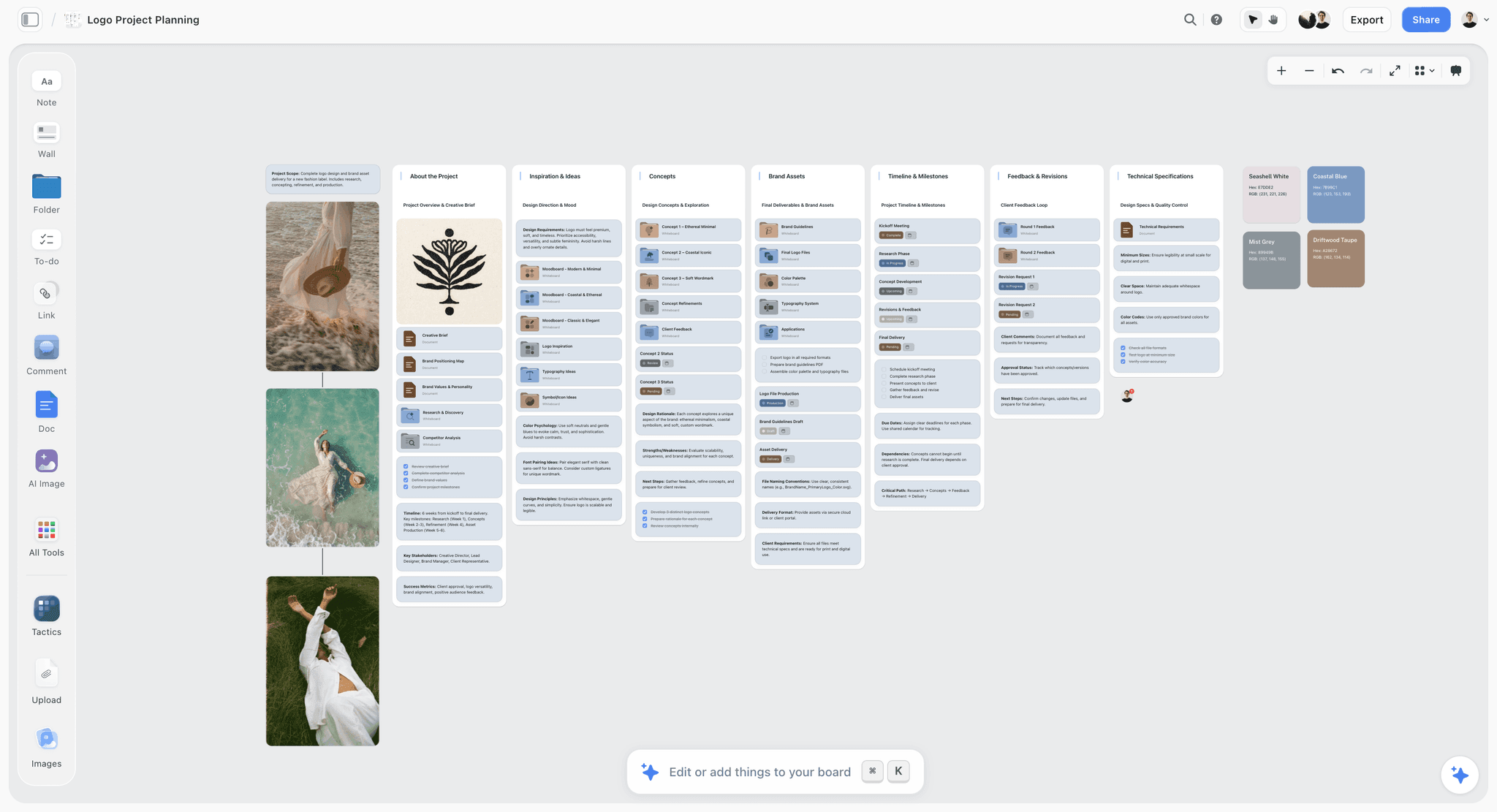
Scope transparency. Does the tool tell you what the AI can see? Storyflow is explicit that it reads the current board plus up to one blueprint and three mentioned documents. Knowing the boundary tells you how to organise your work so the AI is useful, and a tool that is vague about scope leaves you guessing why output varies.
Speed. An AI operation that takes forty seconds gets used a few times. One that takes four seconds becomes part of how you work. This sounds trivial and it is one of the strongest predictors of actual adoption.

Data, Rights and Client Work
For anyone doing client work, three questions need answers before the tool touches a project.
Does your material train their model? Check the terms rather than the marketing page. Many tools default to using customer content for training with an opt-out buried in settings, and for client work that default is frequently a contract breach.
Where is the data processed and stored? This is a real constraint for teams with clients in regulated industries or with data residency requirements.
Who owns the output? Terms vary and matter for commercial work. Also worth knowing: in several jurisdictions purely AI-generated material may not be copyrightable, which affects what you can license to a client.
The honest position for most creative teams is that AI is fine for the thinking, the drafting and the organising, and needs care for anything delivered as a final asset. That distinction is easier to hold if the tool marks provenance.
| Property | Weak version | Strong version | How to test |
|---|---|---|---|
Context | Prompt box only | Reads the working board | Ask it something only your board knows |
Output specificity | Generic to the category | Uses your material | Count whose details appear |
Editing | Regenerate only | Edit in place | Change one line of output |
Provenance | Silent blending | Marked and traceable | Look at a board a month later |
Scope clarity | Unstated | Documented boundary | Read the docs, not the landing page |
Data terms | Trains by default | Opt-in, documented | Read the terms, not the FAQ |
Speed | Tens of seconds | A few seconds | Use it ten times in a row |
The Volume Trap
A large share of AI creative tooling is built to produce more: thirty headlines, twenty concepts, fifty variations.
Volume is almost never the constraint in creative work. A competent team can already generate more options than it can evaluate. The bottleneck is judgement: deciding which option is right, and that is not a task more options help with.
Tools that generate volume shift work rather than removing it. You now have fifty variations to assess, which is a worse job than writing five yourself.
What genuinely helps is AI that reduces the material you have to hold: summarising a research board, spotting what a cluster has in common, finding the gaps in a plan, drafting the mechanical first pass of something structured. Those are compression tasks, and compression is what creative teams are actually short of.
When evaluating, notice which side of that line a feature falls on. Expansion features demo well and get abandoned. Compression features are less impressive in a demo and get used every day.
What Goes Wrong
Trialling on a blank project. Shows you nothing about context, which is the only thing that matters.
Judging by model name. Everyone has access to similar models. The plumbing around them is the product.
Accepting confident wrong answers. A tool with no board access will still answer questions about your board. Fluency is not knowledge.
Ignoring the correction time. The only honest measure of whether a feature saves time, and frequently negative.
Skipping the data terms. Discovered later, at contract stage, when it is expensive.
Buying expansion when you needed compression. More options were never the problem.
The Bottom Line
Ask what the AI can see. That single question separates tools that produce output shaped by your project from tools that produce output shaped by the internet.
Test on real work with real mess, measure correction time rather than generation quality, check provenance and data terms before client material goes anywhere near it, and be sceptical of anything whose main promise is more. The features that survive the trial are the ones that reduce what you have to hold in your head, not the ones that hand you more to evaluate.
FAQ: Evaluating AI Creative Tools
What is the difference between AI-native and AI-powered?
An AI-powered tool added a feature to an existing product, usually a prompt box that does not see the surrounding work. An AI-native tool was designed so the AI has access to the material by default. The practical test is whether the AI can answer a question about your project, which the first kind cannot.
How do I know whether an AI can see my work?
Ask it something only your project knows, and check the answer against reality. A tool without access will produce a confident, plausible, wrong answer rather than saying it cannot see anything, so the test has to use a fact you can verify.
Should I worry about my client work training a model?
Yes, check the terms before you put client material in. Several tools use customer content for training by default with an opt-out in settings, and for most client contracts that default is a problem. This is a terms question, not a marketing-page question.
Is more AI output better?
Almost never. Creative teams are limited by judgement rather than by volume, and a tool that produces fifty options has handed you an evaluation task rather than removing a generation one. Compression features (summarising, finding gaps, spotting patterns) are the ones that survive past the trial.
Is Storyflow free to try?
Not during early access. Storyflow is paid-only right now, with Plus at $7.99 per month billed annually, Pro at $14 which adds AI image generation, twenty times more AI and memory across conversations, and Max at $39 with forty times more AI. The Free plan launches before the end of 2026, and anyone a paid member invites to a board joins free today.
How long should an AI tool trial run?
Long enough to use it on a real deadline, which is usually two to three weeks. Trials on invented work overstate AI usefulness considerably, because invented work has no specific context for the AI to fail to understand.
Table of Contents
Templates to check out for this topic


Templates you can use in Storyflow
Every Storyflow board starts from real structure and an AI that reads the whole canvas. Open one of these templates and make it yours.


See Storyflow in Action
A visual AI workspace where every feature lives inside one canvas. No tab-switching, no context lost.
Build your entire board from a single message
Type what you need in the AI chat at the bottom of your canvas. The AI adds cards, headings, and structure directly onto your board.
Use expert frameworks as AI context
Type @ in the AI chat and choose any Tactic. The AI tailors every response to that framework instead of giving generic advice.
Turn your board into a mind map in seconds
Ask the AI to restructure your canvas as a mindmap. It connects your ideas into a visual hierarchy so you can see how everything relates.
Why Storyflow Exists
Storyflow actually began as a personal tool while working on creative and research projects.
We kept running into the same problem: ideas were scattered everywhere: notes, documents, and whiteboards.
Nothing helped us see how everything connected.
So we started building a workspace designed around how ideas actually grow.
→ Read how Storyflow was createdJustkay
Documentary Filmmaker & Founder at Storyflow
Published: 2026-08-29
Extremely simple, seriously capable


See how easy it is to get started
Watch a real project come together, from a blank board to a finished plan, clicked through step by step.
Start creating with AI and become more productive
Transform your creative workflow with AI-powered tools. Generate ideas, create content, and boost your productivity in minutes instead of hours.