
What Is the SCAMPER Technique? The Complete Guide (2026)
SCAMPER is a brainstorming checklist that transforms an existing idea through seven prompts: Substitute, Combine, Adapt, Modify, Put to another use, Eliminate, Reverse.

Category
Brainstorming
Author

Sara de Klein
Head of Product at Storyflow
Topics
2026-07-15
•
12 min read
•
Brainstorming- what is SCAMPER
- SCAMPER technique
- SCAMPER brainstorming
- SCAMPER method example
What is the SCAMPER technique?
The SCAMPER technique is a brainstorming checklist that transforms an existing idea, product, or process by running it through seven prompts: Substitute, Combine, Adapt, Modify (or Magnify), Put to another use, Eliminate, and Reverse (or Rearrange). Each letter forces a specific change to something you already have, which is why SCAMPER works best for improving an existing idea rather than filling a blank page. Advertising executive Alex Osborn wrote the original idea-spurring questions in 1953. Educator Bob Eberle arranged them into the SCAMPER acronym in his 1971 book "SCAMPER: Games for Imagination Development." SCAMPER does not help you find an idea. It helps you transform the one you already have.
Key Takeaways
- SCAMPER is a seven-prompt checklist for transforming an idea you already have: Substitute, Combine, Adapt, Modify, Put to another use, Eliminate, Reverse. It supplies angles of attack, not answers.
- The defining limit is also the focus: SCAMPER does not help you find an idea, it helps you transform the one you already have. Point it at a blank page and it stalls.
- Each letter pries loose a different hidden assumption inside the idea. Substitute attacks "this part is fixed," Eliminate attacks "every part is necessary," and Reverse attacks "this is the only order."
- It is a memory aid, not a theory of creativity. Alex Osborn wrote the idea-spurring questions in 1953 and Bob Eberle arranged them into the acronym in 1971, so the technique is deliberately low-ceremony.
- The letters are a scaffold, not a law. You do not have to use all seven or run them in order: use the prompts that produce heat and skip the ones that produce nothing.
- Reach for it to improve an existing product, break a creative block, tear down a competitor, or iterate past the two obvious options. For a genuine blank page, use an open ideation method first, then run the survivor through SCAMPER.
- AI fills the seven lanes fast but regresses to the average. The strange, non-obvious option that makes a session worth running is still yours to pick.
Why Seven Fixed Questions Beat "Just Brainstorm Some Improvements"
Sit down in front of a product that already works and try to "think of ways to make it better." Watch what happens. Your mind circles the two or three changes you already had in mind, decides they are fine, and quietly stops. The blank stare is not a failure of creativity. It is a failure of prompting: you gave your brain no angle of attack, so it defaulted to the nearest safe answer.
SCAMPER replaces the blank stare with seven specific questions. Instead of "how do I improve this," you ask "what could I substitute here," then "what could I combine this with," then five more. Each question is a fixed lever you pull on the same idea. The technique does not supply the answers. It supplies the angles, and the angles are what most people are missing.
I build Storyflow, an AI visual workspace, and before that I spent years directing documentary projects where the whole job was taking one existing situation and finding every version of it worth filming. SCAMPER is the desk version of that instinct. I have used it to redesign onboarding flows, break out of a stuck edit, and pressure-test features before we build them. It is not a magic idea generator. It is a discipline that stops you quitting after the first obvious answer.
There is a mechanism underneath this. Cowan's research (Behavioral and Brain Sciences, 2001) established that human working memory holds only about four chunks of information at once. Seven prompts is already more than you can juggle in your head, which is why an unstructured "think harder" session collapses back to the few ideas you started with. SCAMPER externalizes the seven angles so you are not trying to hold them all at the same time. The best way to understand SCAMPER is as an assumption-breaking checklist: each letter attacks a different assumption hiding inside the idea you already have. That frame is what makes the technique work.
Where SCAMPER Comes From: Osborn's Questions, Eberle's Acronym
SCAMPER has two parents. The first is Alex Osborn, the "O" in the ad agency BBDO and the person who popularized the word "brainstorming." In his 1953 book "Applied Imagination," Osborn argued that idea generation is a skill you can prompt on demand, and he included long lists of what he called idea-spurring questions: Put to other uses? Adapt? Modify? Magnify? Minify? Substitute? Rearrange? Reverse? Combine? Those questions were the raw material.
The second parent is Bob Eberle, an educator who took Osborn's sprawling checklist and compressed it into something a person could actually remember. In 1971 he published "SCAMPER: Games for Imagination Development," turning nine-plus scattered prompts into a seven-letter mnemonic aimed originally at building creative thinking in children. The acronym stuck because a mnemonic you can recite beats a checklist you have to look up.
That lineage matters for one practical reason. SCAMPER was designed as a memory aid for questions that already worked, not as a new theory of creativity, so the technique is deliberately low-ceremony. No certification, no rigid order, no scoring. You point the seven questions at a thing and write down what falls out. Its whole value is that it is easy enough to actually use.
The Seven SCAMPER Prompts (Letter, Prompt, and the Question to Ask)
Each letter is one prompt and one assumption it breaks. The example questions below are the versions I actually ask. Keep the assumption column in mind: it is what turns SCAMPER from a word game into a thinking tool.
| Letter | Prompt | Example question to ask | Assumption it breaks |
|---|---|---|---|
S | Substitute | What component, material, rule, or person could I swap out? | "This part is fixed." |
C | Combine | What could I merge this with, or which two versions could become one? | "This stands alone." |
A | Adapt | What has already solved a version of this problem that I could borrow? | "This problem is unique." |
M | Modify (Magnify or Minify) | What if I made this much bigger, much smaller, or changed one attribute? | "This size and shape are right." |
P | Put to another use | Who else could use this, or what else could it do? | "This is for one job." |
E | Eliminate | What could I remove, simplify, or leave out entirely? | "Every part is necessary." |
R | Reverse (or Rearrange) | What if I flipped the order, the roles, or the direction? | "This is the only sequence." |
Read down the last column and the pattern is clear. Every SCAMPER prompt is a different way to break an assumption you did not know you were making. Substitute attacks the belief that a component is load-bearing. Eliminate attacks the belief that a part is necessary. Reverse attacks the belief that the current order is the only order. The line the technique keeps drawing is simple: an idea is a bundle of hidden assumptions, and SCAMPER is seven tools for prying them loose.
You do not have to use all seven, and you do not have to use them in order. The letters are a scaffold, not a law: use the ones that produce heat and skip the ones that produce nothing for the idea in front of you.
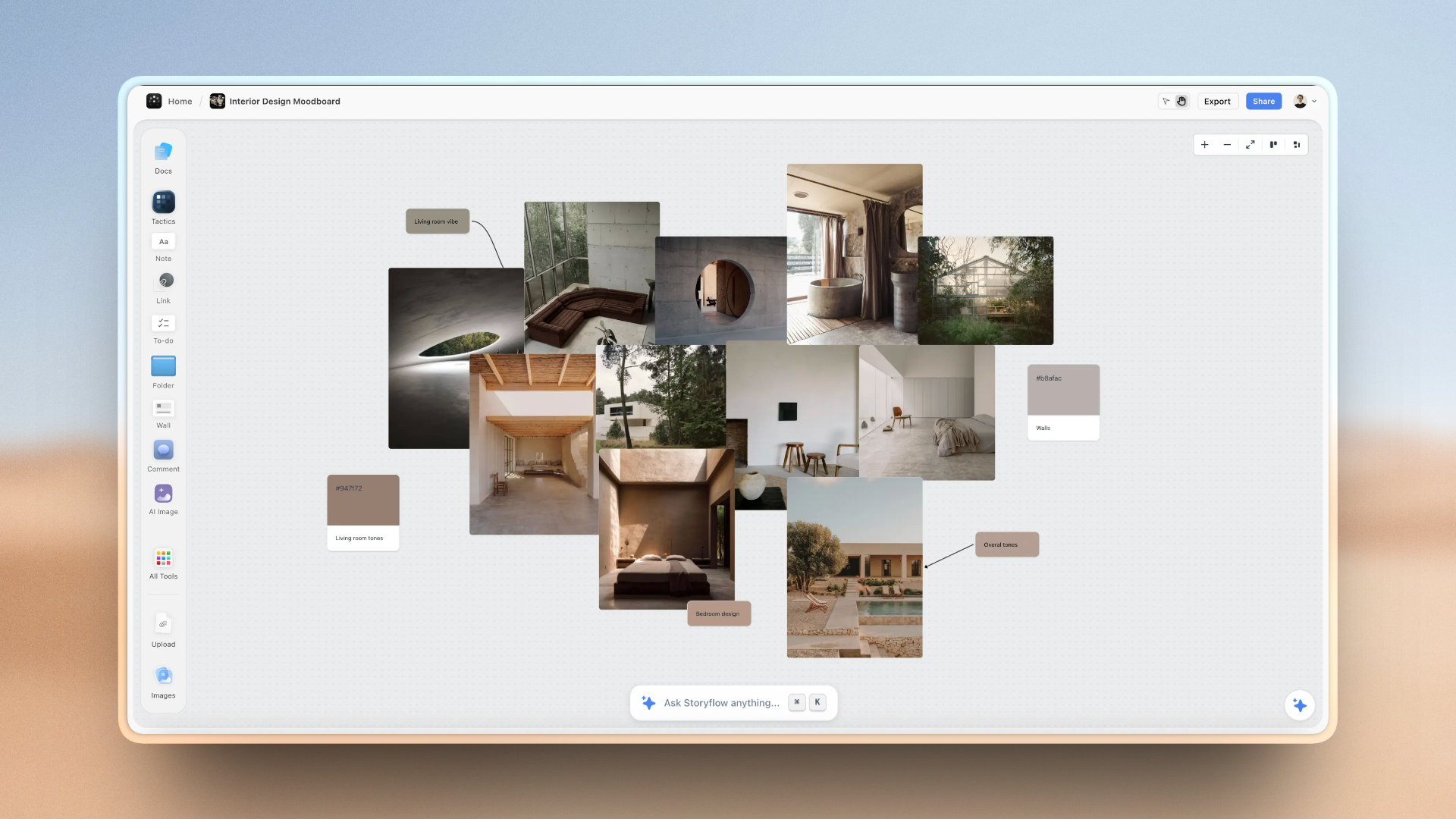
A Storyflow canvas running an idea through the seven SCAMPER prompts
A Worked Example: Running One Idea Through All Seven Prompts
Abstract prompts are easy to nod along to and hard to use. So take one ordinary idea and run it through the whole checklist. The idea: a weekly email newsletter that is not growing. It still goes out every Sunday, still gets polite opens, and has quietly stopped mattering. Here is SCAMPER pointed at it.
Substitute. Replace the weekly long essay with a single annotated link and two sentences of why it matters. Or swap the written format itself for a ninety-second voice note the reader can play in the kitchen. The assumption you just broke: that the newsletter has to be a written essay.
Combine. Merge the newsletter with a podcast so one script serves both. Or combine two thin newsletters into one that earns a real slot in the reader's week. Two half-alive things can become one living thing.
Adapt. Borrow the "one big idea, then three short links" structure that the best news digests use. Or adapt the streak mechanic from language apps: a reader who opens four weeks running gets something the drifters do not. You are not inventing a format, you are importing one that works next door.
Modify (Magnify or Minify). Magnify one recurring section into its own flagship edition once a month, the piece people forward. Or minify the whole thing into a strict three-sentence format so it becomes the newsletter people actually finish.
Put to another use. The back catalog is not dead archive. Turn two years of issues into a short book, a paid course, or the sales collateral you send prospective clients. The same words do a second job.
Eliminate. Cut the fixed Sunday schedule and send only when you have something worth the interruption. Cut the "Hope you had a great week" opener and the long sign-off. Cut images entirely. Removing the ritual often reveals how little of it was load-bearing.
Reverse (or Rearrange). Put the call to action at the top instead of burying it at the bottom. Let readers vote on next week's topic so the direction runs from audience to author instead of the other way around. Reorder the archive into a beginner-to-advanced path so a new subscriber has somewhere to start.
Seven prompts, roughly fifteen concrete directions, from an idea that felt finished. None of these required a flash of genius. They required a fixed question and the discipline to write the answer down. The same seven prompts work just as cleanly on a physical product, a screenplay's second act, a marketing funnel, or a lesson plan. The object changes. The checklist does not.
When to Use SCAMPER (and When to Reach for Something Else)
SCAMPER has a sweet spot, and pretending otherwise is how people end up disappointed by it. Reach for it in four situations:
- You have an existing product, service, or process and need to make it meaningfully better.
- You are creatively blocked on something specific and keep landing on the same tired answer.
- You are doing a teardown of a competitor's product and want a structured way to find the gaps.
- You are iterating on a feature, a campaign, or a format and want more than the two obvious options.
Do not reach for it when you are staring at a genuinely blank page. SCAMPER does not help you find an idea. It helps you transform the one you already have. With no "one you already have," the seven prompts have nothing to act on, and the technique stalls before it starts. Zero-to-one problems want a different tool: free-association brainstorming, mind mapping, or just gathering raw material until a starting shape appears. Bring SCAMPER in the moment you have something, however rough, that is worth interrogating.
The quick decision rule: if you can finish the sentence "I want to improve this ___," use SCAMPER. If the honest sentence is "I have no idea where to start," use an open ideation method first, then run the survivor through SCAMPER.
How AI Supercharges SCAMPER (and Where It Does Not)
SCAMPER and large language models are an unusually good fit, because the technique is a set of well-formed prompts and prompting is exactly what these models are built to answer. You can hand an AI your idea and ask, one letter at a time, "give me eight Substitute options," and get a stocked shelf in seconds instead of an afternoon. The slow part of SCAMPER has always been filling the seven lanes. AI makes the filling nearly free.
The catch is quality, and it is a real one. AI outputs regress toward the average answer, because that is what a model trained on the whole internet is built to produce. Ask for Substitute ideas and you get the five substitutions most people would already think of. The best SCAMPER outputs are the weird ones the AI will not suggest, which means the machine fills the lanes and the human still has to find the gold. Use AI to beat the blank lane, never to pick the winner.
There is a second, quieter problem. A chat window cannot see your idea. You paste in a summary, the model reasons over the summary, and every detail you did not think to type is invisible to it. For a real project with many moving parts, that summary step is where most of the useful context leaks out.
Running SCAMPER on a Canvas: Seven Lanes Instead of Seven Sticky Notes
That leak is the friction worth solving, and it shares a fix with the scatter problem from earlier: give the seven prompts a space where you can see them all at once and where the AI reads the actual idea, not a retyped summary.
This is the specific gap Storyflow closes. You put the idea in the middle of an infinite canvas and lay out seven lanes around it, one per SCAMPER letter, so every option lives as a card in its lane and the whole session is visible at a glance instead of trapped in working memory. Storyflow's AI reads your full active canvas board by default, plus up to 1 blueprint (Tactic) and up to 3 Documents you @-mention, so when you ask it to expand the Eliminate lane it is reasoning over the real idea and everything already on the board, not a summary you retyped. The AI fills the lanes fast, and you spend your attention on the one judgment call SCAMPER always comes down to: which weird option is worth building. Storyflow's Free plan, launching before the end of 2026, will cover unlimited boards for this; the Plus plan is $7.99 per month billed annually ($9.99 monthly).
Storyflow is not the honest answer for every SCAMPER session, and it is worth being clear about where it loses:
- There is no dedicated SCAMPER mode. You build the seven lanes yourself on a blank canvas. If you want a pre-labeled worksheet that walks you letter by letter, a simple document template is lighter and more guided.
- It is cloud-only. There is no offline or local-first option, so for privacy-regulated work or a plane with no wifi, a notebook or a local app wins.
- It is canvas-card-shaped, not document-shaped. If your output needs to be a linear worksheet or a formatted report, you will be exporting and reformatting, and a plain doc would have been shorter.
- The AI averages, the same as any other. The canvas gives the model better context, but it will not hand you the strange, specific idea that makes a SCAMPER session worth running. That part is still on you.
Storyflow is also a newer platform with a smaller template library than a tool like Notion. It belongs in this guide for one narrow, honest reason: SCAMPER is a spatial, multi-lane, context-hungry technique, and a canvas the AI can actually read fits that shape better than a chat box or a sheet of paper.
The Bottom Line
SCAMPER is one of the most useful thinking tools you can memorize, and its usefulness comes entirely from its honesty about what it is. It is a checklist of seven prompts (Substitute, Combine, Adapt, Modify, Put to another use, Eliminate, Reverse) that each break a different assumption hiding inside an idea you already have. It will not conjure a concept from nothing, and it does not pretend to. SCAMPER does not help you find an idea. It helps you transform the one you already have.
So the decision is simple. If you have an existing thing to improve, run it through the seven prompts before you decide it is finished. If you are staring at a blank page, use an open ideation method to find a starting shape first, then bring that survivor to SCAMPER. And if the idea has real moving parts, put it in the middle of a Storyflow canvas, lay out the seven lanes, and let the AI fill each one while you decide which strange option is worth building. Start a SCAMPER board on a Storyflow canvas.
FAQ: SCAMPER Technique
What does SCAMPER stand for?
SCAMPER stands for Substitute, Combine, Adapt, Modify (or Magnify), Put to another use, Eliminate, and Reverse (or Rearrange). Each letter is a prompt you apply to an existing idea to generate variations. The acronym is a memory aid for a set of idea-spurring questions, so the point is not the exact wording of each word but the distinct angle each one forces you to consider.
Who invented the SCAMPER technique?
Bob Eberle, an educator, created the SCAMPER acronym in his 1971 book "SCAMPER: Games for Imagination Development." He built it on the idea-spurring checklist questions that advertising executive Alex Osborn published in his 1953 book "Applied Imagination." Osborn wrote the questions; Eberle organized them into the mnemonic most people learn today.
What is an example of the SCAMPER technique?
Take a weekly email newsletter that has stopped growing. Substitute the long essay for a single annotated link. Combine it with a podcast so one script serves both. Adapt the "one big idea plus three links" structure from news digests. Modify it into a strict three-sentence format. Put the back catalog to another use as a paid course. Eliminate the fixed schedule. Reverse the flow by letting readers vote on the next topic. One idea, seven prompts, a dozen concrete directions.
When should you use SCAMPER?
Use SCAMPER when you already have an existing idea, product, or process and want to improve or reinvent it. It is strongest for iteration, product teardowns, and breaking a creative block where you keep landing on the same answer. It is weakest for genuine blank-page problems, because the seven prompts need an existing thing to act on. If you have nothing to start from, use an open brainstorming or mind-mapping method first.
What is the difference between SCAMPER and brainstorming?
Brainstorming is open-ended idea generation with no fixed structure, good for producing raw quantity from a blank start. SCAMPER is structured and directed: it takes one existing idea and pushes it through seven specific prompts. Think of brainstorming as the tool for finding a starting point and SCAMPER as the tool for transforming a starting point you already have. They are complements, not competitors.
Is SCAMPER good for problem solving?
Yes, for problems that involve improving or redesigning something that already exists. SCAMPER forces you to examine a problem from seven angles you would otherwise skip, which surfaces options a straight-ahead analysis misses. It is less suited to problems that require original diagnosis, where you first need to understand the problem before there is anything to run the checklist against.
Can SCAMPER be used with AI?
Yes, and the fit is strong because each SCAMPER letter is a clean prompt an AI can answer quickly. You can ask a model to generate options for each prompt in seconds, which removes the slow part of the technique. The limitation is that AI outputs trend toward the average, so it is best used to fill the lanes fast while you apply human judgment to pick the non-obvious winners.
What does the M in SCAMPER stand for?
The M stands for Modify, which also covers Magnify and Minify. The prompt asks what happens if you change an attribute, make something much bigger, or make it much smaller. Scaling a feature up into a flagship or shrinking a whole product into a minimal version are both M moves. Some practitioners split Magnify and Minify into separate steps, which is why you sometimes see SCAMPER drawn with more than seven prompts.
Is SCAMPER only for products?
No. SCAMPER works on any existing thing with parts and structure: a service, a business model, a marketing campaign, a lesson plan, a screenplay's second act, or an internal process. The seven prompts do not care what the object is, and they apply as well to a workflow as to a physical product.
What are the limitations of the SCAMPER technique?
SCAMPER needs an existing idea to work on, so it is poor for zero-to-one, blank-page creation. It also tends to produce incremental variations rather than radical breakthroughs, because it transforms what is already there instead of questioning whether the thing should exist at all. And its output can sprawl: seven prompts across a complex idea generate a lot of options, so you need a separate step to evaluate and cut down to what is worth pursuing.
How do you run a SCAMPER session with a team?
Write the idea somewhere everyone can see it, then take the seven prompts one at a time and give the group a few minutes per prompt to call out options without judging them. Capture everything, resist debating quality during generation, and only score and cut once all seven lanes are full. A shared visual space helps, because every prompt and option needs to stay visible at once rather than lost in a chat thread.
Table of Contents
- Key Takeaways
- Why Seven Fixed Questions Beat "Just Brainstorm Some Improvements"
- Where SCAMPER Comes From: Osborn's Questions, Eberle's Acronym
- The Seven SCAMPER Prompts (Letter, Prompt, and the Question to Ask)
- A Worked Example: Running One Idea Through All Seven Prompts
- When to Use SCAMPER (and When to Reach for Something Else)
- How AI Supercharges SCAMPER (and Where It Does Not)
- Running SCAMPER on a Canvas: Seven Lanes Instead of Seven Sticky Notes
- The Bottom Line
- FAQ: SCAMPER Technique
- Related Reading
Templates to check out for this topic


Templates you can use in Storyflow
Every Storyflow board starts from real structure and an AI that reads the whole canvas. Open one of these templates and make it yours.


See Storyflow in Action
A visual AI workspace where every feature lives inside one canvas. No tab-switching, no context lost.
Build your entire board from a single message
Type what you need in the AI chat at the bottom of your canvas. The AI adds cards, headings, and structure directly onto your board.
Use expert frameworks as AI context
Type @ in the AI chat and choose any Tactic. The AI tailors every response to that framework instead of giving generic advice.
Turn your board into a mind map in seconds
Ask the AI to restructure your canvas as a mindmap. It connects your ideas into a visual hierarchy so you can see how everything relates.
Why Storyflow Exists
Storyflow actually began as a personal tool while working on creative and research projects.
We kept running into the same problem: ideas were scattered everywhere: notes, documents, and whiteboards.
Nothing helped us see how everything connected.
So we started building a workspace designed around how ideas actually grow.
→ Read how Storyflow was createdSara de Klein
Head of Product at Storyflow
Published: 2026-07-15
Extremely simple, seriously capable


See how easy it is to get started
Watch a real project come together, from a blank board to a finished plan, clicked through step by step.
Start creating with AI and become more productive
Transform your creative workflow with AI-powered tools. Generate ideas, create content, and boost your productivity in minutes instead of hours.