What Goes in a Director's Book (2026 Guide)
A director's book contains the intent for every scene, the visual references that define it, the blocking and coverage plan, and the specific questions each department needs answered, held in one place the director can open on set.

Category
Filmmaking
Author

Justkay
Documentary Filmmaker & Founder at Storyflow
Topics
2026-08-29
•
12 min read
•
Filmmaking- what goes in a directors book
- directing
- pre-production
- film prep
- shot design
- filmmaking
- Storyflow
What goes in a director's book?
A director's book contains the intent for every scene, the visual references that define it, the blocking and coverage plan, and the specific questions each department needs answered, held in one place the director can open on set. It is not a shot list and it is not a lookbook, though it contains material from both: a shot list says what to capture, a lookbook says what things look like, and the director's book says what each scene is for, which is the thing that lets a crew make good decisions when the plan meets reality. Storyflow is what I use to build one because scene intent, references and blocking sit together on a canvas that opens on a phone at the monitor, and because a physical binder cannot be searched at 6am or updated when day three moves.
Key Takeaways
- The book's job is intent. Every other document on a production records what to do; this one records what it is for.
- Organise by scene, not by department. The director works scene by scene and the book has to match that.
- One line of intent per scene is the single highest-value entry in the whole document.
- Include the questions, not just the answers. The unresolved things are what you need on the day.
- It must be openable on set. A beautiful book on a laptop in the production office is not a director's book.
- It is a working document, not a deliverable. If it looks finished, it is probably not being used.
Build the book as a canvas
A director's book in a binder cannot be searched, shared or updated on the day. Storyflow holds the scene intent, the references and the blocking in one place the whole department can open from set.

What It Is For
A production generates a lot of documents and almost all of them record decisions. The schedule records when. The shot list records what. The lookbook records how it looks. The script records what happens.
None of them record why, and why is what you need when the plan breaks.
The concrete case. It is day four, the location fell through, you are in a different room with worse light and forty minutes. The shot list says a slow push-in on a medium. That shot is not available here. What do you do?
With intent recorded, the answer is quick. The scene is the moment the subject stops performing and tells the truth, and the push-in was there to isolate them from the room. In this space you cannot push, but you can go longer on the lens and lose the background, which achieves the same isolation. Decision made in thirty seconds.
Without intent recorded, you either reproduce the shot badly in a space that does not support it, or you improvise something that looks fine and does not do the scene's job, and you find out in the edit.
The book is insurance against the plan being wrong, and the plan is always wrong somewhere.
The Structure
Organised by scene or sequence, in story order, with a small amount of front matter.
Front matter
Three things, one page equivalent.
The controlling idea. One sentence on what the whole piece is about. Not the logline. The thing that decides arguments. "This is about a man who cannot admit the business is over." Every scene-level decision gets checked against it.
The visual approach. Three or four lines. Lens language, camera behaviour, palette, how much the camera participates. Enough that a DP joining late understands the grammar.
What is fixed. Constraints that cannot move: locations, cast availability, budget realities, anything contractual.
That is the whole front matter. Anything longer does not get read.
Per scene
This is the body of the book and it repeats the same six blocks.
Intent. One or two sentences on what this scene is for, in story terms. Not what happens. What it does. "Establishes that she has already decided, so the argument in scene 9 reads as performance rather than deliberation."
This is the most valuable line in the document and it is the one most often skipped, because it feels obvious while you are writing it. It is not obvious three weeks later at 6am.
References. Two or three images maximum, with the extraction named. Not a moodboard. The specific visual idea for this scene, with a line saying what to take from each. The full lookbook lives elsewhere and is linked.
Blocking. Where people are and how they move. A rough overhead sketch beats a paragraph, and it does not need to be good. Include the camera position and the light source.
Coverage. The shots you intend, in priority order. Marked essential, wanted or bonus, because you will run out of time and the decision about what to lose should be made now rather than at 4pm with everyone tired.
Performance notes. What you need from the cast in this scene, and what you will say to get it. Directors under time pressure default to giving results-oriented direction, which does not work. Having the actual note written down means you give the note you meant to give.
Open questions. What is not decided. "Do we see the letter or only her reaction?" These are the entries you will actually consult on the day, and they are what most books omit because unresolved items feel like incompleteness.
What Does Not Belong
The full script. Reference it. A book that contains the whole script becomes a script with annotations and stops being navigable.
The complete lookbook. Two or three references per scene, chosen. The full set lives in the lookbook and is linked from the book.
The schedule. It changes constantly and the book should not be a stale copy of it. Link to the canonical plan.
Department detail. Wardrobe breakdowns, prop lists, technical specs. Those belong to their departments. The book carries what the director needs to make scene-level decisions.
Anything decorative. A book that has been designed is a book somebody made for an audience. This one has an audience of one to three people and its only job is retrieval speed.
Building It

The build order that works is intent first, across every scene, before any references are gathered.
Writing all the intent lines in one pass, in story order, does something a scene-by-scene build does not: it exposes the scenes that have no job. Every project has two or three of them, scenes that exist because they were in the script or because a location was available, and they are invisible until you try to write what they are for and cannot.
Finding them before the shoot is worth more than everything else in the process.
Then references, then blocking, then coverage, then open questions, each in a full pass across all scenes rather than scene by scene. Passes keep the treatment consistent; scene-by-scene building produces a book where the first five scenes are detailed and the last twelve are thin.
The format question matters more than it sounds. A binder cannot be searched, cannot be updated when day three moves, and exists in one copy that is wherever it was left. A PDF is searchable and static, so it is out of date the moment anything changes. A document is updateable and poor at holding images and sketches side by side.
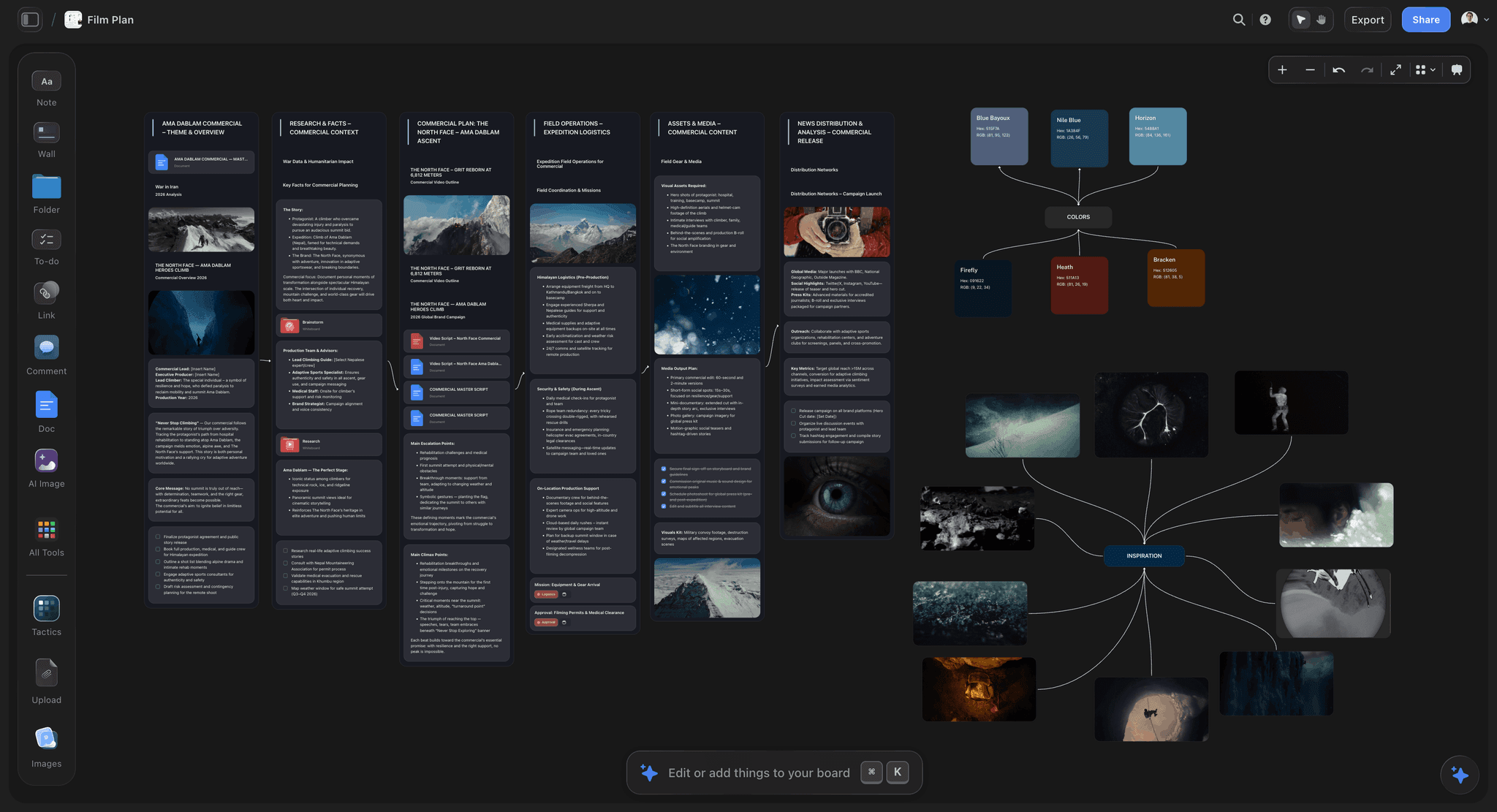
On a Storyflow canvas each scene is a region holding its intent, references, blocking sketch and questions together, and it opens on a phone at the monitor. Because its AI reads the whole board, you can ask it which scenes have no intent line written, or where the coverage is thin, and get an answer from the actual book. Milanote handles this shape of document well too and is a reasonable alternative if you do not need the board read back to you.
| Scene block | Length | Purpose | Consulted on set? |
|---|---|---|---|
Intent | One or two sentences | Decide when the plan breaks | Constantly |
References | Two or three images, annotated | Align the look fast | Occasionally |
Blocking | A sketch | Start the day faster | At the start of each setup |
Coverage | Prioritised list | Decide what to lose | When time runs short |
Performance notes | Two or three lines | Give the right note | Before each take series |
Open questions | Whatever is unresolved | Resolve on the day | Constantly |
Using It on the Day
The book earns its cost in three specific moments.
At the top of each setup. Read the intent line aloud, or at least to yourself. Thirty seconds. It reorients the whole crew and prevents the drift where a setup gets technically excellent and stops serving the scene.
When something breaks. Location changed, weather turned, an actor is unavailable. Go to intent, not to the shot list. The shot list tells you what you cannot do; the intent tells you what you could do instead.
When time runs out. The coverage priorities were set when you could think. Trust them over the judgement of a tired room at the end of a long day.
Update it as you go. When a scene changes on the day, note what actually happened. The book becomes the handover to post, and a post team that knows scene 14 was covered differently and why will make better choices than one working from the original plan.
What Goes Wrong
Intent lines describe the action. "She reads the letter and leaves" is what happens, not what it is for. If the line could be lifted from the script, it is not intent.
The book is too beautiful. Time spent designing it is time not spent on the content, and a polished book discourages the marking-up that makes it useful.
It is only on a laptop. If it cannot be opened at the monitor, it will not be consulted, and everything in it may as well not exist.
Open questions are omitted. Leaves the book looking complete and useless at the exact moments you need it.
It is never updated during the shoot. Post receives the plan rather than the reality, and spends a week working out what actually happened.
Coverage is not prioritised. Every shot marked essential means the decision about what to drop gets made by whoever is watching the clock rather than by the director.
The Bottom Line
The director's book is the only document on a production that records why. Build it scene by scene with intent first, keep the references few and annotated, prioritise the coverage before you are tired, and write down the questions you have not answered.
Then make sure it opens on a phone. A book that cannot be consulted at the monitor is a document that recorded your thinking and then withheld it at the moment you needed it.
FAQ: The Director's Book
Is a director's book the same as a shot list?
No. A shot list is an inventory of what to capture and it is usually produced from the book. The book records what each scene is for, which is what lets you deviate from the shot list intelligently when the day does not go to plan.
How long should a director's book be?
Roughly one screen or one page per scene, which for a short film is ten to twenty pages equivalent and for a feature is considerably more. Length is not the measure: a book where every scene has a real intent line and honest open questions is more useful at half the size of one padded with references.
Do documentary directors need one?
Yes, and it looks different. Instead of blocking and coverage per scene, it carries the questions you need answered, the moments you are hoping to capture, and what each sequence is for in the argument. The intent discipline matters more in documentary, not less, because there is no script holding the structure.
Should the crew see the director's book?
Share the relevant scene regions with the DP and the first AD at minimum. Sharing the whole book widely tends to produce debate about intent, which is the director's call. The exception is documentary, where a small crew benefits from everyone knowing what you are trying to capture.
Is Storyflow free for building a director's book?
Not during early access. Storyflow is paid-only right now, with Plus at $7.99 per month billed annually, and the Free plan launches before the end of 2026. Anyone a paid member invites to a board joins free, which covers a DP or AD who needs to read it on set.
When should the book be finished?
It should not be finished. Draft it in pre-production, take it to the tech recce and revise it there, then update it during the shoot as scenes change. A book that stopped changing when the shoot started is a book nobody is using.
Table of Contents
Templates to check out for this topic


Templates you can use in Storyflow
Every Storyflow board starts from real structure and an AI that reads the whole canvas. Open one of these templates and make it yours.


See Storyflow in Action
A visual AI workspace where every feature lives inside one canvas. No tab-switching, no context lost.
Build your entire board from a single message
Type what you need in the AI chat at the bottom of your canvas. The AI adds cards, headings, and structure directly onto your board.
Use expert frameworks as AI context
Type @ in the AI chat and choose any Tactic. The AI tailors every response to that framework instead of giving generic advice.
Turn your board into a mind map in seconds
Ask the AI to restructure your canvas as a mindmap. It connects your ideas into a visual hierarchy so you can see how everything relates.
Why Storyflow Exists
Storyflow actually began as a personal tool while working on creative and research projects.
We kept running into the same problem: ideas were scattered everywhere: notes, documents, and whiteboards.
Nothing helped us see how everything connected.
So we started building a workspace designed around how ideas actually grow.
→ Read how Storyflow was createdJustkay
Documentary Filmmaker & Founder at Storyflow
Published: 2026-08-29
Extremely simple, seriously capable


See how easy it is to get started
Watch a real project come together, from a blank board to a finished plan, clicked through step by step.
Start creating with AI and become more productive
Transform your creative workflow with AI-powered tools. Generate ideas, create content, and boost your productivity in minutes instead of hours.