
Pre-Production vs Production vs Post-Production: The Complete Guide (2026)
Pre-production, production, and post-production are the three phases of filmmaking. Here is what happens in each, who leads it, what it delivers, and why time saved in pre-production pays off through the shoot and the edit.

Category
Filmmaking
Author

Justkay
Documentary Filmmaker & Founder at Storyflow
Topics
2026-07-15
•
12 min read
•
Filmmaking- pre production vs production vs post production
- three phases of filmmaking
- film production process
- what happens in post-production
What is the difference between pre-production, production, and post-production?
Filmmaking runs in three phases: pre-production (planning), production (the shoot), and post-production (the edit). Pre-production is everything before the camera rolls: locking the script, building the schedule, drawing storyboards, casting, scouting locations, and setting the budget. Production is principal photography, the days you actually capture picture and sound. Post-production is the edit, sound design, color, visual effects, music, and delivery. The three run in order, and each phase inherits whatever the last one left unfinished, which is the reason the oldest rule on set still holds: you fix it in prep, or you pay for it in post. I have run multiple documentary projects through all three phases, and I built Storyflow, a visual planning tool, around how much of a film is decided before day one.
What the Three Phases of Filmmaking Actually Are
Ask most people what makes a film and they describe the shoot: the camera, the lights, the actors on their marks. The shoot is the visible part. It is also the shortest and by far the most expensive, and by the time it starts, the decisions that determine whether the film works have already been made or missed.
Every film school, and the American Film Institute, teaches the same three-phase structure, because it maps to a hard constraint: you cannot shoot a scene you have not planned, and you cannot edit footage you did not shoot. The phases are sequential and one-directional. Nothing flows backward, which is why their order is not a formality but a cost structure.
Here is the model this article is built around. Call it the Prep-Debt Curve. Any decision you defer out of pre-production does not disappear. It becomes prep debt, and like any debt it accrues interest as it travels downstream. A location you never locked is a cheap problem in prep, a delay in production, and a continuity hole in post. Prep debt is cheap to pay in pre-production, costly in production, and ruinous in post. The rest of this guide is that curve, phase by phase.
The short version, before the detail:
- Pre-production is the design phase: script, schedule, breakdown, shot list, storyboards, casting, locations, and budget. It is where the film is actually built.
- Production is principal photography, the shoot. It is the shortest phase and the most expensive per hour, so every unplanned minute costs the most here.
- Post-production is assembly: edit, sound, color, visual effects, music, and delivery. It is where the film is found, but it can only work with what production captured.
- Each phase is led by different people and produces different deliverables that hand off to the next phase.
- The Prep-Debt Curve means a problem deferred from pre-production gets more expensive at every stage downstream.
- The golden rule follows directly: you fix it in prep, or you pay for it in post.
Pre-Production vs Production vs Post-Production: The Complete Comparison
The three phases differ on every axis that matters: what they are for, who runs them, what they produce, and how long they take. This table holds all three in your head at once.
| Phase | Goal | Who leads it | Key deliverables | Typical duration |
|---|---|---|---|---|
Pre-production | Plan and design every shootable decision | Producer and director, with the 1st AD building the schedule | Locked script, scene breakdown, shot list, storyboards, shooting schedule, budget, call sheets, cast, locations | Weeks to months (often longer than the shoot) |
Production | Capture the planned picture and sound | 1st AD runs the floor, director owns performance, DP owns the image | Exposed footage and dailies, production sound, continuity notes, camera reports | Days to weeks (the shortest phase) |
Post-production | Assemble, finish, and deliver the film | Editor with the director, then sound, color, and VFX leads | Assembly, rough cut, picture lock, sound mix, color grade, final master and deliverables | Weeks to months (often the longest) |
Read the duration column and the asymmetry jumps out. Pre-production and post-production are long. Production, the part everyone pictures when they think "making a movie," is the shortest, and it is short on purpose, because it commits the entire unit at once. The numbers are ranges that flex by format: a commercial might shoot in a day after weeks of prep, a documentary might shoot for a year and edit for two. The shape holds regardless.
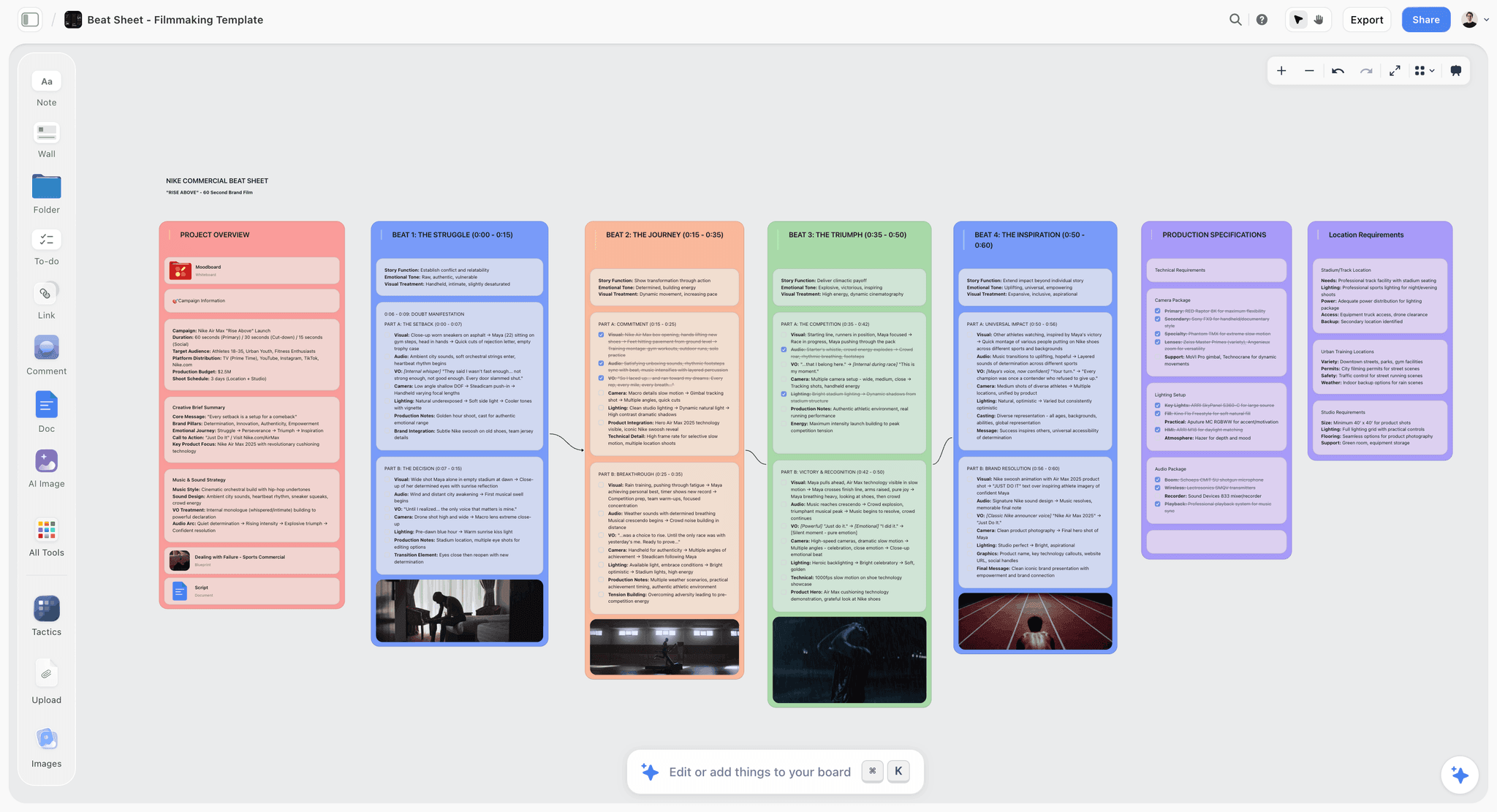
a Storyflow canvas mapping the three production phases with their deliverables
Pre-Production: Where the Movie Actually Gets Made
Pre-production is the phase beginners skip and professionals obsess over. It is unglamorous, it happens in spreadsheets and on corkboards, and it is where the film is genuinely made. Everything after it is execution and repair.
The work is concrete. You develop and lock the script, then break it down scene by scene, listing every cast member, prop, location, costume, and effect. You turn that breakdown into a shooting schedule grouped by location rather than story order, because you shoot every scene at the beach on beach day, not in the order the audience will see them. You draw storyboards and build a shot list so the set knows what to capture. You cast the roles, secure locations, hire the crew, set the budget, and produce the call sheets.
Who leads it. The producer owns logistics, budget, and schedule. The director owns the creative vision. The 1st Assistant Director turns the script breakdown into a workable schedule, and department heads (the DP, the production designer, the casting director) prep their own areas against it.
What it delivers. A locked script, a scene breakdown, a shooting schedule, a shot list, storyboards, a budget, cast, crew, locations, and call sheets. Every one of those documents is a promise the shoot will try to keep.
The handoff. The shot list, storyboards, schedule, and call sheets carry your intent onto the floor. When they are thorough, the set executes. When they are thin, the set improvises, and improvising on a paid crew is the most expensive writing you will ever do.
The familiar approach is to scatter all of this: the script in one app, the schedule in a spreadsheet, storyboards in a folder, references on Pinterest. None of it travels together, and none of it travels to set. That fragmentation is the friction Storyflow removes. It keeps the plan on one canvas, so shot-list cards, storyboard frames, the schedule, and research sit side by side, and the canvas-aware AI reads the full board (plus up to one blueprint and three documents you @-mention) instead of a summary. Story Blueprints such as Hero's Journey and AIDA give a blank canvas a starting structure. Storyflow plans the film and stops at the edit, which the section below is honest about.
Every hour spent here is the cheapest hour in the entire production. This is the flat end of the Prep-Debt Curve, the only place you pay the debt down at face value.
Production: The Most Expensive Room in Filmmaking
Production is where the budget burns fastest, because a single shooting day commits the whole unit at once: cast, crew, equipment, locations, catering, insurance, and the clock. Nothing else in filmmaking spends money at this rate. That is why the phase is short, and why the pressure to keep moving is relentless.
The work is principal photography. The 1st AD runs the day against the schedule, the director works with the actors and watches the monitor, the DP lights and captures the image, the script supervisor tracks continuity, and sound records clean audio. You also shoot coverage, the wides, mediums, and close-ups of each beat, so the edit has options instead of a single locked angle.
Who leads it. On the floor, the 1st AD runs the clock and the call sheet. The director owns performance and the creative choices. The DP owns the image. The producer owns the money and the hard calls when the day runs behind.
What it delivers. Exposed footage and dailies, clean production sound, continuity notes, and camera reports. That raw material is everything post has to work with, and nothing more.
The handoff. Footage, sound, and notes go to the edit. If a scene was not covered, the editor cannot invent the missing angle. The edit can only rearrange what the shoot captured.
Production is also where deferred decisions come due. The location you did not lock, the scene you did not storyboard, the schedule you did not stress-test: all of it surfaces here, on the most expensive day of the project. It is not that problems appear in production. It is that prep debt comes due in production, with interest. The unit stands idle while someone solves a problem a quiet afternoon in pre-production would have solved for free.
Post-Production: Where the Film Is Found
Editors have a saying: a film is written three times, once on the page, once on the set, and once in the edit. Post-production is that third writing, and it is the phase where a good shoot becomes a film or a rough shoot gets quietly rescued.
The work moves in a set order. You start with the assembly, every usable take laid end to end, then cut down to a rough cut, a fine cut, and picture lock, the point where the edit stops changing so the finishing crews can work against something stable. Then come sound design and the mix, the color grade, visual effects, music, titles, and delivery to whatever spec a distributor, platform, or festival demands.
Who leads it. The editor cuts alongside the director. A supervising sound editor and re-recording mixer own the soundtrack. A colorist owns the grade. A VFX supervisor owns the effects. Each is a specialist finishing their own layer of the same film.
What it delivers. A locked picture, a final mix, a color-graded master, and the deliverables package the release requires.
"Fix it in post" is a promise post cannot always keep. Post can trim a slow scene, sweeten muddy sound, stabilize a shaky shot, and grade a flat image into something rich. Post cannot conjure coverage that was never shot, recover audio that clipped past the point of repair, or re-block a scene that did not work on the day. It is not that post is weak. It is that post inherits the shoot's ceiling. The most expensive prep debt of all is the kind you only discover here, when the fix requires a reshoot you can no longer afford to mount.
The Handoffs: Where Films Actually Break
Films rarely fail inside a phase. They fail at the seams, at the two handoffs where one team's output becomes another team's raw material.
Handoff one, prep to production. The shooting schedule, shot list, storyboards, and call sheets translate months of planning into a single day's work. When the handoff is clean and complete, the set simply executes the plan. When it is thin, the set improvises, and every improvised decision is made under the most expensive conditions the project will ever face.
Handoff two, production to post. Footage, sound, and continuity notes translate the shoot into material the edit can shape. When coverage is complete and clearly labeled, the edit flows. When it is patchy or mislabeled, the edit turns into a salvage operation, and the editor spends the budget looking for shots that may not exist.
Both handoffs move the same thing: intent. A film is a chain of handoffs, and the chain is only as strong as its weakest transfer. Prep debt, in the end, is intent that failed to hand off: everything the front of the pipeline understood but never wrote down, now a question the next phase answers at a worse price.
The Golden Rule: You Fix It in Prep, or You Pay for It in Post
The Prep-Debt Curve is not unique to film. It is a special case of a pattern documented across engineering and quality management, which is part of why it is so reliable.
Barry Boehm's software-economics research (1981) found that the cost of fixing a defect climbs steeply the later it is caught: a problem fixed at the design stage costs a small fraction of the same problem fixed after release. Quality management teaches the popular version as the 1-10-100 rule: a problem costs roughly 1 unit to prevent, 10 to correct once it is in the work, and 100 to fix after it reaches the customer. Filmmaking obeys the same curve exactly. A story problem costs a rewrite in pre-production, a reshoot in production, and an unfixable hole in post.
Scheduling optimism makes the curve steeper. Hofstadter's Law, from Douglas Hofstadter's Gödel, Escher, Bach (1979), states that everything takes longer than you expect, even when you account for Hofstadter's Law. In pre-production that optimism costs you nothing. On set it is billed by the hour, in post it is billed by the reshoot.
So the golden rule of the three phases is not a slogan, it is arithmetic. You fix it in prep, or you pay for it in post, and the exchange rate is brutal. An hour of planning is the cheapest hour on the film. An hour of reshoots is the most expensive. The whole skill of producing is moving work left, toward the cheap end of the curve, before the schedule drags it right.
Where Storyflow Fits, and Where It Does Not
If the Prep-Debt Curve is real, the highest-leverage tool you own is whatever makes pre-production faster and more thorough. That is the job Storyflow is built for, and it is worth being precise about where it starts and stops.
What it does: Storyflow is a visual planning canvas for pre-production. Script notes, a beat sheet, storyboard frames as cards, a shot list, a moodboard, research, and a rough schedule live on one infinite canvas instead of across five apps. The AI reads your full active board, plus up to one blueprint and three documents you @-mention, so it reasons over the actual plan rather than a summary. Story Blueprints such as Hero's Journey, AIDA, and Retention Hooks give structure that a blank canvas does not.
Where it does not play, and this is the part that matters most:
- It is not an editing suite. Storyflow does not cut footage. Post-production belongs in Adobe Premiere Pro, DaVinci Resolve, or Avid Media Composer. Storyflow plans the film, those tools finish it.
- It is not on-set software. It does not run the floor or push call sheets to a crew in the field the way a dedicated scheduling tool does. It hands your plan off, it does not manage the shoot day.
- It is cloud-only. There is no offline, local-first mode, so a remote location with no signal is a genuine limitation.
- It is canvas-card-shaped, not a formatted screenplay editor. For industry-standard script formatting, pair it with Final Draft.
Read that list and the placement is obvious. Storyflow is a pre-production tool, not a production or post-production tool. It earns its place at the front of the pipeline, exactly where the Prep-Debt Curve says the leverage is, and then it hands off cleanly to the shoot and the edit rather than pretending to replace them.
Which Phase Deserves Your Attention?
The three phases are not equally worth your effort, because their costs are not equal. Diagnose by symptom:
- If your shoots run long and over budget, the fix is upstream. Overruns on set are almost always prep debt coming due, so invest in the breakdown, the schedule, and the shot list before you invest in more shoot days.
- If your edits feel like salvage jobs, the fix is in production coverage. Shoot more options on every important beat: a wide, a medium, and a close-up, so the edit has something to cut to.
- If your films feel unfocused, the fix is in development. Lock the story and the script before you spend a dollar on the shoot, because no amount of coverage saves a scene that should not exist.
- If you are a solo or documentary filmmaker, pre-production is your single highest-return investment, because you cannot throw crew at a problem on the day the way a funded production can.
Bottom line: pre-production is cheap and decisive, production is short and expensive, and post is long and constrained by everything before it. Put your effort where it compounds, which is the front. Take your next project and build its pre-production on one canvas, with the script, shot list, storyboards, schedule, and references together so the plan actually travels to the shoot. You fix it in prep, or you pay for it in post. Start planning your film on a Storyflow canvas.
FAQ: The Three Phases of Filmmaking
What are the three phases of filmmaking?
The three phases are pre-production (planning), production (the shoot), and post-production (the edit and finishing). Pre-production covers the script, schedule, storyboards, casting, and locations. Production is principal photography. Post-production is editing, sound, color, visual effects, music, and delivery. They always run in that order, and each one feeds the next.
What is the difference between pre-production, production, and post-production?
Pre-production is planning before the camera rolls, production is capturing footage and sound on set, and post-production is assembling and finishing the film. The quickest test: if the camera is not rolling and you are getting ready, that is pre-production; if it is rolling, that is production; if the shoot is over and you are cutting, that is post-production.
What happens in pre-production?
Pre-production is where you lock the script, break it down scene by scene, build the shooting schedule, draw storyboards and a shot list, cast actors, scout and secure locations, hire crew, set the budget, and produce call sheets. It is the design phase of the film, and on most projects it takes longer than the shoot itself.
What happens during production?
Production is principal photography, the days you actually shoot. The 1st Assistant Director runs the schedule, the director works with the actors, the director of photography lights and captures the image, sound records audio, and the script supervisor tracks continuity. The goal is to capture every shot on the shot list, plus enough coverage to give the edit real options.
What happens in post-production?
Post-production turns footage into a film: assembly, rough cut, and picture lock, followed by sound design and mixing, color grading, visual effects, music, titles, and delivery to a distributor or festival spec. The editor leads the cut with the director, while specialist leads finish sound, color, and effects on their own layers.
Which phase takes the longest?
Pre-production and post-production usually take the longest, and production is the shortest. A shoot might last a few days or a few weeks, while planning and editing each run for weeks or months. Production is short by design because it is the most expensive phase per day, so you compress it as hard as the plan allows.
Can you really fix it in post?
Sometimes, but not always, and never cheaply. Post-production can trim pacing, sweeten sound, stabilize shots, and grade color, but it cannot create coverage that was never shot or rescue a scene that did not work on set. "Fix it in post" is a fair plan for small problems and a false hope for large ones, which is why it is cheaper to fix it in prep.
How long should pre-production take?
There is no fixed number, but a useful rule is that pre-production should take at least as long as production, and often several times longer. Documentaries and effects-heavy films need even more. The Prep-Debt Curve is the reason: every hour of planning is the cheapest hour in the project, so under-investing in prep is the most expensive saving you can make.
What tools are used in each phase?
Pre-production runs on planning tools, such as Storyflow for a visual canvas of script, shot list, storyboards, and schedule, or Final Draft for screenplay formatting. Production runs on scheduling and call-sheet tools plus the camera and sound gear on the day. Post-production runs on editing suites: Adobe Premiere Pro, DaVinci Resolve, or Avid Media Composer, alongside dedicated sound and color tools. No single tool spans all three phases well.
Table of Contents
- What the Three Phases of Filmmaking Actually Are
- Pre-Production vs Production vs Post-Production: The Complete Comparison
- Pre-Production: Where the Movie Actually Gets Made
- Production: The Most Expensive Room in Filmmaking
- Post-Production: Where the Film Is Found
- The Handoffs: Where Films Actually Break
- The Golden Rule: You Fix It in Prep, or You Pay for It in Post
- Where Storyflow Fits, and Where It Does Not
- Which Phase Deserves Your Attention?
- FAQ: The Three Phases of Filmmaking
- Related Reading
Templates to check out for this topic


Filmmaking templates you can use in Storyflow
Skip the blank canvas. Open one of these filmmaking boards in Storyflow and the AI builds on the structure that is already there, from research through the shot list.


See Storyflow in Action
A visual AI workspace where every feature lives inside one canvas. No tab-switching, no context lost.
Build your entire board from a single message
Type what you need in the AI chat at the bottom of your canvas. The AI adds cards, headings, and structure directly onto your board.
Use expert frameworks as AI context
Type @ in the AI chat and choose any Tactic. The AI tailors every response to that framework instead of giving generic advice.
Turn your board into a mind map in seconds
Ask the AI to restructure your canvas as a mindmap. It connects your ideas into a visual hierarchy so you can see how everything relates.
Why Storyflow Exists
Storyflow actually began as a personal tool while working on creative and research projects.
We kept running into the same problem: ideas were scattered everywhere: notes, documents, and whiteboards.
Nothing helped us see how everything connected.
So we started building a workspace designed around how ideas actually grow.
→ Read how Storyflow was createdJustkay
Documentary Filmmaker & Founder at Storyflow
Published: 2026-07-15
Extremely simple, seriously capable


See how easy it is to get started
Watch a real project come together, from a blank board to a finished plan, clicked through step by step.
Start creating with AI and become more productive
Transform your creative workflow with AI-powered tools. Generate ideas, create content, and boost your productivity in minutes instead of hours.