How to Write a Case Study (Step-by-Step, 2026)
A step-by-step guide to writing a customer case study that converts: choose the right customer and result, run the interview, gather the proof, structure the story, and deliver it as a page, PDF, or video.

Category
Marketing
Author

Justkay
Documentary Filmmaker & Founder at Storyflow
Topics
2026-07-22
•
17 min read
•
Marketing- how to write a case study
- case study
- case study template
- case study example
- customer case study
- case study structure
How do you write a case study?
To write a case study, tell the story of one customer getting a real result with your product: name the customer and the goal they came in with, the problem they faced, why they chose you, the solution and how it rolled out, and the results with specific numbers, then close on a forward-looking quote. A great case study is a success story with a clear before and after and real metrics, not a testimonial and not a brochure. Choose a customer whose result is specific and provable, interview them for the quotes and numbers that make the story credible, and structure it so a skimming buyer gets the outcome in seconds. Gather every quote, metric, and screenshot as proof, write it tight and scannable, and deliver it as a written page, a one-page PDF, or a video. This guide is the full method, from choosing the customer to the finished, designed case study. I interview real people for a living. As a documentary filmmaker, the whole job is sitting across from someone, earning enough trust that they say the true thing, and then shaping hours of messy, human conversation into a story a stranger will watch to the end. A case study is the same craft aimed at a smaller target. It is a story about a real person who wanted something, hit a wall, made a choice, and came out the other side with a result they can prove. The teams that write bad case studies treat them as marketing copy. The teams that write great ones treat them as short documentaries about a customer, and that is the difference between a page a buyer skims and forgets and a page that closes deals. This guide is the working method: how to find the story, how to interview for it, how to structure it, and where the tool you build it in stops and the final format takes over.

Full disclosure: Storyflow is our own product, so weigh its placement with the skepticism you would apply to any tool a company recommends on its own blog. We rank it first for one job, structuring the story and organizing the proof on one AI-readable canvas, and we are explicit that the final written page belongs in a doc and the designed PDF belongs in Canva or InDesign.
Quick Comparison
Where marketing teams actually structure and deliver a case study, and the one job each tool is best at.
| Tool | Best For | AI Features | Price |
|---|---|---|---|
| Storyflow | Structuring the story + organizing proof | Reads the whole board | $7.99 mo annual (free plan late 2026) |
| Google Docs | Written case study page | Gemini add-on | Free |
| Canva | Designed one-page PDF | Limited | Free / paid |
| InDesign | Art-directed PDF | Limited | Paid (Adobe CC) |
Why Most Case Studies Fail
Most case studies fail because they are written as brochures about the company, not stories about the customer. The tell is right there in the first line: a failed case study opens with the vendor ("Acme is a leading platform for..."), while a great one opens with the customer and the problem they were living with. Buyers do not read case studies to learn about you. They read them to find someone like themselves who had their problem and solved it, so they can borrow that person's confidence before they buy. When the story is about the vendor, the reader has no one to identify with, and identification is the entire mechanism.
The second failure is the missing before and after. A case study with no clear starting state and no measurable ending state is just praise. "They love our product and use it every day" tells a buyer nothing they can act on. "They were spending eleven hours a week on manual reporting, and now they spend under one" is a story, because it has a gap the reader can feel and a number that closes it. Without the before, the after has nothing to stand against, and the whole thing reads as a nice quote rather than proof.
The third failure is no real numbers. Vague results ("significant improvement," "major time savings," "much faster") are the sound of a case study that either did not ask for the metric or was told not to print it. Buyers have learned to read those phrases as an admission that the result was not big enough to name, which is worse than saying nothing. A single concrete number, even a modest one, outperforms a page of superlatives, because it is falsifiable and superlatives are not.
The fourth failure is confusing a case study with a testimonial. A testimonial is a sentence of praise: it says the customer is happy. A case study is a narrative: it shows how the customer got from a problem to a result, with enough detail that a stranger could imagine the same path for themselves. Testimonials are decoration you sprinkle across a site. A case study is a structured argument that a specific kind of buyer, in a specific situation, gets a specific outcome. Teams that treat the two as interchangeable ship long testimonials and wonder why they do not convert.
I have seen genuinely great customer results turned into useless case studies because the write-up buried the story under company boilerplate, dodged the numbers, and never let the customer actually speak. The result was real. The transfer failed. A case study is the transfer, and if it is vague, the reader fills the vagueness with doubt, exactly the doubt you were trying to remove.
The Anatomy of a Case Study That Converts
Every case study that actually moves a buyer, whatever its length or format, carries the same six parts in the same order, whether the writer labels them or not. Some are a single scrollable page and some are a designed multi-page PDF, but the working parts do not change. Here is the anatomy, in the order a reader wants to meet them.
- The customer and their goal. Who the customer is, in the buyer's terms (industry, size, role), and what they were trying to achieve. This is where the reader decides whether this story is about someone like them.
- The challenge or problem. What was in the way: the pain, the cost, the broken process, the stakes if it went unsolved. This is the before state, and it has to be specific enough to hurt.
- Why they chose you. What they tried or considered, and what made them pick you over the alternatives or the status quo. This is the moment of decision, and it quietly handles the buyer's own objections.
- The solution and how it rolled out. What they actually did with your product or service, and how the rollout went. Not a feature list: the story of the change, including any friction, so it reads as real.
- The results, with specific numbers. The after state, quantified. The metrics that matter to this buyer, with the before-and-after gap made explicit, plus any softer wins that round out the picture.
- A forward-looking quote. The customer in their own words on where they are now and what is next, which turns a finished story into an ongoing relationship the reader wants to join.
The order is deliberate. The reader meets the customer to see themselves, feels the problem to care, learns the choice to trust the decision, follows the rollout to believe it is doable, sees the numbers to be convinced, and hears the forward-looking quote to want it. Each part answers the doubt the previous one raises. Skip one and the reader's doubt lands there and stays: skip the numbers and it reads as hype, skip the challenge and the result has no weight, skip why-they-chose-you and the buyer's own objection goes unanswered. The rest of this guide is how to build each part so the doubt never gets a foothold.
Quick Picks: Where to Build a Case Study
Best for structuring the story and organizing all the proof before you write: Storyflow. The infinite canvas where the interview quotes, the metrics, the screenshots, and the six-part story arc all live in one place, and the AI reads the whole board so it can help you draft the narrative and pull the strongest quotes from everything at once. Plus is $7.99/month billed annually. The honest limit: it structures the story and organizes the evidence, but the final written page or designed PDF is built in a doc or a design tool.
Best for a clean written case study page: Google Docs or Notion. When the case study lives as text on your site or in a shared doc, a straightforward writing surface is fast, universal, and easy to review. Free.
Best for a designed one-page PDF: Canva or InDesign. When sales needs a leave-behind that looks finished, with the logo, the pull-quote, and the metrics laid into the page, a design tool is the right final step. Free-to-paid (Canva) or paid (Adobe CC).
Best for boarding screenshots and visual proof: Milanote. If you mainly want a wall of product screenshots and result graphs beside the copy, Milanote is built for it. Free with an item cap, paid from around $12.50/month.
The honest split: most teams structure the story and gather the proof where they can see it all at once, then write and design the final case study in a doc or a designed PDF depending on where it ships. Try Storyflow to structure your case study.
Comparison Table: Where to Build a Case Study
| Tool | Best for | AI on the draft | Visual planning | Free tier | Starting price |
|---|---|---|---|---|---|
Storyflow | Structuring the story and organizing the proof | Reads the whole board | Yes, infinite canvas | Coming late 2026 (invited collaborators join free now) | $7.99/mo annual |
Google Docs | A clean written case study page | Gemini add-on | No | Yes | Free |
Notion | A structured case study doc or page | Notion AI | Limited | Yes | Free + paid |
Milanote | Boarding screenshots and visual proof | Limited | Yes | Yes, item cap | ~$12.50/mo |
Canva | A designed one-page PDF | Limited | Template-based | Yes | Free + paid |
InDesign | An art-directed PDF for sales | Limited | Page layout | No | Paid (Adobe CC) |
Pricing checked July 2026. Competitor prices move and are quoted per plan, so verify on each vendor's page. Storyflow is paid-only during early access, and its Free plan (which will run the whole structuring method) launches before the end of 2026; the paid tier adds the 200+ Story Blueprints and unlimited file uploads. Whichever tool you structure in, the final case study is delivered as a page, a PDF, or a video, so choose the delivery format for where the buyer will meet it, not for the tool.
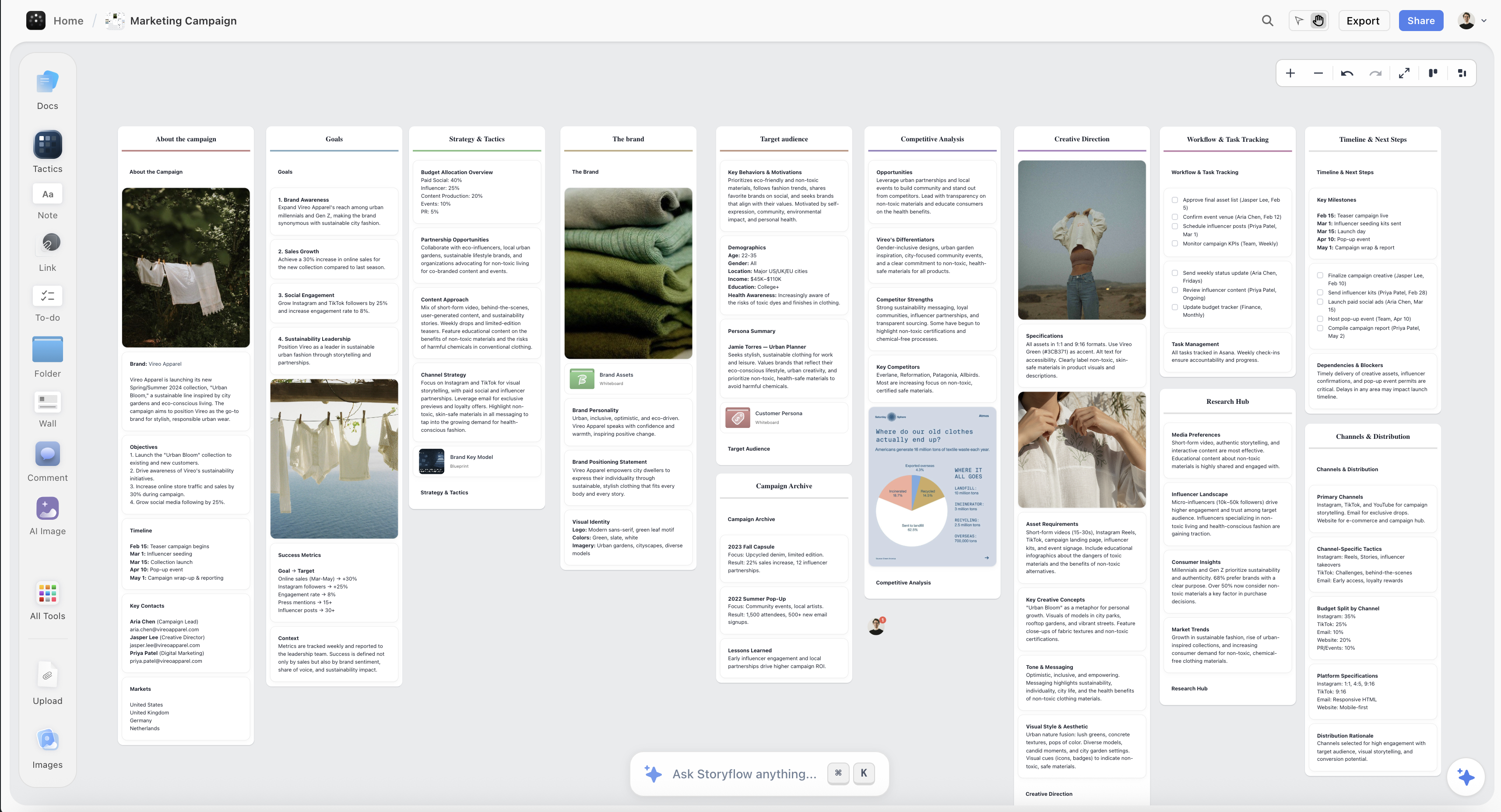
A customer case study structured on the Storyflow canvas, with the interview quotes, metrics, and screenshots organized beside the six-part story arc
Structure your case study on one canvas
The six story beats, the interview quotes, the metrics, and the screenshots live in one place, and the AI reads the whole board so it can draft the narrative and surface the strongest quotes, before you write the final page or design the PDF.

How to Write a Case Study, Step by Step
Here is the full method, from a customer result to a finished case study you can publish. It assumes one customer and one result at a time. Work the steps in this order, because each one produces the raw material the next one needs, and you cannot structure a story you have not yet interviewed for.
Step 1: Choose the customer and the result worth featuring
Start by choosing well, because the wrong customer makes every later step harder and the right one almost writes itself. The best case-study candidate has three things: a result specific and provable enough to quantify, a starting situation that looks like your ideal buyer's, and a willingness to go on the record with numbers. A modest result you can prove beats a spectacular one you cannot. Look for customers who hit a clear milestone, who represent a segment you want more of, and who are enthusiastic enough to give you an hour and a real quote. Avoid the customer whose success is real but unquantifiable, the one who cannot get legal approval to name numbers, and the one whose situation is so unusual that no future buyer will see themselves in it. I decide what the case study is for before I pick the customer: if the goal is to sell to mid-market SaaS teams, the ideal subject is a mid-market SaaS team with a number, not the biggest logo who happens to be handy. Choose the story you need, then find the customer who tells it.
Step 2: Run the interview that gets quotable answers and real numbers
The interview is where the case study is actually made, and it is the step most teams rush or skip. Treat it the way a documentary interview is treated: come prepared, ask open questions, and shut up so the person can talk. The questions that get quotable answers are the ones that ask for the story, not a rating. Ask "what was a normal week like before you switched?" instead of "were you happy with your old process?" Ask "walk me through the moment you decided to try us" instead of "why did you choose us?" Ask "what number changed, and by how much?" and then wait, because the pause is where they reach for the real figure. Chase specifics every time the answer goes vague: when they say "it saved a lot of time," ask "a lot compared to what, in hours?" Record the call (with permission), because the best quotes are almost always the offhand ones you would never think to write down, and you want the customer's own words, not your paraphrase of them. A good case-study interview produces two things: the metrics that prove the result, and five or six sentences in the customer's voice that no marketer could have written. Both come from asking for the story and letting the person tell it.
Step 3: Gather the proof: quotes, metrics, and screenshots
A case study is an argument, and an argument needs evidence, so gather it before you write a word of prose. There are three kinds of proof and you want all three. Quotes are the human proof: the customer in their own words, which is the one thing a competitor cannot fake. Metrics are the hard proof: the before-and-after numbers, ideally two or three that matter to your buyer, sourced from the customer or your own data and cleared for publication. Screenshots and visuals are the tangible proof: the dashboard showing the result, the product in use, a chart of the trend, a photo of the team. Collect more than you will use, and keep every piece tied to where it came from, because a metric with no source is a liability and a quote you cannot attribute is worthless. This is also the moment to handle approval: confirm what the customer will let you name, quote, and show, ideally in writing, so you are not rewriting the whole thing later because legal killed the one number the story rested on. Proof gathered up front is proof you can arrange; proof chased afterward is a case study that stalls.
Step 4: Structure the story before you write it
Now arrange the raw material into the six-part arc from the anatomy above, before you write a single sentence of final prose. Lay out the six beats (customer and goal, challenge, why they chose you, solution and rollout, results, forward-looking quote) and slot every quote, metric, and screenshot under the beat it supports. This is the step where you can see whether you actually have a story or just a pile of nice comments: if the challenge beat is empty, your before state is weak and the interview needs a follow-up; if the results beat has no number, you do not yet have a case study. Structuring visually, with the beats as columns and the evidence as cards you move under them, makes the gaps obvious in a way a blank document never does. This is exactly the part I build on one canvas in Storyflow: the six beats laid across the board, the interview quotes and metric cards and screenshots grouped under each one, and the AI reading the whole board so it can draft the narrative from the actual evidence and flag where a beat is thin. You are not writing yet. You are deciding what the story is and proving you have the proof to tell it, so that writing becomes transcription instead of invention.
Step 5: Write it tight and scannable
Only now do you write, and the goal is tight and scannable, because almost no one reads a case study top to bottom. Write so a buyer who skims in fifteen seconds still gets the whole story: a headline that states the result ("How Acme cut reporting time by 91%"), a one-line summary under it, the metrics pulled out as big bold numbers, subheads that carry the arc so the beats are legible from the scroll, and pull-quotes that let the customer speak from the margin. Keep the prose lean: short paragraphs, plain sentences, the customer as the hero and your product as the thing that helped, never the star. Lead every section with the point and then support it, rather than building to it, because the reader may leave at any line. Cut the adjectives and let the numbers and the quotes do the persuading, since a specific figure is more convincing than any sentence you could write around it. The finished piece should work at two speeds: skimmable in fifteen seconds for the buyer in a hurry, and rewarding to read in full for the buyer doing their diligence. If it only works at one speed, it is not done.
Step 6: Choose the format: written page, one-page PDF, or video
A case study ships in one of three formats, and the right one depends on where the buyer meets it. A written page on your site is the workhorse: it is searchable, linkable, easy to update, and the format most buyers find on their own, so nearly every case study should exist as a page first. A one-page PDF is the sales leave-behind: designed, portable, and built to be attached to an email or dropped into a deal, with the logo, the headline metric, and a pull-quote laid out to be understood in a glance. A video case study is the highest-trust format, because seeing and hearing the real customer say it is harder to fake than any text, and it suits your flagship stories and your homepage, though it costs the most to produce. Many strong results deserve more than one format: the page for discovery, the PDF for sales, and a short video for the stories worth the investment. Decide the format before you design, because a page, a PDF, and a video are laid out differently, and retrofitting one into another is how case studies end up looking wrong for where they live.
Step 7: Build it on one board, then write and design the final where it lives
Do not do all of this in the document the case study will finally live in. The structuring, the interview quotes, the metric cards, and the screenshots want to be seen all at once, and a linear doc hides half of them while you work. So I build the case study on one infinite canvas first: the six beats across the board, every quote and number and screenshot grouped under its beat, the format decided, and the AI reading the whole canvas to draft the narrative and surface the strongest quotes. When the story is structured and the proof is arranged, I make a deliberate move to the final surface: I write the page in Google Docs or Notion, or I design the one-page PDF in Canva or InDesign, pulling from the board where everything already sits in order. The board is where the case study is thought through; the doc or the design tool is where it is finished. Keep those two steps separate on purpose, because trying to structure and design at the same time is how you end up with a beautiful layout wrapped around a story that does not hold.
Where to Write and Design the Final Case Study
Here is the honest part, because the tool you structure in and the surface you finish in are two different choices, and getting this wrong wastes hours.
A written page (Google Docs, Notion, or straight into your CMS) is the right finish when the case study lives on your site or in a shared doc. Most case studies should exist as a page first, because that is where buyers find them, where search indexes them, and where you can update the numbers when the customer's result grows. Write the page as text, keep it scannable, and let your site's design system handle the styling. Do not build a site case study as a PDF and bury it behind a download, because you are hiding the exact proof a self-serve buyer came to find.
A designed PDF (Canva if you want speed and templates, InDesign if you want full art direction) is the right finish when sales needs a leave-behind that looks finished, or when the story is a flagship you want to present rather than publish. A one-page PDF with the logo, the headline metric as a big number, a pull-quote, and a clean layout signals that the result is real and considered. This is where a design tool beats any writing surface, because page design is its whole job, and it is worth the extra hours for the stories that carry your pitch.
So the workflow that actually works is: structure the story and gather the proof where you can see it all at once (a canvas like Storyflow, where the beats, quotes, metrics, and screenshots sit together and the AI reads everything), then write and design the final case study in the surface where it will live. Storyflow is honest about this boundary: it is where the case study is structured and its evidence organized, not where the final page is styled or the PDF is laid out. Match the finish to where the buyer meets it, and never let the format outrun the story.
Common Case Study Mistakes
- Writing about the company, not the customer. Opening with "we are a leading platform" gives the reader no one to identify with. Open with the customer and the problem they were living with.
- No clear before and after. Praise without a starting state is not a story. Establish where the customer began so the result has something to stand against.
- No real numbers. "Significant improvement" reads as an admission the result was not big enough to name. Get a specific figure, even a modest one, and print it.
- Confusing a testimonial with a case study. A sentence of praise is not a narrative. Show the path from problem to result with enough detail that a stranger could picture the same journey.
- Skipping the interview. A case study written from a survey response or a sales note has no real quotes and no texture. Talk to the customer and record it.
- Burying the result. If the headline metric is on paragraph five, the skimming buyer never reaches it. Lead with the outcome and let the story explain it.
- A feature list instead of a rollout. Listing what your product does is not the same as telling how this customer used it. Tell the story of the change, friction and all, so it reads as real.
- Ignoring approval until the end. Building the whole case study around a number the customer's legal team will not clear means rewriting it from scratch. Confirm what you can name, quote, and show up front.
- Designing before it is structured. A gorgeous PDF wrapped around a story with no arc is style covering for a thin idea. Structure and prove it first, then design the finish.
The Bottom Line
A case study is not a brochure about your company. It is a story about a customer, written to make the next buyer see themselves in it and believe they will get the same result. Choose a customer whose result is specific and provable, interview them until you have the numbers and the quotes, gather every piece of proof, structure the six beats before you write, and write it tight enough that a fifteen-second skim still lands the story. Show the customer as the hero and your product as the thing that helped, let the numbers and the real quotes do the persuading, and you will have proof a competitor cannot fake.
The honest boundary holds. Structure the story and organize the evidence where you can see it all at once, the beats beside the quotes beside the metrics, with AI that reads the whole board, and then write and design the final case study in the surface where the buyer meets it: a page on your site, a designed PDF for sales, or a video for the stories worth it. The tool where you structure it and the surface where you finish it are two different choices, and the team that ships case studies that convert makes both on purpose.
If your customer's great result is still a pile of notes and quotes rather than a story a buyer can follow, structure the case study on one canvas in Storyflow and write the story, not the brochure.
FAQ: Case Studies
What is a case study in marketing?
A marketing case study is a document that tells the story of how one real customer achieved a specific, measurable result using your product or service. It follows a structure: the customer and the goal they came in with, the challenge they faced, why they chose you, the solution and how it rolled out, the results with real numbers, and a forward-looking quote. Unlike a testimonial, which is a sentence or two of praise, a case study is a full narrative with a clear before and after, built so a prospective buyer in a similar situation can see themselves getting the same outcome. It is one of the most persuasive assets in B2B marketing because it is social proof with evidence attached: the customer's own words plus numbers a reader can check, rather than claims the vendor makes about itself.
How long should a case study be?
It depends on the format and the buyer, but most written case studies run from 500 to 1,500 words, and the best ones are built to be read at two speeds. A skimming buyer should get the whole story in fifteen seconds from the headline, the pulled-out metrics, and the subheads, while a buyer doing diligence can read the full narrative underneath. A one-page PDF leave-behind is deliberately shorter and more visual, often just the headline result, two or three metrics, a pull-quote, and a short paragraph per beat. A video case study is usually 60 seconds to 3 minutes. Length matters far less than structure and proof: a tight 600-word case study with a clear before-and-after and real numbers outperforms a 2,000-word one that buries the result and dodges the metrics. Write to the story, then cut everything that is not carrying it.
What is the difference between a case study and a testimonial?
A testimonial is a short statement of praise from a customer, usually a sentence or two, that tells a reader the customer is happy. A case study is a structured narrative that shows how the customer got from a specific problem to a specific, measurable result, with enough detail that a stranger could imagine the same path for themselves. The testimonial says "this is good"; the case study says "here is exactly how someone like you got this outcome, and here are the numbers." You use testimonials as short proof points sprinkled across a site or a page. You use a case study when a buyer is seriously evaluating you and needs evidence, a story, and someone to identify with before they commit. Both are useful, but they are not interchangeable, and a long testimonial is not a case study, because it has no arc and no proof beyond the praise itself.
How do you write a case study when the client won't share numbers?
First, ask more precisely, because many customers will share a number they will not share a dollar figure: percentages ("cut reporting time by 90%"), multiples ("tripled qualified leads"), or relative changes often clear legal review when absolute revenue does not. If hard numbers are genuinely off-limits, anchor the story in a concrete before-and-after that is not financial: hours saved per week, steps removed from a process, a backlog cleared, a launch that shipped on time. You can also use your own product data with the customer's permission, or a directional statement they will approve ("reduced onboarding from weeks to days"). What you should not do is paper over the gap with superlatives, because "significant results" reads as an admission there was no printable number. A specific non-financial metric beats a vague financial claim every time. And confirm what is shareable at the interview stage, not after you have built the whole story around a figure that gets cut.
How do you interview a customer for a case study?
Come prepared, record it with permission, ask open questions, and let the customer talk. The questions that produce usable material ask for the story rather than a rating: "what was a normal week like before you switched?" instead of "were you satisfied?", "walk me through the moment you decided to try us" instead of "why us?", and "what number changed, and by how much?" followed by silence, because the pause is where they reach for the real figure. Chase every vague answer into a specific one: when they say it saved time, ask how many hours compared to what. The recording matters because the best quotes are almost always offhand lines you would never think to script, and you want the customer's own words, not your paraphrase. A strong interview gives you two things at once: the metrics that prove the result and five or six sentences in the customer's voice that no marketer could have written. Both come from asking for the story and getting out of the way.
Can AI help write a case study?
Yes, for structuring and drafting, not for inventing the story or the numbers. AI is useful for organizing your interview notes into the six-part arc, drafting a first pass of each beat, tightening the prose, and pulling the strongest quotes out of a long transcript. Because Storyflow's AI reads your full canvas board, plus up to 1 Tactic and 3 Documents you @-mention, it can work from your actual interview quotes, metrics, and screenshots rather than generic prompts, which keeps the draft grounded in the real customer instead of a plausible-sounding invention. What AI cannot do is conduct the interview, verify the numbers, or supply the human credibility that makes a case study convincing, and a case study that reads as generated will lose the trust the format exists to build. Use AI to structure and draft from your real evidence, and bring the interview, the proof, and the final judgment yourself.
Is Storyflow free for writing a case study?
Not during early access. Storyflow's Free plan, which launches before the end of 2026, will include unlimited objects and boards, unlimited collaboration, basic AI, and 20 file uploads, which covers structuring a full case study: the six beats across the board, the interview quotes, the metric cards, and the screenshots all in one place. Paid tiers start at Plus for $7.99/month billed annually ($9.99 monthly), which adds the 200+ Story Blueprints and unlimited file uploads, with Pro at $14/month and Max at $39/month for more AI and, on Pro and Max, AI image generation. There is no separate Team plan; Max is the team tier. Once it launches, the Free plan will genuinely run the whole structuring method, so you'll be able to build the case study and share the board with your team, then write the final page in a doc or design the PDF in a design tool. Storyflow structures the story and organizes the proof; the final written page and the designed PDF happen elsewhere.
Table of Contents
- Why Most Case Studies Fail
- The Anatomy of a Case Study That Converts
- Quick Picks: Where to Build a Case Study
- Comparison Table: Where to Build a Case Study
- How to Write a Case Study, Step by Step
- Where to Write and Design the Final Case Study
- Common Case Study Mistakes
- The Bottom Line
- Author
- FAQ: Case Studies
- Related Reading
Templates to check out for this topic


Templates you can use in Storyflow
Every Storyflow board starts from real structure and an AI that reads the whole canvas. Open one of these templates and make it yours.


See Storyflow in Action
A visual AI workspace where every feature lives inside one canvas. No tab-switching, no context lost.
Build your entire board from a single message
Type what you need in the AI chat at the bottom of your canvas. The AI adds cards, headings, and structure directly onto your board.
Use expert frameworks as AI context
Type @ in the AI chat and choose any Tactic. The AI tailors every response to that framework instead of giving generic advice.
Turn your board into a mind map in seconds
Ask the AI to restructure your canvas as a mindmap. It connects your ideas into a visual hierarchy so you can see how everything relates.
Why Storyflow Exists
Storyflow actually began as a personal tool while working on creative and research projects.
We kept running into the same problem: ideas were scattered everywhere: notes, documents, and whiteboards.
Nothing helped us see how everything connected.
So we started building a workspace designed around how ideas actually grow.
→ Read how Storyflow was createdJustkay
Documentary Filmmaker & Founder at Storyflow
Published: 2026-07-22
Extremely simple, seriously capable


See how easy it is to get started
Watch a real project come together, from a blank board to a finished plan, clicked through step by step.
Start creating with AI and become more productive
Transform your creative workflow with AI-powered tools. Generate ideas, create content, and boost your productivity in minutes instead of hours.