How to Organize Research for a Nonfiction Book
Organize nonfiction research by keeping every extracted claim physically attached to its source, and by separating what you have read from what you now think, because the failure that costs months is not losing a document, it is reaching draft and being unable to prove a sentence you are certain is true.

Category
Writing
Author

Justkay
Documentary Filmmaker & Founder at Storyflow
Topics
2026-08-29
•
13 min read
•
Writing- how to organize research for a nonfiction book
- nonfiction
- research
- book writing
- note taking
- source management
- Storyflow
How do you organize research for a nonfiction book?
Organize nonfiction research by keeping every extracted claim physically attached to its source, and by separating what you have read from what you now think, because the failure that costs months is not losing a document, it is reaching draft and being unable to prove a sentence you are certain is true. Capture the source once with full citation data, extract claims as separate atomic pieces that each carry their origin, and keep a separate layer for your own synthesis so you never have to work out later whether a line was a finding or a conclusion. Storyflow is what I use because the extract, the source and the chapter it serves sit together on one canvas, so a claim can never drift away from the thing that supports it.
Key Takeaways
- Attach every claim to its source at capture time. Reattaching later is the single largest avoidable cost in a nonfiction project.
- Separate three layers: sources, extracted claims, and your own thinking. Merging them makes the draft unverifiable.
- Capture full citation data on first contact. Going back for a page number a year later can take an hour per instance.
- Organise claims by argument, not by source. Chapters are made of claims from many sources, not of sources.
- Record what contradicts you. A book that only collects supporting evidence is one hostile review away from trouble.
- Note what you have not yet found. Absence of evidence needs to be tracked deliberately or it disappears.
Keep the claim next to its source
Research fails at the point where a claim has drifted away from the source that supports it and you cannot re-find the citation. Storyflow keeps the extract, the source and the chapter it serves in one canvas.

The Failure That Costs Months
Every nonfiction writer has the same experience at draft stage. You write a sentence you know is true, you need the citation, and you cannot find it.
You remember reading it. You may remember roughly where. What follows is anywhere from twenty minutes to a full day of searching through PDFs, notebooks, browser history and library records, and sometimes it ends with you cutting a true sentence because you cannot prove it.
Multiply that by the two or three hundred citations in a book. Even at a conservative fifteen minutes per instance for a fraction of them, this is weeks of work that produces nothing new.
The cause is a capture-time decision, not a filing failure. The claim was written into a notes file and the source was in a different place, or was recorded as "Smith, chapter 4" which was sufficient at the time and is not sufficient now. The link existed only in your memory and memory does not survive eighteen months.
A useful diagnostic: open your research from three months ago, pick five claims, and try to produce a full citation for each in under two minutes. Whatever fraction fails is the fraction of your book that is currently unprovable.
Three Layers, Kept Separate
The organising principle is that research has three kinds of content and they behave differently.
Layer 1: Sources
One entry per source, created the first time you touch it, carrying everything a citation needs: author, title, publication, date, publisher, edition, page range, DOI or URL, date accessed, and where your copy lives.
Capture this on first contact, always, before you read. It takes ninety seconds. Recovering it later takes far longer and sometimes fails, particularly for web sources, which move and disappear.
Add a two-line note on what the source is and how reliable you judge it. In a year you will not remember whether a paper was foundational or fringe, and that judgement affects how you use it.
Layer 2: Extracted claims
This is the working layer and where the book actually gets built.
Each claim is one atomic assertion, in its own piece, carrying a permanent link to its source and a precise location. Quote exactly if you are quoting, and mark it clearly as a quotation.
Atomic matters. A note that summarises a whole chapter cannot be used, because when you need one fact from it you have to re-read to find it, and you cannot place it in an argument without dragging the rest along.
Mark the type. Fact, statistic, opinion, anecdote, contested claim. These get used differently and challenged differently, and knowing at a glance whether something is a measured number or an expert's view saves a great deal of time at fact-check.
Include the page number every time. Every single time. This is the discipline that makes the difference and it is the one that erodes when you are reading fast.
Layer 3: Your own thinking
Separate, and visibly separate.
Your synthesis, your argument, the connections you have drawn, the things you believe that no single source states. This is the actual book, and it must never be confused with layer two.
The reason for hard separation is verification. At draft you need to know instantly whether a sentence is something you read or something you concluded. Sentences you read need a citation. Sentences you concluded need to be defensible as reasoning. Confusing the two produces either uncitable claims or an argument that reads as unsupported assertion.
The most common version of this failure is a note that starts as a paraphrase and gets edited over months until it is your own idea wearing a source's clothes.
Organise by Argument, Not by Source

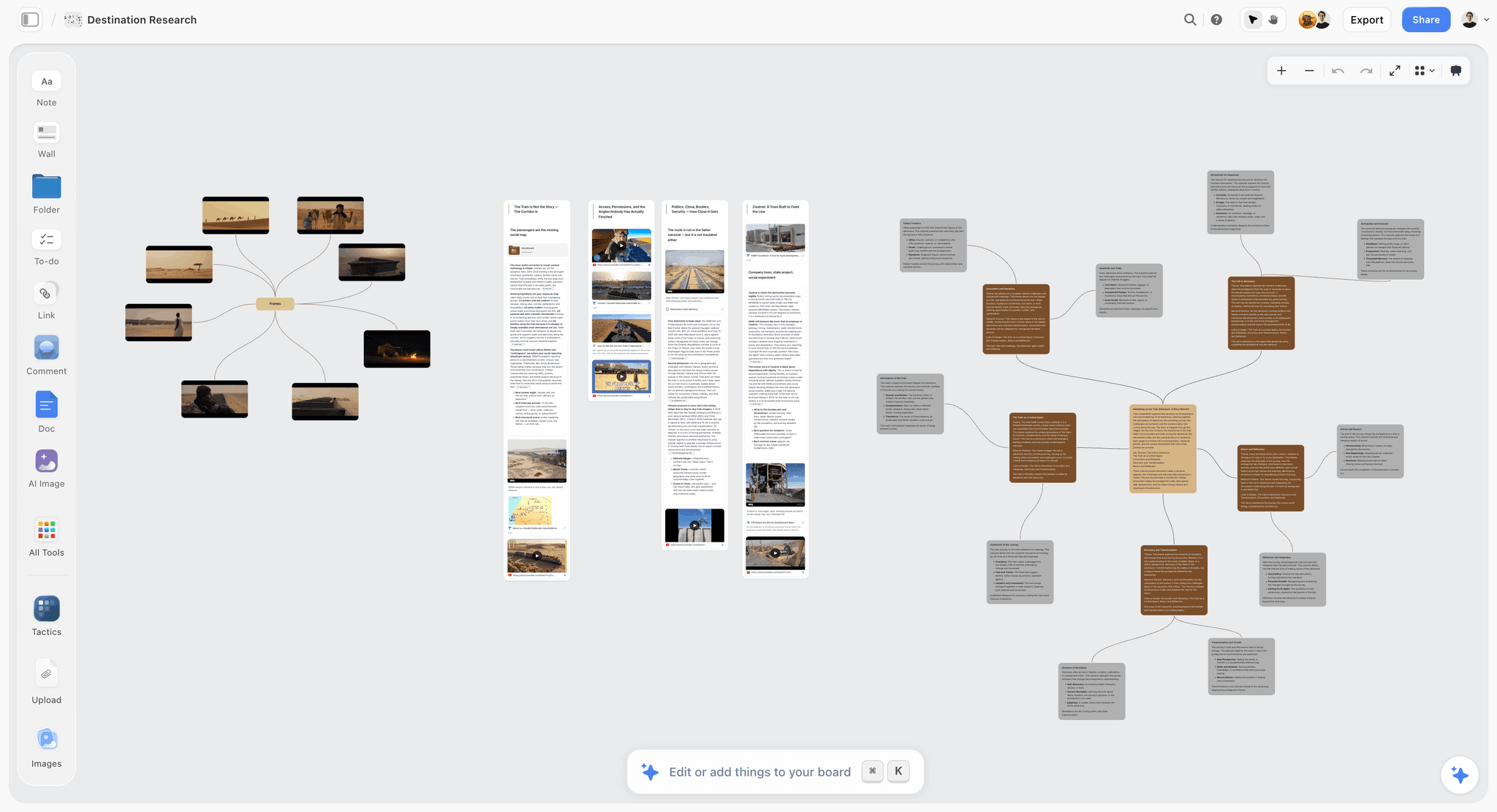
Once claims are extracted, group them by the argument they serve rather than by where they came from.
This is the step that turns research into a book. A chapter is not made of sources; it is made of claims drawn from twenty sources, arranged to support a line of reasoning. Filing by source keeps the material in the shape it arrived in, which is the shape of other people's books.
Practically: create a region per chapter or per argument, and place claims into it. A claim can serve two arguments, so allow it in both.
The gaps become visible immediately. A chapter region holding three claims when the others hold thirty is a chapter you have not researched. That is a specific, actionable finding, and it appears the moment you organise this way.
This is where a canvas outperforms a folder structure or a reference manager. Zotero and Zettelkasten systems handle layers one and two extremely well and are genuinely better than a canvas for citation management and for bibliography generation. What they do not do well is the spatial arrangement of claims into an emerging argument, because a list of notes does not show you the shape of a chapter.
On a Storyflow canvas the claims sit in the argument they serve, with their sources attached and visible, and because its AI reads the whole board you can ask which chapters are thin or which claims currently have no source attached, which is a check you want to run before you start drafting rather than during it.
The practical answer for a large project is often both: Zotero for the bibliography and formal citation, a canvas for building the argument, with the citation key on each claim linking them.
Track Contradictions and Absences
Two categories that most systems drop, both of which matter.
Contradicting evidence. Record it with the same care as supporting evidence, in the same place as the claim it contradicts. A book that only accumulated confirming sources is fragile, and the weakness is usually invisible to the author precisely because they never collected the other side.
When two credible sources disagree, that disagreement is often more interesting than either position, and it is frequently where the book's real contribution lies.
What you have not found. Keep an explicit list of the things you looked for and could not establish. "No data on X before 1970." "Could not confirm the attribution of this quote."
These matter for two reasons. They stop you searching for the same missing thing three times, and several of them will need to appear in the book as honest statements of what is not known, which is a mark of a serious book rather than a gap in one.
| Layer | Contains | Organised by | Must carry |
|---|---|---|---|
Sources | One entry per work | Alphabetical or by key | Full citation data, reliability note |
Claims | Atomic assertions | By argument or chapter | Source link, page, claim type |
Synthesis | Your own reasoning | By chapter | Nothing external, clearly marked as yours |
Contradictions | Opposing evidence | Beside the claim it opposes | Source link, page |
Absences | What you could not find | By question | What you searched, what you concluded |
What Goes Wrong
Claims captured without page numbers. The commonest failure and the most expensive at draft stage.
Notes that summarise rather than extract. Unusable at the sentence level, so you re-read the source when you need one fact from it.
Layers merged. Your thinking and your sources in the same notes, so verification becomes archaeology.
Filed by source. Research stays in the shape it arrived in and the book never emerges from it.
Web sources captured by URL only. The page changes or disappears and the citation dies. Archive the page or save a copy.
Contradictions discarded. They felt like obstacles. They are the argument.
No record of dead ends. You search for the same unfindable thing repeatedly across a year.
The Bottom Line
Attach every claim to its source at capture, with a page number, every time. Keep sources, extracted claims and your own thinking in three visibly separate layers. Organise the claims by the argument they serve rather than by where they came from, and the gaps in your research become visible immediately.
Record what contradicts you and what you could not find. The book that results is one you can defend line by line, and the draft takes weeks less because you never have to go looking for something you already read.
FAQ: Nonfiction Book Research
How should I capture sources I find online?
Full citation data plus an archived copy of the page, on first contact. Web sources move, paywall, and vanish, and a URL alone is not a citation you can defend at fact-check. Archive services or a saved PDF both work; what matters is that a copy exists outside the original site.
Should I use a reference manager or a canvas?
For a book-length project, usually both. Zotero and similar tools are better at citation data, bibliography generation and format switching. A canvas is better at arranging claims into an emerging argument, which is a spatial problem a list cannot show you. Link them with a citation key on each claim.
How atomic should a research note be?
One assertion per note. If a note contains two facts, you cannot place it in an argument without dragging the second one along, and you will end up re-reading to extract what you needed. Atomic notes are more work at capture and dramatically less work at draft.
How do I keep my own ideas separate from sources?
Put them in a visibly different layer, formatted differently, and never edit a source note into an idea. The failure mode is gradual: a paraphrase gets rewritten across months until it reads as your own thinking, and at fact-check nobody can tell which it is.
Is Storyflow free for book research?
Not during early access. Storyflow is paid-only right now, with Plus at $7.99 per month billed annually, and the Free plan launches before the end of 2026. Anyone a paid member invites to a board joins free. Zotero is free and remains the best free option for the citation layer specifically.
When should I stop researching and start writing?
When the chapter regions are evenly populated and new sources are mostly confirming what you already have rather than adding to it. The organised-by-argument structure makes this visible: uneven chapters mean more research, evenly full chapters that stop growing mean it is time to draft.
Table of Contents
Templates to check out for this topic


Research templates you can use in Storyflow
Gather sources, personas, and findings on one canvas, then let the AI read across all of it. Open any of these research boards to start.


See Storyflow in Action
A visual AI workspace where every feature lives inside one canvas. No tab-switching, no context lost.
Build your entire board from a single message
Type what you need in the AI chat at the bottom of your canvas. The AI adds cards, headings, and structure directly onto your board.
Use expert frameworks as AI context
Type @ in the AI chat and choose any Tactic. The AI tailors every response to that framework instead of giving generic advice.
Turn your board into a mind map in seconds
Ask the AI to restructure your canvas as a mindmap. It connects your ideas into a visual hierarchy so you can see how everything relates.
Why Storyflow Exists
Storyflow actually began as a personal tool while working on creative and research projects.
We kept running into the same problem: ideas were scattered everywhere: notes, documents, and whiteboards.
Nothing helped us see how everything connected.
So we started building a workspace designed around how ideas actually grow.
→ Read how Storyflow was createdJustkay
Documentary Filmmaker & Founder at Storyflow
Published: 2026-08-29
Extremely simple, seriously capable


See how easy it is to get started
Watch a real project come together, from a blank board to a finished plan, clicked through step by step.
Start creating with AI and become more productive
Transform your creative workflow with AI-powered tools. Generate ideas, create content, and boost your productivity in minutes instead of hours.