
How to Turn Ideas into an Action Plan with AI: A Step-by-Step Guide (2026)
Most ideas stay ideas because the process of turning them into something executable gets treated as easier than it is. This guide runs the full 9-step process: from raw idea capture through framework selection, AI pressure-testing, action sequencing, and the first action you take today.

Category
Creative Process
Author

Sara de Klein
Head of Product at Storyflow
Topics
2026-04-14
•
22 min read
•
Creative Process- how to turn ideas into an action plan with AI
- ideas into action plan AI step by step
- AI action planning
How do you turn ideas into an action plan with AI?
To turn ideas into an action plan with AI, capture every idea on a visual canvas the AI can read (Storyflow is built for this), define one specific outcome, give the AI your real constraints, then have it map your ideas onto a proven framework and sequence them into actions. Most AI planning fails because the AI is handed the idea but not the context around it: your other ideas, your constraints, and what you are actually working toward. By the end of this guide you will have a sequenced, usable action plan from whatever collection of ideas is currently sitting unfinished in your notes.
Key Takeaways
- Run the whole thing as a nine-step process from idea dump to first action. Having ideas and having a plan are different things, and the work between them is the real bottleneck, not the ideas.
- Write the outcome as one specific, time-bound, testable sentence. "Ship the beta to 100 users by end of Q2 with at least a 40% activation rate" is an outcome, while "new product launch" is only a title.
- Sort every idea into one of three types: a direction, a task, or a question. Mixing strategy, to-dos, and open research in one plan is how plans become bloated and unexecutable.
- Map your strongest direction onto a proven framework before generating tasks. AIDA, the Hero's Journey, or a problem-solution-validation loop gives your ideas a sequence and exposes the gaps you have not thought about yet.
- Pressure-test the direction with three prompts before building it out. Ask what assumptions might be false, what would have to be true for it to fail, and what similar project succeeded or failed and why.
- Write actions one person can finish in under four hours without waiting on anything. "Write the first draft of the welcome email sequence" is an action, while "work on emails" is just a reminder, and more than 30 actions means you have several projects in one plan.
- Map dependencies so parallel work does not get sequenced serially. Ordering everything in a single line is how a six-week plan quietly becomes a fourteen-week one.
- Set three checkpoints as decision questions, then name the first action and start it today. NYU research found that specifying the when and where of a first action raises completion rates by over 50%.
The Problem With How Most People Turn Ideas into Plans
You probably have a note-taking app with 40-something ideas in it. You have voice memos you meant to transcribe. You have the back of an envelope with the thing you thought of on the commute. The ideas exist. The problem is that "having ideas" and "having a plan" are two completely different things, and most people try to skip from one to the other without doing the work in between.
The typical approach: open a new Google Doc, write "Action Plan" at the top, and try to type a sequence of steps directly from memory. What you get is whatever was loudest in your head that morning, organised into a list that starts strong and gets vaguer as you go. When AI gets added to this process, it usually makes it worse: paste an idea into ChatGPT, receive a confident seven-point plan, and spend the next month trying to execute something that does not account for your actual constraints, your other ideas, or the fact that three of those seven points require resources you do not have.
The ideas are not the bottleneck. The work between having an idea and knowing what to do first is.
Getting every idea onto one visible canvas is step one, Storyflow's infinite whiteboard gives you the space to do it without forcing structure early

The work between having ideas and having a plan is the part most tools skip, Storyflow keeps it all in one place
What You Need Before You Start
- A complete dump of your current ideas on this topic: Not a curated shortlist, the raw unordered collection including the half-formed ones. Filtering too early is how good ideas get cut before they get a fair test.
- A one-sentence description of the outcome you want: "Launch the new series" is not an outcome. "Publish the first three episodes with at least 200 subscribers before October" is. The specificity determines the quality of everything that follows.
- Your real constraints written down: Time available per week, team size, budget ceiling, hard deadline. AI gives sharper planning output when it knows what you are working with, not just what you want.
- A visual workspace where your ideas and AI context live in the same place: Storyflow's free tier works for this entire guide. When your ideas are on a canvas the AI can read, the planning output reflects your actual project, not a generic template for someone else's project.
How to Turn Ideas into an Action Plan with AI: Step by Step in 2026
Step 1: Get Every Idea Out of Your Head and Onto One Surface
Before you structure anything, the full idea set needs to be visible in one place.
Open a blank canvas and spend 10 to 15 minutes writing out every idea, thought, or angle you have on this project. Include the ones that feel half-formed or contradictory. Include the version you rejected last month. Include the thing someone mentioned offhand at a meeting that you half-dismissed. You are not evaluating yet. You are externalising.
Most people start planning with a subset of their ideas: the ones they can remember when they sit down. Research on creative cognition consistently shows that the most novel ideas surface later in a generation exercise, not first. If you start structuring before you have the full set on the table, you are optimising a partial inventory.
Where Storyflow helps: The infinite whiteboard canvas gives you the spatial freedom to spread ideas out without forcing any structure on them. Notes, links, images, and voice recordings all land on the same surface. The AI reads the whole board before it helps you do anything with it.
Common mistake: Curating the list while you generate it. If you catch yourself thinking "that won't work" before you have written it down, write it down anyway. Filtering and generating use conflicting cognitive modes. Running them simultaneously produces fewer ideas and worse ones.
Step 2: Write the Outcome This Plan Is Working Toward
One sentence. Specific, time-bound, and testably measurable.
The outcome sentence is not the project title. "New product launch" is a title. "Ship the beta to 100 users by end of Q2 with at least a 40% activation rate" is an outcome. Every decision in the plan gets filtered through whether it moves toward this sentence. If it does not, it does not belong in the plan.
This step takes most people 5 to 10 minutes and feels like it should be obvious. It rarely is. I have worked with teams who spent three separate planning sessions without ever agreeing on what "done" looked like. The plans they built were technically coherent but pointed at three different destinations depending on who you asked.
Where Storyflow helps: Pin the outcome sentence at the top of your canvas before you do anything else. When you bring the AI in during later steps, it reads this sentence as context, which means its suggestions are filtered through your actual goal, not a generic version of your project type.
Common mistake: Writing a goal instead of an outcome. "Grow the audience" is a goal. "Reach 500 subscribers on the new channel within 90 days of the first upload" is an outcome. Goals are directional. Outcomes are testable. A plan built from a goal has no way to know when it has succeeded.
Step 3: Sort Your Ideas by Type
Not all ideas are the same kind of thing, and treating them as if they are is how plans become bloated and unexecutable.
Go through your idea canvas and tag each one as one of three types. A direction is a strategic angle or creative approach the whole plan could take: "Make the product documentation conversational rather than technical" is a direction. A task is a concrete, doable action that serves a direction: "Rewrite the onboarding email sequence in second person" is a task. A question is something you need to answer before you can make a decision: "Do users actually read the documentation or skip straight to the product?" is a question.
Mixing these three types in a single plan produces a document that is partly strategy, partly to-do list, and partly open research. None of those things gets the focus it needs. Most unexecuted plans contain all three types treated as if they are equivalent.
Where Storyflow helps: On the canvas, use different coloured notes or separate wall sections to group by type. The visual separation makes it immediately obvious where you have too many directions competing, where you have tasks with no parent direction, or where you have questions that should be answered before planning continues.
Common mistake: Treating every idea as a task. Directions need to be selected first. Tasks should only be generated after you have committed to a direction. Writing tasks for every possible direction produces a plan for twelve projects, not one.
Step 4: Apply a Proven Framework to Your Top Direction
Your strongest direction needs structure. A framework provides a tested sequence of elements that have worked for this type of project before.
The right framework depends on what you are building. A marketing launch might use AIDA (Attention, Interest, Desire, Action) as the backbone. A narrative project might use the Hero's Journey. A product development sprint might use a problem-solution-validation loop. The framework does not replace your specific ideas: it gives them a sequence to live inside and fills in the gaps you have not thought about yet.
Spend 15 to 20 minutes mapping your direction's tasks and questions onto the framework structure. Where does each one land? What framework steps have no content yet? Those gaps are the parts of the plan you have not addressed. They will be the failure points if you ignore them.
Where Storyflow helps: Storyflow's Blueprint Tactics library contains over 200 proven frameworks you add directly to your canvas. The Hero's Journey Tactic, the AIDA Tactic, the Retention Hooks Tactic, and many others each create a Blueprint with flip cards: one side shows guidance for that framework step, the other is where you write your specific content. Each card has its own AI assistant that understands the framework context it belongs to. You fill in the cards with your ideas, and the result is your specific direction inside a tested structure. This is one of the most practically useful features for converting an idea dump into a real plan because the framework tells you what you have not thought about yet.
Common mistake: Picking the framework that sounds most interesting rather than the one that best matches the output you are building. A persuasion framework applied to a creative development process produces steps in the wrong order. Use the framework that fits what you are trying to produce, not the one you are most familiar with.
Step 5: Use AI to Pressure-Test Your Direction
Before you build out the full plan, ask the AI to find what you are taking for granted.
With your direction on the canvas, your outcome sentence visible, and your framework mapping done, run three prompts in sequence:
- "What assumptions am I making about my audience, market, or resources that might not be true?"
- "What would have to be true for this direction to fail even if it is well-executed?"
- "What is the most similar project that has been attempted before, and what made it succeed or fail?"
These three prompts surface different types of hidden risk. The first finds assumption gaps. The second finds execution risks. The third finds analogues you have not considered. You are not trying to kill the direction. You are trying to find its weak points before you have spent six weeks building toward them.
The output of this step is a short list of things to watch for: decision points where the plan might need to adjust. This is not a reason to delay starting. It is a reason to plan checkpoints.
Where Storyflow helps: In Storyflow, the AI reads your outcome sentence, your direction notes, and your framework Blueprint before responding. The risk identification reflects your specific project context, not a generic answer to a generic question. The difference between "what are the risks of launching a content series?" and "what are the risks of this specific direction, mapped to this framework, with these constraints?" is significant in the quality of what comes back.
Common mistake: Running this step before Step 4. Without a framework structure, the AI does not have enough context to identify specific risks. "What could go wrong with my idea?" produces generic answers. "What could go wrong with this direction, mapped to these framework steps, with these constraints?" produces useful ones.
Step 6: Break the Direction into Concrete Next Actions
Now generate the task list, but from the framework, not from memory.
Go through each framework step and ask: what specific, completable action moves this step forward? An action is something one person can finish in under four hours without waiting for anything else. If the answer to that question is "we need to figure out X first," that is a question (tag it), not a task.
A good action looks like: "Write the first draft of the welcome email sequence, under 300 words per email, for a new user who signed up but has not completed onboarding." A bad action looks like: "Work on emails." The first one has a clear scope, output, and constraint. The second is not executable: it is a reminder that something needs to happen.
For a project with seven framework steps, you should have between 15 and 25 specific actions at the end of this step. More than 30 suggests you have multiple projects inside one plan.
Where Storyflow helps: Each Blueprint Tactic card is the right container for the actions belonging to that framework step. Use the card's document view to list the specific actions for each step. The card's context keeps you within the scope of that framework phase when you are writing, which prevents mixing actions from different stages and keeps the plan legible.
Common mistake: Writing actions that require multiple people without naming who is responsible. "Set up the technical infrastructure" is not an action: it is a delegation. A real action has a single owner. If no one owns it, it will not get done.
Step 7: Sequence the Actions with Dependencies
Order the actions: which must happen before which, and what can happen in parallel?
Go through your action list and for each action, ask: is there anything this cannot start without? If yes, it depends on that thing. Map the dependencies first. These form the critical path. Actions with no dependencies can start immediately. Actions with dependencies start when their prerequisites are complete.
A 20-action plan might have a critical path of 8 actions and 12 actions that can happen in parallel or whenever capacity allows. Understanding this structure tells you two things: the minimum time the plan takes (the critical path length), and where you can accelerate by working in parallel.
Most creators and small teams sequence everything serially when much of it can run simultaneously. This is how a six-week plan becomes a fourteen-week plan without anyone noticing.
Where Storyflow helps: The kanban view in Storyflow lets you move actions between stages: Not Started, In Progress, Blocked, and Complete. Blocked actions are visible immediately, which prevents the silent stall (the situation where something has been stuck for five days without anyone noticing).
Common mistake: Assuming every action must wait for the one before it. Challenge each dependency. The question is not "what could come before this?" but "what genuinely cannot start before this is complete?" The answer is usually fewer things than your first instinct suggests.
Step 8: Set Three Checkpoints Before You Start
A plan without checkpoints is a plan that gets abandoned at the first obstacle rather than adjusted.
Define three moments in the plan where you will evaluate progress and make a real decision: continue, adjust, or stop. These are not deadlines. A deadline says "this must be done by this date." A checkpoint says "by this date, here is what I will know, and here is the decision I will make based on what I have learned."
For a 12-week plan, checkpoints might fall at weeks 3, 7, and 11. At week 3: has the early work produced the expected signal? At week 7: is the direction still right, or do we need to pivot? At week 11: does the evidence support reaching the outcome defined in Step 2?
Write each checkpoint decision as a question, not a milestone. The question forces you to define what "good progress" looks like before you get there, which makes the evaluation honest rather than retrospective.
Where Storyflow helps: Pin the three checkpoint questions on the canvas above the framework Blueprint. Their visual proximity to the plan structure keeps them from becoming abstract calendar events and turns them into active decision questions the AI can reference when you revisit the plan.
Common mistake: Setting checkpoints but not defining what a positive result looks like at each one. A checkpoint without a success definition becomes a check-in meeting, not a decision point.
Step 9: Name the First Action and Do It Today
The most important moment in any action plan is the moment it stops being a document and starts being work.
Look at your sequenced action list and find the one action that can begin right now, without waiting for anything else. Write its name at the top of the canvas. Set a timer for 20 minutes. Start it.
Not tomorrow. Not after one more review pass. Research from NYU's psychology department found that specifying the when and where of a first action increases completion rates by over 50% compared to committing to a goal without a named first action. The act of naming the first action is not administrative: it is the highest-leverage step in the entire process.
The first 20 minutes of actual work will surface more useful information about the plan than another hour of refining it. You will discover what is harder than expected, what took less time, and what question you should have answered in Step 5. That information only becomes available when you engage with the work.
Where Storyflow helps: With full project context on the canvas, ask the AI: "Based on this plan and these constraints, what is the single best starting action?" The AI identifies the action with the most leverage, not the easiest one or the first one alphabetically.
Common mistake: Using the planning process as a reason to keep planning. The point at which you have a sequenced list of specific actions with dependencies and three checkpoints is the point at which you have done enough planning. Further refinement without starting is productive procrastination wearing a project management hat.
Storyflow's AI reads your outcome, constraints, and Blueprint framework before generating the action sequence
Kanban view makes blocked actions immediately visible so plans do not stall silently
The 9-Step Process at a Glance
- Idea capture : Get everything out of your head onto one surface, 10-15 minutes
- Outcome statement : Write a specific, time-bound, measurable outcome in one sentence
- Idea typing : Sort ideas into directions, tasks, and questions
- Framework selection : Map your top direction to a proven structure (Tactics in Storyflow)
- AI pressure test : Run three prompts to surface hidden assumptions and execution risks
- Action generation : Write specific, ownable, completable tasks per framework step
- Sequencing : Map dependencies and identify what can run in parallel
- Checkpoints : Set three decision moments and define what good progress looks like at each
- First action : Name it, set a timer, start it today
Tips and Best Practices
Give AI your constraints before your idea
The most common AI planning mistake is describing the idea without describing what you are working with. "Help me plan a marketing campaign" produces a generic plan. "Help me plan a marketing campaign: two-person team, $3,000 budget, six-week timeline, audience of independent freelancers who are evaluating project management tools" produces something executable. In Storyflow, your constraints live on the canvas permanently and the AI reads them in every prompt without you having to re-enter them.
The idea that survives pressure is not always the best one
I have backed directions that looked solid under every pressure test and still missed because my definition of the target audience was too vague to catch the mismatch. Before running Step 5, write your target audience as one specific sentence. Not a category like "small business owners" but a specific person. "A freelance brand strategist, three years in, taking on their first retainer client" is a person. That specificity changes the risk questions the AI identifies and the actions that follow.
Separate planning sessions from working sessions
Planning and executing use different cognitive modes. Switching between them (adding new ideas to the plan while trying to execute actions from it) slows both processes down. Run a dedicated 60 to 90 minute planning session to complete Steps 1 through 8. Then close the planning canvas and work from the action list. Revisit and update the plan at checkpoints, not continuously.
A plan that never changes is one that is not being used
The checkpoint structure in Step 8 creates legitimate revision moments. If you reach the first checkpoint and evidence says the direction needs adjusting, adjusting it is not failure: it is the plan functioning correctly. The failure mode is continuing to execute a direction that the evidence says is wrong because you have invested too many weeks in it. Checkpoints give you permission to adjust without abandoning.
Write your questions as explicitly as your tasks
Most plans contain hidden questions masquerading as tasks. "Identify the right distribution channel" sounds like an action. It is actually a question: "which distribution channel is most viable for this audience, timeline, and budget?" Questions cannot be executed: they can only be answered. Separating questions from tasks in Step 3 prevents a plan full of open research items from looking like an execution plan and then failing to produce results.
Common Mistakes to Avoid
Mistake: Starting with structure before capturing the full idea set Planning from memory feels efficient because you move straight to something concrete. The ideas that are hardest to retrieve (usually the most original ones) never make it into the plan. Spend 10 to 15 minutes on unconstrained capture before you touch any structure.
Mistake: Writing a goal instead of an outcome The goal sounds clear enough so you skip the specificity work. Every stakeholder ends up with a slightly different version of "done" in their head, and the plan drifts toward the version that gets asserted most confidently. Write the outcome in one specific, time-bound sentence before the first planning action.
Mistake: Asking the AI to generate the plan from scratch Describing the idea and asking for a plan feels like the obvious first step. The plan you get back does not account for your real constraints, your other competing ideas, or the specific context of your project. The AI did not know about them. Put your ideas, outcome, constraints, and framework on the canvas first. Then ask the AI to structure and sequence what is already there.
Mistake: Writing tasks without mapping dependencies The action list looks complete, so execution starts. Three weeks in, two actions are blocked because something they needed was not sequenced first, and nobody noticed because the dependency was never made explicit. For every action, ask specifically: is there anything this cannot start without?
Mistake: Abandoning the plan at the first obstacle The first obstacle feels like evidence the direction was wrong. Work restarts from scratch, which takes another planning cycle and often produces a plan with the same structural problem because the root cause was never identified. When the plan hits an obstacle, revise the relevant section at the next checkpoint. Rebuild from the beginning only if the outcome itself has changed.
Start Your First Action Plan Today
What stops most people is not a shortage of ideas. It is the sense that turning them into a real plan requires more time, more clarity, or a better tool than they currently have. None of those things become true by waiting. The clarity comes from starting the process, not from delaying it until you feel ready to start.
Open a new Storyflow board and spend 10 minutes writing every idea you have on one project you have been meaning to act on. Do not structure it yet. Just get it visible. The free tier gives you everything you need to run this full process: unlimited canvas space, Blueprint Tactics including the Hero's Journey and AIDA frameworks from Step 4, and an AI that reads your full canvas before it helps you shape what is there. Add your outcome sentence. Add your constraints. Then let the structure emerge from Step 3 onward.
The best action plan is not the most thorough one. It is the one that produced the first action and made it specific enough to actually take. Build something you can start from today, and let the checkpoints do the work of keeping it honest.
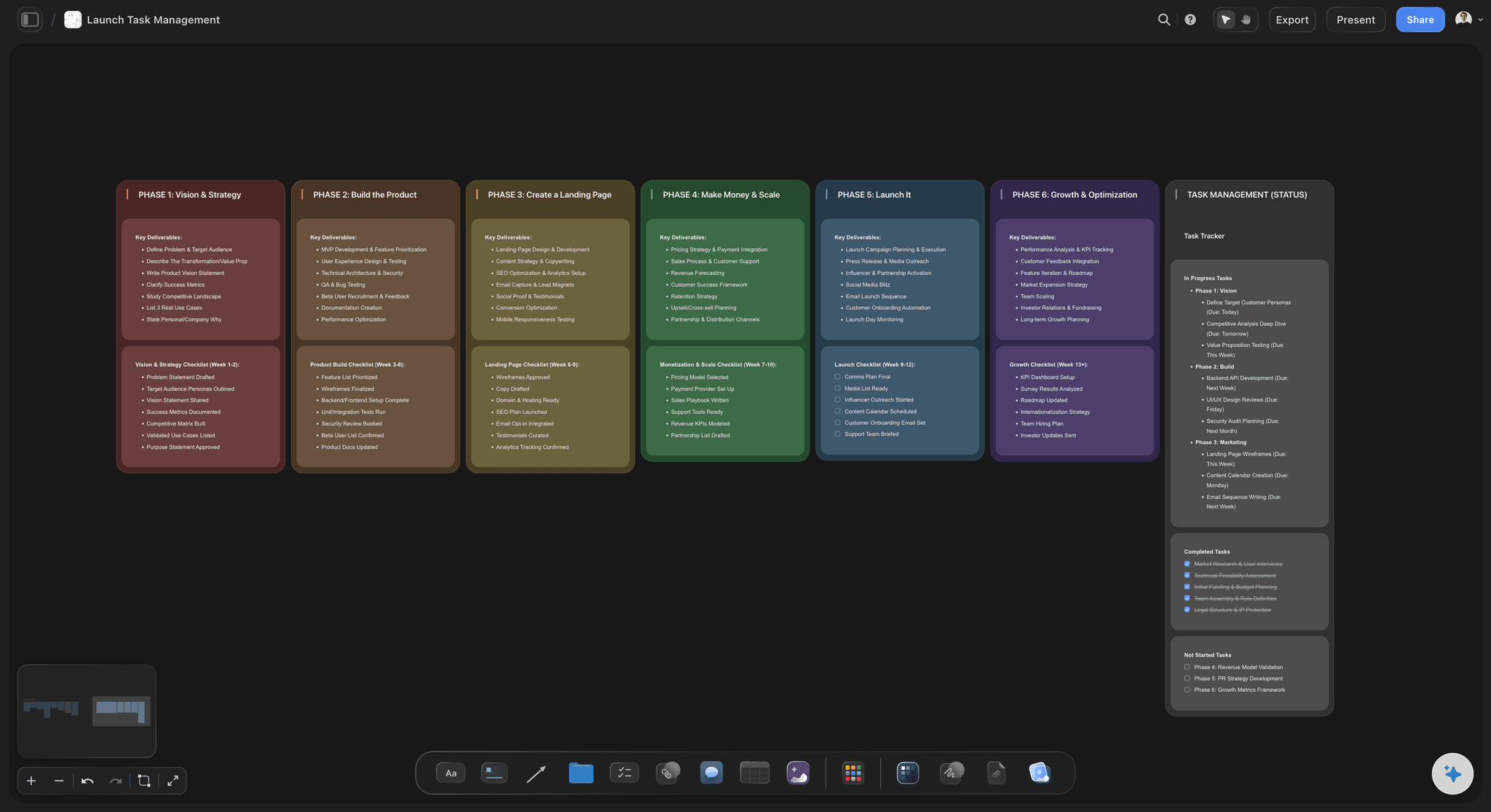
A launch task board on Storyflow turns the sequenced actions from Step 7 into something you can track from not started to complete, and the free tier runs the whole process without a paid plan
FAQ: How to Turn Ideas into an Action Plan with AI
How long does it take to turn ideas into an action plan with AI?
The full nine-step process takes 90 to 120 minutes the first time. Steps 1 through 3 (capture, outcome, sorting) take about 30 minutes. Steps 4 through 5 (framework and pressure test) take another 30 to 40 minutes. Steps 6 through 8 (actions, sequencing, checkpoints) take 30 to 40 minutes. With practice and a saved template, most people complete the process in under 60 minutes. Step 9 takes as long as the first action takes.
How is turning ideas into an action plan different from writing a to-do list?
A to-do list is a collection of tasks. An action plan is a sequenced structure of specific actions serving a defined outcome, built on a proven framework, with dependencies mapped and decision checkpoints set. The differences that matter: an action plan has a single testable outcome, actions are ordered by dependency rather than topic, there are explicit moments built in to evaluate and adjust the direction, and every action connects back to a framework step that gives it context.
Can I do this process with ChatGPT instead of Storyflow?
You can run Steps 5 and 6 with ChatGPT and get useful output. The limitation is context: ChatGPT does not retain your full idea set, outcome statement, constraints, and framework mapping between sessions. Every prompt requires re-entering context manually, and the AI responds to what you just pasted rather than the full picture of your project. In Storyflow, your ideas, outcome, constraints, and Blueprint all live on a canvas the AI reads before responding, which produces planning output that reflects your actual project rather than a generic version of it. The honest exception: if your plan is already a structured task list and you mostly need assignees, time tracking, and sprint reporting, a dedicated project management tool like Asana or Linear will execute it better than Storyflow. Storyflow's strength is the messy middle between raw ideas and a sequenced plan, not the long-tail operational tracking after the plan is set.
How many ideas should I start with in Step 1?
Any number works. The capture step is about completeness, not volume. The goal is to externalise every idea related to this project, whether that is five or fifty. Projects with few starting ideas often surface more options during the 15-minute generation window. Projects with many ideas almost always contain duplicates and tasks mixed with directions. The sorting step in Step 3 resolves this quickly and is worth the effort regardless of how many ideas you start with.
What if I have too many ideas and cannot decide which direction to pursue?
Run Step 3 first: separate directions from tasks and questions. You almost certainly have fewer genuine directions than you think. Most items in a large idea list are tasks or variations on two or three core directions. Once the real directions are isolated, apply the AI pressure test from Step 5 to each one separately. The direction that survives pressure with the fewest unresolvable assumptions is usually the right starting point, not necessarily the most exciting-sounding one.
How do I know if an idea is ready to become an action plan?
An idea is ready when you can write a specific outcome for it. If you cannot write a time-bound, measurable outcome sentence, the idea is still in concept phase and needs more development before it can be planned. This is not a failure: it means the work to do is clarifying the concept, not executing it. Trying to plan a concept-stage idea produces a plan full of directions with no tasks, which cannot be executed and usually stalls within two weeks.
What is the difference between an action plan and a project plan?
An action plan covers the next phase of a project: the sequenced actions needed to reach the next meaningful checkpoint. A project plan covers the full scope, timeline, resource allocation, and milestones from start to completion. Start with an action plan for the first phase of any project. Once you reach the first checkpoint and the direction is validated, extend the plan into the next phase. Building a complete project plan from an initial raw idea usually produces a document that is outdated before the first action is finished.
How often should I update my action plan?
At checkpoints and when something material changes: a constraint shifts, new information invalidates an assumption, or the outcome itself needs to change. Do not update the plan continuously as you work through it. Between checkpoints, the plan is a working document: mark actions complete, flag blocked items, and take notes for the next review. Continuous editing of a live plan adds friction to execution and often becomes a way of avoiding the harder actions.
What do I do with the ideas that did not make it into the plan?
Keep them on the canvas under a clearly labelled section: "Explored, not selected." For each one, add one sentence on why it was set aside. This documentation has real value: when the selected direction hits an obstacle, the rejected ideas are the first place to look for pivots. Several of the most useful adjustments I have made mid-project came from revisiting an idea that was set aside in the first planning session for being too ambitious, then became viable when a constraint changed three weeks in.
Table of Contents
- Key Takeaways
- The Problem With How Most People Turn Ideas into Plans
- What You Need Before You Start
- How to Turn Ideas into an Action Plan with AI: Step by Step in 2026
- The 9-Step Process at a Glance
- Tips and Best Practices
- Common Mistakes to Avoid
- Start Your First Action Plan Today
- Step 1: Get Every Idea Out of Your Head and Onto One Surface
- Step 2: Write the Outcome This Plan Is Working Toward
- Step 3: Sort Your Ideas by Type
- Step 4: Apply a Proven Framework to Your Top Direction
- Step 5: Use AI to Pressure-Test Your Direction
- Step 6: Break the Direction into Concrete Next Actions
- Step 7: Sequence the Actions with Dependencies
- Step 8: Set Three Checkpoints Before You Start
- Step 9: Name the First Action and Do It Today
- FAQ: How to Turn Ideas into an Action Plan with AI
- Related Reading
Templates to check out for this topic


Templates you can use in Storyflow
Every Storyflow board starts from real structure and an AI that reads the whole canvas. Open one of these templates and make it yours.


See Storyflow in Action
A visual AI workspace where every feature lives inside one canvas. No tab-switching, no context lost.
Build your entire board from a single message
Type what you need in the AI chat at the bottom of your canvas. The AI adds cards, headings, and structure directly onto your board.
Use expert frameworks as AI context
Type @ in the AI chat and choose any Tactic. The AI tailors every response to that framework instead of giving generic advice.
Turn your board into a mind map in seconds
Ask the AI to restructure your canvas as a mindmap. It connects your ideas into a visual hierarchy so you can see how everything relates.
Why Storyflow Exists
Storyflow actually began as a personal tool while working on creative and research projects.
We kept running into the same problem: ideas were scattered everywhere: notes, documents, and whiteboards.
Nothing helped us see how everything connected.
So we started building a workspace designed around how ideas actually grow.
→ Read how Storyflow was createdSara de Klein
Head of Product at Storyflow
Published: 2026-04-14
Extremely simple, seriously capable


See how easy it is to get started
Watch a real project come together, from a blank board to a finished plan, clicked through step by step.
Start creating with AI and become more productive
Transform your creative workflow with AI-powered tools. Generate ideas, create content, and boost your productivity in minutes instead of hours.