

Category
Visual Thinking
Author

Justkay
Documentary Filmmaker & Founder at Storyflow
Topics
2026-06-27
•
Updated July 2, 2026
•
14 min read
•
Visual Thinking- how to create a mind map from scratch
- how to make a mind map
- mind map step by step
- mind mapping for beginners
- how to start a mind map
- mind map method
How do you create a mind map from scratch?
Start with a central question (not a topic), dump every related idea around it without judging, cluster the ideas into branches, build the hierarchy, connect across branches, then prune until the map shows a decision. Three passes: dump, structure, prune. Paper works; a canvas helps once rearranging by hand slows you down.
1) Quick Answer: How to Create a Mind Map from Scratch
To create a mind map from scratch, start with a central question, dump every related idea around it without organizing, then cluster those ideas into branches, build a hierarchy, draw the connections between branches, and prune until the map shows you a decision. The order matters more than the drawing. Most people fail at mind mapping because they try to organize while they brainstorm, which freezes them at the blank center. A mind map is not a picture of what you know. It is a tool for finding what you do not.
The whole method runs in three passes. The first pass is the dump: get everything out, judge nothing. The second pass is the structure: cluster, branch, and rank what you dumped. The third pass is the prune: cut what does not serve the question and pull out the decision. Collapse those three passes into one and you get the familiar, useless mind map: a tidy diagram of things you already knew that helped you decide nothing.
I have used mind maps to scope documentary projects, untangle research, and plan product features, and the maps that earned their time were never the prettiest ones. They were the ones built around a real question, dumped fast, and pruned hard. This guide is the exact process, with no app required to start.
You can do every step here on paper. If you want the version that scales (where you can rearrange branches freely and bring AI in later), see How to Create a Mind Map with AI.
2) What a Mind Map Actually Does
A mind map is a radial diagram: one central idea in the middle, branches spreading outward, sub-branches off those. That is the shape. The shape is not the point. The point is what the shape forces you to do.
A list makes you commit to an order before you have one. You write item one, then item two, and the sequence pretends to be meaningful when it is usually just the order things occurred to you. A mind map removes that pressure. Everything radiates from the center at once, so you can see the whole problem before you decide what follows what. A mind map is not a picture of what you know. It is a tool for finding what you do not. The gaps show up as thin branches, and the thin branches are where the real work is.
There is a cognitive reason this works. Cowan's research (Behavioral and Brain Sciences, 2001) established that human working memory holds roughly four chunks of information at once. A complex problem has far more than four moving parts, so holding it in your head means constantly dropping pieces. A mind map offloads the parts onto the page, which frees working memory to do the thing it is good at: spotting relationships between parts you can now see all at once. Tony Buzan, who popularized the technique in "The Mind Map Book" (1996), built the whole method on that offloading.
Be honest about when not to use one. If your information is genuinely sequential (a recipe, a checklist, a set of instructions where order is the meaning), a list or an outline beats a mind map. The map is for problems where the structure is unknown and you are trying to find it, not for content where the structure is already linear.
3) What You Need Before You Start
You need almost nothing, which is the point. A mind map from scratch has a low floor and a high ceiling.
- A question worth mapping. Not a topic, a question. "Marketing" is a topic and produces a useless map. "How do we get our first 100 customers" is a question and produces a useful one. Step 1 is entirely about this.
- A surface bigger than a sheet of notebook paper. A mind map grows outward, and the most common beginner mistake is starting in the center of a small page and running out of room by the third branch. Use a large sheet, a whiteboard, or a digital canvas with infinite space.
- Something to write with that is easy to move or erase. Sticky notes, a whiteboard, or a digital tool. The map will be wrong at first, on purpose, and you need to be able to rearrange it without starting over. Permanent ink on paper fights the method.
- Fifteen minutes of uninterrupted time for the first dump. The dump pass only works at speed. If you stop to organize, you break it.
That is the entire kit. You do not need software to make a useful mind map. You need software when the map gets big enough that rearranging it by hand becomes the bottleneck, which is Step 7.
4) Step 1: Start with a Question, Not a Topic
The single biggest predictor of whether a mind map is useful is what sits in the center. A topic in the center produces a map that documents. A question in the center produces a map that decides.
Write your central question in the middle of the surface and put a circle around it. The circle matters more than it looks: it marks the center as the thing every branch must serve. A topic like "Product launch" invites you to map everything tangentially related to launching a product, and you will, and none of it will help. A question like "What has to be true for this launch to hit 1,000 signups in week one" invites you to map only the things that move that number.
Make the question specific and make it have a stake. "How do I grow my channel" is weak. "What kind of video would make a first-time viewer subscribe" is strong, because it has a clear test for every branch: does this help a first-time viewer subscribe, yes or no. The test is the forcing function. Without it, every idea looks relevant, and a map where everything is relevant is a map that decides nothing.
If you cannot phrase your center as a question yet, that is useful information. It usually means you do not yet know what you are actually trying to figure out, and ten minutes spent sharpening the question will save an hour of mapping the wrong thing.
5) Step 2: Dump Everything Before You Organize Anything
This is the pass everyone gets wrong, because it requires doing the opposite of what feels responsible. You are going to add ideas as fast as they come, in no order, with no structure, judging nothing.
Work outward from the center. Every idea, association, worry, example, or question that the central question triggers, write it down and connect it to the center with a line. Do not group yet. Do not rank yet. Do not stop to ask whether an idea is good. The goal of the dump is volume and honesty, not quality. A bad idea on the page can be cut in two seconds; a good idea you talked yourself out of before writing is gone.
The reason to separate the dump from the structuring is mechanical. The part of your brain that generates ideas and the part that judges them work against each other. Run them at the same time and the judge strangles the generator, which is exactly the blank-center freeze most people experience as "I am bad at mind mapping." You are not bad at it. You are organizing too early. A mind map is not a picture of what you know. It is a tool for finding what you do not, and you cannot find what you do not know if you only let yourself write down what you are sure of.
Keep going until the ideas slow to a trickle, then push for three more. The last few are often the most interesting, because they come from past the obvious. By the end of the dump the map will look like a mess. That is correct. The next pass is where it becomes a map.
6) Step 3: Cluster the Dump into Branches
Now the judge comes back. Look at the chaos from the dump and start finding the natural groupings. Most of your scattered ideas will fall into a handful of families, and those families become your main branches.
Read through everything you dumped and ask which ideas belong together. A launch map might cluster into audience, message, channels, offer, and timing (if that is your map, the Marketing Campaign template opens with those buckets already on the board). You will not know the clusters before the dump; they emerge from it, which is why the order is dump first, cluster second. Drag related ideas near each other, or on paper, mark them with the same symbol or color. Each cluster is a candidate main branch off the center.
Aim for somewhere between three and seven main branches. Fewer than three usually means your question was too narrow to need a map. More than seven means you are either mapping several questions at once (split them into separate maps) or you have not clustered hard enough (some of those branches are really sub-branches of each other). The three-to-seven range is not arbitrary; it keeps the map inside the span you can hold in view and reason about, rather than a sprawl you have to scroll to read.
Name each main branch with a noun or a short phrase, not a sentence. The branch label is a container, not a claim. "Audience" is a good branch. "We need to figure out who the audience is" is a sentence that belongs inside the branch, not as its label.
Put your question in the center and let the first branches appear
The AI mind map generator turns your central question into a first set of branches on an infinite canvas, so you spend your time clustering and pruning instead of staring at a blank center.

7) Step 4: Build the Hierarchy
With main branches named, you arrange the dumped ideas underneath them as sub-branches, and you do it with a specific rule: each level down is a level more specific.
Take each idea from the dump and hang it off the main branch it serves, as a sub-branch. Then look at the sub-branches and ask whether any of them have their own children. "Channels" might have sub-branches for organic, paid, and partnerships, and "paid" might have its own children for the specific platforms. You are building a tree where the trunk is the question, the main branches are the families, and the depth is the detail. Three or four levels deep is plenty for most maps; past that, you are usually documenting rather than thinking.
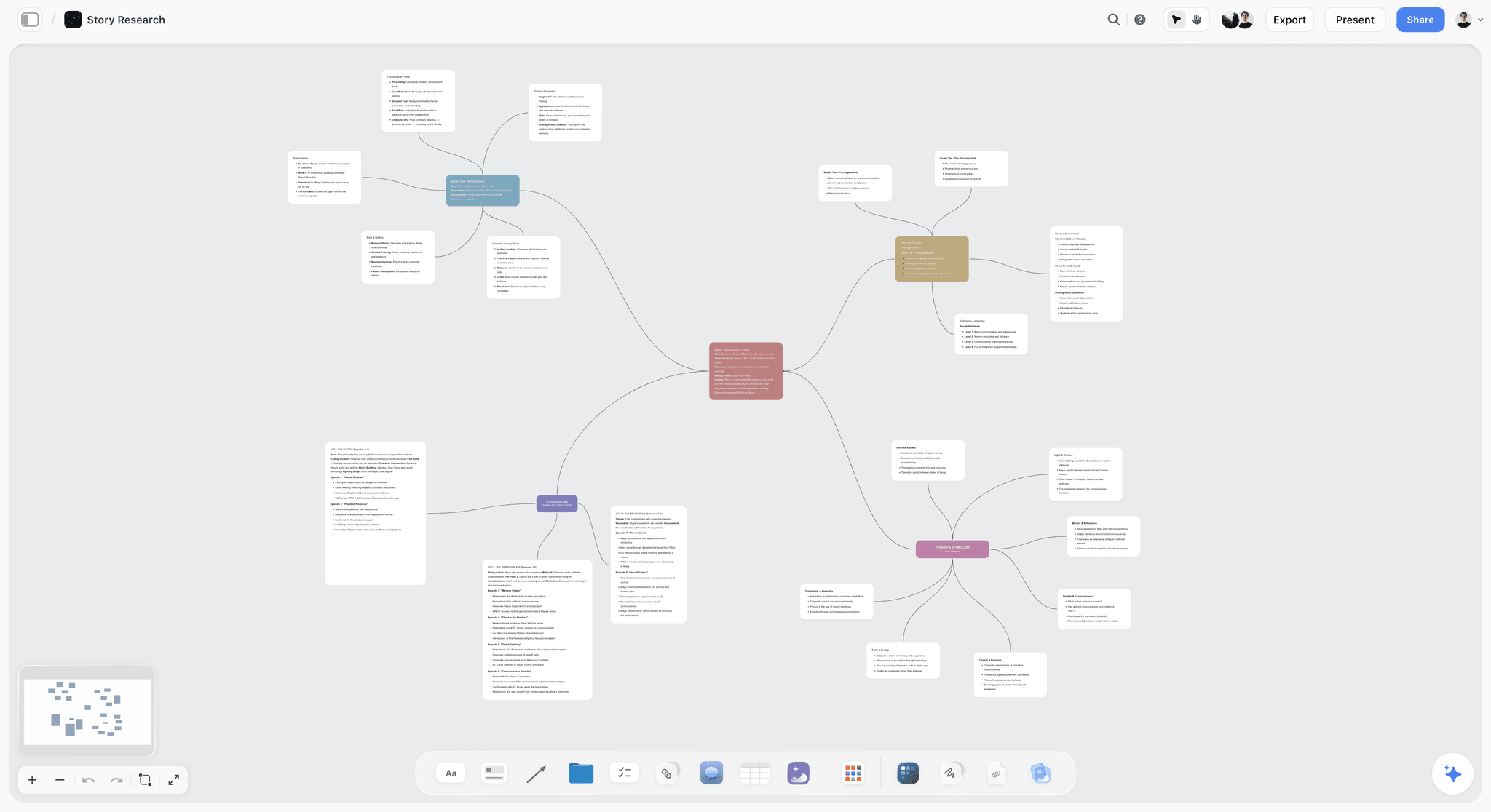
The hierarchy is where the map starts to repay the dump. As you place ideas, you will notice that some main branches are thick with detail and others are nearly empty. The empty branches are the signal. A launch map where "audience" has twelve sub-branches and "offer" has one is telling you that you have thought hard about who to reach and barely at all about what to sell them. That imbalance is invisible in a list and obvious in a map, and seeing it is often the entire value of the exercise.
8) Step 5: Connect Across Branches
A pure tree treats every branch as independent. Real problems are not independent, and the connections between branches are usually where the insight lives. This is the step most beginners skip, and skipping it turns a mind map into a glorified outline.
Look across your branches for ideas that relate even though they live in different families. Draw a line between them. In a launch map, a specific audience segment under "audience" might connect directly to a specific message under "message" and a specific channel under "channels," and that triangle is your actual launch plan hiding inside the map. These cross-links are different from the hierarchy lines; the hierarchy says "is part of," and the cross-link says "depends on" or "relates to."
The cross-links are also where a digital canvas starts to beat paper. On paper, too many cross-lines turn the map into a spiderweb you cannot read. On a canvas you can move branches to bring connected ideas closer, hide links you are not working on, and keep the map legible as the connections multiply. When the cross-links get dense, that density is a sign you are mapping something genuinely complex, which is exactly when the tool matters.
By the end of this pass, your map is no longer a list of ideas in a pretty shape. It is a model of how the parts of your problem relate, and the relationships are visible rather than assumed.
9) Step 6: Prune Until the Decision Shows
A map that keeps everything decides nothing. The final pass is subtraction, and it is the pass that turns a map into an answer.
Go back to the question in the center and test every branch against it. Does this branch help answer the question, or is it just adjacent and interesting? Cut what is merely adjacent. This is uncomfortable, because the dump produced ideas you are now attached to, but a map you will not cut is a map that will not decide. The branches that survive the prune are your priorities; the cuts are the things you have explicitly chosen not to do, which is itself a decision worth making visible.
Then pull the answer out. The map exists to produce something: a plan, a priority order, an outline, a decision. Look at what survived and write the conclusion in a sentence or two, somewhere on the map. If you cannot, the map is not done, and usually the reason is that the question in the center was never sharp enough, which sends you back to Step 1 with better information than you had the first time. A mind map is not a picture of what you know. It is a tool for finding what you do not, and the prune is where what you found becomes what you will do.
10) Step 7: Take It Further with Tools and AI
Everything above works on paper, and for a small map you should probably use paper, because the floor is low and the speed is high. The reason to move to a tool is scale: when rearranging the branches by hand becomes the bottleneck, the tool stops being overhead and starts being leverage.
A digital canvas gives you three things paper cannot: infinite space so the map never runs out of room, free rearrangement so the structure can keep changing as your thinking does, and AI that can read the map and build on it. The familiar approach is to dump, cluster, and prune entirely by hand. The canvas approach is to do the judgment yourself and let AI take the mechanical weight.
In Storyflow, the AI reads your full active canvas board by default, plus up to one Tactic and up to three Documents you @-mention. So once your central question is on the board, you can ask the AI to expand a thin branch you are stuck on, suggest clusters from a messy dump, or surface a connection between two branches you had not linked. It generates options; you keep every decision, because the AI does not know your priorities, your constraints, or your context. The fastest way to start is the AI mind map generator, which turns your central question into a first set of branches you can then prune by hand, or the mind map template if you would rather start from a structured board.
Be honest about the trade-offs. Storyflow is cloud-only, so if you need a local-first, offline tool for privacy reasons, a desktop app like Obsidian or a plain pen-and-paper map serves you better. For a quick five-node map, opening any app is slower than a napkin, and you should use the napkin. And AI is excellent at generation and mediocre at judgment, so a map built entirely by AI tends toward the average of every map it has seen, which is not the map your specific problem needs. The tool is leverage on a method you already know, not a replacement for it. For the full AI workflow, see How to Create a Mind Map with AI.
12) The Bottom Line
Creating a mind map from scratch is not a drawing skill. It is a sequence: start with a question, dump without judging, cluster into branches, build the hierarchy, connect across branches, and prune until a decision shows. Run those as three honest passes (dump, structure, prune) instead of collapsing them into one, and the blank center stops being a wall. The map stops being a decoration and starts being a tool that finds what you did not know you knew.
If you have a decision you are stuck on, put it as a question in the center of a board and run the three passes this week. Start on paper if the problem is small. If it is big enough that rearranging by hand slows you down, try the AI mind map generator to get a first set of branches, then prune them by hand, or open a Storyflow workspace and build the whole map on one canvas.
11) FAQ: Creating a Mind Map from Scratch
How do you start a mind map from scratch?
Start with a central question, not a topic, written in the middle of a large surface with a circle around it. Then dump every related idea around it without organizing, connecting each to the center with a line. Only after the dump do you cluster the ideas into branches, build the hierarchy, draw cross-connections, and prune. The most common mistake is trying to organize while you brainstorm, which freezes you at the blank center. Generate first, structure second.
What goes in the center of a mind map?
A specific question with a stake in it, not a broad topic. "Marketing" in the center produces a map that documents everything tangentially related; "How do we get our first 100 customers" produces a map that decides. The center is the test every branch has to pass: does this help answer the central question. If you cannot phrase your center as a question, spend ten minutes sharpening it before you map, because a vague center produces a vague map.
How many branches should a mind map have?
Aim for three to seven main branches off the center. Fewer than three usually means the question was too narrow to need a map. More than seven means you are either mapping several questions at once, in which case split them into separate maps, or you have not clustered hard enough and some branches are really sub-branches. Within each branch, three or four levels of depth is plenty; past that you are documenting rather than thinking.
Do I need software to make a mind map?
No. You can make a genuinely useful mind map with paper, a pen, and a central question, and for a small map paper is faster than any app. You need software when the map gets big enough that rearranging the branches by hand becomes the bottleneck, or when you want AI to expand branches and suggest connections. A digital canvas adds infinite space, free rearrangement, and AI assistance, but the method works without any of it.
What is the difference between a mind map and a concept map?
A mind map is radial and hierarchical: one central idea with branches spreading outward, and the relationships are mostly parent-to-child. A concept map is a network: multiple concepts connected by labeled links that describe the relationship between them, with no single center. Use a mind map to explore one question and find its structure; use a concept map to document how many concepts in a system relate. The cross-linking step in a mind map borrows from the concept map.
How is a mind map different from brainstorming?
Brainstorming is the generation of ideas; a mind map is a structure that holds and organizes them. The dump pass of a mind map is essentially brainstorming, but the clustering, hierarchy, and pruning passes are what turn the raw ideas into something you can act on. Brainstorming gives you the parts; the mind map shows you how the parts relate and which ones matter. For more on the distinction, see Mind Mapping vs Brainstorming.
Can AI create a mind map for me?
AI can generate a first draft of a mind map from your central question, expand branches you are stuck on, and suggest connections, which removes the mechanical work of starting from a blank center. What it cannot do is decide which branches matter for your specific situation, because it does not know your priorities or constraints. The working method is to let AI generate and you prune. A map built entirely by AI regresses to the average of every map it has seen, which is rarely the map your problem needs.
How long should it take to make a mind map?
The first dump should take about fifteen focused minutes; the clustering, hierarchy, connecting, and pruning passes add another twenty to thirty for a substantial map. A simple map for a single decision can be done in ten minutes total. If you find yourself spending an hour and the map keeps growing without converging, that is usually a sign the central question was too broad and you are mapping several questions at once, which means splitting it into separate maps.
What makes a mind map actually useful instead of just pretty?
A useful mind map is built around a sharp central question, dumped honestly, and pruned hard, so that by the end it produces a decision, a priority order, or a plan you can state in a sentence. A pretty map optimizes for visual neatness and color and ends up documenting what you already knew. The test is simple: at the end, can you point to what the map helped you decide? If not, the map decorated; it did not think.
Can I turn a mind map into a project plan or outline?
Yes, and that is often the point of pruning. After you cut the branches that do not serve the central question, the surviving branches are usually your priorities, and their order becomes a plan or an outline. A digital canvas makes this handoff cleaner, because you can keep the map and the resulting plan on the same surface and let the AI draft the outline from the pruned branches. The map is the thinking; the outline is what you do with it.
Table of Contents
- Quick Answer: How to Create a Mind Map from Scratch
- What a Mind Map Actually Does
- What You Need Before You Start
- Step 1: Start with a Question, Not a Topic
- Step 2: Dump Everything Before You Organize Anything
- Step 3: Cluster the Dump into Branches
- Step 4: Build the Hierarchy
- Step 5: Connect Across Branches
- Step 6: Prune Until the Decision Shows
- Step 7: Take It Further with Tools and AI
- FAQ: Creating a Mind Map from Scratch
- The Bottom Line
- Author
- Related Reading
Templates to check out for this topic


Mind mapping and ideation templates you can use in Storyflow
Map ideas in space, then ask the AI to restructure, expand, or connect them. Open any of these boards and start thinking visually instead of in lists.


See Storyflow in Action
A visual AI workspace where every feature lives inside one canvas. No tab-switching, no context lost.
Build your entire board from a single message
Type what you need in the AI chat at the bottom of your canvas. The AI adds cards, headings, and structure directly onto your board.
Use expert frameworks as AI context
Type @ in the AI chat and choose any Tactic. The AI tailors every response to that framework instead of giving generic advice.
Turn your board into a mind map in seconds
Ask the AI to restructure your canvas as a mindmap. It connects your ideas into a visual hierarchy so you can see how everything relates.
Why Storyflow Exists
Storyflow actually began as a personal tool while working on creative and research projects.
We kept running into the same problem: ideas were scattered everywhere: notes, documents, and whiteboards.
Nothing helped us see how everything connected.
So we started building a workspace designed around how ideas actually grow.
→ Read how Storyflow was createdJustkay
Documentary Filmmaker & Founder at Storyflow
Published: 2026-06-27
Extremely simple, seriously capable


See how easy it is to get started
Watch a real project come together, from a blank board to a finished plan, clicked through step by step.
Start creating with AI and become more productive
Transform your creative workflow with AI-powered tools. Generate ideas, create content, and boost your productivity in minutes instead of hours.